

We use cookies to ensure our website works properly and to personalise your experience. Cookies policy
MES's College of Pharmacy, Sonai, Newasa, Ahilyanagar 414105
Ethanol extract of Coscinium fenestratum was evaluated in the form of 5% w/w extract and 10% w/w extract in the excision wound extracted on the dorsal side of the experimental animals, the10% w/w extract ointment showed significant improvement in wound models and the result were compatible to that of the standard drug povidone iodine (5% w/w) in terms of wound contracting ability, epithelial period and tensile strength(1,2). Gastric ulcer is among the most common gastrointestinal disorders, which affects approximately 5-10% of people during their life. In recent years, abundant work has been carried out on herbal medicine to clarify their potential efficacy in gastric ulcer prevention or management(3). This review provides information on its phytochemical profile and antiulcer activity of ethanolic extract of Coscinium fenestratum (CF) (Family: Menispermaceae) stem bark in ethanol induced peptic ulceration in the albino rats. The preliminary phytochemical screenings of various extracts were carried out to determine the pharmacognostical profile of the stem-bark. Preliminary ethanol extracts of CF (Gaertn) colebr. Were subjected to the acute oral toxicity study according to the OECD Guideline No. 425. Based on which, three dose levels, i.e., 100, 200 and 400 mg/kg were selected for the further study. In ulcer model, various parameters were studied viz., gastric volume, pH, total acidity, free acidity, and ulcer index. Ranitidine at 50 mg/kg used as the standard drug. The ethanolic extract of CF at the dose of 100, 200 and 400 mg/kg treated groups offered 1.54%, 9.88% and 51.85% ulcer protection in ethanol induced peptic ulcers(2,4). Background: Herbal medicines have long been investigated as alternative or complementary therapies for gastric ulcer, given their rich phytochemical composition and relatively lower side effect profile compared to conventional drugs. Coscinium fenestratum (family Menispermaceae), known locally as “tree turmeric or “ham,” is a critically endangered medicinal plant widely used in traditional Ayurvedic and Southeast Asian systems of medicine. Ethanol pharmacological records attribute multiple therapeutic effects to this species, including antioxidant, antidiabetic, anti- inflammatory, and anti-ulcer activities. Phytochemically, C. fenestratum contains a variety of bioactive compounds, notably alkaloids such as Berberine and palmatine, flavonoids, and phenolics, which may contribute to its observed pharmacological effects.
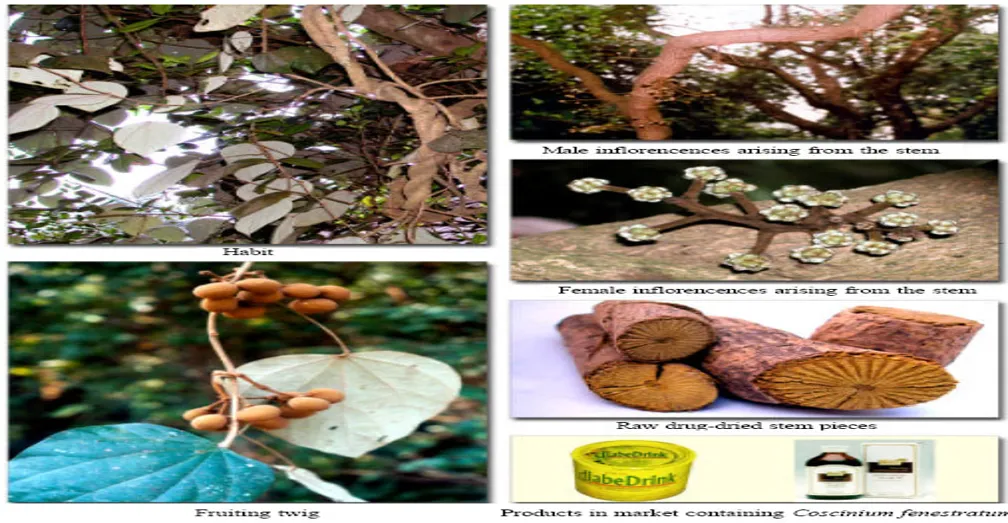
Coscinium fenestratum (Gaertn.) Colebr. is widely known as, ‘tree turmeric’. It belongs to the plant family Menispermaceae. The wood of Coscinium fenestratum has been traditionally utilized in fabric dyeing. Yellow is the most typical color produced by this plant. Coscinium fenestratum is used in Malaysia for dyeing. Most populations of this species have been exploited on a substantial scale in its natural habitats and it has not been cultivated1. It is a woody climbing shrub with cylindrical stem, externally yellowish-brown and internally yellowish in color. Its stem has often been used as a substitute for berberis. However, it can be readily distinguished by the presence of large vessels in the wood, absence of annual rings and the crenate ring of sclerenchyma beneath the cortex. The stem yields a yellow dye, which is used either alone or in combination with turmeric and other coloring materials. The roots of Coscinium fenestratum contain alkaloids berlambine, dihydroberlambine, 12, 13-dihydro-8-oxo berberine, tetrahydroberberine, oxyberberine and noroxy hydrastinine(2).The application of medicinal plants in public and medicine is a practice that has been observed for many years. Ulcer is defined as a break (open wound) in the epithelial lining of the stomach, duodenum, or lower esophagus that results from the excess secretion of gastric acid (hyperacidity), or possibly bacterial and mechanical action . Based on the locus of occurrence in the gastro-intestinal tract (GI), ulcer is classified into four types; gastric, duodenal, esophageal, and meckel’s diverticulum ulcer(1,2).. Gastric ulcer is the most common gastrointestinal disease characterized by damage in the gastric mucosa associated with hemorrhage and perforation. The cause of gastric ulcer is multi-factorial, and is mostly attributed to the disequilibrium between aggressive luminal factors such as hydrochloric acid, pepsin secretion, H. pylori infection and bile salts and defensive mucosa- protective factors such as mucin, bicarbonate secretion, prostaglandins, nitric oxide and growth factors. Gastric ulcer is said to occur due to an imbalance between luminal acid synthesis and mucosal defense. acid and pepsin components constitute the aggressive factors, and the mucous layer of mucin–bicarbonate secretion, prostaglandins, and other healing factors constitutes the defensive factors (Sanyal et al., 1983) (2,3). Ulcer therapy is now mainly mainly directed toward reducing the harmful effects of offensive acid secretion in the Stomach (Sairam et al., 2003). Conventional treatment of ulcer comprises regular food and adequate rest, use of antacids, and avoidance of ulceroganic foods (Anoop C Jegadeesan, 2003). In addition, H2 receptor blockers and Proton-pump inhibitors are advocated to reduce gastric acid secretion. The use of anti-ulcer agents, however, has been shown to induce a wide array of deleterious and adverse effects, leading to their withdrawal or cessation in clinical practice (Hoogerwerf C Pasricha, 2001). Hence, efforts are continuously being made to derive active principles from natural sources to suggest an alternative remedy for the treatment of gastric ulcer(1,3).. Peptic ulcer is the most common gastrointestinal disorder characterized by deep erosion s involving the entire mucous thickness leading to a perforation in extreme cases. Since, the time it was believed that the pathogenesis is due to excess secretion of gastric acid. The latest approach for the treatment of peptic ulcer disease is by reducing acid secretion and restoring gastric mucous protection. The knowledge of peptic ulcer disease and its pathogenesis has put forth the development of a variety of drugs like PPI’s, H2 blockers, acid neutralizing agents etc in counteracting the disease process and restoring the balance(5). In this modern world gastrointestinal disorders are the universal problem. Nowadays people are subjected to increase in stress due to the modern life style and they often consume fast foods. These factors lead to many kinds of gastro intestinal disorders. About 10% of the population may develop peptic ulcer in their life time. It affects 9.5% among women and 10.5% among men. Duodenal ulcer is most frequent in the individuals of age group 30 to 55 years(6). In the general population 20-50% is infected with H. pylori, its prevalence increases with age and 15-20% of the infected individuals will develop peptic ulcer .Coscinium fenestratum (Gaertn.) Colebr. Is widely known as, ‘tree turmeric’. It belongs to the plant family Menispermaceae. The wood of coscinium fenestratum has been traditionally utilized in fabric dyeing(7).
MATERIALS AND METHODS:
Coscinium fenestratum has been found to possess various pharmacological actions such as antioxidant, laxative, antiproliferative, antidiabetic, anti-hypotensive, anti-plasmodial and antibacterial activities. Various parts of the plant is used for fever, muscle pain, stomach pain, malaria, diarrhea, ulcers and infection of the eyes. The stem is anti-inflammatory and antiseptic. Used to treat tastelessness, bleeding piles, cough, wounds, ulcers, skin diseases, abdominal disorders, jaundice, liver disorders, intrinsic hemorrhage, diabetes, fever, and general debility. It also has antifungal and anti-yeast, activities(9). Stem bark of C. fenestratum was authenticated, shade dried, powdered, and extracted with 95 % ethanol using cold maceration. The concentrated extract was subjected to phytochemical screening revealing the presence of alkaloids, flavonoids, and phenolic compounds(8). Gastric ulcers were induced via a combination of ethanol which promotes acid accumulation and mucosal injury, a well-established model for evaluating anti-ulcer activity. After treatment for 7 days, animals were sacrificed; gastric juice was collected to measure volume, pH, total acidity, mucus content, and pepsin activity(9). Ulcer index and percent protection were calculated.Plant material – Enough amounts of leaves and stem of C. fenestratum was collected from Boys town, Mananthavady, Wayanad District, Kerala in the month of July 2012 (11o84’18” N, 75o92’09” E) and was air dried at 50 oC. Botanical voucher specimen has been deposited With the herbarium of M.S. Swaminathan Herbarium, Wayanad, Kerala (MSSH-0104)(30). Additionally, gastric and liver tissues were evaluated for antioxidant markers including lipid peroxidation (LPO), superoxide dismutase (SOD), glutathione (GSH), and catalase (CAT).The fine material powder is collected and used for extraction of the crude drug in aqueous solvents by Soxhlet extraction method(11). This method comprises a constant hot extraction with a controlled amount of water. The plant material is dried, then ground into a powder and stored in an airtight container. After that, water is added and mixed in. In order to speed up the extraction process, heat is applied continuously(12). The entire procedure takes no more than 15 minutes. The typical dilution factor for a crude medication is between 4:1 and 16:1. It's purpose is to remove plant compounds that are both water- and heat-soluble.
Column Chromatography
1. Leaves
MEK extract (3 g) was accurately weighed and washed with Diethyl ether for removing undesirable fractions which were 20E negative. The remaining extract was dissolved in 6 ml MeOH and pre adsorbed to 6 g acidic alumina (Merck) used For column chromatography.
2. Stem
MEK extract (650 mg) was accurately weighed out and Dissolved in 3 ml MeOH and pre adsorbed to 3g acidic Alumina as above. The same was loaded to a 35 g acidic Alumina column and elution was started with 100% CHCl3 and Later on moved to MeOH/ CHCl3 mixtures. A total of 16 Fractions were collected. Fractions 3-5 (8% MeOH) were Berberine positive and fractions 7-16 (10% MeOH) were 20E Positive.
HPLC conditions
The HPLC analyses were performed on a Shimadzu -SPD-M-204 instrument equipped with DAD (Diode Array Detector) with Phenomenex luna 5µ C18 (2) 100A, size 250×4.6 nm column.
IR spectrum conditions
the IR spectra of both standard 20E (Sigma) and sample Isolated from Coscinium were recorded on a Shimadzu IR Affinity -1 machine in KBr.
LC-MS
Electro spray ionization mass spectra were collected on an agilent 6340 series ion trap mass spectrometer coupled to an agilent 1200 series HPLC system. The samples were infused to the mass spectrometer through a reversed phase column (Zorbax SB- C18, 2.1 35 cm) with solvent A (0.1% Formic Acid in water) and solvent B (0.1% Formic acid in Acetonitrile).
SCIENTIFIC CLASSIFICATION
|
Category |
Description |
|
Kingdom |
Plantae |
|
Phylum |
Magnoliophyta |
|
Class |
Magnoliopsida |
|
Order |
Ranunculales |
|
Family |
Menispermaceae |
|
Genus |
Coscinium |
|
Species |
Coscinium fenestratum |
Table 1: showing Physicochemical and Oraganoleptic Values.
|
Physicochemical Constants |
Values |
Limit |
Organoleptic Characters |
Properties |
|
Parameter |
Values |
Limit |
Parameter |
Properties |
|
TA |
6.1% |
NMT 3% |
Taste |
Bitter |
|
AIA |
4.3% |
NMT 2% |
Color |
Yellowish |
|
ASE |
2.6% |
NMT 3% |
Odour |
Mild |
Plant activity:
Anti-hypertensive activity
A 50% ethanol extract of Coscinium fenestratum stem material (AECF) has been found to possess hypotensive action in anaesthetised dogs, rats and guinea pigs in a dose-related pattern(9).
Toxicity
In the acute toxicity test, an oral dose of 5000 mg/kg of water extract of Coscinium fenestratum did not produce mortality or significant changes in the general behavior of animals and the gross appearance of internal organs of rats(9).
Antioxidant activity
Antioxidant effect of methanol extract of Coscinium fenestratum stem powder was examined using carbon tetrachloride-intoxicated rat liver as the experimental model. Rats were treated with the methanol extract for 90 days orally at the dose of 60-mg/kg body weight(9).
CNS depressant activity
A study was conducted by Prashith Kekuda et al.,29, to investigate the analgesic and CNS depressant property of methanol extracts of Coscinium fenestratum Colebr. in an animal model(9).
Antiproliferative activity
Methanol and methanol-water extracts of Coscinium fenestratum exhibited antiproliferative activities in a concentration-dependent manner against human HT-1080 fibrosarcoma cells among the seventy-seven Vietnamese medicinal plants(9).
Cytotoxicity
That edible plant Coscinium fenestratum was extracted with 95% ethanol and tested with cytotoxic effects using Hep2 cells(9).
Anti-nociceptive activity
In a study by Chitra et al.,33 the effect of Coscinium fenestratum on inflammatory pain induced by formalin in mice was conducted(9).
Hepatoprotective activity
Hepatotoxic rats were treated with methanol extract of Coscinium fenestratum stem for 90 days(9).
Anti-gonococcal activity
Coscinium fenestratum (Gaertn.) Colebr. the extract demonstrated strong activity against Neisseria gonorrhoeae ATCC 49226 with MIC value of 47.39 µg/ml(9).
Antibacterial activity
The antibacterial effect of Coscinium fenestratum is mainly due to the presence of berberine(9).
Antifungal activity
Berberine extracted from Coscinium fenestratum exhibited antifungal activity against various fungi like Phytophthora parasitica, Phytium spp., Colletotrichum gloeosporioides, Cercospora spp., Fusarium oxysporum, and Alternaria porri(9).
Antiplasmodial activity
The methanol extract of Coscinium fenestratum had the strongest antiplasmodial activity with EC (50) value of 0.5-µg/ml of the 42 extracts from 14 medicinal plants used in Vietnamese traditional medicine to treat malaria(9).
Negative study (Neurotoxicity)
Oral administration of Coscinium fenestratum alcoholic extract at dosages of 5, 10 and 20 mg/kg body weight for 14 days increased the rats body weight and decreased the neuron density in the cerebral cortex, hippocampus and striatum(9).
Mechanism of Action for drugs:
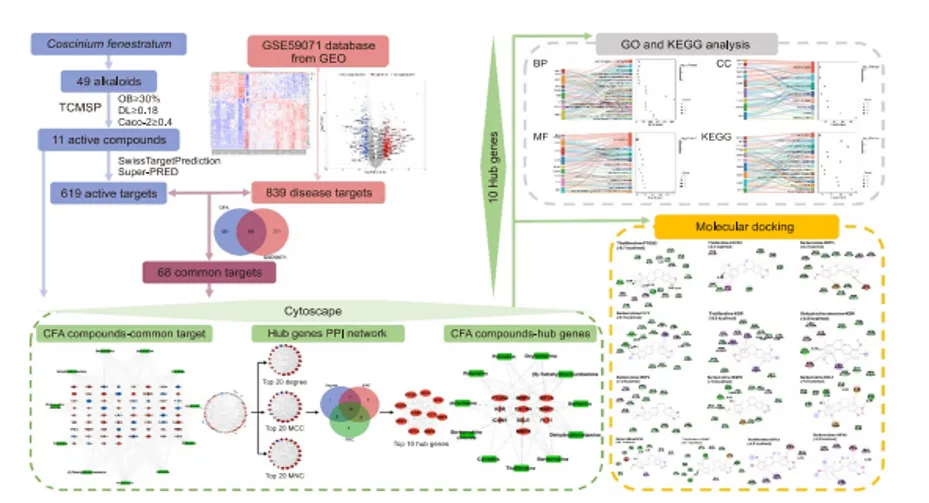
The image represents a network pharmacology and molecular docking approach used to explain the mechanism of action of Coscinium fenestratum (CF) against disease conditions such as gastric ulcer and inflammation.
1. Identification of Phytoconstituents
Initially, active phytochemical compounds present in Coscinium fenestratum were identified using the TCMSP database. Around 49 alkaloids and 11 active compounds were selected based on pharmacokinetic properties such as oral bioavailability (OB) and drug-likeness (DL). Major compounds include berberine, palmatine, and jatrorrhizine.
2. Prediction of Drug Targets
The active compounds were evaluated using databases such as SwissTargetPrediction and Super-PRED to identify possible biological targets. Approximately 619 active targets related to the compounds were predicted.
3. Disease Target Identification
Disease-related genes were collected from the GEO database (GSE49071), which provided about 839 disease-associated targets involved in gastric ulcer and inflammatory pathways.
4. Common Target Screening
By comparing compound-related targets and disease-related targets using a Venn diagram, 68 common targets were identified. These common targets are considered the potential therapeutic targets through which Coscinium fenestratum exerts its pharmacological effects.
5. Protein–Protein Interaction (PPI) Network Analysis
The common targets were evaluated using Cytoscape software to construct a protein–protein interaction (PPI) network. Hub genes with the highest interactions were identified, including inflammatory and oxidative stress-related proteins. These hub genes play an important role in ulcer formation, inflammation, apoptosis, and oxidative damage.
6. GO and KEGG Pathway Enrichment Analysis
Gene Ontology (GO) analysis categorized the targets into:
KEGG pathway analysis showed that the targets are mainly involved in:
These pathways explain the anti-ulcer, antioxidant, and anti-inflammatory activities of Coscinium fenestratum.
7. Molecular Docking Analysis
Molecular docking analysis was carried out to study the binding affinity between active compounds and hub proteins. The major alkaloids such as berberine showed strong binding interactions with target proteins, indicating stable drug–target interactions and confirming the therapeutic potential of the plant compounds
DISCUSSION AND CONCLUSION
The increasing development of antibiotic resistance of pathogenic microorganisms, particularly of is a major health concerning worldwide. The screenings of plant materials and their isolated substances for new antimicrobial compounds represent an important source for new effective medicines. In this study, extracts of nineteen plants could inhibit this particular microorganism causing STD-related diseases. Several techniques were applied to test for antimicrobial properties such as disc diffusion technique, agar dilution technique and bioautography. The agar diffusion technique was used for the first screening because of its convenience and short time consuming. From this screening result, four plant extracts with promising activity against , which were Plumbago indica, Coscinium fenestratum, Caesalpinia sappan and Alpinia conchigera extracts, were selected for further study. Agar dilution technique was used to determine MIC values of these extracts and it was demonstrated that only the extracts from Coscinium fenestratum and Caesalpinia sappan gave MICs less than 200 g/ml. Coscinium fenestratum stem crude extract promoted the best MIC value at 47.39 g/ml against Neisseria gonorrhoeae ATCC 49226 which is about 1/4 time of MIC of the extract of enriched physalin fraction from Physalis angulata (Silva et al., 2005), and about 1/20 to 1/200 times of MICs of fresh garlic against Neisseria gonorrhoeae WHO V (Ruddock et al., 2005). For, all clinical isolates of Neisseria gonorrhoeae, the average MIC of Coscinium fenestratum crude extract was 56.39 g/ml indicating its good antigonococcal activity. From the results of bioautographic assay of the methanolic crude extract against Neisseria gonorrhoeae ATCC 49226, the positive result was found at Rf value of 0.42, which was the same position as berberine. The MIC values of separated pure berberine for Neisseria gonorrhoeae ATCC 49226 and 11 clinical isolates were found to be 13.51 and 17.66 g/ml, respectively. Comparing MIC values of berberine to isolated compounds from other plants, Pettit et al. (2003) reported the MIC values of hydnocarpin-d,5′ -methoxyhydnocarpin-d, palstatin and luteolin isolated from Hymeneae palustris in the Family Fabaceae against Neisseria gonorrhoeae were 0.5, 0.625, 1, and 16–32 g/ml, respectively. Moreover, Swart et al. (2002) reported that the MIC value of p-methoxybenzylisothiocyanate for ATCC 49226 and PPNG were 4 g/ml determined by quick microplate method. In this study, the acute toxicity was determined and no toxicity detected at the dose of 5 g of the crude extract of Coscinium fenestratum per kilogram of mice. Although Coscinium fenestratum has long been used in Thai folk medicine for gonorrhea treatment and was reported to have broad spectrum of antimicrobial activity, there has been no scientific report on antigonococcal activity of this plant before. These recent findings provide the scientific data of relevant antigonococcal activity of Coscinium fenestratum and its active compound.
The leaves (100 g) and stem (50 g) of Coscinium were put to Sequential hot extraction starting with Petroleum ether (PE) Followed by Chloroform (CHCl3), Ethyl Methyl Ketone (MEK) and finally Methanol (MeOH). The extracts were Filtered, solvents removed below 400; and the yield obtained is Presented in . Thin layer chromatography (TLC) of the MEK extracts of both leaf and stem showed distinct spots for 20E on comparison with an authentic sample of 20E, but PE, CHCl3 and MeOH extracts were negative. The presence of berberine in MEK and MeOH extracts of both stem and leaves Were confirmed by direct comparison with an authentic sample (Sigma) by colour reaction, TLC and HPLC.
Ecdysterone has been isolated, quantified and physically characterised from C. fenestratum for the first time. Ecdysterone being a multifaceted active bio molecule may e the potential hypoglycemic active principle of Coscinium alcoholic extract reported in rat model . Coscinium leaves, usually discarded as a waste from ayurvedic industry can be value added as a potential source for 20E.
REFERENCES

Ganesh Kurhade, Dr. R. B. Pandhare, V. K. Deshmukh, A. R. Pawar, A Review on the Antiulcer Activity of Coscinium fenestratum, Int. J. of Pharm. Sci., 2026, Vol 4, Issue 6, 2270-2280. https://doi.org/10.5281/zenodo.20608600
 10.5281/zenodo.20608600