

We use cookies to ensure our website works properly and to personalise your experience. Cookies policy
Samarth Institute of Pharmacy, Belhe, Maharashtra, India
Herbal medicines continue to gain global attention due to their safety, accessibility, and therapeutic potential. This review focuses on the pharmacological activities of guava leaf extract and camphor, two widely used natural agents in traditional and modern herbal medicine. Guava leaves are rich in flavonoids, tannins, and phenolic compounds that exhibit antimicrobial, antioxidant, anti-inflammatory, antidiabetic, and wound-healing properties. Camphor, a terpenoid compound obtained from aromatic trees, demonstrates notable antiseptic, analgesic, anti-inflammatory, and counter-irritant effects. The combined use of these agents may enhance therapeutic outcomes in oral care, dermatological conditions, respiratory disorders, and localized infections. This review summarizes their phytochemical composition, mechanisms of action, and pharmacological evidence, highlighting their potential as economical and biocompatible alternatives to synthetic drugs. Further experimental and clinical investigations are recommended to standardize dosage, evaluate long-term safety, and support their integration into evidence-based herbal formulations..
GUAVA: - PSIDIUM GUAJAVA
Since ancient times, they have been used for nutrition because they contain a number of phytochemicals (secondary metabolites) that are essential for biological interactions [1]. These bioactive substances have been utilized in traditional medicine because they help treat and prevent a variety of illnesses, promoting general health [2]. Essential oils and herbal extracts are examples of plant-based bioactive materials that have drawn a lot of interest lately due to their potential in the creation of functional meals and nutraceuticals. These materials provide a useful option for
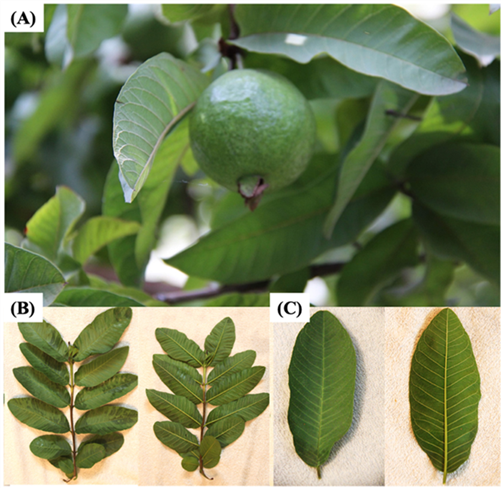
Figure no. 1 Guava leaves
food and pharmaceutical formulations as a functional ingredient since they are rich in bioactive chemicals such phenolics, flavonoids, and pigments [3]. The guava (Psidium guajava L.), a perennial fruit crop found in tropical and subtropical regions of the world, is one of these plants. It is a member of the Myrtaceaceae family and is native to tropical America. It has gained commercial significance in a number of nations due to its hardiness, prolific output, and low care requirements. India, China, Mexico, Brazil, the Netherlands, and the Philippines are major guava producers [4]. The guava plant's roots, bark, stem, leaves, and fruit are all used to cure a variety of conditions, including diarrhea, diabetes, and stomachaches. The dark green, elliptical guava leaves are useful for treating respiratory and gastrointestinal issues as well as Figure no. 1 Guava leaves boosting platelet counts in dengue patients [5]. Although the fruit is extensively consumed and known for its health advantages, there is growing interest in its leaves due to their potential for both medicinal and utilitarian uses [6]. Numerous bioactive substances, such as flavonoids (quercetin, kaempferol, and myricetin), tannins, phenolics (gallic acid, ferulic acid, and caffeic acid), carotenoids, and triterpenoids, are abundant in guava leaves. These substances have pharmacological activity; flavonoids, for example, improve the antioxidant-defense mechanism by scavenging free radicals and lowering oxidative stress, thereby preventing cellular damage [7,8]. These bioactives work together to improve the medicinal and functional qualities of guava leaves, making them appropriate for use in food products with a health focus.
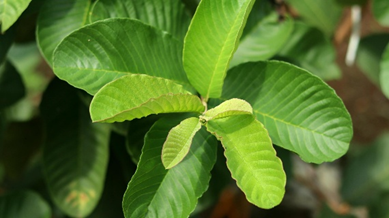
Figure no. 2 Guava leaf
Food can be preserved, its shelf life increased, and its nutritional value enhanced by their antioxidant, antibacterial, and anti-inflammatory properties [9]. To increase the yield, purity, and bioavailability of bioactives like flavonoids, tannins, and phenolic acids, advanced extraction techniques for bioactive compounds from plant materials are currently being used, such as ultrasound-assisted, microwave-assisted, and enzyme-assisted methods [10,11].
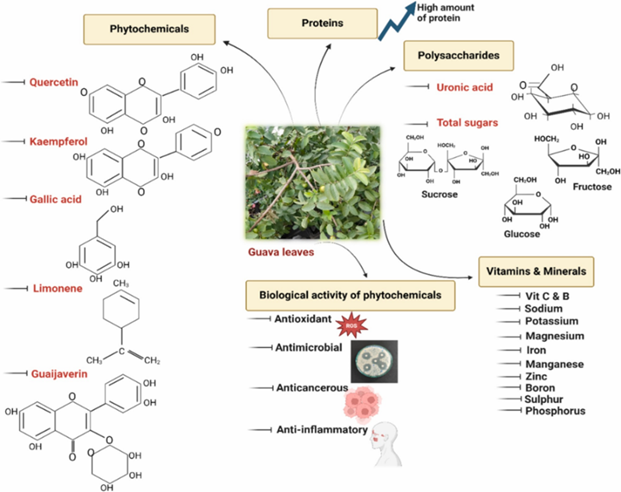
Figure no. 3 Chemical constituents of guava
SCIENTIFIC CLASSIFICATION : Table no. 1
|
Kingdom |
Plantae |
|
Division |
Magnolioohyta |
|
Class |
Magnoliopsida |
|
Sub-Class |
Rosidae |
|
Order |
Myrtales |
|
Family |
Myrtaceae |
|
Genus |
Psidium |
|
Species |
p. guajava |
CAMPHOR
The wood of Camphor laurel (Cinnamomum camphora) and other similar trees in the laurel family is used to make camphor, a white, crystalline material with a strong taste and odor. A form of this aromatic evergreen tree is planted in the southern United States, particularly in Florida. Camphor trees are native to China, India, Mongolia, Japan, and Taiwan [13, 14].
Steam distillation, purification, and sublimation of the tree's wood, twigs, and bark yield camphor [15]. Camphor has numerous medicinal uses, including topical analgesic, antiseptic, antispasmodic, antipruritic, anti-inflammatory, anti-infective,
rubefacient, contraceptive, moderate expectorant, nasal
decongestant, cough suppressant, etc. [15–16]. In addition to being administered by injection, inhalation, and ingestion, camphor is readily absorbed through the skin [15, 17].
Along with cineol, linalool, eugenol, limonene, safrole, αpinene, βpinene, βmyrecene, αhumulene, pcymene, nerolidol, borneol, camphene, and a few
other components, camphor is the primary component of Cinnamomum
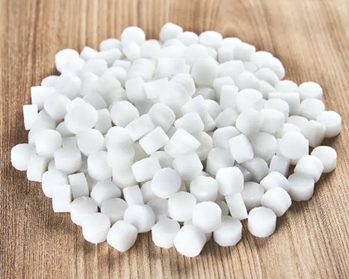
Figure no. 4 Camphor
camphora leaves [13, 17, 18].
APPLICATIONS
PHARMACOLOGICAL ACTIVITY
Antioxidant activity
A series of lipophilic radicals cause lipid autoxidation. In the biological setting, several oxidase enzymes produce hydrogen peroxide through enzymatic means. In the production and activation of inflammatory mediators, hydrogen peroxide functions as a signaling molecule through the hydroxyl free radical. Guava has a significant amount of vital antioxidants and has radio-protective qualities. These signaling molecules have a significant impact on tissue damage and the development of numerous diseases, including diabetes [24]. It is also enhanced with a variety of vitamins and minerals. Notably, guava contains essential antioxidants including lycopene and avonoids, as well as phenolic components like flavonoids.
These elements aid in the eradication of malignant cells and the avoidance of early skin aging. Quercetin is the most powerful antioxidant found in guava leaves and is well-known for its spasmolytic properties. When exposed to organic or aqueous solvents, guava extracts have a significant antioxidant reservoir that can stop oxidation reactions [25]. The concentration of these compounds rises in direct proportion to higher extract concentrations, and pink guava has strong antioxidant activity. Guava is particularly rich in antioxidants, which are crucial in lowering the incidence of degenerative diseases like cancer, arteriosclerosis, arthritis, cardiovascular disease, inflammation, and cognitive decline.
Because of its antioxidative qualities, guava extracts have the ability to treat a variety of illnesses and difficulties. The precise mechanisms underlying guava's antioxidant and other pharmacological activities require further investigation. Interestingly, the flesh of red guava contains a variety of unique carotenoids, of which thirteen have been specifically identified as guava carotenoids responsible for its antioxidant activity [26].
Antidiabetic activity
Through a number of studies, numerous scientists have investigated P. guajava's potential in the fight against diabetes. In particular, studies have shown that extracts from guava leaves and bark efficiently improve muscle cell absorption of glucose and suppress α-amylase activity. Moreover, guava leaves extract has been shown to reduce fasting glucose plasma levels, and fastinginsulin levels, with an effect on insulin resistance in diabetic KK and lethal yellow (Ay) mice, and carry a heterozygous mutation of the agouti gene (KK-Ay strain) [27]. Furthermore, P. guajava leaf extracts have been shown to reduce fasting blood glucose levels, control lipid profiles, and alter glucose metabolism in streptozotocin-induced diabetic rats (STZ).
It is noteworthy that in diabetic rats given STZ, both raw fruit peels and aqueous preparations from unripe guava fruit peels show hypoglycemic effects [28]. Blood glucose levels decreased when guava fruit was administered at doses of 0.125 and 0.250 g/kg for a month [29]. Additionally, it has been demonstrated that supplementing diabetic mice with avonoids derived from P. guajava can significantly improve insulin resistance and fasting glucose plasma levels [30]. Research has indicated that guava seeds, pulp, and leaves contain polyphenols that may lower blood glucose levels in diabetic rats. P. guajava's capacity to increase glycogen synthase levels while lowering glycogen phosphorylase enzyme activity may be responsible for these anti-diabetic actions [31].
Antibacterial action
Guava leaf extracts have been shown to be highly effective in stopping the growth of numerous bacterial strains and to have strong antifungal and antibacterial properties [32]. Flavonoids found in P. guajava leaves are thought to be responsible for its antibacterial qualities. Numerous studies have highlighted the antibacterial activity of guava, especially its flavonoid components. The concentrated liquid form of P. guajava leaves has demonstrated impressive antibacterial activities against a range of test strains. According to reports, flavonoid extracts from guava leaves have antibacterial qualities. The presence of favonoid glycosides, specifically Morin-3-O-alpha-L-lyxopyranoside and Morin-3-O-alpha-L-arabinopyranoside, is responsible for the extract's antibacterial activity [33]. These favonoids have been proven to have particular effects, according to studies. to demonstrate antimicrobial action. Furthermore, it has been demonstrated that the flavonoid guaijaverin inhibits the development of plaque [34].
Analgesic Anti-inammatory activity
Flavonoids, tannins, polyphenols, ellagic acid, triterpenoids, quercetin, guaijaverin, and a number of other chemical components are thought to interact intricately to give the leaf extract from the P. guajava plant its anti-inflammatory properties. These assertions are corroborated by animal experiments that demonstrate the anti-inflammatory qualities of guava leaf extract. These results provide pharmacological support for the plant's traditional and folkloric uses in the treatment and management of painful, inflammatory, and arthritic conditions in several rural African communities.
P. guajava ethanolic leaf extract has been shown to have anti-inflammatory properties both in vivo and in vitro. The findings show that guava leaves significantly lower the production of inflammatory mediators (nitric oxide and prostaglandin E2) that are triggered by lipopolysaccharides [35]. Anticancer activity Bioactive phytochemicals found in different portions of the P. guajava plant have been shown to have anticancer activities. P. guajava and its bioactive compounds, especially those derived from its leaves, have been shown in numerous studies to selectively prevent the growth of malignant cells without endangering healthy cells. Researchers used Michigan Cancer Foundation-7 cells (MCF-7) to test the potential anti-cancer effects of guava seed polysaccharides. They concluded that MCF-7 cell viability was significantly inhibited in a dose-dependent manner [36]. The anticancer activity of a lycopene extract of P. guajava, with an IC50 value of 29850 at 5964 ng/mL, was observed by other researchers who investigated the anticancer potential of red P. guajava extract. A human colorectal carcinoma cell line derived from an adult male (HCT116) and a human colorectal adenocarcinoma cell line with epithelial shape cells (HT29) were used in a recent investigation to identify chemicals with anticancer activity. With an IC50 value of less than 0.03 µg/mL, another investigation showed P. guajava's greatest inhibitory effectiveness against malignant cells [37]. Tetracosane, vitamin E, and ß-sitosterol are among the chemical components of P. guajava that are suspected to be responsible for its anticancer properties. Lung cancer, colorectal cancer, breast cancer, cervical cancer, and prostate cancer are just a few of the cancers that guava extracts have been shown to be successful against. The guava plant's various parts contain bioactive phytochemicals that have demonstrated antimicrobial, antioxidant, anti-inflammatory, and antidiabetic properties. These findings imply that guava extracts and their bioactive components may be useful substitutes or additional treatments for human cancer [38, 39].
Anthelmintic Activity
Anthelmintic activity has been shown in the leaf extract; the ethanolic extract (100 mg/ml) exhibits more anthelmintic activity than the aqueous extract. When compared to other extracts, the methanolic extract of P. guajava leaves showed notable anthelmintic activity, according to a recent study. In earthworms, the methanolic extract caused the highest rates of paralysis (1.820±0.242 min) and death (5.573±0.315 min), outperforming the effects of piperazine citrate. This supports the traditional use of guava leaf extract as a natural remedy for anthelmintic illnesses by indicating that it may be useful in treating parasitic infections in humans [40]. Additionally, an increase in total proteins, intracellular H2O2, lipid peroxidation products, and the activity of enzymes like glutathione S-transferase and superoxide dismutase suggest that the antiparasitic mode of action involves pro-oxidative activity. As a result, the guava tree's stem bark hydro-alcoholic extract showed antiparasitic efficacy in vitro [41]. The anthelmintic qualities of guava extracts have been the subject of numerous studies, with a particular emphasis on the hydroalcoholic extracts made from the guava tree's stem bark and leaves. These extracts have been found to contain a variety of bioactive substances, such as flavonoids, tannins, saponins, alkaloids, and steroids.
These chemical components are thought to be the main causes of the anthelmintic activity found in guava extracts. Studies using gastrointestinal sheep nematodes and strains of Caenorhabditis elegans resistant to levamisole have evaluated the anthelmintic activity of guava extracts. The results of these studies suggest that guava extracts could be utilized as natural anthelmintics and could be used into medication formulations intended to treat illnesses brought on by parasitic worms. To determine the effectiveness and safety of guava extracts as anthelmintic agents for human usage, more research is necessary.
Antidiarrhoeal activity
African traditional medicine has long used guava leaves to cure and manage diarrhea [42]. Guava extracts, especially the aqueous extract of guava leaves, have been shown to have antidiarrheal effects in a number of studies [43, 44]. These studies have mainly focused on infectious diarrhea and have usually used rodent and mouse models to evaluate the antidiarrheal effects. The combined findings of these studies indicate that guava extracts may be used as a natural treatment for diarrhea, especially in some rural southern African areas. The presence of chemical components such flavonoids, tannins, and saponins is associated with the antidiarrheal activity of guava extracts, which is thought to contribute to their efficacy in reducing diarrhea [45]. However, more investigation is necessary to determine the effectiveness and safety of guava extracts as human antidiarrheal medications.In rats and mice with castor oil-induced antidiarrhea, the guava leaf aqueous extract showed notable dose-dependent efficacy. Similar to the effects of atropine, this extract decreased intestinal transit and late gastric emptying. Additionally, guava leaves significantly and dose-dependently decreased the amount of castor oil produced (enteropooling) in rats and mice. Guava leaves significantly and dose-dependently postponed the beginning of castor oil-induced diarrhea, decreased frequent bowel movements, and lessened the severity of diarrhea in these animals, much like loperamide 10 mg/kg. It's important to remember that ripe guava fruit can help relieve constipation because of its laxative qualities. Unripe guava fruit, on the other hand, is mostly used as an astringent and antidiarrheal agent. Guava leaves are rich in a variety of chemicals with bacteriostatic and fungistatic qualities, however consuming too much unripe guava fruit can cause nausea, vomiting, and fever. They have antifungal qualities against Geotrichum candidum RIBB-SCM43 and Geotrichum candidum RIBB-SCM44 and are recognized for their capacity to inhibit the growth of certain bacteria. Guava leaves are useful in traditional medicine and as possible sources of natural antibacterial agents because of their qualities [46].
CONCLUSION
The substantial therapeutic potential of camphor and guava leaves as organic bioactive substances with a variety of pharmacological characteristics is highlighted in this review. The antioxidant, antibacterial, anti-inflammatory, antidiabetic, and wound-healing properties of guava leaves are attributed to their abundance of flavonoids, tannins, and phenolic substances. Conversely, camphor is useful in topical and respiratory preparations due to its proven antiseptic, analgesic, anti-inflammatory, and counter-irritant properties.
The antidiarrheal activity of guava extracts is linked to the presence of chemical components like flavonoids, tannins, and saponins, which is thought to contribute to their efficacy in reducing diarrhea [45]. The combined use of these two natural substances may offer synergistic benefits.
However, further research is required to ascertain the safety and efficacy of guava extracts as antidiarrheal drugs for humans.Guava leaf aqueous extract demonstrated significant dose-dependent efficacy in rats and mice with castor oil-induced antidiarrhea. This extract reduced intestinal transit and late stomach emptying, which is comparable to the effects of atropine. care, dermatological applications, and localized infections, guava leaves dramatically and dose-dependently reduced the quantity of castor oil produced (enteropooling) in rats and mice. They are prospective substitutes or supplementary agents to synthetic pharmaceuticals due to their botanical origin, affordability, and biocompatibility. To determine the ideal dosage, formulation stability, and long-term safety, further systematic experimental research, toxicity evaluations, and clinical trials are needed. Their incorporation into contemporary herbal therapies may be supported by future studies that concentrate on innovative delivery methods and evidence-based validation.
REFERENCES
v15i8.43179
2015;1;5(1):10-4. https://doi.org/10.1016/j.apjtb.2014.12.002
v15i8.43179
2015;1;5(1):10-4. https://doi.org/10.1016/j.apjtb.2014.12.002


Sakshi Sadgir, Gadge Shubham, Atharva Sarode, Shrawani Chaudhary, Snehal Moikar, Phytomedicine in Cancer Therapy: Pharmacokinetic Modulation, Molecular Mechanisms and Translational Challenges, Int. J. of Pharm. Sci., 2026, Vol 4, Issue 3, 2567-2577. https://doi.org/10.5281/zenodo.19181607
 10.5281/zenodo.19181607