

We use cookies to ensure our website works properly and to personalise your experience. Cookies policy
Pravra Rural Education society's Institute of pharmacy.
Advances in molecular pharmacology and a better understanding of how most diseases work have created a need to target the cells that start and progress these diseases. This is particularly important for life-threatening diseases that require treatments with many side effects. It's essential to target tissues accurately to reduce overall exposure. Recent drug delivery systems (DDS) use new technology to speed up the delivery of drugs to specific sites, which improves treatment effectiveness and reduces unwanted accumulation in the body. As a result, they are crucial for managing and treating diseases. New DDS have more benefits than traditional drug delivery systems due to their improved performance and precision. These systems are made of nanomaterials or small devices with multiple functions. They are biocompatible, biodegradable, and have high viscoelasticity with a longer circulation time in the body. This review provides a clear look at the history and technological progress of drug delivery systems. It covers the latest developments, their therapeutic uses, challenges in their application, and future directions for better performance and usage.
Modern drug delivery technology started in 1952 with the introduction of Spansule® sustained-release capsules. These capsules are designed to release a drug over 12 hours after oral administration, beginning with an immediate dose followed by a gradual release of the remaining medication. [1] The primary purpose of a drug delivery system is to serve as a carrier for an entrapped or bound therapeutic agent, ensuring its precise and effective transport to the intended site of action. In this context, our focus is on delivery systems specifically designed to target ocular tissues. The development of new drug molecules is both costly and time-consuming. Therefore, efforts have been made to improve the safety–efficacy profile of existing drugs through approaches such as individualized therapy, dose titration, and therapeutic drug monitoring. Additionally, strategies like controlled-rate delivery, sustained release, and targeted delivery have emerged as highly promising methods and are being actively explored. [1]
Conventional dosage forms (like tablets, capsules, injections, syrups, etc.) often release the drug immediately and non-specifically, which causes several problems
a) Poor absorption from target site.
b) Poor bioavailability.
c) High first-pass metabolism.
d) Fluctuation in plasma drug level.
e) Premature excretion from the body.
f) Repeated dosing.
g) High dose dumping. [2]
Nanotechnology involves creating functional systems at the molecular scale. These systems show unique physical, electrical, and optical properties, making them useful in many fields, from materials science to biology. One of the most recognized areas of nanotechnology research is nanomedicine, which applies nanotechnology to design precise medical tools for disease detection, prevention, and treatment. [3]
Objectives:
a) To highlight the need for targeted drug delivery in life-threatening diseases to reduce systemic side effects.
b) To explain how recent drug delivery systems (DDS) enhance treatment effectiveness by delivering drugs specifically to the disease site.
c) To compare advantages of new DDS over conventional dosage forms, focusing on precision, controlled release, and reduced accumulation.
d) To provide a review of the historical evolution and technological progress of drug delivery systems.
e) To explain how nanotechnology and nanomedicine contribute to designing precise, effective, and innovative systems for disease detection, prevention, and treatment. [1], [2], [3], [4]
TYPES OF NANO FORMULATIONS
1. Liposomes: The introduction of liposomal drug delivery systems has transformed the pharmaceutical industry, a concept first proposed by Alec Bangham in 1961.Since that time active work in liposomal research has taken place, and their use is now completely established in a variety of sectors, including drug, biomolecules and gene delivery. Liposomes are spherical vesicles that are composed of a lipid bilayer and an aqueous cavity. Liposomal structural constituents are phospholipids or synthetic amphiphiles with or without the inclusion of sterols such as cholesterol, which plays a role in modulating membrane permeability
1.1 Composition:
a. Phospholipids
b. Cholesterol
c. Surface Modifiers
d. Aqueous Core
1.2 Mechanism: Liposomes can be designed to have either low or high pH inside them. At this pH, the dissolved drug molecules become charged because the environment is outside the drug’s isoelectric point (pI) range. As the pH inside the liposome gradually returns to neutral, the drug also becomes neutral. In this neutral state, the drug can easily pass through the liposomal membrane. [5]
1.3 Application:
1. Liposomes as drug delivery vehicles.
2. Increased therapeutic index
3. Liposomes as a lysosomotropic carrier
4. Liposomes in multi-drug resistance.
5. Liposomes in antimicrobial, antifungal (lung therapeutics) & antiviral (anti-HIV) therapy.
6. Liposomes as a carrier of immunomodulators [6],[7],[8]
2. Polymeric Nanoparticles: Polymeric nanoparticles (NPs) have gained significant attention in recent years because of their unique properties arising from their small size. They offer several advantages as drug carriers, such as enabling controlled drug release, protecting active molecules from environmental degradation, and enhancing both bioavailability and therapeutic effectiveness. The term “nanoparticle” generally refers to two main types: nanocapsules and nanospheres, which differ in structure.
2.1 Types of polymeric nano particles:
2.1.1 Nanocapsules: consist of an oily core, where the drug is usually dissolved, surrounded by a polymeric shell that regulates the drug’s release.
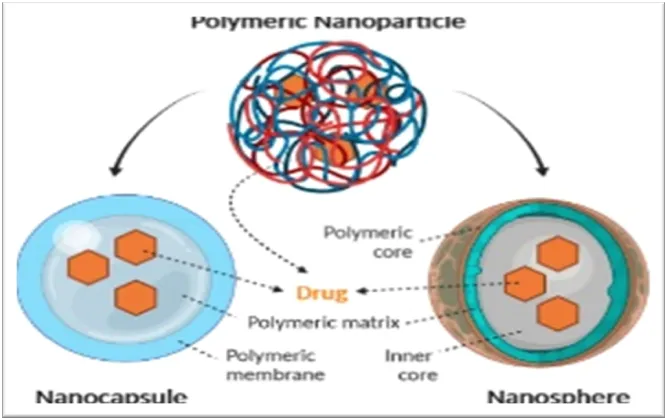
Figure 2.1: Polymeric Nanoparticles
2.1.2 Nanospheres: on the other hand, are made of a continuous polymeric network in which the drug can either be encapsulated within or adsorbed onto the surface. [9],[10],[11]
2.2 Composition:
a. polyethylene glycol (PEG)
b. polylactide-co-glycoside (PLGA) [12]
2.3 Mechanism: Polymeric nanoparticles can control how drugs are released, either by allowing them to slowly diffuse through the polymer matrix or by breaking down the matrix itself. They are being studied as drug delivery systems for targeting tumour’s directly and for carrying drugs across biological barriers, especially the blood–brain barrier. [13]
2.4 Application:
1. Cancer therapy
2. Intra cellular targeting
3. Vaccine adjuvant
4. DNA delivery
5. Vaccine & gene therapy [9],[10],[11],[12],[13]
3. Solid Lipid Nanoparticles: Solid–lipid nanoparticles (SLNs) and nanostructured lipid carriers (NLCs) are advanced systems used to deliver drugs and other bioactive molecules for diagnosis, therapy, and treatment. These tiny carriers can improve how well drugs dissolve and pass through cell membranes, boost their bioavailability, and keep them in the body for a longer time. They are also safer because of their low toxicity and ability to target specific sites.
NLCs are considered the second generation of lipid nanoparticles and are different from SLNs because of their structure. Unlike SLNs, NLCs are made by mixing a liquid lipid with a solid lipid. This special composition allows NLCs to hold more drug, release it more effectively, and remain more stable. [14],[10]
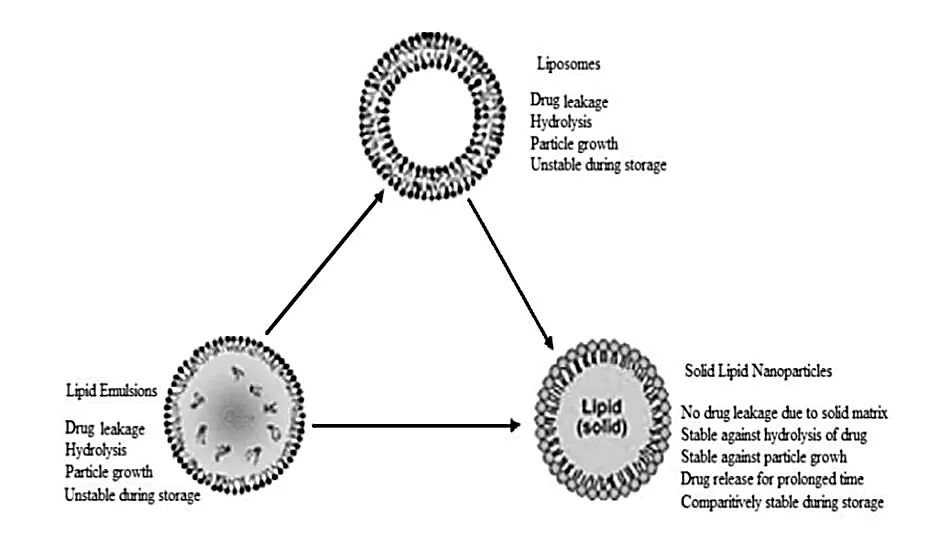
Figure 3.2: Solid Lipid Nanoparticles
SLNs are very tiny particles (smaller than 1000 nanometers) used to deliver drugs. They are made from fats (lipids) that stay solid at both room temperature and body temperature. To keep them stable, surfactants are added. They help drugs remain stable and increase their availability in the body. They allow drugs to be released in a controlled manner. They can carry different types of drugs and can be given in many ways such as by mouth, injection, or through the skin.
3.1 Composition:
a. Lipid Core
b. Surfactants / Emulsifiers
c. Active Pharmaceutical Ingredient (API)
d. Aqueous Dispersion Medium. [15]
3.2 Mechanism: Solid lipid nanoparticles (SLNs) are made by mixing melted lipids with surfactants in water and then cooling them, which causes the lipids to form nanoparticles. These nanoparticles have a solid lipid matrix that traps hydrophobic drugs and keeps them stable at the nanoscale. The drug is released either by slowly diffusing through the lipid matrix or when the lipid core gradually breaks down. SLNs improve drug solubility, protect drugs from degradation, and allow targeted delivery, which increases bioavailability and enhances therapeutic effects.
3.3 Application:
1. Improves bioavailability of poorly soluble drugs.
2. Helps in crossing biological barriers like the blood–brain barrier (BBB).
3. Used for delivery of anticancer drugs with reduced side effects.
4. Provides occlusive effect, enhances skin hydration.
5. Enhances immune response by controlled antigen release.
6. SLNs can be administered via oral, parenteral, pulmonary, and topical routes.
Improve drug absorption in GI tract and lungs. [16]
3 Dendrimers: Dendrimers are Nano sized, symmetrical molecules consisting of a small central atom surrounded by multiple symmetric branches, known as Dendron. Their structure plays a crucial role in drug release. Dendrimers grow outward from a core–shell structure that reacts with monomers during synthesis. They exhibit excellent compatibility with biological systems. The unique characteristics of dendrimers include their hyper-branched architecture and well-defined spherical shape. These properties make them highly versatile, with wide applications in medical and biomedical fields. Dendrimer-based Nano formulations improve the solubility of poorly soluble drugs, enable targeted delivery to specific tissues, enhance bioavailability, and provide controlled drug release. [17] Dendrimers are star-shaped, hyper-branched nanoparticles composed of a core, repeating branch units, and surface functional groups, making them highly effective drug delivery systems. They enhance drug bioavailability, solubility, and stability, while minimizing systemic toxicity and enabling precise, controlled, and targeted release.Drugs can either be encapsulated within the internal cavities of dendrimers or attached to their surface through covalent bonds. Their size, architecture, and surface chemistry can be easily modified, allowing customization for specific therapeutic applications, such as anticancer drug delivery, gene therapy, or ocular treatments. [18]
4.1 Composition:
a. Core Unit
b. Repeating Units (Branches / Generations).
c. Surface Functional Groups (Terminal Groups) [18]
4.2 Mechanism: The mechanism of dendrimer synthesis involves two primary strategies: divergent and convergent growth. These stepwise, repetitive chemical reactions build a precisely structured, hyperbranched polymer, layer by layer, known as a generation. [19]
4.3 Applications:
1. Improve solubility, bioavailability, and stability of drugs.
2. Protect genetic material from enzymatic degradation.
3. Used in cancer and cardiovascular disease imaging.
4. Surface-modified dendrimers can disrupt bacterial cell walls.
5. Deliver anticancer drugs selectively to tumour sites.
6. Used as adjuvants in vaccines to enhance immune response. [20]
4 Noisome & Transferosome’s: Noisome are tiny, bubble-like carriers made from biodegradable materials. They are safe, stable, and low-cost, making them a good alternative to liposomes. Niosomes can overcome problems like drug instability, quick breakdown, poor absorption, and low solubility. They are very useful for delivering medicines such as anticancer, antioxidant, anti-inflammatory, antimicrobial, and antibacterial agents directly to where they are needed.
Noisome are drug delivery vesicles made from non-ionic surfactants, while transfersomes are ultradeformable vesicles composed of phospholipids and edge activators. The key difference is niosomes’ simple, non-phospholipid-based structure, making them more stable and cost-effective, whereas transfersomes’ unique phospholipid composition provides enhanced flexibility for penetrating biological barriers and delivering active agents like drugs, proteins, and peptides.
a. Noisome: Consist of a bilayer formed by non-ionic surfactants and cholesterol, with hydrophilic ends facing outward and hydrophobic ends facing inward. [21]
b. Transferosome’s: Composed of phospholipids and “edge activators” (e.g., biocompatible surfactants) which impart flexibility and deformability to the lipid bilayer. [21],[22],[23]
5.1 Composition:
A. Noisome: a. Non-ionic surfactant
b. Cholesterol
c.Charge-inducing agents (optional):
• Positive charge
•Negative charge
d. Aqueous core [22]
B. Transferosome’s: a. Phospholipids
b. Edge activators
c. Aqueous core
d. Optional stabilizers [24]
5.2 Mechanism:
Noisome: Noisome deliver drugs by creating a bilayer membrane made of non-ionic surfactants and cholesterol, which traps the drug inside. They work by merging with cell membranes or changing the structure of the skin to release the drug at the target site. This improves drug permeability, increases hydration and flexibility of the skin’s outer layer (stratum corneum), and allows the drug to be released in a controlled manner over time. [21]
Transfersomes: Transferosomes improve transdermal drug delivery because of their highly flexible phospholipid bilayer structure. This flexibility allows them to pass through the skin’s tiny pores without breaking. They move into the skin due to the natural hydration gradient between the skin and the transfersomes gel or solution. Once inside, they cross the stratum corneum (the main skin barrier) and carry drugs deep into the epidermis and even into the bloodstream. Edge activators in their structure make the vesicles more flexible, helping them act both as drug carriers and penetration enhancers. [25]
5.3 Applications:
A. Niosomes application:
1.Deliver drugs directly to specific tissues or organs, reducing side effects.
2. Maintain drug action for a longer period.
3. penetration through the skin.
4. drugs with better selectivity and lower toxicity.
5.improve immune response. [21]
B. Transfersomes application:
1. Used to deliver drugs through the skin into systemic circulation
2. Used in skin-care formulations for enhanced penetration of active ingredients
3. Used in transdermal patches for hormones
4. Help deliver anticancer drugs directly to tumour sites with better penetration and reduced toxicity.
5. Provide long-lasting therapeutic effects. [25]
6. Nanoemulsion: Emulsions are mixtures of two liquids, where one liquid is spread out as small droplets within the other. Nanoemulsions are very small emulsions, with droplet sizes ranging from a few tens to a few hundred nanometers. They are useful in medicines, foods, and cosmetics because of their special properties, such as very small size, large surface area, better mixing of water-insoluble (hydrophobic) substances, and improved absorption.
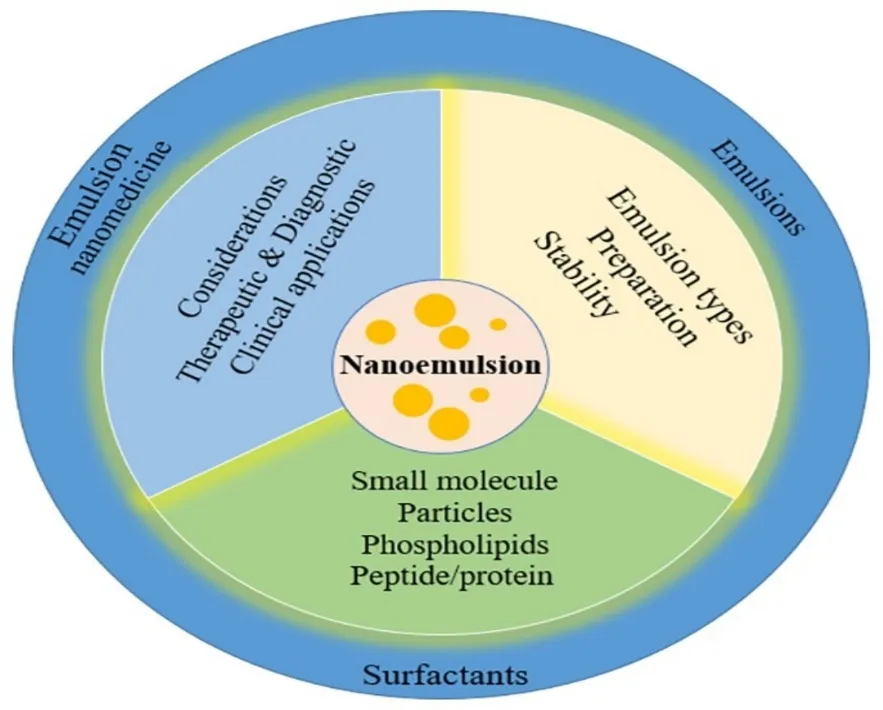
Figure 6.1: Nanoemulion
Nanoemulsions are drug delivery systems that use nanometer-sized droplets (20–200 nm) to enhance the solubility, bioavailability, and stability of drugs—especially those that are hydrophobic or poorly soluble in water. They are composed of an oil phase, an aqueous phase, and surfactants/co-surfactants, which together form a stable, transparent formulation. Nanoemulsions can be administered through multiple routes, including oral, topical, intravenous, and intranasal. As a versatile platform, they provide advantages such as controlled drug release and targeted delivery, making them suitable for treating a wide range of conditions. [26]
6.1 Composition:
a. Antioxidants
b. Preservatives
c. Active pharmaceutical ingredient (API)
d. Co-surfactant (s)
e. Surfactant (s) [27]
6.2 Mechanism: Nanoemulsions work by encapsulating and dissolving drugs inside very tiny oil or water droplets. Because the droplets are extremely small and have a large surface area, the drug can be absorbed more easily in the body. This improves the solubility, absorption, and bioavailability of the drug. Nanoemulsions can also help drugs cross biological barriers (like skin or cell membranes) and allow for controlled or sustained release, making the drug more effective. [28]
6.3 Application:
1. Nanoemulsions can be delivered via inhalation or nasal sprays, allowing rapid absorption and bypassing first-pass metabolism.
2. They protect drugs from degradation in the gastrointestinal tract and improve intestinal absorption, useful for peptides, proteins, and poorly soluble drugs.
3. Nanoemulsions provide a safe vehicle for intravenous administration of lipophilic drugs, ensuring uniform distribution and reducing irritation.
4. Nanoemulsions can be surface-modified to deliver drugs directly to specific tissues, cells, or receptors, minimizing side effects.
5. Nanoemulsions improve the solubility of poorly water-soluble drugs (like hydrophobic drugs), leading to better absorption and higher bioavailability.[26],[27],[28]
APPLICATION OF NANO FORMULATIONS
1. Cancer therapy
2. CNS drug delivery
3. Antimicrobial/antiviral therapy
4. Vaccines (mRNA vaccines and lipid nanoparticles as case study
5. Personalized medicine
6. Gene and Nucleic Acid Delivery
7. Deliver antibiotics and antifungals more efficiently. [29]
ADVANTAGES OF NANO FORMULATIONS
1.Reduced dosing frequency and minimized side effects lead to improved adherence.
2.Minimizes systemic toxicity by lowering the required dose and avoiding off-target accumulation.
3.Capable of crossing barriers like the blood–brain barrier, skin, and mucosal membranes.
4.Protects drugs from degradation
5.Allows for prolonged drug action and reduced dosing frequency.
6.Improves solubility and absorption of poorly water-soluble drugs.
7.Enhanced patient compliance
8.Targeted delivery & reduced side effects [30]
CHALLENGES & LIMITATIONS
A. Challenges:
1. Complex preparation methods: Techniques like high-pressure homogenization, solvent evaporation, or microfluidics require precision, specialized equipment, and expertise.
2. Stability issues: Nanoparticles may aggregate, precipitate, or undergo changes in size and surface charge, reducing efficacy.
3. Drug loading limitations: Certain drugs have poor compatibility with nanocarriers, leading to low encapsulation efficiency.
B. Limitations:
1. Scale-up difficulties: Laboratory-scale formulations often do not translate easily to large-scale manufacturing.
2. Shelf-life concerns: Nanoformulations may degrade or lose stability during storage.
3. Reproducibility: Maintaining uniform size, shape, and surface properties across batches can be challenging. [31]
FUTURE PROSPECTIVES
1. Smart nanoformulations (stimuli-responsive nanoparticles)
2. Theranostics (drug + imaging in one system)
3. CRISPR & gene delivery applications
4. 3D-printed nanomedicines [32]
CONCLUSION
Recent advances in nanoformulations have transformed drug delivery by providing precise, tunable platforms—such as liposomes, polymeric nanoparticles, solid lipid nanoparticles/nanostructured lipid carriers, dendrimers, niosomes/transfersomes, and nanoemulsions—that improve drug solubility, stability, targeting, and therapeutic index. These systems offer clear advantages over conventional dosage forms by enabling controlled release, reducing off-target toxicity, improving bioavailability, and enabling delivery across challenging biological barriers (e.g., the blood–brain barrier), which has important implications for cancer therapy, CNS disorders, vaccines, gene delivery, and antimicrobial treatments.
Despite these strengths, several translational hurdles remain: complex and sometimes non-scalable manufacturing processes, stability and shelf-life concerns, limited drug-loading for certain cargos, batch reproducibility, and regulatory and long-term safety questions. Addressing these limitations will require standardized characterization methods, improved scalable production techniques, robust stability and toxicology studies, and closer collaboration between academia, industry, and regulators.
Looking ahead, the most promising directions include stimuli-responsive “smart” nanoparticles, integrated theranostic platforms that combine therapy with imaging, gene-editing delivery systems (e.g., CRISPR carriers), and novel fabrication strategies such as 3D-printed nanomedicines tailored for personalized therapy. If these technological developments are coupled with rigorous preclinical evaluation and patient-focused clinical translation, nanoformulations are well positioned to deliver major, safe, and clinically meaningful improvements in disease management.
REFERENCES



Aniket Tupe, Hemant Vadak, Gaurav Ghawate, Advances in Nano Formulation for Drug Delivery, Int. J. of Pharm. Sci., 2026, Vol 4, Issue 10, 4278-4287. https://doi.org/10.5281/zenodo.23686528
 10.5281/zenodo.23686528