

We use cookies to ensure our website works properly and to personalise your experience. Cookies policy
Pharmacy Department, Shahajirao Patil Vikas Pratishthan’s S.B Patil College of Pharmacy.
Three dimensional (3D) printing has been commonly used in areas such as aviation and automotive manufacturing. However, there has been increasing interest in the healthcare sector, specifically pharmaceuticals. Recently, the pharmaceutical industry have looked into how 3D printing can revolutionize drug manufacturing to give more accurate, personalized formulations. [1, 9, 15] The key advantage of using 3D printing over traditional manufacturing is the ability to tailor the drug to the individual patient. Traditional manufacturing is usually one size fits all and provides set standard dosages. Using 3D printing, drugs with specific dosages for the individual can be manufactured, increasing the efficiency of treatment and reducing negative side effects. Patients who require highly specific dosing, such as children and the elderly will benefit greatly. [11, 20] With increasing interest in 3D printing, much research has been conducted. Many different printing methods can be used to produce complex drug designs, controlled release drugs and combination drugs that would be difficult to achieve with traditional methods. As technology continues to improve, it is likely to have a huge impact on pharmaceutical science, providing patient-specific drugs. This review outlines the main 3D printing methods that are suitable for pharmaceutical manufacture. We also consider how these can help improve drug manufacture, patient outcomes and increase innovation in personalised medicine. [9, 10, 15, 21].
Personalised medicine has become an area of increasing interest within both healthcare and the pharmaceutical industry. It involves designing treatment specific to the individual based on the understanding that every patient will respond differently to therapeutics due to individual and biological factors. [4, 14]
Medications have largely been produced in bulk using traditional methods for over two hundred years. There are only a few set strengths available meaning treatment lacks individuality for many individuals. Patients might not get the amount of medicine they need. This can lead to results or harmful side effects. It is said that many, as 70% of patients do not get the effect they should from regular medicines. Also 90% of medicines only work for 30 to 50% of people.Adverse drug reactions caused by poor interactions between drugs and a patients’ biology, contribute to approximately 7% of hospital admissions. This shows there is a clear need for more personalized and accurate treatments. [1, 4, 7, 14].Therefore personalisation is being developed where medication can be tailored to suit the patient based on their physical characteristics, current conditions, treatments, response to medication, genetic profile and demographic factors such as sex, age and weight. [1, 4, 14].
3D printing (additive manufacturing) has been found to be some of the most promising ways to achieve this. This involves creating items by building them up in layers using digital designs. This can be used within pharmacy to create 3D printed items known as printlets. These are small tablets which can be personalised to suit the needs of the patient.The dose, the way it is made and how it releases in the body can be changed for each person. Other parts that are not related to treatment, like the shape, the size, the feel and the taste can be changed to make the medicine more comfortable and easier to take for patients, kids and older people. [11 20].
Many studies have demonstrated the versatility of 3D printing technology with various dosage forms, including fast dissolving or dispersible tablets, sustained release tablets, gastric retention systems, suppositories, Minitablets and even medical devices. The polyprintlet has been developed whereby multiple drugs can be printed into one dose, allowing individualised dosing for patients on complex regimes. [22, 23, 24, 26]
3D printing allows for on demand manufacturing meaning bespoke medicines can be produced by hospitals and pharmacies. This increases availability of individualised medicines and reduces reliance on slow extemporaneous manufacture. It can also help reduce the length of a patients stay in hospital as the medicines will be manufactured in a more efficient manner. [9, 15]
This review will discuss the key 3D printing technologies used within pharmaceutical manufacturing, including fused deposition modelling (FDM), ink jet printing and stereolithography (SLA). Reasons for why 3D printing is being adopted, recent developments and applications will also be discussed, alongside challenges faced to fully introduce this technology into clinical and industrial pharmacy. Overall this review will highlight the role pharmacists, clinicians and biomedical engineers will have to aid innovation and implement 3D printing to develop safe, effective patient centred solutions to support the future of precision medicine. [9, 10, 15, 21]
HISTORY AND DEVELOPMENT OF 3D PRINTING:-
3D printing was created in the 1970s. Now it has evolved to become a powerful technology used in many fields such as manufacturing, healthcare and pharmacy. Below are the main points of its development. [9, 10, 15, 21] .
1971 Pierre A.L. Ciraud:-
In 1971 Pierre A.L. Ciraud presented a theory whereby powdered material would be spread into layers and then fused using a high intensity beam of light such as a laser. He suggested that plastics or metals could be printed using this technique to create solid objects. This idea led to the creation of Selective Laser Sintering (SLS) which is now widely used in situations that require a high level of accuracy and complicated geometries. [9, 10, 21, 29].
1981 Hideo Kodama (Japan):-
Hideo Kodama was a researcher in Japan who developed one of the first 3D printing systems in 1981. He used photopolymers which harden when exposed to UV light to print 3D objects. This was one of the first examples of 3D printing being used and an essential step towards creating additive manufacturing technologies today. [9, 10, 15, 21].
1984 Chuck Hull:-
In 1984 Chuck Hull developed Stereolithography (SLA). This was the first commercial 3D printing process. It works by using UV light to harden liquid resin in layers to create 3D objects. This was an important advancement for 3D printing as it transformed it from an idea into something usable. This has changed the way manufacturers, designers and engineers make prototypes and products. [9, 10, 15]
1989 S. Scott Crump:-
S. Scott Crump along with his wife Lisa Crump developed a new technique in 1989 called Fused Deposition Modelling (FDM). This uses molten plastic which is then extruded and allowed to cool and solidify. They also co-founded Stratasys which became one of the leading companies in the field. FDM is one of the most widely used techniques for rapid prototyping and low volume manufacturing. [9, 10, 15, 21].
1990s Emanuel “Ely” Sachs:-
In the 1990s Emanuel “Ely” Sachs an engineer at MIT developed Binder Jet Printing. This uses a liquid binder to fuse together powder particles to create a solid object. This increased the range of materials that could be printed. Sachs is also known for creating the name 3D printing which is now used globally.
2000s:-
3D printing expanded to cover more industries such as automotive and aerospace. Most of these were for rapid prototyping. This meant companies could create prototypes quickly reducing costs.
A large breakthrough occurred in 2005 when the RepRap Project was created. This created the first open source 3D printer that could self-replicate. This opened up 3D printing to a larger audience such as researchers, hobbyists and teachers. They could experiment with the technology at a greatly reduced price. [9, 10, 15]
2010s:-
3D printing was used more in the healthcare sector in the 2010s. This included printing prosthetic limbs, dental devices and surgical tools. Being able to create bespoke medical items was a big step forward. In 2015 the FDA approved Spritam an epilepsy drug to be the first 3D printed drug. This was a big achievement in the industry showing that drugs could be personalised to the patient. [9, 15, 21].
2020s:-
The most advanced applications of 3D printing have been seen in the 2020s. This includes developments in personalised medicine. Patients can now have very complex drug delivery systems to meet their needs. For example, tablets can be printed to deliver their drug at specific times or amounts to meet their conditions. Bioprinting has also become an area of interest. This involves printing real tissues and organs. Scientists are investigating if they can print working tissues or organs from humans to transplant or test drugs.
There is also ongoing work to print drugs on demand in hospitals or pharmacies. This could improve the efficiency and personalisation of patient care by providing the perfect dosage and formulation for each individual patient. [1, 9, 15].
HISTORY OF 3D PRINTING IN INDIA:-
3D printing started in the early 2000s in India. It was mainly used for research and models in the IITs and CSIR labs. However, industries such as automobile, aerospace and healthcare have started to use 3D printing to speed up and reduce costs in designing items. In around 2010 companies in India have started to bring 3D printing to the market such as Imaginarium and Objectify. In 2017 doctors at AIIMS performed the first 3D printed spinal implant surgery in India. The government are supporting 3D printing through the “Make in India” programme and the National Strategy for Additive Manufacturing (2022). 3D printing is now used in India to create houses, medical devices and defence components showing good progress in advanced manufacturing. [9, 10, 15, 21]
TYPES OF PHARMACEUTICAL 3D PRINTING SYSTEM:-
3D printing was first developed by Charles Hull in 1986 but has now evolved into various different types. ‘3D printing’ is now an umbrella term for various different technologies that all work by building objects in layers. Most techniques follow a similar process called the ‘3Ds of 3D printing’. Overall there are 6 types of 3D printing that are commonly used in the pharmaceutical industry. These are described below. [9,15,21].
1. Binder Jet Printing Schematic:
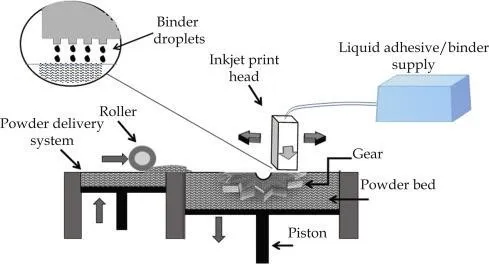
Working:-
1. A nozzle with a binder solution is accurately moved across a flat bed of powder in the x- y direction. The binder is deposited only onto the desired regions of powder according to the design of the object. At these points the binder causes the powder particles to adhere together and therefore start to form a solid structure, this will form the first layer of the object. The platform then falls down a little in the z direction so that the next layer can be printed. A roller or similar is used to add a new even layer of powder.
2. The nozzle is then moved across the new layer of powder and binder is deposited into the design required. This is repeated and each layer is built upon the previous layer.
3. After multiple layers have been printed a complete 3D object will be formed, such as a tablet/capsule.This technique allows precise formation of 3D printed medicines/printlets and therefore has huge potential to produce patients specific medications. [9,15,21]
Advantages:
Disadvantages:
2. Fused Deposition Modelling (FDM) Schematic:
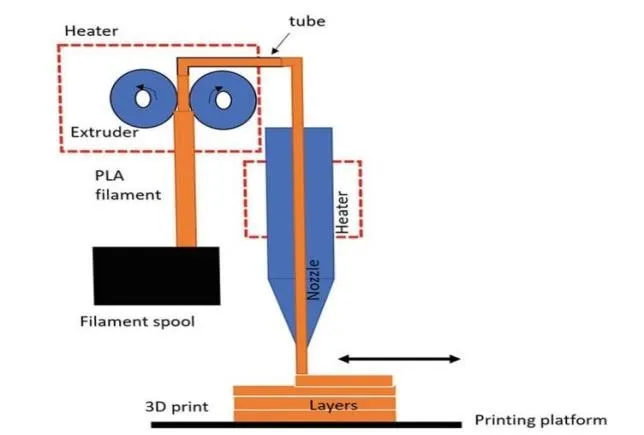
Working:-
1. In this there is a plastic filament which contains the API that is drug and it fed through a heated nozzle.
2. The plastic is melted and the nozzle moves back and forth to print the liquid onto the flat platform.
3. The platform slowly lowers so that more layers can be printed one by one to form the 3D printed medication. [9,15,21]
Advantages:-
Disadvantages:
4. Semi-Solid Extrusion Schematic:
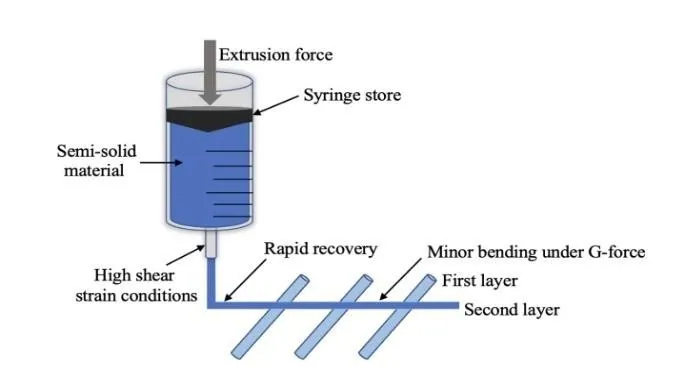
Working:-
1. The drug is forced out from a syringe in a thick paste or the gel like Consistency .
2. The head of the printer moves in various/ Multiple directions (i.e left/right, back/front, upward/backward in every direction.
3. This places the drug onto a surface and it solidifies as it cools. [9,15,21]
Advantages:
Disadvantages:
5.Direct Powder Extrusion:-
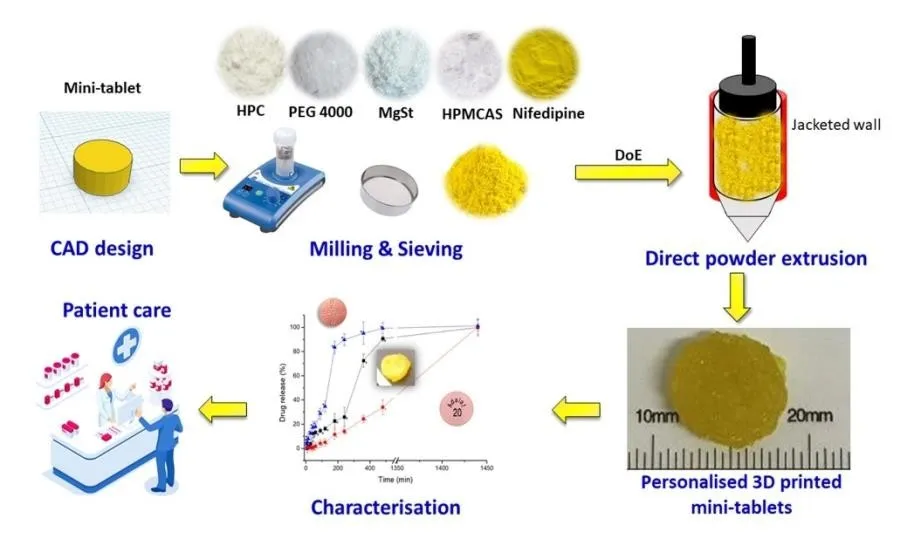
Working:
1. The drug powder along with other ingredients are put into a hopper.
2. The powder is then transported by a rotating screw to an area in the printer where it is heated and melts to form a thick liquid. This is then printed and hardened as it cools to form the object.
3. The platform lowers step by step to build up the 3D medication. [9,15,21].
Advantages:
Disadvantages:
6.StereolithographySchematic:
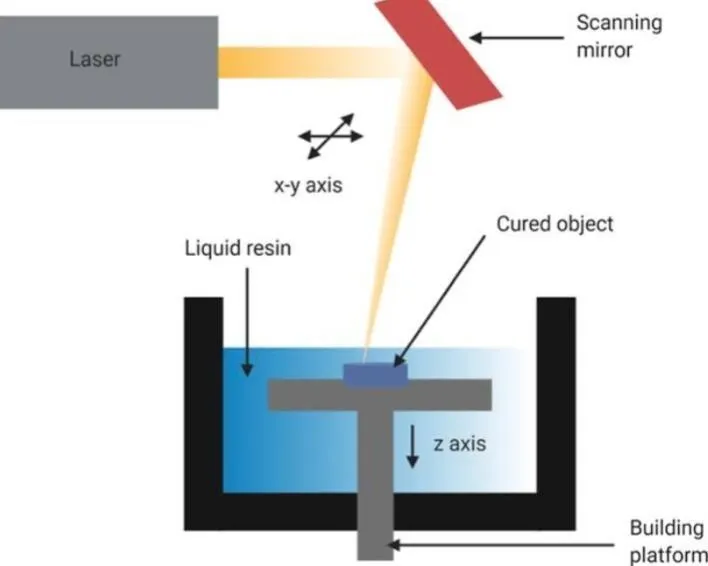
Working:-
1. A liquid resin is cured in thin layers.
2. The resin hardens when exposed to intense light, such as UV light.
3. Once the layer has formed the platform lowers and another layer of resin is added. This continues until the full 3D medication has formed. [9,15,21].
Advantages:
Disadvantages:
7.Selective Laser Sintering (SLS) Schematic:
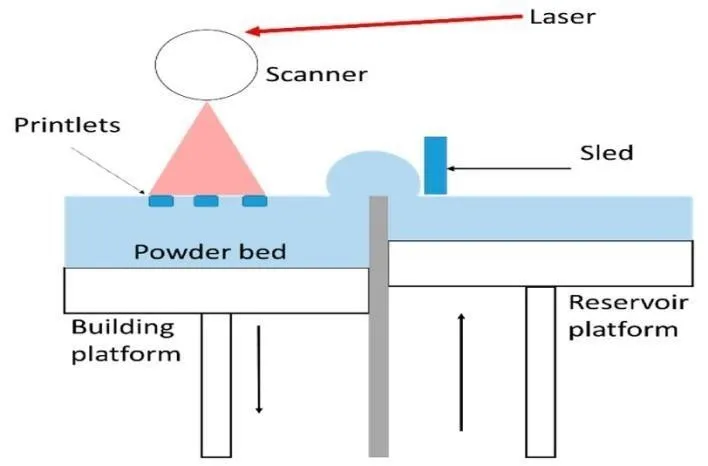
Working :
1. Using a laser the design is traced onto the bed of powder to produce the object, such as a medication.
2. The laser heats specific areas to cause the powder particles to stick together.
3. Another layer of powder is added and this is repeated until the object is complete. [21,29]
Advantages:
Disadvantages:
APPLICATION:-
1.Tablets:-
2.3DP benefits:-
Examples:-
1. Vaccines: 3DP was used with hydrogels to create very pointed needles. This helped with pain free vaccine delivery. (Ochoa et al.)
2. Fast printing: A technique called CLIP was used to create very small needles in just 10 minutes. No moulds were needed. (Johnson et al.)
3. Skin cancer: Microneedles were used to deliver chemotherapy drugs slowly over 5 weeks. (Lu et al.)
4. Biodegradable & safe for skin: 3DP needles dissolved into the skin. Drug was released smoothly. (Luzuriaga et al.)
5. Insulin: Special shaped needles delivered insulin in 30 minutes. (Pere et al.)
6. Splint: 3DP patch was used as a small splint. It also delivered pain relief drugs to the trigger finger. (Lim et al.) [21]
Why they are useful:-
3.Biorobotics:-
Examples:
Some robots use heart cells. These cause the robot to move or cause the liquid to move.
The flagellum swimmer uses heart cells to create a long tail to enable it to move like a small fish.
Small heart pumps have been created by placing heart cells onto a soft flexible material. The heart cells cause the fluid to move along small tubes. [21]
Special features:
4. 3D printed models.
Benefits:
Real life examples:
5.Overall benefits:
CONCLUSION:-
3D printing has the potential to change the way medicines are produced and used in hospitals and pharmacies. Instead of creating large amounts of medicine, the technology allows small amounts of personalised medicine to be created when needed. This means patients receive safer, more effective personalised medicine. [1, 9, 15]. Pharmacists, doctors and nurses play an important role in implementing this technology. They can help researchers and companies create better healthcare solutions for the future. [9, 10, 15, 21]
REFERENCES


Trushna Gardade, Neha Ghule, Prachi Ghadage, Dose by Design: Pharmacy in 3-Dimensional Printing Era, Int. J. of Pharm. Sci., 2026, Vol 4, Issue 11, 2720-2730. https://doi.org/10.5281/zenodo.24308422
 10.5281/zenodo.24308422