

We use cookies to ensure our website works properly and to personalise your experience. Cookies policy
Dr J. J. Magdum Pharmacy College [Degree], Jaysingpur.
Naproxen is a widely used non-steroidal anti-inflammatory drug (NSAID) classified as BCS Class II, which means it has low aqueous solubility and high permeability. Because dissolution often limits how quickly such a drug reaches the bloodstream, poor solubility can hold back the performance of an oral dosage form. Deep eutectic solvents (DESs), and the subgroup called natural deep eutectic solvents (NADES), are tunable liquid media. Their hydrogen-bonding behaviour and polarity can be adjusted by changing the components and their ratios. This review asks whether NADES merit study as solubilising media for naproxen. It keeps apart what is established for DESs in general and what is still unknown for one particular L-proline–glucose mixture. Earlier work has measured naproxen solubility in choline-based and betaine-based DES–water mixtures. These results suggest that DES-assisted solubilization is feasible, but they cannot predict how a different composition will behave. The proposed 5:3 L-proline: glucose molar ratio is therefore a hypothesis that needs experimental confirmation. A reasonable study would move from solvent characterization to equilibrium solubility measured with proper controls, then to dilution and precipitation tests and compatibility checks, and only afterwards to a solid oral dosage form. Viscosity, water content, dose uniformity, stability and safety are the main practical concerns. Greater solubility in a solvent does not, by itself, mean faster dissolution from a finished product or better bioavailability. The review includes tables covering solvent properties, controls, risks and stage gates to support planning.
Before a drug can be absorbed, it has to dissolve in the fluid of the gastrointestinal tract. This makes poor aqueous solubility one of the most common problems in oral product development. Naproxen is prescribed for pain and inflammatory conditions. The amount that dissolves depends on pH, temperature, the degree of ionisation and the composition of the medium, so a solubility value tells us little unless the conditions behind it are reported. For a formulator, the important question is not only whether a solvent takes up more drug. It is whether that system can be made into a stable, reproducible dosage form that releases the drug at an acceptable rate (Amidon et al., 1995) [1] ; (Mokhtarpour et al., 2019) [2].
DESs and NADES have attracted interest because their components and ratios can be varied to adjust the solvent's properties. They also fit the aims of green chemistry, which gives them clear appeal in pharmaceutics. Even so, a natural origin does not make a mixture non-toxic, safe to swallow or suitable as an excipient. Each composition needs evidence that matches its intended use (Paiva et al., 2014) [3] ; (Chevé-Kools et al., 2025) [4].
1.1 Solubility, dissolution and the Biopharmaceutics Classification System
The Biopharmaceutics Classification System (BCS) groups drugs according to aqueous solubility and intestinal permeability (Amidon et al., 1995) [1]. Naproxen is usually placed in Class II. For drugs in this class, absorption is often limited by how quickly and how completely the drug dissolves, so formulation work tends to focus on dissolution rather than permeation. This explains why solvent-based and solid-state approaches are attractive for naproxen. It also means the right endpoint is dissolution under physiologically relevant conditions, not a high concentration in a solvent that the body never encounters.
This review keeps three related quantities separate. The first is equilibrium solubility, the highest concentration reached at thermodynamic equilibrium in a defined medium. The second is apparent or supersaturated concentration, which may be higher but is not stable. The third is the dissolution rate from a dosage form, which depends on solubility, surface area, hydrodynamics and the excipients present.
1.2 Established solubility-enhancement strategies
A NADES-based method should be compared with techniques that already exist. A new approach is only worth pursuing if it offers a real advantage for the chosen drug and dosage form (Williams et al., 2013) [5] ; (Xie et al., 2024) [6].
Table 1: Common Strategies for Improving the Dissolution of Poorly Soluble Drugs (General Overview)
| Strategy | Principle | Practical considerations |
|---|---|---|
| Salt formation | The ionised form of a weak acid or base dissolves faster than the free form | Requires an ionisable group; the salt may convert back to the free form in the gut; hygroscopicity and stability need checking |
| Particle-size reduction | A larger surface area increases dissolution rate, but equilibrium solubility is unchanged | Milling or nanosizing; aggregation and handling problems |
| Solid dispersions | The drug is dispersed in a hydrophilic carrier, often in a higher-energy state (Serajuddin, 1999) [7] ; (Leuner & Dressman, 2000) [8] ; (Vasconcelos et al., 2007) [9]. | Physical stability (recrystallisation), choice of carrier, scale-up |
| Cosolvents, surfactants, complexation | Altered medium polarity, micellar solubilisation or inclusion complexes (Higuchi & Connors, 1965) [10]. | Precipitation on dilution; limits on excipient levels for oral use |
| pH modification | Local pH shifts the ionisation of weak acids or bases | Depends on buffer capacity and diffusion-layer behavior |
| DES / NADES | A tunable, hydrogen-bonding solvent that may keep the dissolved drug stable | Viscosity, water content, oral safety data, conversion into a solid dosage form |
2. DES and NADES: Concepts and Terminology
A deep eutectic solvent is a mixture whose melting point is far lower than that of any of its individual components, usually because the components interact strongly with one another. Many DESs combine a hydrogen-bond acceptor (HBA) with a hydrogen-bond donor (HBD). The term NADES refers to systems made from naturally occurring primary metabolites, such as organic acids, amino acids and sugars. The two terms are not always interchangeable. A natural origin for the ingredients does not prove that a mixture forms a deep eutectic phase, and it does not prove that the mixture is safe for pharmaceutical use (Smith et al., 2014) [11]; Hansen et al., 2021) [12].
Two ingredients that become liquid on heating should not be called a NADES for that reason alone. Composition, phase behaviour, water content, viscosity, thermal properties and spectroscopic data all help show whether a material behaves as claimed. Water deserves particular attention. A small amount can lower viscosity, but larger amounts alter the hydrogen-bond network and change the mixture's properties (Dai et al., 2013) [13]; Hansen et al., 2021) [12].
2.1 Historical background
Abbott and colleagues described the deep eutectic concept using choline chloride–urea mixtures (Abbott et al., 2003) [14]. (Choi et al. 2011) [15] later proposed that primary metabolites such as sugars, amino acids and organic acids could form liquid phases inside living organisms, which led to the NADES concept. Subsequent reviews extended the field into extraction, catalysis, materials science and pharmaceutics (Zhang et al., 2012) [16]; (Paiva et al., 2014) [3]; (Smith et al., 2014) [11]; (Hansen et al., 2021) [12]. More recent reviews discuss the composition, preparation and use of NADES in food, pharmaceutical and biomedical settings (Yadav et al., 2026) [17]. (Freitas DS et al.,2025) [18]. (Tarif E et al.,2026) [19]. Others focus on the role of deep eutectic systems in pharmaceutical formulation (Emami & Shayanfar, 2020) [20]; (Zechen L., 2026) [21]; (Panbachi S et al.,2026) [22].
2.2 Classification and typical components
Pharmaceutical papers often use the groupings below. They are conceptual categories, and a particular mixture may fall between two of them.
Table 2: Properties of DES/NADES and Their Pharmaceutical Relevance
| Property | Influence | Relevance to the proposed system |
|---|---|---|
| Hydrogen-bonding network | Governs solvation of polar and hydrogen-bonding solutes | May stabilise the carboxylic acid and methoxy groups of naproxen in solution |
| Viscosity | Often high, and strongly dependent on temperature and water content | Affects handling, filtration, mixing, content uniformity and dissolution kinetics |
| Water content | Alters viscosity, polarity and network structure | Must be controlled and reported; changes during storage as the material takes up moisture |
| Acidity / pH of aqueous dilutions | Set by the acidic components and by dilution | Changes naproxen ionisation and therefore its apparent solubility |
| Thermal behavior | Melting or glass transition, and decomposition range | Guides preparation temperature and storage conditions |
| Chemical reactivity | Components may react on heating or during storage | Reducing sugars and amines can brown; acids may esterify under forcing conditions (to be tested, not assumed) |
3. Why Investigate L-Proline and Glucose?
L-proline is an amino acid and glucose is a sugar. Each carries functional groups that can take part in intermolecular interactions, so combining them is a reasonable starting point. The outcome, however, depends on the molar ratio, thermal history, water content and phase behaviour. The 5:3 molar ratio proposed here must either come from a verified source or be treated as a hypothesis to be tested. It should not be described as optimal in general.
A candidate solvent is also not the same thing as a finished pharmaceutical excipient. Grade, impurities, ratio and residual water can all affect performance. Oral use adds requirements of its own: a safety justification, compatibility with the drug and reproducible manufacture. A clear liquid on its own does not show that a system is suitable (Chevé-Kools et al., 2025) [4]; (Li et al., 2025) [25].
3.1 What the literature says about proline–glucose systems
Proline-based eutectic mixtures are well represented in the NADES literature. They are usually prepared with an organic acid such as malic acid, or with a sugar and water (Dai et al., 2013) [13]. (Janicka et al. (2021) [26] examined L-proline protonated with hydrochloric, sulfuric or phosphoric acid and paired with glucose or xylitol as the HBD. The authors reported densities of about 1343–1606 kg/m³, viscosities at 20 °C of roughly 700 to 48,600 mPa·s, and pH values between about 1.6 and 2.5 for 0.1 M aqueous solutions. These figures are quoted as reported in that study and should be checked against the original paper before use.
Two points follow for this project. First, such mixtures are very viscous and strongly acidic when diluted, and both properties affect naproxen ionisation and handling. Second, those systems depended on an added mineral acid to protonate the proline. They are therefore not equivalent to an acid-free L-proline–glucose mixture, and their numerical values should not be transferred to the proposed 5:3 system.
4. Naproxen and the Solubility Challenge
Because naproxen ionisation depends on pH, the dissolved concentration can differ considerably between unbuffered water and buffers at physiological pH. A drug–NADES sample can only be compared fairly with a water control when temperature, drug loading, equilibration time, pH, separation method, dilution and assay conditions are all controlled. The solid form of the drug and the risk of precipitation after dilution also need attention.
4.1 Physicochemical profile
Selected properties of naproxen
Property Information
| Chemical class -- | Arylpropionic acid (profen) NSAID; the marketed active form is the (S)-enantiomer. |
|---|---|
| Molecular formula and -- mass | C14H14O3; about 230.26 g/mol. |
BCS class -- Class II (low solubility, high permeability).
Acid–base character -- Weak carboxylic acid; pKa usually reported near 4.2–4.3 (with some variation between sources).
Solvent behavior -- Practically insoluble in water; soluble in ethanol and methanol.
pH–solubility trend -- Low solubility at gastric and weakly acidic pH; marked higher
in the intestinal range because the molecule ionizes.
Naproxen is a weak acid, so its solubility is lowest at low pH, such as in the fasted stomach, and much higher at intestinal pH. Any benefit attributed to a NADES must therefore be tested at more than one pH, including 1.2, 4.5 and 6.8, and again after dilution. A system that raises solubility mainly by shifting the local pH could behave quite differently once buffered gastric or intestinal fluid takes over.
4.2 Implications for study design
5. Direct Evidence: Naproxen and DES
Mokhtarpour and colleagues measured naproxen solubility in aqueous solutions of choline chloride-based DESs prepared with urea, malonic acid or ethylene glycol. Solubility varied with DES concentration and temperature, and the malonic acid system performed well under the conditions tested. The authors also analysed volumetric and compressibility data to probe drug–solvent interactions (Mokhtarpour et al., 2019) [2]. This is direct evidence that some DES–water systems can alter naproxen solubility. It does not show that every DES or NADES will behave in the same way.
A later study examined naproxen dissolution in a choline-based DES–water mixture at several temperatures, and again found that composition and temperature shape the result (Moradi M et al.,2022) [27]. Barzegar-Jalali and co-workers determined and correlated naproxen solubility in betaine-based DES–water mixtures between 293.15 and 313.15 K (Barzegar-Jalali et al., 2022) [28]. That work extends the evidence to a non-choline HBA described as low in toxicity. Its temperature range and correlation approach also provide a useful methodological model, although the solvent chemistry still differs from L-proline–glucose.
Mohammadian et al. (2019) [29] reported experimental naproxen solubilisation data alongside computational tools, which offers another point of comparison. These papers are helpful reference points because they study naproxen itself. Even so, no enhancement factor reported for those systems should be credited to the proposed 5:3 mixture.
6. How a NADES Might Influence Solubility
Several mechanisms could contribute. Hydrogen bonds between the drug's functional groups and the solvent may stabilise dissolved molecules. The polarity and microenvironment of the solvent may shift the balance between drug–solvent and drug–drug interactions. A mixture can also change activity coefficients and the energy needed to move drug molecules from the solid into solution. For an ionisable drug such as naproxen, pH and ionisation can strongly influence apparent solubility. Each of these is plausible, but none is established for the proposed system until data support it (Hansen et al., 2021) [12]; (Lu & Chen, 2022) [30].
6.1 Mechanistic hypotheses for naproxen in proline–glucose
Interaction Possible sites
Hydrogen bonding -- Naproxen –COOH and methoxy oxygen with glucose –
OH And proline –COO⁻/–NH₂⁺.
Ionic / acid–base interaction -- Naproxen –COOH with the basic centre of proline.
Hydrophobic / π interactions -- Naproxen naphthalene ring with the proline ring or
Sugar CH groups.
Cosolvent-like polarity change -- Lower bulk polarity relative to water
6.2 Thermodynamic perspective
When solubility is measured at several temperatures, the apparent enthalpy, entropy and Gibbs energy of dissolution can be estimated using a van't Hoff-type analysis. This is a common approach in solvation studies of drugs in mixed media. These values describe the apparent process in one specific medium, and they should be interpreted cautiously if the solvent composition changes with temperature or water content.
7. Characterisation of the Candidate Solvent
FTIR spectroscopy can show changes in the environment of functional groups, which helps to assess interactions between components. Peak shifts alone do not prove that a deep eutectic phase has formed. DSC provides thermal information, and TGA, where available, helps assess mass loss and thermal stability. Water content should always be recorded, because it can change viscosity, phase behaviour and solvation (Dai et al., 2013) [13]; (Hansen et al., 2021) [12]. ATR-IR has also been proposed as a rapid way to estimate water content in DESs .(Elderderi S et al., 2020) [31].
7.1 Preparation considerations
Laboratory preparation commonly involves gentle heating with stirring, evaporation from a shared solvent, or freeze-drying of aqueous solutions. Whichever method is chosen, the temperature, time, mixing and the amount of water added or lost should be recorded. With a mixture that contains both a reducing sugar and an amino acid, prolonged heating should be avoided or justified, and any colour change should be noted. Many NADES are hygroscopic, so the prepared material should be kept in tightly sealed containers.
7.2 Physicochemical characterisation
Viscosity affects handling, mass transfer, mixing, filtration and dissolution kinetics. A thick solvent can slow mass transfer even while it raises equilibrium solubility. Density and refractive index are useful batch descriptors, but on their own they do not establish pharmaceutical suitability. Measuring pH in low-water or non-aqueous mixtures requires a method suited to the matrix, and such readings should not be placed alongside ordinary aqueous pH values without caution.
Characterisation should include replicate measurements, documented instrument settings and suitable controls. Reports should state whether a sample is neat NADES, a water-diluted mixture or a drug-loaded system. Without that information, changes caused by water content or composition may be wrongly attributed to drug–solvent interactions. Independently prepared batches should reproduce one another before any property is described as characteristic of the system. (Gygli G et al., 2020) [32].
8. Measuring Naproxen Solubility
The shake-flask method is the standard way to estimate equilibrium solubility. Excess drug is equilibrated with a defined medium, the undissolved solid is removed, and the dissolved drug is quantified with a validated method. UV-visible spectrophotometry is suitable if selectivity, linearity, accuracy and precision are demonstrated and the solvent components do not interfere. Chromatography may be the better option when the matrix disturbs UV readings. The assay must be validated for the actual sample matrix and should not simply be carried over from another solvent system (Mokhtarpour et al., 2019) [2].
The essential controls are naproxen in the reference aqueous medium, a solvent blank, a drug-free NADES matrix and, where relevant, a pH-matched control. Results should state units, temperature, pH, equilibration time, number of replicates, variability and the basis of calculation. A fold-enhancement value is meaningful only when the numerator and denominator were measured under comparable conditions. Values taken from unrelated studies cannot support a claim of enhancement for this project.
It is also important to check whether an increase survives dilution. A supersaturated solution may start at a high concentration and then precipitate. Measuring concentration after a defined dilution, or over time, shows whether the system sustains solubilisation. This matters for oral products, which encounter changing volumes, pH, salts and digestive components.
8.1 Suggested experimental design
The design below is proposed for the project and does not describe completed work. Conditions should be finalised with the supervisor and adapted to the equipment available.
Table 3: Proposed Solubility Experiment Layout
| Element | Suggested approach |
|---|---|
| Media | Water; buffers at pH 1.2, 4.5 and 6.8; aqueous NADES at several mass fractions (for example, a range from low to high up to the practical viscosity limit); neat NADES where feasible |
| Temperature | 25 °C as a reference and 37 °C for physiological relevance; optionally a five-point series for thermodynamic analysis |
| Equilibration | Excess naproxen under constant agitation; sample at several times (for example 24, 48 and 72 h) until the concentration levels off |
| Separation | Centrifugation, or filtration through a filter shown not to adsorb naproxen; discard the first portion of filtrate; hold temperature constant during separation |
| Sample preparation | Accurate dilution of the aliquot in a solvent that is miscible with the matrix and suitable for the assay |
| Quantification | Validated HPLC or UV method; calibration prepared in matched matrix; report linearity, accuracy, precision, LOD and LOQ |
| Replicates | At least three independent preparations per condition; report mean and standard deviation |
| Residue check | XRPD or DSC on the undissolved solid to confirm the solid form has not changed |
| pH recording | pH of aqueous samples before and after equilibration |
8.2 Calculations
Solubility can be expressed in several units as appropriate: mg/mL, mol/L, mole fraction and mg per g of solvent. Fold enhancement is the solubility in the test medium divided by the solubility in the reference medium, with both measured at the same temperature and pH. The reference must be stated clearly. For dosage-form planning, the mass of solvent needed to carry a given dose equals the dose divided by the solubility, expressed as mg of drug per g of solvent. This simple relation quickly shows whether a liquid-containing tablet is realistic.
9. Dilution and Precipitation Behaviour
An oral product will be diluted by gastric and intestinal fluid, so a dilution study should be a core experiment rather than an optional extra. A drug-loaded NADES of defined composition is added to a fixed volume of medium, for example pH 1.2, 4.5 and 6.8 buffers, under controlled agitation and temperature. Samples are withdrawn at set intervals, separated from any precipitate and assayed. The concentration–time profile shows whether the drug stays in solution, precipitates quickly or declines gradually.
10. Compatibility and Stability
Drug–solvent compatibility should be established before any formulation claim is made. Spectroscopic and thermal results can suggest possible interactions, but no single technique demonstrates chemical stability. Drug assay, appearance, water content, precipitation and changes during storage may all be relevant. Any stability study should specify packaging, storage conditions, sampling times and acceptance criteria. A short observation should be described as preliminary and not presented as a complete stability programme.
10.1 Stability study outline
A modest plan would store the drug-loaded NADES and the final dosage form in closed containers at controlled room temperature and under an accelerated condition. Samples would be taken at fixed times for assay, related substances, water content and appearance and, for dosage forms, dissolution. Conditions and criteria should follow the relevant guidance and be agreed in advance.
11. From Liquid NADES to a Solid Oral Dosage Form
A good solubility result is only one stage of formulation development. A liquid NADES can make powder blends sticky, impede flow, cause poor die filling, change compactibility or migrate during storage. It can also affect disintegration and dissolution in ways that equilibrium solubility does not predict. Reviews identify viscosity, formulation complexity, safety and regulatory uncertainty as continuing difficulties for DES-based pharmaceutical systems (Liu et al., 2022) [33]; (Chevé-Kools et al., 2025) [4].
In broad terms, a developer may pursue a formulation that contains the liquid directly, or a solid intermediate in which a suitable carrier holds or spreads the liquid phase. The choice depends on drug loading, the amount of solvent required, carrier compatibility, physical stability, manufacturability and dose. These are development decisions rather than fixed recipes, so the chosen route should be justified by data and by a development plan approved by the supervisor.
In oral films, the liquid may affect polymer hydration, flexibility, tackiness, drying and crystallisation. In tablets, it may affect powder flow, compaction, friability, disintegration and release. In both cases, performance has to be measured and cannot be assumed from a clear drug solution.
11.1 Dosage-form options
Table 4: Dosage-form Routes for a NADES-containing Naproxen Product (Qualitative Comparison)
| Route | Possible advantages | Principal challenges |
|---|---|---|
| Liquid-filled capsule | Avoids powder-flow problems; the liquid is contained within the shell | Shell compatibility with a hygroscopic, acidic liquid; leakage; limited fill volume |
| Adsorbed onto a porous carrier, then tableted | Converts the liquid into a free-flowing powder; familiar tableting process | Limited liquid capacity of the carrier; tablet hardness and friability; drug recrystallisation on the carrier |
| Solid-dispersion-type intermediate | Analogous to established solid-dispersion approaches (Serajuddin, 1999) [7]; (Leuner & Dressman, 2000) [8] | Physical stability; the NADES may plasticise the matrix |
| Oral film | Thin, fast-hydrating format; no large tablet to swallow | Limited dose capacity; tackiness; recrystallisation during drying; moisture sensitivity |
| Research use only (solubility medium) | Provides mechanistic insight without a product claim | Does not by itself yield a dosage form |
12. Evaluation of a Tablet or Oral Film
For tablets, the relevant quality attributes include appearance, mass variation, content uniformity, mechanical strength, friability, disintegration and dissolution. For films, useful attributes include thickness, mass per unit area, content uniformity, folding endurance, tensile properties, surface characteristics, residual moisture, disintegration or dissolution time, and stability. The tests and acceptance criteria should follow the applicable pharmacopoeial standards and the intended product (Aulton & Taylor, 2013) [34].
Dissolution testing requires a defined medium, apparatus, agitation rate, sampling schedule and validated assay. A comparator formulation is essential. Faster in-vitro dissolution does not by itself show better bioavailability, faster onset of action or improved clinical outcome. Those claims require further evidence (Amidon et al., 1995) [1]; (Dressman et al., 1998) [35].
Suggested quality tests
Dosage form Tests
Tablet -- Appearance; weight variation; hardness; friability; thickness;
disintegration; content uniformity; dissolution; moisture.
Oral film -- Thickness; weight uniformity; folding endurance; tensile strength;
surface pH; disintegration time; content uniformity; residual moisture;
dissolution.
Both -- In-vitro release at pH 1.2, 4.5 and 6.8; stability sampling.
12.1 Dissolution design
13. Interpreting Results Responsibly
Solubility, dissolution, permeability, bioavailability and therapeutic performance are related but distinct endpoints. A solvent may raise equilibrium concentration while the finished tablet releases the drug slowly. A formulation may also improve dissolution without any clinically meaningful change. Posters and dissertations should clearly separate measured findings, expected outcomes and hypotheses. Numerical values should be reported only if they were obtained in the project or are correctly credited to a cited study.
14. Safety, Regulatory and Sustainability Considerations
NADES are often described as greener alternatives, because their components can be renewable and the mixtures may reduce the use of some volatile organic solvents. Sustainability, however, has to be judged by comparison. Production and purification of the components, water use, heating energy, solvent recovery, waste and end-of-life behaviour all count. An ingredient of natural origin can still cause toxicity or irritation at certain concentrations or by certain routes. Pharmaceutical use requires an exposure-based safety assessment that also takes impurities and batch consistency into account (Paiva et al., 2014) [3]; (Chevé-Kools et al., 2025) [4].
For oral products, the safety of the whole mixture matters, not only the safety of its separate components. A candidate system should be assessed for intended exposure, tolerability, compatibility and possible effects on the gastrointestinal environment. Acceptance as a food ingredient or a common excipient cannot simply be extended to a new combination or concentration. Quality-by-design principles help define critical material and quality attributes (ICH Q8 (R2)2009) [36].
14.1 Specific points for this project
15. Quality-by-Design Considerations
A quality-by-design approach starts from the intended product profile and identifies the attributes that may influence quality. For a NADES-containing naproxen product, important material attributes could include component ratio, water content, viscosity, drug loading and solvent composition. Important product attributes could include content uniformity, mechanical properties, stability, disintegration and dissolution. The links between these factors should be tested rather than assumed. ICH Q8 (R2) provides a framework for pharmaceutical development, but its principles need to be adapted to the scale of the project and the evidence available.
A risk assessment helps to rank the experiments. High viscosity may make mixing and dose uniformity difficult to achieve. Water uptake may change the solvent over time. Dilution may trigger precipitation, and excipient interactions may slow release. Recording these risks, together with how each will be assessed, strengthens the scientific rationale and makes the project easier to defend at a viva or research presentation.
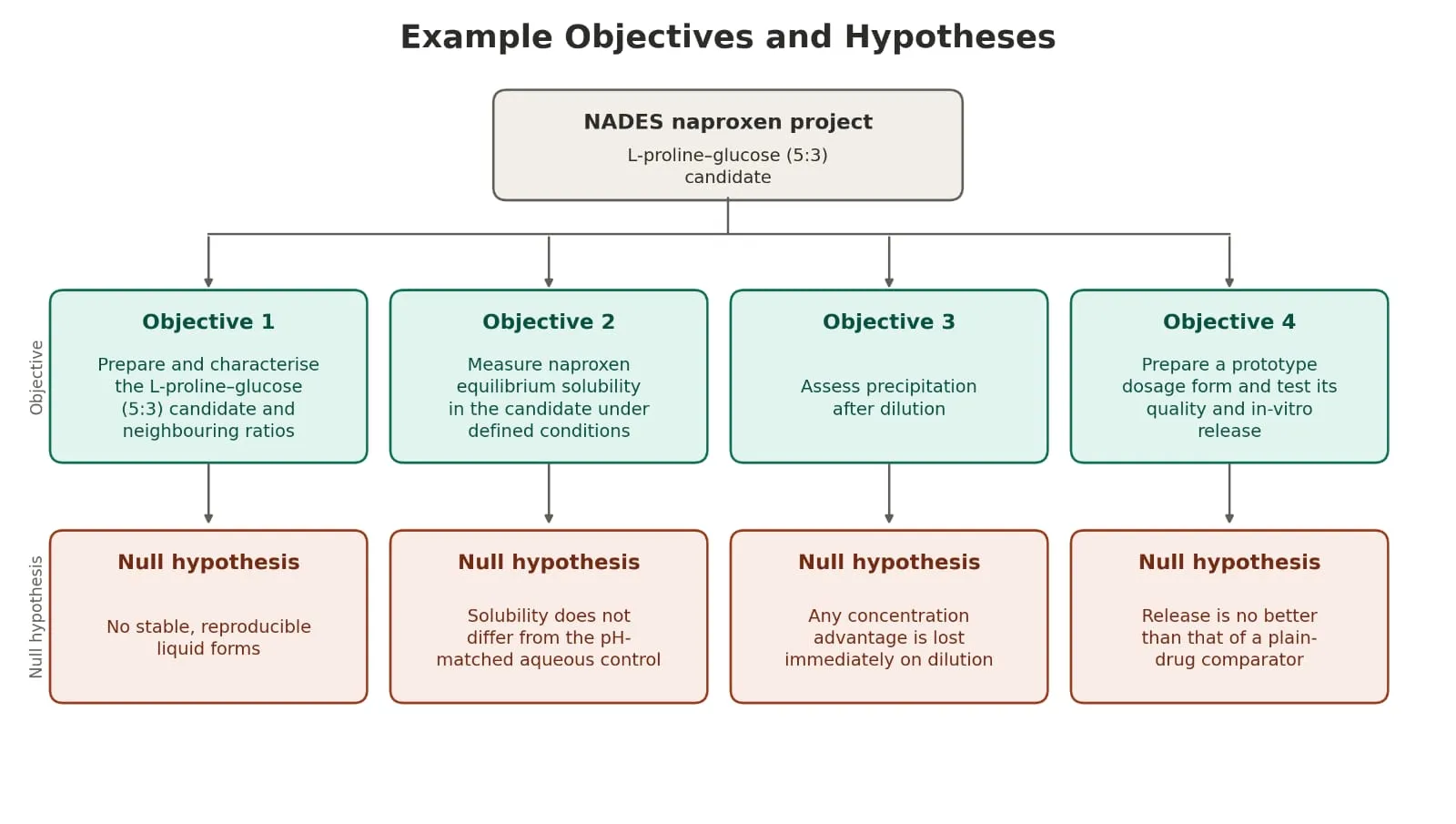
16. Example Objectives and Hypotheses
17. Suggested Development Framework
Stage 1 is literature and material verification. It involves confirming the identity and ratio of the components, finding the primary source for the chosen composition, and checking whether the reported system is actually described as a NADES. Reagent grades, water content and batch identifiers should be recorded. Stage 2 is characterisation, in which spectral, thermal and physicochemical properties are documented and repeat batches are compared. Stage 3 is solubility assessment, using validated analytical methods, controls, replicates and clearly stated conditions. Stage 4 is dilution and precipitation assessment, which shows whether a concentration advantage persists as the solvent fraction changes. Stage 5 is formulation feasibility, in which a tablet or film strategy is selected on the basis of the measured solvent properties and intended dose, and its quality and dissolution are then evaluated.
This staged approach avoids a common weakness in research, which is moving from a clear solvent mixture directly to a dosage-form claim. That jump skips three questions: is the solvent reproducible, does the drug stay dissolved after dilution, and does the final product release the drug properly? Staging also allows go/no-go criteria to be set before time and material are spent on optimising a formulation.
18. Future Directions
Future work could compare more than one candidate composition, measure the effect of controlled water content, test how robust the solubility result is, and determine whether any concentration advantage survives biorelevant dilution. If a solid dosage form is pursued, the programme should establish whether the solvent is retained, whether the drug crystallises, and whether the product remains physically and chemically stable. Scale-up, solvent recovery, packaging compatibility and a safety justification would all be required before any translational claim.
The value of the project lies in producing reliable, composition-specific evidence. A modest but reproducible enhancement, together with a workable dosage form, may be worth more than a large concentration figure measured in a solvent that cannot be made into an oral product.
CONCLUSION
NADES are promising research tools because their composition can be tuned to influence solvation and other physicochemical properties. Published naproxen-specific DES studies give a reason to explore solvent-assisted solubilisation, but they do not establish how an L-proline–glucose mixture at a 5:3 molar ratio will perform. A credible B.Pharm-level study should combine careful solvent characterisation, controlled solubility measurements, dilution and precipitation assessment, compatibility testing and a justified oral formulation strategy. Claims about improved dissolution should rest on project data, and claims about bioavailability or clinical benefit require considerably stronger evidence. The most useful contribution will be a transparent, reproducible evaluation that also reports negative or inconclusive findings if those are what the work produces. Natural Deep Eutectic Solvents (NADES) have emerged as promising pharmaceutical systems due to their tunable composition and ability to modify solvation properties. Although previous studies support the potential of deep eutectic solvents for naproxen solubilisation, the performance of an L-proline–glucose system at a 5:3 molar ratio remains unexplored. Therefore, the present study aims to evaluate its potential for enhancing naproxen solubility through physicochemical characterization, solubility assessment, dilution stability, precipitation studies and drug–solvent compatibility evaluation. The findings will provide a scientific basis for assessing its suitability for potential oral drug delivery applications.
Selected Evidence Highlights
REFERENCES





Hardik Koli, Dr. Priyanka Gaikwad, Deeksha Kodole, Gayatri Patil, Harshada Sutar, Diksha Kognole, Dhananjay Narke, Natural Deep Eutectic Solvent-Based Enhancement of Naproxen Solubility for Oral Drug Delivery, Int. J. of Pharm. Sci., 2026, Vol 4, Issue 11, 2652-2664. https://doi.org/10.5281/zenodo.24301382
 10.5281/zenodo.24301382