

We use cookies to ensure our website works properly and to personalise your experience. Cookies policy
Department of Pharmaceutical Analysis, College of Pharmaceutical Sciences, Government Medical College, Thiruvananthapuram, Kerala, India-695011
Pioglitazone hydrochloride is an oral antidiabetic drug belonging to the thiazolidinedione class and is primarily used in the management of type 2 diabetes mellitus. The development of a simple, rapid, accurate and precise analytical method is essential for the routine quality control of pioglitazone hydrochloride in pharmaceutical dosage forms. The present study aims to develop and validate reliable reverse phase high performance liquid chromatography (RP-HPLC) method for the estimation of pioglitazone hydrochloride in pharmaceutical dosage forms. Chromatographic separation was achieved using a reverse phase C18 column with an optimized mobile phase consisting of Methanol and Acetonitrile (95:5v/v) at a flow rate of 0.6ml/min. The detection wavelength was set at 269nm and the injection volume was 20µl. Under the optimized chromatographic conditions, the selected antidiabetic drug (Pioglitazone hydrochloride) showed a well resolved and symmetrical peak with a retention time of 2.8min. The developed method was validated according to linearity, accuracy, precision, robustness limit of detection, limit of quantification and system suitability. The method demonstrated good linearity over the concentration range of 10-50µg/ml, with a correlation coefficient of 0.9999. The percentage recovery was found out to be within the acceptable range, indicating satisfactory accuracy. The method exhibited good precision, with % RSD values within the prescribed limits. The developed method was also found to be robust against small deliberate variations in chromatographic conditions and was successfully applied to the quantitative estimation of pioglitazone hydrochloride in pharmaceutical dosage forms. The method was found to be simple, rapid, accurate, precise and robust and making it suitable for routine analysis and quality control of pioglitazone hydrochloride formulations
Diabetes mellitus is a chronic metabolic disorder characterized by persistently elevated blood glucose levels resulting from inadequate insulin secretion, impaired insulin action, or a combination of both. Among its various forms, type 2 diabetes mellitus (T2DM) is the most common and represents a major global health challenge due to its rapidly increasing prevalence and the development of serious long-term complications such as retinopathy, nephropathy, neuropathy, and cardiovascular disease(1,2,3). Effective control of blood glucose levels is essential to reduce the risk of these complications and improve the quality of life of affected individuals. Consequently, the availability of accurate and reliable analytical methods for the quality assessment of antidiabetic medications is crucial during pharmaceutical development, manufacturing, and routine quality control(4).
Pioglitazone hydrochloride is a widely prescribed oral antidiabetic drug belonging to the thiazolidinedione class. It exerts its therapeutic effect by acting as a selective agonist of peroxisome proliferator-activated receptor gamma (PPAR-γ), thereby improving insulin sensitivity in peripheral tissues and reducing hepatic glucose production(5). Because of its proven efficacy in achieving glycemic control and its extensive clinical use, pioglitazone hydrochloride has become an important therapeutic option for the management of T2DM, both as a single agent and in fixed-dose combination formulations with other antidiabetic drugs.
The quality, safety, and therapeutic efficacy of pharmaceutical products depend on accurate and reliable analytical techniques for quantitative estimate of active pharmaceutical constituents. The methodical process of developing analytical methods involves optimizing chromatographic settings for effective separation, precise quantification, and repeatable outcomes. The choice of chromatographic column, mobile phase composition, pH, flow rate, detection wavelength, injection volume, and column temperature are important factors affecting technique performance. Adequate resolution, symmetrical peak form, suitable retention time, and excellent analytical sensitivity are all ensured by properly optimizing these parameters(6).
Reverse phase high performance liquid chromatography (RP-HPLC) has become one of the most popular analytical techniques for quantitative determination of pharmaceutical substances due to ease of use, accuracy, precision and reproducibility. RP-HPLC benefits include excellent separation efficiency, very short analytical times, minimal sample preparation and compatibility with a wide range of pharmaceutical substances. These features make RP-HPLC the most popular analytical technique for routine quality control, assay determination, dissolution testing, impurity profiling, and stability investigations in pharmaceutical companies and research labs(7).
Prior to the routine use of an analytical method for pharmaceutical analysis, it must be validated to establish that it routinely produces accurate and repeatable results. Validation of an analytical method is a particular set of procedures to prove that a method is suitable for its intended purpose. According to the International Council for Harmonization (ICH) recommendation Q2(R2), the analytical techniques should be tested for specificity, linearity, range, accuracy, precision, detection limit, quantitation limit, robustness, and system suitability. Validation guarantees that the method developed will yield analytical data for pharmaceutical quality assurance that is regulatory compliant and scientifically acceptable(8).
Pioglitazone hydrochloride has been quantified by various analytical methods including UV-visible spectrophotometry, HPLC, HPTLC, UPLC, capillary electrophoresis and LC-MS/MS either alone or in combination with other antidiabetic drugs. While many of these techniques show good analytical performance, some call for complicated mobile phase compositions, costly solvents, lengthier chromatographic run durations, sophisticated instruments, or time-consuming sample preparation techniques. The development of simple, rapid, accurate, precise, affordable and reliable RP-HPLC methods for routine quality control analysis of pioglitazone hydrochloride in pharmaceutical dosage forms is still needed(9-12).
The present study was therefore undertaken to develop and validate a simple, rapid, accurate, precise, economical, and robust RP-HPLC method for the quantitative estimation of pioglitazone hydrochloride in pharmaceutical dosage forms. The developed method was optimized to achieve efficient chromatographic separation and validated according to the current ICH analytical method validation guidelines. The validated method is expected to provide a reliable, cost-effective, and reproducible analytical procedure suitable for routine quality control, assay determination, stability studies, and pharmaceutical research involving pioglitazone hydrochloride.
Reference standards for Pioglitazone hydrochloride was obtained from Synokem Pharmaceuticals Ltd, Delhi. Pioglitazone formulation (Pioglit 15mg) was purchased from local drug store. HPLC grade Acetonitrile, Methanol and water Merck specialities (Pvt) Ltd. Mumbai.
The method employed for this study utilized the Agilent 1220 Infinity LC (G4288C) which consist of a pump, injector and variable wavelength detector. The analytical column used was the Agilent Eclipse Plus C18 with dimensions of 4.6×100mm and a particle size of 3.5µm. the Shimadzu analytical balance was utilized for weighing both the standards and samples. Merck Millipore membrane filter with pore size of 0.45 µm was used for mobile phase filtration. Additionally, Agilent Technologies PVDF syringe filters with 0.45 µm was used for sample filtration.
Preparation of stock solution: Accurately weighed 10mg of pioglitazone and added to a 10ml standard flask, dissolved in methanol and was made upto volume to obtain a concentration of 1000 µg/ml.
Preparation of working standard solution: Diluted the stock solution with methanol to obtain working standard solutions of concentrations 10-50 µg/ml.
Study of spectral characteristics of Pioglitazone
The UV absorption spectrum for Pioglitazone was recorded using UV-Visible spectrophotometer by scanning 50 µg/ml working standard solution in the range of 200-400nm. 269nm was found to be the λmax.
Method Development
Based on the various physicochemical properties of Pioglitazone hydrochloride such as the solubility, pKa, molecular weight, log P values etc…a number of chromatographic trials were carried out to initiate the method development for the determination of Pioglitazone Hydrochloride.
Various chromatographic parameters like mobile phase composition, column type, column length, pH, flow rate etc… were assessed for obtaining well resolved, sharp, symmetrical peaks with satisfactory system suitability parameters for pioglitazone hydrochloride.
The current developed method was validated as per ICH guidelines. The various parameters validated are as follows:
Linearity: It is the ability of an analytical procedure to achieve test results which are directly proportional to the amount of analyte in the sample. This was carried out by injecting and recording the responses of standard solutions of pioglitazone hydrochloride in the range of 10-50µg/ml. Then calibration curve was constructed by plotting concentration against corresponding peak area values and determined the correlation coefficient and regression line equation.
Accuracy: It’s the degree of agreement between the value found and the value that is recognized as either an approved reference value or a conventional actual value. The accuracy of current method was evaluated by recovery studies. Spiked standard pioglitazone solution to sample solution at three concentration levels (80%, 100%, 120%). Prepared three replicates of each level which were injected into HPLC and recorded the responses. % recovery was determined.
Precision: Describes the degree of agreement (or scatter) between a set of measurements made from several samplings of the same homogenous sample under specific circumstances. It was evaluated by injecting six replicates of Pioglitazone Hydrochloride solution of concentration 10µg/ml on the same day (intra day) and subsequent days (inter day) under the same experimental conditions. Recorded the peak area responses for each six replicates from the chromatogram and % RSD was found.
Limit of detection is the lowest concentration of analyte in a sample that is detectable but may not be precisely quantified whereas the Limit of quantification is the lowest concentration of analyte in a sample that can be accurately and precisely measured quantitatively. Both LOD and LOQ were determined according to the ICH guidelines.
LOD (Detection limit) = 3.3 σ/Slope
LOQ (quantification limit) = 10 σ/Slope , where σ is the standard deviation.
Robustness: It is the measure of capacity of an analytical procedure to remain unaffected by small but deliberate changes in method parameters and provides an indication of its reliability during normal usage. It was assessed by injecting three replicates of 10µg/ml Pioglitazone Hydrochloride standard solution by changing the flow rate at 0.6±0.1 ml/min. Peak area responses were recorded and % RSD was calculated.
System suitability test: Five replicates of Pioglitazone Hydrochloride working standard solutions were prepared and injected into the instrument and evaluated the system suitability parameters by determining the %RSD of Rt, peak areas, theoretical plates and tailing factors. All of these were found to be within the acceptable limit.
Assay of pioglitazone tablet dosage form
20 tablets of Pioglitazone hydrochloride(15mg) were weighed to calculate the average weight per tablet. An amount of powder equivalent to 10mg of Pioglitazone was weighed and transferred to a 10ml volumetric flask and added sufficient amount of mobile phase and sonicated. Then volume was made up to the mark using mobile phase. Filtered the solution through 0.45µm membrane filter and from this solution 0.1ml was pipetted out into a 10ml volumetric flask, diluted using mobile phase to produce a sample solution of concentration 10µg/ml, which was injected into the HPLC and obtained the chromatogram. Assay was determined using the peak area.
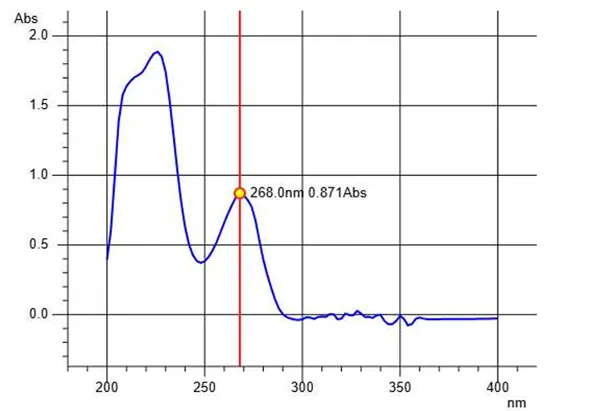
Fig.no.1 UV spectrum for Pioglitazone Hydrochloride
The spectrum was scanned from 200-400nm and the wavelength of maximum absorption (λmax) was found to be 269nm. Fig.no.1 shows the UV spectrum obtained for pioglitazone.
After conducting several chromatographic trials by varying the column parameters, mobile phase composition, flowrate, detection wavelength etc…a simple, rapid and reliable RP-HPLC method was developed for detecting and estimating pioglitazone hydrochloride. The developed method was optimized for producing well resolved, symmetrical peaks for the analyte with satisfactory system suitability parameters and the optimized conditions were selected for subsequent method validation. Fig.2-6 depicts the chromatograms obtained for pioglitazone at different concentrations (10-50µg/ml).
Optimized chromatographic conditions:
Column : Eclipse Plus C18(150mm*4.6mm*3.5µm)
Mobile phase : Methanol : Acetonitrile (95:5)
Flow rate (Isocratic) : 0.6ml/min
Detection wavelength : 268nm
Injection volume : 20µl
Run time : 6min
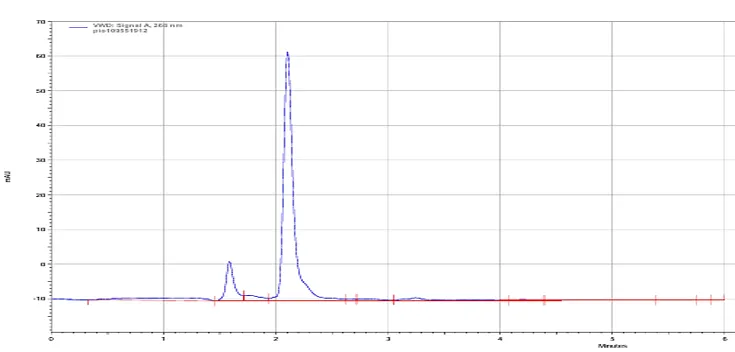
Fig. no.2 Chromatogram for 10µg/ml
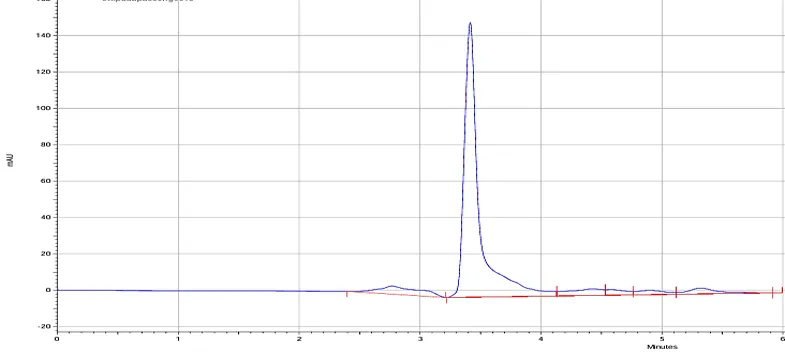
Fig.no.3 Chromatogram for 20µg/ml
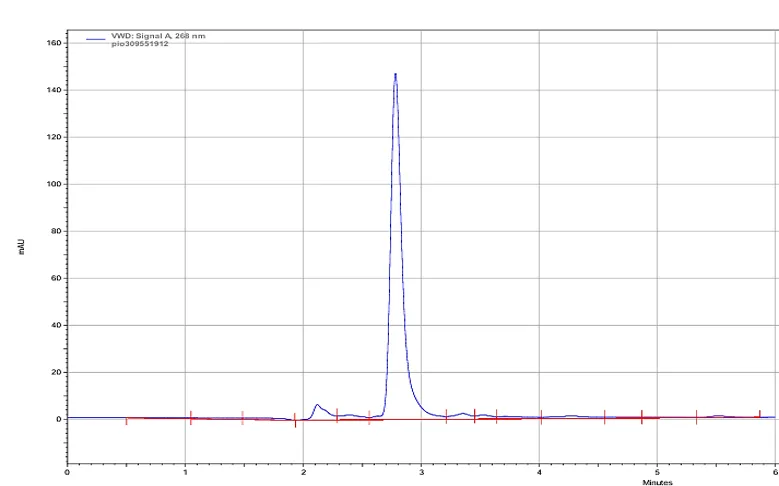
Fig.no.4 Chromatogram for 30µg/ml
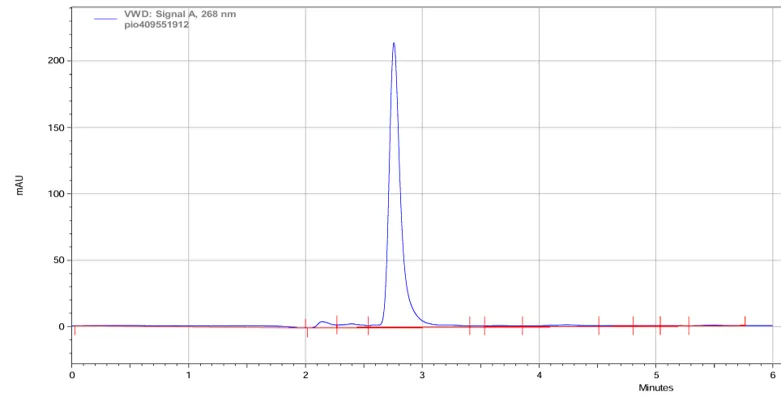
Fig. no.5 Chromatogram for 40 µg/ml
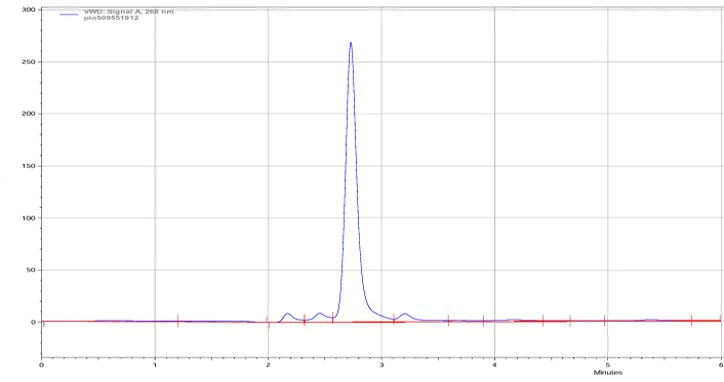
Fig.no.6 Chromatogram for 50µg/ml
The developed method was validated as per ICH guidelines.
The linear response of Pioglitazone hydrochloride was determined using 5 different concentrations of the standard solution(10-50µg/ml). Peak area values of each level is recorded and is shown in the Table no. 1. Linearity was evaluated using the calibration curve, which exhibited an excellent linear relationship over the concentration range of 10-50µg/ml. Determined R2 values and was found to be 0.9999.
Table no.1 Linearity data
|
Concentration (µg/ml) |
Peak area |
|
10 |
1125843 |
|
20 |
2191785 |
|
30 |
3320164 |
|
40 |
4461695 |
|
50 |
5582345 |
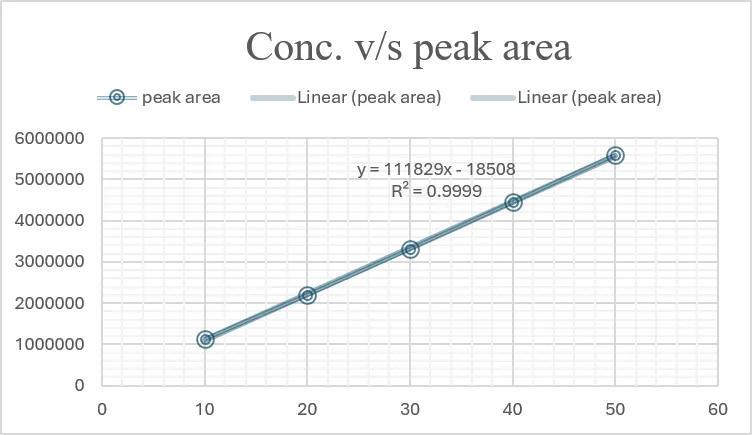
Fig.no.7 Calibration plot of Pioglitazone Hydrochloride (Conc. v/s peak area)
Accuracy was evaluated by standard addition method at 3 concentration level- 80%,100%,120%. Each level was analysed in triplicates and their peak area values were recorded (Table no.2). A fixed concentration of 10 µg/ml of sample as the base and standard pioglitazone hydrochloride was then added at 3 concentration levels (80,100,120%). The results obtained as % recovery is given in Table no.3. From the obtained results, it was found that the accuracy of the developed method was within the specified limit.
Table no.2 Recovery study data of Pioglitazone
|
Percentage recovery(%) |
Peak area |
|
80% |
1982674 |
|
2025614 |
|
|
1926175 |
|
|
100% |
2190114 |
|
2165512 |
|
|
2123688 |
|
|
120% |
2380224 |
|
2392525 |
|
|
2482077 |
Table no.3 Recovery study results of Pioglitazone
|
% Level |
Amount present (µg/ml) |
Amount added (µg/ml) |
Drug recovered (µg/ml) |
% Recovery |
Mean % Recovery |
%RSD |
|
80 |
10 |
8 |
17.89 |
99.42 |
98.13 |
1.17 |
|
17.74 |
98.55 |
|||||
|
17.39 |
96.61 |
|||||
|
100 |
10 |
10 |
19.75 |
98.75 |
98.40 |
0.54 |
|
19.53 |
97.65 |
|||||
|
19.76 |
98.82 |
|||||
|
120 |
10 |
12 |
21.45 |
97.5 |
98.38 |
0.91 |
|
21.56 |
98 |
|||||
|
21.92 |
99.64 |
The precision of the proposed method was assessed through repeatability study. The values obtained for both intra day and inter day are given in Table no.5 and 6 respectively and the %RSD was found to be <2.
Table no.4 Repeatability study data
|
Injections |
Peak area |
|
|
|
Intra day |
Inter day |
|
1 |
1125354 |
1134523 |
|
2 |
1125218 |
1112271 |
|
3 |
1121027 |
1086945 |
|
4 |
1109263 |
1094639 |
|
5 |
1098719 |
1098493 |
|
6 |
1089425 |
1079948 |
Table no.5 Results of Repeatability study (Intra day)
|
Sl no |
Amount present (µg/ml) |
Amount obtained (µg/ml) |
Percentage label claim(%) |
|
1 |
10 |
10.23 |
102.3 |
|
2 |
10 |
10.23 |
102.3 |
|
3 |
10 |
10.18 |
101.8 |
|
4 |
10 |
10.08 |
100.8 |
|
5 |
10 |
9.99 |
99.9 |
|
6 |
10 |
9.91 |
99.1 |
|
Mean |
10.1033 |
||
|
SD |
0.1332 |
||
|
%RSD |
1.32% |
||
Table no.6 Results of Repeatability study (Inter day)
|
Sl no |
Amount present (µg/ml) |
Amount obtained (µg/ml) |
Percentage label claim(%) |
|
1 |
10 |
10.31 |
103.1 |
|
2 |
10 |
10.11 |
101.1 |
|
3 |
10 |
9.89 |
98.9 |
|
4 |
10 |
9.95 |
99.5 |
|
5 |
10 |
9.99 |
99.9 |
|
6 |
10 |
9.82 |
98.2 |
|
Mean |
10.0117 |
||
|
SD |
0.1758 |
||
|
%RSD |
1.76% |
||
The LOD and LOQ were determined using residual standard deviation and slope and the values are given in Table no.7
Table no.7 LOD and LOQ Data by Residual plot method
|
Parameter |
Values |
|
Slope |
111829.14 |
|
Residual SD |
24293.88 |
|
LOD |
0.717µg/ml |
|
LOQ |
2.172µg/ml |
This was evaluated by deliberately introducing small by variations in the selected chromatographic conditions, namely flow rate, mobile phase composition, detection wavelength. The effect of these variations on retention time, peak area, theoretical plate and tailing factor was studied. Small variations in the flow rate produced predictable changes in retention time without adversely affecting the chromatographic performance of the developed method. Thus the developed RP-HPLC method was found to be robust towards small deliberate variations in the optimized chromatographic conditions and is considered reliable for routine estimation of pioglitazone in pharmaceutical dosage forms.
System suitability testing was performed to verify the adequacy and consistency of the chromatographic system prior to analysis. The optimized chromatographic conditions were applied and replicate injections of the pioglitazone standard solution was evaluated. The system suitability results obtained for the developed method were presented in Table no.9. All the evaluated parameters complied with the predefined acceptance criteria, indicating that the chromatographic system was suitable for the intended quantitative analysis of pioglitazone in pharmaceutical dosage form.
Table no.9 System suitability data
|
Mean Ret. Time |
%RSD of Peak area |
Theoretical plate |
Tailing factor |
|
2.62 min |
1.36% |
5004.329 |
1.362 |
Assay
The developed method was applied for the quantitative estimation of pioglitazone in the marketed tablet dosage form. The % assay of pioglitazone was calculated by comparing the peak area obtained for the sample with that of the standard. The assay of tablet was performed using the concentration of 10µg/ml. The peak area and the amount obtained is given in the Table no. 10
Table no.10 Assay results
|
Peak area |
Amount obtained (µg/ml) |
||
|
Standard |
Sample |
Standard |
Sample |
|
1125843 |
1121027 |
10 |
10.20 |
Percentage label claim of Pioglitazone in the marketed formulation (Pioglit 15mg) was found to be 99.57%.
CONCLUSION
A simple, rapid, accurate and precise RP-HPLC method was developed and validated as per ICH guidelines for the quantitative estimation of Pioglitazone Hydrochloride. The developed chromatographic conditions provided satisfactory separation of Pioglitazone Hydrochloride with well defined symmetrical peak and suitable retention time. The proposed method demonstrated acceptable linearity, accuracy, precision, robustness within the validated range, complying with the requirements of ICH guidelines. The developed method also offers the advantages of simplicity, reproducibility and relatively short analysis time, making it suitable for routine quality control analysis. Therefore, the current RP-HPLC method can be effectively applied for the quantitative estimation of Pioglitazone Hydrochloride in bulk drug and pharmaceutical formulations.
REFERENCES

Sandra Chandran, Geetha P Nair, Analytical Method Development and Validation of Pioglitazone hydrochloride by RP-HPLC in Pharmaceutical Dosage Form, Int. J. of Pharm. Sci., 2026, Vol 4, Issue 9, 2937-2948, https://doi.org/10.5281/zenodo.22916089
 10.5281/zenodo.22916089