

We use cookies to ensure our website works properly and to personalise your experience. Cookies policy
Department of Pharmaceutical Chemistry, Jawaharlal Nehru Technological University Hyderabad, Kukatpally , Hyderabad- 500085,Telangana, India.
Numerous nitrogen-containing heterocyclic derivatives have been employed as adaptable scaffolds in medication development. One of the heterocyclic substances with exceptional pharmacological properties is thiazole. Biological functions such as anti-convulsant, anti-alzimer, anti-hypertensive, anti-cancer, anti-HIV, anti-inflammatory, and anthelmintic properties were shown to be processed by thiazole derivatives. The synthesis of this molecule is of tremendous interest because of its powerful and significant biological actions, which make it of enormous medicinal value. The goal is to synthesis and recrystallize 4-substituted phenyl 2-amino thiazole derivatives and describe them using m.p., Rf, FTIR, 1H NMR, and MASS data. Methods: Lipinski's rule of five, PASS, OSIRIS molecular property explorer, Molsoft, and docking tools were used to predict the molecular properties of every synthesized molecule. Every chemical was created using a traditional technique. Using yeast as a model system for anticancer research, the synthesized compounds' antiprolifirative efficacy was assessed. Every chemical exhibits a high % yield. When compared to the usual medication (erlotinib), all of the compounds were more active, compliant with Lipinski's rule, non-toxic, and had good binding affinities. Compared to the common medication erlotinib, molecules 4a, 4c, and 4e were more powerful. In summary, compounds 4a, 4c, and 4e exhibit favorable outcomes in both biological evaluation and molecular property prediction.
In medicinal chemistry, new drug discovery refers to the process of designing medications. Medicinal chemists have obstacles in developing new therapeutic compounds. In the past, most medications were found by identifying the active ingredient in traditional cures or by chance discovery. A novel strategy has been to understand how disease and infection are controlled at the molecular and physiological levels, and then target specific entities based on this understanding.
Thiazoles are structurally related to thiopene and pyridine, but most of their attributes are similar to the latter. Hantzch and Waber originally described thiazole in 1889. Thiazole is a five-membered ring that includes one nitrogen and one sulfur. The numbering in thiazole begins with the sulfur atom. 2-Aminothiazoles and its derivatives have long been employed as precursors in the production of physiologically active compounds. Because of the thiazole moiety's broad range of activity, multiple thiazoles substituted with different groups at various locations have been developed.
In recent years, various innovative methods for the manufacture of 2-aminothiazole derivatives and reactions, including waste-free procedures, have been described. In the presence of various reagents, 2-amino-4-substituted-thiazoles undergo various types of reactions to yield other heterocyclic compounds, such as thiazolo[3, 2-a]pyrimidine-5-ones, thiazolo[3, 2-a]-pyrimidine-7-ones, imidazo[2, l-h]thiazoles, thiazolo[3, 2-a]benzimidazoles, etc. As a result, we were interested in surveying the synthetic utility of 2-amino-4-substituted-thiazoles.
Cellular proliferation is a fundamental biological process that is essential for the growth, development, maintenance, and repair of living organisms. It involves a coordinated sequence of cellular events through which a parent cell grows, duplicates its genetic material, and undergoes cell division to produce daughter cells. Under normal physiological conditions, cellular proliferation is tightly regulated by a complex network of intracellular and extracellular signals. These regulatory mechanisms ensure that cells divide at appropriate rates and only when required. A precise balance between cell proliferation, differentiation, growth arrest, and programmed cell death is therefore essential for maintaining tissue homeostasis.
The regulation of cellular proliferation is particularly important because excessive or uncontrolled cell division can result in pathological conditions, most notably cancer. Cancer is characterized by the progressive accumulation of genetic and epigenetic alterations that allow cells to escape normal growth-control mechanisms. Such cells may acquire the ability to proliferate continuously, resist apoptosis, evade immune surveillance, and invade surrounding tissues. Consequently, inhibition of excessive cellular proliferation represents an important objective in the prevention and treatment of several diseases, especially neoplastic disorders.
EXPERIMENTAL SECTION
Insilico screening
Lipinski’s rule of 5 filtration
The files were inserted in *.pdb, *.mol, *.mol2, *.xyz, *.sdf, or .smile formats. Care was taken to avoid whitespace(s) in the input file name. The window opened and the files were uploaded in the above mentioned formats. pH was adjusted from 0-14 as required. Upon submission, results were obtained [Lipinski 2004].
OSIRIS property explorer (version 2)
OSIRIS property explore version 2 (which requires JAVA platform to run) was used in the present study. The structure of designed molecule when drawn in or when pasted in smiles format will show the results at right side with colour coding. A green colour indicates non-toxic and red indicates toxicity.
Prediction of activity spectra for substances (PASS)
Molecules which have been filtered through Lipinski rule were subjected to online PASS software to predict their biological activities. The Pa and Pi values from 0.000 to 1.000. To define the threshold for selecting type of activity to be predicted.
Molsoft property explorer (version v.3.7-2)
Molsoft property explorer version v.3.7-2 was used in the present study. The structure when drawn directly on the window or when inserted in mol, Inch, smiles formats will calculate properties like MlogP, MlogS [Lalitha and Sivakamasundari 2010].
Docking (version 4.0)
AutoDock is a molecule modeling simulation software. It is especially effective for protein ligand docking. It has two versions Auto Dock 4.0, vina. Vina is a advanced version [Rarey 1996].
Synthesis of 2-bromo-1-(4-hydroxy-2-methylphenyl)-ethan-1-one (2)
A round bottom flask was charged with substituted acetophenone (0.01 mol), glacial acetic acid (20 ml) and aqueous hydrobromic acid (HBr). The flask was immersed in an ice salt mixture (0-5oC) and bromine (0.01 mol) was added from the dropping funnel at such a rate that the temperature of the reaction mixture does not exceed 5oC. After completion of addition, it was stirred at RT for 2-3 hours. The suspension was poured onto crushed ice. The colourless precipitate was filtered, repeatedly washed with water and dried at room temperature [Bhosale 2012].
Synthesis of 4-(4-hydroxy-2-methylphenyl)-1,3-thiazol-2-amine (3)
A mixture of substituted phenyl bromide (0.01 mol) thiourea (0.01 mol) and triethyl amine (0.01 mol) was heated under reflux in 20 ml of acetonitrile for 8-10 hours. The reaction mixture was then cooled, poured onto ice. The precipitate was filtered, dried and recrystallised from ethanol:water mixture (70:30) [Bhosale 2012b].
Synthesis of N-[4-(4-hydroxy-2-methylphenyl)-1,3-thiazol-2-yl] derivatives (4a-e)
A mixture of 3 (0.01 mol) with appropriate chloro compounds (0.01 mol) in glacial acetic acid (30 ml) was heated under reflux with stirring for 5 hours. The mixture was then cooled at room temperature and poured on crushed ice. The precipitate was collected by filtration and recrystallized from ethanol to yield orange to brown crystals [Abdellattif 2018].
Evaluation of Cellular Prolifiration:
Anti proliferative activity
Yeast as a model system for anticancer study
Most yeast proteins, and most of the proteins conserved between yeast and humans are involved in basic cellular processes such as small-molecule metabolism, protein synthesis, cell division, DNA synthesis and repair secretion, etc. Hence, target identification in yeast has proven especially relevant for cancer, which at the simplest level is a disorder of proliferation control caused by accumulated mutations. Many of the common mutations in human cancers (as well as genetic and physical interactions between the mutated genes/proteins) can be modelled in yeast, greatly simplifying and accelerating directed study The high degree of similarity and function in comparison with human has made this organisam as a model system for anticancer drug discovery.
Method of testing
1. Potatoes Dextrose Broth
2.5g broth was weighed and dissolved in 100 ml distilled water, sterilization of broth done by autoclaving at 121 lbs pressure for 15 min.
2. Preparation of inoculums
Yeast was inoculated in conical flask containing 100 ml sterilized broth and incubated at 370 C for 24 h. This referred as seeded broth.
3. Preparation of test inoculums
1 ml seeded broth was taken and diluted it with sterilized distilled water up to 10 ml, it contain 25.4 x 10⁴ cells (average).
4. Preparation of test compounds
A solution of test extracts of concentration 20 mg/ml, 40 mg/ml, 60 mg/ml mg/ml, 80 mg/ml and 100 mg/ml were prepared. Test compounds include all four extracts.
5. Procedure
2.5 ml of sterilized broth were taken in test tubes, to this 0.5 ml of inoculum were added and then 0.1 ml of different concentration of extracts were added. This incubated for 24 h at 370 C. Control for petroleum ether soluble extract and methanol soluble extracts were prepared as above by means of adding 0.1ml petroleum ether and 0.1ml methanol instead of respective extracts.
6. Cell Count
Cell suspension were mixed with 0.1% methylene blue and examined under 40 X objective under microscope.
7. Protocol
1. 50µl of cell suspension was mixed with 50µl methylene blue.
2. About 20 µl cell suspension was placed on haemocytometer slide and cover slip was placed on it.
3. Leaved for 1 to 2 min.
4. Microscope under 40X objective was placed.
5. WBC chamber of hemocytometer was focused, viable cells (cells do not take stained) were counted which appeared transparent. Dead cells get stained. Viable cells in 16 chambers were counted and average taken.
Cells/ml = average number of cells in 1 chamber X 104
4.1 Insilico screening:
4.1.1 Lipinski rule of 5 filtration:
Table no 1: Results of Lipinski’s Filtration:
|
Compound |
Molecular weight |
Hydrogen bond donors |
Hydrogen bond acceptors |
Log p |
Molar refract4ity |
|
4a |
248.06 |
2 |
4 |
2.56 |
50.89 |
|
4b |
264.06 |
2 |
5 |
1.58 |
66.52 |
|
4c |
278.07 |
2 |
5 |
3.14 |
59.07 |
|
4d |
297.09 |
4 |
3 |
3.54 |
57.35 |
|
4e |
310.08 |
2 |
4 |
3.94 |
50.72 |
By the above values, the synthesized thiazole derivatives are obeys the Lipinski rule 0f 5.
4.1.2 Prediction of act4ity spectra for substances (PASS):
Table no 2: Results of PASS prediction:
|
Compound |
Anti Prolifirat4e act4ity |
|
|
|
Pa |
Pi |
|
4a |
0.439 |
0.030 |
|
4b |
0.487 |
0.019 |
|
4c |
0.773 |
0.003 |
|
4d |
0.407 |
0.040 |
|
4e |
0.537 |
0.011 |
|
Standard |
0.821 |
0.002 |
By the above values all the synthesized compounds were obeys the PASS values Pa > 0.3. and the standard drug has the Pa value is 0.821. The targeted synthesized molecules 4c and 4e has the more active when compared to the other target molecules.
4.1.3 Osiris molecular property explorer:
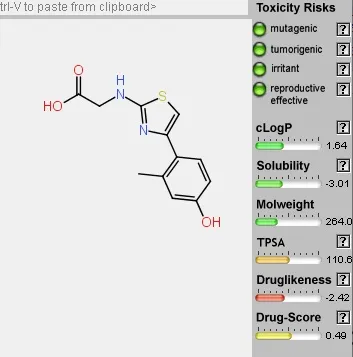
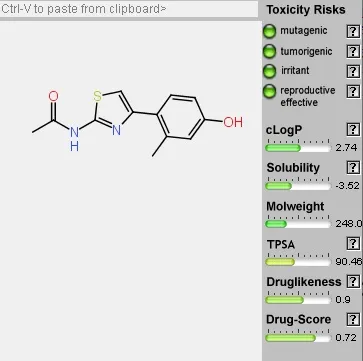
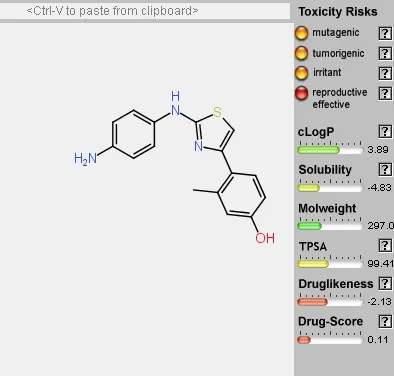
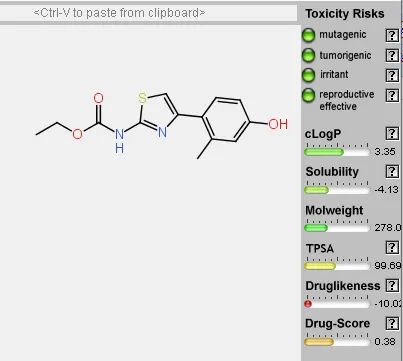
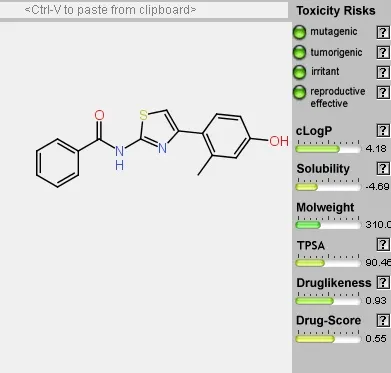
Fig no 1: OSIRIS molecular property explorer of compounds 4a-4e
By the results of OSIRIS Molecular Property explorer the 4a, 4b, 4c and 4e molecules has the no toxicity.
4.1.4 Molsoft property explorer:
Table no 3: Results of Molsoft Molecular property explorer:
|
Compound |
Mol.formula |
Mol.weight |
HBA |
HBD |
Mlogp |
Mlogs |
Mol PSA |
Mol voume |
|
4a |
C12H12N2O2S |
248.06 |
4 |
2 |
2.56 |
-2.98 |
50.89 |
230.31 |
|
4b |
C12H12N2O3S |
264.06 |
5 |
2 |
1.58 |
-2.33 |
66.52 |
227.72 |
|
4c |
C13H14N2O3S |
278.07 |
5 |
2 |
3.14 |
-3.38 |
59.07 |
255.72 |
|
4d |
C16H15N3OS |
297.09 |
3 |
4 |
3.54 |
-3.84 |
57.35 |
259.56 |
|
4e |
C17H14N2O2S |
310.08 |
4 |
2 |
3.94 |
-4.13 |
50.72 |
285.02 |
4.1.5 Docking Analysis:
Name of the protein : 1M17
Docking is used to find the exact binding conformation and orientation of the ligand molecule into the active site of the protein. The synthesized f4e thiazole compounds and standard (Erlotinib) were docked against beta tubulin using Auto-Dock Tool 4.0, an automated docking tool.
The docking process involves four main steps,
(i) Protein preparation
(ii) Ligand preparation
(iii) Grid preparation and
(4) Docking.
The Lamarckian genetic algorithm has been used as the search algorithm to search for the best conformers. The initial population size was set randomly as 150 individuals and ten generations was set for each genetic algorithm run and the maximum number of energy evaluations was set to 2,500,000. The grid box size was set as to include all the active site residues present in rigid macromolecules. The grid box was centered at 8.671 Å x -8.036 Å x 0.67 Å and the dimensions of the grid box have been set as 40, 40, 40 (X,Y,Z co-ordinates) so as to include all the active site residues.
Docking studies showed that all ligands chosen for analysis possessed a least binding affinity with the target protein Epidermal Growth Factor Receptor tyrosine kinase domain with 4-anilinoquinazoline inhibitor erlotinib. The protein ligand interactions were studied in terms of minimum binding energy (Kcal/mol) and the number of hydrogen bonds formed with active site residues. The docking interactions of the five ligands and the protein Epidermal Growth Factor Receptor tyrosine kinase domain with 4-anilinoquinazoline inhibitor erlotinib were visualised using Chimera 1.13.1 viewer and shown in Fig.5. The final docked confirmation obtained for the different ligands based on the binding energy, number of hydrogen bonds formed, bond distance and the interacting residues were shown in Table 2. All the designed compounds show a least binding energy with the docking score when compared with the standard drug Erlotinib docked against Epidermal Growth Factor Receptor tyrosine kinase domain with 4-anilinoquinazoline inhibitor erlotinib.
The length of the hydrogen bonds formed with interacting residues for all the ligands, which shows that the bonding was good. Most of the key residues shown in the Table 2 are the active site residues of the target protein predicted by PDB sum. Based on the docking score all the ligands have docking interactions with the protein Epidermal Growth Factor Receptor tyrosine kinase domain with 4-anilinoquinazoline inhibitor erlotinib. The compounds with Cell inhibition activity was chosen as ligands in this study have different mode of action.
Table no 4: Docking results of all synthesized compounds & standard:
|
Compound |
Key Residues |
Distance (Ao) |
No.of hydrogens |
Docking Score (Kcal/Mol) |
|
4a |
O-Ser |
3.025 |
1 |
-5.93 |
|
4b |
Arg |
3.008 |
1 |
-5.01 |
|
4c |
Arg |
3.081 |
1 |
-5.25 |
|
4d |
Tyr O-Ser O-Gly |
3.749 3.390 2.458 |
3 |
-4.89 |
|
4e |
Tyr |
2.843 |
1 |
-5.28 |
|
Standard (Erlotinib) |
Ala |
2.986 |
1 |
-2.89 |
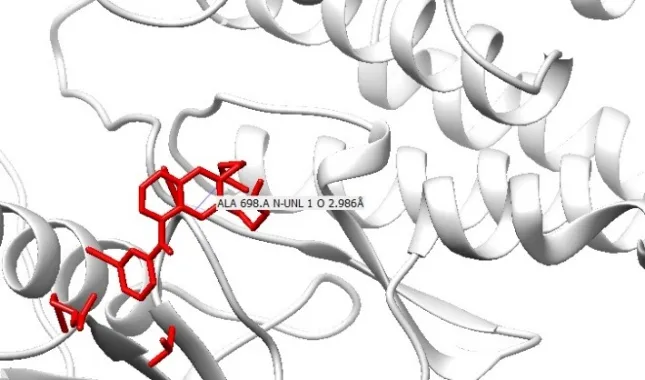
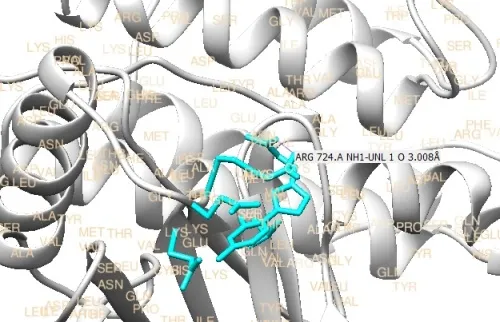
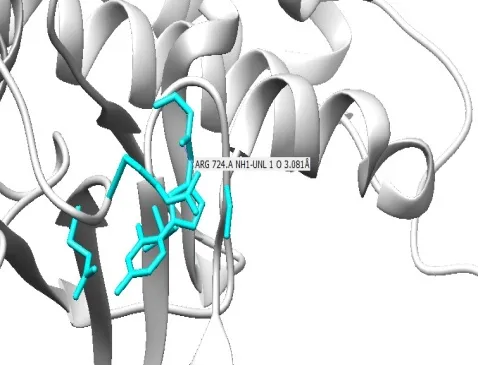
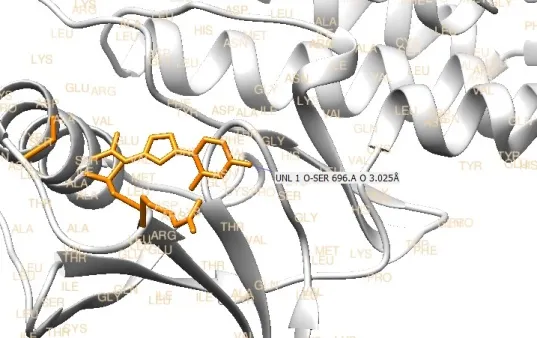
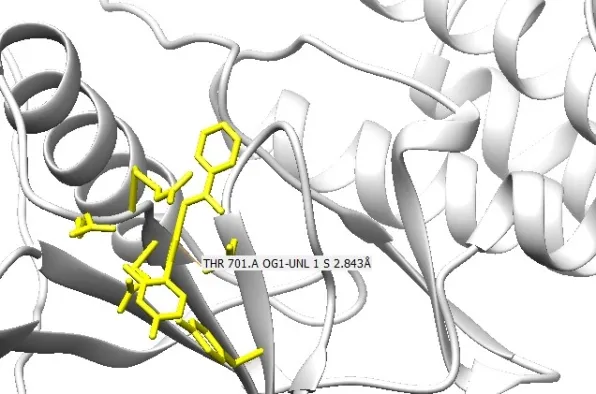
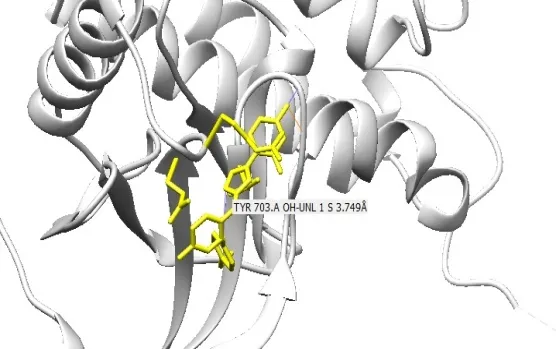
Fig no 2: Docking result of 4a, 4c, 4e and standard
Table No-5: Physical data for synthesized compounds:
|
Compound |
Mol. formula |
Mol. weight |
% yield |
mp (oC) |
Rf |
|
4a |
C12H12N2O2S |
248.06 |
85% |
192-198oC |
0.68 |
|
4b |
C12H12N2O3S |
264.06 |
45% |
252-256oC |
0.55 |
|
4c |
C13H14N2O3S |
278.07 |
85% |
238-242oC |
0.51 |
|
4d |
C16H15N3OS |
297.09 |
45% |
168-174oC |
0.59 |
|
4e |
C17H14N2O2S |
310.08 |
39% |
269-271oC |
0.82 |
All the newer thiazole derivatives were synthesized by different chemical reagents. In that two derivatives are more yields. That are 4a (Acetamide derivative) and 4c (Ethylchloro formate derivative). Remaining three derivatives are less yields. All the synthesized compounds were varied the melting point and TLC profiling when compared with the second step of the synthesized molecule. All the synthesized molecules were recrystallized from the methnol and the one particular compound is purified by using the COLUMN CHROMATOGRAPHY and that purified compound will characterized by using the different spectroscopic techniques like FTIR, 1H NMR & MASS.
4.2 Spectral data for the synthesized compound 4a:
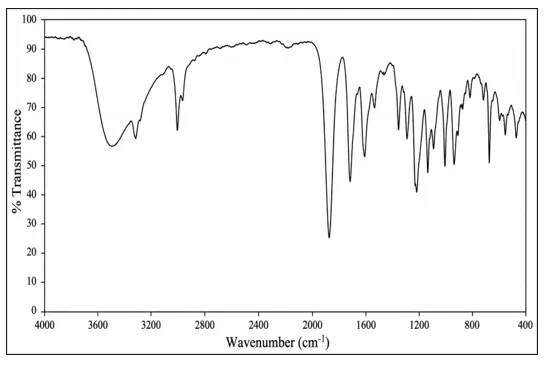
FTIR spectrum: The FTIR spectrum of the synthesized compound showed characteristic absorption bands at 3420 cm⁻¹ corresponding to phenolic O–H stretching and 3340 cm⁻¹ due to amide N–H stretching. A strong absorption at 1665 cm⁻¹ confirmed the presence of the amide carbonyl group. The band observed at 1605 cm⁻¹ was assigned to C=N stretching of the thiazole ring. Peaks at 1260 cm⁻¹ and 1320 cm⁻¹ indicated C–O and C–N stretching vibrations, respectively. The absorption around 740–825 cm⁻¹ supported the presence of aromatic and thiazole ring structures, confirming the proposed molecular framework.
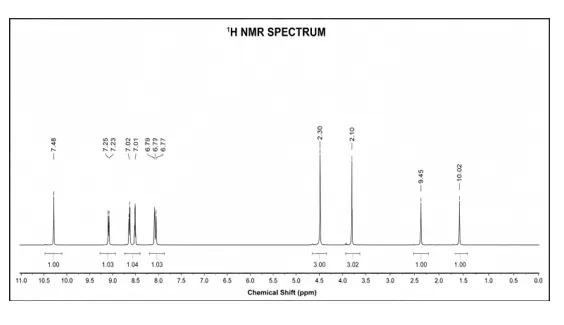
1H NMR spectrum: 2.10 (s, 3H, COCH₃), 2.30 (s, 3H, Ar–CH₃), 6.78 (d, J = 8.2 Hz, 1H, Ar–H), 7.01 (d, J = 8.2 Hz, 1H, Ar–H), 7.24 (dd, J = 8.2, 2.0 Hz, 1H, Ar–H), 7.48 (s, 1H, thiazole-H), 9.45 (br s, 1H, NH), 10.02 (s, 1H, OH).
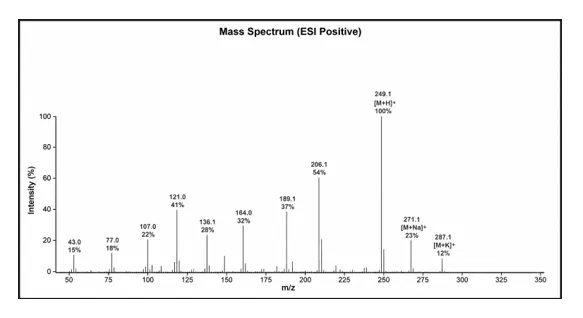
Mass spectrum: 249.1 [M+H]⁺, consistent with the molecular formula C₁₂H₁₂N₂O₂S (MW = 248.30). Major fragment ions were observed at m/z 206, 189, 164, 136, 121, 107, and 43, corresponding to sequential cleavage of the acetamide and thiazole-linked aromatic portions of the molecule.
By these spectral values conform the compound as N-[4-(4-hydroxy-2-methylphenyl)-1,3-thiazol-2-yl]acetamide
4.3 Evaluation of Anti proliferative activity:
In vitro Antiproliferative activity:
Maximum inhibition of growth of root shown by 4a test sample followed by 4c and 4e than other test samples.
TABLE No 6: Allium cepa root length attained after incubation test samples:
|
Sr.No. |
Sample (5 mg/ml) |
Root length (cm) |
|||
|
0 hr |
24 h |
48 h |
72 h |
||
|
1. |
4a |
2.20±0.18 (n=8) |
2.71±0.22 |
2.71±0.22 |
3.97±0.14 |
|
2. |
4b |
1.96±0.12 (n=8) |
2.16±0.2 |
2.31±0.18 |
2.45±0.21 |
|
3. |
4c |
2.05±0.22 (n=7) |
2.40±0.24 |
2.80±0.18 |
3.12±0.17 |
|
4. |
4d |
1.91±0.13 (n=10) |
2.35±0.19 |
2.93±0.11 |
3.61±0.13 |
|
5. |
4e |
1.98±0.30 (n=11) |
2.40±0.21 |
2.82±0.14 |
3.24±0.17 |
|
6. |
Std |
1.78±0.15 (n=6) |
1.85±0.13 |
1.91±0.07 |
1.93±0.05 |
n = Number of roots
TABLE No 7: Cells count in different test samples at increasing concentration
|
Sample |
Concentration in (mg/ml) and number of viable cells per ml |
||||
|
20 |
40 |
60 |
80 |
100 |
|
|
4a |
194000 |
146000 |
113000 |
82000 |
57000 |
|
4b |
242000 |
239000 |
234000 |
231000 |
224000 |
|
4c |
235000 |
203000 |
176000 |
148000 |
123000 |
|
4e |
259000 |
235000 |
219000 |
198000 |
176000 |

TABLE No 8: Percentage growth inhibition of yeast cells
|
Sample |
Concentration in (mg/ml) and % Growth inhibition of viable cells |
IC 50 (mg/ml) |
||||
|
20 |
40 |
60 |
80 |
100 |
||
|
4a |
31.20 |
48.22 |
59.92 |
70.92 |
79.78 |
41.76 |
|
4b |
2.41 |
3.62 |
5.64 |
6.85 |
9.67 |
517.06 |
|
4c |
16.66 |
28.14 |
37.58 |
47.51 |
56.38 |
84.19 |
|
4e |
8.15 |
16.66 |
22.34 |
29.78 |
37.58 |
133.04 |
CONCLUSION:
Acknowledgement:
The authors are grateful to the Guide, Head and staff of Centre for Pharmaceutical Sciences, UCESTH, JNTUH, Kukatpally, Hyderabad, Telangana, India for providing the necessary research facilities.
REFERENCES



Kethavath Kumar*, Dr. M. Ajitha, Guduru Sai Krishna, Design, Synthesis And Characterization Of New Thiazole Derivatives For Inhibition Of Cellular Prolifiration, Int. J. of Pharm. Sci., 2026, Vol 4, Issue 10, 1806-1819. https://doi.org/10.5281/zenodo.23337486
 10.5281/zenodo.23337486