

We use cookies to ensure our website works properly and to personalise your experience. Cookies policy
1Department of Pharmaceutical Sciences, Kumaun University, Bhimtal Campus, Nainital-263136
2Department of Pharmaceutical Sciences, Kumaun University, Bhimtal Campus, Nainital-263136.
Adiantum capillus-veneris, commonly known as maidenhair fern, is recognized in Ayurvedic medicine as a potent Rasayana, attributed with rejuvenating properties. This study aimed to validate its traditional claim of enhancing mental capabilities by investigating the antioxidant and acetylcholinesterase (AChE) inhibitory activities of the plant's aerial parts. The aerial parts were extracted using various solvents. However, 50% hydroalcoholic extract demonstrated the highest total flavonoid content (18.2 ± 2.33 mg/g) and significant antioxidant activities in DPPH, ABTS, FRAP, and TBRAS assays, achieving inhibition rates of 90.16%, 92.71%, 90.10%, and 89.45% at 1.0 mg/ml, respectively. Further, fractionation of the active extract yielded 21 fractions, out of which six fractions showed notable antioxidant and AChE inhibitory potential. The highest antioxidant activity and AChE inhibitory potential were reported with fraction 13. The presence of quercetin was confirmed in the most active fraction 13, suggesting its role in mediating the observed bioactivities. These findings support the potential therapeutic applications of A. capillus-veneris in managing cognitive disorders, particularly Alzheimer's disease, and highlight the need for further exploration of its bioactive constituents using different in vivo models.
Adiantum capillus-veneris, belonging to the Pteridaceae family, commonly known as the maidenhair fern, is an herb that has been traditionally used as a ‘Rasayana’ in Ayurvedic system of medicine [1-3]. Rasayana refers to a class of herbs, minerals, and other natural substances that are believed to have rejuvenating and restorative properties. Rasayana herbs are considered to promote longevity, enhance physical and mental capabilities, and increase resistance to disease. Rasayana plants are believed to be good antioxidants which act by reducing the oxidative stress [4]. Therefore, the present study aimed at validating one of its traditional claims i.e., mental capabilities by performing the activity-guided fractionation of the crude extract(s) of the aerial parts of A. capillus-veneris for the identification of photochemical with potent in vitro antioxidant and AChE inhibitory properties. By isolating the active constituents, we can gain insights into the mechanisms underlying the medicinal properties of A. capillus-veneris and explore its potential for therapeutic applications in Alzheimer’s disease [5].
MATERIALS AND METHODS
Plant Material
The aerial parts of the A. capillus-veneris were collected from Kempty fall, Mussoorie, Dehradun, Uttarakhand and authenticated by botanical survey of India, Dehradun with herbarium sheet no. 115873. Other chemicals like Hydroalcoholic, ethanol, ethyl acetate, 2,2-Diphenyl-1-picrylhydrazyl (DPPH), Ascorbic acid, potassium-persulfate, ferric tripyridyltriazine, sodium duodecyl sulphate, 5, 5-dithiobis (2-nitrobenzioc) acid, Orthophosphoric acid, procured from authenticated vender and all of them were analytical grade.
Preparation of Extract (s)
The extracts were prepared using Soxhlet apparatus with petroleum ether, hexane and 50% hydroalcohol at 30 °C. The 25 g of powder of aerial parts of A. capillus-veneris was packed in the Soxhlet apparatus and extraction was performed until 12 cycles [6]. The extracts so obtained were reduced to semi-solid consistency under reduced pressure and stored in the refrigerator until further use [7]. For the evaluation of in vitro antioxidant and Ach inhibitory potential, extracts were dissolved as described in their given assays. Based on the results obtained, the most active extract was further fractionated using column chromatography technique [8]. The elution was carried out in the following gradient order: Ethyl acetate: alcohol (10:0), Ethyl acetate: alcohol (8:2), Ethyl acetate: alcohol (6:4), Ethyl acetate: alcohol (4:6), Ethyl acetate: alcohol (2:8), Alcohol: hydroalcoholic (10:0), Alcohol: hydroalcoholic (8:2), Alcohol: hydroalcoholic (6:4), Alcohol: hydroalcoholic (4:6), Alcohol: hydroalcoholic (2:8) and 21 fractions were collected (fractions: F1–F21) (Figure 1). The fractions were then concentrated and evaluated for in-vitro antioxidant and AChE inhibitory activity. The dry extracts re-dissolved in distilled water and used for biological assays. Distilled water was used in the control group [9,10]. The percentage yield was calculated as follows:
Percentage yield=Weight of Extract(mg)Weight of Sample (mg)
Preliminary Phytochemical Screening
The preliminary phytochemical screening of the crude extracts was carried out for detecting the presence of alkaloids, flavanoids, tannins, saponins, glycosides, terpenoids, phenols and steroids as per standard methods described by Trease & Evans 1989 [11].
Total Flavonoid Content (TFC)
TFC of the extracts was calculated as per the method of Phuyal et al., (2020) with slight modification [12-14].
Antioxidant and Radical Scavenging Activity
Diphenyl-1-picrylhydrazyl (DPPH) Assay
The evaluation of the scavenging activity of the 50% hydroalcoholic extract and its fractions was carried out using the 2,2-diphenyl-1-picrylhydrazyl (DPPH) assay with slight modifications [15]. The absorbance was measured at 517 nm and % inhibition was calculated using the following equation:
Inhibition of DPPH radical %=(AC-AS)ACx100……(Eq.2)
AC is the absorbance of control (without test sample) and AS is the absorbance of the test samples at different concentrations 16].
Azino-bis-3-ethylbenzothiazoline-6-sulphonic acid (ABTS) Assay
The ABTS test was performed using 50% hydroalcholic extract and its fractions with minor modifications in Miller et al., (1993) approach. The decrease in absorbance at 734 nm was calculated using the following equation:
Inhibition of ABTS radical (%) =(AC-AS)ACx100……(Eq.3)
AC is the absorbance of control (without test sample) and AS is the absorbance of the test samples at different concentrations [17,18].
Ferric-Reducing Ability of Plasma (FRAP) Assay
The total antioxidant potential of 50% hydroalcoholic extract and its fractions was calculated using ferric-reducing ability of plasma (FRAP) assay at low pH. The total antioxidant potential was calculated using a modified method of Benzie and Strain (1996) [19,20].
Thiobarbituric acid reactive substances (TBRAS) Assay
The slightly modified TBRAS assay is used for calculating the extent of lipid peroxidation in egg yolk homogenate [21]. The absorbance of the organic upper layer was measured at 532 nm and converted to a percentage using the formula:
Inhibition of Lipid Peroxidation (%) =(AC-AS)ACx100……(Eq.4)
where AC is the absorbance of control (without test sample) and AS is the absorbance of the test samples at different concentrations [22].
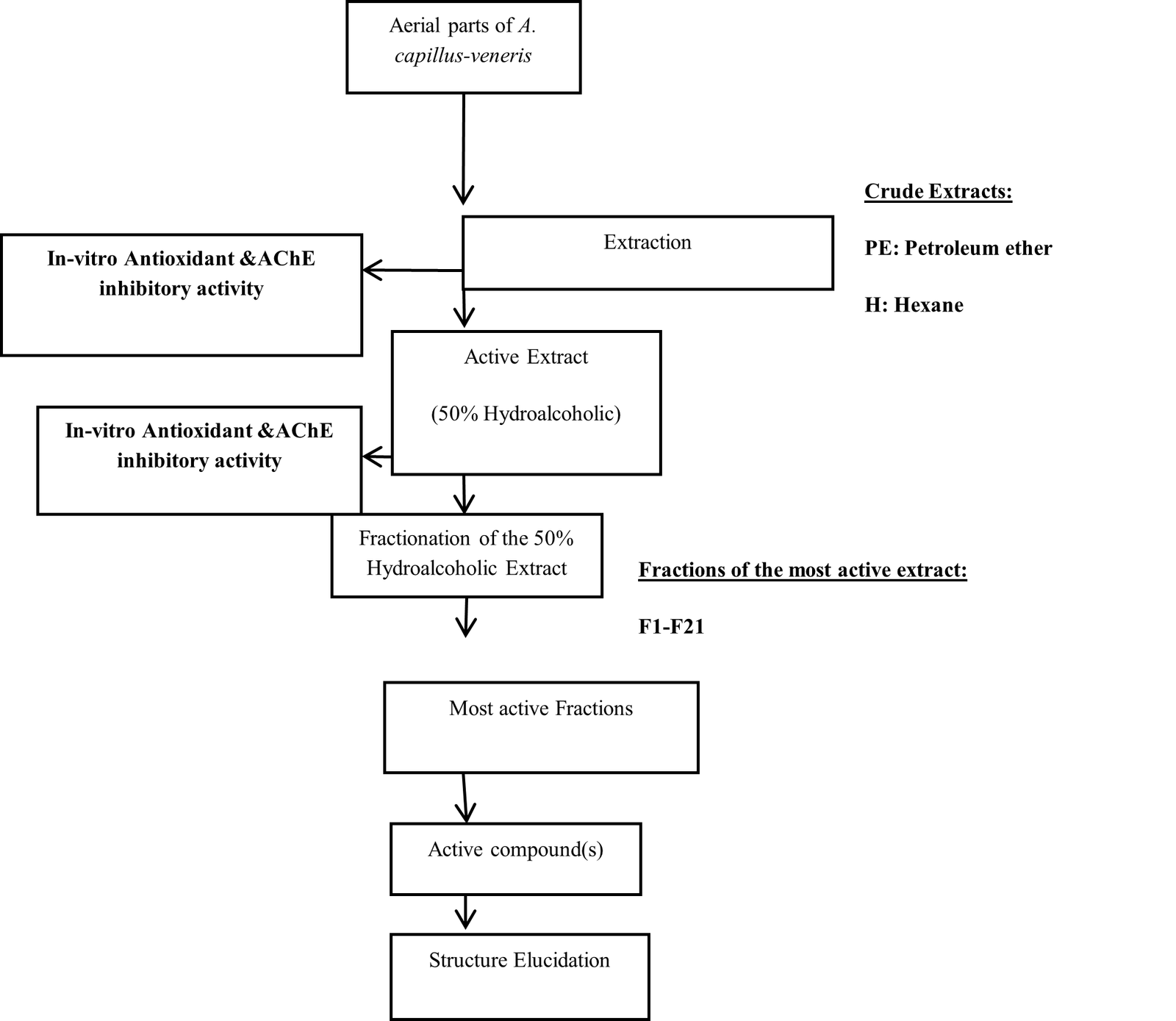
Figure 1: Experimental Design.
Acetylcholinesterase (AChE) Inhibitory Assay
The effect of 50% hydroalcoholic extract and its fractions on AChE enzyme was tested using modified method of Ellman et al. (1961). Galantamine was used as the standard. Percent acetylcholinesterase inhibition was calculated [23,24]:
Percentage inhibition (%) =(E-S)Ex100……(Eq.5)
Where, E is the activity of enzyme without test sample and S is the activityof enzyme with test sample. The experiments were done in triplicate [25].
HPLC Profiling and Quantification of Flavonoids in the Active Fraction(s)
The most active fractions (F7, F8, F9, F11, F12 & F13) and the reference compound (1 mg/mL) solutions were prepared in 50% hydroalcohol and filtered through 0.45 mm PTFE filter; 20 mL was injected into the High-Performance Liquid Chromatography (HPLC) system. The analysis was performed on a Prominence UFLC system (Shimadzu, Japan) containing LC-20AD system controller, Phenomenex Gemini C18 column (250 3 4.6 mm, 5 mm), a column oven (CTO-20A), a Rheodyne injector (USA) with a loop of 20 mL volume and a diode array detector (SPD-M20A).
The HPLC analysis was performed by the method of Rodriguez-Delgado et al. (2001) with some modifications. The mobile phase used was solvent A: Orthophosphoric acid in water and solvent B: hydroalcoholic with the gradient program 0-25 min 60?nd 36% B. The flow rate was 2 mL/min, the injection volume was 10 µL and column was at 25°C temperature. The fractions were monitored at 370 nm. Sample peaks were identified by comparing with retention times of standard peaks. LC Lab Solutions software was used for data acquisition and analysis. The sample was spiked with individual standards for confirmation.
Statistical Analysis
The experimental results were expressed as the mean ±SEM of triplicate measurements. The data were subjected to one-way analysis of variance and the significance of differences between means was calculated by Graph Prism pad version is 10.3.0 and the significance accepted at P?0.05.
RESULTS AND DISCUSSION
The extracts obtained after successive extraction of aerial parts of A. capillus-veneris (28–30 °C) with different solvents were tested for in vitro antioxidantpotential using DPPH, ABTS, FRAP and TBRAS assays; and anti-Alzheimer’s potential in terms of AChE inhibition assay. Crude extract with better activity was further fractionated using different solvents. These fractions were then assessed for their antioxidant and anti-AChE efficacy as described for the crude extracts. From these fractions, the fraction(s) with maximum antioxidant and anti-AChE potential were further subjected to the identification and isolation of the bioactive constituent(s) responsible for antioxidant and anti-AChE activity. The percentage yield of petroleum ether, hexane and 50% hydroalcoholic extracts were reported to be 3.46, 4.58 and 11.23%, respectively. The preliminary phytochemical screening of 50% hydroalcoholic extract reported the presence flavonoids in higher amount along with other phytoconstituents as compared to other extracts. However, the other two extracts were devoid of flavonoids.
Total Flavonoid Content
In the present study, the total flavonoid content was found to be 18.2±2.33 mg/gm in 50 % hydroalcoholic extract which was reported to be the highest among all the extracts, indicating the presence of significant quantity of flavonoids in the plant. The 50% hydroalcoholic extract was further tested for identification of types of flavonoids. The ferric chloride test reported the presence of high intensity of colour reporting the presence of quercetin. Flavonoids possess a unique structure that allows them to scavenge free radicals effectively. Their antioxidant properties are attributed to their ability to donate electrons, chelate metal ions, and modulate cellular signaling pathways, which collectively help in reducing oxidative stress [26,27].
Antioxidant activity of Crude Extracts and Fractions
Out of the three extracts tested, 50% hydroalcoholic extract reported the highest dose-dependent antioxidant activity in DPPH, ABTS, FRAP and TBRAS tests with 90.6, 92.71, 90.1, and 89.45% inhibition, respectively at 1.0 mg/ml. Similarly, out of the 21 fractions, six fractions viz.,Fraction7, 8, 9, 11,12 and 13 were reported to be active when screened using all the above four tests as shown in Table 1. Among these six active fractions, fraction only Fraction 13 reported the highest antioxidant potential activity as 92.86, 91.11, 90.32, and 90.0% respectively at 1 mg/ml. The fraction 13 was further processed for the identification of active constituent responsible for the antioxidant potential that made the significant difference from other fractions. Quercetin was reported to be present in fraction 13. It also showed dose-dependent antioxidant activity with maximum inhibition of 93.2, 89.36, 94.6 and 96.8% at 1 mg/ml in respective antioxidant assays. The antioxidant activity of 50% hydroalcoholic extract, all the active fractions and quercetin was comparable to standard ascorbic acid. There are multiple etiologies for the development ofAlzheimer’s but oxidative stress also plays the key role in the pathogenesis of AD. It is an early and prominent feature in AD pathogenesis, preceding the hallmark lesions of A? plaques and neurofibrillary tangles. Targeting oxidative stress and enhancing antioxidant defenses may offer promising therapeutic strategies for Alzheimer's disease [28-31].
Acetylcholinesterase Inhibitory activity of Crude Extracts and Fractions
Out of the three extracts tested, 50% hydroalcoholic extract reported the highest dose-dependent AChE inhibitory activity with 54.7 % inhibition at 1.0 mg/ml as shown in Table 1. Petroleum ether and hexane extracts were devoid of activity. Similarly, out of the 21 fractions of active extract, six fractions viz., Fractions 7, 8, 9, 11, 12 and 13 were reported to be active dose-dependently when screened as above with maximum inhibitory potential of 57.33±0.28, 62.09, 65.47, 49.51, 68.09 and 94.20% at the highest tested concentration of 1mg/ml, respectively. Among these six active fractions, fraction 13 reported the highest AChE inhibitory potential. Fraction 13 was further processed for the identification of active constituent responsible for the AChE inhibitory potential. Quercetin was reported to be present in fraction 13 and showed dose-dependent AChE inhibitory potential with maximum inhibition of 82.08±0.57 % at 1 mg/ml. The AChE inhibitory potential of 50% hydroalcoholic extract, all the active fractions and quercetin was comparable to standard galantamine. AChE also plays a crucial role in the development of Alzheimer's disease due to its dual role in cholinergic neurotransmission and its interaction with amyloid-beta. Although AChE inhibitors provide symptomatic relief, their impact on disease progression and pathology but some studies suggest that while AChE inhibitors can improve cognitive function temporarily, they may not address the underlying disease mechanisms and could even worsen the pathological state by increasing the neurotoxicity associated with AChE-A? complexes [32-34]. This necessitates further investigation to optimize therapeutic strategies for Alzheimer's disease.
Table 1: In Vitro Antioxidant and Anti-AChE activity of A. capillus-veneris.
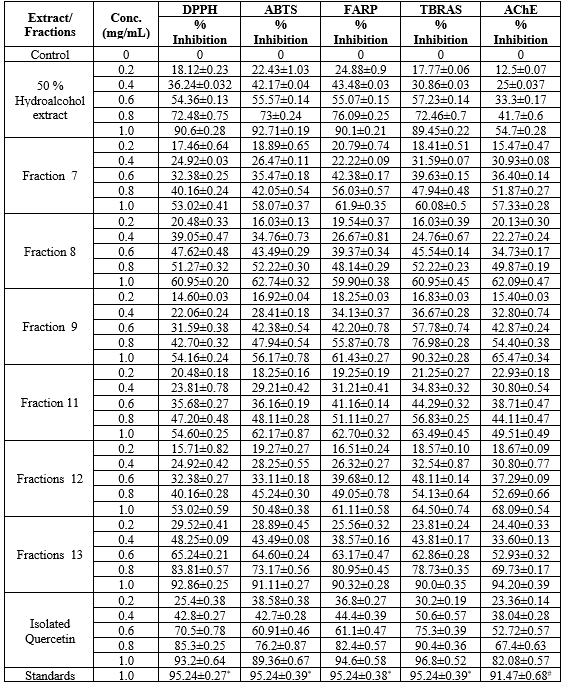
*Ascorbic acid and #Galantamine.
HPLC Profiling and Quantification of Flavonoids in the Active Fraction(s)
HPLC analysis was used in order to establish the presence of flavonoid compounds in the most active fraction, F13. Prior to HPLC analysis, active fraction 13 was subjected to identification tests to identify the type of flavonoid. The fraction 13 developed the high intensity colour in ferric chloride test indicating the presence of quercetin. When, the chromatogram of fraction 13
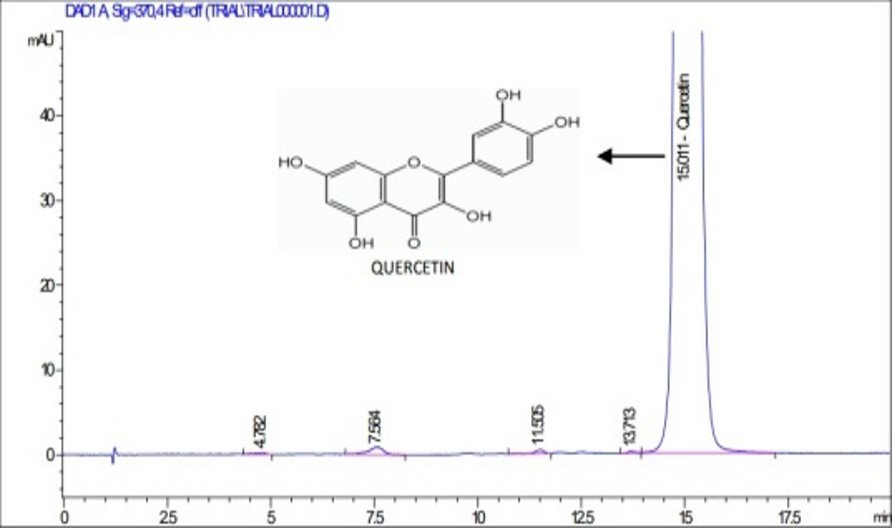
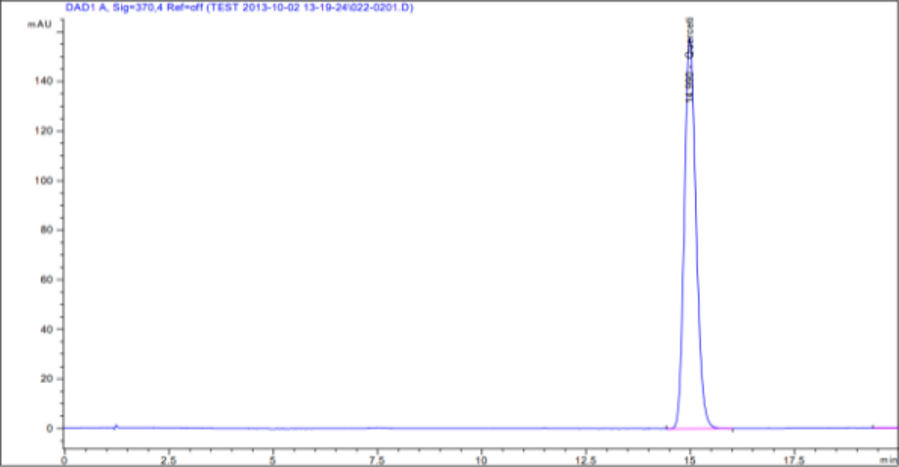
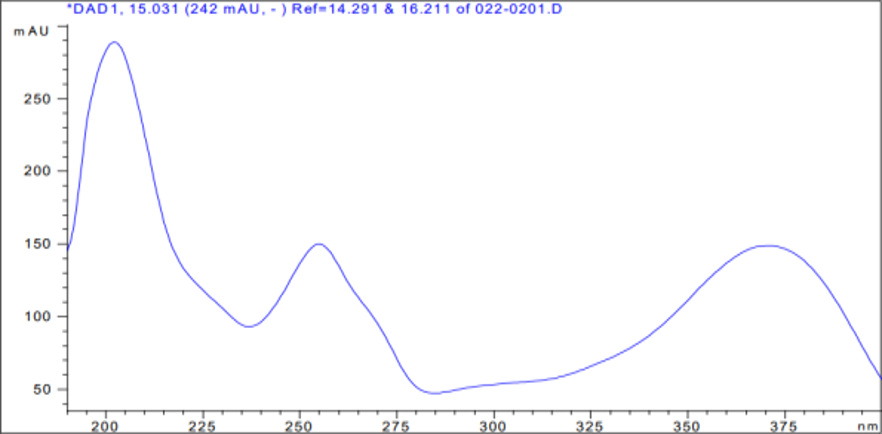
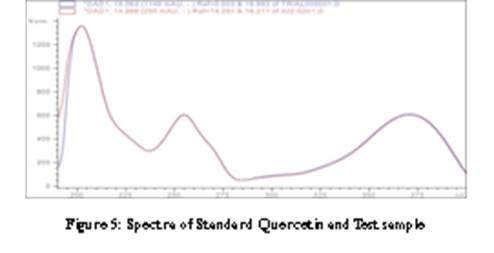
was compared with standard flavonoids, it seems to be equal to quercetin. Further, the fraction was accurately identified through HPLC analysis. Keeping In view, the purity of peak was examined, by the area normalization approach and it was found to be 99.7%. DAD detector was employed for this process as it is used to compare and validate the sample and standard spectra. The results are indicated by Figures 2 and 3, which display the HPLC chromatograms of the fraction(s) sample and the reference quercetin, respectively. Additionally, the test sample, the standard quercetin, and the combined standard and test sample spectra are also displayed in Figures 4 and 5. After analysis by HPLC the fraction 13 as again tested for its different organoleptic properties. The organoleptic properties of fraction 13 were as: odour less and distinct yellow coloration. The precise melting point of pure fraction was reported to be within the range of 316.7 °C ± 0.756 °C, indicating its high purity which is close to the M.P. of its corresponding standard i.e., 316-318°C. The solubility studies of the fractions also indicated its solubility parameter very close to quercetin, in ethanol (54.7777±0.233 mg/ml) and methanol (51.2222±2.16 mg/ml) slightly soluble (0.10617±0.99 mg/ml) in water, and practically insoluble (0.06035±0.0018) in phosphate buffer at pH 6.8. Further, the fraction was analysed by IR absorption peaks and observed its various important peaks viz. C-O stretch in the aryl ether ring at 1263.04, C=C stretch at 1610.97, In-plane and outplane bending at 1318.63, O-H stretch 3277.17, C=O stretch at 1666.54, in-plane and out plane bending at 820.06 and O-H bending of phenol function at 1381.63 .The observed peaks were indicated the strong presence of quercetin. Therefore, the authenticity and purity of quercetin was confirmed through the identification of its major peaks, as depicted in Figure 6.
Figure 6: FTIR Spectrum of Quercetin
CONCLUSION
It can be concluded that A. capillus-veneris may prove to be as dual-edge sword by acting on oxidative stress and cholinergic cascades. The dual action may prove beneficial in regard of neurodegenerative diseases, where oxidative stress and cholinergic deficits are prevalent. Although the findings of the study are promising, it is essential to acknowledge the limitations. The research was conducted in vitro, so further reserch are needed to evaluate the efficacy and safety of A. capillus-veneris in vivo. Additionally, the complex interactions between various phytochemicals in the plant need to be explored to fully understand their synergistic effects and potential therapeutic applications. It can be concluded that the study validates the traditional use of Adiantum capillus-veneris in Ayurveda as a Rasayana plant with potential cognitive-enhancing properties. The significant antioxidant and AChE inhibitory activities observed suggest that this plant could be a valuable candidate for the development of natural therapies aimed at preventing or managing neurodegenerative diseases. Future research should focus on in vivo studies and the elucidation of the mechanisms underlying the bioactivities of this plant to harness its full therapeutic potential.
CONFLICTS OF INTEREST
There are no conflicts of interest.
ORCID
Ruchi Solanki: 0009-0001-9463-7226
REFERENCES


Ruchi Solanki , Vijay Juyal , Antioxidant And Acetylcholinesterase Inhibitory Potential Of Adiantum Capillus-Veneris Linn.: Validation Of Its Rasayana Potential, Int. J. of Pharm. Sci., 2024, Vol 2, Issue 9, 595-605. https://doi.org/10.5281/zenodo.13749969
 10.5281/zenodo.13749969