

We use cookies to ensure our website works properly and to personalise your experience. Cookies policy
Department of Pharmaceutics, Nimra College of Pharmacy, Jupudi, Ibrahimpatnam, Vijayawada, Andhra Pradesh, India
Buccal drug delivery provides a non-invasive route for systemic drug administration and can reduce exposure to gastrointestinal degradation and hepatic first-pass metabolism. The present study focused on the development and characterization of mucoadhesive buccal films containing abacavir sulphate using a solvent-casting technique. Hydroxypropyl methylcellulose (HPMC E15) was used as a film-forming polymer, while hydroxypropyl cellulose (HPC) and sodium carboxymethylcellulose were investigated as mucoadhesive/release-modifying polymers. Propylene glycol was used as a plasticizer and permeation enhancer, and an ethyl-cellulose backing membrane was incorporated to support unidirectional drug release. Ten formulations (F1–F10) were prepared and evaluated for physical appearance, weight variation, thickness, folding endurance, mucoadhesive strength, surface pH, drug content, moisture absorption, moisture loss, tensile strength, swelling index, in-vitro residence time and in-vitro drug release. The films showed weights of 92.26±0.65 to 96.63±0.27 mg and thicknesses of 0.115±0.01 to 0.185±0.02 mm. Surface pH values were 6.82±0.01 to 6.88±0.03, while drug content ranged from 92.62±0.62% to 99.65±0.74%. Mucoadhesive strength ranged from 5.46±0.17 to 8.49±0.02 dyn/cm², and in-vitro residence time ranged from 1.52±0.06 to 9.57±0.04 h. Drug release increased progressively over 8 h. Formulation F10 showed 99.85% cumulative release at 8 h, whereas F1 showed 45.56%. FTIR and DSC findings reported in the thesis indicated no significant drug–excipient incompatibility. The release data were additionally evaluated using zero-order, first-order, Higuchi and Korsmeyer–Peppas models.
Buccal drug delivery is an attractive transmucosal approach for systemic and local delivery of therapeutic agents. The buccal mucosa is relatively accessible and immobile and can retain mucoadhesive dosage forms for extended periods. Compared with conventional oral administration, buccal delivery can provide a pathway into systemic circulation while reducing exposure to the gastrointestinal environment and hepatic first-pass metabolism. These characteristics make buccal films useful for drug delivery systems requiring controlled or sustained release.
Buccal films are thin, flexible polymeric dosage forms that can provide improved patient comfort and residence compared with conventional solid dosage forms. Mucoadhesive polymers hydrate at the mucosal surface and interact with mucus through mechanisms including hydrogen bonding and polymer-chain interpenetration. The present work investigated abacavir sulphate as a model drug for a mucoadhesive buccal film intended to provide sustained drug release.
MATERIALS AND METHODS
Abacavir sulphate was obtained from Aurobindo Pharma Ltd., India. HPMC E15, ethyl cellulose, hydroxypropyl cellulose and sodium CMC were used as formulation polymers. Ethanol, propylene glycol, hydrochloric acid, sodium dihydrogen orthophosphate and sodium hydroxide.
Preformulation and compatibility studies
Drug–excipient compatibility was investigated by physical observation, FTIR spectroscopy and differential scanning calorimetry (DSC). FTIR evaluation over 4000–500 cm⁻¹ and DSC analysis using samples heated from 20–300°C at 10°C/min under nitrogen. UV spectrophotometric analysis established an absorption maximum of 285 nm for abacavir sulphate in pH 6.8 phosphate buffer.
Preparation of buccal films
The films were prepared by solvent casting. Different formulations were developed using HPC and sodium CMC as mucoadhesive/release-retarding polymers and HPMC E15 as a film-forming and release-retarding polymer. Propylene glycol was used as plasticizer/permeation enhancer. The backing membrane was prepared using 5% ethyl cellulose in acetone:isopropyl alcohol (65:35), with dibutyl phthalate as plasticizer. The polymeric drug-containing solution was cast, dried under controlled conditions and laminated with the backing membrane. The composition of U5Ivarious U5IAbacavir U5Isulphate U5Imucoadhesive U5Ibuccal U5Ifilms given in table no 1.
Table No: 1 Composition U5Iof U5Ivarious U5IAbacavir U5Isulphate U5Imucoadhesive U5Ibuccal U5Ifilm U5Iformulations U5Iwith U5IHPMC E15
|
Formulation Code |
Abacavir U5Isulphate U5I(mg) |
Abacavir U5Isulphate (mM) |
HPMC U5IE15 (mg) |
Sodium CMC (mg) |
HPC (mg) |
Ethanol (ml) |
Distilled water (ml) |
PG (ml) |
|
F1 |
300 |
0.447 |
200 |
50 |
-- |
6 |
3.5 |
0.5 |
|
F2 |
300 |
0.447 |
200 |
100 |
-- |
6 |
3.5 |
0.5 |
|
F3 |
300 |
0.447 |
200 |
150 |
-- |
6 |
3.5 |
0.5 |
|
F4 |
300 |
0.447 |
200 |
200 |
-- |
6 |
3.5 |
0.5 |
|
F5 |
300 |
0.447 |
200 |
250 |
-- |
6 |
3.5 |
0.5 |
|
F6 |
300 |
0.447 |
200 |
-- |
50 |
6 |
3.5 |
0.5 |
|
F7 |
300 |
0.447 |
200 |
-- |
100 |
6 |
3.5 |
0.5 |
|
F8 |
300 |
0.447 |
200 |
-- |
150 |
6 |
3.5 |
0.5 |
|
F9 |
300 |
0.447 |
200 |
-- |
200 |
6 |
3.5 |
0.5 |
|
F10 |
300 |
0.447 |
200 |
-- |
250 |
6 |
3.5 |
0.5 |
Evaluation of films
The prepared films were evaluated for weight variation, thickness, folding endurance, mucoadhesive strength, surface pH, drug content, moisture absorption, moisture loss, tensile strength, swelling index and in-vitro residence time. In-vitro drug release was studied over 8 h at predetermined intervals. Release data were fitted to zero-order, first-order, Higuchi and Korsmeyer–Peppas models.
RESULTS AND DISCUSSION
Drug–excipient compatibility
Physical observation showed the drug–excipient mixtures to be cream-yellow, smooth, homogeneous and free from visible lumps. FTIR spectra of pure abacavir sulphate showed characteristic bands, while the optimized formulation retained the characteristic drug bands with only minor shifts. The thesis interprets these findings as evidence of no significant drug–polymer chemical interaction. DSC of pure abacavir sulphate showed a sharp endothermic peak at 227.04°C. The optimized film showed broadening and reduced intensity of the drug peak without new significant thermal events, supporting compatibility of the drug with the formulation components.
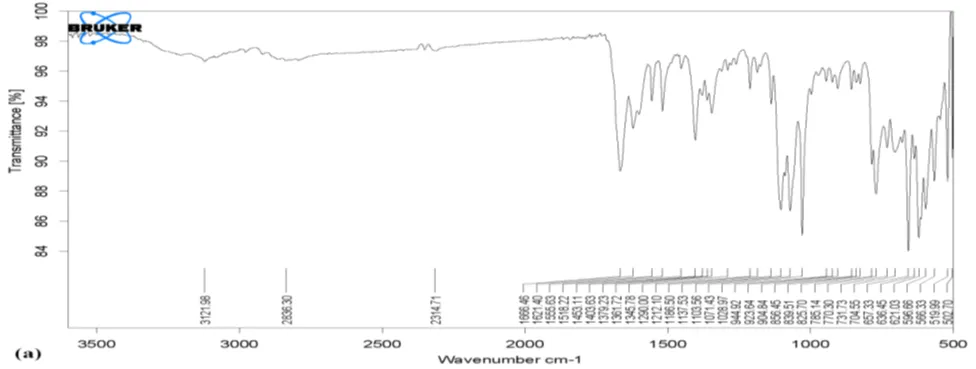
U5I Fig No:1 FT-IR U 5Ispectra U 5Iof U5Ipure U5 Idrug U5Iof U5IAbacavir U 5Isulphate
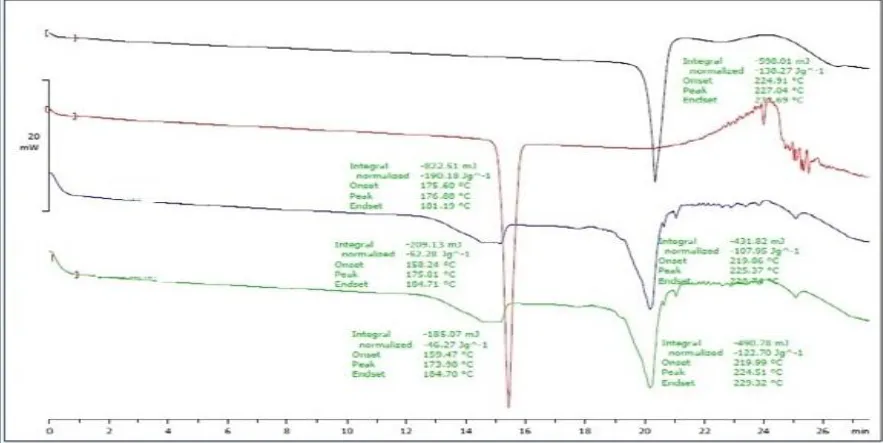
U5 Fig No:2 IDSC U5IThermogram U5Iof Abacavir sulphate, HPMC, Na CMC, HPC.
Table No: 2 physicochemical characterization U5IAbacavir U5Isulphate U5Imucoadhesive U5Ibuccal U5Ifilms
|
Formulation |
Weight (mg) |
Thickness (mm) |
Folding endurance |
Mucoadhesive strength |
Surface pH |
Drug content (%) |
|
F1 |
92.26±0.65 |
0.115±0.01 |
161.25±2.08 |
5.46±0.62 |
6.82±0.01 |
92.62±0.62 |
|
F2 |
93.54±0.47 |
0.121±0.02 |
164.48±1.02 |
6.42±0.41 |
6.86±0.02 |
96.82±0.15 |
|
F3 |
94.95±0.52 |
0.132±0.06 |
165.46±1.36 |
6.68±0.62 |
6.84±0.01 |
95.25±0.48 |
|
F4 |
94.57±0.11 |
0.148±0.05 |
170.58±1.52 |
5.46±0.17 |
6.85±0.02 |
98.62±0.25 |
|
F5 |
95.41±0.62 |
0.165±0.04 |
173.63±1.42 |
7.04±0.62 |
6.87±0.01 |
98.75±0.47 |
|
F6 |
96.62±0.85 |
0.184±0.05 |
172.14±1.02 |
8.48±0.85 |
6.88±0.03 |
99.43±0.63 |
|
F7 |
95.42±0.61 |
0.174±0.08 |
169.42±1.05 |
5.96±0.51 |
6.85±0.04 |
97.21±0.15 |
|
F8 |
94.14±0.24 |
0.124±0.04 |
168.48±1.47 |
6.48±0.04 |
6.84±0.01 |
94.45±0.25 |
|
F9 |
95.21±0.84 |
0.116±0.07 |
167.68±1.68 |
6.60±0.087 |
6.82±0.02 |
95.48±0.56 |
|
F10 |
96.63±0.27 |
0.185±0.02 |
156.25±1.42 |
8.49±0.02 |
6.83±0.01 |
99.65±0.74 |
The films showed relatively narrow ranges in weight, thickness and surface pH. The surface pH values were close to neutrality, which the thesis associates with reduced likelihood of buccal irritation. Drug content was within 92.62–99.65%, indicating reasonably uniform drug distribution among the formulations. Mucoadhesive strength varied among batches, with F10 reported at 8.49±0.02 dyn/cm².
Table No: 3 Moisture, mechanical and swelling properties of U5IAbacavir U5Isulphate U5Imucoadhesive U5Ibuccal U5Ifilms
|
Formulation |
Moisture absorption (%) |
Moisture loss (%) |
Tensile strength (kg/cm²) |
Swelling index (%) |
Residence time (h) |
|
F1 |
0.59±0.11 |
1.02±0.01 |
5.62±0.12 |
11.45±0.56 |
1.52±0.06 |
|
F2 |
1.42±0.25 |
1.45±0.52 |
8.68±0.42 |
19.86±0.48 |
1.96±0.04 |
|
F3 |
1.89±0.36 |
1.68±0.24 |
9.48±0.62 |
23.48±0.74 |
2.04±0.06 |
|
F4 |
2.25±0.15 |
1.98±0.35 |
10.47±0.58 |
26.85±0.63 |
2.36±0.02 |
|
F5 |
2.69±0.62 |
2.04±0.15 |
11.46±0.24 |
31.56±0.14 |
3.68±0.04 |
|
F6 |
2.96±0.84 |
2.16±0.18 |
12.85±0.56 |
33.75±0.85 |
3.98±0.02 |
|
F7 |
3.06±0.57 |
2.24±0.16 |
13.46±0.24 |
36.59±0.62 |
4.52±0.03 |
|
F8 |
3.18±0.62 |
2.34±0.58 |
14.75±0.15 |
38.95±0.52 |
5.85±0.08 |
|
F9 |
3.28±0.24 |
2.46±0.22 |
15.63±0.18 |
40.52±0.47 |
6.84±0.07 |
|
F10 |
3.56±0.85 |
2.68±0.14 |
18.26±0.48 |
42.52±0.22 |
9.57±0.04 |
Moisture absorption ranged from 0.59±0.11% to 3.56±0.85%, while moisture loss ranged from 1.02±0.01% to 2.68±0.14%. Tensile strength increased from 5.62±0.12 to 18.26±0.48 kg/cm². Swelling index ranged from 11.45±0.56 to 42.52±0.22%, and in-vitro residence time ranged from 1.52±0.06 to 9.57±0.04 h. The thesis relates increasing swelling and residence time to polymer concentration and hydration behavior.
In-vitro drug release
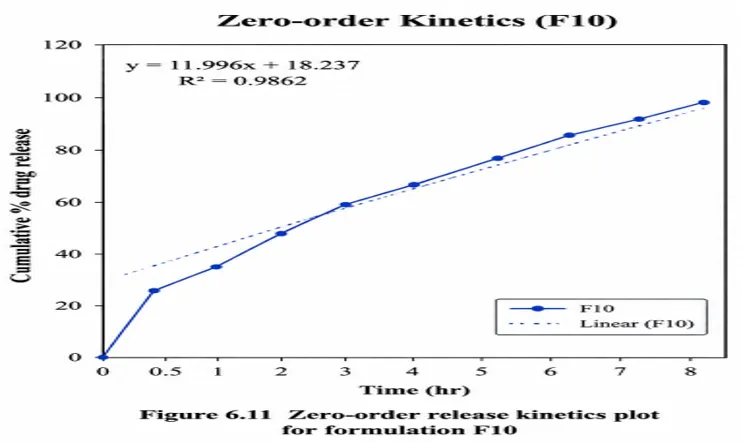
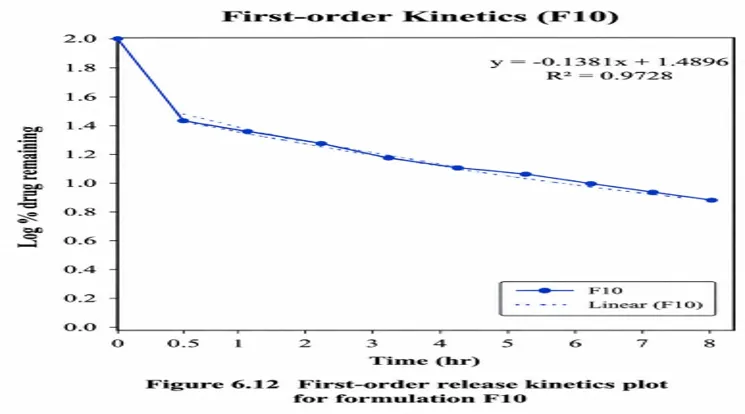
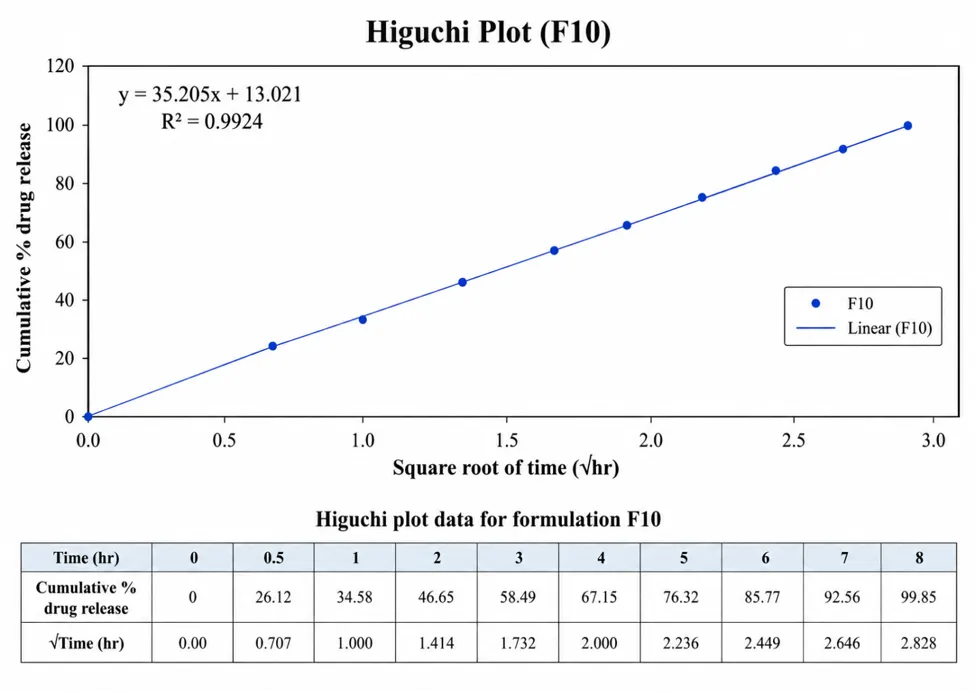
All formulations showed progressive drug release over 8 h. At 8 h, cumulative release ranged from 45.56% for F1 to 99.85% for F10. F9 and F8 showed 87.48% and 85.47% release, respectively. The thesis attributes differences in release to formulation composition, polymer characteristics, hydration, diffusion and matrix properties. The reported release profiles therefore demonstrate formulation-dependent drug liberation over the study period.
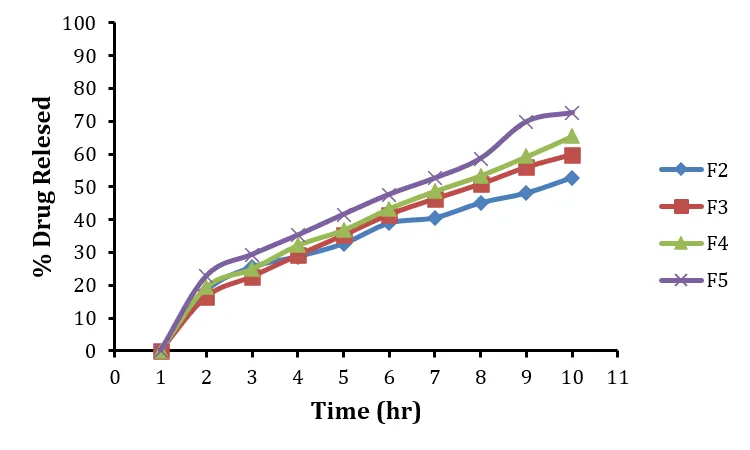
Figures 4 dissolution profile of U5IAbacavir U5Isulphate U5Imucoadhesive U5Ibuccal U5Ifilm F1-F
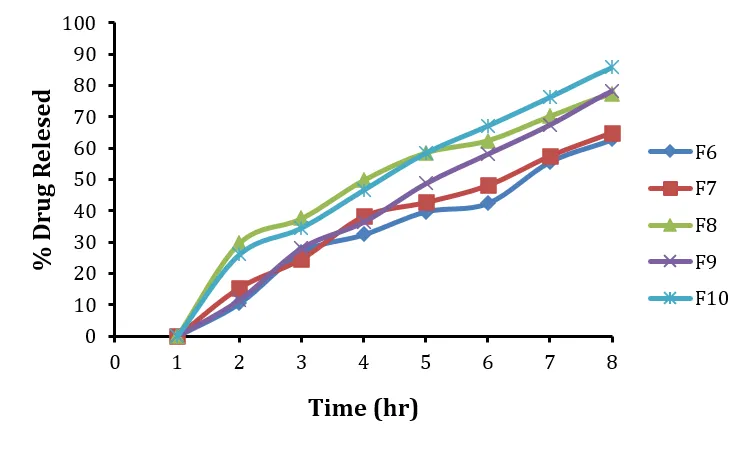
Figures 5 dissolution profile of U5IAbacavir U5Isulphate U5Imucoadhesive U5Ibuccal U5Ifilm F5-F10
RELEASE KINETICS
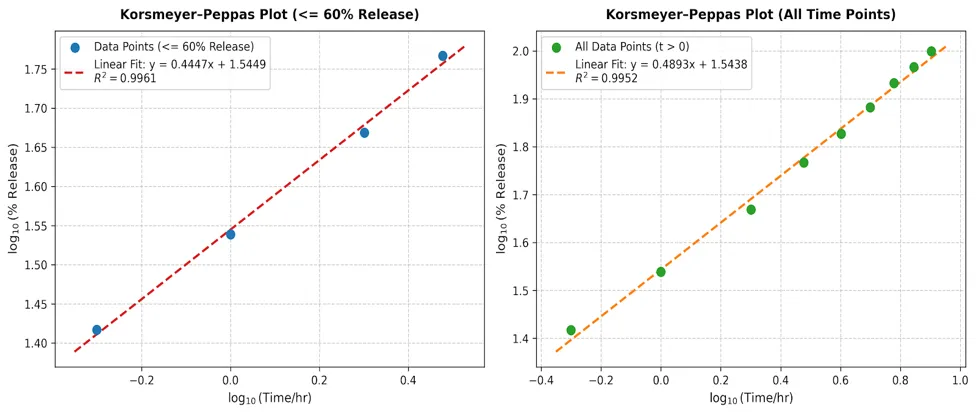
The thesis evaluated zero-order, first-order, Higuchi and Korsmeyer–Peppas models. Zero-order analysis assesses release at a relatively constant rate, whereas first-order analysis relates release to the amount of drug remaining. The Higuchi model evaluates diffusion-controlled release from a matrix, and the Korsmeyer–Peppas model is used to interpret the mechanism of release. For the Korsmeyer–Peppas analysis, the thesis reports a regression equation of y = 0.4447x + 1.5449 with R² = 0.9961 for the applicable release region (≤60% release), with an n value of 0.4447, interpreted in the thesis as a Fickian diffusion-controlled mechanism.
CONCLUSION
Mucoadhesive buccal films of abacavir sulphate were successfully prepared by solvent casting using HPMC E15 and other mucoadhesive/release-modifying polymers. The prepared films exhibited acceptable physical, mechanical, swelling, mucoadhesive and drug-content characteristics. FTIR and DSC studies reported no significant incompatibility between abacavir sulphate and the formulation components. All formulations showed progressive drug release over 8 h, with F10 reaching 99.85% cumulative release. The study demonstrates the feasibility of developing abacavir sulphate buccal films with sustained drug-release characteristics and measurable buccal residence.
REFERENCES

Duddukuri Mallikarjuna, Dr. D. Chandra Sekhar Naik, Development and Characterization of Buccal Mucoadhesive Films for Sustained Delivery of Abacavir Sulfate, Int. J. of Pharm. Sci., 2026, Vol 4, Issue 9, 4214-4220. https://doi.org/10.5281/zenodo.23060749
 10.5281/zenodo.23060749