

We use cookies to ensure our website works properly and to personalise your experience. Cookies policy
Arvind Gavali College of Pharmacy, Jaitapur, Satara, Maharashtra, India 415004
Conventional aqueous ophthalmic solutions suffer from poor precorneal residence and ocular bioavailability below 5% due to rapid tear turnover, nasolacrimal drainage and reflex blinking, necessitating frequent instillation. Thermo-Sensitive in situ gelling systems that are instilled as a low-viscosity liquid and undergo a sol-to-gel transition at the ocular surface temperature offer a strategy to prolong precorneal retention and improve therapeutic performance. The present study aimed to design, statistically optimize and characterize thermo-Sensitive in situ ophthalmic hydrogel of diclofenac sodium using Pluronic F127 and chitosan. Nine hydrogel batches (F1–F9) were prepared by the cold method as per a 3² full factorial design, with PF127 (16, 18, 20% w/v) and chitosan (0.1, 0.2, 0.3% w/v) as independent variables and gelation temperature and viscosity as dependent responses. Formulations were screened for physical appearance, pH, viscosity and gelation temperature/time, and optimized using Design-Expert software. The optimized batch was further characterized by FTIR, DSC, XRD, HET-CAM ex vivo ocular irritation testing, in vitro drug release, release kinetic modelling and 30-day accelerated stability studies. Analysis of variance showed the two-factor-interaction (2FI) model was statistically significant for both gelation temperature and viscosity with PF127 concentration identified as the dominant factor for both responses. Numerical optimization selected batch F3 (16% PF127, 0.3% chitosan) with a desirability of 1.000, gelation temperature of 36.2 °C and viscosity of 510 cP; predicted-versus-experimental bias was below 3% for both responses. FTIR confirmed the absence of drug–excipient interaction. Demonstrated non-irritant behavior on HET-CAM testing. The PF127–chitosan-based thermo-Sensitive hydrogel optimized by a 3² factorial design is a safe, physically stable and sustained-release in situ gelling system for the ophthalmic delivery of diclofenac sodium, and represents a promising alternative to conventional eye drops.
The eye is a highly protected organ equipped with static and dynamic precorneal barriers the corneal epithelium, tear film, nasolacrimal drainage and reflex blinking that together limit the ocular bioavailability of conventionally instilled eye drops to less than 5% of the administered dose.[1] Owing to rapid precorneal clearance, most of an instilled dose is lost within minutes of administration, necessitating frequent dosing to maintain therapeutic drug levels; this compromises patient compliance and increases the risk of systemic side effects from nasolacrimal absorption. Diclofenac sodium, a non-steroidal anti-inflammatory drug widely used in the management of post-operative ocular inflammation and cystoid macular oedema, is conventionally administered as an aqueous eye drop and is particularly susceptible to these bioavailability limitations.[2]
In situ gelling systems are designed to overcome this limitation by being administered as a low-viscosity liquid and subsequently forming a gel in response to an environmental stimulus such as temperature. Thermoresponsive systems based on poloxamers have attracted attention because their sol–gel transition can be adjusted through polymer concentration and formulation composition. Chitosan is a natural, cationic polysaccharide that has been investigated in ocular delivery because of its mucoadhesive and film-forming characteristics.[3] Combining chitosan with Pluronic F127 can provide a balance between thermoresponsive gelation and mucoadhesive properties.[4]
Previous studies have reported poloxamer/chitosan systems for ocular delivery and have demonstrated the importance of polymer concentration and composition on gelation and rheological behavior. The gelation temperature and rheological behavior of PF127–chitosan systems are highly sensitive to the relative concentrations of both polymers, making a systematic, statistically driven optimization approach essential for rational formulation development. Design of Experiments (DoE), and specifically full factorial designs, allow simultaneous evaluation of the main and interactive effects of multiple formulation variables on critical quality attributes with a minimal number of experimental runs, and have been increasingly applied to the optimization of thermo-Sensitive ophthalmic gels.[5]
The present study was undertaken to design and statistically optimize a thermo-Sensitive in situ ophthalmic hydrogel of diclofenac sodium using PF127 and chitosan by means of a 3² full factorial design, with gelation temperature and viscosity as the dependent responses, followed by comprehensive physicochemical, spectral, thermal and ex vivo safety characterization of the optimized formulation.
2. MATERIALS AND METHODS
2.1. Materials
Diclofenac sodium was procured from Loba Chemie Pvt. Ltd., Mumbai, India. Pluronic F127 was procured from Sigma-Aldrich Pvt. Ltd. Chitosan was procured from Loba Chemie Pvt. Ltd., Mumbai, India. All reagents used were of analytical grade.
2.2. Method
The thermo-responsive hydrogel was prepared using the cold method, also known as the poloxamer cold technique, in which Pluronic F-127 was dissolved while being constantly stirred in 4°C cold distilled water. Prevent aggregation and ensure complete solubilization. The drug and chitosan solution were subsequently incorporated under cold conditions to obtain a homogeneous formulation. Weigh Pluronic F-127 (16–20 % w/v). Add slowly to cold distilled water (4°C). Stir gently to avoid lump formation. Keep refrigerated (4°C) for 12–24 hours until fully dissolved. Cold method prevents clumping and ensures clear solution. Weigh required quantity of chitosan (0.1–0.3% w/v in a 1% v/v acetic acid solution, dissolve. Use a magnetic stirrer to stir constantly for four to six hours. Allow to stand overnight to remove air bubbles. Filter if necessary to remove undissolved particles. Clear viscous solution should be obtained. Weigh Diclofenac sodium (0.1% w/v). Dissolve in small quantity of distilled water. Add sodium chloride (0.9%) for isotonicity. Take Pluronic F-127 solution (cold condition). Add chitosan solution slowly under stirring. Add drug solution gradually. Stir continuously to obtain uniform mixture. Maintain temperature at 4°C during mixing. Adjust pH to 7.4 using NaOH (0.1N). Make up final volume using distilled water. [6,7]
2.3. Experimental Design (Design-Expert software)
A 3² full factorial design (Design-Expert software) was employed to evaluate the influence of two independent formulation variables Pluronic F127 concentration and chitosan concentration on gelation temperature (Y₁) and viscosity (Y₂) as dependent responses. Nine formulations (F1–F9) were generated as per the design matrix and evaluated experimentally.[8]
3. PRE-FORMULATION STUDIES
3.1. Fourier transform infrared spectroscopy (FTIR):
One analytical technique for figuring out chemical interactions was IR spectroscopy. Diclofenac Sodium, Pluronic F127 and Chitosan infrared spectrum is determined using a Fourier Transform Infrared Spectrophotometer (Bruker). An adequate sample was taken and immediately transferred to the IR platform. Next, the spectra were evaluated from 4000 to 400cm-1 in wavelength. The resulting spectrum was compared to Diclofenac Sodium normal frequencies. [9,10]
3.2. Differential scanning calorimetry (DSC):
The thermotropic properties and thermal behavior of the drug were assessed using DSC. It monitors the movement of heat into and out of the sample and references at a predefined, controlled temperature. DSC was employed to analyze the thermal characteristics of the drug 5 mg of the specimen were heated at 10 ℃/min between 30℃ to 300 ℃ in an N2 environment with an evacuation rate of 20 milliliters per minute using a sealing metal pan. This led to the creation of a DSC thermogram for pure drug. [11,12]
3.3. UV-Visible Spectrophotometric Technique for Analysis of Diclofenac Sodium
Ten milligrams of diclofenac sodium were dissolved in one hundred milliliters of phosphate buffer pH 7.4 in a volumetric flask to create the standard stock solution. To obtain a clear solution, the mixture was sonicated for ten minutes. The stock solution's final concentration is 10µg/ml. Making a working standard solution of 2,4,6,8, and 10µg/ml. A UV-visible spectrophotometer was used to scan this standard working solution in the 200–400 nm range. [13, 14]
4. FORMULATION AND OPTIMIZATION
Table No. 1: Composition of Hydrogel
|
Batch |
F1 |
F2 |
F3 |
F4 |
F5 |
F6 |
F7 |
F8 |
F9 |
|
PF127 (%) |
16 |
18 |
16 |
18 |
20 |
20 |
20 |
18 |
16 |
|
Chitosan (%) |
0.2 |
0.3 |
0.3 |
0.2 |
0.2 |
0.1 |
0.3 |
0.1 |
0.1 |
|
Diclofenac sodium (%) |
0.1 |
0.1 |
0.1 |
0.1 |
0.1 |
0.1 |
0.1 |
0.1 |
0.1 |
|
Benzalkonium Chloride (%) |
0.01 |
0.01 |
0.01 |
0.01 |
0.01 |
0.01 |
0.01 |
0.01 |
0.01 |
4.2. Optimization
The study employed a 3² factorial design, where two factors, each with three levels, were investigated. Design Expert Software was used to create the design. In this study, a 3² full factorial design was implemented, focusing on PF 127 Concentration (X1) and Chitosan Concentration (X2) chosen as independent variables. The levels of these two factors, with three different levels: low, medium, and high, were established based on a preliminary study conducted before initiating the experimental design. Throughout the study, all other formulation and processing variables remained constant. The response variables selected were Gelation temperature (Y1) and Viscosity (Y2). The prepared hydrogel batches were evaluated and characterized across various parameters. [15]
5. CHARACTERIZATION OF OPTIMIZED BATCH
5.1. Viscosity
The rheological characteristics of solutions and gels were measured using the Brookfield DV-E Viscometer. The formulations were measured at 100 rpm in a 50 ml Beaker with a spindle number 62. The angular velocity sequence was then reversed. Two readings of the viscosity were averaged.[16]
5.2. Spreadability
A 0.5 g sample of gel product will be placed in the middle of a 6 cm by 2 cm glass plate to assess each formulations spread ability. A two-centimetre diameter circle will be drawn on the glass plate. A 500 g weight will be placed on top of the second glass plate for five minutes after it has been placed on top of the first. Each gel product's spread will be calculated using the circle's final diameter (in centimetre) following the removal of the weights (n = 3). [17,18]
5.3. FTIR analysis
The FTIR spectra of pure drug and optimized in situ gel formulation were examined using an FTIR Spectrophotometer (Bruker) with a scanning range of 4000–400 cm1 in order to examine the interactions between drug and polymer. [19,20]
5.4. XRD analysis
XRD investigation to identify nature and analyse the purity of material. [21]
5.6. DSC Analysis
Determine the thermal properties and thermotropic features of both the improved formulation and the pure hydrogel. An aluminium pan containing about 1 mg of the specimen was heated at a rate of 10 'C/min over a temperature range of 30 to 300 ℃ in a N2 environment with a flow rate of 20 ml/min. [22,23]
5.7. In-Vitro Drug Release
Using a diffusion cell system (DBK/Franz type), the study evaluated the in vitro drug release for the recently created thermos-responsive hydrogel. Observing the drug release rate under simulated ocular conditions was the goal. To enable drug diffusion across the membrane, a hydrated dialysis membrane was positioned between the donor compartment, which held the hydrogel, and the receptor compartment, which held the STF, which was kept at a steady temperature of 37 ± 0.5 °C and continuously stirred. In order to maintain sink conditions, samples were removed from the receptor chamber at prearranged intervals and replaced with an equal volume of fresh buffer. A measured amount of hydrogel equivalent to a specific amount of drug was placed in the donor compartment. The drug's λ max value was used in spectrophotometric analysis of the samples, and the cumulative percentage drug release was computed. The drug release mechanism was identified by analysing the data from the various kinetic models. Because the drug diffused through the polymeric network, the study's results showed that the hydrogel could deliver drugs in a sustained and controlled manner, indicating that the hydrogel may be able to do so for a long time.[24]
5.8. HET-CAM for ex vivo ocular irritation test
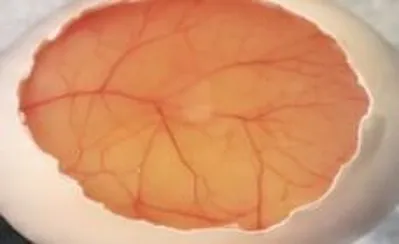
The HET-CAM system is an ex vivo method that can be used to assess the possible negative effects of ophthalmic (eye) products. In order to ascertain the degree of irritation that occurred following the application of a test material to the chicken egg, vascularization (such as bleeding, lysis the rupturing of cells or deep vascularity) within the medullary zone of the chorioallantois membrane of chicken eggs is periodically recorded. HET-CAM is frequently used as a first step in determining the safety of a drug product for use in humans because it is thought to be a quick, repeatable, and non-invasive method for evaluating ocular drug delivery systems. [25,26]
6. RESULTS AND DISCUSSION
6.1. Pre-Formulation Studies
6.1.1. Fourier transform infrared spectroscopy (FTIR):
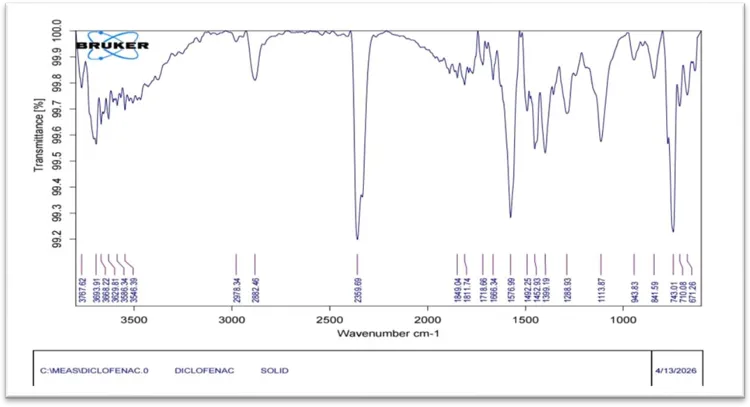
Spectra 1: FTIR of Diclofenac
FTIR analysis of the sample showed major absorptions at 3693, 2882, 1718, 1576, and 743 cm−1. The strong C=O stretching band at 1718 cm−1, together with aromatic C=C and C–H features at 1576 and 2882 cm−1 and an out-of-plane aromatic bend at 743 cm−1, confirm the presence of diclofenac in its acidic form.
6.1.2. Differential scanning calorimetry (DSC):
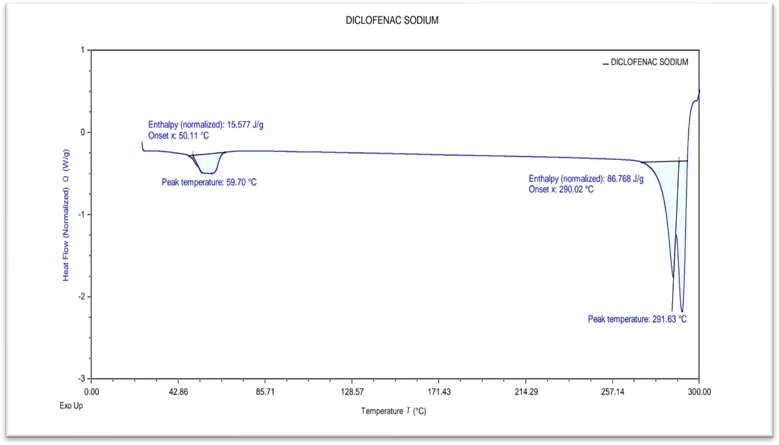
Thermogram No. 1: DSC of Diclofenac sodium
Diclofenac sodium melting point, which appears to be a sharp endothermic peak at 291.63 degrees Celsius, verifies that the substance is crystalline and pure. The drug is thermally stable and does not undergo any polymorphic transitions in the range of temperatures examined, according to the DSC thermogram lack of any extra peaks.
6.1.3 UV-Visible Spectrophotometric Technique for Analysis of Diclofenac Sodium
An analytical method was developed for diclofenac sodium using a UV-Visible spectroscopy. A solution of diclofenac sodium with a 10 μg/ml concentration was analyzed to determine the optimal wavelength for analysis. By examining diclofenac sodium UV spectrum, the peak absorbance was identified at 276nm, consistent with the literature findings.
6.2. Optimization
A total 9 experimental run were generated by using Design Expert software. The 3² full factorial design for optimization of the Pluronic F127/Chitosan ophthalmic hydrogel system. The experimental formulations generated by the DoE were evaluated for gelation temperature and viscosity, and the observed responses were subjected to statistical analysis. The results demonstrated that changes in the concentration of Pluronic F127 and chitosan produced measurable variations in the selected responses. An increase in Pluronic F127 concentration generally resulted in an increase in viscosity and a reduction in gelation temperature, which can be attributed to the temperature-dependent micellization and increased polymer concentration.
Table No. 2: Experimental run and Responses
|
|
|
Factor 1 |
Factor 2 |
Response 1 |
Response 2 |
|
Run |
Std |
A:PF 127 Concentration (%) |
B: CH Concentration (%) |
Gelation temperature (℃) |
Viscosity (CPs) |
|
4 |
1 |
16 |
0.2 |
36.5 |
470 |
|
8 |
2 |
18 |
0.3 |
33.6 |
690 |
|
7 |
3 |
16 |
0.3 |
36.2 |
510 |
|
5 |
4 |
18 |
0.2 |
34 |
620 |
|
6 |
5 |
20 |
0.2 |
32.4 |
800 |
|
3 |
6 |
20 |
0.1 |
32.8 |
730 |
|
9 |
7 |
20 |
0.3 |
30 |
940 |
|
2 |
8 |
18 |
0.1 |
34.5 |
560 |
|
1 |
9 |
16 |
0.1 |
36.8 |
420 |
The ANOVA results showed that the developed 2FI model was statistically significant with an F-value of 71.41 (p = 0.0002), indicating that the model adequately explains the variation in gelation temperature and that the probability of obtaining such a high F-value due to random error is only 0.02%.
Table No. 3: ANOVA of Response 1 Gelation Temperature
|
Source |
Sum of Squares |
df |
Mean Square |
F-value |
p-value |
|
|
Model |
38.37 |
3 |
12.79 |
71.41 |
0.0002 |
significant |
|
A-Pluronic F127 conc. |
34.08 |
1 |
34.08 |
190.28 |
< 0.0001 |
|
|
B-Chitosan concentration |
3.08 |
1 |
3.08 |
17.21 |
0.0089 |
|
|
AB |
1.21 |
1 |
1.21 |
6.76 |
0.0483 |
|
|
Residual |
0.8956 |
5 |
0.1791 |
|
|
|
|
Cor Total |
39.27 |
8 |
|
|
|
|
Among the formulation variables:
Pluronic F127 concentration (A) significantly affected gelation temperature (p < 0.0001) and exhibited the highest F-value (190.28), indicating that it is the most influential factor. Chitosan concentration (B) also had a significant effect (p = 0.0089).
The interaction between Pluronic F127 and Chitosan (AB) was significant (p = 0.0483), suggesting that the effect of one polymer depends on the concentration of the other.Fit Statistics
Table No. 4: Fit Statistic Response 1 Gelation Temperature
|
Std. Dev. |
0.4232 |
R² |
0.9772 |
|
Mean |
34.09 |
Adjusted R² |
0.9635 |
|
C.V. % |
1.24 |
Predicted R² |
0.8983 |
|
|
|
Adeq Precision |
21.9746 |
The model demonstrated excellent predictive ability with:
R² = 0.9772
Adjusted R² = 0.9635 Predicted R² = 0.8983
The difference between the adjusted and predicted R² values is less than 0.2, indicating good agreement and satisfactory predictive capability. The Adeq Precision value of 21.975 (>4) confirms an adequate signal-to-noise ratio, making the model suitable for optimization and navigation of the design space.
Final Equation in Terms of Coded Factors
Gelation temperature = 34.09 − 2.38A − 0.7167B − 0.55AB
This equation indicates that increasing both Pluronic F127 and Chitosan concentrations decreases the gelation temperature, with Pluronic F127 exerting the strongest influence.
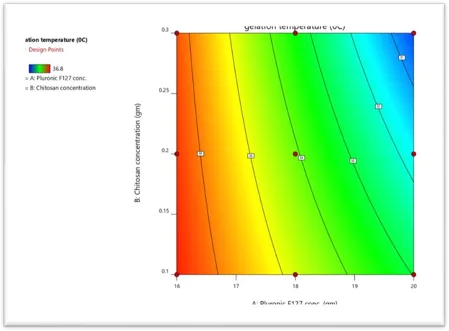
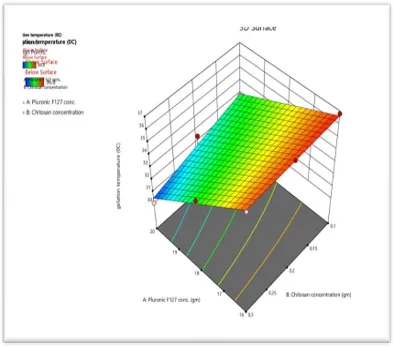
Figure No.1: Counter Plot and 3D Response Surface Plot of Gelation Temperature
The ANOVA for viscosity showed that the 2FI model was highly significant with an F-value of 195.29 (p < 0.0001), demonstrating that the selected factors significantly influence the viscosity of the hydrogel formulation. The probability that this result occurred due to noise is less than 0.01%. The individual factors showed the following significance:
Pluronic F127 concentration (A): highly significant (p < 0.0001, F = 496.34) Chitosan concentration (B): significant (p = 0.0003, F = 80.16)
Interaction term (AB): significant (p = 0.0281, F = 9.36)
Table No. 5: ANOVA of Response 2 Viscosity
|
Source |
Sum of Squares |
df |
Mean Square |
F-value |
p-value |
|
|
Model |
2.252E+05 |
3 |
75077.78 |
195.29 |
< 0.0001 |
significant |
|
A-Pluronic F127 conc. |
1.908E+05 |
1 |
1.908E+05 |
496.34 |
< 0.0001 |
|
|
B-Chitosan concentration |
30816.67 |
1 |
30816.67 |
80.16 |
0.0003 |
|
|
AB |
3600.00 |
1 |
3600.00 |
9.36 |
0.0281 |
|
|
Residual |
1922.22 |
5 |
384.44 |
|
|
|
|
Cor Total |
2.272E+05 |
8 |
|
|
|
|
These results indicate that both polymers and their interaction contribute significantly to the viscosity of the hydrogel system.
Fit Statistics
Table No. 6: Fit Statistic Response 2 Viscosity
|
Std. Dev. |
19.61 |
R² |
0.9915 |
|
Mean |
637.78 |
Adjusted R² |
0.9865 |
|
C.V. % |
3.07 |
Predicted R² |
0.9529 |
|
|
|
Adeq Precision |
38.2511 |
The model exhibited excellent goodness of fit with: R² = 0.9915
Adjusted R² = 0.9865 Predicted R² = 0.9529
The close agreement between adjusted and predicted R² values confirms the robustness and reliability of the model. Additionally, an Adeq Precision value of 38.251 (>4) indicates an excellent signal and confirms the suitability of the model for optimization purposes.
Final Equation in Terms of Coded Factors
Viscosity = 637.78 + 178.33A + 71.67B + 30.00AB
The positive coefficients indicate that increasing Pluronic F127 and Chitosan concentrations increases the viscosity of the hydrogel. Among the two factors, Pluronic F127 has the greatest influence on viscosity, while the positive interaction term suggests a synergistic effect when both polymers are increased simultaneously.
The equation in terms of coded factors can be used to make predictions about the response for given levels of each factor. By default, the high levels of the factors are coded as +1 and the low levels are coded as -1. The coded equation is useful for identifying the relative impact of the factors by comparing the factor coefficients.
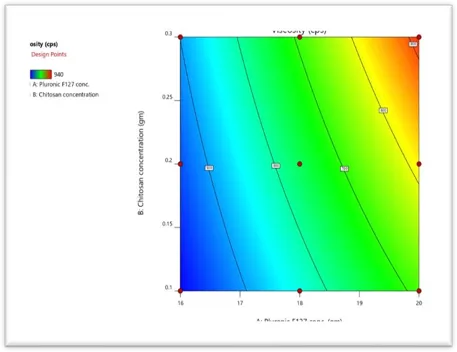
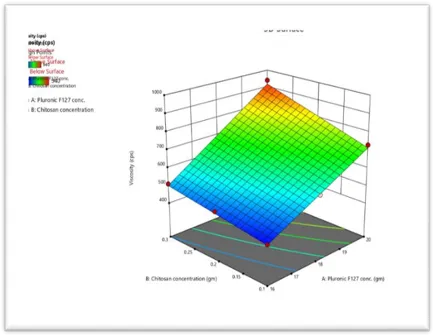
Figure No.2: Counter Plot and 3D Response Surface Plot of Viscosity
Table No. 7: Optimized Solutions
|
Sr. No |
Pluronic F 127 Concentration |
Chitosan Concentration |
Gelation temperature |
Viscosity |
Desirability |
|
|
1 |
16.938 |
0.166 |
35.498 |
524.169 |
1.000 |
Selected |
|
2 |
16.000 |
0.100 |
36.639 |
417.778 |
1.000 |
|
|
3 |
20.000 |
0.100 |
32.972 |
714.444 |
1.000 |
|
|
4 |
18.000 |
0.200 |
34.089 |
637.778 |
1.000 |
|
The optimized batch (PF127 16.938% + Chitosan 0.166%) balances: In situ gelling at ocular surface temperature (~35.5°C). Adequate viscosity (524 CPs) for prolonged precorneal residence without causing blurred vision or discomfort Minimal polymer concentration, reducing potential irritation and cost.
This section should present your experimental validation of the optimized batch. The typical format is:
Table No. 8: Predicted vs Experimental comparison
|
Parameter |
Predicted |
Experimental |
% Error |
|
Gelation Temperature (°C) |
35.498 |
36.2 |
1.98% |
|
Viscosity (CPs) |
524.169 |
510 |
2.70% |
A % bias of less than 5% confirms the validity and predictive accuracy of the 2FI model, justifying the use of Design Expert software and the 3² full factorial design for optimization of the Pluronic F127/Chitosan ophthalmic hydrogel system.
Characterization of Optimized batch
Viscosity of hydrogel was analyzed using Brookfield viscometer. The formulations exhibited pseudoplastic flow with viscosity increased when it comes in contact with ocular surface. The optimized formulation showed ideal rheological behavior suitable for ocular drug delivery. [27]
Table No. 9: Viscosity of hydrogel
|
Formulation Code |
Viscosity |
|
F3 Batch |
510 |
The spreadability of formulations ranged from 5.50 to 6.30 cm. The optimized formulation showed 6.03 ± 0.06 cm, indicating good spreadability and suitable consistency for ocular delivery.
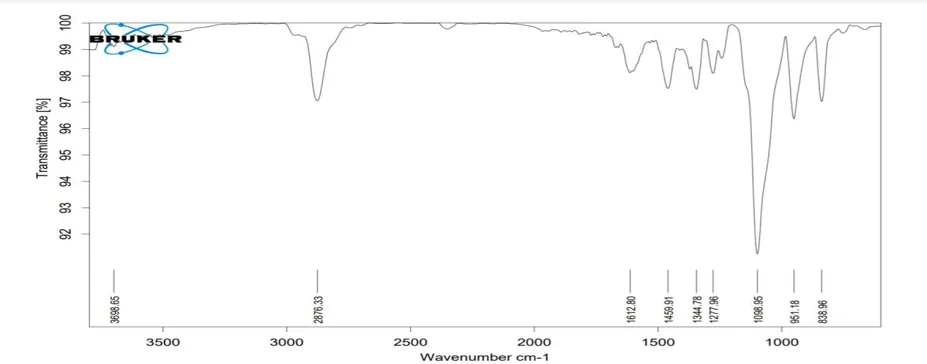
Spectra 2: FTIR of Optimized batch
The optimized hydrogel FTIR spectrum revealed distinctive peaks at 3688.65 cm⁻¹ (O–H/N–H stretching), which indicated hydrogen bonding; 2876.33 cm⁻¹ (C–H stretching) which confirmed the presence of Pluronic F127; and 1612.80 cm⁻¹ (amide/N–H bending), which represented chitosan and diclofenac sodium. The chitosan structure is further supported by additional peaks at 1459.91 cm⁻¹ (C–H bending). The polyether backbone of Pluronic F127 is confirmed by the peaks at 1277.96 cm⁻¹ and 1098.95 cm⁻¹ (C–O–C stretching). Diclofenac sodium is confirmed by the peaks at 951.18 cm⁻¹ (aromatic C–H bending) and 838.96 cm⁻¹ (C–Cl stretching). Good drug–excipient compatibility and the drug's physical entrapment within the hydrogel matrix are indicated by the absence of any discernible peak shift or disappearance.
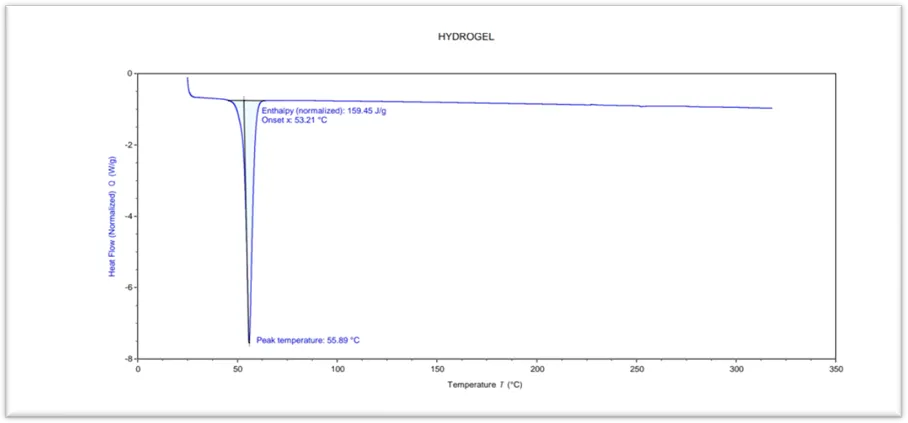
Thermogram No. 2: DSC of Optimized batch
Differential scanning calorimetry (DSC) analysis of the thermoresponsive hydrogel revealed a pronounced endothermic transition with an onset temperature of 53.21 °C and a peak temperature of 55.89 °C. The associated enthalpy change was 159.45 J g⁻¹.This thermal event is attributed to the thermally induced phase transition of the hydrogel network, involving disruption of polymer water interactions and dehydration of the polymer chains. The sharpness of the peak indicates a relatively homogeneous and cooperative transition process.
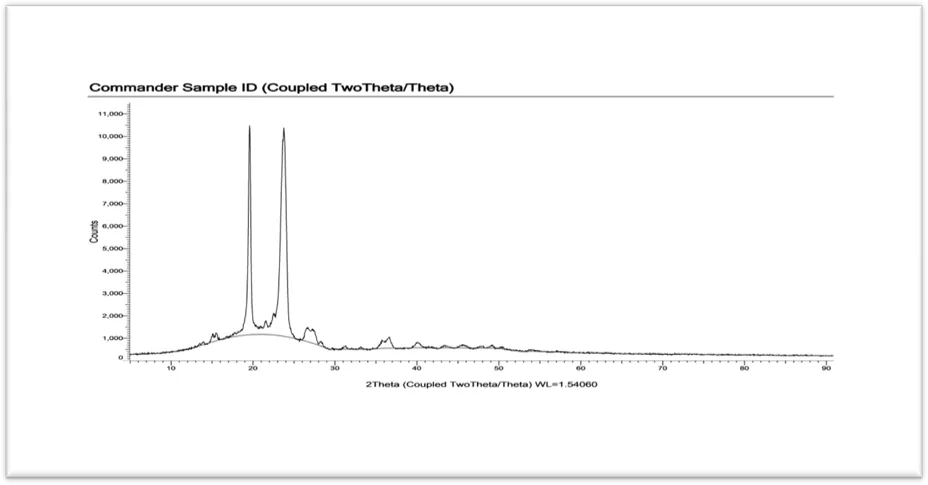
Thermogram No. 3: XRD of Optimized batch
The XRD pattern of the thermoresponsive hydrogel exhibited two characteristic diffraction peaks at approximately 2θ = 20–25° along with a broad diffuse halo. The broad halo indicates the predominantly amorphous nature of the hydrogel matrix, whereas the presence of sharp peaks suggests the existence of limited crystalline regions within the polymer network. The reduced intensity and broadening of peaks indicate a decrease in crystallinity, which may be attributed to polymer chain entanglement and cross-linking within the hydrogel structure. These findings confirm the successful formation of a semi-crystalline thermoresponsive hydrogel system.
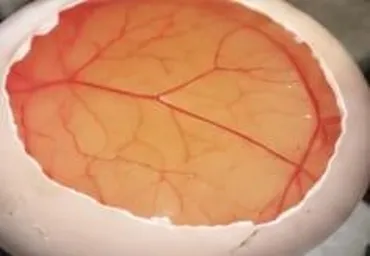
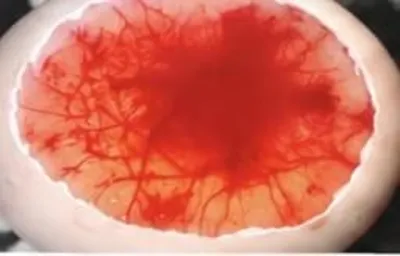
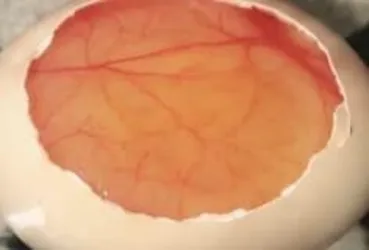
The HET-CAM study confirms that the developed thermo-sensitive hydrogel formulation (F3 batch) is non-irritant and safe for ophthalmic application, exhibiting significantly reduced irritation compared to the standard diclofenac solution
|
|
|
Negative control 0.9%NaCl |
Positive control (1% SDS) |
|
|
|
Standard diclofenac solution |
Test formulation (F3 Batch) |
Figure No.3: HET-CAM for ex vivo ocular irritation test
Table No. 10: In-Vitro Drud Release of Hydrogel
|
Time (hr) |
Absorbance (y) |
Cumulative Drug Released (% CDR) |
|
0 |
0 |
0 |
|
1 |
0.106 |
1.41% |
|
2 |
0.165 |
12.83% |
|
3 |
0.228 |
25.25% |
|
4 |
0.292 |
38.10% |
|
5 |
0.358 |
51.59% |
|
6 |
0.412 |
63.02% |
|
7 |
0.468 |
75.04% |
|
8 |
0.522 |
86.89% |
Quantitative analysis of the released diclofenac sodium was performed via UV-Visible Spectroscopy at a maximum wavelength (λmax) of 276 nm. Concentrations were calculated utilizing a previously validated calibration curve equation:
y = 0.0259x + 0.0987
The optimized hydrogel formulation exhibited a sustained drug release cumulative drug release of 86.89% in 8 hrs. Release profile shows prolonged therapeutic drug release.
CONCLUSION
The results of this study demonstrate that the Pluronic F127–chitosan-based thermoresponsive hydrogel is a promising and effective system for the ophthalmic delivery of diclofenac sodium. The formulation exhibited appropriate gelation behavior, good physicochemical properties, sustained drug release, and excellent ocular tolerance. The absence of drug–polymer interaction, along with the non-irritant nature confirmed by the HET-CAM test, highlights the biocompatibility and safety of the developed system. Furthermore, the thermosensitive nature of the hydrogel enhances precorneal retention time, potentially improving therapeutic efficacy and patient compliance.
REFERENCES


Aviraj Phadtare, Vishal Yadav, Kailas Karande, Vasant Lokhande, Design and Characterization of Smart Thermo-Sensitive Hydrogel by Using Pluronic F127 and Chitosan, Int. J. of Pharm. Sci., 2026, Vol 4, Issue 9, 4146-4159. https://doi.org/10.5281/zenodo.23058757
 10.5281/zenodo.23058757