View Article

  • Artificial Intelligence and Machine Learning Applications in Pharmaceutical Analysis: From Traditional Analytical Approaches to Intelligent Pharmaceutical Systems – A Comprehensive Review

  • 1Department of computer science & engineering (AI and ML), S J C Institute of Technology, Chikballapur, Karnataka, India.

    2Department of pharmaceutical sciences, Sri K.V. College of Pharmacy, Chikballapur, Karnataka, India.

Abstract

Pharmaceutical analysis underpins the identity, purity, potency and safety of medicines. Conventional workflows based on chromatography, spectroscopy and mass spectrometry are reliable but depend on manual interpretation and generate data volumes that are hard to exploit fully. Artificial intelligence (AI) and machine learning (ML) offer data-driven tools for peak detection, retention-time and spectral prediction, impurity identification, dissolution and stability modelling, anomaly detection and real-time process analytical technology (PAT). This narrative review, based on a structured search of peer-reviewed and regulatory sources published mainly from 2021 to 2026, compares traditional and AI-enabled workflows, summarises ML methods and their applications across analytical areas, and examines explainable AI, digital twins, generative AI and autonomous laboratories. In the sources reviewed, the strongest evidence concerns spectroscopy-based prediction for PAT and dissolution and retention-time prediction supported by large public datasets, whereas evidence for stability forecasting, rare-impurity identification and autonomous laboratories is limited and seldom validated at industrial scale. Regulatory thinking is converging on risk-based, context-of-use credibility assessment and lifecycle management. We propose a conceptual Intelligent Pharmaceutical Analysis Framework (IPAF) linking instrumentation, data integrity, AI analytics, decision support and governance, and identify priorities: standardised validated datasets, explainable and uncertainty-aware models, and prospective multi-site validation.

Keywords

Artificial intelligence, Machine learning, Pharmaceutical analysis, Process analytical technology, Quality control, Explainable AI

Introduction

× Popup Image

Pharmaceutical analysis determines active substances, impurities, excipients and dosage forms throughout the product lifecycle, from development to quality control, stability testing and regulatory approval 1,2. It relies on chromatography (HPLC, UPLC, GC, LC-MS, GC-MS), spectroscopy (UV-Vis, FTIR, Raman, NIR, NMR) and capillary electrophoresis. Despite instrumental progress, workflows face large and complex datasets, time-consuming and analyst-dependent interpretation, demanding method development, limited predictive capability, rising regulatory expectations and high costs, pressures that grow with continuous manufacturing and its dense data streams 3,4.

Artificial intelligence (AI) denotes computational systems performing tasks associated with human intelligence; machine learning (ML) learns relationships from data, and deep learning (DL) uses multilayer neural networks 5. AI is widely used in pharmaceutical research and development 6,7, and reviews now address pharmaceutical analysis 8,9. Its use aligns with Quality by Design, process analytical technology (PAT) and risk-based quality systems 10,11; ICH Q2 (R2) and Q14 introduce a lifecycle approach that includes multivariate procedures 12,13, and regulators have begun to publish AI-specific expectations 14,15.

Existing reviews cover AI across the pharmaceutical value chain 16, a single technology such as neural networks in PAT 17 or digital twins 18, or analysis at a general level 8,9. To the best of our knowledge, an integrated treatment that contrasts traditional and AI-enabled workflows, grades the maturity of evidence by analytical area, maps AI use onto regulatory expectations and proposes a deployable architecture is lacking. This review therefore (i) compares traditional and AI-enabled analysis, (ii) summarises ML methods and applications, (iii) relates them to regulatory expectations, (iv) identifies research gaps and (v) proposes the Intelligent Pharmaceutical Analysis Framework (IPAF).

MATERIALS AND METHODS

This is a narrative review supported by a structured search. PubMed, Scopus, Web of Science, ScienceDirect, SpringerLink, IEEE Xplore and Google Scholar were searched for 2021–2026 using Boolean combinations of terms such as “artificial intelligence in pharmaceutical analysis”, “machine learning in analytical chemistry”, “deep learning in pharmaceutical sciences”, “AI in chromatography/spectroscopy”, “process analytical technology”, “digital twins in pharmaceuticals”, “explainable artificial intelligence”, “AI agents in pharmaceutical manufacturing” and “AI in dissolution and stability studies”; reference lists and regulatory websites (FDA, EMA, ICH, PIC/S) were also screened. English-language peer-reviewed articles, reviews, conference papers and guidance documents addressing AI, ML or advanced analytics in chromatographic, spectroscopic, quality-control, PAT, dissolution, stability or impurity applications were included; duplicates, unrelated or purely clinical studies, and papers lacking methodological detail were excluded. Earlier foundational works (algorithm papers, textbooks, ICH/FDA guidelines) are cited as background, not primary evidence. Extracted items (technique, AI method, data, metrics, limitations) were synthesised narratively by theme; no pooling or formal risk-of-bias scoring was attempted.

RESULTS AND DISCUSSION

3.1 Traditional versus AI-based analysis

Traditional methods combine validated techniques with expert interpretation and remain the reference for compliance 1,2. AI adds automated processing, pattern recognition and prediction, with reported benefits in speed, reduced analyst variability and preventive quality management 17; these depend on representative data, validation, model maintenance and human oversight (Table 1). Complexity does not guarantee superiority: ANN models predicted dissolution more accurately than PLS in one study 19, yet no single retention-time model is best across datasets 20.

Table 1: Traditional Versus Ai-Enabled Pharmaceutical Analysis (Conceptual)

Parameter Traditional AI-enabled (potential and caveats)
Data processing Manual or semi-automated review by analysts Automated feature extraction and classification; needs validated pipelines and oversight
Method development Experimentation and design of experiments Predictive models can narrow experiments; transfer between systems is limited 20
Process monitoring Off-line or at-line sampling In-line PAT with multivariate or ML models 4,17
Spectral interpretation Expert evaluation, PLS calibration 21,22 ML/DL classification and quantification 23; needs calibration sets and maintenance
Dissolution testing Destructive, time-consuming tests Surrogate models from spectra or process data, at research stage 19,24
Impurity profiling Manual spectral interpretation Candidate structures from MS/MS; orthogonal confirmation needed 25,26
Cost and documentation High labour; manual reports Possible long-term savings; validation, security and skills investment 16,27

3.2 Machine learning techniques

Supervised methods (random forests 28, support vector machines 29, gradient boosting 30) support quality prediction, spectral classification and dissolution modelling; unsupervised methods (PCA, clustering) support exploration and outlier detection; deep networks (ANN, CNN, LSTM 31, transformers 32) model nonlinear and sequential data (Table 2). Chemometric PLS 21 remains the essential baseline.

Table 2: Machine Learning Algorithms and Pharmaceutical Applications

Algorithm Category Illustrative applications Strengths / limitations
Random forest Supervised Quality prediction, dissolution modelling Robust to noise / limited transparency
Support vector machine Supervised Spectral classification, impurity detection Good for high dimensions / parameter sensitive
Gradient boosting Supervised Stability prediction, process optimisation High accuracy on tabular data / overfitting risk
PCA, clustering Unsupervised Chemometrics, batch grouping, outliers Simplify data / linear or cluster assumptions
ANN Deep learning Dissolution prediction, process modelling Captures nonlinearity / needs adequate data
CNN Deep learning Image and spectral classification Automatic features / large labelled sets
LSTM Deep learning Process monitoring, time-series forecasting Handles sequences / training complexity
Transformer Deep learning Spectral interpretation, documentation Contextual learning / costly, hard to validate

3.3 Chromatographic analysis

AI can automate peak integration, deconvolution, retention-time (RT) prediction, method optimisation and outlier detection (Figure 1). RT prediction is best documented: large datasets such as METLIN SMRT (about 80,000 molecules) and RepoRT (88,325 records from 49 LC systems) enabled deep-learning models, which generally outperform classical regressors but degrade for dissimilar molecules 20,33–35. This evidence comes mainly from metabolomics; transfer to validated pharmaceutical assays is unproven. For LC-MS, CSI:FingerID, SIRIUS 4, CFM-ID 4.0 and MSNovelist propose structures for unknowns 25,26,36,37; such candidates are hypotheses requiring confirmation.
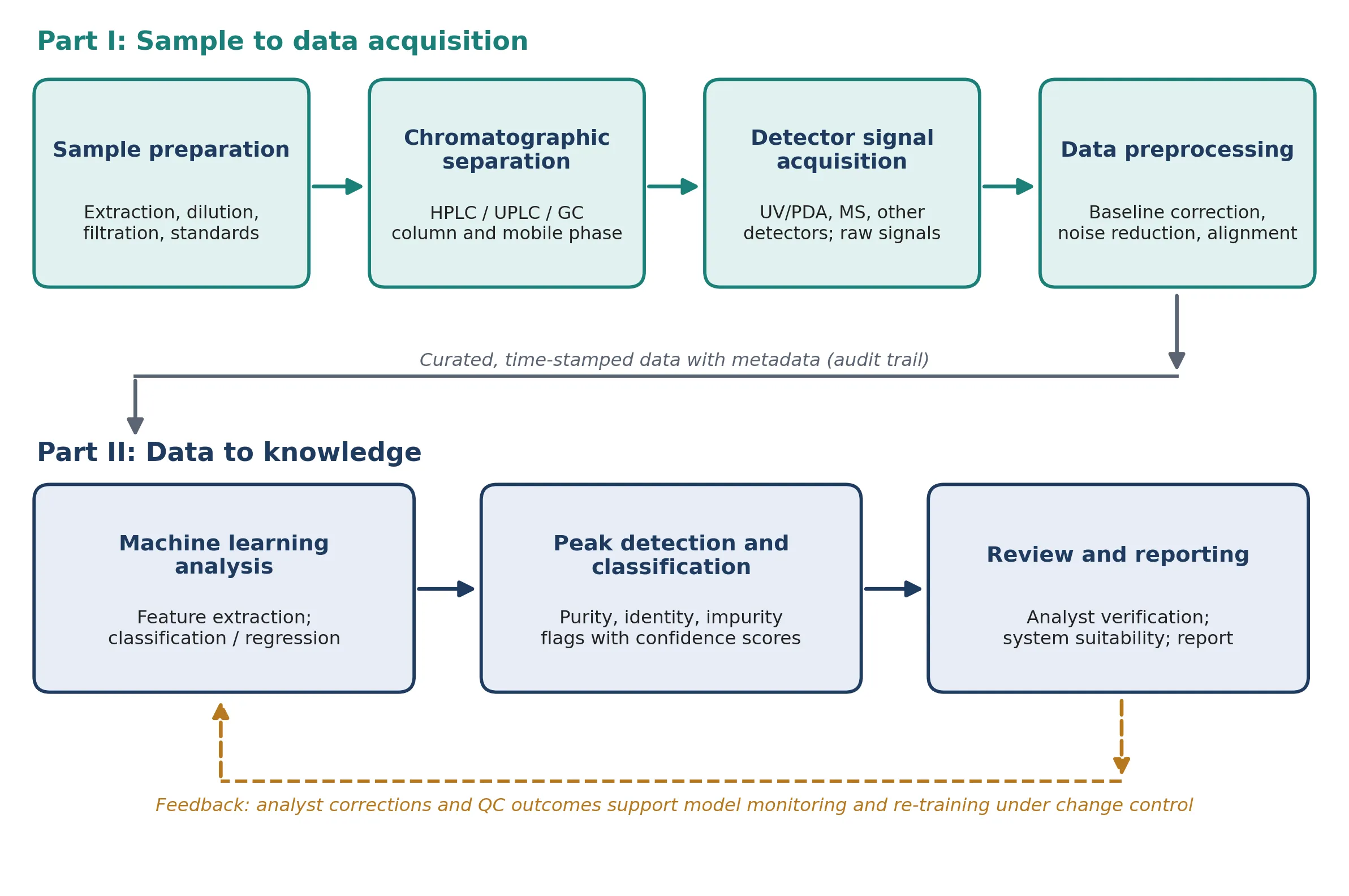
figure

Figure 1: AI-assisted Chromatographic Workflow (Conceptual Schematic; No Experimental Data).

3.4 Spectroscopic analysis

Multivariate calibration is long established for NIR and Raman 22, and ML/DL extends it to mixture identification, blend monitoring and process control 23,38,39. FTIR (material identification, counterfeit screening) and NMR (structure and impurity elucidation) applications are described in the original draft and need supporting pharmaceutical references.

3.5 Quality control and PAT

PAT encourages timely measurement of quality attributes 11, and ANNs can integrate data from several PAT tools for real-time monitoring and feedback 17. NIR-based ML surrogates have supported real-time release testing of dissolution 40, an in-line surrogate was shown in continuous blending 24, and interpretable ANNs gave retrospective process understanding 41 (Figure 2). Model maintenance and calibration transfer remain open issues.
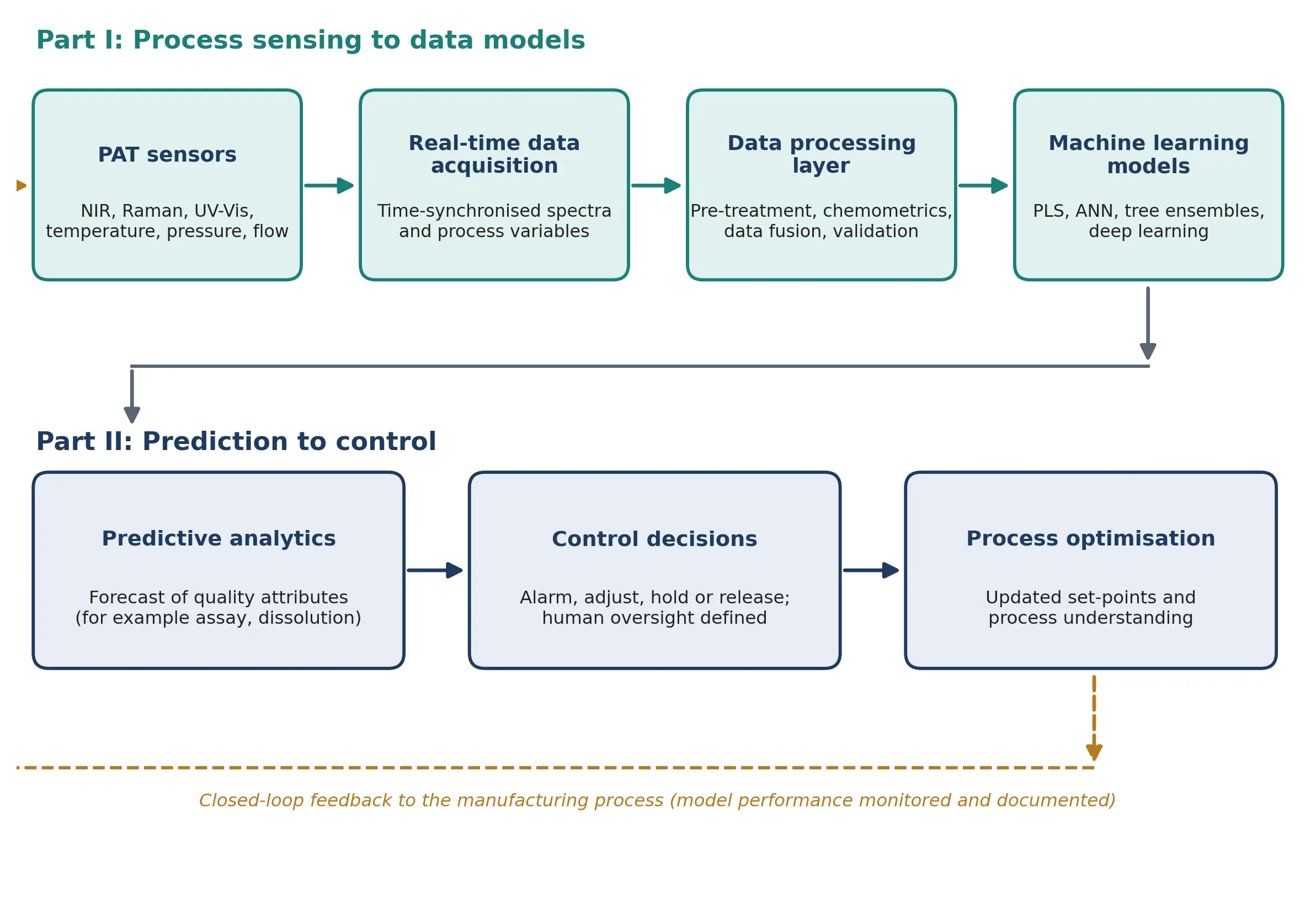
figure

Figure 2: AI-integrated PAT Framework with Closed-Loop Feedback (Conceptual Schematic; No Experimental Data).

3.6 Dissolution, stability and impurity profiling

ANNs trained on NIR or Raman spectra predicted dissolution profiles of extended-release tablets (37 manufacturing settings) more accurately than PLS 19, and of immediate-release tablets with f2 above 59 42; studies are formulation-specific with little cross-formulation validation. Stability follows ICH protocols and stability-indicating methods 43,44; AI could support shelf-life prediction and QbD formulation optimisation 45, but few prospectively validated examples were found. For impurities, MS-based tools can generate candidate structures 26,37, but rare pharmaceutical impurities are underrepresented in training data and confirmation remains necessary.

3.7 Emerging technologies

Explainable AI (for example Shapley-value attributions 46; reviews 47) supports scrutiny but not validation. A digital twin mirrors a physical process 48; a 2020 review found no full digital twin in pharmaceutical manufacturing 18, with later reviews broadening the scope 49. Language models are explored for documentation 27 and LLM agents have planned and executed chemistry experiments 50, as have robotic platforms 51, but these are not quality-control deployments; hallucination, confidentiality and validation are obstacles, and draft EU GMP Annex 22 was reported to exclude generative AI from critical GMP use 52. Federated learning is a candidate answer to data scarcity and confidentiality.

3.8 Regulatory and validation considerations

ICH Q2 (R2) and Q14 provide a lifecycle view of analytical procedures including multivariate methods 12,13; the EMA reflection paper covers AI across the medicinal product lifecycle 14; the FDA draft guidance (January 2025) proposes a seven-step, risk-based credibility assessment tied to a defined context of use 15; and draft Annex 22, with revised Annex 11, would set GMP requirements for AI in manufacturing (consultation July–October 2025) 52. Practically, laboratories should define the context of use first; separate training, validation and test data; apply data-integrity principles; monitor drift; place model changes under change control; and keep human oversight and documentation.

3.9 Literature matrix and research gaps

Table 3: Literature Survey Matrix (Representative Sources)

No. Source Area / technique Reported finding Gap for this review
1 Nagy et al. 17 PAT; ANN review ANNs combine multiple PAT data streams for real-time monitoring and feedback Industrial-scale validation
2 Dharmamoorthy et al. 8 Analysis; AI review Covers quality control, process optimisation, regulatory compliance and challenges No technique-level evidence grading
3 Kowtharapu et al. 9 Analysis; AI models Overviews AI models and conceptual instrument designs Designs not validated
4 Liu et al. 20 RT prediction; DL review Large datasets enabled DL; no single best model Benchmarks; pharma transfer
5 Pan et al. 38 Raman; ML/DL review Reviews preprocessing and AI for mixture identification Real-time pharma use
6 Galata et al. 19 Dissolution; ANN vs PLS ANN beat PLS on NIR/Raman data Single formulation
7 Mészáros et al. 24 RTRT; NIR, PLS, ANN In-line blend uniformity and dissolution prediction Multi-product validation
8 Chen et al. 18 Digital twins; review No full digital twin yet in pharmaceutical manufacturing (2020) Analytical-lab twins

Table 4: Research Gaps and Suggested Directions

Area Gap Suggested direction
Chromatography Real-time peak models; transfer of RT models to validated pharma methods Pharmaceutical benchmark datasets; prospective evaluation
Spectroscopy Few large validated spectral datasets; calibration transfer Shared reference data; transfer learning
Quality control Explainable, regulation-compliant systems Context-of-use validation; uncertainty-aware models
Dissolution / stability Formulation-specific models; little long-term validation Multi-site external validation; real-time confirmation
Impurity profiling Scarce data for rare impurities Curated libraries; orthogonal confirmation
Digital twins / agents Early-stage adoption; outside regulated QC Pilot twins; human-in-the-loop agents under GxP

3.10 Proposed Intelligent Pharmaceutical Analysis Framework (IPAF)

IPAF is a conceptual six-layer architecture (Figure 3): instrumentation and sensors; data infrastructure and integrity; data processing; AI/ML analytics; decision support and control; and governance, validation and regulatory alignment, with explainability, data governance and human oversight as cross-cutting requirements. Autonomy is staged from assisted to automated to autonomous; most reviewed evidence supports the first two. Adoption should begin with low-risk use cases and assisted analytics, move to validated automation for defined contexts of use, and consider closed-loop operation only after sustained monitored performance.
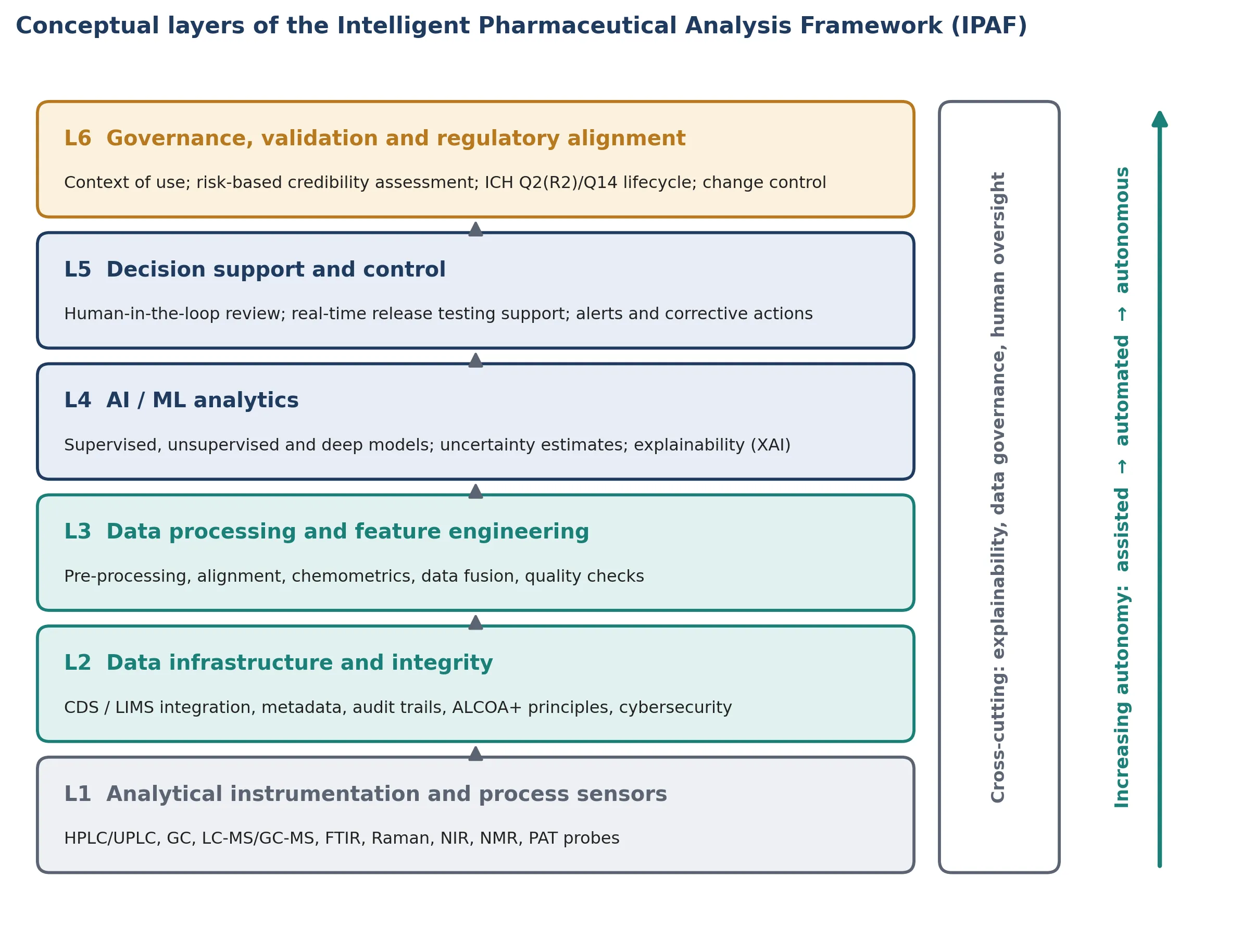
figure

Figure 3: Conceptual Layers of IPAF (Proposed in This Review; Not Experimentally Validated).

3.11 Limitations and future perspectives

This narrative review is limited to English sources and listed databases, without quantitative synthesis; much RT and MS evidence comes from metabolomics; regulatory documents are evolving; and IPAF is unvalidated. Priorities are standardised curated pharmaceutical datasets (including impurity and degradation data), explainable and uncertainty-aware models, prospective multi-site validation, practical lifecycle management with drift monitoring, privacy-preserving collaboration, and carefully governed use of generative AI beginning with non-critical tasks.

CONCLUSION

AI and ML are becoming valuable complements to established analytical methods. The strongest evidence supports spectroscopy-based prediction for PAT and dissolution and data-driven retention-time and structure prediction; evidence for stability forecasting, rare-impurity identification, analytical digital twins and autonomous laboratories is limited. Barriers include scarce standardised datasets, interpretability, data security, model maintenance and validation frameworks acceptable to regulators. Regulation is converging on risk-based, context-of-use credibility assessment and lifecycle control, and IPAF offers a conceptual route toward connected, increasingly automated analytical laboratories.

ACKNOWLEDGEMENT

The authors thank the researchers whose published work underpins this review.

CONFLICT OF INTEREST

The authors declare no financial, commercial, professional, institutional or personal conflicts of interest. No external funding was received.

REFERENCES

  1. Skoog DA, Holler FJ, Crouch SR: Principles of Instrumental Analysis. 7th ed. Boston: Cengage Learning; 2018.
  2. Snyder LR, Kirkland JJ, Dolan JW: Introduction to Modern Liquid Chromatography. 3rd ed. Hoboken (NJ): Wiley; 2010.
  3. Simon LL, Pataki H, Marosi G, et al: Assessment of recent process analytical technology (PAT) trends: a multiauthor review. Org Process Res Dev 2015; 19 (1):3–62.
  4. Fonteyne M, Vercruysse J, De Leersnyder F, Van Snick B, Vervaet C, Remon JP, et al: Process analytical technology for continuous manufacturing of solid-dosage forms. TrAC Trends Anal Chem 2015; 67:159–166.
  5. LeCun Y, Bengio Y, Hinton G: Deep learning. Nature 2015; 521 (7553):436–444.
  6. Kolluri S, Lin J, Liu R, Zhang Y, Zhang W: Machine learning and artificial intelligence in pharmaceutical research and development: a review. AAPS J 2022; 24 (1):19.
  7. Mottaghi-Dastjerdi N, Soltany-Rezaee-Rad M: Advancements and applications of artificial intelligence in pharmaceutical sciences: a comprehensive review. Iran J Pharm Res. doi:10.5812/ijpr-150510.
  8. Dharmamoorthy G, et al: The role of artificial intelligence in pharmaceutical analysis: a comprehensive review. Asian J Pharm 2026; 20 (1):151.
  9. Kowtharapu LP, Katari NK, Muchakayala SK, Marisetti VM: Overview of artificial intelligence (AI) in pharmaceutical analysis: instrument design and industrial applications. Ann Pharm Fr. 2026. doi:10.1016/j.pharma.2026.06.001.
  10. International Council for Harmonisation: ICH Q8 (R2): Pharmaceutical Development. Geneva: ICH; 2009.
  11. US Food and Drug Administration: Guidance for Industry: PAT – A Framework for Innovative Pharmaceutical Development, Manufacturing, and Quality Assurance. 2004.
  12. International Council for Harmonisation: ICH Q2 (R2): Validation of Analytical Procedures. Geneva: ICH; 2023.
  13. International Council for Harmonisation: ICH Q14: Analytical Procedure Development. Geneva: ICH; 2023.
  14. European Medicines Agency: Reflection Paper on the Use of Artificial Intelligence (AI) in the Medicinal Product Lifecycle. Amsterdam: EMA; 2024.
  15. US Food and Drug Administration: Considerations for the Use of Artificial Intelligence to Support Regulatory Decision-Making for Drug and Biological Products: Draft Guidance for Industry and Other Interested Parties. Docket FDA-2024-D-4689. January 2025. Fed Regist 2025; 90 (4).
  16. Ali AMA, Alrobaian MM: Strengths and weaknesses of current and future prospects of artificial intelligence-mounted technologies applied in the development of pharmaceutical products and services. Saudi Pharm J 2024; 32 (5):102043. doi:10.1016/j.jsps.2024.102043.
  17. Nagy B, Galata DL, Farkas A, Nagy ZK: Application of artificial neural networks in the process analytical technology of pharmaceutical manufacturing – a review. AAPS J 2022; 24 (4):74. doi:10.1208/s12248-022-00706-0.
  18. Chen Y, Yang O, Sampat C, Bhalode P, Ramachandran R, Ierapetritou M: Digital twins in pharmaceutical and biopharmaceutical manufacturing: a literature review. Processes 2020; 8 (9):1088. doi:10.3390/pr8091088.
  19. Galata DL, Farkas A, Könyves Z, Mészáros LA, Szabó E, Csontos I, et al: Fast, spectroscopy-based prediction of in vitro dissolution profile of extended release tablets using artificial neural networks. Pharmaceutics 2019; 11 (8):400.
  20. Liu Y, Yoshizawa AC, Ling Y, Okuda S: Insights into predicting small molecule retention times in liquid chromatography using deep learning. J Cheminform 2024; 16:113. doi:10.1186/s13321-024-00905-1.
  21. Geladi P, Kowalski BR: Partial least-squares regression: a tutorial. Anal Chim Acta 1986; 185:1–17.
  22. Roggo Y, Chalus P, Maurer L, Lema-Martinez C, Edmond A, Jent N: A review of near infrared spectroscopy and chemometrics in pharmaceutical technologies. J Pharm Biomed Anal 2007; 44 (3):683–700.
  23. Luo R, Popp J, Bocklitz T: Deep learning for Raman spectroscopy: a review. Analytica 2022; 3 (3):287–301. doi:10.3390/analytica3030020.
  24. Mészáros LA, Gyürkés M, Varga E, Tacsi K, Honti B, Borbás E, et al: Real-time release testing of in vitro dissolution and blend uniformity in a continuous powder blending process by NIR spectroscopy and machine vision. Eur J Pharm Biopharm. 2024.
  25. Dührkop K, Shen H, Meusel M, Rousu J, Böcker S: Searching molecular structure databases with tandem mass spectra using CSI:FingerID. Proc Natl Acad Sci U S A 2015; 112 (41):12580–12585.
  26. Dührkop K, Fleischauer M, Ludwig M, Aksenov AA, Melnik AV, Meusel M, et al: SIRIUS 4: a rapid tool for turning tandem mass spectra into metabolite structure information. Nat Methods 2019; 16 (4):299–302.
  27. Han Y, Tao J: Revolutionizing pharma: unveiling the AI and LLM trends in the pharmaceutical industry. arXiv:2401.10273. 2024.
  28. Breiman L: Random forests. Mach Learn 2001; 45 (1):5–32.
  29. Cortes C, Vapnik V: Support-vector networks. Mach Learn 1995; 20 (3):273–297.
  30. Chen T, Guestrin C: XGBoost: a scalable tree boosting system. In: Proceedings of the 22nd ACM SIGKDD International Conference on Knowledge Discovery and Data Mining. New York: ACM; 2016. p. 785–794.
  31. Hochreiter S, Schmidhuber J: Long short-term memory. Neural Comput 1997; 9 (8):1735–1780.
  32. Vaswani A, Shazeer N, Parmar N, Uszkoreit J, Jones L, Gomez AN, et al: Attention is all you need. Adv Neural Inf Process Syst 2017; 30:5998–6008.
  33. Domingo-Almenara X, Guijas C, Billings E, Montenegro-Burke JR, Uritboonthai W, Aisporna AE, et al: The METLIN small molecule dataset for machine learning-based retention time prediction. Nat Commun 2019; 10:5811.
  34. Kretschmer F, Harrieder EM, Hoffmann MA, Böcker S, Witting M: RepoRT: a comprehensive repository for small molecule retention times. Nat Methods. 2024. doi:10.1038/s41592-023-02143-z.
  35. Haddad PR, Taraji M, Szücs R: Prediction of analyte retention time in liquid chromatography. Anal Chem 2021; 93 (1):228–256.
  36. Wang F, Liigand J, Tian S, Arndt D, Greiner R, Wishart DS: CFM-ID 4.0: more accurate ESI-MS/MS spectral prediction and compound identification. Anal Chem 2021; 93 (34):11692–11700.
  37. Stravs MA, Dührkop K, Böcker S, Zamboni N: MSNovelist: de novo structure generation from mass spectra. Nat Methods 2022; 19 (7):865–870.
  38. Pan L, Zhang P, Daengngam C, Chongcheawchamnan M: A review of artificial intelligence methods combined with Raman spectroscopy to identify the composition of substances. arXiv:2104.04599. 2021.
  39. De Beer T, Burggraeve A, Fonteyne M, Saerens L, Remon JP, Vervaet C: Near infrared and Raman spectroscopy for the in-process monitoring of pharmaceutical production processes. Int J Pharm 2011; 417 (1–2):32–47. doi:10.1016/j.ijpharm.2010.12.012.
  40. Galata DL, et al: Real-time release testing of dissolution based on surrogate models developed by machine learning algorithms using NIR spectra, compression force and particle size distribution as input data. Int J Pharm. 2021.
  41. Nagy B, Szabados-Nacsa Á, Fülöp G, Nagyné Turák A, Galata DL, Farkas A, et al: Interpretable artificial neural networks for retrospective QbD of pharmaceutical tablet manufacturing based on a pilot-scale developmental dataset. Int J Pharm 2023; 633:122620.
  42. Péterfi O, Nagy ZK, Sipos E, Galata DL: Artificial intelligence-based prediction of in vitro dissolution profile of immediate release tablets with near-infrared and Raman spectroscopy. Period Polytech Chem Eng. 2023.
  43. Bakshi M, Singh S: Development of validated stability-indicating assay methods – critical review. J Pharm Biomed Anal 2002; 28 (6):1011–1040.
  44. Blessy M, Patel RD, Prajapati PN, Agrawal YK: Development of forced degradation and stability indicating studies of drugs – a review. J Pharm Anal 2014; 4 (3):159–165.
  45. Yu LX: Pharmaceutical quality by design: product and process development, understanding, and control. Pharm Res 2008; 25 (4):781–791.
  46. Lundberg SM, Lee SI: A unified approach to interpreting model predictions. Adv Neural Inf Process Syst 2017; 30:4765–4774.
  47. Samek W, Montavon G, Lapuschkin S, Anders CJ, Müller KR: Explaining deep neural networks and beyond: a review of methods and applications. Proc IEEE 2021; 109 (3):247–278.
  48. Grieves M: Digital Twin: Manufacturing Excellence through Virtual Factory Replication. White paper; 2014.
  49. Maharjan R, Kim NA, Kim KH, Jeong SH: Transformative roles of digital twins from drug discovery to continuous manufacturing: pharmaceutical and biopharmaceutical perspectives. Int J Pharm X. 2025. doi:10.1016/j.ijpx.2025.100409.
  50. Boiko DA, MacKnight R, Kline B, Gomes G: Autonomous chemical research with large language models. Nature 2023; 624 (7992):570–578.
  51. Burger B, Maffettone PM, Gusev VV, Aitchison CM, Bai Y, Wang X, et al: A mobile robotic chemist. Nature 2020; 583 (7815):237–241.
  52. PIC/S; European Medicines Agency: Joint stakeholders consultation on the revision of Chapter 4 (Documentation), Annex 11 (Computerised Systems) and the new Annex 22 (Artificial Intelligence) of the PIC/S and EU GMP Guides (consultation 7 July–7 October 2025). Available from: https://picscheme.org/en/news/joint-stakeholders-consultation-on-the-revision-of-chapter-4.

Reference

  1. Skoog DA, Holler FJ, Crouch SR: Principles of Instrumental Analysis. 7th ed. Boston: Cengage Learning; 2018.
  2. Snyder LR, Kirkland JJ, Dolan JW: Introduction to Modern Liquid Chromatography. 3rd ed. Hoboken (NJ): Wiley; 2010.
  3. Simon LL, Pataki H, Marosi G, et al: Assessment of recent process analytical technology (PAT) trends: a multiauthor review. Org Process Res Dev 2015; 19 (1):3–62.
  4. Fonteyne M, Vercruysse J, De Leersnyder F, Van Snick B, Vervaet C, Remon JP, et al: Process analytical technology for continuous manufacturing of solid-dosage forms. TrAC Trends Anal Chem 2015; 67:159–166.
  5. LeCun Y, Bengio Y, Hinton G: Deep learning. Nature 2015; 521 (7553):436–444.
  6. Kolluri S, Lin J, Liu R, Zhang Y, Zhang W: Machine learning and artificial intelligence in pharmaceutical research and development: a review. AAPS J 2022; 24 (1):19.
  7. Mottaghi-Dastjerdi N, Soltany-Rezaee-Rad M: Advancements and applications of artificial intelligence in pharmaceutical sciences: a comprehensive review. Iran J Pharm Res. doi:10.5812/ijpr-150510.
  8. Dharmamoorthy G, et al: The role of artificial intelligence in pharmaceutical analysis: a comprehensive review. Asian J Pharm 2026; 20 (1):151.
  9. Kowtharapu LP, Katari NK, Muchakayala SK, Marisetti VM: Overview of artificial intelligence (AI) in pharmaceutical analysis: instrument design and industrial applications. Ann Pharm Fr. 2026. doi:10.1016/j.pharma.2026.06.001.
  10. International Council for Harmonisation: ICH Q8 (R2): Pharmaceutical Development. Geneva: ICH; 2009.
  11. US Food and Drug Administration: Guidance for Industry: PAT – A Framework for Innovative Pharmaceutical Development, Manufacturing, and Quality Assurance. 2004.
  12. International Council for Harmonisation: ICH Q2 (R2): Validation of Analytical Procedures. Geneva: ICH; 2023.
  13. International Council for Harmonisation: ICH Q14: Analytical Procedure Development. Geneva: ICH; 2023.
  14. European Medicines Agency: Reflection Paper on the Use of Artificial Intelligence (AI) in the Medicinal Product Lifecycle. Amsterdam: EMA; 2024.
  15. US Food and Drug Administration: Considerations for the Use of Artificial Intelligence to Support Regulatory Decision-Making for Drug and Biological Products: Draft Guidance for Industry and Other Interested Parties. Docket FDA-2024-D-4689. January 2025. Fed Regist 2025; 90 (4).
  16. Ali AMA, Alrobaian MM: Strengths and weaknesses of current and future prospects of artificial intelligence-mounted technologies applied in the development of pharmaceutical products and services. Saudi Pharm J 2024; 32 (5):102043. doi:10.1016/j.jsps.2024.102043.
  17. Nagy B, Galata DL, Farkas A, Nagy ZK: Application of artificial neural networks in the process analytical technology of pharmaceutical manufacturing – a review. AAPS J 2022; 24 (4):74. doi:10.1208/s12248-022-00706-0.
  18. Chen Y, Yang O, Sampat C, Bhalode P, Ramachandran R, Ierapetritou M: Digital twins in pharmaceutical and biopharmaceutical manufacturing: a literature review. Processes 2020; 8 (9):1088. doi:10.3390/pr8091088.
  19. Galata DL, Farkas A, Könyves Z, Mészáros LA, Szabó E, Csontos I, et al: Fast, spectroscopy-based prediction of in vitro dissolution profile of extended release tablets using artificial neural networks. Pharmaceutics 2019; 11 (8):400.
  20. Liu Y, Yoshizawa AC, Ling Y, Okuda S: Insights into predicting small molecule retention times in liquid chromatography using deep learning. J Cheminform 2024; 16:113. doi:10.1186/s13321-024-00905-1.
  21. Geladi P, Kowalski BR: Partial least-squares regression: a tutorial. Anal Chim Acta 1986; 185:1–17.
  22. Roggo Y, Chalus P, Maurer L, Lema-Martinez C, Edmond A, Jent N: A review of near infrared spectroscopy and chemometrics in pharmaceutical technologies. J Pharm Biomed Anal 2007; 44 (3):683–700.
  23. Luo R, Popp J, Bocklitz T: Deep learning for Raman spectroscopy: a review. Analytica 2022; 3 (3):287–301. doi:10.3390/analytica3030020.
  24. Mészáros LA, Gyürkés M, Varga E, Tacsi K, Honti B, Borbás E, et al: Real-time release testing of in vitro dissolution and blend uniformity in a continuous powder blending process by NIR spectroscopy and machine vision. Eur J Pharm Biopharm. 2024.
  25. Dührkop K, Shen H, Meusel M, Rousu J, Böcker S: Searching molecular structure databases with tandem mass spectra using CSI:FingerID. Proc Natl Acad Sci U S A 2015; 112 (41):12580–12585.
  26. Dührkop K, Fleischauer M, Ludwig M, Aksenov AA, Melnik AV, Meusel M, et al: SIRIUS 4: a rapid tool for turning tandem mass spectra into metabolite structure information. Nat Methods 2019; 16 (4):299–302.
  27. Han Y, Tao J: Revolutionizing pharma: unveiling the AI and LLM trends in the pharmaceutical industry. arXiv:2401.10273. 2024.
  28. Breiman L: Random forests. Mach Learn 2001; 45 (1):5–32.
  29. Cortes C, Vapnik V: Support-vector networks. Mach Learn 1995; 20 (3):273–297.
  30. Chen T, Guestrin C: XGBoost: a scalable tree boosting system. In: Proceedings of the 22nd ACM SIGKDD International Conference on Knowledge Discovery and Data Mining. New York: ACM; 2016. p. 785–794.
  31. Hochreiter S, Schmidhuber J: Long short-term memory. Neural Comput 1997; 9 (8):1735–1780.
  32. Vaswani A, Shazeer N, Parmar N, Uszkoreit J, Jones L, Gomez AN, et al: Attention is all you need. Adv Neural Inf Process Syst 2017; 30:5998–6008.
  33. Domingo-Almenara X, Guijas C, Billings E, Montenegro-Burke JR, Uritboonthai W, Aisporna AE, et al: The METLIN small molecule dataset for machine learning-based retention time prediction. Nat Commun 2019; 10:5811.
  34. Kretschmer F, Harrieder EM, Hoffmann MA, Böcker S, Witting M: RepoRT: a comprehensive repository for small molecule retention times. Nat Methods. 2024. doi:10.1038/s41592-023-02143-z.
  35. Haddad PR, Taraji M, Szücs R: Prediction of analyte retention time in liquid chromatography. Anal Chem 2021; 93 (1):228–256.
  36. Wang F, Liigand J, Tian S, Arndt D, Greiner R, Wishart DS: CFM-ID 4.0: more accurate ESI-MS/MS spectral prediction and compound identification. Anal Chem 2021; 93 (34):11692–11700.
  37. Stravs MA, Dührkop K, Böcker S, Zamboni N: MSNovelist: de novo structure generation from mass spectra. Nat Methods 2022; 19 (7):865–870.
  38. Pan L, Zhang P, Daengngam C, Chongcheawchamnan M: A review of artificial intelligence methods combined with Raman spectroscopy to identify the composition of substances. arXiv:2104.04599. 2021.
  39. De Beer T, Burggraeve A, Fonteyne M, Saerens L, Remon JP, Vervaet C: Near infrared and Raman spectroscopy for the in-process monitoring of pharmaceutical production processes. Int J Pharm 2011; 417 (1–2):32–47. doi:10.1016/j.ijpharm.2010.12.012.
  40. Galata DL, et al: Real-time release testing of dissolution based on surrogate models developed by machine learning algorithms using NIR spectra, compression force and particle size distribution as input data. Int J Pharm. 2021.
  41. Nagy B, Szabados-Nacsa Á, Fülöp G, Nagyné Turák A, Galata DL, Farkas A, et al: Interpretable artificial neural networks for retrospective QbD of pharmaceutical tablet manufacturing based on a pilot-scale developmental dataset. Int J Pharm 2023; 633:122620.
  42. Péterfi O, Nagy ZK, Sipos E, Galata DL: Artificial intelligence-based prediction of in vitro dissolution profile of immediate release tablets with near-infrared and Raman spectroscopy. Period Polytech Chem Eng. 2023.
  43. Bakshi M, Singh S: Development of validated stability-indicating assay methods – critical review. J Pharm Biomed Anal 2002; 28 (6):1011–1040.
  44. Blessy M, Patel RD, Prajapati PN, Agrawal YK: Development of forced degradation and stability indicating studies of drugs – a review. J Pharm Anal 2014; 4 (3):159–165.
  45. Yu LX: Pharmaceutical quality by design: product and process development, understanding, and control. Pharm Res 2008; 25 (4):781–791.
  46. Lundberg SM, Lee SI: A unified approach to interpreting model predictions. Adv Neural Inf Process Syst 2017; 30:4765–4774.
  47. Samek W, Montavon G, Lapuschkin S, Anders CJ, Müller KR: Explaining deep neural networks and beyond: a review of methods and applications. Proc IEEE 2021; 109 (3):247–278.
  48. Grieves M: Digital Twin: Manufacturing Excellence through Virtual Factory Replication. White paper; 2014.
  49. Maharjan R, Kim NA, Kim KH, Jeong SH: Transformative roles of digital twins from drug discovery to continuous manufacturing: pharmaceutical and biopharmaceutical perspectives. Int J Pharm X. 2025. doi:10.1016/j.ijpx.2025.100409.
  50. Boiko DA, MacKnight R, Kline B, Gomes G: Autonomous chemical research with large language models. Nature 2023; 624 (7992):570–578.
  51. Burger B, Maffettone PM, Gusev VV, Aitchison CM, Bai Y, Wang X, et al: A mobile robotic chemist. Nature 2020; 583 (7815):237–241.
  52. PIC/S; European Medicines Agency: Joint stakeholders consultation on the revision of Chapter 4 (Documentation), Annex 11 (Computerised Systems) and the new Annex 22 (Artificial Intelligence) of the PIC/S and EU GMP Guides (consultation 7 July–7 October 2025). Available from: https://picscheme.org/en/news/joint-stakeholders-consultation-on-the-revision-of-chapter-4.

Photo
Nagarjuna G.R.
Corresponding author

Department of computer science & engineering (AI and ML), S J C Institute of Technology, Chikballapur, Karnataka, India.

Photo
Veerap Anusha
Co-author

Department of pharmaceutical sciences, Sri K.V. College of Pharmacy, Chikballapur, Karnataka, India.

Nagarjuna G. R., Veerap Anusha, Artificial Intelligence and Machine Learning Applications in Pharmaceutical Analysis: From Traditional Analytical Approaches to Intelligent Pharmaceutical Systems – A Comprehensive Review, Int. J. of Pharm. Sci., 2026, Vol 4, Issue 10, 4866-4874. https://doi.org/10.5281/zenodo.23829637

More related articles
FTIR Spectroscopic Investigation of Drug–Excipie...
Mitalkumari Patel, Praful Bharadia...
Evaluation of Anti-inflammatory, Anti-microbial Ac...
Rohit Kumar Bargah, Heeralal Singh, Arun Kumar Kashyap...
Ashwagandha “(Withania somnifera) as a Nutraceutical: Its Phytochemical Compos...
Shreya Tondlikar, Snehal Jadhav, Sneha Jankar, Saurabh Patara, Pratiksha Pandit, Aditi Bangar...
A Review on Phytochemical and Pharmacological Perspective of Medical Plans Used ...
Tanuja Baravkar, Umesh Joshi, K. R. Biyani, Shruti Deshmukh, Snehal Wankhade, Utkarsha Mathe, Trupti...