

We use cookies to ensure our website works properly and to personalise your experience. Cookies policy
¹Department of Pharmaceutics, Shree Naranjibhai Lalbhai Patel College of Pharmacy, Umrakh, Bardoli.
²Department of Pharmaceutics, Prime Institute of Pharmacy, Navsari.
³Department of Pharmacology, Shree Naranjibhai Lalbhai Patel College of Pharmacy, Umrakh, Bardoli.
?Department of Pharmaceutics, Sardar Patel University, Anand.
Background: Controlled release drug delivery systems (CRDDS) are designed to provide prolonged and predictable drug release, improve therapeutic efficacy, reduce dosing frequency, minimize adverse effects, and enhance patient compliance. Objectives: To review the application of Artificial Intelligence (AI) and Machine Learning (ML) techniques in predicting drug release and absorption kinetics and to highlight their role in optimizing controlled release drug delivery systems. Materials and Methods: Relevant scientific literature concerning AI/ML-based prediction and optimization of controlled release drug delivery systems was reviewed, with emphasis on Artificial Neural Networks (ANN), Support Vector Machines (SVM), Random Forest (RF), Deep Learning (DL), Gradient Boosting, Bayesian Optimization, dissolution prediction, formulation optimization, bioavailability, pharmacokinetics, Physiologically Based Pharmacokinetic (PBPK) modeling, and in vitro–in vivo correlation (IVIVC). Results: AI and ML approaches have demonstrated potential for predicting dissolution profiles, optimizing formulation and manufacturing variables, selecting suitable excipients, and designing matrix and coated controlled-release systems. These approaches also facilitate prediction of bioavailability, intestinal absorption, pharmacokinetic parameters, and IVIVC. Integration of AI with smart drug delivery systems, personalized medicine, adaptive dosing, nanocarriers, and 3D-printed dosage forms provides opportunities for patient-specific and responsive drug delivery. Conclusion: AI represents a promising data-driven approach for improving the prediction, optimization, and development of controlled release drug delivery systems. Despite its potential to enhance predictive accuracy and reduce experimental workload, challenges related to data quality, model interpretability, validation, and regulatory acceptance need to be addressed for successful translation into pharmaceutical development.
Controlled release drug delivery systems (CRDDS) have earned a central place in pharmaceutical research, largely because they let drugs be released at a predetermined rate over an extended period rather than all at once. Compared to conventional dosage forms, this offers several real advantages: plasma drug concentrations stay more consistent, patients need fewer doses, side effects are often reduced, and compliance tends to improve simply because there's less to remember. None of this works, though, without being able to accurately predict how a drug will be released, absorbed, and processed in the body. And that's where things get complicated-formulation variables and physiological factors interact in ways that are genuinely hard to untangle, which is exactly why more advanced computational approaches have become necessary for improving both prediction accuracy and formulation efficiency. [1,3]
Conventional pharmaceutical formulation development primarily relies on empirical experimentation and mechanistic mathematical models. Empirical methods involve repeated laboratory trials to optimize formulation variables, making the development process labor-intensive, expensive, and time-consuming. Mechanistic models, including zero-order, first-order, Higuchi, Hixson–Crowell, and Korsmeyer–Peppas equations, have been widely used to explain drug release mechanisms. Although these models provide valuable scientific understanding, they often assume simplified conditions and may not adequately describe the complex nonlinear interactions among formulation composition, manufacturing parameters, and physiological variables. Consequently, traditional approaches may have limited predictive capability when developing advanced controlled release formulations or personalized drug delivery systems.[1,4]
The rapid advancement of Artificial Intelligence (AI) and Machine Learning (ML) has introduced a new paradigm in pharmaceutical research and development. AI algorithms such as Artificial Neural Networks (ANN), Support Vector Machines (SVM), Random Forest (RF), Deep Learning (DL), Gradient Boosting, and Bayesian Optimization can analyze large pharmaceutical datasets and identify complex relationships that are difficult to detect using conventional statistical methods. These technologies are increasingly being applied to predict dissolution profiles, optimize formulations, estimate bioavailability, simulate intestinal absorption, improve physiologically based pharmacokinetic (PBPK) models, and enhance in vitro–in vivo correlation (IVIVC). AI also supports the development of personalized medicine by enabling patient-specific dose optimization and adaptive drug delivery systems. Through predictive modeling and data-driven decision-making, AI significantly reduces formulation development time, minimizes experimental trials, lowers development costs, and improves the quality of pharmaceutical products. [1-5]
This review aims to provide a focused overview of how Artificial Intelligence is being applied in pharmaceutical research, with particular emphasis on predicting drug release and absorption kinetics in controlled release drug delivery systems.
Specifically, it aims to:
Examine how AI models predict dissolution profiles and optimize formulation variables, reducing dependence on extensive laboratory trials.
Assess AI's role in designing controlled release dosage forms, including matrix tablets and coated systems.
Evaluate AI applications in predicting bioavailability, intestinal absorption, PBPK modeling, and IVIVC.
Highlight AI's contribution to personalized medicine and adaptive drug delivery.
Critically summarize recent literature to identify key opportunities and challenges in integrating AI into pharmaceutical development.
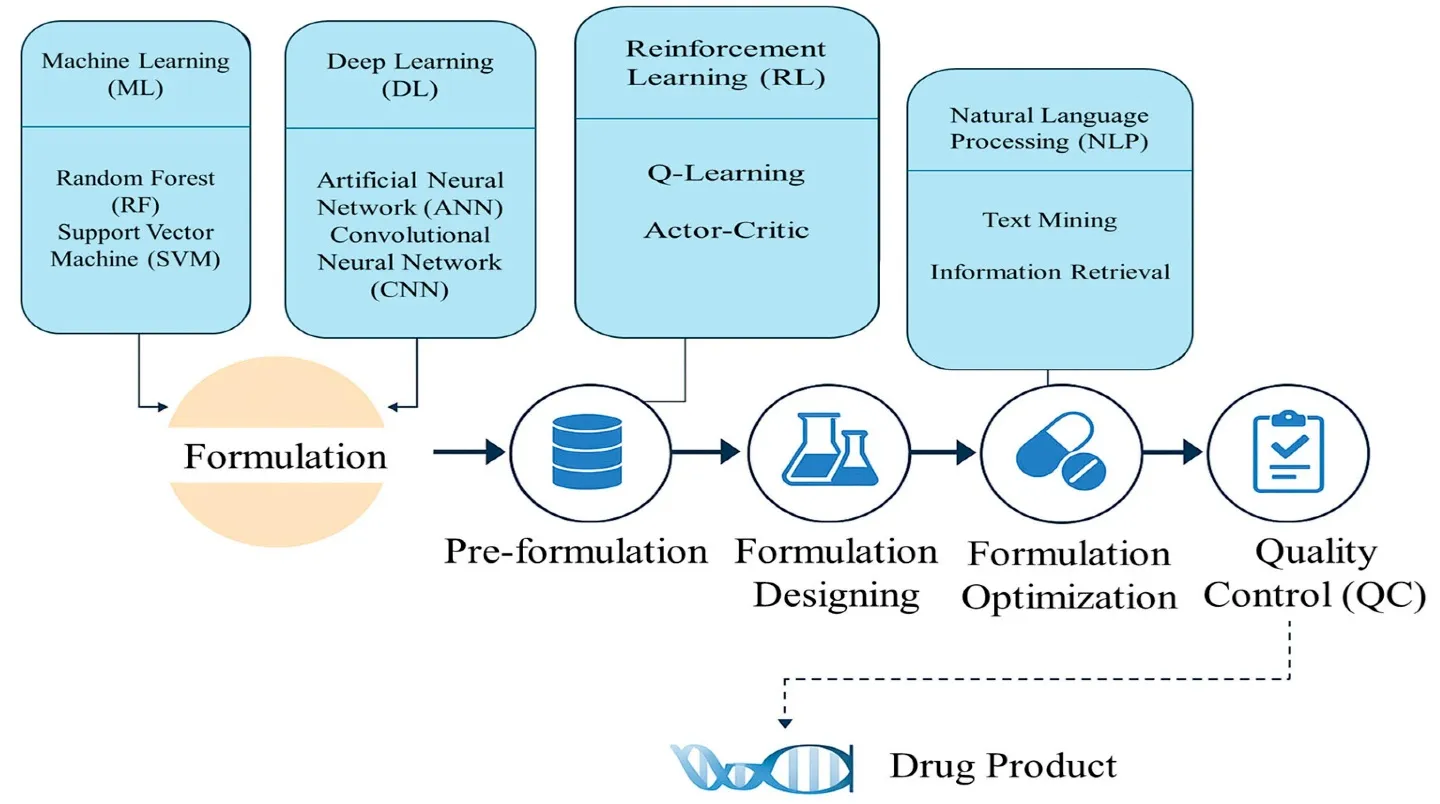
Fig – 1 - Introduction
Fundamentals of Drug Release and Absorption Kinetics
Understanding the principles governing drug release and absorption is essential for developing effective controlled release drug delivery systems. Drug release determines the rate and extent at which an active pharmaceutical ingredient becomes available for absorption, while absorption kinetics influences the onset, intensity, and duration of therapeutic action. Conventional mathematical models have long been used to explain these processes; however, they often fail to accurately describe the complex interactions among formulation variables, physiological conditions, and patient-specific factors. Recent advances in Artificial Intelligence (AI) have introduced data-driven approaches capable of predicting drug release behavior, absorption kinetics, and pharmacokinetic performance with significantly higher accuracy than traditional empirical methods. AI-driven predictive models are therefore becoming an integral part of modern pharmaceutical formulation development and optimization.[1-5]
Drug Dissolution and Drug Release Mechanisms
Drug dissolution is the process by which a solid drug dissolves in a biological fluid before becoming available for absorption. In controlled release formulations, dissolution is closely associated with drug release, where the active pharmaceutical ingredient is released gradually over a predetermined period. The mechanism of drug release depends on the physicochemical properties of the drug, the characteristics of the polymer matrix, environmental conditions, and the design of the dosage form.
Controlled release formulations generally release drugs through one or more of the following mechanisms:
Diffusion-controlled release
Erosion-controlled release
Swelling-controlled release
In many modern dosage forms, these mechanisms occur simultaneously, making drug release highly complex. Understanding these mechanisms is essential because they directly influence dissolution profiles, absorption kinetics, and therapeutic performance. AI models have recently been developed to predict these release mechanisms by analyzing formulation variables and large experimental datasets, reducing reliance on extensive laboratory experimentation. [1,3]
Diffusion-Controlled Drug Release
AI has significantly improved the prediction of diffusion-controlled drug release by learning complex relationships among formulation variables that cannot be accurately represented by conventional diffusion equations Instead of relying solely on Fickian diffusion equations, AI models can simultaneously evaluate multiple formulation variables and generate highly accurate predictions of release kinetics. This capability substantially reduces formulation development time, minimizes experimental trials, and supports Quality by Design (QbD)-based formulation optimization. Recent studies have demonstrated that AI-assisted predictive models outperform conventional mathematical models when analyzing complex diffusion-controlled systems.[1,3,5]
Erosion-Controlled Drug Release
Predicting polymer degradation experimentally requires lengthy stability studies and repeated dissolution testing. AI overcomes this limitation by analyzing polymer characteristics, degradation behavior, environmental conditions, and previous formulation data to estimate erosion rates and corresponding drug release profiles. Machine learning algorithms can optimize biodegradable polymer selection and predict release duration before formulation development. AI-driven predictive modeling therefore reduces development costs while improving formulation accuracy and consistency. Recent pharmaceutical studies have highlighted AI as a valuable tool for predicting erosion-controlled drug release and optimizing biodegradable drug delivery systems. [1,4,5]
Swelling-Controlled Drug Release
Swelling-controlled systems involve highly complex interactions among polymer hydration, diffusion, erosion, and matrix relaxation, making mathematical prediction challenging. AI-based predictive models can integrate multiple formulation variables, including polymer viscosity, swelling index, water uptake, and dissolution data, to accurately estimate release kinetics. Deep learning and machine learning algorithms have demonstrated superior performance in modeling swelling-controlled systems because they capture nonlinear relationships that conventional mechanistic equations cannot adequately describe. AI therefore supports rapid formulation optimization, reduces experimental workload, and facilitates the development of intelligent controlled release dosage forms capable of delivering consistent therapeutic performance.[1,3,5]
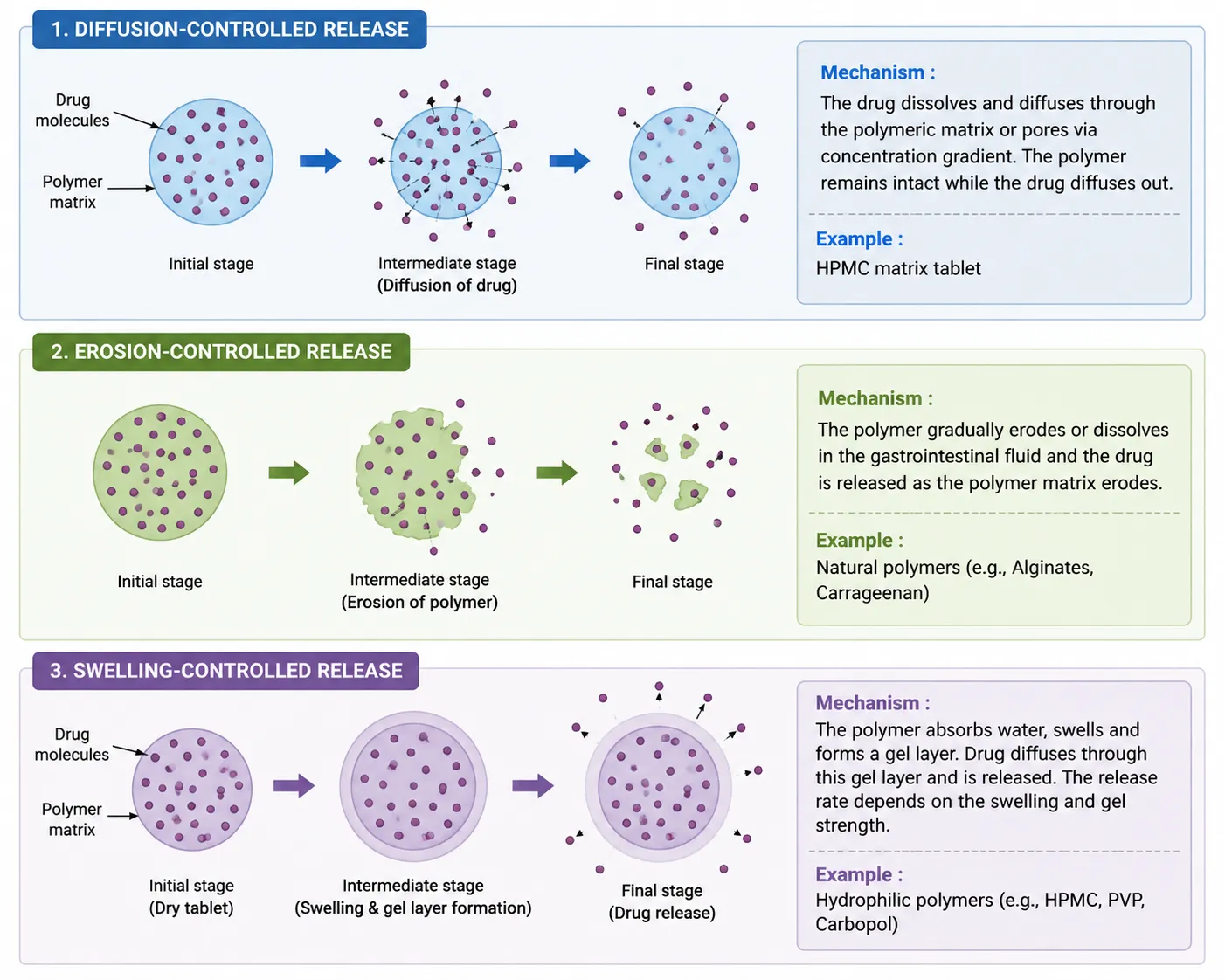
Fig – 2 - Drug Dissolution and Drug Release Mechanisms
Pharmacokinetic Basics (ADME)
Drug release from a pharmaceutical dosage form does not guarantee therapeutic effectiveness unless the released drug is successfully absorbed and reaches the site of action. Pharmacokinetics describes the movement of a drug through the body and is commonly explained by the ADME process, which includes Absorption, Distribution, Metabolism, and Excretion. These four processes determine the onset, intensity, and duration of drug action and are therefore critical during the development of controlled release formulations. Understanding ADME is also essential for developing predictive AI models because these processes directly influence drug release behavior, bioavailability, and therapeutic outcomes.
Absorption
Absorption is the process by which a drug moves from its site of administration into the systemic circulation. For orally administered controlled release formulations, absorption depends on the dissolution rate of the drug, gastrointestinal pH, intestinal permeability, gastric emptying time, membrane transport, and first-pass metabolism.
Artificial Intelligence has become an important tool for predicting drug absorption by analyzing molecular descriptors, dissolution profiles, permeability data, and physiological parameters simultaneously. Machine learning models can estimate oral bioavailability, intestinal permeability, and absorption kinetics without extensive in vivo experimentation. AI is also integrated with Physiologically Based Pharmacokinetic (PBPK) models to improve prediction of absorption profiles and optimize formulation design during early drug development.[1-4]
Distribution
Following absorption, drug molecules are distributed from the bloodstream to various tissues and organs. Drug distribution depends on several physiological and physicochemical factors, including plasma protein binding, tissue permeability, blood flow, lipophilicity, and molecular size. For controlled release formulations, maintaining appropriate drug distribution is important because prolonged drug release should provide sustained therapeutic concentrations without excessive tissue accumulation.
AI models can predict tissue distribution by integrating physicochemical properties with physiological datasets. Machine learning algorithms estimate important pharmacokinetic parameters such as volume of distribution and tissue partition coefficients, allowing researchers to evaluate drug disposition before clinical studies. AI-assisted PBPK models further improve prediction accuracy by incorporating patient-specific physiological information.[2,4]
Metabolism
Drug metabolism refers to the enzymatic conversion of drug molecules into metabolites, primarily within the liver by cytochrome P450 (CYP450) enzymes. Metabolism influences drug half-life, bioavailability, therapeutic activity, and toxicity. Controlled release formulations are often designed to maintain therapeutic concentrations while minimizing extensive first-pass metabolism.
Artificial Intelligence assists in predicting metabolic pathways, enzyme interactions, and metabolite formation using molecular descriptors and biological datasets. AI algorithms can identify compounds susceptible to extensive hepatic metabolism and predict potential drug-drug interactions. These predictions facilitate early optimization of formulation strategies and improve overall drug safety. [2,5]
Excretion
Excretion is the final pharmacokinetic process responsible for eliminating drugs and their metabolites from the body. Drugs are primarily eliminated through the kidneys, although biliary, pulmonary, and intestinal excretion may also occur. The rate of drug elimination influences dosing frequency, accumulation, and therapeutic duration. Controlled release formulations are designed to compensate for elimination by providing sustained drug release over an extended period.
Machine learning algorithms can predict drug clearance, renal elimination, half-life, and total body clearance by analyzing pharmacokinetic and physiological data. AI-assisted prediction of excretion parameters contributes to dose optimization, personalized therapy, and virtual clinical simulations, reducing the need for extensive pharmacokinetic studies.[2,5]
Mathematical Models Used to Describe Drug Release
Mathematical models are widely used to describe the kinetics of drug release from pharmaceutical dosage forms. These models help researchers understand release mechanisms and compare different formulations. However, conventional mathematical models generally assume ideal release conditions and often fail to explain the complex nonlinear behavior observed in modern controlled release systems. Artificial Intelligence complements these classical models by learning from experimental datasets and improving prediction accuracy.
Zero-Order Model
The zero-order model describes systems that release a constant amount of drug per unit time, independent of drug concentration.
Equation
Qt = Q₀ + K₀t
Where:
Qt = Amount of drug released at time t
Q₀ = Initial amount of drug
K₀ = Zero-order release constant
AI models improve zero-order prediction by analyzing multiple formulation variables simultaneously instead of assuming a perfectly constant release rate. Machine learning algorithms can identify deviations from ideal zero-order behavior and optimize formulation variables to achieve sustained release profiles more accurately. [9,10]
First-Order Model
The first-order model assumes that drug release is proportional to the amount of drug remaining in the dosage form.
Equation
log Qt = log Q₀ − Kt / 2.303
AI algorithms recognize nonlinear release behavior that cannot be fully explained by first-order equations. By integrating dissolution data, polymer characteristics, and formulation variables, machine learning models generate more realistic release predictions than conventional kinetic equations alone. [9,10]
Higuchi Model
The Higuchi model is one of the most widely used mathematical models for describing diffusion-controlled drug release from matrix systems. It assumes that drug release is primarily governed by diffusion through a porous matrix.
Equation
Qt = KH √t
Where:
Qt = Amount of drug released
KH = Higuchi dissolution constant
Machine learning models overcome Higuchi model limitations by considering multiple interacting variables such as polymer concentration, porosity, particle size, swelling behavior, and erosion. AI therefore provides more accurate prediction of diffusion-controlled release under real physiological conditions than the classical Higuchi equation alone. [6,7]
Korsmeyer–Peppas Model
The Korsmeyer–Peppas model is a semi-empirical equation used when drug release involves more than one release mechanism.
Equation
Mt/M∞ = Ktⁿ
Where:
Mt/M∞ = Fraction of drug released
K = Release constant
n = Release exponent
Interpretation of n
n ≤ 0.45 → Fickian diffusion
0.45 < n < 0.89 → Non-Fickian (anomalous) transport
n = 0.89 → Case II transport
n > 0.89 → Super Case II transport
Rather than estimating only the release exponent (n), AI evaluates the combined influence of diffusion, swelling, erosion, polymer relaxation, and environmental conditions. Deep learning models therefore provide more comprehensive prediction of complex release mechanisms than the Korsmeyer–Peppas equation alone, particularly for advanced controlled release formulations.[9,10]
APPLICATIONS OF AI IN PREDICTING DRUG RELEASE
Pharmaceutical formulation has traditionally relied on long cycles of trial-and-error experimentation, particularly when it comes to predicting how a drug will be released from its dosage form. Over the past few years, artificial intelligence has started to change that picture. Tools such as artificial neural networks (ANN), machine learning (ML), deep learning (DL), random forest (RF), support vector machines (SVM), and Bayesian optimization are now being used by formulation scientists to forecast drug release behavior, fine-tune formulations, and speed up the design of controlled-release products. The appeal is straightforward: these methods cut down on the number of physical experiments needed, lower development costs, and tend to produce more accurate, reproducible formulations.
Predicting Dissolution Profiles
Dissolution testing sits at the heart of quality control for controlled-release products, since the rate and extent of drug release directly shapes how well a medicine works in the body. Historically, generating a dissolution profile has meant running the same formulation through repeated lab trials, tweaking variables, and waiting for results. AI offers a shortcut: by learning from existing dissolution datasets, a trained model can estimate how a new formulation will behave before a single tablet is made.
To make these predictions, AI models typically draw on a range of formulation and process variables, including:
Drug solubility
Polymer concentration
Particle size
Compression force
Tablet hardness
Porosity
Coating thickness
Dissolution medium
pH
Temperature
Commonly used models: Artificial Neural Networks (ANN), Random Forest (RF), Support Vector Machines (SVM), Deep Neural Networks (DNN), Gradient Boosting.[1,3,5]
AI in Formulation Optimization
Choosing the right excipients
Selecting suitable excipients is one of the more time-intensive parts of formulation work. AI can speed this up by mining historical formulation databases and flagging which excipients are likely to work well with a given drug. In practice, this means AI-assisted predictions of:
Drug–excipient compatibility
Polymer compatibility
Solubility enhancement
Stability
Drug loading efficiency
Release characteristics
Rather than testing dozens of excipients on the bench, formulators can use AI to narrow the field to a handful of strong candidates.[5,11]
Optimizing formulation variables
Beyond excipient choice, AI is also applied to fine-tune the formulation parameters that govern release behavior, such as:
Polymer concentration
Drug-to-polymer ratio
Binder concentration
Lubricant amount
Compression force
Coating thickness
Tablet weight
Machine learning algorithms can sift through thousands of possible parameter combinations far faster than a human team could, converging on the formulation most likely to hit the desired release target with the fewest experimental iterations.[1,4]
AI in Controlled-Release Systems
Matrix tablets
Matrix tablets remain one of the most widely used controlled-release formats, but their release behavior depends on a tangle of interacting variables, including polymer type, polymer concentration, tablet hardness, and how the drug diffuses through the matrix. AI models are well suited to handling this kind of multivariable problem, predicting:
Drug release kinetics
Swelling behavior
Matrix erosion
Polymer degradation
Diffusion mechanism
This allows formulators to refine a sustained-release matrix tablet design before it ever reaches the manufacturing floor. [1,3]
Coated systems
For coated tablets and pellets, drug release is governed largely by the properties of the coating itself. AI models can estimate how the following factors will influence the final dissolution profile:
Coating thickness
Coating composition
Plasticizer concentration
Spray rate
Drying temperature
Coating uniformity
These models can also be used to optimize the coating process itself, helping reduce batch-to-batch variability during manufacturing.[1,5]
APPLICATIONS OF AI IN PREDICTING ABSORPTION KINETICS
Predicting how a drug will be absorbed in the body has always been one of the trickier parts of pharmaceutical development. Absorption depends on a tangle of factors-the drug's own physicochemical properties, gut physiology, how easily it crosses membranes, how it's metabolized, transporter activity, and the formulation itself. Working all of this out the traditional way means running extensive lab experiments and clinical studies, which takes time and money. AI offers a way to pull these variables together computationally, giving fairly accurate predictions of absorption behavior, bioavailability, and pharmacokinetic parameters well before a drug reaches that stage-which speeds up development and helps teams make better formulation decisions earlier on. [1-5]
Bioavailability Prediction
Bioavailability is the fraction of a drug that actually makes it into systemic circulation unchanged, and it's one of the clearest indicators of how effective a formulation will be therapeutically. AI models, particularly machine learning and deep learning approaches, predict oral bioavailability by working through drug-related parameters such as: Molecular weight, lipophilicity (Log P), water solubility, pKa, Hydrogen bond donors and acceptors, permeability, first-pass metabolism, transporter interactions.
Algorithms like Artificial Neural Networks (ANN), Random Forest (RF), Support Vector Machines (SVM), and Gradient Boosting process these inputs to estimate how much of a drug is likely to be absorbed into systemic circulation. One of the more practical upsides here is that AI can flag compounds with poor oral bioavailability very early in drug discovery-long before they'd otherwise be caught-which helps avoid late-stage failures and wasted development spend. [1,3,5]
Intestinal Absorption Models
Since the small intestine is where most oral drug absorption happens, predicting absorption here means accounting for membrane permeability, dissolution rate, intestinal transit time, transporter proteins, and metabolic enzymes — all at once.
AI-based intestinal absorption models pull together experimental and computational data, including: Caco-2 permeability data, PAMPA permeability, molecular descriptors, solubility, particle size, CYP450 metabolism.
From this, machine learning models work out whether a drug is likely to show high, moderate, or poor intestinal absorption. They can also help pinpoint specific absorption barriers and suggest structural tweaks or formulation strategies to improve uptake. [3,5]
Physiologically Based Pharmacokinetic (PBPK) Modeling with AI
PBPK models simulate a drug's absorption, distribution, metabolism, and excretion (ADME) using mathematical representations of human physiology. Building these models the conventional way requires huge amounts of physiological data and fairly complex equations. AI helps lighten that load by integrating large clinical datasets with machine learning to sharpen accuracy and cut down model-building time.
AI supports PBPK modelling by:
Predicting absorption rate constants
Estimating tissue distribution
Predicting hepatic metabolism
Simulating transporter-mediated absorption
Optimizing pharmacokinetic parameters
Personalizing models to individual patient characteristics
These AI-enhanced models are increasingly used to estimate drug exposure in special populations-pediatric, geriatric, hepatic-impaired, renal-impaired patients and even to run virtual clinical trials and optimize dosing before human studies begin.[2,5]
In Vitro–In Vivo Correlation (IVIVC) Enhancement Using AI
IVIVC links lab dissolution data to a drug's actual in vivo absorption profile — but building a reliable correlation is genuinely hard, since absorption is shaped by so many physiological variables. AI helps by analyzing dissolution data, formulation variables, physiological parameters, and clinical pharmacokinetic data together, rather than piecemeal.
AI models typically integrate:
Dissolution profiles
Drug release kinetics
Permeability data
Gastric emptying time
Intestinal transit time
Plasma concentration–time profiles
Pharmacokinetic parameters
Machine learning is particularly good at catching nonlinear relationships between in vitro and in vivo data that are easy to miss otherwise, improving predictions of plasma drug concentration and cutting down on how many bioequivalence studies are needed. [4,5]
Integration of Artificial Intelligence with Controlled Release Systems
Controlled release drug delivery systems (CRDDS) have become a major advancement in pharmaceutical technology, offering sustained drug release, better therapeutic outcomes, and fewer doses for patients. But designing and fine-tuning these systems isn't simple - formulators have to juggle multiple variables at once, including polymer concentration, drug loading, particle size, and release kinetics. For decades, getting this right meant running countless experimental trials, an approach that's both slow and expensive.
Artificial Intelligence (AI) is changing that picture. Tools like machine learning (ML), deep learning (DL), neural networks, and predictive analytics now let researchers sift through massive pharmaceutical datasets and predict how a formulation will actually behave before it's ever tested in the lab. Studies coming out in recent years show AI can sharpen formulation optimization, forecast drug release profiles, support personalized therapy, and help build smarter drug delivery platforms altogether. Put simply, AI is helping push controlled release technology toward a future that's far more personalized and responsive than what's been possible until now. [1-5]
Smart Drug Delivery Systems
Smart drug delivery systems are a step up from conventional controlled release formulations - they can actually respond to what's happening in the body or environment, reacting to things like pH, temperature, enzymes, glucose levels, magnetic fields, or specific biomarkers. Instead of releasing a drug on a fixed schedule regardless of circumstance, these systems adjust based on the patient's actual condition in real time.
This is where AI really earns its place. Machine learning algorithms can dig through huge datasets covering polymer behavior, drug properties, and biological responses, then use that to predict release behavior with impressive accuracy. That predictive power means researchers can zero in on the right formulation variables much faster, rather than relying on endless trial and error.
We're already seeing this play out in the design of smart nanocarriers - liposomes, polymeric nanoparticles, dendrimers, micelles, and the like. AI helps engineer these carriers so they hit their target more precisely while keeping systemic toxicity low. On top of that, AI is helping connect drug delivery systems with Internet of Things (IoT) healthcare devices, opening the door to continuous patient monitoring paired with real-time treatment adjustments.
Taken together, AI and smart delivery technology have real potential to improve outcomes, make treatment easier for patients to stick with, and cut down on side effects - all by giving clinicians tighter control over how and where a drug is released. [1,3,4,11]
Personalized Medicine
Personalized medicine is built around a simple idea: treatment should reflect the individual patient, not a generic average. The old "one-size-fits-all" model often misses important differences in how people metabolize drugs, how their disease progresses, or how they respond to therapy. AI is proving to be one of the most powerful tools for making personalized medicine practical, mainly because it can make sense of incredibly complex, patient-specific data.
Machine learning and deep learning models can pull together information from genomics, proteomics, metabolomics, electronic health records, and even wearable devices. By spotting patterns hidden in all that data, AI can anticipate how a given patient might respond to a particular therapy and suggest a treatment plan tailored to them specifically.
For controlled release systems, this means drug release profiles can be customized to match what an individual actually needs. AI algorithms, for instance, can work out the ideal release rate and dosing schedule based on someone's metabolism, how advanced their disease is, and their specific therapeutic goals. Formulations built this way have real potential to boost effectiveness while keeping side effects to a minimum.
There's also growing interest in using generative AI to produce synthetic patient datasets. This approach helps train models more effectively and supports precision medicine research, all while sidestepping some of the privacy concerns and data shortages that often slow this kind of work down.[2,5,12,13]
Real-Time Prediction and Adaptive Dosing
Adaptive dosing is arguably one of the most exciting applications of AI in this space. Standard controlled release formulations release drugs on a fixed, predetermined schedule. The problem is that a patient's physiology doesn't stay fixed - it shifts throughout the day and over the course of treatment, which means dosing sometimes needs to shift too.
AI-driven adaptive dosing systems solve this by pulling in real-time data from biosensors, wearables, and implantable monitors. Things like blood glucose, heart rate, blood pressure, and drug plasma levels can all be tracked continuously and run through machine learning models as the data comes in.
From there, AI can forecast how a patient's condition is likely to change and calculate exactly how much drug is needed to keep treatment effective. The controlled release system then adjusts its output automatically. This closed-loop setup helps keep drug levels steady within the therapeutic window, cutting down on the swings that can cause problems.
A good real-world example is the AI-assisted artificial pancreas used for managing diabetes. It tracks glucose levels continuously, predicts where they're headed, and adjusts insulin delivery on the fly leading to better blood sugar control and fewer complications down the line.
This kind of adaptive, closed-loop approach marks a real shift toward healthcare that's both autonomous and centered on the individual patient.[1,3,4,12]
AI in the Design of Novel Drug Delivery Platforms
Building new drug delivery platforms has traditionally meant a lot of trial-and-error experimentation. AI is speeding that process up considerably by making formulation design more data-driven and predictive from the start.
Machine learning models can now estimate critical parameters: particle size, encapsulation efficiency, drug loading capacity, polymer degradation, and release kinetics: before a single experiment is run. That alone saves a tremendous amount of time and resources.
Nanoparticle-based delivery is one area where AI has made particularly strong gains. By analyzing physicochemical properties and how nanoparticles interact biologically, AI models can pinpoint the characteristics most likely to achieve targeted, controlled delivery. Similar methods are now being applied to polymeric systems, hydrogels, microneedles, and implantable devices as well.
AI is also being paired with 3D printing technology, which opens up the possibility of fabricating dosage forms customized to a specific patient - unique geometries, tailored release profiles, all built around individual therapeutic needs.
Beyond that, AI is contributing to the design of stimuli-responsive, self-regulating delivery systems that can adjust their behavior based on physiological signals - a meaningful step toward delivery platforms that are genuinely intelligent and self-sufficient.[1,3,5,11,14]
Comparison: Traditional Models vs AI Approaches
For years, building controlled release drug systems meant relying on fixed mathematical formulas and a lot of trial-and-error lab work. AI has now brought a different way of doing things one that learns from data instead of starting from rigid equations. Here's a quick look at how they stack up.
Accuracy: Traditional models (like Higuchi or Korsmeyer-Peppas equations) are reliable for straightforward release patterns, but they hit a wall when several factors are at play together. AI handles that complexity much better, since it can spot relationships humans or simple formulas wouldn't catch.
Flexibility: Old-school models are basically locked to whatever drug or polymer they were built for - change something, and you often need a new equation. AI is more like a system that keeps learning; feed it new data, and it adjusts.
Data Requirements: This is one area where traditional methods have the edge - they don't need huge amounts of data to give decent results. AI is the opposite; it needs a lot of good-quality data to actually be useful, though that data is becoming easier to find these days.
Interpretability: Traditional models are transparent - you can see exactly why a result came out the way it did. AI, especially deep learning, doesn't really explain itself the same way, which is part of why regulators are still cautious about trusting it fully.
Table 1: Comparison of Traditional Models and AI Approaches
|
Parameter |
Traditional Models |
AI-Based Approaches |
|
Accuracy |
Moderat works well for simple cases but struggles when many variables interact |
High picks up complex, nonlinear patterns that equations often miss |
|
Flexibility |
Limited equations need rework whenever the formulation changes |
High easily adapts to new drugs, data, or patient needs |
|
Data Requirements |
Works fine with smaller datasets |
Needs large, high-quality datasets to perform well |
|
Interpretability |
Easy to understand based on known scientific principles |
Harder to interpret often works like a "black box" |
CONCLUSION
Artificial Intelligence (AI) and Machine Learning (ML) are emerging as powerful tools for transforming the development of controlled release drug delivery systems by enabling data-driven prediction, formulation optimization, and personalized drug delivery. The reviewed literature indicates that AI-based approaches, including Artificial Neural Networks, Support Vector Machines, Random Forest, Deep Learning, Gradient Boosting, and Bayesian Optimization, can effectively analyze complex relationships among drug properties, formulation variables, manufacturing parameters, and physiological factors. Compared with conventional mathematical models such as zero-order, first-order, Higuchi, and Korsmeyer–Peppas models, AI approaches offer greater flexibility and potential for predicting complex and nonlinear drug release profiles.
AI also provides significant opportunities for predicting absorption, bioavailability, pharmacokinetic parameters, intestinal permeability, and ADME behavior. Integration of AI with PBPK modeling and IVIVC can further improve the prediction of in vivo drug performance and support more efficient formulation development. Moreover, the combination of AI with smart drug delivery systems, nanocarriers, adaptive dosing, personalized medicine, and 3D-printed dosage forms may enable patient-specific and responsive drug delivery.
REFERENCES




Mann Patel, Jay Parmar, Visha Patel, Vishv Patel, Artificial Intelligence-Driven Prediction and Optimization of Drug Release and Absorption In Controlled Release Drug Delivery Systems, Int. J. of Pharm. Sci., 2026, Vol 4, Issue 10, 527-540, https://doi.org/10.5281/zenodo.23160765
 10.5281/zenodo.23160765