

We use cookies to ensure our website works properly and to personalise your experience. Cookies policy
Department of Pharmaceutics, Centre for Pharmaceutical sciences, University college of engineering, science and technology JNTUH, Kukatpally, Hyderabad, 500085.
Main aim of this project is to formulate and to perform comparative evaluation of Clopidogrel hydrogen sulphate liquid and solid self -nano emulsifying drug delivery system (SNEDDS). Solubility studies were performed andexcipients were selected. Pseudo ternary phase diagram was constructed by using aqueous titration method. Then, liquid Self nano emulsifying drug delivery system was formulated. Then, evaluated for particle size, self-emulsification time, subjected for freeze thaw cycle, centrifugation, drug content was determined and invitro drug release studies were performed. The optimized liquid SNEDDS is converted into solid SNEDDS by using adsorbent technique and further evaluation were performed and compared with the liquid SNEDDS.
Drugs are mostly given through oral route. Around 40% of new chemical have entities shown low aqueous solubility, which results in low bioavailability, high intra and inter subject variability and lack of dose proportionality. Oral bioavailability also depends on many factors such as stability in gastrointestinal fluids, intestinal permeability, resistance to metabolism by cytochrome p450 enzymes present in gut enterocytes and liver hepatocytes. Manny strategies, like oral lipid – based drug delivery systems is one of the promising approaches to increase the bioavailability of the poorly soluble drugs. Self-emulsifying drug delivery systems (SEDDS) have been emerged as one of the greatest strategies for overcoming the issue of poor oral bioavailability of highly lipophilic drugs, especially the drugs which comes under BCS class II and Class IV. SEDDS, when they come contact with the gastrointestinal fluids, they rapidly form fine oil-in water emulsions. Thereby, overcome the problems of solubility and dissolution, then enhances drug solubilization and intestinal absorption. In addition, these systems provide formulation flexibility and enables the development of immediate and controlled release formulations.
1.1. WHAT ARE SEDDS: -SEDDS are isotropic of mixture of oil, surfactant and co-surfactant or co-solvents. The main principle is that, they form fine oil in water emulsion, when they come contact with the gastrointestinal fluids, they immediately form fine oil-in water emulsions.
1.2. TYPES OF SEDDS
Based on the droplet size of, these emulsions are divided as microemulsion or nano emulsion. Microemulsion drug delivery system (SMEDDS) is transparent microemulsion with droplet size ranging between 100 and 200 and self-nano emulsifying drug delivery system (SNEDDS) less than 100 nm.
1.3. SELF -NANO EMULSIFYING DRUG DELIVERY SYSTEMS9
Self-nano emulsifying drug delivery systems (SNEDDS) are anhydrous homogeneous liquid mixtures contains excipients like oil, surfactant, drug and co-surfactant which rapidly form oil-in-water nano-emulsion 100 nm or less in size upon dilution with water under gentle stirring.
1.5. MECHANISM OF SELF-EMULSIFICATION [2,3,13,14]
Self-emulsification occurs when the entropy change favoring dispersion is greater than the energy required to increase the surface area of the dispersion. Free energy in the micro-emulsion formation is directly proportional to the energy required to create new surface between the two phases, and is given by the equation:
∆G= ∑Nπ2σ
Where,
∆G-Free energy associated with the process.
Σ-Represents interfacial energy.
In order to prevent the phase separation of emulsions, emulsifying agent is added. these emulsifying agents form a protective layer around the droplets and prevents the coalescence
2. MATERIALS
Clopidogrel hydrogen sulphate, Gelucire 44/14, Captex 200, capmul MCM, Kolliphor RH 40, Transcutol HP, ethanol, capsules, Neusilin us2.
3. METHODOLOGY
3.1. SOLUBILITY STUDIES:
3.2. PSEUDO TERNARY PHASE DIAGRAM:
3.3. FORMULATION OF LIQUID SELF-EMULSIFYING DRUG DELIVERY SYSTEM
4.EVALUATION:
4.1. DETERMINATION OF PARTICLE SIZE, PDI AND ZETA POTENTIAL:
4.2. SELF-EMULSIFICATION TIME:
4.3. FREEZE THAW CYCLE:
4.4. DISPERSIBILITY TEST:
This test was performed by adding of 0.1ml formulation into 250ml of water with gentle agitation using, time taken to form formation of nano emulsion was observed, nano emulsion was evaluated using the grading system.
4.5. PERCENTAGE TRANSMITTANCE:
L-SNEDDS (0.1ml) were diluted to 10ml of water and observed for percentage transmittance in UV-visible spectroscopy in the range of 600-650nm.
4.6. ROBUSTNESS TO DILUTION:
L-SNEDDS were diluted with water, 0.1 N HCl, and phosphate buffer of ratio 1:1000 and observed for phase separation and precipitation.
4.7. DRUG CONTENT:
Drug content in formulation was determined by taking 0.1 ml L-SNEDDS and diluted upto 10ml with ethanol, analyzed by using UV visible spectroscopy.
4.8. IN VITRO DRUG RELEASE STUDIES:
The drug release was determined by using Franz diffusion cell by using egg membrane,the egg membrane was extracted and placed between the donar and receptor compartments. The receptor compartment was filled with the media and continuously stirred using a magnetic bead. The formulation was added into donar compartment. Around 1ml was withdrawn at time intervals of 5, 10, 15, 20, 30,45, 60- and fresh media was replaced in receptor compartment. The samples were analyzed by using UV visible spectroscopy.
5.FORMULATION OF L-SNEDDS INTO S-SNEDDS:
1. Adsorption technique: In this method, porous carriers are used to convert L-SNEDDS into solid, the formed free flowing powder was filled into capsules.
EX: Neusilin US2
5.1. ADSORPTION TECHNIQUE TO CONVERT L-SNEDDS INTO S-SNEDDS:
L-SNEDDS is converted to S-SNEDDS by using the adsorption technique by adding neusilin US2 to two grams of optimized L-SNEDDS until a free-flowing powder is formed, and the powder is filled into the capsules for future evaluation.
6. EVALUATION:
6.1. DROPLET SIZE, ZETA POTENTIAL AND PDI:
1mg of formulation diluted with 100ml of water, PDI, Zeta potential and droplet size was determined Zetasizer by using nano ZS 90 (Malvern Instruments)
6.2. SELF-EMULSIFICATION TIME:
6.3. ROBUSTNESS:
Solid formulations were dissolved at 1:100 ratios in water, 0.1N HCL and phosphate buffer and gently agitated by using a magnetic stirrer. Clear emulsion indicates Good, and less clear or dull emulsion indicates a bad emulsion appearance.
6.4. DISPERSIBILITY TEST:
6.5. IN VITRO DRUG RELEASE STUDIES:
6.6. ACCELERATED STABILITY STUDIES:
7.RESULTS
7.1. SOLUBILITY OF CLOPIDOGREL HYDROGEN SULPHATE IN DIFFERENT EXCIPIENTS:
Table no:1 Solubility of Clopidogrel hydrogen sulphate in different excipients
|
S.no |
Category |
Excipient |
Concentration |
|
1 |
Oil |
Captex 200 |
10.63+0.002 |
|
2 |
Oil |
Gelucire 44/14 |
14.63+0.004 |
|
3 |
Oil |
Capmul MCM |
10.45+0.02 |
|
4 |
Surfactant |
Kolliphor RH 40 |
6.78+0.002 |
|
5 |
Surfactant |
Kolliphor HS 15 |
2.91+0.002 |
|
6 |
Surfactant |
Cremophor EL |
10.53+0.003 |
|
7 |
Co-surfactant |
Lauro glycol 90 |
36.44+0.003 |
|
8 |
Co-surfactant |
Transcutol HP |
85.09+0.361 |
|
9 |
Co-surfactant |
Labrafac lipophile |
19.22+0.606 |
7.2. PSEUDO TERNARY PHASE DIAGRAMS
Table no:3 Smix 3:1 ratio
|
Oil: Smix ratio [4:1] |
Oil
|
Smix |
Water |
Total |
%oil |
%smix |
%water |
Remarks |
|
1:9 |
50 |
450 |
3048 |
3548 |
12.68 |
1.40 |
85.90 |
Transparent |
|
2:8 |
100 |
400 |
3672 |
4172 |
9.58 |
2.39 |
88.01 |
Transparent |
|
3:7 |
150 |
350 |
2438 |
2936 |
11.91 |
5.10 |
82.98 |
Transparent |
|
4:6 |
200 |
300 |
2888 |
3388 |
8.98 |
5.90 |
85.25 |
Transparent |
|
5:5 |
250 |
250 |
2882 |
3382 |
7.39 |
7.39 |
85.21 |
Milky white |
|
6:4 |
300 |
200 |
2152 |
2652 |
7.54 |
11.31 |
81.14 |
Milky white |
|
7:3 |
350 |
150 |
3576 |
4072 |
3.68 |
8.59 |
87.81 |
Milky white |
|
8:2 |
400 |
100 |
2208 |
2708 |
3.69 |
12.92 |
81.53 |
Milky white |
|
9:1 |
450 |
50 |
3811 |
4311 |
1.15 |
12.43 |
88.90 |
Milky white |
Table no:4 Smix 2:1 ratio
|
Oil: Smix ratio [4:1] |
Oil |
Smix |
Water |
Total |
%oil |
% Smix |
%water |
Remarks |
|
1:9 |
50 |
450 |
3753 |
425 |
10.5 |
1.17 |
88.2 |
Milky white |
|
2:8 |
100 |
400 |
4111 |
461 |
9.72 |
2.16 |
89.1 |
Milky white |
|
3:7 |
150 |
350 |
3719 |
4219 |
8.2 |
3.5 |
88.1 |
Milky white |
|
4:6 |
200 |
300 |
5149 |
5149 |
5.8 |
3.8 |
90.2 |
Milky white |
|
5:5 |
250 |
250 |
3859 |
3859 |
6.4 |
6.4 |
87.04 |
Milky white |
|
6:4 |
300 |
200 |
3768 |
4268 |
4.6 |
7.0 |
88.2 |
Transparent |
|
7:3 |
350 |
150 |
4341 |
4841 |
3.09 |
7.2 |
89.6 |
Transparent |
|
8:2 |
400 |
100 |
3534 |
4034 |
2.4 |
9.9 |
87.6 |
Transparent |
|
9:1 |
450 |
50 |
2635 |
3135 |
1.5 |
14.3 |
84 |
Transparent |
Table no:5 Formulation table
|
Formulation |
Smix |
Drug |
Oil |
Surfactant |
Co-surfactant |
|
G1C3T1[1:9] |
3:1 |
75 |
200 |
1350 |
450 |
|
G1C3T1[2:8] |
3:1 |
75 |
400 |
1200 |
400 |
|
G1C3T1[3:7] |
3:1 |
75 |
600 |
1050 |
350 |
|
G1C3T1[4:6] |
3:1 |
75 |
800 |
900 |
300 |
|
G1C2T1[1:9] |
2:1 |
75 |
200 |
1200 |
600 |
|
G1C2T1[2:8] |
2:1 |
75 |
400 |
1066.6 |
533.3 |
|
G1C2T1[3:7] |
2:1 |
75 |
600 |
933.3 |
466.6 |
|
G1C2T1[4:6] |
2:1 |
75 |
800 |
800 |
400 |
7.3. PARTICLE SIZE, PDI AND ZETA POTENTIAL:
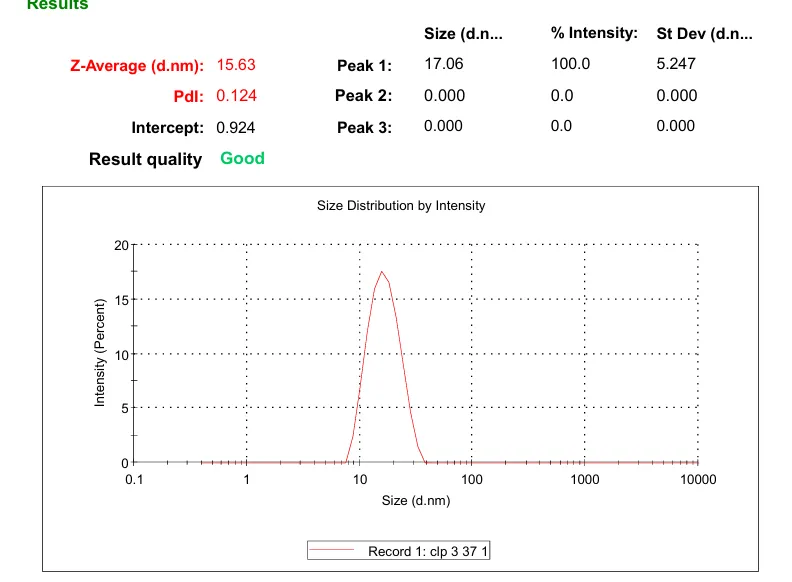
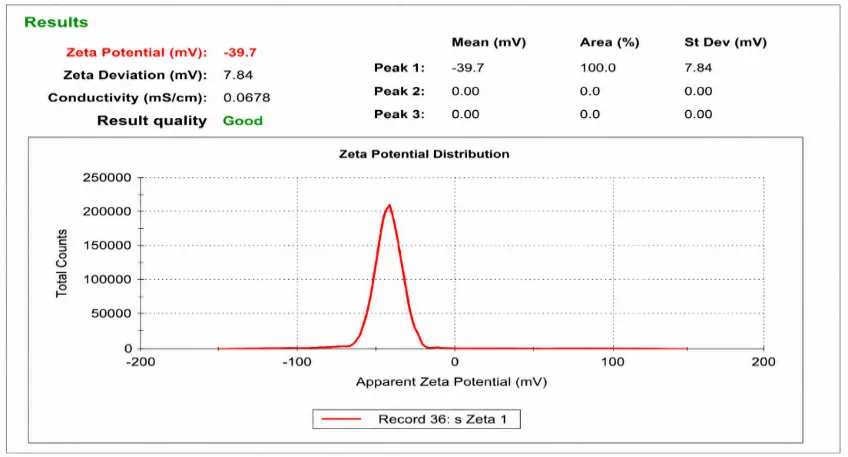
Fig no 1: particle size and PDI of G1C3T1 [3:7] Fig no 2 : zeta potential of G1C3T1 [3:7]
7.4. DISPERSIBILITY TEST:
All the formulations comes under grade A, dispersed within 1 minute.
7.5. SELF-EMULSIFYING TIME:
Table no:6 Self-emulsification time values of L-SNEDDS
|
Formulation |
Self-emulsification time in 0.1N HCL |
Self-emulsification time in water |
|
G1C3T1 [1:9] |
16+1 |
29+5 |
|
G1C3T1 [2:8] |
20+3 |
18+2 |
|
G1C3T1 [3:7] |
10+2 |
15+6 |
|
G1C3T1 [4:6] |
12+2 |
17+2 |
|
G1C2T1 [1:9] |
25+3 |
20+4 |
|
G1C2T1 [2:8] |
16+2 |
26+2 |
|
G1C2T1 [3:7] |
29+5 |
18+3 |
|
G1C2T1 [4:6] |
29+5 |
20+1 |
7.6. FREEZE THAW CYCLE:
There is no phase separation or cracking was seen after subjecting to the freeze thaw cycle.
7.7. PERCENTAGE TRANSMITTANCE:
Two formulations show a % transmittance of more than 90%, indicating clear emulsions.
Table No 7: Percentage Transmittance Values of Clopidogrel L-SNEDDS
|
Formulation |
% Transmittance |
|
G1C3T1 [1:9] |
91.25+0.29 |
|
G1C3T1 [2:8] |
82.8+0.62 |
|
G1C3T1 [3:7] |
97.5+0.35 |
|
G1C3T1 [4:6] |
90.04+0.6 |
|
G1C2T1 [1:9] |
87.37+0.15 |
|
G1C2T1 [2:8] |
90.15+0.68 |
|
G1C2T1 [3:7] |
83.04+0.32 |
|
G1C2T1 [4:6] |
88.64+0.24 |
7.8. ROBUSTNESS TO DILUTION:
There is no phase separation of any formulation after diluting with water,0.1N HCL,phosphate buffer.
7.9. DRUG CONTENT:
Table no 8: Drug content of Clopidogrel L-SNEDDS
|
Formulation |
Drug content (%) |
|
G1C3T1 [1:9] |
88.34+0.44 |
|
G1C3T1 [2:8] |
90.78+0.26 |
|
G1C3T1 [3:7] |
98.33+0.56 |
|
G1C3T1 [4:6] |
91.48+0.35 |
|
G1C2T1 [1:9] |
88.02+0.67 |
|
G1C2T1 [2:8] |
85.06+0.34 |
|
G1C2T1 [3:7] |
90.45+0.45 |
|
G1C2T1 [4:6] |
85.36+0.62 |
Formulation G1C3T1 [3:7] was found to be having more drug content of 98.33%
7.10. IN VITRO DRUG RELEASE STUDIES:
Based on evaluation results, G1C3T1[3:7] as the optimized formulation and performed an in vitro dissolution study.
Table no: 9 % Drug release of G1C3T1[3:7] formulation
|
Time |
%Drug release |
|
5 |
32.67 |
|
10 |
39.9 |
|
15 |
47.98 |
|
20 |
55.72 |
|
30 |
65.74 |
|
45 |
75.25 |
|
60 |
88.85 |
7.11. CONVERSION OF CLOPIDOGREL L-SNEDDS INTO S-SNEDDS:
Clopidogrel L-SNEDDS is converted to S-SNEDDS by using the adsorption technique by adding neusilin US 2 to two grams of optimized L-SNEDDS until a free-flowing powder is formed, and the powder is filled into the capsules for further evaluation.
Table no10: composition of S-SNEDDS
|
Formulation |
L-SNEDDS |
Adsorbent [Neusilin US2] |
Total
|
|
G1C3T1[3:7] |
2ml |
1gm |
3gm |
7.12. DROPLET SIZE, ZETA POTENTIAL AND PDI:
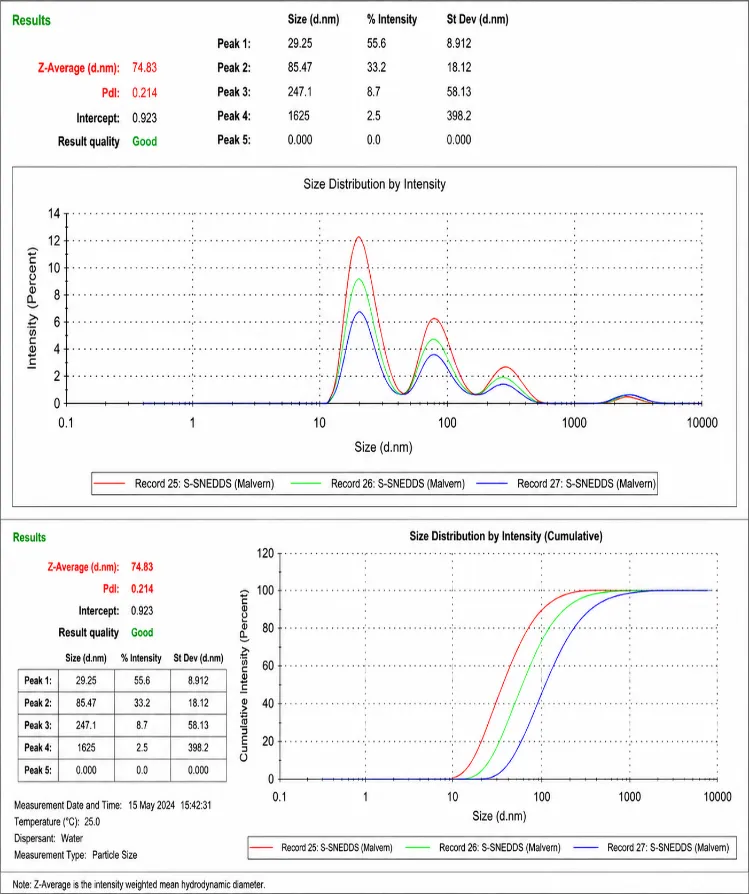
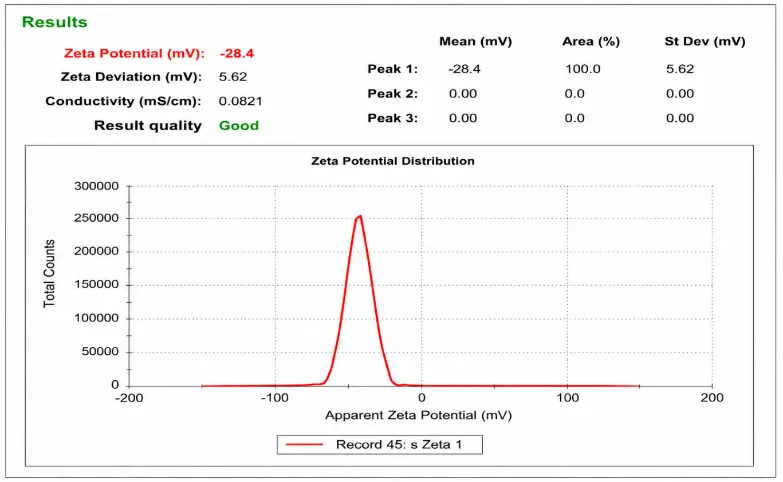
Fig. No 3: particle size and PDI of S- SNEDDS Fig no 4: zeta potential of S-SNEDDS
7.13. SELF-EMULSIFICATION TIME:
Table No 11: self-emulsification of S-SNEDDS
|
Formulation |
water |
0.1N HCL |
|
G1C3T1[3:7] |
28+2 |
23+4 |
7.14. DISPERSIBILITY TEST:
Visual observation of clopidogrel S-SNEDDS showed that the formulation is grade B, forming emulsions in 2 minutes
Table No 12: Dispersibility test of Clopidogrel S- SNEDDS in grading system
|
Formulation |
Observation |
Grade |
|
G1C3T1[3:7] |
Rapidly forming clear blue emulsion within 2 min |
B |
7.15. ROBUSTNESS TO DILUTION:
7.16.IN VITRO DRUG RELEASE STUDIES
Table No 13: % drug release S-SNEDDS
|
Time [min] |
%Drug release |
|
5 |
36 |
|
10 |
59 |
|
15 |
72 |
|
20 |
80 |
|
30 |
87.5 |
|
45 |
94.7 |
|
60 |
98.8 |
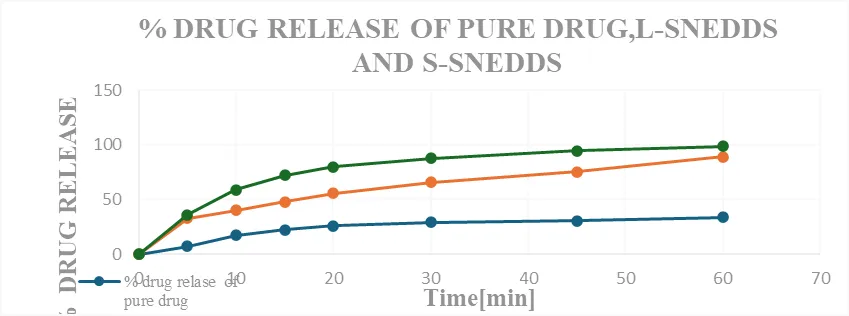
Fig no 5: Comparison of % drug release of pure drug, L- and S-SNEDDS
7.17. ACCELERATED STABILITY STUDIES:
Table No 14: % drug release S-SNEDDS after accelerated stability studies
|
Time |
% Drug release S-SNEDDS on day one |
% Drug release after three months of accelerated stability studies |
|
0 |
0 |
0 |
|
5 |
36.23 |
35.7 |
|
10 |
59.43 |
58.13 |
|
15 |
72.5 |
71.37 |
|
20 |
80 |
79.98 |
|
30 |
87.5 |
86.6 |
|
45 |
94.7 |
94.2 |
|
60 |
98.8 |
98.3 |
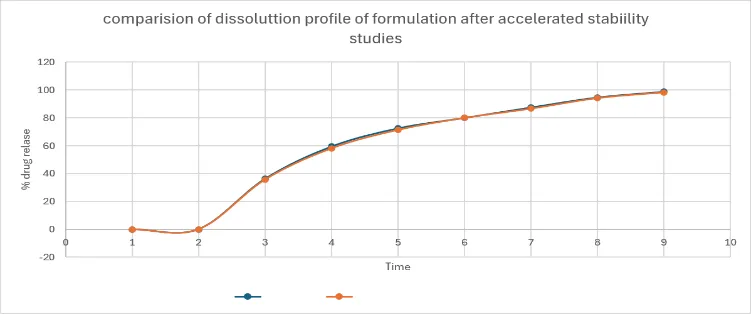
Fig no 6:comparative graph of dissolution after accelerated stability study
SUMMARY AND CONCLUSION
Clopidogrel hydrogen sulphate is a less soluble drug that has been selected to formulate as an SNEDDS to increase its solubility and dissolution rate. Pseudo-ternary phase diagrams were constructed by using water titration method with the Smix ratio of 2:1 & 3:1, which gave clear nano emulsion, bluish clear emulsion and white emulsion. Eight formulations were formulated; among them, G1C3T1[3:7] was selected as the optimized formulation based on its size 15.63 nm, zeta potential mV -39.7 and PDI (0.124), drug release (88.85 %), self-emulsification time (16 sec), dispersibility test grade (A), % Transmittance (98.587±0.67%). Optimized formulation was further converted into solid and evaluations was performed to solid formulation which has given better results: Robustness to dilution was passed, Dispersity grade (B), self-emulsification time (28 sec), Invitro drug release (98.8) and particle size (78.83), PDI (0.214), Zeta potential(28.7-mV) and accelerated stability studies was performed and compared with day 1 formulation, day drug release (98.8)and drug release compared after 1 month (98.3), Optimized formulation drug release compared with pure drug (33.2%). Hence, Clopidogrel hydrogen sulfate S-SNEDDS has the capability for enhancement of solubility and dissolution rate.
REFERENCES



Shaik Nushrath Bhanu, Dr. K. Anie Vijetha, Dr. M. Sunitha Reddy, Formulation And Comparative Evaluation of Liquid and Solid Self-Nano-Emulsifying Drug Delivery System of Clopidogrel Hydrogen Sulphate, Int. J. of Pharm. Sci., 2026, Vol 4, Issue 10, 472-482, https://doi.org/10.5281/zenodo.23160513
 10.5281/zenodo.23160513