

We use cookies to ensure our website works properly and to personalise your experience. Cookies policy
¹ Department of Pharmacology, Shambhunath Institute of Pharmacy, Jhalwa, Prayagraj, Uttar Pradesh, India - 211015.
² Department of Pharmacology, Shambhunath Institute of Pharmacy, Jhalwa, Prayagraj, Uttar Pradesh, India - 211015.
³ Herbal Research and Development Institute (HRDI), Mandal, Gopeshwar, District Chamoli, Uttarakhand, India - 246401.
Background: Chronic stress can lead to anxiety like behavioral changes. Plants rich in antioxidant and bioactive compounds are being explored for potential anti-anxiety effects. Hippophae salicifolia D. Don is a Himalayan medicinal plant whose leaves have many phytochemicals but its effect in CUMS induced anxiety model is not well studied.Objective: To evaluate the anxiolytic-like effect of methanolic leaf extract of H. salicifolia in CUMS-exposed Wistar albino rats using Elevated Plus Maze.Methods: Dried leaves were extracted with methanol by Soxhlet method. 100 g leaf powder gave 8.5 g extract yield 8.5% w/w. phytochemical screening was done. 20 male Wistar rats, 150 g, were divided into 5 groups, n=4 each. CUMS was given for 21 days. Normal control and negative control got 0.5% CMC, standard got fluoxetine 10 mg/kg, test groups got extract 200 and 400 mg/kg. Treatment was given daily along with CUMS. On last day, anxiety behavior was tested on EPM for 5 min. Open arm time, open arm entries, closed arm time and closed arm entries were noted. Data shown as Mean ± SEM, analyzed by one way ANOVA with Tukey's test.Results: Extract yield was 8.5% w/w. Screening showed flavonoids, tannins and phenolic compounds, alkaloids absent. CUMS reduced open arm time to 44.50 ± 5.24 s vs 110.00 ± 5.77 s in normal control. Fluoxetine group showed 116.50 ± 3.62 s, while 200 mg/kg and 400 mg/kg extract showed 68.25 ± 3.12 s and 108.75 ± 8.75 s. Open arm entries were 1.25 ± 0.25 in negative control and 3.75 ± 0.48 in 400 mg/kg group. Closed arm time increased after CUMS and reduced after treatment. Closed arm entries showed no significant change.Conclusion: Under present conditions, methanolic leaf extract of H. salicifolia showed anxiolytic like behavior in EPM, with 400 mg/kg showing better effect. Further work is needed for mechanism and active compound
Anxiety is a common behavioural and psychiatric problem marked by excess fear, worries and altered behaviour [1-3] long term stress causes lasting changes in the body including changes in HPA-axis, oxidative stress, inflammatory signals and neuronal plasticity [4-6] these mechanisms have been used to develop animal models to study stress-related anxiety. The Chronic Unpredictable Mild Stress (CUMS) model is widely used in research as repeated exposure to different mild, unpredictable stressors produces behavioural and physiological changes related to chronic stress. CUMS has been successfully used in rodents including rats to assess stress-related behaviour [7-11] in the present work a 21 day CUMS protocol was applied in male Wistar albino rats. Medicinal plants are a rich source of bioactive compounds having antioxidant, anti inflammatory and neuroprotective properties. Flavonoids and phenolic compounds are of special interest because oxidative and inflammatory pathways may play a role in stress induced neuronal problems. Hippophae salicifolia D. Don, belonging to family Elaeagnaceae and commonly grouped under Himalayan sea buckthorn, contains various phytochemicals including flavonoids and phenolics in its leaves [12-17] Earlier studies have reported antioxidant and other activities of the leaves.Previous work on H. salicifolia have shown antioxidant, antidiabetic, antimicrobial and stress-protective effects and protective effects in a multiple-stress model and showed antioxidant and biological effects of leaf extract in a diabetic model. Leaf samples from Northeast India have also shown antioxidant and bioactive properties [12-19] However, direct study of anxiolytic like effect of methanolic leaf extract of H. salicifolia in a CUMS-induced anxiety model in Wistar rats is still limited. This gap formed the basis for the present study.
METHADOLOGY
Plant Information: Hippophae salicifolia D. Don is a member of family Elaeagnaceae. It is one of the wild Hippophae that grows in the Himalayas and it grows at an elevated altitude. In the recent years, it has become very popular in pharmacological studies due to its unique phytochemistry and biological activities. Various plant parts of H. salicifolia have been used for their therapeutic values. In the current research, leaves were chosen for studying due to the presence of various active components in the leaves like flavonoids, phenols and other antioxidants. Leaves morphology and chemistry are already well documented in pharmacognostic and phytochemical studies. Also, there are various reports on pharmacological activities of H. salicifolia leaf extracts. [12-19]
Plant Material: Dried leaves of Hippophae salicifolia D. Don were obtained from Herbal Research & Development Institute (HRDI), Mandal, Gopeshwar, Chamoli, Uttarakhand. The leaves were checked, cleaned to remove dust and other matter, and kept for extraction. Identification and authentication of the plant was done by HRDI, Mandal, Gopeshwar, Chamoli, Uttarakhand. A voucher sample was submitted at HRDI with Voucher Specimen No. 2105 [Ref-BSI/NRC Herb (Ident.)/2026-27/295 dated 15.07.2026].
Extract Preparation: The dried powdered leaves (100 g) of Hippophae salicifolia were extracted through Soxhlet apparatus with methanol as the solvent. Two batches were made in the extraction process, where each batch involved the use of 500 mL methanol. Extraction was continued for about 12 cycles till the material was fully exhausted. After extraction, solvent was removed under reduced pressure on a rotary evaporator. The concentrated extract was dried further to get a 8.5gm semi-solid mass, corresponding to an extraction yield of 8.5% w/w.
Phytochemical Screening: The methanolic leaf extract was checked by qualitative phytochemical tests. Mayer's test was used for alkaloids, Shinoda and lead acetate tests were used for flavonoids, gelatin test for tannins and ferric chloride test for phenols.[20] In the extract, flavonoids, tannins and phenolic compounds were present, while alkaloids were not found.
Standard Drug: Fluoxetine was used as standard reference drug. Selected dose was 10 mg/kg body weight, p.o. In case of 150 g rats, dose was calculated as:10 mg/kg × 0.15 kg = 1.5 mg Volume of administration was maintained at 10 mL/kg, that comes to 1.5 mL for a rat having 150 g. Drug was administered orally once daily for the period of 21 days CUMS protocol. [7-8,10,21]
Experimental Animals: Twenty male Wistar albino rats with body weight of approximately 150 g were purchased from M/s Chakraborty Enterprise, Kolkata. Rats were maintained under temperature of 22 ± 2 °C, 50-60 % humidity and 12:12 h light-dark cycle. Rats were given standard pellet diet and water ad libitum. Rats were acclimated for 7 days before starting the experiment. Experimental procedure was performed according to CPCSEA guidelines and approval from IAEC.
Experiment: Twenty male Wistar albino rats weighing approx 150 g were randomly divided into five groups four rats in each group (n=4). Group I was normal control and received 0.5% CMC as vehicle. Group II was CUMS-induced negative control and received 0.5% CMC only. Group III was standard group and received fluoxetine 10 mg/kg/day orally. Groups IV and V received methanolic leaf extract of Hippophae salicifolia at 200 mg/kg/day and 400 mg/kg/day orally, respectively, suspended in 0.5% CMC. Animals in CUMS groups were exposed to different mild stressors in random order for 21 days. Stressors were restraint, cold water swimming, noise, foreign object, tail clipping, fasting, water deprivation, cage tilting, continuous light, pairing, wet bedding, empty cage, crowded housing, hot water swimming and tail suspension. [7-8,10] All treatments were given daily along with the 21 day CUMS protocol.
CUMS Induction: The CUMS procedure was applied for 21 days continuously, with different mild stressors given in a random order each day, following the method described in earlier reports [7-8,10]
Table: 1 CUMS Induction
|
Day |
Day-time stressor |
Night-time stressor |
|
Day 1 |
Physical restraint- 6 h |
Cage tilting -12 h |
|
Day 2 |
Cold-water swimming - 5 min + Noise - 30 min |
Water deprivation- 12 h |
|
Day 3 |
Exposure to foreign object -6hr |
Fasting -12 h + Overnight illumination |
|
Day 4 |
Tail clip - 3 min |
Cage tilting -12 h + Pairing- 24 hr |
|
Day 5 |
Tail suspension |
Fasting - 12 h + Wet bedding - 12 h |
|
Day 6 |
Social crowding - 2 h |
Empty cage - 12 h + Water deprivation -12 h |
|
Day 7 |
Hot-water swimming -5 min + Noise - 30 min |
Normal rest |
|
Day 8 |
Exposure to foreign object-6hr |
Fasting - 12 h + Wet bedding - 12 h |
|
Day 9 |
Physical restraint - 6 h |
Empty cage - 12 h + Overnight illumination |
|
Day 10 |
Tail clip - 3 min + Noise - 30 min |
Cage tilting - 12 h + Water deprivation -12 h |
|
Day 11 |
Cold-water swimming - 5 min |
Fasting - 12 h + Pairing - 24 h |
|
Day 12 |
Tail clip – 3min |
Wet bedding - 12 h + Water deprivation - 12 h |
|
Day 13 |
Social crowding -2 h |
Cage tilting - 12 h |
|
Day 14 |
Hot-water swimming - 5 min |
Normal rest |
|
Day 15 |
Noise -30 min |
Fasting - 12 h + Overnight illumination |
|
Day 16 |
Physical restraint - 6 h |
Wet bedding - 12 h |
|
Day 17 |
Cold-water swimming - 5 min + Tail clip - 3 min |
Water deprivation - 12 h + Pairing - 24 h |
|
Day 18 |
Exposure to foreign object-6hr |
Empty cage - 12 h |
|
Day 19 |
Hot-water swimming – 5 min |
Fasting - 12 h + Cage tilting – 12 h |
|
Day 20 |
Inversion of light/dark cycle |
Inversion of light/dark cycle |
|
Day 21 |
Social crowding – 2 h + Noise – 30 min |
Normal rest |
Examination of anxiety: At end of study, each rat was placed on EPM for 5 min. Open arm time, open arm entries, closed arm time, closed arm entries were recorded. More open arm exploration was taken as less anxiety. [22-23]
Analytical Statistics: Results were expressed as mean ± SEM. The data were analyzed using one-way ANOVA followed by the Tukey's multiple comparison tests. Values of P<0.05 were considered significant.
RESULT: From 100 g dried leaf powder of H. salicifolia 8.5g methanolic extract was obtained. Yield was 8.5% w/w. Methanolic leaf extract of H. salicifolia gave positive test for flavonoids, tannins and phenolic compounds. Alkaloids were absent.
Effect of H. salicifolia methanolic leaf extract on anxiety-like behaviour was checked in Elevated Plus Maze. Normal control showed open arm time 110.00 ± 5.77 s with 3.00 ± 0.41 open arm entries, while CUMS control showed decrease in open arm exploration with open arm time 44.50 ± 5.24 s and 1.25 ± 0.25 entries. Fluoxetine group showed 116.50 ± 3.62 s open arm time and 3.25 ± 0.48 entries. Extraction at 200 mg/kg led to a 68.25 ± 3.12 s increase in open arm time and 2.50 ± 0.29 entries, while 400 mg/kg gave 108.75 ± 8.75 s open arm time and 3.75 ± 0.48 entries. The closed arm time for normal control, CUMS control, fluoxetine, low dose, and high dose groups is 190.00 ± 5.77, 255.50 ± 5.24, 183.50 ± 3.62, 231.75 ± 3.12, and 191.25 ± 8.75 s, respectively. The closed arm entries for the same groups are 2.75 ± 0.48, 2.75 ± 0.48, 3.00 ± 0.41, 2.50 ± 0.29, and 2.75 ± 0.48, respectively. Overall extract showed dose dependent improvement in EPM and 400 mg/kg dose was almost similar to normal and fluoxetine group.
Table 2 Evaluation of Anxiolytic Activity by Elevated Plus Maze
|
Parameter |
Normal Control (0.5% CMC) |
Negative Control (0.5% CMC) |
Positive Control (fluoxetine 10mg/kg) |
Low Dose (200mg/kg) |
High Dose (400mg/kg) |
|
Open-arm time (s) |
110.00 ± 5.77 |
44.50 ± 5.24 |
116.50 ± 3.62 |
68.25 ± 3.12 |
108.75 ± 8.75 |
|
Open-arm entries |
3.00 ± 0.41 |
1.25 ± 0.25 |
3.25 ± 0.48 |
2.50 ± 0.29 |
3.75 ± 0.48 |
|
Closed-arm time (s) |
190.00 ± 5.77 |
255.50 ± 5.24 |
183.50 ± 3.62 |
231.75 ± 3.12 |
191.25 ± 8.75 |
|
Closed-arm entries |
2.75 ± 0.48 |
2.75 ± 0.48 |
3.00 ± 0.41 |
2.50 ± 0.29 |
2.75 ± 0.25 |
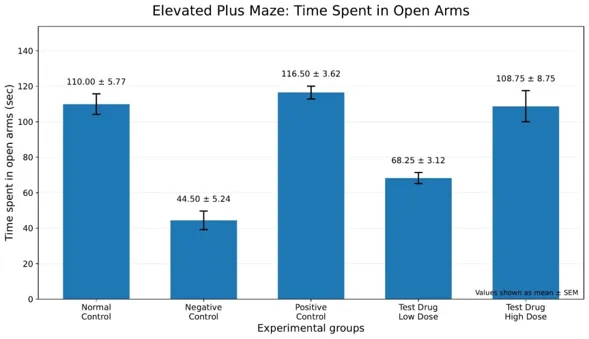
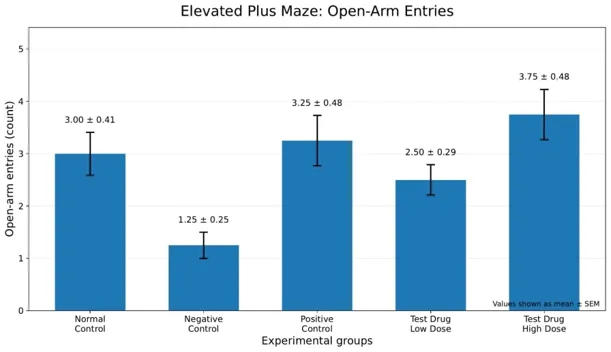
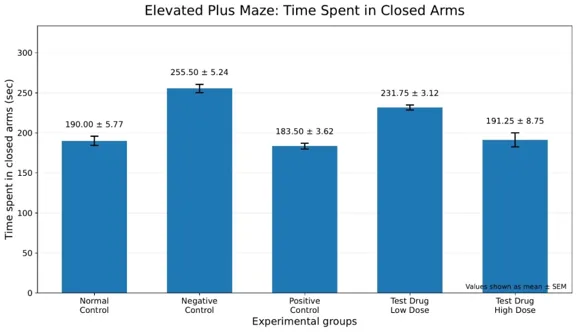
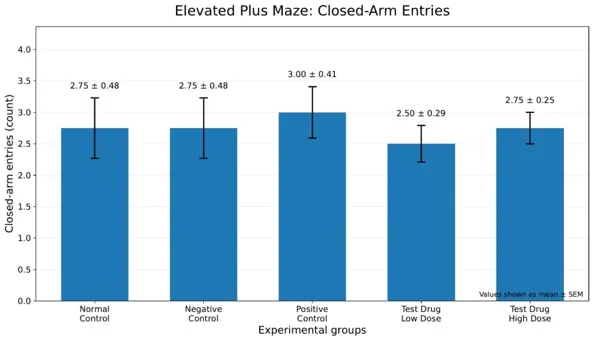
Figure 1: Effect of Hippophae salicifolia Methanolic Leaf Extract on EPM Parameters
DISCUSSION
The work was planned to see if methanolic extract obtained from leaves of Hippophae salicifolia can reduce anxiety like behaviour produced by chronic unpredictable mild stress (CUMS) in rats. In this model, animals were subjected to different mild stressors daily for 21 days in a random manner. Such continuous unpredictable stress is known to develop a state similar to anxiety, which can be measured using Elevated Plus Maze (EPM) [7-8,10,12,22-23] In our results, rats exposed to CUMS spent very less time in open arms and showed fewer open-arm entries when compared to normal animals. Open-arm time was reduced from 110.00 ± 5.77 s in normal control to 44.50 ± 5.24 s in CUMS control, while closed-arm time was increased from 190.00 ± 5.77 s to 255.50 ± 5.24 s. This type of behaviour reflects increased anxiety after chronic stress, which is in line with previous CUMS studies. Treatment with fluoxetine (10 mg/kg/day) brought back the values to near normal, with open arm time of 116.50 ± 3.62 s and closed arm time of 183.50 ± 3.62 s. Fluoxetine, being an established antidepressant and anxiolytic, served as a suitable positive control. [21] In the case of extract treated groups, a dose wise improvement was noted. The low dose of 200 mg/kg elicited only a minimal increase in open arm time of 68.25 ± 3.12 seconds while the high dose of 400 mg/kg had significant effects with open arm time of 108.75 ± 8.75 seconds and closed arm time of 191.25 ± 8.75 seconds. and closed-arm time of 191.25 ± 8.75 s. These readings were almost equivalent to those of normal control and fluoxetine group, suggesting that 400 mg/kg has better anxiolytic like activity in this test. Phytochemical checking of the extract showed occurrence of flavonoids, tannins and phenols. Earlier reports on H. salicifolia also mention the same class of compounds and link them to antioxidant and neuroprotective properties. Therefore, the behavioural improvement observed here may be due to the combined action of these phytoconstituents, though the exact active molecule was not isolated in this work. It should be noted that EPM only indicates behavioural response related to anxiety; it does not prove a clinical anxiolytic mechanism. Also, we did not perform any neurochemical or receptor level study. Hence, the outcome can be described as anxiolytic like behaviour in EPM model. Detailed work on isolated compounds and their mechanism of action will be required to confirm the findings.
CONCLUSION
The current work was carried out to check the effect of methanolic extract of Hippophae salicifolia leaves on CUMS induced anxiety like behaviour in Wistar albino rats. The leaf powder gave 8.5% w/w extract and in qualitative testing it showed flavonoids, tannins and phenolic compounds. When tested in Elevated Plus Maze, CUMS rats showed low open arm activity, while extract treated rats showed improvement. Especially the 400 mg/kg dose increased open arm time and reduced closed arm time, and its effect was close to normal control and standard fluoxetine group. So in this animal model, the extract exhibited anxiolytic like behavioural effect. Still this is only a preliminary finding based on behavioural observation. To come to any final conclusion regarding its medicinal use, more detailed studies are needed like higher number of animals, biochemical, molecular and histological evaluation, isolation of responsible compound and its mechanism of action.
REFERENCES



Abhyuday, Mandvi Tiwari, Arvind Kumar Bhandari, Evaluation Of the Anti Anxiety Activity of Methanolic Leaf Extract Of Sea Buckthorn (Hippophae salicifolia) In A Chronic Unpredictable Mild Stress (CUMS) Model In Wister Albino Rates, Int. J. of Pharm. Sci., 2026, Vol 4, Issue 10, 541-548, https://doi.org/10.5281/zenodo.23160856
 10.5281/zenodo.23160856