

We use cookies to ensure our website works properly and to personalise your experience. Cookies policy
1PhD scholar, GTU-School of Applied Sciences and Technology, Gujarat Technological University, Ahmedabad, Gujarat, India, Associate Professor, GTU-School of Applied Sciences and Technology, Gujarat Technological University, Ahmedabad, Gujarat, India.
2Associate Professor, GTU-School of Applied Sciences and Technology, Gujarat Technological University, Ahmedabad, Gujarat, India.
Background: The distribution of bacterial growth during quadrant streaking is influenced by the way an inoculation loop transfers cells across the agar surface. This study examined whether a 4 mm helical coil loop differed from conventional 2, 4 and 6 mm loops in the quadrant at which countable Escherichia coli colonies became apparent. Methods: A laboratory-maintained E. coli ATCC 25922 culture was prepared as a suspension standardized to 1.0 McFarland for streaking. The four loop configurations were compared using the four-flame, four-quadrant streaking procedure. Three sets of quadrant-wise observations were available for each configuration. Numerical colony counts were summarized as mean ± sample standard deviation when all three sets were countable; dense growth and colonies too close to count were retained as categorical observations. Results: The 4 mm helical coil loop yielded 16, 15 and 22 visible colonies in Q2 (17.67 ± 3.79) and no visible growth in Q3 or Q4 in any set. The conventional 4 mm loop showed dense growth in Q2 in all three sets and countable colonies in Q3 (19.67 ± 3.51) and Q4 (10.00 ± 2.65). The 2 and 6 mm conventional loops showed variable Q2 patterns. Conclusion: Under the recorded experimental conditions, the helical coil loop produced countable second-quadrant colonies consistently, whereas the conventional 4 mm loop required later quadrants for countable growth. This consistent second-quadrant pattern highlights the potential of the
Obtaining discrete colonies from a mixed or concentrated inoculum remains one of the most familiar tasks in a microbiology laboratory. In quadrant streaking, a small quantity of culture is spread over successive areas of solid medium, reducing the number of viable cells deposited along later streak lines. The method is inexpensive and straightforward, but the outcome depends on more than the bacterial strain. The amount of material initially carried by the loop, its contact with the agar and the manner in which it is moved all contribute to the final colony pattern (Sanders, 2012; American Society for Microbiology, 2008).
The terminal ring of a conventional inoculation loop is available in different diameters. In practical use, a larger or smaller ring may change the quantity of inoculum deposited and the contact area between the wire and agar. It would be misleading, however, to assume a fixed relationship between loop diameter and the quadrant of first isolation: culture density, operator technique, medium condition and the direction of streaking also matter. Dense growth and discrete colonies may even occur in different parts of the same quadrant.
A helical coil inoculation loop was described previously by Chauhan et al. (2026). In contrast to the straight shaft and distal ring of a conventional loop, the device incorporates a series of helical turns immediately before the distal circular loop. The current investigation builds on that design but addresses a narrower question: how does the spatial distribution of E. coli colonies differ when a standardized 4 mm helical coil loop is compared with conventional 2, 4 and 6 mm loops under the same four-flame streaking approach? The diameter-matched conventional 4 mm loop is particularly informative because the terminal ring diameter is shared, although other geometric features differ.
The objective was to document quadrant-wise growth and the first quadrant with countable colonies for each instrument, using the three recorded experimental sets. No suspension-turbidity performance comparison was undertaken in this study; the 1.0 McFarland value refers only to standardization of the culture suspension used for streaking.
MATERIALS AND METHODS
2.1. Experimental design and loop configurations
Four inoculation tools were evaluated: conventional nichrome loops with terminal ring diameters of 2 mm, 4 mm and 6 mm, and a 4 mm helical coil inoculation loop. Three experimental sets were recorded for each configuration. All plates were streaked using the four-flame procedure. The helical loop was formed from nichrome wire with approximately 7–10 turns, nominal spacing of 0.7–1.0 mm and an angled helical portion, as described for the earlier device. Its distal ring diameter was standardized to 4 mm based on practical handling during streaking. The design is associated with Indian Registered Design No. 387653-001.
Table 1: Inoculation-loop Configurations Evaluated in the Comparative Experiment.
| Code | Loop configuration | Terminal diameter |
|---|---|---|
| C2 | Conventional loop | 2 mm |
| C4 | Conventional loop | 4 mm |
| C6 | Conventional loop | 6 mm |
| H4 | Helical coil loop | 4 mm |
2.2. Bacterial culture and inoculum preparation
Escherichia coli ATCC 25922 was obtained from the existing culture collection of the School of Applied Sciences and Technology, Gujarat Technological University, Ahmedabad. A suspension of the laboratory-maintained culture was standardized to 1.0 McFarland and used as the inoculum for streak plating with the four loop configurations. This standardization step was intended to provide a comparable starting suspension; McFarland turbidity was not treated as an experimental outcome.
2.3. Four-quadrant streaking and assessment
Each loop was assessed using the four-flame streaking approach, with the plate divided operationally into four successive streaking regions (Q1–Q4). we recorded visible colony numbers when individual colonies could be distinguished. Regions showing dense growth or colonies too close to count were not recorded in in estimated numerical count. “No growth” denotes no visible colonies or growth in the recorded region; it imply that the region contained no viable bacteria. As shown in the figure 1.
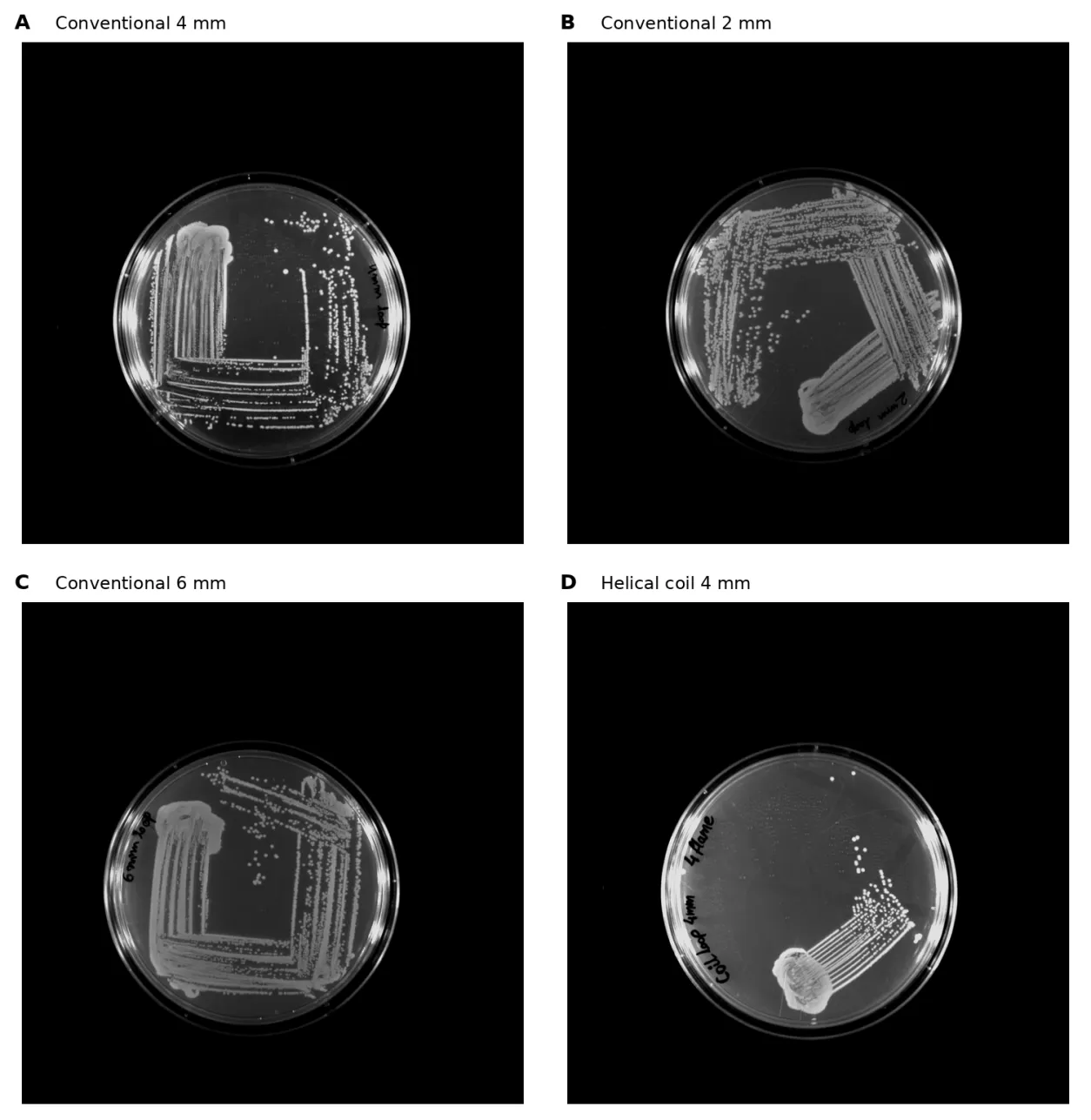
Figure 1: Representative E. coli ATCC 25922 Streak Plates Prepared Using the Four-Flame Method: (A) Conventional 4 mm, (B) Conventional 2 mm, (C) Conventional 6 mm and (D) Helical Coil 4 mm
2.4. Data handling and descriptive statistics
For quadrants with three numeric observations, the arithmetic mean and sample standard deviation were calculated. Dense and too-close-to-count observations were not converted to numerical values, and partially numeric quadrants were not averaged. Because several outcomes were categorical and the independence of the three sets has not been established from the available records, no inferential significance testing was performed. The endpoint “countable colonies” is reported separately from confirmed physical isolation: a colony count alone cannot establish adequate separation from adjacent growth.
RESULTS
3.1. Overall quadrant-wise growth patterns
The four instruments produced noticeably different distributions of visible growth. Dense Q1 growth was recorded for every conventional loop in all three sets. The conventional 4 mm loop remained dense in Q2 in each set, whereas the 2 mm and 6 mm loops showed a mixture of dense or too-close-to-count growth and small numerical counts. By contrast, the helical coil loop had numerical counts in both Q1 and Q2 in all three sets. No visible growth was recorded in Q3 or Q4 for the helical coil condition.
Table 2: Quadrant-wise Observations. Numerical Values Are Mean ± Sample SD (N = 3) Only Where All Sets Were Countable. TCC, Too Close to Count; ng, No Visible Growth. Semicolons Separate Individual Set Observations.
| Loop | Q1 | Q2 | Q3 | Q4 |
|---|---|---|---|---|
| Conventional 2 mm | Dense (3/3) | 2; Dense; 1 | TCC (3/3) | 27.33 ± 3.06 |
| Conventional 4 mm | Dense (3/3) | Dense (3/3) | 19.67 ± 3.51 | 10.00 ± 2.65 |
| Conventional 6 mm | Dense (3/3) | TCC; 2; 3 | 7.00 ± 3.61 | 16.33 ± 2.08 |
| Helical coil 4 mm | 15.33 ± 2.31 | 17.67 ± 3.79 | NG (3/3) | NG (3/3) |
3.2. Performance of the 4 mm helical coil loop
With the 4 mm helical coil loop, Q1 contained 14, 18 and 14 visible colonies in sets 1–3, respectively (15.33 ± 2.31). The corresponding Q2 counts were 16, 15 and 22 (17.67 ± 3.79). Q2 was therefore countable in all three sets. The absence of visible growth in Q3 and Q4 was also consistent across the three sets.
3.3. Conventional loop observations
The conventional 2 mm loop showed dense growth in Q1 for all three sets. Its Q2 observations were 2 colonies, dense growth and 1 colony, while Q3 was too close to count in all sets. Countable Q4 colonies were recorded as 24, 30 and 28 (27.33 ± 3.06). For the conventional 4 mm loop, Q1 and Q2 were dense in every set; Q3 counts were 20, 23 and 16 (19.67 ± 3.51), and Q4 counts were 7, 11 and 12 (10.00 ± 2.65). The conventional 6 mm loop had dense Q1 growth and Q2 observations of too-close-to-count growth, 2 colonies and 3 colonies. Its Q3 counts were 3, 8 and 10 (7.00 ± 3.61), and Q4 counts were 18, 14 and 17 (16.33 ± 2.08).
3.4. Graphical comparison
Figure 2 displays means only for quadrants with three numerical observations; it deliberately omits quadrants that were dense, too close to count or only partly countable. Figure 3 preserves the set-level distinction between qualitative and numerical observations. Neither figure converts confluent growth into arbitrary colony counts.
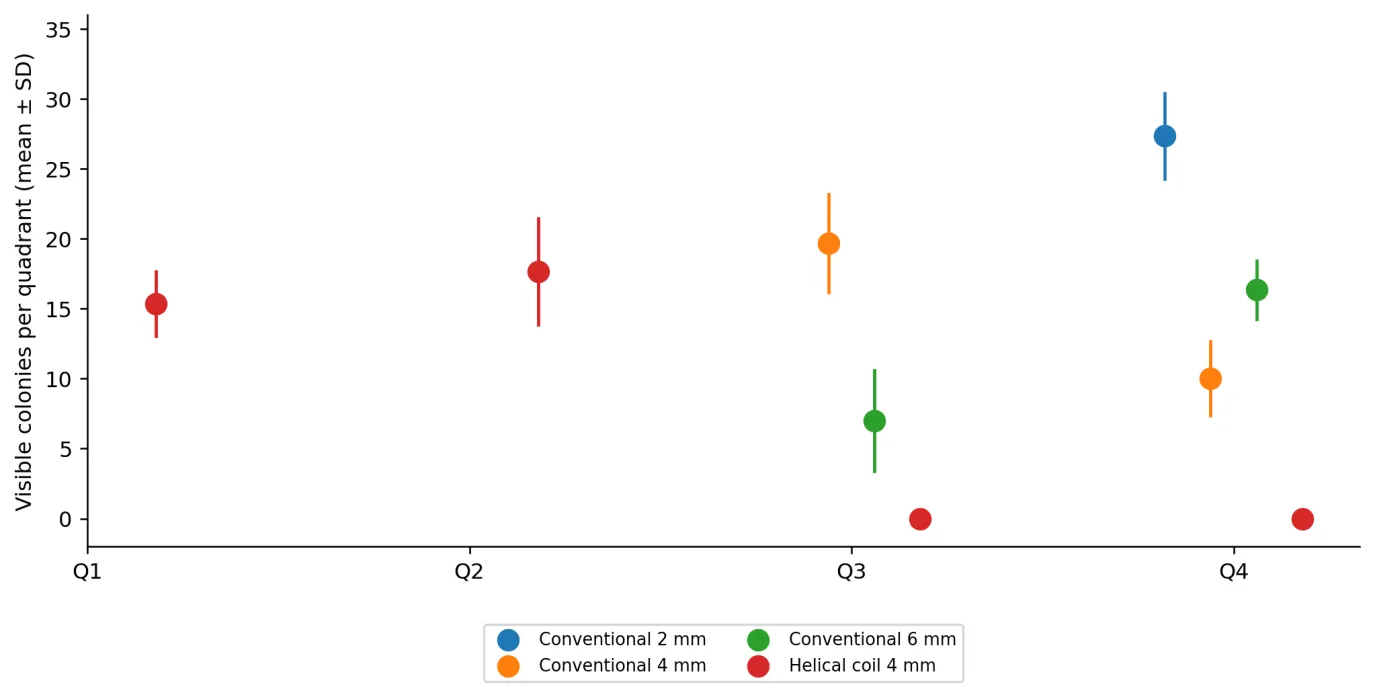
Figure 2: Mean Visible Colony Counts (± Sample SD) by Quadrant for Fully Numerical Observations. Missing Points Indicate Categorical or Partially Countable Observations, Not Zero Growth.
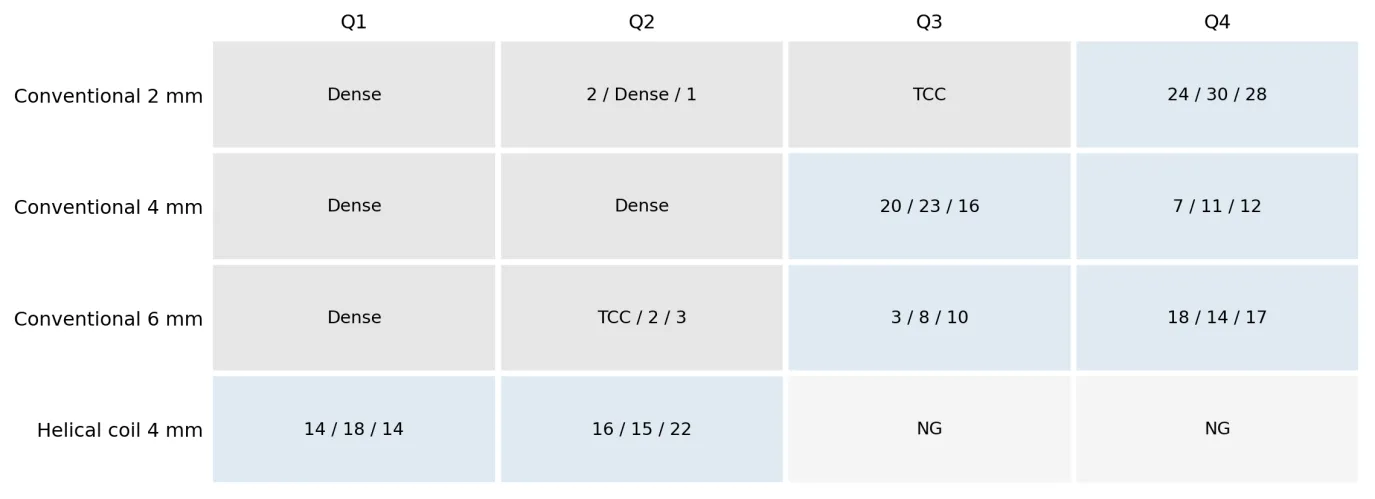
Figure 3: Recorded Streaking Outcomes Across the Four Loop Configurations. Numerical Entries Are Individual Set Counts in Order; Dense = Dense Growth, TCC = Too Close to Count, ng = No Visible Growth.
Table 3: Original Set-Level Observations
| Set | Loop | Q1 | Q2 | Q3 | Q4 |
|---|---|---|---|---|---|
| 1 | Conventional 2 mm | Dense | 2 | TCC | 24 |
| 1 | Conventional 4 mm | Dense | Dense | 20 | 7 |
| 1 | Conventional 6 mm | Dense | TCC | 3 | 18 |
| 1 | Helical coil 4 mm | 14 | 16 | NG | NG |
| 2 | Conventional 2 mm | Dense | Dense | TCC | 30 |
| 2 | Conventional 4 mm | Dense | Dense | 23 | 11 |
| 2 | Conventional 6 mm | Dense | 2 | 8 | 14 |
| 2 | Helical coil 4 mm | 18 | 15 | NG | NG |
| 3 | Conventional 2 mm | Dense | 1 | TCC | 28 |
| 3 | Conventional 4 mm | Dense | Dense | 16 | 12 |
| 3 | Conventional 6 mm | Dense | 3 | 10 | 17 |
| 3 | Helical coil 4 mm | 14 | 22 | NG | NG |
DISCUSSION
The present study demonstrated the promising performance of the standardized 4 mm helical coil inoculation loop for early colony isolation of Escherichia coli ATCC 25922 using the four-quadrant streak plate technique. The helical coil loop consistently produced countable colonies in the second quadrant across all three experimental sets, with a mean of 17.67 ± 3.79 colonies. In comparison, the conventional 4 mm loop exhibited dense growth in the second quadrant, with countable colonies appearing in subsequent quadrants. These findings highlight the potential of the helical coil design to facilitate earlier colony separation during routine microbiological streaking.
The distinctive helical geometry may contribute to the observed bacterial distribution by influencing the deposition of inoculum across the agar surface. The standardized 4 mm terminal diameter also provided convenient handling during streaking. Unlike the conventional loops, the helical coil produced a consistent growth pattern, with countable colonies in Q2 and no visible growth in Q3 and Q4 across the three experimental sets. This observation suggests that the modified loop geometry may support effective bacterial distribution within the initial streaking regions.
The use of a 1.0 McFarland suspension of E. coli ATCC 25922 provided a standardized starting inoculum for comparing the four loop configurations. The findings extend the earlier work of Chauhan et al. (2026) by demonstrating the performance of the standardized 4 mm helical coil loop against conventional loops of 2, 4 and 6 mm diameter under the four-flame streaking method. Overall, the results identify the helical coil loop as a promising alternative inoculation tool for obtaining countable bacterial colonies at an earlier stage of streak plating.
CONCLUSION
This study compared a standardized 4 mm helical coil inoculation loop with conventional 2 mm, 4 mm and 6 mm loops during four-flame streaking of E. coli ATCC 25922. A 1.0 McFarland bacterial suspension was used as the starting inoculum. Across three recorded experimental sets, the helical coil loop produced 16, 15 and 22 visible colonies in the second quadrant, yielding a mean of 17.67 ± 3.79 colonies. Countable Q2 colonies were recorded in every set, establishing a consistent early colony-formation pattern under the conditions examined.
The conventional 4 mm loop, which shared the same nominal terminal diameter as the helical coil loop, showed dense growth in Q2 in all three sets and yielded countable colonies in subsequent quadrants. The conventional 2 mm and 6 mm loops displayed different and more variable quadrant-wise patterns. In contrast, the helical coil loop produced a repeatable distribution concentrated in Q1 and Q2, with no visible growth recorded in Q3 or Q4. These findings distinguish the observed streaking behavior of the standardized helical design from that of the three conventional loop configurations.
The results identify the 4 mm helical coil loop as a promising tool for obtaining countable colonies at an early stage of the four-quadrant streaking procedure. Its consistent second-quadrant performance, together with the use of a diameter-matched conventional control, provides an encouraging basis for further development of the device. Future studies quantifying well-separated, recoverable colonies across larger independent datasets can establish the breadth of this performance and its value in routine laboratory practice. The present study contributes experimental evidence supporting the potential application of the helical coil configuration in bacterial streaking and colony isolation.
Declaration
The quadrant-wise observations used in this revision are reproduced in Table 3. The authors gratefully acknowledge the GTU-School of Applied Sciences and Technology (GTU-SAST), Gujarat Technological University (GTU), Ahmedabad, India, for providing the laboratory facilities, infrastructure, and institutional support necessary to conduct the experimental investigations presented in this study. AI-based tools were used solely for English language correction, grammar checking, and improvement of readability. The authors take full responsibility for the content of the manuscript.
REFERENCES

Kartik Chauhan, Dr. Dolatsinh Zala, Comparative Analysis of a Novel 4 mm Helical Coil Inoculation Loop and Conventional 2 mm, 4 mm, and 6 mm Inoculation Loops for Bacterial Streaking and Colony Isolation, Int. J. of Pharm. Sci., 2026, Vol 4, Issue 11, 3137-3142. https://doi.org/10.5281/zenodo.24360557
 10.5281/zenodo.24360557