

We use cookies to ensure our website works properly and to personalise your experience. Cookies policy
Department of Chemistry, University of Allahabad, Prayagraj, UP, India 211001.
Cannabinoids represent a structurally diverse class of molecules with potential applications in antiviral and anticancer drug discovery. However, their conformational flexibility, polypharmacology, physicochemical limitations, and heterogeneous biological effects complicate the identification of therapeutically relevant candidates. This review examines how computer-aided drug discovery, molecular simulation, quantum chemistry, quantitative structure–activity relationship modelling, and artificial intelligence can be integrated to investigate cannabinoid chemical space and prioritize candidate compounds. Antiviral applications, including SARS-CoV-2 proteases and viral-entry mechanisms, are considered alongside anticancer investigations involving receptor tyrosine kinases, cannabinoid-sensitive receptors, and intracellular signalling pathways. Particular emphasis is placed on distinguishing computational predictions from experimentally demonstrated molecular binding, target inhibition, and cellular activity. The complementary contributions and limitations of molecular docking, molecular dynamics, binding free-energy estimation, and ADMET prediction are examined in relation to candidate prioritization. The review further discusses dataset quality, model validation, uncertainty estimation, and the challenges of translating predicted interactions into biologically meaningful outcomes. An integrated computational–experimental framework is proposed in which candidate selection, biochemical and biophysical validation, cellular evaluation, selectivity assessment, and structure–activity relationship analysis inform iterative lead optimization. Future progress will depend on experimentally anchored AI-assisted design, improved uncertainty quantification, and explicit consideration of pharmacokinetics, toxicity, and target-specific biological context.
1.0 Introduction
Cannabinoids constitute a structurally and pharmacologically diverse class of bioactive molecules encompassing phytocannabinoids from Cannabis sativa, endogenous cannabinoids, and synthetic or semi-synthetic derivatives designed to modify potency, selectivity, metabolic stability, pharmacokinetics, and therapeutic properties [1–5]. More than one hundred phytocannabinoids have been identified, including Δ⁹-tetrahydrocannabinol (Δ⁹-THC), cannabidiol (CBD), cannabigerol (CBG), cannabinol (CBN), cannabichromene (CBC), tetrahydrocannabivarin (THCV), cannabidiolic acid (CBDA), and cannabigerolic acid (CBGA) [1,5–8]. Advances in biosynthesis, metabolic engineering, analytical chemistry, and synthetic biology have further expanded access to minor cannabinoids and structurally modified analogues [1,8–11]. Variations in side-chain architecture, oxidation state, cyclization, functional groups, and stereochemistry can substantially influence molecular recognition, physicochemical properties, metabolism, and biological activity [5,8,12]. This chemical diversity offers opportunities for drug discovery but also creates a complex search space that benefits from systematic computational prioritization.
Cannabinoid pharmacology has traditionally been associated with the endocannabinoid system (ECS), which comprises cannabinoid receptors, endogenous ligands, and the enzymes responsible for endocannabinoid synthesis and degradation [3,13–16]. Cannabinoid receptors CB1 and CB2 are class A G-protein-coupled receptors that predominantly couple to Gi/o proteins and regulate neurotransmission, immune responses, inflammation, metabolism, and cell survival [3,13,14]. CB1 is highly expressed in the central nervous system and contributes to the psychoactive effects of Δ⁹-THC, whereas CB2 is more prominent in immune and peripheral tissues and has attracted interest for developing compounds with reduced central psychotropic effects [3,14–17]. However, cannabinoid activity extends beyond CB1 and CB2 to transient receptor potential (TRP) channels, GPR55, peroxisome proliferator-activated receptors (PPARs), serotonin receptors, and other membrane-associated or intracellular targets [4,7,18–21,26]. This broader pharmacology creates opportunities for target-specific and multi-target interventions but complicates selectivity assessment and mechanism attribution.
The availability of experimentally resolved cannabinoid-receptor structures has strengthened the structural basis for computational investigation. Cryo-electron microscopy and complementary structural studies have clarified ligand recognition, receptor activation, G-protein coupling, and conformational changes in CB1- and CB2-associated systems [22,23]. These structures provide experimentally informed templates for molecular docking, pharmacophore modeling, molecular dynamics (MD), and free-energy calculations [24–27]. Combined with advances in computational chemistry, they enable systematic exploration of cannabinoid–target interactions beyond conventional empirical screening.
Historically, cannabinoid-based medicines have been investigated primarily for symptomatic applications, including analgesia, chemotherapy-induced nausea and vomiting, appetite stimulation, and selected neurological disorders [28–32]. Although clinically meaningful benefits have been established for some indications, the strength of evidence varies with the indication, formulation, dose, cannabinoid composition, and clinical setting [29–31]. In oncology, cannabinoids have a more established role in supportive care than as direct anticancer agents, for which the evidence remains predominantly preclinical [33–36]. The 2024 American Society of Clinical Oncology guideline similarly emphasized the stronger clinical evidence for symptom management than for most other cancer-related outcomes [37]. Nevertheless, emerging mechanistic evaluations continue to highlight their potential role in modulating diverse oncogenic pathways and cellular phenotypes [38–40]. Accordingly, the antiviral and direct anticancer applications discussed in this review should be considered emerging drug-discovery opportunities rather than established clinical efficacy.
The chemical diversity summarized in Table 1 illustrates the potential of cannabinoids as adaptable molecular scaffolds for structure–activity relationship (SAR) investigation. Many cannabinoids combine hydrophobic and aromatic surfaces with hydrogen-bonding functionalities, whereas acidic derivatives such as CBDA and CBGA contain ionizable carboxyl groups that can alter physicochemical properties and target recognition [1,5,8]. These structural differences provide a basis for investigating how molecular features influence target engagement, selectivity, and biological activity. Computational methods can help prioritize candidates within this chemical space, provided that predictions are interpreted in the context of the available experimental evidence.
Table 1: Representative Cannabinoid Scaffolds and Their Relevance to Computationally Guided Antiviral and Anticancer Drug Discovery.
| Cannabinoid / derivative | Chemical class / characteristic | Computationally relevant molecular targets | Major computational approaches | Antiviral relevance | Anticancer relevance | |
| Δ⁹-THC | Major psychoactive phytocannabinoid; lipophilic tricyclic scaffold | CB1, CB2; TRP channels; selected intracellular signaling proteins | Molecular docking; MD simulations; pharmacophore analysis; QSAR | Emerging/preclinical target and mechanism studies | Apoptosis, proliferation, migration and receptor-mediated signaling | |
| CBD | Non-intoxicating phytocannabinoid with a flexible terpenophenolic scaffold | CB2, TRPV1, PPARγ, GPR55 and other intracellular targets | Molecular docking; MD; MM-PBSA/MM-GBSA; QSAR; ADMET prediction | Antiviral activity and viral/host-target interaction studies | Apoptosis, oxidative stress, autophagy, cell-cycle regulation and signaling | |
| CBG | Non-intoxicating phytocannabinoid; biosynthetic precursor-related scaffold | CB1/CB2; TRP channels; selected signaling proteins | Docking; MD; virtual screening; ADMET profiling | Emerging antiviral investigations, including viral/host targets | Emerging antiproliferative and signaling-related studies | |
| CBN | Oxidative degradation product of Δ⁹-THC | CB1/CB2 and cannabinoid-sensitive signaling pathways | Docking; pharmacophore modeling; molecular-property prediction | Limited/emerging antiviral evidence | Receptor-mediated and emerging anticancer investigations | |
| CBDA | Acidic cannabinoid; carboxylated precursor of CBD | SARS-CoV-2 spike protein/ACE2 interface and host-entry processes | Molecular docking; structural analysis; virtual screening | Reported inhibition of spike–ACE2 interaction; important antiviral computational/experimental scaffold | Limited compared with CBD; potential derivative-design scaffold | |
| CBGA | Biosynthetic precursor of major phytocannabinoids | SARS-CoV-2 spike-related targets; cannabinoid-sensitive pathways | Docking; virtual screening; molecular interaction analysis | Reported interference with viral entry-related processes | Emerging research; useful precursor/scaffold for derivative optimization | |
| THCV | Propyl analogue of THC with distinct receptor pharmacology | CB1/CB2; metabolic signaling pathways | Docking; QSAR; molecular-property and pharmacological modeling | Limited/emerging antiviral investigation | Metabolic signaling and emerging anticancer relevance | |
| CBC | Non-intoxicating phytocannabinoid | TRP channels; cannabinoid-sensitive signaling pathways | Molecular docking; pharmacophore/QSAR approaches | Limited evidence; potential scaffold for future screening | Emerging antiproliferative and signaling-related research | |
| Synthetic cannabinoid derivatives | Chemically optimized cannabinoid analogues with tunable substituents | Viral proteases, viral entry proteins, kinases, GPCRs and other disease-relevant targets | High-throughput virtual screening; docking; MD; free-energy calculations; QSAR/AI-ML; ADMET | Target-specific antiviral lead identification and optimization | Target-directed anticancer lead discovery and structure–activity optimization | |
| Ajulemic acid and related analogues | Synthetic cannabinoid acid derivatives designed to retain therapeutic activity while reducing psychoactive effects | PPARγ and inflammatory/oncogenic signaling pathways | Docking; molecular-property prediction; QSAR; structure–activity analysis | Potential host-directed therapeutic relevance | Inflammation-associated cancer pathways and lead optimization | |
Abbreviations:
CB1/CB2, cannabinoid receptor type 1/type 2; TRP, transient receptor potential; PPARγ, peroxisome proliferator-activated receptor gamma; GPR55, G-protein-coupled receptor 55; MD, molecular dynamics; MM-PBSA, molecular mechanics–Poisson–Boltzmann surface area; MM-GBSA, molecular mechanics–generalized Born surface area; QSAR, quantitative structure–activity relationship; ADMET, absorption, distribution, metabolism, excretion, and toxicity; AI-ML, artificial intelligence–machine learning. The therapeutic relevance listed here reflects predominantly preclinical, mechanistic, and/or computational evidence and should not be interpreted as established clinical efficacy.
The antiviral potential of cannabinoids has received increased attention, particularly following the emergence of SARS-CoV-2 and the availability of structural information for viral entry and replication proteins, including the spike receptor-binding domain (RBD), main protease (Mpro/3CLpro), and papain-like protease (PLpro) [54–60]. Many cannabinoid scaffolds are highly lipophilic and may exhibit limited aqueous solubility, extensive plasma-protein binding, metabolic transformation, and variable oral bioavailability [12,86,87]. CBD pharmacokinetics can also depend on formulation, administration route, and food intake [86]. These pharmacological, toxicological, and safety considerations have been extensively characterized in preclinical and early-stage clinical evaluations [54–58], alongside studies examining specific anti-angiogenic pathways [59] and the genetic determinants of phytocannabinoid biosynthesis [60]. Consequently, predicted target affinity may not translate into sufficient exposure at the relevant biological site. Subsequent studies investigated phytocannabinoids against viral proteins, viral–host interfaces, and host-associated pathways [61–65]. Although computational screening and simulations have identified potentially favorable interactions, docking scores and predicted complex stability do not independently establish antiviral efficacy. Experimental studies reporting inhibitory activity, direct target interaction, or interference with viral entry provide stronger evidence for selected candidates [63,64]. CBD-related investigations have also implicated host-directed processes, including endoplasmic-reticulum stress and innate immune signaling, illustrating that cannabinoid-associated antiviral effects may not be restricted to direct inhibition of viral proteins [66–68]. Further computational studies have explored multi-target interactions and alternative cannabinoid scaffolds, reinforcing the need to distinguish predicted binding from experimentally demonstrated activity [69].
In oncology, preclinical investigations have associated cannabinoids with changes in cell proliferation, apoptosis, autophagy, oxidative stress, migration, invasion, angiogenesis, and cellular metabolism [70–76]. These effects have been linked to CB1 and CB2 as well as GPR55, TRP channels, nuclear receptors, and intracellular signaling pathways [70–74]. However, responses depend on the cannabinoid structure, tumor type, receptor expression, concentration, exposure duration, and cellular environment [70–76]. CBD has attracted particular interest, although reported effects on cancer-cell viability and proliferation vary across experimental models and conditions [12,18,20,75]. Mechanistic investigations have implicated pathways including PI3K/AKT/mTOR, MAPK, AMPK, HIF-1α, and PPARγ, as well as processes associated with tumor migration, invasion, angiogenesis, and glioblastoma progression [70–74,76–78]. These diverse outcomes mean that anticancer activity should not be treated as a single endpoint or attributed automatically to one receptor or pathway.
Cannabinoids have also been investigated as potential partners for conventional anticancer agents, with experimental studies reporting synergistic, additive, or antagonistic effects depending on the compound combination, concentration, and biological context [79–81]. In parallel, computational and experimental investigations have examined cannabinoid interactions with conventional oncogenic targets, including epidermal growth factor receptor (EGFR) and human epidermal growth factor receptor 2 (HER2) [82–85]. These studies illustrate the value of integrating docking, molecular simulation, energetic evaluation, and predicted absorption, distribution, metabolism, excretion, and toxicity (ADMET) properties. Nevertheless, neither favorable docking scores nor predicted pathway interactions establish kinase inhibition, therapeutic synergy, or anticancer efficacy; these claims require appropriate biochemical and cellular validation.
Taken together, antiviral and anticancer investigations suggest that cannabinoids should be considered chemically tunable scaffolds rather than solely ligands of CB1 and CB2. Their potential target space includes viral enzymes, viral–host interfaces, receptor tyrosine kinases, ion channels, nuclear receptors, and intracellular signaling regulators. Exploring this space requires balancing target recognition and potency against selectivity, pharmacokinetics, toxicity, and polypharmacology. Computational approaches can support this process by connecting molecular structure with binding modes, conformational dynamics, energetics, molecular properties, and predicted biological activity [24–27,41–53].
Several challenges, however, limit the translation of computationally prioritized cannabinoids into reliable leads. Many cannabinoid scaffolds are highly lipophilic and may exhibit limited aqueous solubility, extensive plasma-protein binding, metabolic transformation, and variable oral bioavailability [12,86,87]. CBD pharmacokinetics can also depend on formulation, administration route, and food intake [86]. Consequently, predicted target affinity may not translate into sufficient exposure at the relevant biological site. Similarly, cannabinoid polypharmacology can provide opportunities for multi-target modulation but may also introduce off-target effects, drug–drug interactions, and toxicity, particularly in combination with anticancer treatments [3–8,79,88]. Candidate prioritization should therefore incorporate developability and safety assessments alongside target-focused calculations.
Computational reliability presents an additional challenge. Docking predictions depend on protein preparation, protonation states, ligand conformations, binding-site definition, scoring functions, and the treatment of receptor flexibility [41–47]. MD simulations provide information about dynamic interactions but remain sensitive to force fields, ligand parameterization, system preparation, simulation duration, and conformational sampling [41–47]. MM-PBSA/MM-GBSA calculations can assist comparative ranking but should not be treated as exact experimental binding free energies. Likewise, quantitative structure–activity relationship (QSAR) and artificial intelligence/machine learning (AI/ML) models are affected by dataset quality, chemical-space coverage, assay heterogeneity, activity cliffs, and insufficient external validation [48–53]. These limitations are particularly relevant to cannabinoid datasets containing stereoisomers, acidic precursors, metabolites, minor cannabinoids, and synthetic derivatives.
A further distinction must be maintained between predicted target engagement and observed biological activity. A compound may affect viral replication or cancer-cell viability through a mechanism different from the target proposed computationally; conversely, measurable binding may not produce a cellular response because of permeability, metabolism, efflux, pathway redundancy, or compensatory signaling. Integrating computational predictions with orthogonal experimental approaches—including surface plasmon resonance, thermal-shift assays, enzyme inhibition, cellular target-engagement assays, and genetic perturbation—can provide stronger mechanistic support [63,82–85]. This integration is essential for distinguishing promising computational hypotheses from candidates with experimentally substantiated activity.
These considerations motivate a closed-loop computational drug-discovery strategy in which complementary methods progressively reduce uncertainty. The process begins with chemical-space generation and target selection, followed by virtual screening using pharmacophores, molecular similarity, QSAR, or AI/ML-assisted ranking. Molecular docking can then evaluate plausible binding modes, while MD simulations and binding free-energy methods assess dynamic behavior and relative energetic favorability. Where scientifically relevant, quantum-chemical calculations can characterize electronic structure, charge distribution, frontier orbitals, and reactivity descriptors. ADMET and drug-likeness assessment subsequently help identify liabilities involving permeability, metabolism, toxicity, and other developability properties. Candidates should be prioritized using the combined evidence rather than a single numerical score, then evaluated experimentally through appropriate biochemical or biophysical assays, cellular studies, and, where justified, in vivo investigation. Experimental findings can inform SAR analysis and lead optimization, with improved structures returned to the computational workflow for iterative reassessment.
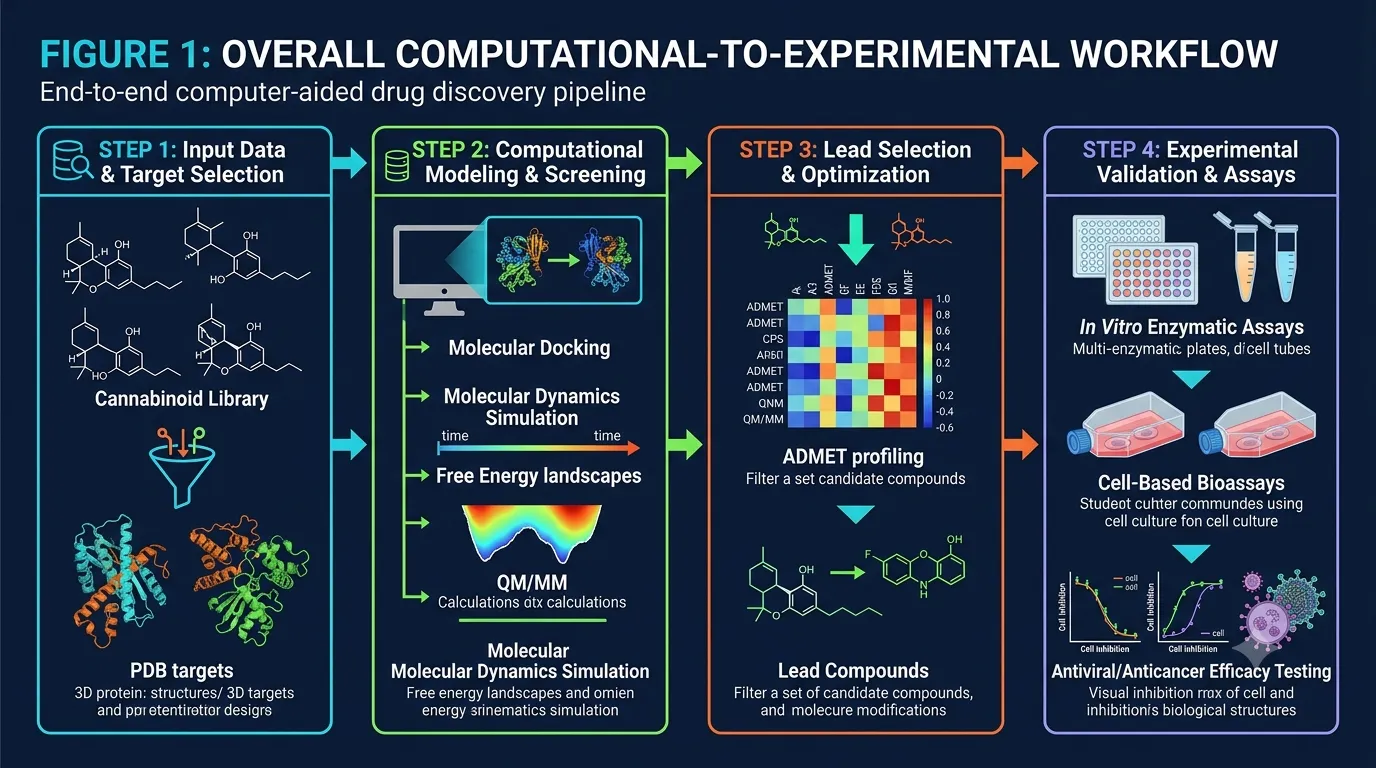
Figure 1: Integrated computational-to-experimental workflow for the discovery and optimization of cannabinoid derivatives for antiviral and anticancer applications.
AI/ML can strengthen this workflow through target identification, virtual screening, molecular-property prediction, QSAR, ADMET assessment, and multi-objective optimization [48–53]. By integrating molecular fingerprints, physicochemical descriptors, structural information, and appropriately curated experimental data, these approaches may help prioritize compounds that are difficult to identify using individual computational methods [49–53]. However, limited dataset sizes, chemical-space bias, inconsistent assay conditions, and inadequate external validation can lead to apparently strong retrospective performance without reliable prospective predictions [50–53]. Robust applications therefore require careful dataset curation, appropriate validation strategies, uncertainty assessment, and experimental testing; AI/ML should complement, rather than replace, mechanistic modeling and biological validation.
Against this background, the present review critically examines computationally guided cannabinoid discovery for antiviral and anticancer applications, treating cannabinoids as chemically tunable scaffolds rather than exclusively as natural products or canonical CB1/CB2 ligands. It evaluates the roles and limitations of molecular docking, MD simulations, binding free-energy analysis, quantum-chemical calculations, ADMET prediction, and AI/ML-assisted prioritization. Antiviral applications are considered across viral enzymes, viral entry, viral–host interfaces, and host-directed mechanisms, while anticancer applications encompass receptor tyrosine kinases, cannabinoid-sensitive receptors, signaling pathways, and relevant cellular phenotypes. Particular emphasis is placed on the relationship between computational predictions and biochemical, cellular, or in vivo evidence. Finally, the review identifies challenges associated with computational reproducibility, dataset quality, developability, pharmacokinetics, toxicity, and polypharmacology, and discusses how integrated modeling, uncertainty-aware prediction, experimental validation, and iterative lead optimization may support more reliable cannabinoid discovery.
2.0 Cannabinoid Chemical Space and Molecular Target Landscape
2.1. Structural diversity and organization of cannabinoid chemical space
Computational discovery of cannabinoid-derived therapeutics begins with defining the chemical space to be explored. This space includes major and minor phytocannabinoids, biosynthetic intermediates, acidic precursors, degradation products, and synthetic or semi-synthetic derivatives. More than one hundred phytocannabinoids have been identified in Cannabis sativa, including Δ⁹-tetrahydrocannabinol (Δ⁹-THC), cannabidiol (CBD), cannabigerol (CBG), cannabinol (CBN), cannabichromene (CBC), tetrahydrocannabivarin (THCV), cannabidiolic acid (CBDA), and cannabigerolic acid (CBGA) [89–92]. Classification based mainly on Δ⁹-THC and CBD content therefore overlooks a broader repertoire of minor cannabinoids and related metabolites [91]. Advances in synthetic chemistry and biosynthetic engineering are also improving access to rare compounds for computational and experimental investigation [89,90].
Phytocannabinoids are predominantly meroterpenoid structures arising from polyketide-derived and terpenoid biosynthetic pathways. CBGA occupies a central position in this network, giving rise to several cannabinoid families through enzymatic cyclization and subsequent transformations [89,90]. Acidic cannabinoids, including CBDA, CBGA, and tetrahydrocannabinolic acid (THCA), can undergo decarboxylation to form their corresponding neutral compounds, while oxidation, cyclization, hydroxylation, and side-chain modification generate further structural variants [90]. Varin cannabinoids add diversity through shorter propyl side chains, whereas synthetic and semi-synthetic derivatives enable deliberate modification of substituents, stereochemistry, polarity, and conformational properties. These structural differences can substantially affect receptor affinity, target selectivity, membrane partitioning, conformational preferences, and metabolism [89–92]. For example, experimental investigations of minor cannabinoids against SARS-CoV-2 Mpro have associated differences in decarboxylation state and side-chain length with differences in inhibitory activity [93]. Thus, structurally similar compounds may display markedly different biological effects—an important form of activity cliff that should be considered when constructing computational libraries and predictive models.
Chemical-space definition must also account for compound availability. Some minor cannabinoids occur naturally at low abundance, limiting their isolation and experimental screening. Synthetic biology, enzymatic biotransformation, and asymmetric synthesis are expanding access to these compounds [89,90]. Virtual libraries can therefore extend beyond immediately available molecules, but generated derivatives must remain chemically plausible, with appropriate valence, stereochemistry, protonation states, substitution patterns, and synthetic accessibility. For practical computational screening, cannabinoid chemical space can be organized into four overlapping groups: major phytocannabinoids, minor and rare phytocannabinoids, biosynthetic or degradation products, and synthetic or semi-synthetic derivatives. The relative priority of these groups should depend on the target, therapeutic objective, physicochemical requirements, and availability of reliable experimental data.
2.2. Structural determinants of cannabinoid molecular recognition
Many cannabinoids combine hydrophobic aromatic surfaces, flexible alkyl substituents, and polar functional groups. This architecture can support interactions with hydrophobic transmembrane cavities and soluble-protein binding sites. Aromatic and aliphatic regions contribute hydrophobic and van der Waals interactions, whereas phenolic and carboxylic groups may participate in hydrogen bonding and electrostatic interactions. Ring architecture, stereochemistry, conformational flexibility, and the ionization state of functional groups further influence the orientation of these interaction features.
These characteristics have direct implications for molecular docking and ligand preparation. Cannabinoids may adopt multiple conformations in solution, and the preferred solution conformation may differ from that observed in a protein-binding site. Acidic cannabinoids can also exhibit environment-dependent protonation states, while highly lipophilic neutral compounds may associate strongly with membranes. Reliable computational comparisons therefore require appropriate treatment of stereochemistry, protonation and tautomeric states where relevant, conformer generation, and energy minimization. These steps are particularly important when comparing closely related derivatives or assembling datasets for quantitative structure–activity relationship (QSAR) and machine-learning models.
Molecular recognition also depends on receptor dynamics. Structural studies of CB1 and CB2 signaling complexes have revealed ligand-associated conformational changes and distinct receptor activation states [94,95]. Subsequent structure-based virtual screening and molecular dynamics (MD) simulations have leveraged these receptor states to model partial agonism, ligand recognition, and subtype selectivity for diverse cannabinoid analogues [96,97]. These findings support integrating docking with MD and, when appropriate, binding free-energy calculations rather than treating a single predicted binding pose as conclusive evidence.
Chemical similarity can also be associated with target promiscuity. Modifications intended to reduce CB1-mediated psychoactivity, for example, may also alter CB2 activity or interactions with non-canonical targets. Consequently, computational design should not always maximize affinity for a single protein; depending on the therapeutic objective, it may instead seek selective activation or inhibition, partial agonism, allosteric modulation, or controlled polypharmacology. The appropriate design objective must therefore be defined before candidates are ranked.
2.3. Canonical and non-canonical molecular targets
The cannabinoid target landscape includes the canonical CB1 and CB2 receptors as well as non-canonical targets such as transient receptor potential (TRP) channels, GPR55, peroxisome proliferator-activated receptors (PPARs), serotonin receptors, ion channels, and intracellular signaling proteins [90,92]. This broader landscape allows cannabinoid derivatives to be investigated against disease-associated proteins beyond the endocannabinoid system (ECS). Experimentally resolved CB1 and CB2 structures provide a basis for structure-guided investigation, but their similarity presents a challenge for subtype selectivity. A compound predicted to interact favorably with one receptor may also recognize the other, depending on the binding mode and receptor conformation. Structural studies have identified conserved binding-pocket features and receptor-specific elements relevant to ligand recognition [94,95]. Ensemble docking, MD, interaction fingerprinting, and free-energy calculations can therefore help compare receptor states and investigate potential determinants of selectivity.
Other target classes require different considerations. TRP channels are dynamic membrane proteins with multiple ligand-accessible sites, so static docking may incompletely represent their ligand-recognition behavior; membrane-embedded MD and ensemble-based approaches may provide complementary information [90,92]. PPARγ offers a structurally defined ligand-binding domain linked to metabolic, inflammatory, and cancer-associated signaling, whereas GPR55 and other G-protein-coupled receptors extend the potential target space to pathways involved in proliferation, inflammation, and immune regulation [90,92].
This diversity makes target-space mapping important alongside chemical-space exploration. A target-focused workflow can begin with a disease-relevant protein and subsequently assess off-target interactions and polypharmacological profiles. Such analyses may be relevant where multiple pathways contribute to cancer phenotypes or where antiviral effects could involve both direct viral inhibition and host-directed mechanisms. However, multi-target predictions must be interpreted carefully: a broad predicted interaction profile is not automatically beneficial and requires evidence of functional relevance and acceptable selectivity.
2.4. Antiviral target landscape
The antiviral target landscape has been shaped substantially by structural studies of SARS-CoV-2. Computationally tractable targets include the main protease Mpro/3CLpro, papain-like protease PLpro, spike protein, the spike–ACE2 interface, and selected host factors involved in viral entry or replication. These targets represent different stages of infection and offer distinct opportunities for inhibitor discovery.
Mpro is attractive for structure-based screening because its catalytic site is characterized and is essential for viral polyprotein processing. Computational studies have screened cannabinoid libraries against Mpro and identified candidate compounds with favorable predicted interactions [98,99]. Experimental investigation of minor cannabinoids has also identified measurable Mpro inhibition for selected compounds, including tetrahydrocannabutol and CBGA, while surface plasmon resonance provided evidence of direct interaction for CBGA [93]. These findings illustrate the value of connecting computational prioritization with biochemical and biophysical evidence.
PLpro provides another potential target because of its roles in viral polyprotein processing and modulation of host responses. Computational screening has examined PLpro alongside Mpro, raising the possibility of identifying compounds with complementary or dual-target activity [98,99]. Such a strategy could be useful, but predicted dual targeting requires experimental confirmation and assessment of selectivity before it can be considered a meaningful therapeutic advantage.
The spike protein represents a distinct target class because it mediates host-cell entry through interactions involving ACE2. Experimental studies have reported that CBDA and CBGA can interact with spike-associated systems and interfere with cellular entry [100]. Computational investigations have also examined cannabinoid interactions with the spike receptor-binding domain and the RBD–ACE2 interface using docking, MD, and energetic analysis [99,101]. Because protein–protein interfaces can be conformationally variable and may not resemble conventional small-molecule binding pockets, interface mapping and evaluation of alternative structures can be important complements to single-structure docking.
These antiviral targets can therefore be grouped into viral enzymes, viral structural proteins, and host or viral–host interfaces. The distinction is computationally important: catalytic pockets may be more amenable to conventional structure-based screening, whereas entry-associated interfaces and host-directed targets require consideration of conformational variability, cellular context, and selectivity. Screening 45 cannabinoids against Mpro, PLpro, and ACE2 demonstrated the feasibility of comparing a broader cannabinoid library across multiple targets [99]. A separate computational investigation of 29 phytocannabinoids identified different candidate subsets for spike–ACE2 and Mpro systems, indicating that structural features relevant to one antiviral mechanism may not translate directly to another [101]. These findings support organizing antiviral discovery around target-specific mechanisms rather than assuming that one cannabinoid scaffold will be equally suitable for all targets.
2.5. Anticancer target landscape
The anticancer target landscape is more heterogeneous than the antiviral landscape because cancer involves diverse molecular alterations, signaling networks, tumor microenvironments, and disease-specific phenotypes. Relevant target classes include cannabinoid receptors and GPR55, TRP channels, receptor tyrosine kinases such as EGFR and HER2, angiogenic receptors such as VEGFR, and intracellular pathways associated with PI3K/AKT/mTOR, MAPK, AMPK, PPARγ, apoptosis, autophagy, oxidative stress, and cell-cycle regulation.
EGFR provides an example of a non-canonical cannabinoid target suitable for structure-based investigation. Computational and experimental studies have examined CBD, CBG, and CBN interactions with the EGFR tyrosine-kinase domain, with biochemical and biophysical measurements providing evidence of target interaction [102]. Subsequent work integrated flexible and semi-flexible docking, MM-GBSA calculations, ADME-Tox prediction, and 200-ns MD simulations to screen 50 cannabinoid and terpene phytochemicals. Several cannabinoids, including CBDA, CBD, THCV, Δ⁹-THC, Δ⁸-THC, CBL, and THCA, were prioritized as potential EGFR-targeting compounds [103]. These results illustrate the use of complementary computational filters, although predicted binding and simulation behavior should not be equated with demonstrated anticancer efficacy.
HER2 represents another receptor tyrosine kinase of interest. A study combining docking, surface plasmon resonance, kinase inhibition assays, and cellular experiments reported interactions of CBD, CBG, and CBN with the HER2 tyrosine-kinase domain [104]. Comparison across EGFR and HER2 may help investigate structural determinants of kinase selectivity and identify whether related cannabinoid scaffolds display distinct target profiles.
VEGFR-1 and VEGFR-2 provide additional targets associated with tumor angiogenesis. Computational screening of 110 cannabinoid derivatives against EGFR, VEGFR-1, and VEGFR-2 identified candidate structures across these targets and incorporated predicted ADME and toxicity properties into prioritization [105]. Multi-target analysis can thus extend candidate selection beyond maximizing predicted affinity for a single protein. Nevertheless, predicted multi-target binding remains a hypothesis until supported by suitable biochemical and cellular experiments.
Not all cannabinoid-associated anticancer effects can be explained by direct interaction with one protein. Phenotypes involving apoptosis, autophagy, oxidative stress, mitochondrial function, metabolism, proliferation, migration, and angiogenesis may reflect interconnected pathways or multiple targets. Target-centric computational discovery begins with a defined protein and evaluates compounds for potential modulation of its function. Phenotype-centric discovery instead begins with an observed cellular response and investigates the molecular targets and pathways that may explain it. These approaches are complementary: structure-based methods are particularly useful when reliable target structures and defined binding sites are available, whereas network pharmacology, pathway analysis, transcriptomic integration, and phenotype-informed models may be more appropriate when biological effects arise from complex signaling interactions.
2.6. Chemical space–target space relationships for computational discovery
The central challenge in cannabinoid discovery is not simply the size of the chemical library, but the relationship between molecular structure, target recognition, biological mechanism, and developability. A single scaffold may interact with several proteins, while closely related derivatives may exhibit different activities against the same target. This creates a multidimensional structure–activity–target relationship influenced by ligand similarity, binding-site architecture, receptor state, and biological context.
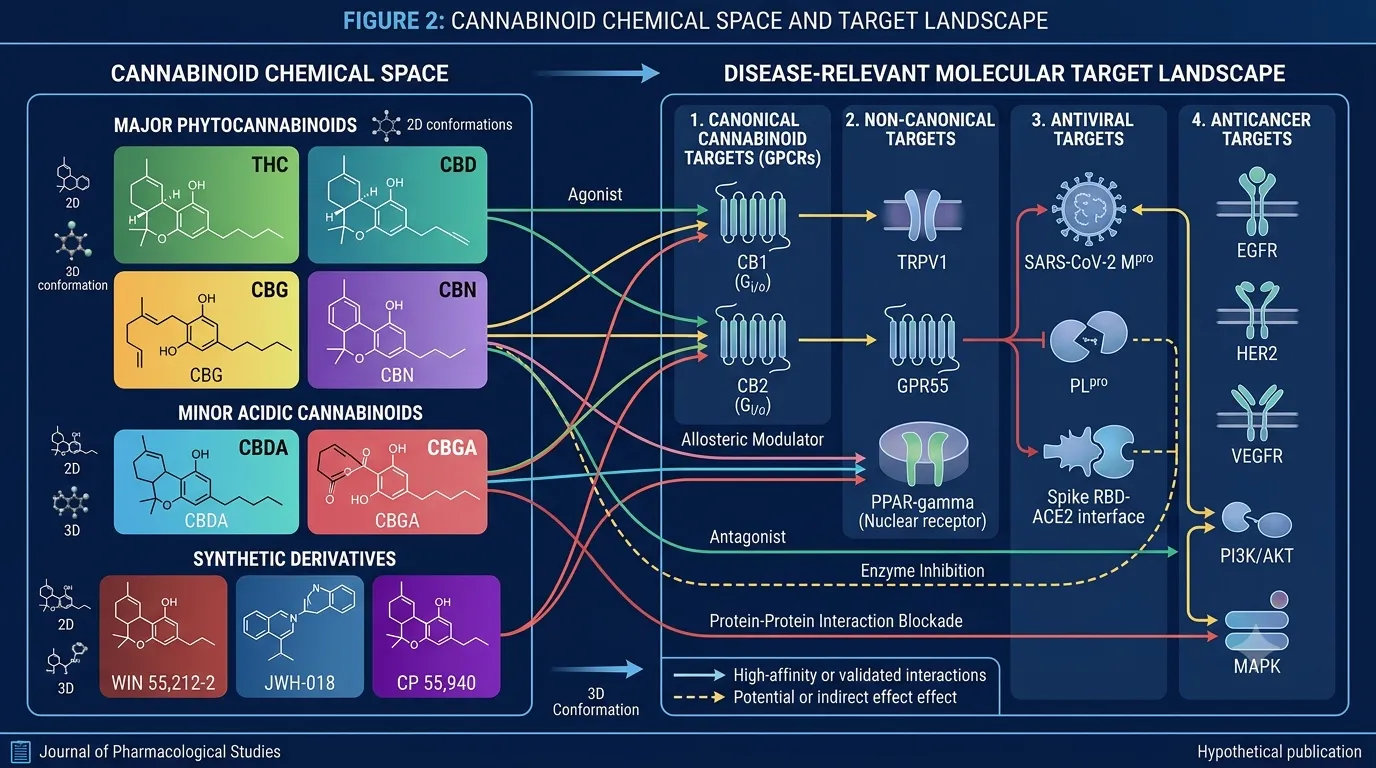
Figure 2: Cannabinoid Chemical Space and Associated Molecular Target Landscape Relevant to Antiviral and Anticancer Drug Discovery.
The chemical-space dimension includes major and minor phytocannabinoids, acidic cannabinoids, metabolites, synthetic analogues, and computationally designed derivatives. The target-space dimension includes CB1/CB2 and non-canonical cannabinoid-sensitive proteins, viral enzymes and structural proteins, viral–host interfaces, receptor tyrosine kinases, angiogenic receptors, and intracellular signaling proteins. The objective is not merely to identify high-scoring ligand–protein pairs, but to prioritize combinations supported by an appropriate balance of molecular recognition, dynamic behavior, relative energetics, selectivity, developability, and biological relevance.
Different target classes may require different computational strategies. GPCRs such as CB1 and CB2 may benefit from ensemble-based approaches that account for receptor conformational states and membrane environments. Soluble enzymes such as Mpro and kinase domains such as EGFR can be investigated using structure-based docking and energetic analysis, whereas spike–ACE2 interfaces may require interface mapping and alternative receptor conformations. Pathway-level anticancer mechanisms may require network-based or multi-omics approaches in addition to protein–ligand modeling.
Accordingly, virtual screening, docking, MD, binding free-energy calculations, quantum-chemical analysis, ADMET prediction, QSAR, and AI/ML should be treated as complementary rather than interchangeable tools. Their outputs become most useful when integrated with biochemical target-engagement assays, biophysical measurements, cellular phenotyping, and, where justified, in vivo studies. Experimental findings can then refine SAR analyses and predictive models, guiding subsequent rounds of chemical-space exploration. Cannabinoid discovery is therefore best viewed as an iterative, experimentally anchored process in which candidate selection depends on converging evidence rather than a single computational score.
3.0 Computational Strategies for Cannabinoid Drug Discovery
The chemical-space–target-space framework established in Section 2 provides the basis for computationally guided cannabinoid discovery. Its implementation requires complementary methods to evaluate molecular recognition, conformational flexibility, binding energetics, developability, and biological activity. These considerations are particularly important for cannabinoids because of their structural diversity, stereochemistry, hydrophobicity, conformational flexibility, and interactions with diverse targets, including cannabinoid receptors, ion channels, viral proteins, kinases, and intracellular signaling proteins.
No single computational method can reliably address all these requirements. Molecular preparation establishes chemically appropriate ligand and target structures; virtual screening and pharmacophore modeling reduce chemical-space complexity; docking proposes binding modes; molecular dynamics (MD) evaluates dynamic behavior; free-energy methods refine energetic comparisons; quantum-chemical calculations characterize electronic properties; and absorption, distribution, metabolism, excretion, and toxicity (ADMET) prediction assesses developability. Quantitative structure–activity relationship (QSAR) and artificial intelligence/machine learning (AI/ML) provide complementary approaches for learning structure–activity relationships and prioritizing unexplored chemical space.
Importantly, computational scores support candidate prioritization but do not independently establish biological efficacy. Their reliability depends on structural preparation, conformational sampling, solvation, scoring functions, and model assumptions. A hierarchical workflow can reduce these uncertainties and identify candidates for experimental testing, while generating mechanistic hypotheses for subsequent structure–activity relationship (SAR) analysis.
3.1 Molecular Preparation and Target Identification
Reliable computational discovery begins with chemically valid ligand structures and biologically relevant target models. Errors introduced during preparation can propagate through docking, MD, free-energy calculations, and ADMET prediction. Cannabinoid libraries should therefore undergo structure standardization, duplicate removal, stereochemical and valence validation, appropriate protonation and tautomer-state assignment, and conformational sampling. These steps are especially important for compounds containing stereogenic centers, flexible alkyl chains, and ionizable functional groups.
Library construction should distinguish experimentally characterized cannabinoids from hypothetical or computationally generated derivatives. Synthetic accessibility, chemical stability, and stereochemical integrity can complement preliminary descriptors such as molecular weight, lipophilicity, hydrogen-bonding capacity, topological polar surface area, rotatable bonds, and aqueous solubility. These properties are particularly relevant because cannabinoid lipophilicity can affect membrane partitioning, solubility, and apparent biological activity. Target selection requires comparable care. Experimentally resolved crystal or cryo-electron microscopy structures are generally preferred when they represent a biologically relevant conformational state. Where such structures are unavailable, homology models, AlphaFold-derived structures, or other comparative models may be useful, although structural uncertainty should be acknowledged. Protein preparation may involve correcting bond orders, adding hydrogens, addressing missing residues and crystallographic waters, assigning protonation states, and performing restrained minimization.
Preparation must reflect the target's physical environment. Protonation states can be particularly important for viral proteases and kinases, whereas membrane and lipid environments are essential for G-protein-coupled receptors (GPCRs) and ion channels. For cannabinoid receptors, the functional state also matters because agonists, antagonists, inverse agonists, and allosteric modulators may recognize different receptor conformations. Target identification should extend beyond disease association to consider mechanism, structural reliability, measurable activity, and the relationship between molecular engagement and the desired phenotype. Relevant antiviral targets include viral enzymes, structural proteins, and viral–host interfaces; anticancer targets may include receptor tyrosine kinases, signaling proteins, metabolic enzymes, apoptosis regulators, and cannabinoid-sensitive pathways. This biological definition guides the screening strategies described below.
3.2 Virtual Screening and Pharmacophore Modeling
Virtual screening reduces the number of cannabinoid candidates requiring detailed computational or experimental evaluation. Structure-based screening uses three-dimensional target structures, whereas ligand-based approaches exploit information from known active compounds. Pharmacophore modeling is useful when essential molecular-recognition features are known, even if the precise binding pose remains uncertain. Pharmacophores represent the spatial arrangement of features such as hydrogen-bond donors and acceptors, aromatic centers, hydrophobic regions, ionizable groups, and exclusion volumes. For cannabinoid discovery, pharmacophore models can help investigate CB1/CB2 recognition and identify features associated with receptor subtype selectivity. Earlier studies have demonstrated their utility in identifying candidate CB1 antagonists and CB2-selective ligands. Pharmacophore filtering can also support scaffold hopping by retaining chemically distinct compounds that reproduce relevant recognition features.
A practical strategy combines complementary filters rather than relying on one screening method. Chemical validity, physicochemical properties, pharmacophore matching, ligand diversity, docking, rescoring, MD, and ADMET prediction can be applied sequentially according to library size and target quality. Deep-learning-assisted pharmacophore approaches may further support large-scale screening and discrimination between related receptor-binding environments. The principal limitation is dependence on the quality and diversity of reference ligands and structural information. A model derived from a narrow chemical series may reproduce its existing bias and overlook compounds with distinct recognition mechanisms. Multiple pharmacophore hypotheses, alternative receptor conformations, and complementary ligand- and structure-based filters can improve coverage of chemical space.
3.3 Molecular Docking
Molecular docking is a widely used structure-based method for proposing ligand-binding poses and ranking candidate compounds. By sampling ligand positions and conformations within a binding site and applying an approximate scoring function, docking can identify potential hydrophobic, π–π, hydrogen-bonding, van der Waals, and electrostatic interactions. These predicted interactions can inform hypotheses about molecular recognition and guide SAR-based modifications.
Docking has been applied to cannabinoid receptors, viral proteins, and cancer-associated targets such as EGFR and HER2. Its main limitation is that a docking score is not equivalent to experimentally measured binding affinity. Conventional protocols approximate protein flexibility, solvation, entropy, polarization, and conformational adaptation, which can be particularly consequential for flexible cannabinoids and dynamic GPCRs. Several strategies can improve the robustness of docking predictions. Ensemble docking evaluates multiple experimentally determined or MD-derived receptor conformations; induced-fit methods account for limited receptor adaptation; and consensus docking compares predictions from different algorithms or scoring functions. Post-docking MM-PBSA/MM-GBSA or more rigorous free-energy calculations can provide further energetic discrimination.
For antiviral discovery, docking can investigate plausible binding modes in catalytic or regulatory sites of Mpro and PLpro or at viral–host interfaces. In anticancer applications, it can examine binding pockets in targets such as EGFR and HER2. In both cases, docking should be treated as a hypothesis-generating and prioritization method, with predicted interactions assessed using dynamic, energetic, and experimental approaches.
3.4 Molecular Dynamics
Molecular dynamics extends a static docking hypothesis by describing time-dependent protein–ligand behavior. Using molecular-mechanics force fields, MD simulations propagate the motions of the protein, ligand, solvent, ions, and, where appropriate, membrane components. The resulting trajectories can reveal conformational fluctuations, interaction persistence, solvent organization, and ligand-associated structural changes. MD is particularly relevant to cannabinoid receptors because CB1 and CB2 are membrane-embedded GPCRs with dynamic functional states. Simulations can investigate ligand recognition, receptor conformational changes, activation-associated behavior, and potential determinants of subtype selectivity. Common analyses include root-mean-square deviation (RMSD), root-mean-square fluctuation (RMSF), hydrogen-bond occupancy, contact frequencies, ligand positional stability, and principal-component or essential-dynamics analysis.
These metrics require contextual interpretation. Low RMSD alone does not establish strong binding: a trajectory may preserve an incorrect pose, while biologically relevant conformational transitions may involve substantial fluctuations. Interpretation should therefore emphasize chemically meaningful interactions, convergence, and reproducibility rather than a single stability measure. Simulation protocols must also reflect the target environment. CB1 and CB2 generally require suitable lipid, solvent, ion, and membrane representations, whereas soluble viral enzymes and many kinase systems can often be simulated in aqueous environments. MD trajectories can supply representative structures for subsequent MM-PBSA/MM-GBSA or more rigorous free-energy calculations.
A key limitation is that conventional simulations may not capture slow conformational transitions within accessible timescales. Multiple independent trajectories, enhanced sampling, or experimentally constrained simulations may therefore be necessary when conclusions depend on substantial structural rearrangements. MD is most informative when it tests and refines a binding hypothesis rather than serving as an isolated measure of binding strength.
3.5 Binding Free-Energy Calculations
Binding free-energy methods seek to estimate the thermodynamic favorability of ligand association. Practical approaches range from endpoint methods such as molecular mechanics Poisson–Boltzmann surface area (MM-PBSA) and molecular mechanics generalized Born surface area (MM-GBSA) to more computationally demanding alchemical methods, including free-energy perturbation (FEP) and thermodynamic integration.
MM-PBSA and MM-GBSA are useful for refining cannabinoid candidate rankings because they can be applied to MD trajectories at lower computational cost than rigorous alchemical calculations. They combine molecular-mechanics interaction energies with solvation contributions and can provide comparative rankings and residue-level energy decomposition. The latter may help identify energetic hotspots and structural features relevant to potency or receptor subtype selectivity.
However, endpoint estimates should not automatically be interpreted as experimental thermodynamic quantities. Their reliability depends on force fields, dielectric treatment, protonation states, conformational sampling, entropy treatment, and trajectory selection. These limitations become especially important when comparing structurally diverse cannabinoids.
Accordingly, MM-PBSA/MM-GBSA is best used for relative prioritization within well-defined chemical series. More rigorous alchemical calculations may be more appropriate for quantitative comparison of closely related analogues during lead optimization than for screening very large libraries. A practical hierarchy is therefore broad docking, MD and endpoint-energy refinement, followed by higher-accuracy free-energy calculations for a smaller set of promising candidates.
3.6 Quantum-Chemical Approaches
Quantum-chemical methods provide an electronic description that conventional molecular-mechanics force fields cannot fully capture. Density functional theory (DFT), semiempirical quantum mechanics, and quantum mechanics/molecular mechanics (QM/MM) approaches can be used to investigate electrostatic potentials, atomic charges, frontier orbitals, polarization, conformational energetics, and reactive sites. For cannabinoids, electronic descriptors may help explain differences among related structures and can be incorporated into QSAR models to relate molecular properties to experimentally measured activity. Quantum-similarity and three-dimensional QSAR approaches have also been explored for modeling cannabinoid activity and cytotoxicity-related endpoints.
QM methods become particularly relevant when the hypothesis involves electronic effects, chemical reactivity, metabolic transformation, or covalent interactions. QM/MM can investigate a localized chemically active region within a larger protein environment. However, full quantum-mechanical treatment of protein–ligand systems is computationally expensive. QM is therefore generally best used as a refinement tool for selected candidates rather than as the first step in large-scale screening.
3.7 ADMET and Drug-Likeness Prediction
Predicted target affinity alone does not establish therapeutic potential. Absorption, distribution, metabolism, excretion, and toxicity determine whether a candidate can achieve sufficient exposure while maintaining an acceptable safety profile. ADMET assessment should therefore inform candidate prioritization throughout discovery rather than being postponed until the final stages. Initial filters commonly include molecular weight, lipophilicity, hydrogen-bonding capacity, topological polar surface area, rotatable bonds, solubility, and rule-based drug-likeness criteria. These descriptors require careful interpretation for cannabinoids because high lipophilicity is common within the class and can influence both membrane partitioning and experimental exposure. More comprehensive predictions may address intestinal absorption, permeability, plasma-protein binding, blood–brain barrier penetration, cytochrome P450 interactions, metabolic stability, clearance, transporter interactions, cardiotoxicity, hepatotoxicity, mutagenicity, and cytotoxicity. Tools such as SwissADME, ADMETlab, and admetSAR provide rapid multi-endpoint predictions, including those supported by machine-learning models.
ADMET requirements also depend on the therapeutic objective. Antiviral candidates may require suitable exposure in respiratory or other infection-relevant tissues, whereas anticancer candidates may require systemic exposure and tumor penetration. Central nervous system penetration may be desirable for some indications but undesirable for others, particularly when CB1-associated psychoactive effects are a concern. CB2-oriented strategies may offer opportunities to reduce some CB1-associated liabilities, although selectivity and safety must be established experimentally. ADMET predictions should be evaluated alongside target selectivity because strong predicted affinity for a desired target does not compensate for potentially harmful interactions with unrelated receptors, ion channels, metabolic enzymes, or cardiac targets. Such predictions remain probabilistic and are most useful for identifying potential liabilities and prioritizing candidates for subsequent pharmacokinetic and toxicological evaluation.
3.8 QSAR and AI/ML Approaches
QSAR complements structure-based methods by relating molecular representations to experimentally measured biological activity. Models may use physicochemical descriptors, molecular fingerprints, topological indices, pharmacophore features, three-dimensional fields, or quantum-chemical descriptors to predict continuous endpoints such as (Ki), (IC50), and (EC50), or to classify compounds as active or inactive.
These approaches are relevant to cannabinoids because relatively small structural changes can alter receptor affinity, subtype selectivity, functional efficacy, and biological activity. Machine-learning QSAR models based on measured CB1/CB2 activities have been combined with structure-based screening to identify candidate selective ligands, while quantum-similarity and 3D-QSAR approaches provide complementary electronic and spatial descriptors.
Nonlinear algorithms—including random forests, gradient boosting, support-vector machines, neural networks, graph neural networks, and deep-learning architectures—can model relationships that are difficult to capture using conventional linear methods. Model inputs may include molecular fingerprints, molecular graphs, SMILES representations, physicochemical descriptors, protein sequences, and three-dimensional structures. Cannabinoid-focused studies illustrate the potential of ML for predicting CB1/CB2 affinity and selectivity, while highlighting limitations involving data quality, inconsistent endpoints, inactive-compound representation, and interpretability [106–114].
A key application is chemical-space prioritization. Rather than experimentally testing every candidate, ML models can identify compounds or chemical regions predicted to have favorable properties. Active-learning strategies can then select informative compounds for experimental evaluation, incorporate the results, and reprioritize subsequent candidates in a design–make–test–learn cycle. Generative AI can further propose structures against multiple objectives, including predicted affinity, selectivity, physicochemical properties, synthetic accessibility, and toxicity. Such generated molecules nevertheless require chemical validation, synthetic feasibility assessment, target-specific evaluation, and experimental confirmation.
Model validation is essential for determining whether predicted performance generalizes beyond the training data. Internal accuracy may be misleading when training and test compounds occupy similar chemical space. Scaffold-based splitting, external validation, applicability-domain analysis, uncertainty estimation, and prospective experimental testing provide stronger assessments of predictive utility. These measures are particularly important for cannabinoid datasets with heterogeneous assay conditions, different receptor states, inconsistent activity definitions, and imbalanced active/inactive distributions.
The principal outputs, limitations, and validation requirements of the computational methods discussed above are compared in Table 2. This comparison emphasizes that method selection should reflect the scientific question and that computational predictions require independent validation before biological activity or therapeutic potential can be inferred.
Table 2: Comparative Overview of Computational Methods for Cannabinoid Drug Discovery
| Computational method | Principal output | Key limitations | Appropriate validation requirements |
|---|---|---|---|
| Molecular preparation and target structure selection | Standardized cannabinoid structures and prepared protein or target models | Incorrect stereochemistry, protonation states, missing residues, or an unsuitable target conformation can bias downstream results | Verify chemical structures, stereochemistry, protonation states, and target-model quality; compare alternative plausible states where relevant |
| Virtual screening and pharmacophore modeling | Prioritized compounds and target-compatible molecular features | Depends on library diversity, pharmacophore assumptions, and the quality of known ligand information | Benchmark against known actives and suitable decoys; assess enrichment and screening performance on independent compounds |
| Molecular docking | Predicted binding poses and approximate scoring-based rankings | Scoring functions imperfectly represent solvation, protein flexibility, entropy, and competing binding modes | Redock known ligands, assess pose recovery, and compare predictions with independent binding data where available |
| Molecular dynamics (MD) simulations | Binding-site stability, conformational changes, interaction persistence, and solvent-mediated effects | Results depend on force fields, sampling duration, starting structures, and simulation setup; stability alone does not establish binding affinity | Use replicate simulations and convergence checks; compare predicted interactions or dynamics with available structural or experimental evidence |
| Binding free-energy calculations | Relative or absolute estimates of ligand-binding free energy, depending on the method | Sensitive to sampling, parameterization, protonation states, and treatment of solvent and entropy | Assess convergence and uncertainty; benchmark against experimental affinity data or suitable reference ligands |
| Quantum-chemical and QM/MM calculations | Electronic structure, charge distribution, interaction energetics, and selected reaction or polarization effects | Computational cost restricts system size and sampling; results depend on the chosen model and level of theory | Check model and method sensitivity; compare relevant molecular properties or mechanistic predictions with experimental or higher-level computational data |
| ADMET and drug-likeness prediction | Predicted absorption, distribution, metabolism, excretion, toxicity, and developability indicators | Prediction reliability depends on training-data coverage and may be limited for unusual cannabinoid structures | Confirm priority liabilities using appropriate experimental assays, such as solubility, permeability, metabolic stability, cytotoxicity, or toxicity testing |
| QSAR and AI/ML models | Predicted activity, molecular-property relationships, candidate rankings, and potentially proposed structures | Dataset bias, data leakage, limited applicability domains, and poor generalization to new chemical scaffolds | Use scaffold-aware or otherwise appropriate data splitting, independent external testing, uncertainty assessment, and experimental testing of prioritized predictions |
Abbreviations:
ADMET, absorption, distribution, metabolism, excretion, and toxicity; AI/ML, artificial intelligence and machine learning; MD, molecular dynamics; QM/MM, quantum mechanics/molecular mechanics; QSAR, quantitative structure–activity relationship.
Integrated Computational Prioritization
The methods described above are most effective when integrated into an evidence-generating hierarchy. A practical workflow begins with molecular preparation and target identification, followed by virtual screening and pharmacophore modeling, docking, MD, free-energy estimation, quantum-chemical analysis where justified, and ADMET assessment. QSAR and AI/ML can support prioritization at multiple stages rather than being restricted to the end of the workflow. The sequence need not be strictly linear. QSAR can reduce an initial library before docking, MD-derived interaction fingerprints can inform subsequent learning, and ADMET filters can be reapplied as candidates progress. The appropriate level of refinement depends on library size, structural quality, computational resources, and the maturity of the biological hypothesis.
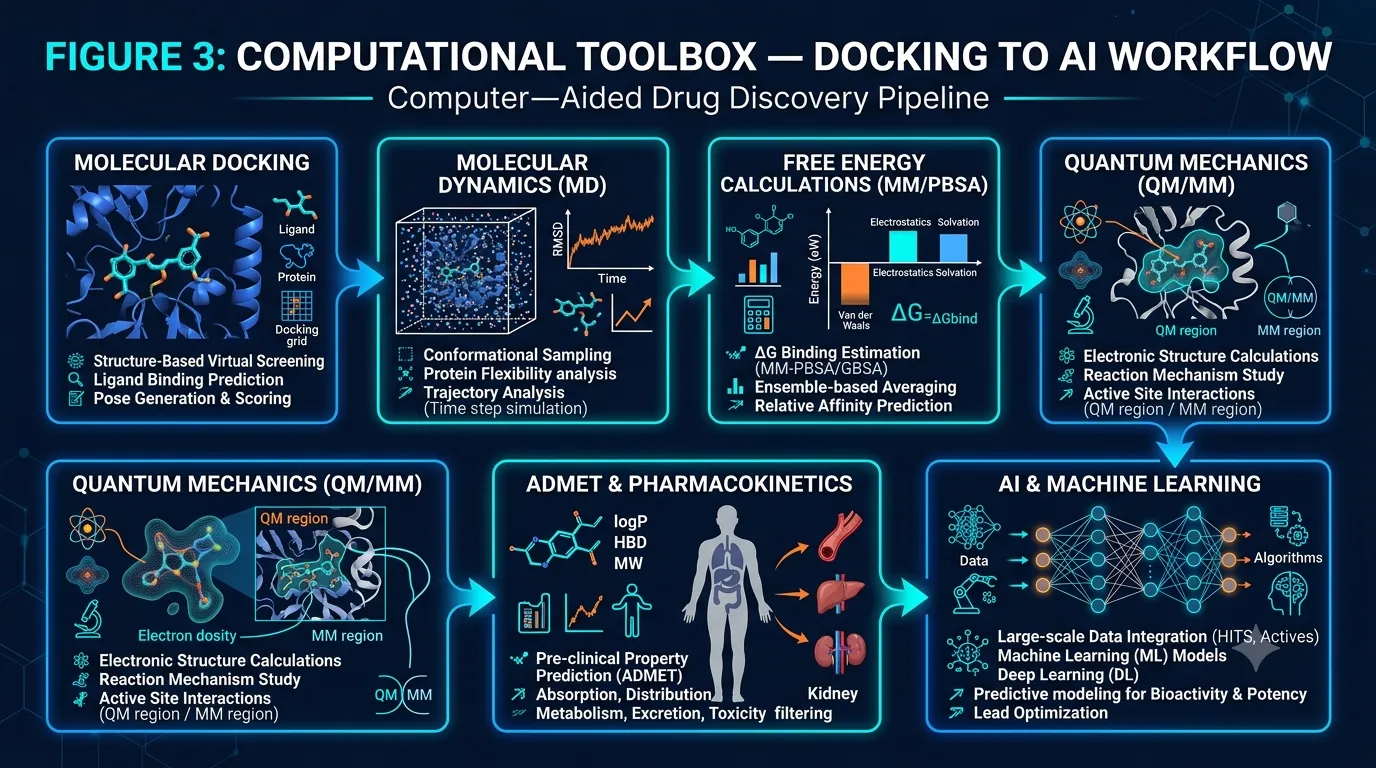
Figure 3: Integrated Computational Toolbox for Cannabinoid Drug Discovery.
Complementary computational approaches are arranged along a hierarchical discovery workflow encompassing molecular preparation, target identification, virtual screening, pharmacophore modeling, molecular docking, molecular dynamics simulations, binding free-energy estimation, quantum-chemical calculations, ADMET prediction, QSAR, and artificial intelligence/machine-learning approaches. Each layer provides distinct information about molecular recognition, conformational behavior, binding energetics, electronic properties, developability, or structure–activity relationships, enabling progressively refined candidate prioritization rather than reliance on a single computational score.
The objective is not to identify the cannabinoid with the most favorable docking score, but to prioritize candidates supported by convergent evidence for molecular recognition, dynamic behavior, energetic plausibility, chemical accessibility, pharmacokinetic feasibility, acceptable predicted liabilities, and biological relevance. A favorable docking prediction may not survive MD, energetic analysis, or ADMET assessment; conversely, a moderate docking score may remain worth investigating when supported by stronger downstream evidence. Computational predictions should therefore guide, rather than replace, biochemical and cellular experiments. This framework establishes the methodological basis for the case studies examined in Section 4, which considers cannabinoids investigated against antiviral targets and mechanisms, and Section 5, which addresses anticancer applications. These sections move from how candidates are computationally prioritized to the more consequential question of how convincingly their predicted mechanisms and biological activities are supported by experimental evidence.
4.0 Computationally Guided Antiviral Discovery
The chemical-space–target-space framework established in Section 2 and the computational toolbox described in Section 3 provide the basis for prioritizing cannabinoids against viral targets. Potential intervention points include viral proteases and polymerases, proteins involved in host-cell entry, viral–host interfaces, and host pathways regulating replication or antiviral immunity. Depending on the mechanism, cannabinoid discovery may involve direct viral-target inhibition, interference with viral entry, or host-directed antiviral activity. Structure-based methods are particularly suitable for proteins and defined molecular interfaces, whereas host-directed mechanisms may require systems-level approaches to capture signaling, gene expression, and cellular metabolism.
The reported antiviral effects of cannabinoids remain heterogeneous and depend on the compound, virus, concentration, target, and host response. SARS-CoV-2 has attracted substantial computational attention because structural information for Mpro, PLpro, spike, and host entry factors has enabled virtual screening, docking, molecular dynamics (MD), energetic analysis, and ADMET prediction. However, this literature also illustrates the distinction between computationally predicted interactions and experimentally established antiviral activity. Accordingly, this section evaluates both the capabilities and limitations of computational studies, emphasizing how far their predictions have progressed toward biological validation.
4.1 Computational Targeting of Viral Replication Proteins
Viral replication proteins are attractive targets because inhibiting essential enzymes can disrupt viral replication. For SARS-CoV-2, the main protease Mpro (3CLpro) and papain-like protease PLpro process viral polyproteins required for replication and transcription. Their experimentally determined structures have supported structure-based screening using docking, pharmacophore approaches, and MM-GBSA analysis [107–109]. More direct computational screening has examined phytocannabinoid interaction with the host receptor-binding interface. In particular, molecular modeling studies targeting the human ACE2 receptor have evaluated how active ingredients in Cannabis sativa might disrupt viral-entry mechanisms [110]. Other computational screening identified 6-prenylapigenin, cannabivarin, and Δ8-THCA-A as potential ACE2-interacting compounds.
Early studies primarily used docking to investigate phytocannabinoid interactions with Mpro. Raj et al. screened 32 cannabinoids and selected Δ9-THCA, Δ9-THC, CBN, CBD, and CBDA for subsequent MD simulations. This illustrates the hierarchical strategy discussed in Section 3: docking identifies candidate interactions, while MD evaluates their persistence under a simulated molecular environment. Nevertheless, persistent interactions indicate computational compatibility rather than confirmed enzyme inhibition. Scores from different studies also cannot be compared directly when receptor preparation, protonation, conformational sampling, scoring functions, and solvation treatments differ.
Broader screening expanded the chemical space and target range. A structure-based analysis of 45 Cannabis sativa cannabinoids identified compounds including cannabichromanon, cannabinolic acid, cannabinol, and cannabicyclolic acid as candidates for one or more targets, incorporating ADME and toxicity predictions. Another investigation identified canniprene, cannabigerolic acid monomethyl ether, cannabichromene, and CBGA as potential Mpro binders. These findings support screening beyond a small set of canonical cannabinoids, although predicted binding alone cannot establish antiviral function.
A stronger computational–experimental connection was demonstrated by Liu et al., who combined docking with biochemical inhibition assays and surface plasmon resonance (SPR). THCB and CBGA showed reported Mpro IC₅₀ values of 3.62 and 14.40 μM, respectively, while CBGA also exhibited measurable binding by SPR. The reported relationship between decarboxylation, alkyl-chain length, and anti-Mpro activity provides a useful basis for structure–activity relationship (SAR) analysis. In this case, docking helped interpret molecular interactions, whereas biochemical inhibition and SPR supplied independent evidence of functional inhibition and direct binding. The findings also emphasize that acidic cannabinoids and their neutral counterparts should be treated as distinct chemical entities because decarboxylation can alter hydrogen bonding, molecular recognition, and physicochemical properties. Overall, these studies illustrate an evidence progression from predicted binding to dynamic evaluation and, where available, biochemical and biophysical validation. Candidates supported by independent experimental measurements provide stronger evidence than compounds prioritized solely by docking scores.
4.2 Targeting Viral Entry and Spike–Host Interactions
Interfering with viral entry offers an alternative to inhibiting replication enzymes. SARS-CoV-2 entry involves recognition of host ACE2 by the spike receptor-binding domain (RBD), alongside proteolytic processing and membrane-entry mechanisms. Computational studies have therefore examined spike, ACE2, the spike–ACE2 interface, and host proteases as potential intervention points.
One study docked 42 cannabis compounds against the RBD–ACE2 complex and identified CBGVA, CBNA, and luteolin among the favorable candidates. Other computational screening identified 6-prenylapigenin, cannabivarin, and Δ8-THCA-A as potential ACE2-interacting compounds. These predictions suggest possible interference with viral–host recognition but do not establish inhibition of cellular entry. The original studies also recognized the need for subsequent efficacy and toxicity evaluation [101,110].
More direct evidence was reported by van Breemen and co-workers, who used affinity-selection mass spectrometry to identify cannabinoid acids interacting with SARS-CoV-2 spike and subsequently tested CBGA and CBDA in pseudovirus and live-virus entry assays. Both compounds inhibited cellular entry, including for the Alpha and Beta variants examined in that study. This progression demonstrates the complementary roles of computation and experimentation: structural modeling can generate binding hypotheses, while entry assays determine whether a candidate produces a functional antiviral effect. These findings also reinforce the importance of representing acidic and neutral cannabinoids separately in screening libraries. Their differences may influence protein recognition, solubility, membrane distribution, and metabolism, affecting both predicted binding and experimental activity.
4.3 Host-Directed Antiviral Mechanisms and Computational Opportunities
Cannabinoid antiviral activity may also involve host pathways associated with inflammation, oxidative stress, apoptosis, endoplasmic-reticulum stress, and innate immunity. Such mechanisms are not readily captured by docking against a single viral protein. CBD provides an example: Nguyen et al. reported inhibition of SARS-CoV-2 replication in cell-based systems associated with an endoplasmic-reticulum stress response and innate immune signaling [45]. This finding illustrates why interactions with isolated viral proteins may not explain the dominant biological mechanism of a cannabinoid.
Computational investigation of host-directed activity therefore benefits from network pharmacology, transcriptomic analysis, pathway enrichment, molecular interaction networks, and multi-omics integration. These methods can identify candidate host proteins and pathways, which can then be examined using docking or MD when suitable structural targets are available. For example, transcriptomic changes involving interferon signaling, oxidative stress, or endoplasmic-reticulum pathways can be integrated with target-prediction methods to identify potential upstream regulators.
Host-directed mechanisms nevertheless require careful interpretation. Modulating inflammatory signaling does not necessarily suppress viral replication, and immunomodulation may be beneficial or detrimental depending on the infection and its stage. Computational hypotheses should therefore be evaluated alongside viral-load measurements, replication assays, cell viability, cytokine responses, and pathway-specific biomarkers.
4.4 Comparative Analysis Across Antiviral Targets
The availability of multiple viral and host structures enables cannabinoids to be evaluated across a broader target space, consistent with the chemical-space × target-space framework introduced in Section 2. This approach may reveal complementary target profiles, but it can also generate false positives if favorable docking scores are interpreted as evidence of meaningful polypharmacology [109]. For SARS-CoV-2, comparative screening can encompass Mpro, PLpro, spike, ACE2, and other entry- or replication-associated proteins. The 45-cannabinoid study described in Section 4.1 illustrates this approach by evaluating Mpro, PLpro, and ACE2 within a common computational framework. Such analyses can help prioritize compounds for which multiple predicted interactions are biologically plausible. A target–ligand interaction matrix can be represented as:
Aij=f (Li,Tj)
where (Li) represents cannabinoid (i), (Tj) represents antiviral target (j), and (f) denotes a computational or experimentally measured interaction metric. Depending on the available evidence, the matrix may incorporate docking scores, MD-derived interaction persistence, free-energy estimates, biochemical inhibition, or cellular activity.
The matrix can reveal target preferences and candidates for further investigation, but broad docking across multiple proteins increases the risk of false-positive predictions. Highly hydrophobic cannabinoids may score favorably against unrelated binding sites without producing biologically relevant multi-target activity. Target expression, cellular localization, selectivity, achievable concentration, and functional relevance must therefore be considered alongside predicted interaction profiles.
Table 3: Comparative Overview of Computational Strategies for Antiviral Cannabinoid Discovery
| Antiviral strategy | Main computational focus | Principal limitation | Evidence needed for validation |
|---|---|---|---|
| Direct viral-target inhibition | Docking, MD, and binding free-energy analysis of viral enzymes such as Mpro and PLpro | Predicted binding does not establish enzyme inhibition or antiviral activity | Biochemical inhibition, direct-binding measurements where appropriate, and cellular antiviral assays |
| Viral-entry interference | Modeling of spike, ACE2, spike–ACE2 interactions, and entry-associated proteins | Predicted interface binding may not disrupt entry in a cellular system | Binding or competition studies and pseudovirus or live-virus entry assays |
| Host-directed antiviral activity | Network pharmacology, transcriptomics, pathway analysis, and target-specific modeling | Pathway modulation may not suppress replication and may produce context-dependent immune effects | Viral replication measurements, cell viability, cytokine analysis, and pathway-specific assays |
| Multi-target antiviral activity | Comparative target–ligand matrices and integrated interaction analysis | Favorable scores across multiple targets may reflect nonspecific interactions rather than useful polypharmacology | Target-specific validation, selectivity assessment, and cellular evidence connecting the targets to the antiviral phenotype |
| SAR-guided lead optimization | QSAR/ML, docking, MD, and free-energy comparison of related analogues | Predictions may not generalize beyond the training compounds or account for developability | Independent activity measurements, analogue testing, and assessment of selectivity, stability, and ADMET properties |
This table complements Figure 4 by comparing antiviral strategies and their validation requirements rather than repeating the figure’s mapping of target classes and evidence levels.
4.5 Molecular Dynamics and Energetic Evaluation of Antiviral Hits
The antiviral literature illustrates the value of progressing from static docking to dynamic and energetic analysis. MD can assess whether predicted ligand orientations persist during simulation and characterize interaction patterns, solvent effects, and protein conformational changes. For Mpro, trajectory analysis may examine contacts with catalytic-pocket residues, hydrogen-bond persistence, ligand orientation, and changes in the binding site. The early 32-cannabinoid study provides an example of selecting docking candidates for subsequent MD. More generally, antiviral workflows have combined docking, MD, ADMET assessment, and binding-energy calculations to reduce reliance on individual docking results [108].
MD should, however, be treated as a computational evaluation step rather than an experimental substitute. A ligand that remains in a simulated binding site does not necessarily have high experimental affinity or inhibit the target. MM-PBSA/MM-GBSA can provide additional energetic estimates from simulation trajectories, while more rigorous free-energy methods may help compare closely related analogues during SAR optimization. These methods are most informative when computational protocols are consistent and the predictions can be compared with experimental measurements from the same chemical series.
Antiviral computational evidence can therefore be considered at three complementary levels:
1. Structural evidence: predicted binding poses and molecular interactions.
2. Dynamic evidence: persistence of interactions and conformational behavior during MD.
3. Energetic evidence: estimated relative or absolute binding free energies, depending on the method.
Agreement across these levels strengthens a computational hypothesis, but biochemical and cellular testing remains necessary to establish biological activity.
4.6 ADMET-Aware Prioritization of Antiviral Candidates
As discussed in Section 3, predicted target affinity alone does not determine translational value. ADMET properties should be considered alongside target recognition, particularly because cannabinoid lipophilicity can promote membrane association while limiting aqueous solubility. Metabolism may also produce compounds with biological properties different from those of the parent molecule, and acidic and neutral cannabinoids can exhibit distinct physicochemical behavior.
Candidate prioritization should therefore integrate target interactions, dynamic and energetic evidence, ADMET properties, selectivity, and experimental validation rather than relying on a single score. The weighting of these factors should reflect the intended therapeutic application. For example, a cannabinoid with favorable predicted Mpro binding but poor exposure may be less promising than a somewhat weaker binder with better metabolic stability and relevant tissue exposure. For a locally administered antiviral, local concentration and tissue penetration may be more important than systemic exposure.
ADMET predictions are useful for early filtering, but their reliability depends on the model and chemical space represented in its training data. Priority liabilities should be examined using appropriate experimental measurements, including solubility, permeability, metabolic stability, cytotoxicity, and toxicity testing.
4.7 From Computational Hits to Experimental Validation
A key limitation of the antiviral cannabinoid literature is the uneven progression from computational predictions to experimental evidence. Many studies report favorable docking against SARS-CoV-2 proteins, whereas fewer establish biochemical inhibition, direct binding, cellular antiviral activity, and in vivo efficacy within the same investigation. The minor-cannabinoid Mpro study provides a useful example of combining biochemical inhibition, SPR, and docking. Similarly, the CBGA and CBDA studies progressed from spike-interaction analysis to pseudovirus and live-virus entry assays. These examples support designing computational studies around planned experimental validation rather than treating docking as the final endpoint [107,111].
A practical validation cascade comprises:
1. Computational prioritization: screening, docking, and assessment of predicted interactions.
2. Biochemical and biophysical testing: evaluation of target inhibition and direct molecular binding, as appropriate.
3. Cellular antiviral testing: measurement of antiviral activity alongside cell viability and relevant controls.
4. Mechanistic evaluation: confirmation that observed effects are consistent with the proposed target or host pathway.
5. In vivo assessment: evaluation of exposure, efficacy, and safety when supported by earlier evidence.
Each stage addresses a different uncertainty. Biochemical assays evaluate target function, biophysical methods assess direct binding, and cellular studies determine whether molecular interactions translate into antiviral activity. In vivo studies address additional questions of exposure, efficacy, and safety. This hierarchy is particularly important because observed antiviral phenotypes may arise from direct viral inhibition, host modulation, cytotoxicity, or combinations of these effects.
4.8 Structure–Activity Relationships and Computational Optimization
Once antiviral activity has been supported experimentally, computational analysis can shift from broad screening to focused lead optimization. The objective is to identify structural modifications that improve potency, selectivity, stability, and developability. The reported relationship between decarboxylation, alkyl-chain length, and Mpro inhibition provides an example of using experimental SAR to guide analogue design. Docking can suggest modification sites near relevant residues, MD can assess whether binding modes are retained, and free-energy calculations can help prioritize closely related analogues [101]. QSAR and ML methods can further relate measured antiviral activity to molecular descriptors or fingerprints and support predictions for unexplored derivatives.
Active-learning strategies offer a route to iterative optimization by selecting informative compounds for synthesis and testing, updating models with the resulting measurements, and refining subsequent selections. This approach may be useful for minor cannabinoids, whose natural abundance can constrain systematic experimental screening. Nevertheless, computationally generated or prioritized derivatives must also satisfy requirements for synthetic accessibility, chemical stability, ADMET properties, target specificity, and safety. Computational design should expand experimentally supported chemical space rather than replace experimental decision-making.
4.9 Critical Assessment of Antiviral Cannabinoid Discovery
The available literature identifies cannabinoids as a chemically diverse space for antiviral investigation, but computationally predicted candidates should not be regarded as established antiviral drugs. Docking scores are not directly comparable across studies, static structures may inadequately represent target flexibility, and predicted interactions may not persist during simulation. ADMET predictions also remain uncertain, particularly for highly lipophilic compounds. Most importantly, concentrations required for antiviral activity may exceed achievable free concentrations in relevant tissues.
Biological context introduces further uncertainty. Viral inhibition may reflect direct target inhibition, host-cell modulation, cytotoxicity, or combinations of these mechanisms. Appropriate controls are therefore needed to distinguish specific antiviral effects from nonspecific cellular responses.
The literature is also concentrated on SARS-CoV-2. Although the computational principles can be applied to other viruses, differences in target structures, replication mechanisms, entry pathways, and host responses limit direct transfer of conclusions. The antiviral potential of cannabinoids against viruses such as HIV, HCV, and HSV-1 therefore remains less systematically developed within the computational framework considered here. Direct antiviral and immunomodulatory effects should be evaluated separately and in the context of each infection[51].
4.10 Integrated Perspective
The antiviral case studies reinforce the central premise of Sections 1–3: computational discovery is most informative when multiple levels of evidence are integrated rather than treating docking as an endpoint. Chemical-space definition and target selection establish the discovery problem; virtual screening and docking generate candidate hypotheses; MD and energetic analysis evaluate structural and thermodynamic plausibility; ADMET assessment addresses developability; and biochemical, biophysical, cellular, and in vivo studies determine whether predictions translate into biological activity.
The resulting closed-loop workflow can be summarized as:
Cannabinoid chemical space → viral/host target selection → virtual screening → docking → MD → free-energy/interaction analysis → ADMET filtering → experimental target validation → cellular antiviral testing → SAR optimization → computational rescreening.
The strongest candidates are therefore not necessarily those with the most favorable docking scores, but those for which predicted interactions, target inhibition, cellular antiviral activity, exposure, and safety evidence converge. This framework also establishes a basis for comparison with anticancer discovery. Viral targets often involve defined catalytic sites or protein–protein interfaces, whereas cancer involves heterogeneous targets and phenotypes, including receptor tyrosine kinases, intracellular signaling, apoptosis, autophagy, metabolism, and tumor-specific cellular contexts. Section 5 extends the same evidence hierarchy to anticancer cannabinoid discovery while considering how target heterogeneity and network-level biology influence computational prioritization and validation.
The progression from computational prediction to experimental evidence across antiviral and anticancer applications is summarized in Figure 4.
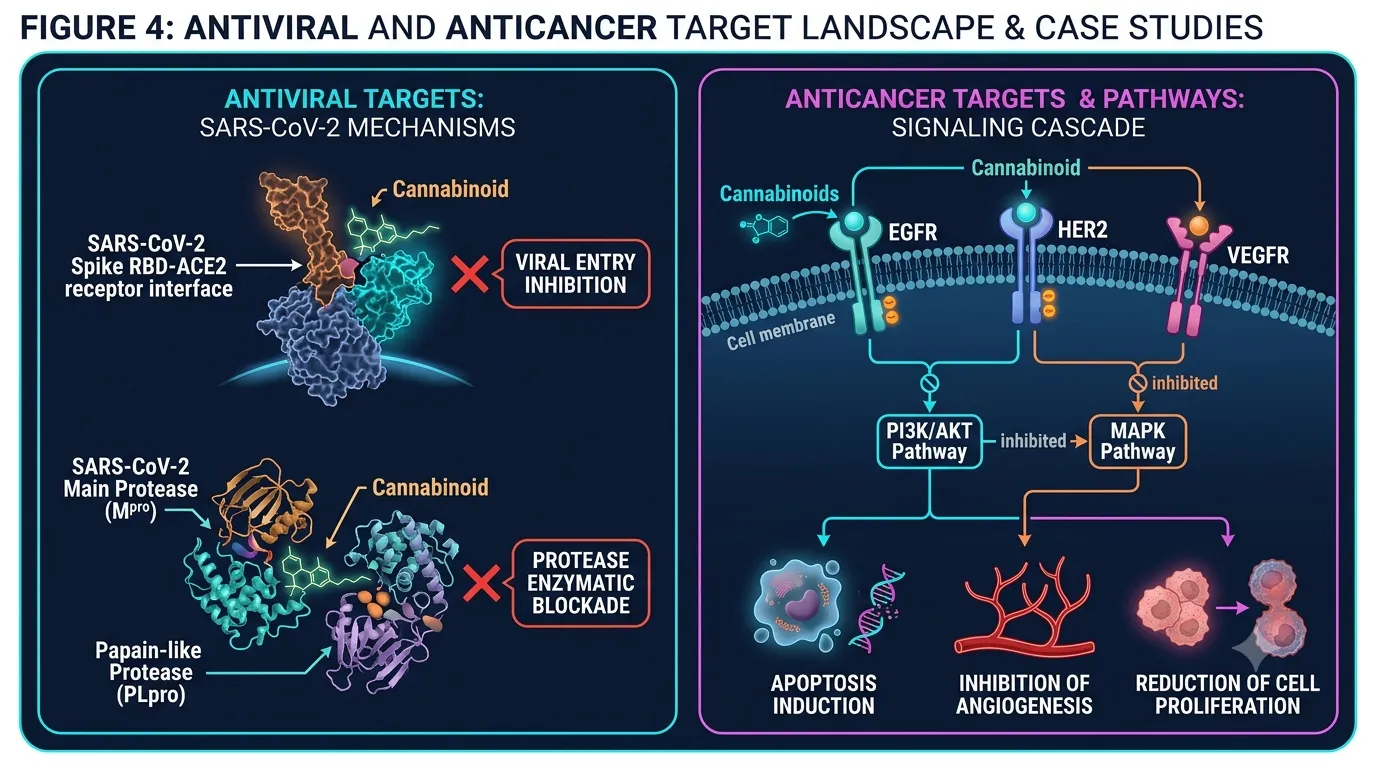
Figure 4: Computationally investigated cannabinoid derivatives across antiviral and anticancer target spaces and their levels of experimental validation.
5.0 Computationally Guided Anticancer Discovery
Building on the chemical-space–target-space framework in Section 2 and the computational strategies discussed in Sections 3 and 4, cannabinoid-based anticancer discovery presents a more heterogeneous target landscape than antiviral discovery. Cancer involves interconnected receptor tyrosine kinases (RTKs), intracellular signaling proteins, transcriptional regulators, metabolic enzymes, apoptosis and autophagy pathways, angiogenic factors, and tumor–microenvironment interactions. Cannabinoid structural diversity and reported effects on these processes create opportunities for target-based and phenotype-based discovery. However, their pleiotropic activity also complicates the distinction between direct target engagement and downstream cellular effects.
Computational approaches can help prioritize candidates by integrating virtual screening, molecular docking, molecular dynamics (MD), binding free-energy estimation, quantum-chemical analysis, ADMET prediction, and artificial intelligence/machine learning (AI/ML). Yet anticancer activity cannot be inferred solely from predicted binding. A cannabinoid may reduce cancer-cell viability without directly inhibiting the protein used for docking, while binding to a cancer-associated target does not necessarily produce a meaningful cellular response. Accordingly, computational predictions should be evaluated through a staged evidence hierarchy that considers target engagement, functional activity, cellular response, selectivity, and pharmacological feasibility.
5.1 Cancer target space for computational cannabinoid discovery
The principal target classes relevant to computational cannabinoid discovery include: (i) cannabinoid receptors and noncanonical cannabinoid-sensitive proteins; (ii) RTKs and membrane-associated signaling proteins; (iii) intracellular signaling and survival pathways; and (iv) proteins associated with angiogenesis, apoptosis, autophagy, oxidative stress, and cancer metabolism.
CB1 and CB2 are canonical cannabinoid targets, but their relevance varies with tumor type, receptor expression, and cellular context. Noncanonical targets, including transient receptor potential (TRP) channels, GPR55, and peroxisome proliferator-activated receptors (PPARs), further broaden the target space. These proteins may be investigated using structure-based or ligand-based methods when suitable structures, reliable models, or experimentally characterized ligands are available.
RTKs such as epidermal growth factor receptor (EGFR) and human epidermal growth factor receptor 2 (HER2) are attractive targets because their kinase domains contain structurally characterized ATP-binding pockets suitable for virtual screening. Their roles in tumor proliferation and survival also provide opportunities to connect computational predictions with biochemical and cellular assays. Vascular endothelial growth factor receptors (VEGFR-1 and VEGFR-2) offer additional targets for investigating angiogenic signaling. A computational study of 110 cannabinoid derivatives against EGFR, VEGFR-1, and VEGFR-2 illustrates the application of multitarget screening to cancer-associated kinases [105].
Thus, computational discovery need not be restricted to CB1 and CB2. Cannabinoid scaffolds can be investigated across kinase domains, ion channels, and intracellular signaling proteins, provided that target selection is supported by a plausible biological rationale and a feasible validation strategy.
Table 4: Anticancer Target Classes, Computational Opportunities, and Validation Requirements for Cannabinoid Discovery
| Target class | Computational opportunity | Principal limitation | Key validation requirements |
|---|---|---|---|
| CB1, CB2, and noncanonical cannabinoid-sensitive proteins | Docking, ligand-based screening, MD, and target-network analysis | Receptor expression and biological effects vary across tumor contexts | Direct target-engagement assays, pathway analysis, and appropriate cellular perturbation experiments |
| EGFR and HER2 kinases | Structure-based screening, docking, MD, and binding-energy calculations | Predicted pocket binding does not establish kinase inhibition or selectivity | Direct-binding measurements, kinase inhibition assays, and target-relevant cellular studies |
| VEGFR-1 and VEGFR-2 | Comparative docking and multitarget prioritization | Favorable predicted binding may not suppress angiogenic signaling | Kinase assays and suitable functional assays of angiogenic activity |
| Apoptosis, autophagy, and survival pathways | Network pharmacology, transcriptomic analysis, pathway modeling, and target-specific docking | Pathway changes may be indirect or secondary to cellular stress | Pathway-specific biomarkers, perturbation experiments, and cell-viability controls |
| Cancer metabolism and oxidative-stress pathways | Metabolic-network analysis, multi-omics integration, and mechanistic modeling | Metabolic responses are context-dependent and may not identify a direct molecular target | Metabolomic or biochemical measurements, pathway analysis, and relevant cellular assays |
| Multitarget and phenotype-associated networks | Target–ligand matrices, AI/ML, and integration of molecular and cellular data | Apparent polypharmacology may reflect nonspecific binding or general cytotoxicity | Target selectivity, normal-cell comparisons, mechanistic validation, and pharmacological assessment |
The table complements the computational-method comparison in Section 3 and the antiviral-strategy comparison in Section 4 by focusing on cancer-specific target classes and the evidence required to establish their biological relevance.
5.2 Cannabinoid targeting of EGFR: a computational case study
EGFR is an important example of structure-based anticancer discovery because aberrant signaling through this receptor can promote tumor-cell proliferation, survival, migration, and therapy resistance [102]. Its tyrosine-kinase domain provides a structurally defined target for computational screening.
Daoui and co-workers screened 50 cannabinoid- and terpene-derived phytochemicals against EGFR tyrosine kinase [103]. Their workflow combined semi-flexible and flexible docking, MM-GBSA calculations, ADME-Tox prediction, and 200 ns MD simulations. Nine compounds—CBDA, CBD, THCV, Δ9-THC, Δ8-THC, CBL, THCA, β-caryophyllene, and γ-elemene—were identified as promising computational candidates. The study illustrates the value of a hierarchical computer-aided drug-discovery workflow. Initial docking prioritized compounds, while subsequent filtering, energetic calculations, and MD provided additional information about their predicted interactions. Trajectories were analyzed using root-mean-square deviation (RMSD), root-mean-square fluctuation (RMSF), protein–ligand contacts, radius of gyration, and solvent-accessible surface area.
These analyses provide complementary structural information but do not establish experimentally meaningful EGFR inhibition. Favorable docking may reflect hydrophobic complementarity within the ATP-binding pocket without producing functional inhibition. Likewise, a stable simulated complex does not prove target engagement in cells. The identified compounds should therefore be regarded as candidates for experimental investigation, not as confirmed EGFR-targeted anticancer agents.
5.3 Cannabinoid targeting of HER2 and experimental validation
HER2 provides a more extensive example of computational predictions being evaluated using biophysical, biochemical, and cellular measurements. As a member of the ErbB receptor family, HER2 contributes to signaling associated with tumor proliferation and survival and provides a structurally suitable target for kinase-directed analysis.
Lamtha et al. investigated CBD, CBG, and CBN against HER2 tyrosine kinase using surface plasmon resonance (SPR), kinase inhibition assays, molecular docking, and cancer-cell viability measurements [104]. SPR measurements indicated direct interaction with HER2-TK, with reported dissociation constants ((K_D)) of 6.16 μM for CBD and 17.07 μM for CBG. CBG and CBD also inhibited HER2 kinase activity, with reported IC₅₀ values of 24.7 and 38 nM, respectively. Docking implicated residues including Leu796, Thr862, and Asp863. In HER2-positive SKOV3 ovarian cancer cells, CBD and CBG reduced cell viability, with reported IC₅₀ values of 13.8 and 16.6 μM, respectively. This study provides a more informative evidence chain than docking alone:
Workflow 5.1. Computational prediction and experimental validation of a kinase-directed cannabinoid
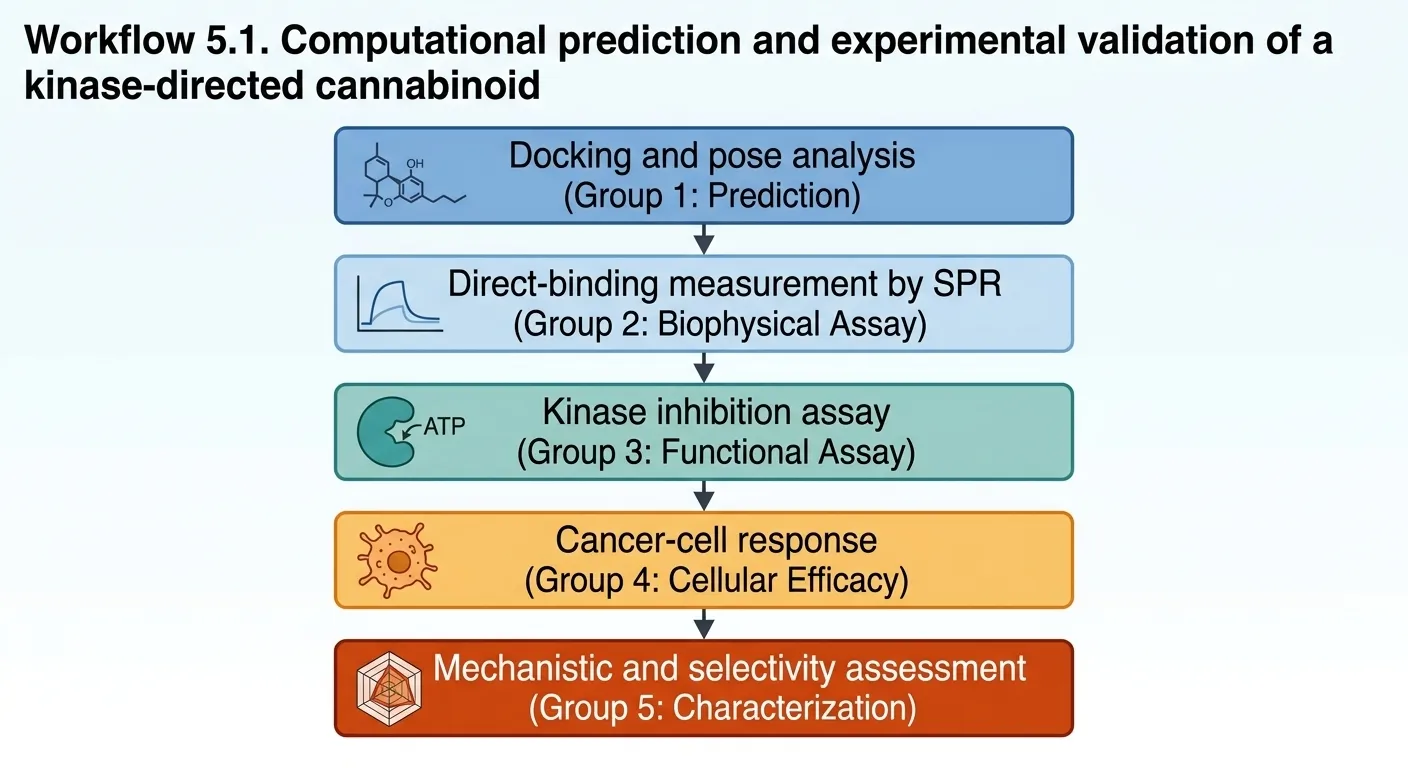
The results also demonstrate why (KD), enzymatic IC₅₀, and cellular IC₅₀ must not be treated as interchangeable measures. They describe different processes: molecular binding, functional enzyme inhibition, and a cellular phenotype. Cellular activity additionally depends on permeability, intracellular concentration, receptor abundance, downstream signaling, metabolism, and interactions with other targets. Consequently, the strongest interpretation combines computational evidence with independent experimental measurements while distinguishing molecular affinity from functional and cellular potency.
5.4 Multitarget inhibition of EGFR and VEGFR
Cancer progression can involve both proliferative and angiogenic signaling, motivating the investigation of cannabinoid derivatives against multiple cancer-associated targets. Ayoobi and Choi evaluated 110 cannabinoid derivatives against EGFR, VEGFR-1, and VEGFR-2 using molecular docking and pharmacokinetic analysis [105]. The study identified candidate structures across these targets and assessed predicted interactions alongside ADME properties.
An important observation was that favorable docking performance did not always coincide with favorable drug-likeness. Some highly lipophilic derivatives and glucuronidated THC-related structures showed favorable predicted binding but less desirable pharmacokinetic characteristics. This illustrates a key limitation of affinity-only ranking: computational scoring can prioritize molecules that interact favorably with a binding pocket but may be unsuitable as drug leads.
A multitarget interaction matrix can be expressed as
Mij = f (Li, Tj )
where (Li) denotes cannabinoid derivative (i), (Tj) denotes cancer-associated target (j), and (f) represents a computational or experimentally measured interaction metric. Depending on the available evidence, the matrix may incorporate docking scores, predicted binding free energies, MD-derived interaction persistence, or measured target activity.
Such an analysis can help distinguish potentially selective compounds from candidates with complementary multitarget profiles. However, broad predicted binding does not automatically represent beneficial polypharmacology. Therapeutically useful multitarget activity should be supported by a mechanistic rationale, experimental target validation, and an acceptable safety profile. The findings of Ayoobi and Choi should therefore be interpreted as hypothesis-generating until the predicted interactions are experimentally confirmed [105].
5.5 Dynamic and energetic validation of anticancer candidates
Molecular docking provides a largely static representation of ligand recognition, whereas cancer-associated proteins may undergo substantial conformational changes. MD can assess whether predicted cannabinoid–protein interactions persist during simulation and characterize protein flexibility, ligand orientation, and contact patterns.
The EGFR study by Daoui et al. illustrates this approach through 200 ns simulations of selected cannabinoid and terpene complexes [103]. Analyses of RMSD, RMSF, protein–ligand contacts, radius of gyration, and solvent-accessible surface area provided complementary information about simulated complex behavior.
For kinase-directed cannabinoids, MD can investigate whether a ligand remains in the predicted binding pocket, which interactions persist, and whether alternative binding modes emerge. Nevertheless, simulated stability should not be equated with experimental affinity or kinase inhibition.
MM-PBSA and MM-GBSA calculations can provide additional energetic estimates, while more rigorous free-energy methods may help compare closely related analogues during SAR optimization. These approaches are sensitive to force fields, sampling, solvation assumptions, and entropy treatment. Their greatest value is therefore often comparative, particularly when candidates are evaluated using consistent protocols and experimental data from the same chemical series.
The computational evidence can be considered at three complementary levels:
1. Structural: predicted poses and interactions.
2. Dynamic: interaction persistence and conformational behavior during MD.
3. Energetic: estimated binding free energies or relative energetic differences.
Agreement among these levels strengthens a computational hypothesis, but experimental binding and functional assays are still required to establish target activity.
5.6 Cannabinoid chemical space and target selectivity
Cannabinoids differ in side-chain length, oxidation state, stereochemistry, aromatic substitution, and acidic versus neutral functional groups. These differences can affect molecular polarity, hydrogen bonding, conformational preferences, membrane permeability, and intracellular distribution. Computational methods can help relate such structural variation to target recognition and selectivity.
Selectivity is particularly important in kinase-directed discovery because ATP-binding pockets can share substantial structural similarity. A compound predicted to bind EGFR may also interact with HER2 or other kinases. Depending on the therapeutic objective, such cross-reactivity may be beneficial or undesirable.
Computational selectivity profiling can evaluate compounds against related proteins and compare predicted interaction fingerprints, MD-derived contacts, and free-energy estimates. Experimental kinase panels are then needed to determine whether the predicted selectivity is reproduced.
The optimization objective is therefore not simply to maximize predicted binding to one target. It is to improve the desired activity relative to unwanted off-target activity while maintaining acceptable ADMET and toxicity properties. For multitarget candidates, the desired profile should be defined by the biological rationale rather than by the number of targets showing favorable docking scores.
5.7 Target-based versus phenotype-based discovery
Target-based discovery begins with a defined protein and prioritizes compounds predicted to modulate its activity. It is well suited to structurally characterized targets such as EGFR and HER2, where binding predictions can be tested using biochemical assays.
Phenotype-based discovery begins instead with a cellular response, such as reduced proliferation, apoptosis, altered migration, or changes in autophagy. This strategy is particularly relevant to cannabinoids because their biological effects may involve multiple pathways rather than a single molecular target.
A phenotype-driven workflow can integrate transcriptomic, proteomic, metabolomic, or phosphoproteomic measurements with network analysis and target prediction. Experimentally observed cellular signatures can identify candidate pathways and proteins, which may subsequently be examined using docking and MD when suitable structural models are available.
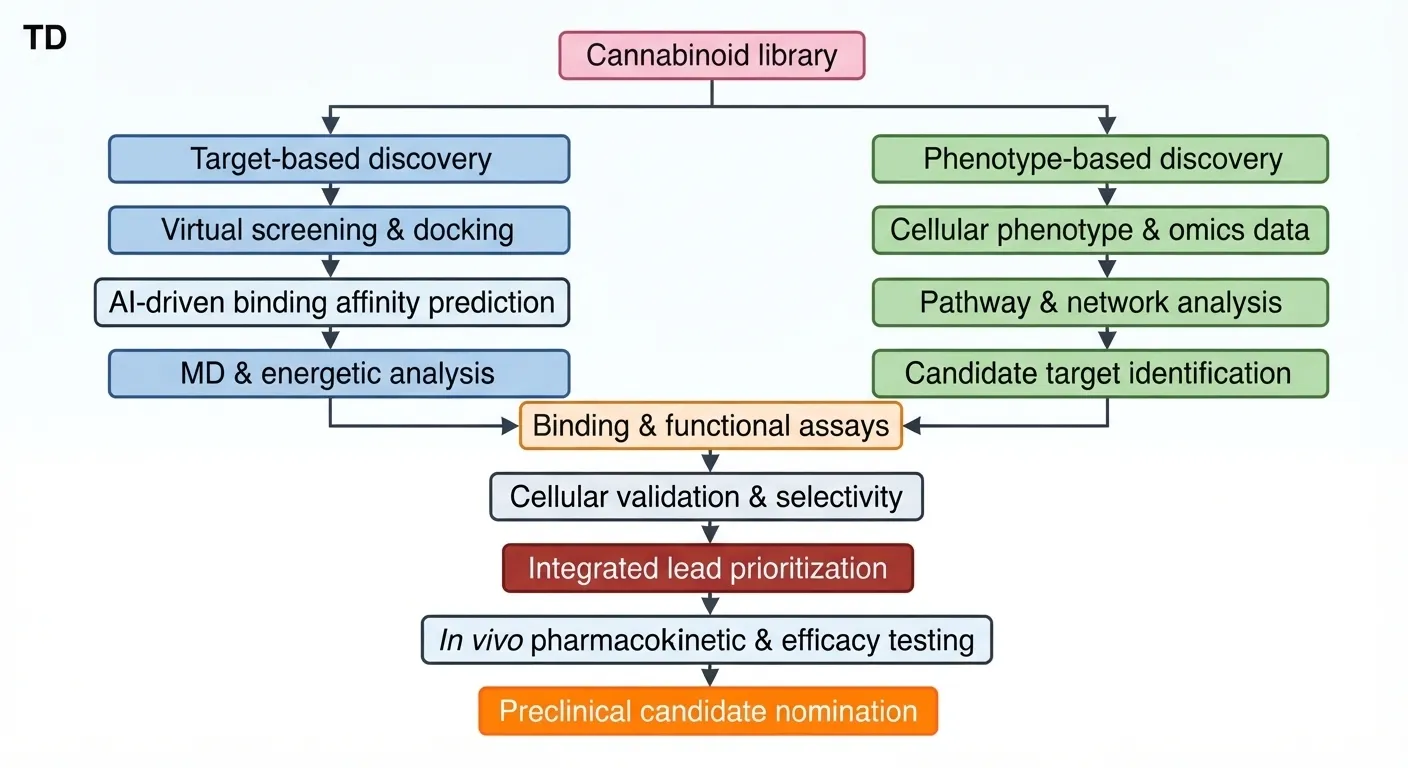
The two strategies are complementary: target-based methods provide mechanistic precision, whereas phenotype-based methods can capture biological effects that are not readily explained by a single target. Their integration may help distinguish direct target effects from downstream consequences, although computationally inferred networks still require experimental validation.
5.8 Apoptosis, autophagy, and signaling pathways
Reported anticancer effects of cannabinoids include changes in apoptosis, autophagy, oxidative stress, cell-cycle regulation, and pathways such as PI3K/AKT/mTOR and MAPK. These processes provide additional opportunities for computational investigation, but they are interconnected and strongly dependent on cellular context. Docking a cannabinoid against one pathway protein does not establish that the entire pathway mediates the observed phenotype.
A more robust strategy combines molecular modeling with network-level analysis. Experimentally observed changes in phosphorylation, gene expression, or metabolites can identify candidate pathway nodes. Structural modeling can then examine whether direct interactions are plausible, and MD or free-energy calculations can refine the predicted interactions. Perturbation experiments are needed to determine whether modulation of a candidate target causally contributes to the cellular response.
Workflow 5.3. From cellular phenotype to mechanistic validation
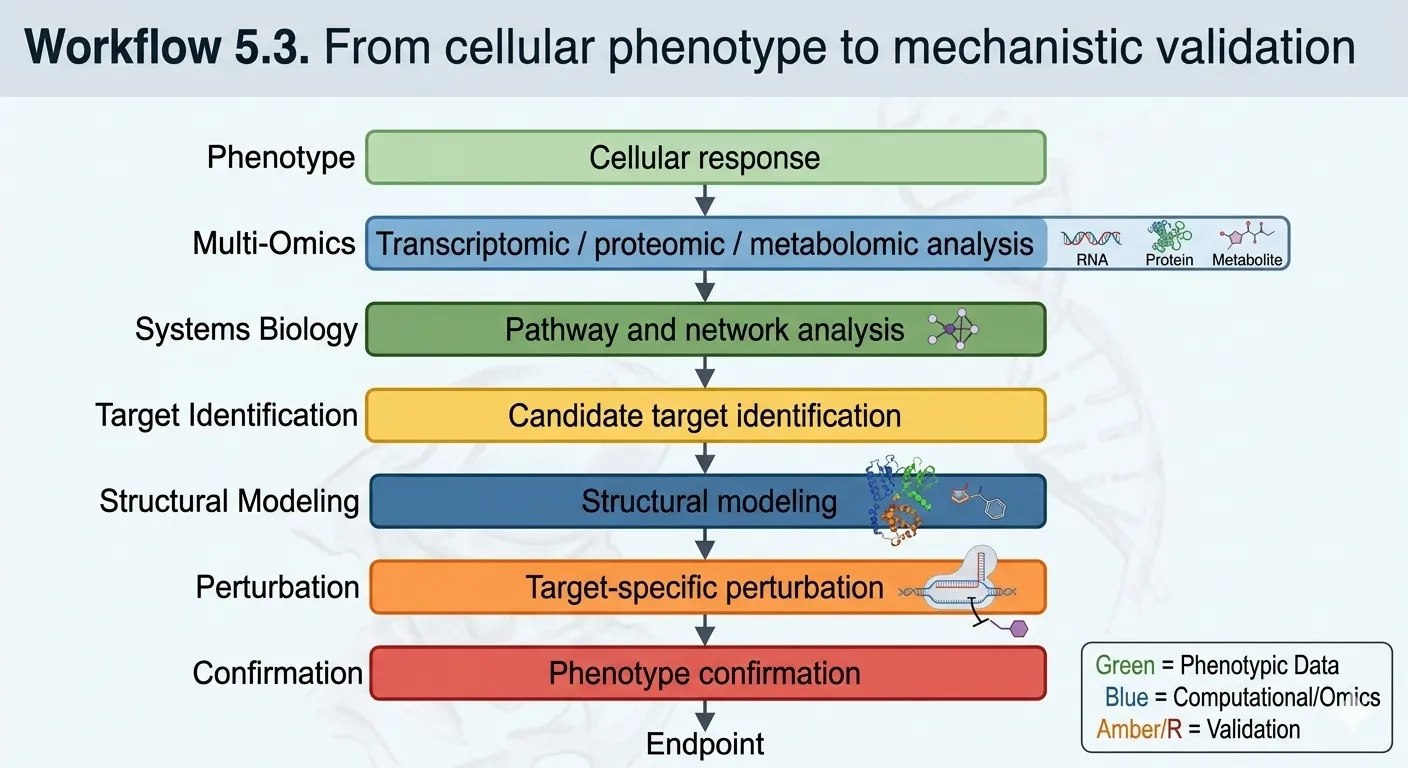
This approach is consistent with the potential polypharmacology of cannabinoids while avoiding the assumption that every predicted network interaction is a confirmed molecular target.
5.9 ADMET-aware prioritization
Moving from a computational hit to an anticancer lead requires simultaneous consideration of potency and drug-development properties. A compound with favorable predicted binding to EGFR, HER2, or VEGFR may have limited value if it exhibits poor solubility, rapid metabolism, excessive nonspecific binding, or unacceptable toxicity. This issue is especially relevant to lipophilic cannabinoids, for which favorable interactions with hydrophobic binding pockets may coexist with unfavorable pharmacokinetic properties. The EGFR/VEGFR study illustrates why drug-likeness and pharmacokinetic assessments should accompany docking-based prioritization [105].
Candidate evaluation should consider tumor penetration, intracellular accumulation, plasma stability, metabolic liabilities, and potential interactions with established anticancer drugs. The relevance of blood–brain barrier penetration also depends on the intended application: central nervous system exposure may be important for some brain tumors but unnecessary or undesirable for peripheral malignancies. ADMET criteria should therefore be tailored to the intended tumor type, therapeutic mechanism, and route of administration. Predictions can support early filtering, but priority liabilities require experimental assessment.
5.10 From computational predictions to experimental validation
Computational anticancer studies become more persuasive when predicted interactions are examined using independent experimental measurements. The HER2 study provides an example by combining docking with SPR, kinase inhibition, and cancer-cell viability assays [104].
A staged validation cascade is:
Workflow 5.4. Evidence progression for computationally prioritized anticancer cannabinoids
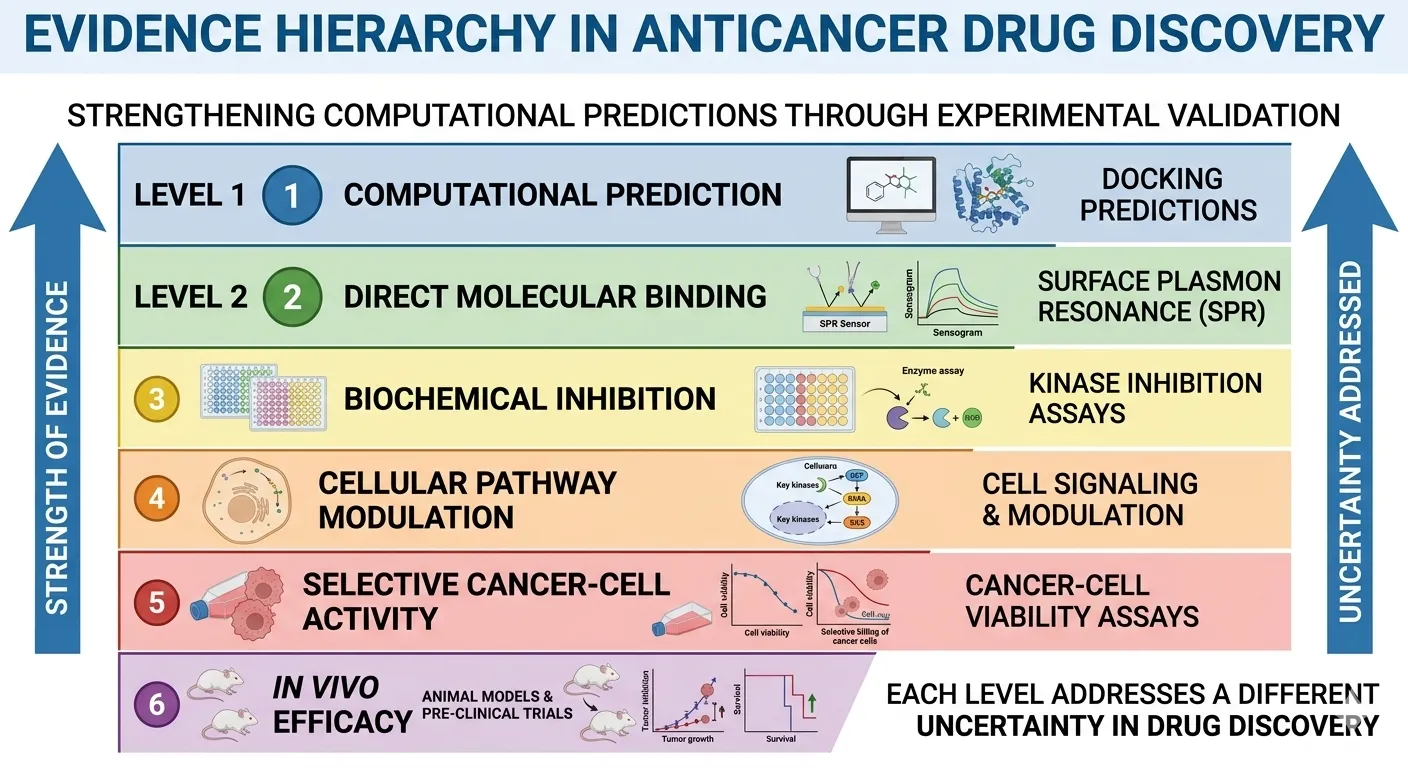
Each stage addresses a distinct uncertainty. SPR or isothermal titration calorimetry can assess direct binding, while biochemical assays determine whether the interaction alters target function. Cellular assays test whether the effect translates into a biological response, and mechanistic experiments assess whether the proposed target contributes causally to that response. Selectivity studies compare effects on cancer cells and appropriate nonmalignant controls. In vivo studies, when justified by prior evidence, address exposure, tumor distribution, efficacy, toxicity, and pharmacodynamic response.
These levels must remain distinct. In the HER2 study, reported binding affinities, kinase-inhibition values, and cellular IC₅₀ values differed substantially [104]. Such differences are expected because molecular binding, enzyme function, and cellular response represent separate biological processes. A convincing lead should therefore be supported by converging evidence rather than a single favorable measurement.
5.11 Computationally guided SAR and lead optimization
After anticancer activity has been experimentally supported, computational analysis can shift from broad screening to focused lead optimization. The objective is to improve potency, selectivity, chemical stability, solubility, and pharmacological feasibility while preserving the desired biological mechanism.
Structure-based SAR analysis can identify ligand positions interacting with important residues. Docking can prioritize focused analogues, MD can assess whether modified structures retain their predicted binding modes, and free-energy calculations can compare closely related compounds. Quantum-chemical calculations may help investigate electronic effects associated with selected structural modifications.
For EGFR and HER2, optimization may seek to improve interactions within ATP-binding regions while limiting unwanted kinase activity. In EGFR/VEGFR multitarget discovery, the objective may instead be to achieve a balanced profile across complementary proliferative and angiogenic pathways.
QSAR and AI/ML can connect experimentally measured activity with molecular descriptors or fingerprints, supporting prediction of unexplored derivatives. Active learning can then prioritize informative compounds for synthesis and testing, with new experimental data used to refine subsequent predictions.
Workflow 5.5. Closed-loop computational optimization
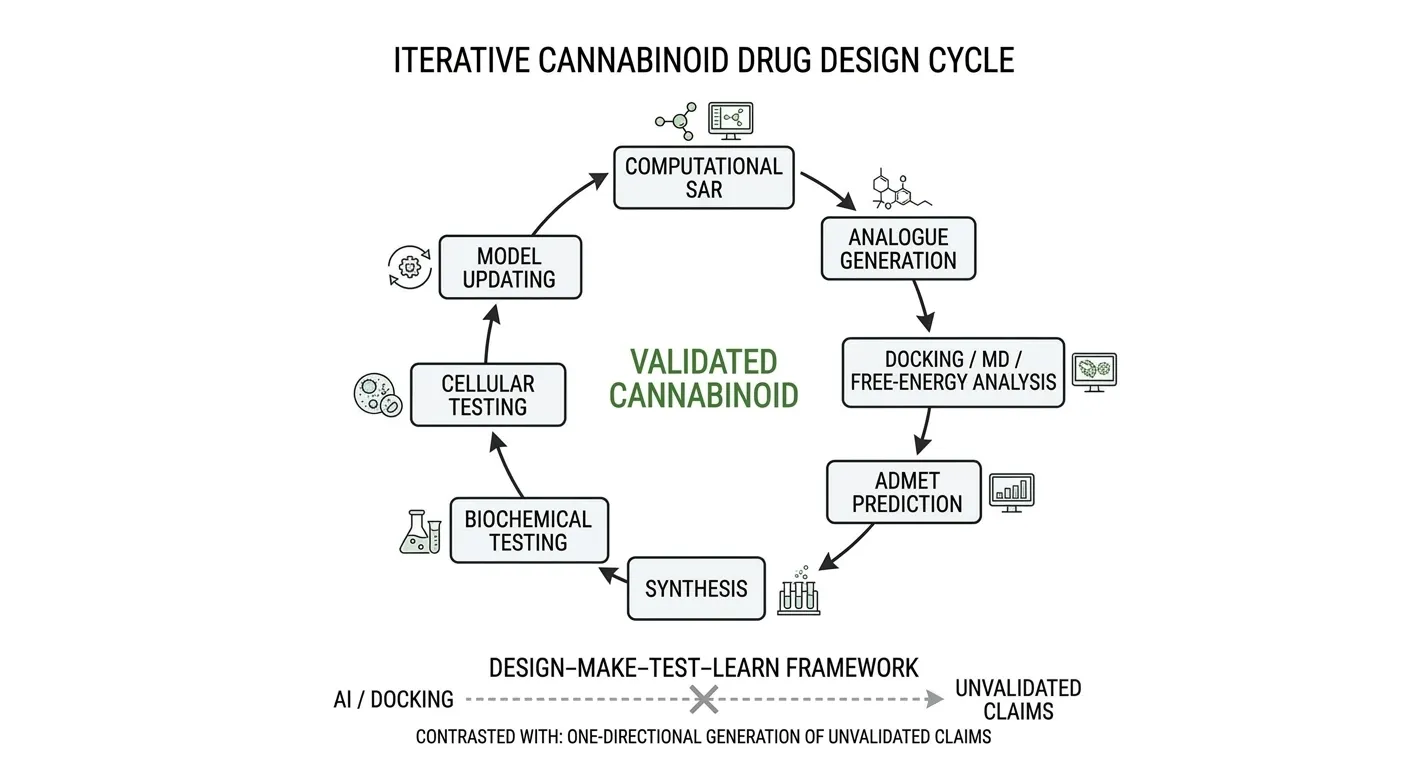
This design–make–test–learn cycle is more defensible than using docking or AI as a one-directional route to unvalidated anticancer claims. Its success depends on reliable experimental endpoints and iterative model evaluation.
5.12 AI/ML-enabled anticancer cannabinoid discovery
AI/ML offers opportunities to extend anticancer cannabinoid discovery beyond experimentally characterized natural products. Supervised models can learn relationships between molecular structure and measured cell viability, target inhibition, or binding affinity. Graph-based models can represent molecular connectivity, while multimodal approaches may integrate chemical structure, protein information, and biological assay data.
However, dataset quality is a major limitation. Cancer-cell viability depends on cell line, exposure duration, concentration, assay method, and genetic background. Moreover, reduced viability may reflect general cytotoxicity rather than a specific anticancer mechanism. Combining heterogeneous measurements without accounting for these differences can produce models that perform well internally but generalize poorly to new compounds or tumor contexts.
Models should therefore use well-defined endpoints, suitable scaffold-based or external validation, and explicit assessment of their applicability domain and prediction uncertainty. Active learning can prioritize compounds that are promising or likely to reduce model uncertainty, followed by experimental testing and model updating.
Workflow 5.6. AI/ML-assisted discovery
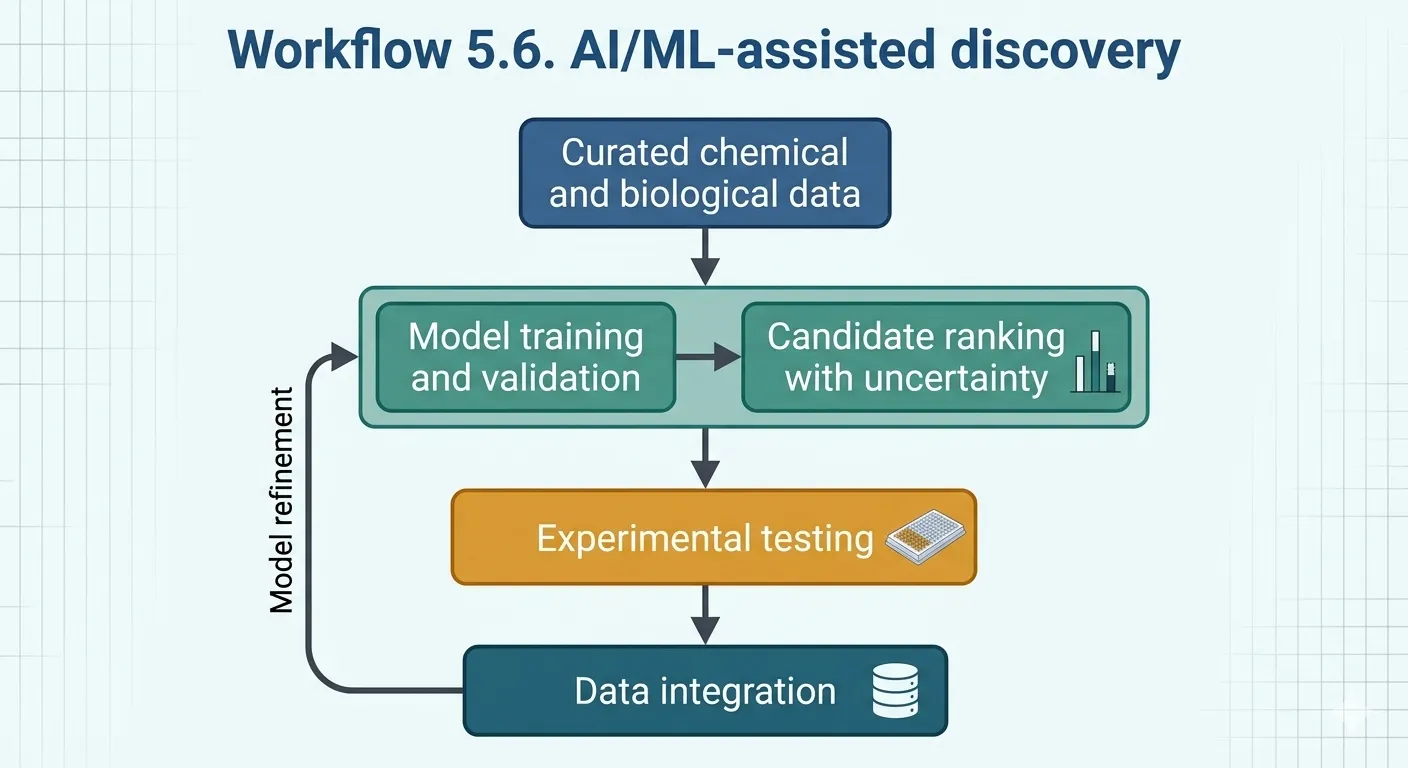
For underexplored cannabinoid classes, this iterative strategy may improve chemical-space coverage and reduce unnecessary screening. Nevertheless, prospective experimental evaluation remains essential, especially for compounds that differ substantially from the training data.
5.13 Critical assessment of computational anticancer discovery
Several limitations prevent most computationally prioritized cannabinoids from being considered established anticancer leads.
I. First, many studies remain predominantly in silico. Favorable docking, simulated stability, and predicted ADMET properties generate hypotheses but do not establish anticancer efficacy. The EGFR/VEGFR investigation, for example, identified candidates requiring further experimental validation [105].
II. Second, docking against ATP-binding pockets can generate false-positive predictions, particularly for lipophilic cannabinoids.
III. Third, cancer biology is context-dependent: activity in one cell line may not transfer to another because of differences in receptor expression, mutations, pathway dependence, drug efflux, or metabolism.
IV. Fourth, cellular cytotoxicity does not establish target-specific action. Mechanistic experiments are needed to connect target engagement with downstream signaling and phenotype.
V. Fifth, cannabinoid effects may involve receptor-mediated and non-receptor-mediated mechanisms, supporting the integration of target-based predictions with phenotype-based and systems-level approaches.
Finally, in vitro activity should not be equated with therapeutic potential. The concentrations required to inhibit cancer cells may be difficult to achieve in vivo or may produce unacceptable toxicity in normal tissues. Computational ADMET predictions can help identify potential liabilities, but experimental pharmacokinetic and toxicological studies remain necessary. Future studies would benefit from more consistent assay endpoints, prospective validation, normal-cell controls, target-selectivity measurements, and explicit links between computational predictions and experimental outcomes. These improvements would make results easier to compare across studies and strengthen the evidence supporting lead selection.
5.14 Integrated perspective
he anticancer case studies illustrate how the framework developed in Sections 2–4 can be extended from relatively defined viral targets to a heterogeneous cancer-associated target space. EGFR and HER2 provide examples of structurally defined kinase targets for which computational predictions can be compared with biochemical and biophysical measurements, while EGFR/VEGFR screening illustrates the potential and limitations of multitarget prioritization [104,105].
The overall discovery process can be summarized as:
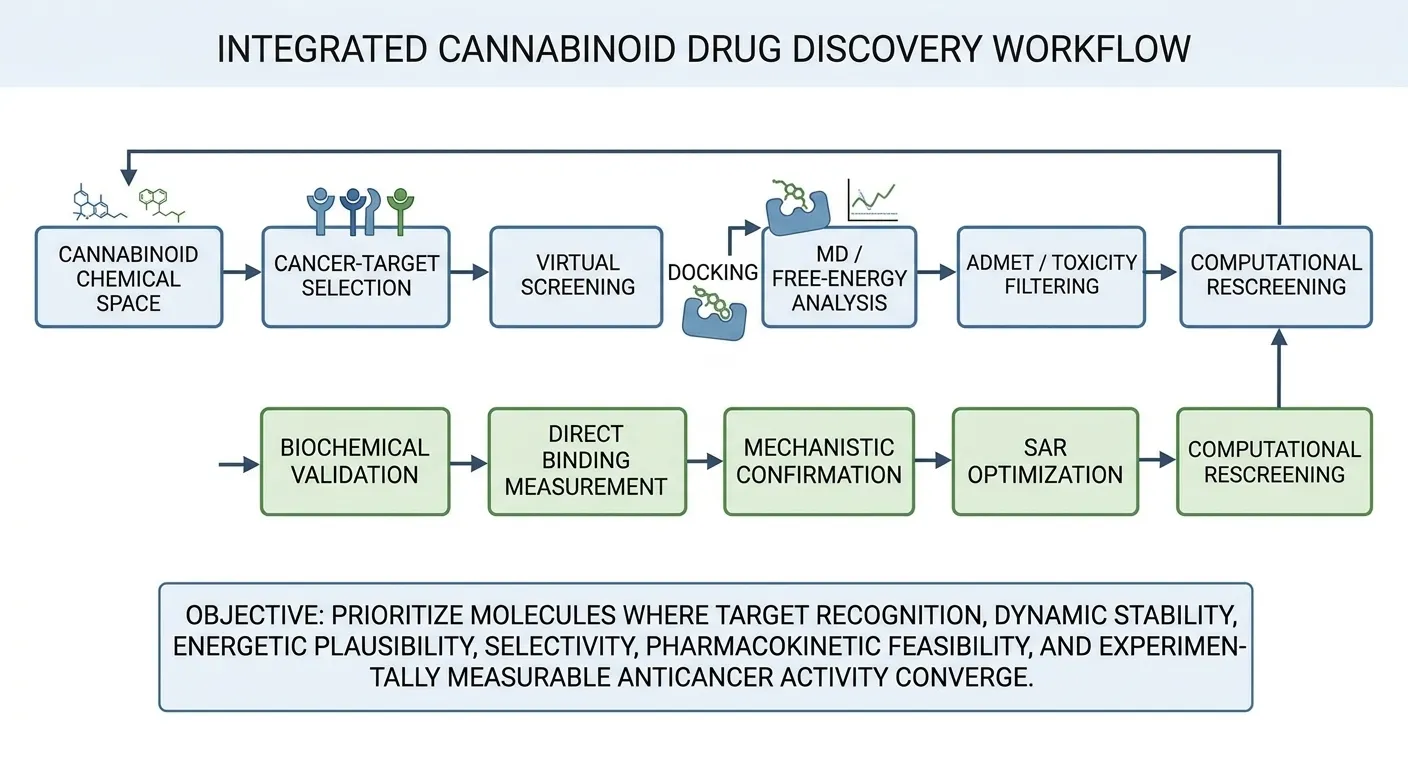
The objective is not merely to identify cannabinoids with favorable predicted binding, but to prioritize compounds for which target recognition, functional activity, selectivity, pharmacokinetic feasibility, and experimentally measurable anticancer effects converge.
Target-centric computational methods provide mechanistic hypotheses, whereas phenotype-based and systems-level approaches can capture biological effects involving multiple pathways. Their integration with AI/ML and experimentally generated data offers a more robust strategy for identifying and optimizing cannabinoid-derived anticancer leads. As in antiviral discovery, computational predictions are most valuable when they guide experiments and are updated in response to experimental findings. Section 6 can build on this framework by examining experimental validation, iterative SAR optimization, ADMET assessment, and computational–experimental feedback.
6.0 From Computational Hits to Experimental Validation and Lead Optimization
The computational approaches discussed in Sections 3–5 provide a framework for exploring cannabinoid chemical space, identifying disease-relevant targets, and prioritizing candidate molecules for antiviral and anticancer applications. However, favorable docking scores, stable molecular-dynamics (MD) trajectories, and predicted binding free energies constitute hypotheses rather than evidence of pharmacological efficacy. This distinction is particularly important for cannabinoids because structural diversity, hydrophobicity, conformational flexibility, and polypharmacology can complicate target recognition and biological interpretation.
Progression from a computational hit to a viable lead therefore requires complementary biochemical, biophysical, cellular, pharmacokinetic, and, where justified, in vivo investigations. Figure 1 presents the broader computational discovery framework; the present section extends it by focusing on experimental evidence, structure–activity relationships (SAR), and iterative lead optimization. The central principle is that computational predictions should guide experiments, while experimental findings should continually refine molecular models and subsequent design decisions.
6.1 Computational hit selection and experimental triage
Candidate selection should integrate multiple criteria rather than rely exclusively on docking scores. Relevant parameters include binding-pose plausibility, interaction patterns, MD-derived stability, estimated binding energetics, pharmacophore compatibility, physicochemical properties, predicted absorption, distribution, metabolism, excretion, and toxicity (ADMET), chemical novelty, and synthetic or isolation feasibility.
For cannabinoids, ionization state, stereochemistry, conformational flexibility, hydrophobicity, aggregation, and nonspecific membrane association also require consideration. Predicted interactions with several proteins should not automatically be interpreted as beneficial multitarget activity because promiscuous binding and assay interference may produce misleading results.
A practical triage strategy comprises three stages: (i) eliminate chemically unsuitable or computationally inconsistent candidates; (ii) compare the remaining compounds using complementary structural and energetic approaches; and (iii) prioritize candidates according to predicted activity, selectivity, developability, and experimental feasibility. This hierarchical strategy reduces dependence on individual scoring functions and provides a more defensible basis for experimental selection.
6.2 Biochemical and biophysical validation
The first experimental question is whether a predicted molecular interaction can be measured. Biochemical assays establish whether a candidate modulates the function of a defined target, whereas biophysical methods investigate direct molecular association. These measurements address related but distinct questions and should be interpreted together.
The SARS-CoV-2 main protease (Mpro) studies discussed in Section 4 illustrate this approach. Computational screening can prioritize cannabinoid candidates through docking, MD, and energetic analysis, but the resulting predictions require experimental evaluation. The minor-cannabinoid investigation discussed in the supplied text combined Mpro inhibition measurements with surface plasmon resonance (SPR) and molecular docking. Reported relationships between inhibitory activity, decarboxylation state, and alkyl side-chain length also provide a basis for subsequent SAR analysis. The precise findings and their associated references should remain aligned with the original studies cited in Section 4.
For suitable targets, SPR, isothermal titration calorimetry, and related biophysical techniques can provide evidence of direct binding, while enzyme assays establish functional modulation. For spike-mediated viral entry, computational predictions involving spike protein or the spike–ACE2 interface should similarly be evaluated through direct-binding measurements and appropriate cell-entry assays. Reported investigations of cannabigerolic acid (CBGA) and cannabidiolic acid (CBDA) binding to the spike S1 subunit illustrate the relevance of quantitative molecular measurements.
The resulting evidence progression is: Computational prediction → direct-binding measurement → biochemical functional assay → cellular validation → selectivity and safety assessment
Each stage reduces a different source of uncertainty. Direct binding does not necessarily establish functional inhibition, and biochemical inhibition does not guarantee a cellular response. Consequently, the strongest conclusions emerge when independent measurements support a consistent mechanism.
Table 5: Experimental Validation Stages and Decision Criteria for Computationally Prioritized Cannabinoids
| Validation stage | Principal question | Suitable evidence | Main limitation |
|---|---|---|---|
| Computational triage | Is the candidate sufficiently plausible to test? | Docking, MD, energetics, pharmacophore and ADMET predictions | Predictions are method-dependent |
| Direct binding | Does the candidate associate with the proposed target? | SPR, isothermal titration calorimetry, or other appropriate binding assays | Binding does not establish functional inhibition |
| Biochemical function | Does binding alter target activity? | Enzyme inhibition or target-specific functional assays | In vitro activity may not translate to cells |
| Cellular efficacy | Does the compound produce the intended phenotype? | Antiviral, viability, apoptosis, signaling, or other relevant assays | Phenotypes may arise through alternative mechanisms |
| Mechanistic and selectivity assessment | Is the proposed target causally relevant, and is activity sufficiently selective? | Target perturbation, engagement assays, related-target panels, normal-cell controls | No single assay fully establishes mechanism or selectivity |
| ADMET and pharmacokinetics | Can suitable exposure be achieved with acceptable safety? | Solubility, stability, permeability, metabolism, exposure, and toxicity measurements | Early measurements may not predict clinical behavior |
| In vivo assessment | Does the candidate produce a reproducible effect in an appropriate model? | Efficacy, pharmacokinetics, tolerability, and pharmacodynamic measurements | Animal-model results do not establish clinical efficacy |
| Iterative optimization | Do experimental data improve subsequent design? | Measured SAR, validated predictive models, and prospective testing | Performance depends on data quality and applicability domain |
6.3 Cellular validation and mechanistic attribution
Following biochemical or biophysical confirmation, cellular experiments determine whether a predicted interaction produces the intended biological effect. This is especially important for cannabinoids because their reported activities may involve receptors, ion channels, signaling proteins, metabolic pathways, membrane-associated processes, and stress responses. A cellular phenotype therefore cannot automatically be attributed to the protein selected for computational screening.
In antiviral discovery, experiments should distinguish inhibition of viral entry, suppression of intracellular replication, modulation of host responses, and nonspecific cytotoxicity. Cellular antiviral activity alone does not establish a proposed viral enzyme as the exclusive or dominant intracellular target. Target-specific biochemical evidence and, where feasible, cellular target-engagement or perturbation experiments are needed to strengthen mechanistic attribution.
A similar distinction applies to anticancer discovery. Predicted interactions with EGFR, HER2, or VEGFR should be evaluated using target-specific assays, while changes in cell viability, apoptosis, migration, invasion, or signaling should be interpreted alongside measurements of target engagement. The HER2-directed study discussed in Section 5 combined computational analysis with SPR, kinase inhibition, and cellular viability measurements [104]. This provides a stronger evidence chain than docking or cell-viability testing alone, although further experiments may still be required to establish causality and selectivity.
Mechanistic validation should therefore address two complementary questions: whether a candidate produces the desired cellular phenotype and whether the proposed molecular target causally contributes to that response. Transcriptomic, proteomic, metabolomic, or phosphoproteomic measurements can help identify affected pathways, while target-specific perturbation experiments can test their functional relevance.
6.4 Selectivity and structure–activity relationships
Once biological activity has been established, selectivity becomes a central consideration. Cannabinoid polypharmacology may be advantageous when multiple disease mechanisms contribute to pathology, but it can also complicate mechanistic interpretation and increase off-target effects. Evaluation should therefore extend beyond single-target potency to include related viral proteins, host targets, kinase families, cannabinoid receptors, ion channels, and other proteins relevant to the observed phenotype.
Computational cross-docking, interaction-fingerprint comparison, MD, and ligand-based target prediction can help identify possible off-target interactions. Nevertheless, experimental profiling is needed to determine whether predicted selectivity is reproduced. The objective is to distinguish a selective inhibitor, a rational multitarget candidate, and a compound whose apparent activity arises from nonspecific interactions.
Experimental validation also provides the foundation for SAR analysis. Structurally related cannabinoids can be compared to identify molecular features that influence potency, selectivity, stability, and pharmacokinetic behavior. Relevant variables include alkyl side-chain length, oxidation state, hydroxylation, carboxylation or decarboxylation, ring substitution, stereochemistry, and conformational restriction. Experimental measurements can then be correlated with computational descriptors, including interaction fingerprints, hydrogen-bonding patterns, molecular flexibility, solvent exposure, and energetic contributions.
The Mpro and kinase-directed studies discussed in Sections 4 and 5 illustrate how experimentally observed activity can generate hypotheses about structural determinants of recognition. These hypotheses can guide the design of analogues, but their predictive value must be assessed against measured activity rather than inferred solely from favorable calculated interactions.
6.5 Computationally guided lead optimization
After an experimentally supported SAR series has been established, computational methods can shift from broad screening toward focused molecular optimization. Docking and pharmacophore modeling can identify candidate substitutions; MD can assess whether modified compounds retain plausible interaction patterns; and binding free-energy calculations can help prioritize closely related analogues. Quantum-chemical calculations may provide additional insight into electronic effects associated with selected functional-group modifications.
Optimization is inherently multiobjective. Increasing predicted target affinity may simultaneously increase lipophilicity, reduce solubility, alter metabolic stability, or increase off-target activity. For cannabinoids, additional considerations may include cannabinoid-receptor selectivity, tissue distribution, psychoactivity, and active metabolites, depending on the intended application. The Workflow 6.2. Closed-loop lead optimization is given as:
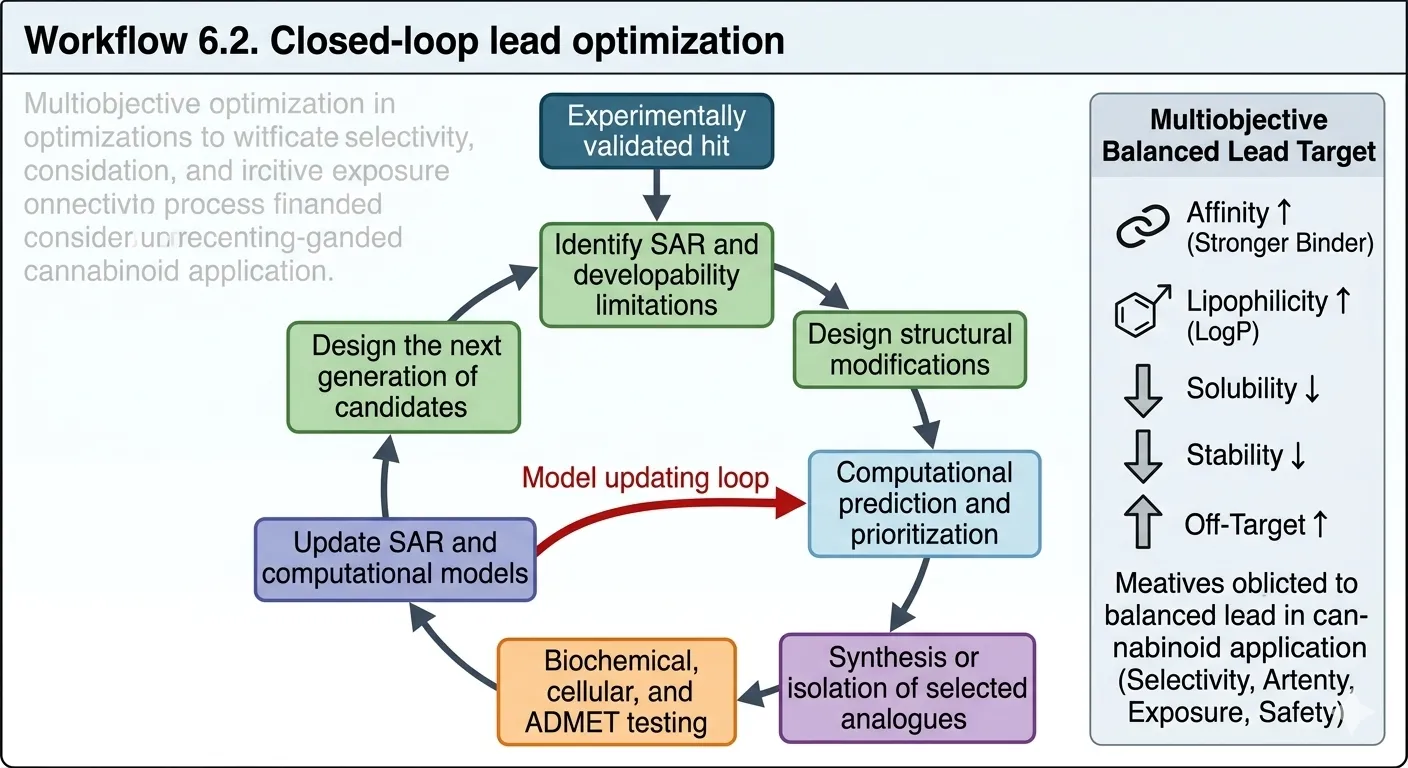
Each cycle generates new evidence about molecular recognition, activity, and developability. Updating models with these data can improve their relevance to the chemical series under investigation. The objective is to obtain a balanced lead with suitable potency, selectivity, stability, exposure, and safety rather than simply the strongest predicted binder.
6.6 AI/ML-assisted prioritization and experimental feedback
The experimental datasets generated during hit confirmation and SAR analysis provide a stronger foundation for artificial intelligence and machine learning (AI/ML) than datasets based exclusively on docking scores. Quantitative structure–activity relationship (QSAR) models, molecular fingerprints, graph-based learning, and ensemble methods can be trained using measured binding, enzyme inhibition, cellular activity, selectivity, and ADMET endpoints. Model reliability depends on data quality, chemical diversity, consistent assay conditions, and clearly defined endpoints. Models trained primarily on docking scores may reproduce scoring-function biases rather than predict biological activity. Cellular measurements also require careful interpretation because cell line, exposure duration, concentration, and assay methodology can substantially affect observed responses.
Active learning offers a complementary strategy by prioritizing compounds that are predicted to be promising or are expected to reduce model uncertainty. Experimental measurements are then incorporated into subsequent training and candidate selection. Appropriate scaffold-based or external validation, uncertainty estimation, and applicability-domain assessment are important for determining whether predictions can be generalized to new cannabinoid derivatives.
Workflow 6.3. AI/ML-enabled experimental prioritization: Curated chemical and experimental data → model training and validation → candidate ranking with uncertainty → experimental testing → data integration → model refinement → next-round prioritization
This iterative strategy can improve the exploration of undercharacterized cannabinoid chemical space. Its principal value lies in connecting predictions to prospective measurements, not in replacing experimental validation.
6.7 ADMET, pharmacokinetics, and in vivo validation
Target potency alone is insufficient to establish lead quality. Following experimental confirmation, ADMET evaluation should integrate computational predictions with measurements of solubility, metabolic and plasma stability, permeability, protein binding, metabolic liabilities, and cytotoxicity. For lipophilic cannabinoids, membrane association and extensive protein binding may complicate the relationship between nominal assay concentration and biologically available exposure.
A compound with strong biochemical inhibition but poor solubility, rapid metabolism, or unacceptable toxicity may be less promising than a moderately potent analogue with improved exposure and safety. Pharmacokinetic studies are therefore needed to determine whether concentrations associated with biological activity can be achieved at acceptable exposure levels. Tissue distribution, active metabolites, and central nervous system exposure should be considered according to the intended therapeutic application. Where the evidence justifies progression, in vivo studies should evaluate efficacy, exposure, tolerability, and pharmacodynamic response. They should also assess whether the proposed mechanism remains plausible in the complexity of a living system. In vitro activity should not be equated with therapeutic potential, because cellular efficacy may fail to translate owing to inadequate exposure, metabolism, compensatory pathways, or toxicity in normal tissues.
The overall evidence hierarchy is:
Computational prediction → biochemical activity → direct target engagement → cellular efficacy → selectivity and toxicity → pharmacokinetic assessment → in vivo efficacy and safety.
Progression through this hierarchy does not automatically validate every preceding assumption. Strong biochemical inhibition may fail to produce cellular efficacy because of inadequate permeability or rapid metabolism, while cellular activity may persist despite weak interaction with the proposed target. Such discrepancies are informative and should be used to revise the mechanistic hypothesis and computational model.
6.8 Critical assessment and integrated perspective
Several limitations continue to restrict the translation of computationally prioritized cannabinoids into validated leads. Experimental studies may differ in protein constructs, assay conditions, cell types, compound purity, exposure times, and endpoint definitions, complicating comparisons across the literature. Computational results are also sensitive to protein-structure quality, protonation states, scoring-function bias, force-field limitations, and incomplete conformational sampling. These challenges are compounded by the possibility of multiple targets and context-dependent biological effects.
Accordingly, the value of computational cannabinoid discovery should not be judged by the number of favorable docking poses or simulated complexes. More persuasive evidence requires agreement among independent computational methods, direct molecular measurements, functional assays, cellular phenotypes, selectivity profiles, and pharmacokinetic and safety assessments. When these measurements disagree, the discrepancy should prompt further investigation rather than selective emphasis on the most favorable result.
The integrated discovery process can be summarized as:
Chemical-space exploration → computational prioritization → biochemical and biophysical validation → cellular and mechanistic testing → selectivity and ADMET profiling → SAR extraction → lead optimization → experimental reassessment → computational model refinement.
This framework connects the chemical-space analysis in Section 2, the computational methods in Section 3, and the antiviral and anticancer applications in Sections 4 and 5. Computational chemistry thus functions not merely as a virtual-screening tool but as an iterative decision-support framework that links molecular design with experimental evidence.
Section 7 builds on this framework by examining the broader methodological, biological, and translational challenges that limit the reproducibility and clinical relevance of computationally prioritized cannabinoid candidates.
7.0 Challenges and Translational Limitations
The transition from computationally prioritized cannabinoids to experimentally validated leads involves challenges extending beyond the accuracy of individual computational methods. Chemical-space complexity, target uncertainty, biological context, model assumptions, pharmacokinetic limitations, and incomplete experimental validation can all contribute to failure. As discussed in Sections 1–6, favorable virtual-screening results do not necessarily translate into biochemical activity, cellular efficacy, or therapeutic benefit.
The central challenge is to establish a reliable connection between molecular predictions and biological outcomes. This requires determining whether a compound binds its proposed target, alters target function, produces the intended cellular response, achieves adequate exposure, and maintains acceptable selectivity and safety. No single computational or experimental method can establish all these properties. Consequently, translational success depends on integrating complementary evidence and treating discrepancies as opportunities to refine molecular hypotheses and discovery models.
7.1 Chemical-space complexity and target uncertainty
The experimentally characterized fraction of cannabinoid chemical space remains limited relative to the potential diversity of natural, minor, acidic, degradation-derived, semisynthetic, and synthetic compounds. Stereochemistry, protonation, tautomerism, conformational flexibility, and interconversion between acidic and neutral forms further complicate molecular representation. A single two-dimensional structure may therefore fail to capture the molecular states relevant to biological recognition.
These limitations affect AI/ML models as well as conventional virtual screening. Chemically biased datasets may support apparently strong predictions within the training domain but perform poorly for structurally novel derivatives. Applicability-domain assessment, uncertainty estimation, and experimentally annotated chemical libraries are therefore important for reliable candidate prioritization.
Target uncertainty presents a related challenge. Cannabinoids may interact with cannabinoid receptors, ion channels, nuclear receptors, viral proteins, host proteins, kinases, and signaling networks. Such polypharmacology may support useful multitarget activity, but it complicates mechanistic attribution. A predicted interaction does not establish that the target dominates the observed cellular or organism-level response, which may also involve downstream signaling, membrane effects, metabolism, or active metabolites.
Accordingly, computational target prediction should be connected to target-deconvolution experiments that establish relationships among molecular binding, functional modulation, pathway changes, and disease-relevant phenotypes.
7.2 Limitations of docking, molecular dynamics, and free-energy calculations
Molecular docking remains useful for efficiently prioritizing cannabinoids and proposing plausible binding modes. However, docking scores are approximations rather than experimental binding free energies. Their reliability depends on receptor structure, conformational sampling, ligand preparation, protonation states, solvent treatment, entropy, and scoring-function assumptions. Flexible cannabinoid side chains and extensive hydrophobic surfaces can further complicate pose ranking.
Consensus docking, receptor ensembles, interaction-fingerprint analysis, and MD can provide complementary evidence, but agreement among computational methods does not eliminate systematic error. This is particularly important for membrane-associated targets, including G-protein-coupled receptors and ion channels, whose conformational states depend on ligand binding, membrane composition, and interacting partners.
MD can characterize conformational changes and interaction persistence, yet its predictive value depends on force-field accuracy, sampling efficiency, simulation duration, starting structures, and appropriate environmental representation. Longer simulations do not guarantee complete sampling, while shorter trajectories may miss slow transitions. MM-PBSA and MM-GBSA calculations are useful for comparative analysis but are sensitive to trajectory selection, solvation assumptions, entropy treatment, and force fields. More rigorous methods, including free-energy perturbation and thermodynamic integration, may improve relative estimates at greater computational cost.
Workflow 7.1. Uncertainty-aware computational prioritization
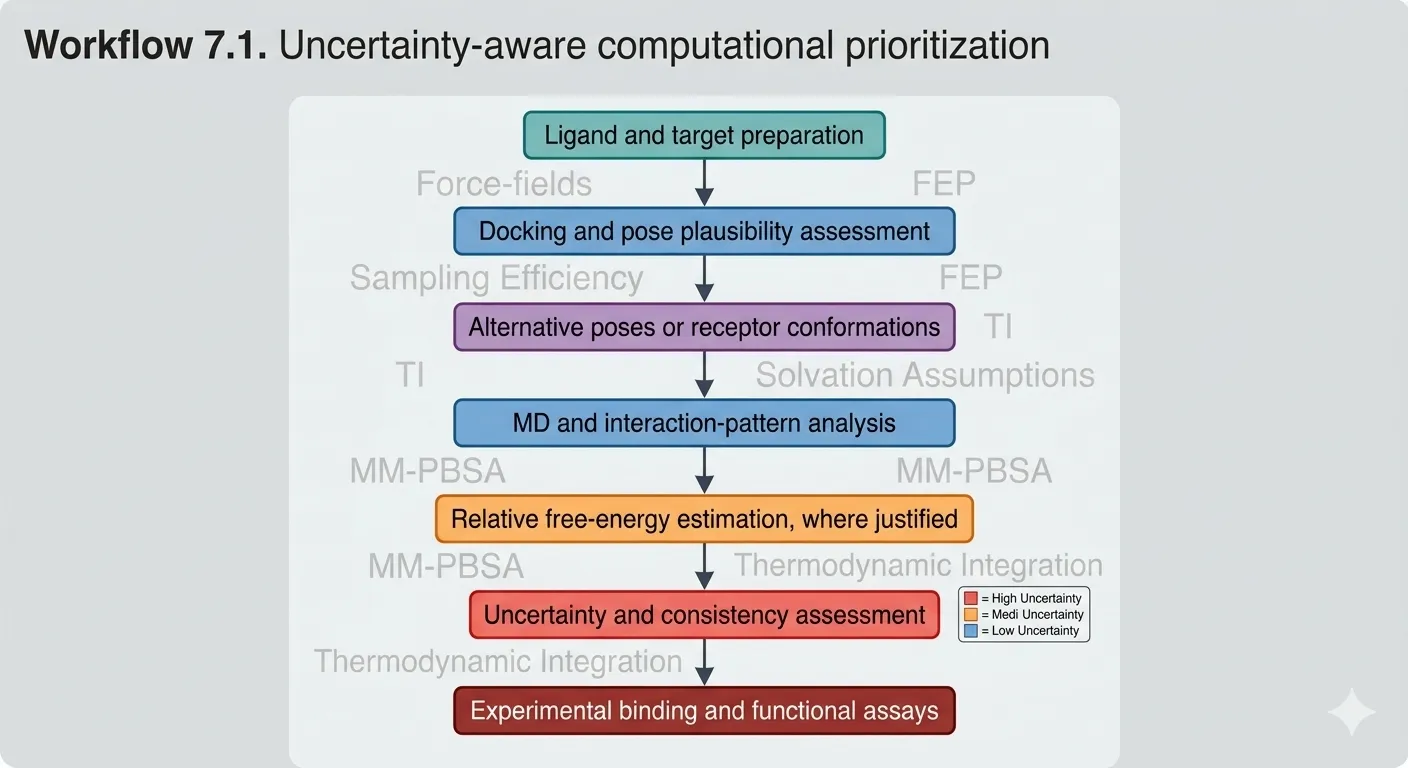
The purpose of this workflow is not to establish activity computationally, but to identify candidates whose predictions are sufficiently plausible and consistent to justify experimental testing. Calculated energetic differences should be interpreted cautiously, especially when they are small or comparable to the uncertainty of the method.
7.3 Data quality, reproducibility, and AI/ML limitations
Computational cannabinoid discovery is constrained by heterogeneous experimental and computational datasets. Published studies may differ in compound purity, target constructs, assay conditions, cell lines, exposure times, concentrations, and endpoint definitions. Computational protocols likewise vary in ligand preparation, receptor structures, docking settings, force fields, simulation parameters, and free-energy methods.
These inconsistencies can affect both reproducibility and model performance. AI/ML models trained on heterogeneous measurements may learn experimental artifacts rather than genuine structure–activity relationships. Random train–test splitting can also overestimate generalization when closely related compounds appear in both sets.
More reliable benchmarking should include scaffold-aware or temporal splitting, external validation, applicability-domain analysis, uncertainty estimation, and prospective experimental testing. Detailed reporting of compound identity, stereochemistry, purity, assay conditions, and computational settings would improve comparability.
Generative models introduce additional challenges. Chemically valid structures are not necessarily synthesizable, biologically active, selective, or ADMET-compatible. Models may also propose molecules outside the chemical domain represented in their training data. AI/ML should therefore complement mechanistic computational chemistry and be evaluated using experimentally measured endpoints rather than docking scores alone.
Workflow 7.2. Experimentally anchored AI/ML discovery: Curated chemical and biological data → model training and validation → uncertainty-aware candidate ranking → prospective experiments → data integration → model refinement → next-round prioritization
Active learning can improve this process by selecting compounds that are promising or likely to provide useful information for reducing model uncertainty. Its value depends on reliable experimental measurements and repeated prospective evaluation.
7.4 ADMET, exposure, selectivity, and safety
A major translational barrier is the gap between molecular potency and achievable biological exposure. Cannabinoids may exhibit high lipophilicity, limited aqueous solubility, extensive protein or membrane association, metabolic transformation, or tissue sequestration. These properties can reduce the concentration available at the intended site of action, even when a compound shows favorable binding or biochemical inhibition.
ADMET considerations should therefore be integrated into early candidate prioritization rather than reserved for late-stage screening. Relevant properties include solubility, permeability, metabolic and plasma stability, protein binding, clearance, toxicity, and expected tissue exposure. The most important criteria depend on the target and intended application: tumor penetration may be critical for anticancer candidates, whereas antiviral exposure requirements depend on whether the target is extracellular, host-associated, or intracellular.
Polypharmacology also complicates selectivity and safety assessment. Broad activity may be desirable when multiple pathways contribute to disease, but promiscuous interactions can compromise safety and mechanistic interpretation. Computational target prediction and cross-docking can identify potential liabilities, while experimental profiling is required to establish the actual selectivity profile. The absence of predicted off-target interactions should not be interpreted as evidence of safety.
Workflow 7.3. Developability and translational assessment
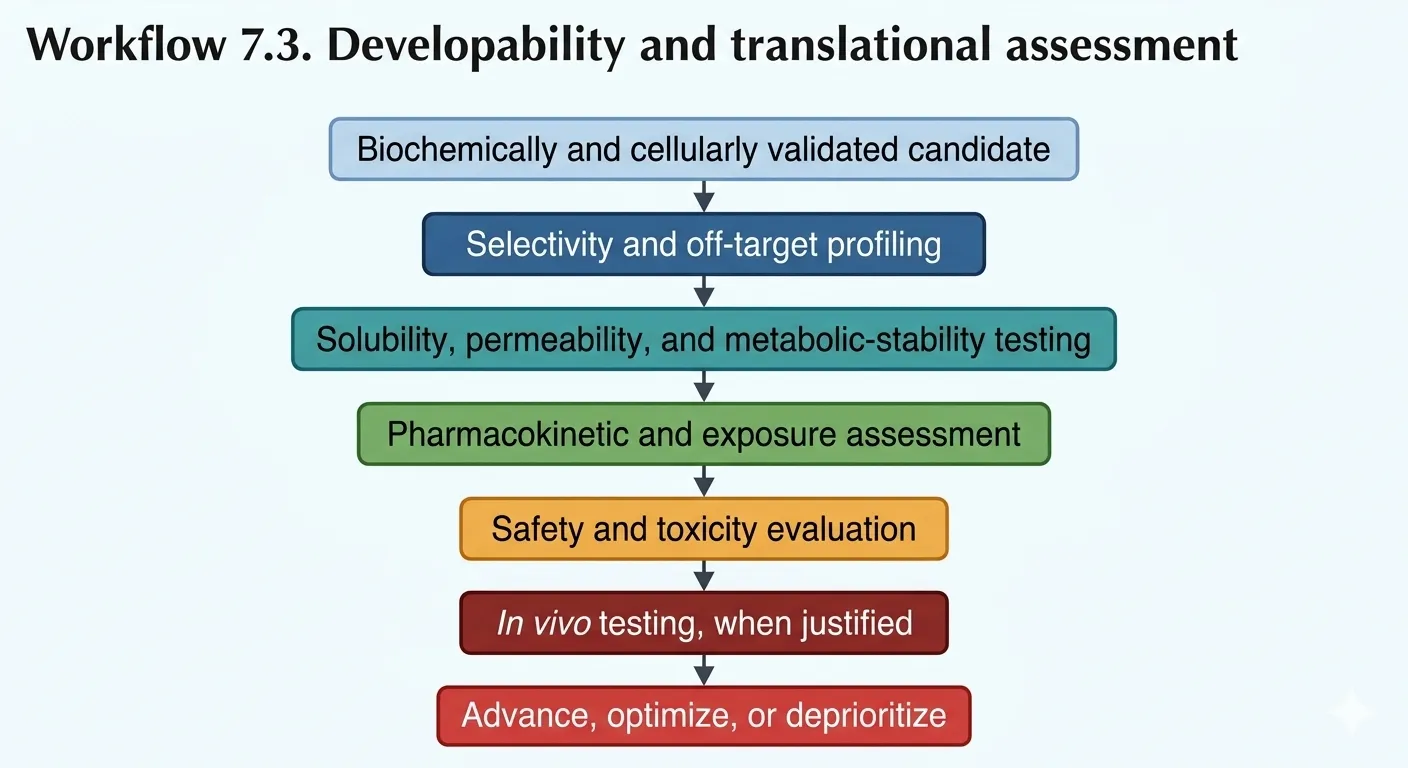
This staged assessment helps distinguish compounds with promising molecular activity from candidates with a realistic prospect of achieving useful exposure and an acceptable safety profile.
7.5 From molecular activity to cellular and in vivo efficacy
The transition from biochemical activity to disease-relevant efficacy remains one of the most consequential gaps in computational drug discovery. A compound may inhibit a purified protein but fail in cells because of inadequate permeability, protein binding, metabolism, competing pathways, or insufficient intracellular exposure. Conversely, cellular activity may occur without meaningful engagement of the proposed target.
The antiviral and anticancer examples in Sections 4 and 5 illustrate why computational predictions involving Mpro, PLpro, EGFR, HER2, VEGFR, or other targets should be treated as mechanistic hypotheses. Biochemical assays assess target function, cellular studies evaluate biological outcomes, and target-specific perturbation experiments help establish causality. These forms of evidence are complementary, not interchangeable.
The translational evidence hierarchy can be summarized as:
Computational prediction → direct binding and biochemical activity → target-dependent cellular mechanism → cellular efficacy → pharmacokinetic exposure → in vivo efficacy and safety → clinical evaluation.
Failure at one stage does not necessarily invalidate the entire computational approach. Strong biochemical activity without cellular efficacy may reveal an exposure limitation, whereas a cellular phenotype without demonstrated target engagement may indicate an alternative mechanism. Both outcomes can guide subsequent experiments and model refinement. Importantly, in vivo efficacy does not by itself establish clinical benefit, which requires appropriate human evidence.
7.6 Experimental standardization and regulatory translation
Differences in cannabinoid source, purity, formulation, stereochemistry, concentration, assay methodology, target construct, and biological model can substantially influence reported activity. Datasets intended for computational modeling should therefore include detailed experimental metadata and clearly defined quantitative endpoints. Standardized procedures and transparent reporting would improve reproducibility and facilitate comparisons across studies.
Translation also requires evidence concerning compound identity, purity, manufacturing consistency, stability, pharmacokinetics, safety, and efficacy. Computational methods can support candidate selection, identify potential liabilities, and prioritize experiments, but they cannot replace experimentally established pharmacological and toxicological evidence.
Prospective validation is particularly important: candidates should be selected using prespecified computational criteria and then evaluated experimentally without relying solely on retrospective agreement with the training data. Such studies can establish whether a workflow genuinely predicts new results rather than simply rationalizing previously observed activity.
7.7 Toward an uncertainty-aware translational framework
The principal challenge in cannabinoid discovery is connecting evidence across distinct biological scales. Molecular structure, target binding, dynamics, thermodynamics, cellular signaling, pharmacokinetics, and therapeutic response represent related but non-equivalent levels of evidence. Predictions at one level cannot automatically be extrapolated to another.
A candidate may have a plausible binding pose but uncertain cellular exposure, or experimentally confirmed cellular activity but unresolved target attribution. A multidimensional evidence profile is therefore more informative than a single composite score. Confidence should be assessed separately for target engagement, functional activity, cellular mechanism, selectivity, exposure, and safety.
The main sources of translational uncertainty can be organized into five levels:
1. Chemical-space uncertainty: incomplete structural characterization, stereochemical complexity, and uncertain synthetic accessibility.
2. Molecular uncertainty: limitations in docking, conformational sampling, MD, and free-energy estimation.
3. Biological uncertainty: target promiscuity, pathway interactions, and incomplete mechanistic attribution.
4. Pharmacological uncertainty: ADMET liabilities, exposure limitations, selectivity, and toxicity.
5. Translational uncertainty: differences between biochemical activity, cellular responses, in vivo outcomes, and clinical benefit.
The resulting discovery strategy should connect these levels through iterative computational and experimental evaluation:
Chemical-space exploration → uncertainty-aware computational prioritization → orthogonal experimental validation → mechanistic and selectivity assessment → ADMET and exposure evaluation → lead optimization → prospective reassessment → model refinement.
Negative or unexpected experimental results are informative when they identify limitations in a binding hypothesis, biological mechanism, or predictive model. The objective is therefore not to eliminate uncertainty entirely, but to reduce it systematically and avoid advancing candidates on the basis of isolated favorable results.
Table 6: Major Translational Challenges in Computational Cannabinoid Discovery and Potential Mitigation Strategies
| Challenge | Consequence | Potential mitigation |
|---|---|---|
| Incomplete cannabinoid chemical space | Poor coverage of novel scaffolds | Expand experimentally characterized libraries and report chemical-domain limitations |
| Docking and scoring uncertainty | False-positive poses and unreliable ranking | Use complementary structural methods and experimental binding assays |
| Receptor flexibility and sampling | Missed conformational states | Apply suitable receptor ensembles, environment-aware MD, and sampling checks |
| Free-energy uncertainty | Unreliable ranking of close analogues | Use consistent protocols, uncertainty assessment, and experimental comparison |
| Heterogeneous datasets | Poor reproducibility and biased models | Standardize endpoints, compound metadata, and computational reporting |
| Polypharmacology | Uncertain mechanism and off-target effects | Combine target deconvolution, selectivity profiling, and mechanistic experiments |
| ADMET and exposure limitations | Failure to translate molecular potency into efficacy | Integrate experimental developability and pharmacokinetic assessment early |
| Weak prospective validation | Overestimated predictive performance | Use external or scaffold-aware validation and prospective experiments |
| Generative AI limitations | Unrealistic or poorly supported candidate predictions | Include uncertainty, synthetic feasibility, applicability-domain checks, and experimental feedback |
7.8 Summary and transition to future perspectives
Computational cannabinoid discovery faces interconnected limitations involving chemical-space coverage, target uncertainty, molecular-model assumptions, data quality, polypharmacology, ADMET, and the translation of molecular activity into therapeutic benefit. Addressing these limitations requires experimentally annotated datasets, standardized reporting, robust model validation, explicit uncertainty estimates, and iterative links between computational predictions and biological measurements.
The central implication is that computational confidence should not be equated with therapeutic confidence. A favorable prediction can justify experimental testing, but lead development requires convergent evidence across molecular, cellular, pharmacological, and organism-level investigations. AI/ML, physics-based modeling, and active learning are most valuable when integrated into this evidence-driven process.
Section 8 can build on these requirements by examining future directions in AI-enabled chemical-space exploration, multimodal learning, mechanistic modeling, and increasingly integrated computational–experimental discovery cycles.
8.0 Future Perspectives
The challenges discussed in Section 7 indicate that progress in computationally guided cannabinoid discovery will depend on integrating molecular modeling, AI/ML, experimental validation, and translational assessment rather than developing increasingly complex algorithms in isolation. As outlined in Sections 3–6, docking, molecular dynamics (MD), free-energy calculations, quantum chemistry, ADMET prediction, and experimental assays provide complementary evidence. Their integration is particularly important for cannabinoids, given their structural diversity, multiple potential targets, and comparatively limited experimental datasets. Future discovery platforms are therefore likely to become multimodal, physics-informed, uncertainty-aware, and experimentally closed-loop. Such systems could improve chemical-space exploration, mechanistic interpretation, and lead optimization while reducing reliance on isolated computational scores.
8.1 Expanding cannabinoid chemical space through generative design
A major opportunity is to explore cannabinoid chemical space beyond naturally abundant compounds, including minor cannabinoids and synthetically accessible derivatives. As discussed in Section 2, variations in side-chain length, stereochemistry, oxidation state, ring substitution, polarity, and conformational flexibility can influence molecular recognition and developability.
Generative AI and computational molecular design could propose derivatives optimized for multiple objectives, including potency, selectivity, solubility, metabolic stability, and reduced toxicity. However, generated structures should be assessed for chemical validity, synthetic accessibility, biological plausibility, and predictive uncertainty. Optimization against a single docking score may favor compounds that bind favorably in a modeled pocket but have unsuitable physicochemical or pharmacological properties.
Future design should therefore be purpose-driven, with the intended biological mechanism and developability requirements defining the chemical space to be explored. This approach could prioritize informative compounds for synthesis and improve the efficiency of subsequent structure–activity relationship (SAR) development.
8.2 Multimodal and physics-informed AI
Current predictive models often rely on individual data types, such as molecular fingerprints, docking scores, or measured activity. Future AI/ML systems could integrate chemical structures, three-dimensional binding poses, MD-derived interaction patterns, free-energy estimates, protein information, omics profiles, cellular phenotypes, and ADMET properties. This integration could help connect molecular recognition with biological responses, addressing the molecular-to-systems-level gap discussed in Section 7.
For antiviral discovery, models could combine viral and host-target information with replication phenotypes, cellular toxicity, and host-response data. In cancer, molecular interactions could be evaluated alongside tumor-specific signaling and molecular profiles. Such models may improve candidate prioritization, although their reliability will depend on standardized datasets, suitable validation, and explicit assessment of uncertainty and applicability domains.
AI should also complement rather than replace molecular physics. Docking, MD, quantum-chemical calculations, and free-energy methods can supply mechanistically interpretable features, including interaction fingerprints, conformational stability, and electrostatic complementarity. Integrating these descriptors with experimental measurements may improve predictions for sparsely characterized or structurally novel cannabinoids. Nevertheless, physics-informed models remain dependent on the accuracy of their underlying calculations and the quality of their training data.
Workflow 8.1. Physics-informed, multimodal cannabinoid prioritization
Chemical structures + target structures + MD/energetic descriptors + biological and ADMET data → multimodal model → activity and uncertainty prediction → candidate prioritization → experimental validation → model updating.
8.3 Dynamic target ensembles and advanced energetic modeling
Future computational studies should increasingly represent target proteins as dynamic ensembles rather than static structures. This is particularly relevant to cannabinoid receptors, ion channels, kinases, and other conformationally regulated proteins. Ensemble docking can evaluate candidate ligands against multiple receptor conformations, while MD and enhanced-sampling methods can investigate conformational transitions, allosteric modulation, and the persistence of ligand interactions.
For membrane-associated targets, simulations that account for the membrane environment, lipid composition, and ligand partitioning may provide a more realistic representation of molecular recognition. These approaches could extend structure-based discovery from static ligand–protein matching toward ensemble-based molecular recognition, although their accuracy remains dependent on sampling and model quality.
Energetic analysis is also likely to advance beyond rapid end-point estimates such as MM-PBSA and MM-GBSA. Free-energy perturbation, thermodynamic integration, metadynamics, and umbrella sampling may help distinguish closely related analogues during lead optimization when adequate sampling and computational resources are available. These methods should be selected according to the scientific question rather than applied routinely to every candidate.
Future studies could also consider binding kinetics, including association and dissociation rates, residence time, and ligand-dependent conformational changes. Compounds with similar equilibrium affinity may differ in their kinetic behavior and downstream pharmacological effects. Combining thermodynamic, kinetic, and experimental evidence could therefore improve the characterization of candidate cannabinoids, complementing the validation strategies in Sections 5 and 6.
8.4 Active learning and closed-loop discovery
Active learning provides a practical route to integrating computational prediction with experimental investigation. Rather than screening a library once and testing a fixed subset, an adaptive model can select compounds according to predicted activity, uncertainty, or their expected contribution to learning about unexplored chemical space.
The process begins with an initial chemical library and predictive model. Selected compounds are then tested using appropriate biochemical or cellular assays, and the resulting data are incorporated into the next modeling cycle. Repeated iteration can improve candidate ranking while reducing unnecessary experiments. In the longer term, integration with automated synthesis, compound handling, and high-throughput assays could support partially automated discovery.
Workflow 8.2. Active-learning design–make–test–learn cycle
Virtual design → activity and uncertainty prediction → informative compound selection → synthesis or compound acquisition → biochemical/cellular testing → data integration → model refinement → next-generation design.
This strategy is well suited to cannabinoid research, where experimental characterization may be limited for rare or newly synthesized derivatives. However, active learning cannot compensate for unreliable assays or poorly defined endpoints. Human oversight remains necessary to interpret unexpected results, assess biological plausibility, and determine whether a computationally prioritized compound warrants further development.
8.5 Digital maps, phenotype-informed discovery, and precision pharmacology
A further opportunity is to develop machine-readable representations of cannabinoid chemical and biological space. Such digital maps could connect compound structures and stereochemistry with predicted or experimentally supported targets, binding modes, biological activity, ADMET properties, and evidence quality. Standardized records of assay conditions, concentrations, target identity, endpoints, and uncertainty would improve reproducibility and enable more meaningful comparisons across studies.
Future discovery is also likely to combine target-based screening with phenotype-based and network-level approaches. Transcriptomic, proteomic, phosphoproteomic, metabolomic, and cellular-imaging data could reveal disease-relevant responses that are not readily explained by a single target. Network analysis could then identify candidate pathways and proteins for subsequent structural modeling and experimental testing.
In cancer, this strategy may help identify compounds associated with particular tumor subtypes or signaling dependencies. In antiviral research, it could help distinguish direct viral inhibition from effects mediated through host pathways. Integrating target-based and phenotype-based evidence would therefore shift the discovery question from which molecule binds a particular target? toward which molecule is most likely to produce the desired phenotype through a plausible mechanism?
Such approaches could ultimately support precision pharmacology. Tumor molecular profiles, viral genotype, host factors, and target expression may influence compound response. Incorporating this contextual information could improve the prioritization of candidates for specific biological settings, although any proposed context-specific effect would require experimental confirmation.
8.6 Explainable AI and multiobjective lead optimization
As AI becomes more influential in candidate selection, predictions should include uncertainty, applicability-domain information, and interpretable molecular or biological features. A high predicted activity is less informative when a compound lies outside the training domain or when confidence in the prediction is unknown. Explainable AI may help identify structural fragments, interactions, or biological features associated with predicted activity, but such explanations should be treated as hypotheses rather than definitive mechanisms.
Uncertainty should also guide experimental selection. High-confidence candidates may be prioritized when their predicted properties meet the intended development criteria, whereas uncertain compounds may be useful when testing them could substantially improve the model.
Lead optimization should likewise move beyond maximizing affinity toward multiobjective optimization. Relevant properties include:
Generative design and multiobjective AI could identify Pareto-optimal candidates that balance competing properties rather than optimizing a single computational metric. The preferred compound may therefore be the one that provides the most suitable overall combination of activity, selectivity, exposure, safety, and developability—not necessarily the one with the most favorable predicted binding score.
8.7 Prospective benchmarking and translational validation
The credibility of computational cannabinoid discovery will depend on rigorous and prospective evaluation. Docking, MD, free-energy calculations, QSAR, and multimodal AI should be compared using clearly defined endpoints and suitable independent test sets. Where feasible, scaffold-based or chemically independent splits should supplement random data splits to assess whether models generalize to new chemical structures.
Most importantly, prospective experimental success should be a central benchmark. Studies should report whether prioritized compounds demonstrate the predicted properties when tested, while distinguishing among predicted binding, experimentally measured affinity, biochemical inhibition, cellular efficacy, pharmacokinetic exposure, and in vivo therapeutic effects.
Standardized experimental protocols and transparent reporting would improve reproducibility and reduce overinterpretation. Validation should progress from direct target engagement and functional assays to cellular mechanism, selectivity, and pharmacological assessment, with in vivo studies undertaken when supported by sufficient prior evidence. This evidence-based approach connects the future directions discussed here with the experimental validation framework developed in Section 6.
Workflow 8.3. Prospective validation and translational assessment
Computational prediction → predefined candidate-selection criteria → prospective biochemical testing → cellular and mechanistic validation → selectivity and ADMET assessment → pharmacological evaluation, where justified → benchmark update.
8.8 Toward an adaptive cannabinoid discovery ecosystem
The convergence of generative design, molecular simulation, multimodal AI, active learning, and experimental automation could transform cannabinoid discovery from a sequential process into an adaptive computational–experimental ecosystem. In this framework, each experimentally characterized compound contributes information to predictive models, while subsequent computational cycles identify candidates that may improve therapeutic potential or resolve important uncertainties.
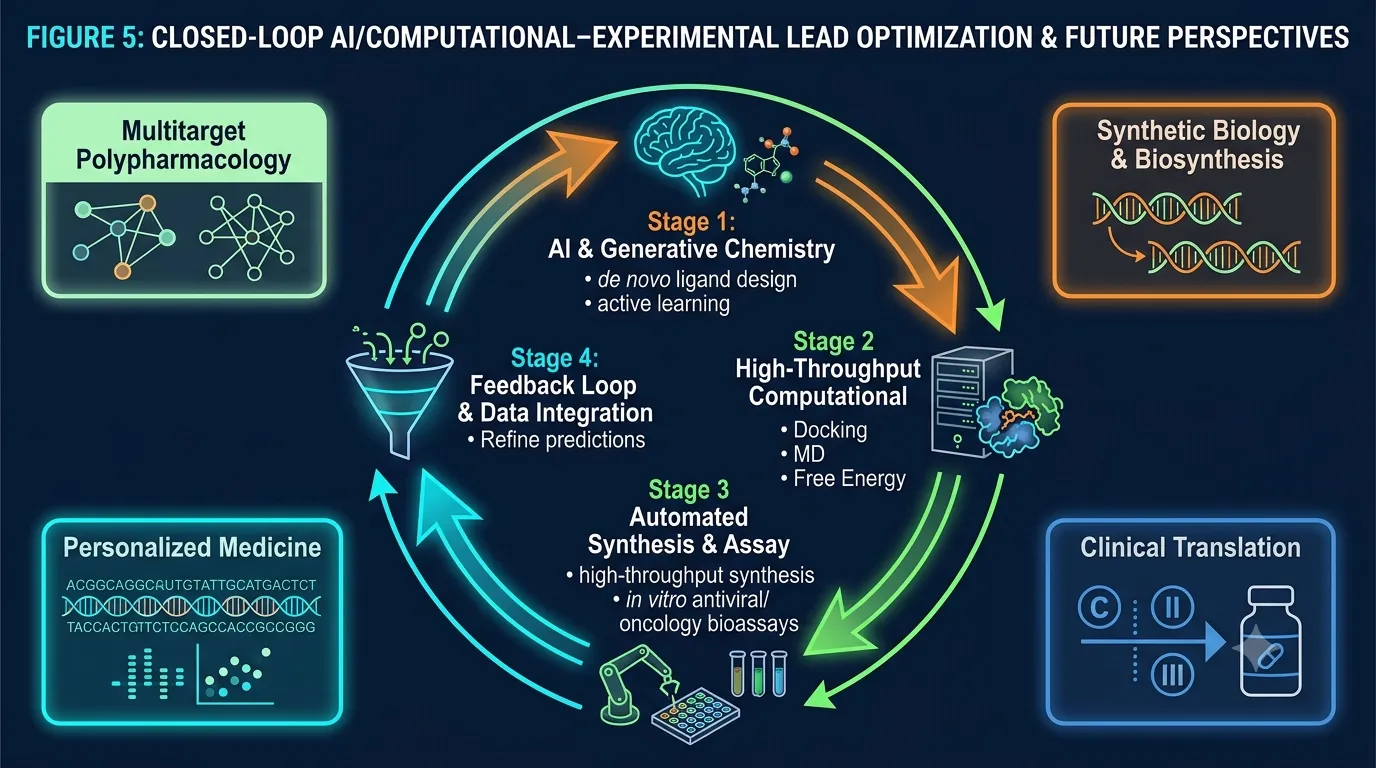
Figure 5: Toward an Uncertainty-Aware, Closed-Loop Computational–Experimental Ecosystem for Cannabinoid Discovery and Lead Optimization.
Overall, the future of computationally guided cannabinoid discovery lies in integrating existing methods rather than replacing one with another. Docking can generate structural hypotheses; MD can characterize conformational behavior; free-energy methods can refine comparisons; quantum chemistry can provide electronic insight; ADMET models can flag potential liabilities; and AI/ML can integrate heterogeneous information and prioritize experiments. However, experimental evidence must remain the basis for biological and translational claims.
The central shift is therefore from single-score prediction toward evidence-based decision-making, in which molecular recognition, functional activity, selectivity, exposure, and safety are assessed together. This integrated strategy could make cannabinoid chemical space more systematically navigable for antiviral and anticancer research. Section 9 can build on this perspective by considering the broader implications, practical implementation, and translational direction of the proposed framework.
9.0 Conclusions
Cannabinoids constitute a structurally diverse and tunable class of molecules with potential for antiviral and anticancer drug discovery. However, their chemical diversity, polypharmacology, and context-dependent biological effects complicate the identification of therapeutically relevant candidates. This review presents an integrated computational and translational framework for connecting cannabinoid chemical space with molecular recognition, biological mechanisms, and experimentally validated therapeutic potential.
A major achievement of this review is the integration of chemical-space exploration with target selection, computational prioritization, and experimental validation. The analysis in Section 2 establishes that discovery extends beyond major phytocannabinoids to minor cannabinoids, metabolites, and synthetic or semisynthetic derivatives interacting with diverse viral, host, receptor, enzyme, and signaling targets. Section 3 demonstrates how virtual screening, pharmacophore modeling, docking, molecular dynamics, free-energy calculations, quantum chemistry, ADMET prediction, QSAR, and AI/ML can provide complementary information for prioritizing candidates. Their combined use is more informative than reliance on any single computational metric.
The antiviral and anticancer applications examined in Sections 4 and 5 illustrate how computational methods can generate mechanistic hypotheses and identify candidate interactions involving viral proteins, entry mechanisms, kinases, receptors, and signaling pathways. However, predicted binding does not establish experimental affinity, target inhibition, cellular efficacy, or therapeutic benefit. Section 6 therefore emphasizes staged validation through biochemical and biophysical assays, cellular and mechanistic studies, selectivity assessment, ADMET characterization, and pharmacological evaluation where justified. Experimental findings should subsequently guide structure–activity relationship (SAR) analysis and lead optimization.
The resulting discovery strategy is iterative rather than linear:
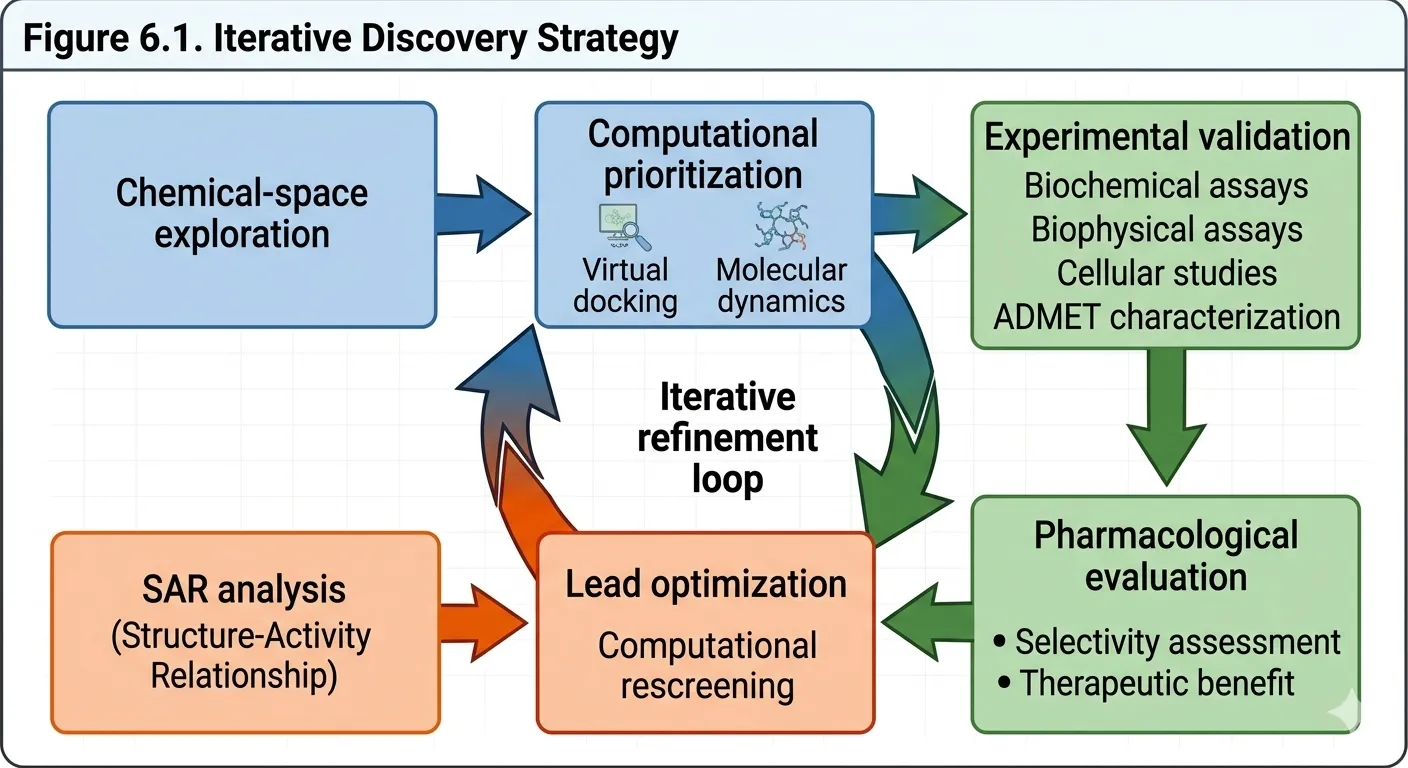
Sections 7 and 8 further establish that progress depends on managing uncertainties arising from incomplete chemical and biological datasets, target flexibility, sampling limitations, polypharmacology, off-target effects, and the gap between predicted activity and achievable exposure. Generative AI, multimodal learning, physics-informed models, ensemble simulations, and active learning offer opportunities to address these challenges. Their reliability, however, depends on data quality, appropriate validation, uncertainty estimation, and prospective experimental testing.
The central contribution of this review is therefore a closed-loop, uncertainty-aware, experimentally anchored framework in which computational chemistry provides mechanistic insight, AI/ML supports scalable prioritization, and experiments establish biological relevance. Candidate selection should consider convergent evidence across molecular interactions, dynamics, energetics, activity, selectivity, pharmacokinetics, and safety rather than favorable docking scores alone.
Ultimately, the success of computationally guided cannabinoid discovery will be measured not by the number of predicted hits, but by the ability to establish reproducible connections between chemical structure, molecular mechanism, disease-relevant phenotype, and therapeutic potential. Integrating prediction with experimental feedback offers a systematic route toward more credible cannabinoid-derived leads for antiviral and anticancer research.
Acknowledgments:
VKY acknowledge the National Supercomputing Mission (NSM) for providing computing resources for PARAM Kamrupa at IIT Guwahati, which C-DAC implements and is supported by the Ministry of Electronics and Information Technology (MeitY) and the Department of Science and Technology (DST), Government of India and also thanks the University of Allahabad for providing a research facility.
REFERENCES

Dr. Vivek Kumar Yadav, Computationally Guided Cannabinoid Discovery for Antiviral and Anticancer Applications: Chemical Space, Molecular Modeling, and Artificial Intelligence, Int. J. of Pharm. Sci., 2026, Vol 4, Issue 10, 4392-4443. https://doi.org/10.5281/zenodo.23722163
 10.5281/zenodo.23722163