

We use cookies to ensure our website works properly and to personalise your experience. Cookies policy
1Scholar Genaba Sopanaro Moze College Of Pharmacy, Wagholi, Pune, India.
2Assistant Professor, Genaba Sopanrao Moze College Of Pharmacy,Wagholi,Pune,India.
3Principal Genaba Sopanaro Moze College Of Pharmacy, Wagholi, Pune, India.
Counterfeit, falsified and substandard medicines remain a major public health concern worldwide, including in India. These products may contain incorrect, insufficient or harmful ingredients, fail to provide the intended therapeutic effect, cause direct toxicity and contribute to loss of confidence in healthcare systems. The scale of the problem varies across countries and medicine categories, while differences in sampling and testing methods make prevalence estimates difficult to compare. This review discusses the terminology and classification of poor-quality medicines and summarises evidence on their global prevalence, with attention to findings from Africa and India. It examines contributing factors such as weaknesses in regulatory oversight, manufacturing and quality control, gaps in supply-chain traceability, limited access to affordable quality-assured medicines, unauthorised sales and inadequate reporting. The review also considers consequences for treatment outcomes, patient safety, healthcare costs, antimicrobial resistance and public trust. Strategies to address the problem include stronger regulatory frameworks, good manufacturing practices, secure procurement and distribution, traceability technologies, post-marketing surveillance, risk-based sampling, laboratory testing, oversight of online sales, professional training, public awareness and international information sharing. Digital authentication and portable screening tools can support detection, but should complement rather than replace appropriate quality testing and regulatory investigation. Persistent challenges include unequal regulatory capacity, complex cross-border supply chains, under-reporting and barriers to accessing reliable medicines. A coordinated, evidence-informed approach involving regulators, manufacturers, healthcare professionals and the public is needed to prevent, detect and respond to poor-quality medicines and improve access to safe, effective and quality-assured medical products.
medicines are essential for preventing, diagnosing and treating illnesses and that the quality, safety and effectiveness of medicines are key to healthcare.spread of poor quality and fake medicines is still a big public health problem, around the world.
The World Health Organization says that substandard medicines are approved medicines that do not meet the quality rules while falsified medicines purposely lie about what they are, what they contain or where they come from.[1] Although the term counterfeit medicine is widely used its meaning can change depending on regulatory rules. It is very important to tell the difference between falsified medicine and substandard medicine because fraud and quality problems need different ways to investigate, stop and control. The WHO says the list one in ten medicines, in low- and middle-income countries is substandard or counterfeit medicine [1].
This estimate shows how big the problem is. It should not be seen as a rate that is the same in every country or for every type of medicine. A systematic review by Mekonnen and colleagues looked at how substandard falsified, unlicensed and unregistered medicines are in Africa. Their work shows why ongoing monitoring and strong regulation are so important [2]. In a way Tegegne and colleagues reviewed the quality of antimicrobial medicines in some East African countries. They found that 151 out of 669 samples did not pass at least one quality test. Still these results are only relevant to the studies and places that were included [3]. Because of differences in how samples were collected, how w tests were done and what kinds of medicines were studied it is important to think before using these prevalence numbers to make broad conclusions.
Substandard and falsified medicines can seriously harm patients and the health systems they depend on. Medicines that have little or no active ingredient may not work at all. That means they don’t treat the illness and the patient could stay sick longer or not get the treatment in time. Medicines with ingredients or dangerous contaminants can also cause unexpected side effects or poisoning. Poor-quality antimicrobials are especially risky. When these medicines don’t work, treatment. That could lead to antimicrobial resistance. That means bacteria become harder to treat and infections become more dangerous [1, 3]. Beyond health issues patients and their families may have to pay more for medical care and lose income from being sick. Health systems may see costs and lose trust from the public. Still the full size of these impacts is hard to measure. Salami and colleagues found weak points in the way studies look at the health, economic and social effects of substandard and falsified medicines in low- and middle-income countries. They also said there is no information about the social effects [4].
Recent research shows that we must pay attention to both the weaknesses in supply chains and the factors that affect how medicines are bought and used. Pal and colleagues looked at knowledge, attitudes, practices and demand-side strategies related to falsified medicines. They pointed out that these areas are key for research and action [5]. At the time Fryze and Naughton reviewed medicine recalls that happened through legal supply chains in several countries. Their analysis found a variety of quality problems in recalled medicines. They also noted that India was a source of some falsified medicines that were recalled in Zambia, Sri Lanka, Brazil and Nepal [6]. These findings show how important it is to have quality assurance and international cooperation.. It’s also important not to see these results as a full picture of how widespread falsified medicines are in India.
India plays a role in this discussion because of its large pharmaceutical manufacturing capacity and its place in global medicine supply chains. Keeping medicine quality high needs action from groups—manufacturers, regulatory authorities, distributors, pharmacists and other healthcare workers. To protect patients we need quality-control testing, reliable product tracking, good reporting systems, public awareness and easy access to quality-assured medicines. These parts should work together to prevent and control problems.
This review looks at falsified medicines as a global public health issue with special focus on India. It aims to explain the right terms and how medicines are classified. It also reviews what we know about how common these fake medicines are, what leads to them and what harm they cause. The review checks ways to detect and identify falsified medicines. It also looks at the rules, technology and professional actions that can help fight this problem. Finally the review considers the challenges of putting these solutions into practice and sets out research needs. The goal is to strengthen quality assurance and keep patients safe.
CLASSIFICATION OF COUNTERFEIT MEDICINES
The words we use to talk about medicines that're not good have changed over time. In science papers, rules and everyday talks people sometimes mix up words like counterfeit, fake substandard, falsified, unregistered and unlicensed. These words look alike. They do not always mean the same thing. Knowing what each word means helps us count how many poor-quality medicines there are report possible bad medicines and make rules that fit the problem.[1, 7]
WHO calls bad medicines substandard and falsified medical products. WHO does this to separate medicines that simply do not meet the quality rules from medicines that are deliberately made to trick people or health workers. That difference matters a lot. A medicine can have a defect without being falsified.. A falsified medicine is made to mislead. So the word counterfeit medicine must be used with care, in science papers. The meaning must be spelled out.[1, 8]
The major categories of poor-quality and falsified medicines and their associated concerns are summarized in Table 1."
Table 1: Classification of Counterfeit Medicines
| Category | Description |
|---|---|
| Substandard medicines | Authorized medicines that fail to meet established quality standards or specifications, potentially resulting in reduced effectiveness or safety problems. |
| Unregistered and Unlicensed medicine | Medicines that have not received the required approval or registration from the national regulatory authority for marketing in a particular country. |
| Falsified medicines | Medicines that deliberately misrepresent their identity, composition or source. They may contain incorrect, insufficient or harmful ingredients. |
| Counterfeit medicines | Products involving intentional deceit or improper representation. Specific legal definitions differ across regions and can relate to intellectual property violations. |
Substandard medicines
Substandard medicines, sometimes called out-of-specification products, are products that have been approved but do not meet the required quality standards [8]. These issues can affect the identity, strength, purity, dissolution, stability or other quality features of a medicine. Problems may come from manufacturing controls, mistakes during production, improper storage or issues during transport and distribution.
For instance a batch of an approved tablet might have more active ingredients than expected or fail to dissolve properly. If tests show the product does not meet the quality rules it is considered substandard.. Having a quality problem does not mean the product was intentionally tampered with. Officials must investigate to find out what went wrong and why [1, 8].
Unregistered and unlicensed medicines
unlicensed medicines are products that have not been evaluated or approved by the proper medicines regulatory authority in the country or region where they are sold. This applies even if local laws allow exceptions [8]. Registration and licensing rules exist to make sure that medicines are safe, effective and of quality before they are allowed to be used by the public.
Not having registration does not automatically mean that a medicine is fake or poor in quality. For example a medicine might be real and properly made. It could still be supplied through an unofficial channel or might not have the official marketing approval. At the time an unregistered medicine might be fake or it might not meet proper quality standards. Whether a medicine is genuine. Not depends on the evidence available and the specific rules that apply in the area.
Falsified medicines
Falsified medicines are products that deliberately or fraudulently misrepresent their identity, composition or source [1, 8]. Misrepresentation can involve information on the label, an incorrect declaration of ingredients, misleading packaging or a false claim, about the manufacturer or origin of the product. These falsified medicines may contain the active ingredient, an incorrect amount of the intended ingredient, no active ingredient or potentially harmful substances.
For example a product sold as a branded medicine may be packaged to imitate the original product even though it was manufactured by an unauthorized source or contains a different formulation. Such a product may be considered falsified when deliberate misrepresentation is established. The appearance of a package is not sufficient to confirm falsification; appropriate investigation and where necessary laboratory testing are required.
Falsified medicines present a public health concern because patients may receive ineffective or harmful treatment without knowing that the product is not genuine. Detecting these falsified medicines may require examination of packaging and labeling verification of the manufacturer and supply‑chain records and analytical testing of the products contents [1, 7].
Counterfeit medicines
The phrase counterfeit medicine is often used in talks and some legal systems to describe fake or dishonest drug products. However the meaning of the phrase may be different in each jurisdiction. In some contexts counterfeiting is linked to trademark infringement or to copying a brand without permission. In contrast the WHO's health language focuses on whether a medical product deliberately misrepresents its identity, its ingredients or its source.[7, 8]
Because of this distinction counterfeit medicines should not automatically be treated as a synonym for every medicine. A genuine medicine can fail a quality test because of a mistake made while manufacturing or because it has been stored incorrectly. It is not counterfeit. Likewise a product can be falsified even if the packaging looks convincing or if the brand name is well known. Clear terminology helps people avoid confusion between fraud, accidental quality problems and regulatory violations.
In this review the term counterfeit medicines is kept in the sense used in the article title and, in everyday public discussion. Where the evidence allows a precise classification the terms substandard, falsified and unregistered/unlicensed are used separately. This approach supports an accurate interpretation of published studies and regulatory reports
GLOBAL PREVALENCE AND EPIDEMIOLOGY OF SUBSTANDARD AND FALSIFIED MEDICINES
The global prevalence of substandard and falsified medicines changes from one country to another from region to region and across types of medicine treatments. It is hard to know how widespread this problem really is. Different studies use ways to collect samples, test medicines and group the results. Some studies mix falsified medicines together while others also include medicines that are not registered or approved. Because of these differences the numbers and estimates reported in studies need to be understood in the context of the methods and locations where each study was done [1, 2].
Global Prevalence
The World Health Organization (WHO) says that at least one in ten medicines in low- and middle-income countries is substandard or falsified [1]. This finding shows how big the problem of medicine quality is, in places where regulation and lab testing are scarce.. This number is not a single rate that applies to every country or every type of medicine.The WHO’s Global Surveillance and Monitoring System logged 877 cases of falsified medical products from August 2017 to December 2021 and the number of reported cases grew on average by 36.3% each year during that span [9]. Those numbers show the incidents that were reported, not the whole scope of medicine problems, across the world. Still they make it clear that we must strengthen monitoring and share information more effectively [9].
Prevalence in Africa
I read that Mekonnen and colleagues studied 27 reports on medicines that were substandard, falsified, unlicensed or unregistered in Africa. The study reported a prevalence of 22.6% for falsified medicines, based on the studies they included [2]. Antibiotics, antimalarials and other therapeutic categories were among the medicines that were examined. The authors also pointed out supply‑related factors that are linked to medicine‑quality problems.
These findings show that poor‑quality medicines create a public health problem in the region. Still the prevalence estimate should be interpreted cautiously because the studies varied in where they were carried out, what medicines were tested and how the testing was done. This prevalence number should not be taken as a figure for every African country or, as a global prevalence estimate [2].
The situation in India
India is a place to look at medicine quality because India makes many medicines and works with suppliers around the world. Researchers Fryze and Naughton looked at medicine recalls that were not good or were fake which were found in supply chains in many countries. Their study showed that some medicines recalled in Zambia, Sri Lanka, Brazil and Nepal came from India.[6]
These results show how important it is to keep quality checks and to work together across borders.. Medicine recalls do not tell us how common bad or fake medicines are, in India. To get an estimate we need wide surveys that look at medicine quality and we must carefully study regulatory data to separate ordinary quality problems from intentional cheating.[6]
Challenges in estimating prevalence
There are challenges when trying to estimate how common substandard and falsified medicines are. Different studies often use ways to collect samples. They may look at types of medicines and use different testing methods. Some studies only focus on places where poor-quality medicines are already known to be a problem. This can make it hard to apply their findings to areas. Also there is no way to classify substandard medicines, falsified medicines, unregistered medicines or unlicensed medicines. This makes it difficult to compare results across studies [2, 3].
To get answers we need standardized sampling methods, reliable lab testing, clear reporting and stronger collaboration between regulatory agencies. Accurate and representative data would help us find which medicines and supply chains are most, at risk. It would also support decision-making by regulators and help protect patients more effectively.
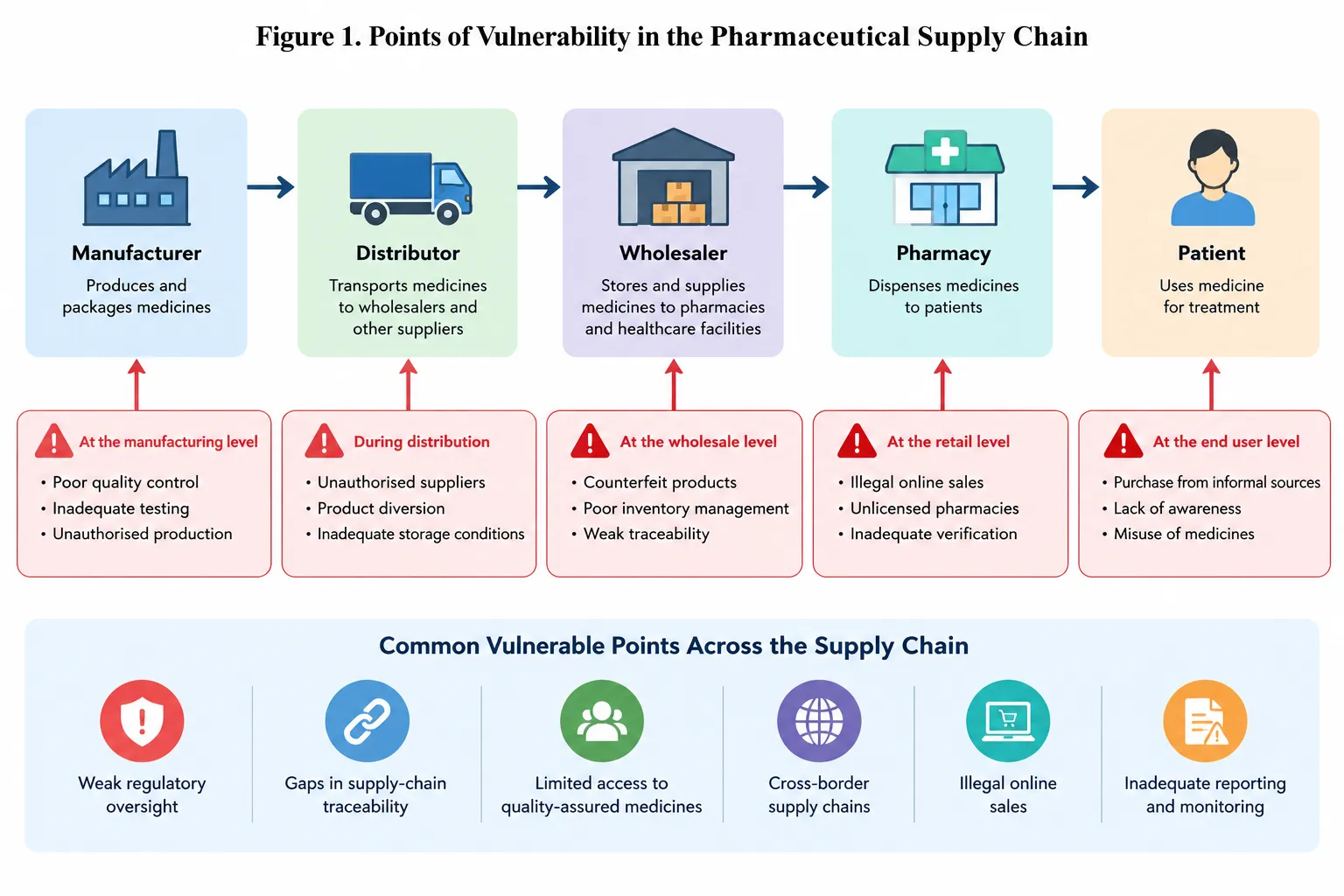
CAUSES AND CONTRIBUTING FACTORS
The circulation of medicines and falsified medicines comes from many linked factors that touch manufacturing, regulation, distribution and consumer behaviour. Substandard medicines may come from production or bad storage practices. Falsified medicines are intentionally misrepresented to make money. Weak regulatory oversight, supply chains, limited access to affordable medicines and the rise of unauthorized online sales all add to the persistence of this problem [1, 5, 10].
Weak regulatory systems
Effective regulatory authorities are essential for ensuring that medicines meet established standards of quality, safety and efficacy. However limited resources, inadequate laboratory facilities, insufficient inspections and weak enforcement reduce the ability of authorities to detect and control poor-quality products. Differences in capacity between countries can also create difficulties in monitoring medicines that move across national borders [1, 10].
Manufacturing and quality control
Bad manufacturing methods and not enough quality control can lead to medicines that are not good enough. Issues can be things like the amount of active ingredients getting mixed in by mistake, medicines not working the way they should and not staying good for long. Not keeping up with the production standards or looking into quality problems can let bad batches get to people. These problems don't always mean someone is trying to trick people on purpose. They show how important it is to keep quality checks going all the time [1].
Hard to track medicine supply chains
Medicines might go through companies who sell them to people who get them to stores and then to patients. When these supply chains don't have ways to track where the medicine came from or make sure it's real there can be chances for people to switch the medicine, mess with it or put fake medicine in. Not having records and not working well together with the people involved can make it harder to find out what's wrong and take back the bad medicine [1, 10].
Not enough access to medicines
When medicines are too expensive or not enough are available or only the real ones are hard to find some people might look for cheaper options from places that are not official or from websites that are not trusted. These places might not make sure the medicine is real or that it was stored the way. Even if it's not the reason for medicine, not being able to find real medicines can make people more likely to buy something that is not safe [1, 10].
Selling medicines unofficial places
More people are buying medicines online which has made it harder for the people who check on medicines to do their job. Some websites that are not allowed to sell medicines might offer them without a prescription or without checking if they are real or where they came from. People might not be able to tell the sellers from the fake ones especially if the websites look real or say things that are not true. Pal and other researchers said that people and doctors need to know more about medicines and that there needs to be better ways to get people to ask for the right ones [5].
Not enough people. Not enough reports
Not knowing enough about the dangers of bad medicines can stop people from seeing something that is not right or from reporting when they think something is wrong. Doctors and others who work with patients might also need training so they can spot signs that something is not right and report it to the right people. A study in 2025 by Pal and other researchers found that not many doctors or regular people knew about the dangers of finding medicines or how to report them [5].
Money. Intentional cheating
Fake medicines might be made or sold to get money by tricking patients, doctors or real companies. People who do this might take advantage of the need for medicines when there is not enough medicine around or when the people in charge are not doing their job. When there is corruption or no one is stopping this it can help these bad people do their work. Unlike mistakes that happen by accident, making medicines is on purpose and needs to be looked into and punished [1].
All these reasons for fake medicines are connected and can't be fixed with just one solution. Making sure that medicines are made right, that the rules are followed, that the medicine can be tracked from start to finish and that people know more about the problems while also making sure that real medicines are available and not too expensive is important to stop medicines from getting to people [1, 5, 10].
Public Health Consequences of Substandard and Falsified Medicines
Substandard and falsified medicines are a problem for public health. They might not work as they should so people don’t get better.. Worse, they could have dangerous stuff in them that hurts the patient.[1, 4] This is not a problem for the person taking the medicine. It can affect hospitals and communities too. When medicines don’t work people need treatments. That costs money. It can also lead to germs that don’t respond to drugs anymore..[1, 4, 5] When people lose trust in medicines they may avoid getting care.. How bad is it really? It’s hard to say for sure. Not enough research has looked at the effects of these fake or low-quality medicines, on health and society.[4, 5]
Treatment. Disease Progression
Medicines that do not contain enough of the active pharmaceutical ingredient (API) or that contain wrong ingredients or that have other quality defects may fail to give the expected therapeutic effect [1, 11]. When treatment failure occurs the disease may keep going or get worse which might delay recovery and require medical care [1, 4]. How serious the outcome is depends on the medicine the disease is in. Whether good alternative treatment is available [1, 4].
The consequences may be especially serious for diseases that need effective treatment, such as malaria and bacterial infections [4, 11]. A systematic review of studies that looked at the health and economic impacts of substandard and falsified (SF) medicines in low‑ and middle‑income countries found that many studies estimated a burden caused by poor‑quality antimalarials although the numbers varied because of different methods and assumptions [4]. The review used studies from sub‑Saharan Africa so its findings must not be applied to India or other regions unless local evidence supports them [4].
Toxicity and direct harm to patient
Toxicity and direct harm to patients can occur when medicines from the source country referred to as SF medicines contain contaminants, wrong ingredients or incorrect amounts of active substances [1, 11]. The effects on patients may vary depending on the type of substance. How much they were exposed to. Possible outcomes include poisoning, damage to organs or other serious health problems [1]. These risks are especially troubling when children are affected or when quality issues go unnoticed until many patients have already been exposed [1, 13].
A serious incident in India in 2025 showed how dangerous bad-quality medicines can be. Reports linked the deaths of children in Madhya Pradesh to a cough syrup called Coldrif that contained diethylene glycol at levels higher than allowed. Diethylene glycol is a toxic chemical that can cause severe kidney injury [14]. This case shows how important it is to ensure that ingredients are safe, that manufacturing processes are properly controlled and that regulatory authorities are actively monitoring medicine quality [13, 14]. Still it is important to understand that contamination and falsification are not the thing. A medicine that is contaminated or substandard should not be called falsified unless there is evidence that someone intentionally misrepresented it [1, 11].
Economics. Pressure on Healthcare Systems
The consequences of SF medicines also include losses for patients, families and healthcare systems [1, 4]. When treatment fails patients may need consultations, diagnostic tests, replacement medicines or hospital care potentially increasing the overall cost of treatment [1, 4]. Prolonged illness may also affect patients’ ability to work and increase the time and resources required from family caregivers [4].
Salami and colleagues reviewed 11 studies on the health social impacts of SF medicines in low- and middle-income countries [4]. Their review found that the available evidence was limited and that methods used to estimate the burden varied considerably [4]. The authors also identified a lack of evidence on social outcomes demonstrating the difficulty of calculating the complete cost of poor-quality medicines [4]. Consequently economic estimates should be interpreted according to the population, disease and methods examined in each study than presented as precise measures of the global burden [4].
Poor-quality products can also enter pharmaceutical supply chains making timely detection, investigation and recall important for limiting further exposure [6]. A 2025 systematic review of recall evidence across countries found that recalls involved a range of quality problems, including contamination, out-of-specification results, stability issues and packaging defects [6]. These findings show that medicine-quality problems are not limited to products sold through channels [6].
Loss of public trust
Salami and other researchers looked at 11 studies about the health and social effects of SF medicines in middle-income countries [4]. Their analysis showed that the information available was not enough and that the ways to measure the impact were very different [4]. The researchers also noticed that there was no information about social effects, which made it hard to figure out the full cost of medicines that are not of good quality [4]. Because of this, economic estimates should be seen as related to the population, disease and methods used in each study instead of being seen as exact numbers for the whole world [4].
Poor-quality medicines can also get into the supply chains for drugs. This makes it important to find them quickly, look into the problem and recall the products to stop people from being affected [6]. A review from 2025 that looked at recall data from countries found that recalls covered many types of quality issues, such as contamination results that were not within the required standards, problems with how long the medicine stays good and issues with the packaging [6]. These results show that problems with medicine quality are not, in medicines sold through certain channels [6].
Effective Strategies to Combat Counterfeit Medicines
Combating counterfeit medicines requires coordinated efforts by regulatory authorities, pharmaceutical manufacturers, healthcare professionals and the public [9, 18]. An effective approach should combine strong regulation, quality assurance, secure supply chains, reliable detection methods and public awareness [5, 9, 15].
Table 2: The Major Strategies for Preventing and Controlling Counterfeit Medicines
| Strategies | Key measures |
|---|---|
| Strengthening regulatory frameworks | Enforcing licensing requirements, conducting regular inspections, risk-based sampling and taking appropriate action against violations. |
| Improving manufacturing and quality assurance | Following Good Manufacturing Practices (GMP), verifying raw materials, conducting quality testing and maintaining proper storage and transportation conditions. |
| Securing supply chains through traceability | Purchasing medicines from authorized suppliers, maintaining distribution records and using serialization, barcodes and QR codes to support product tracking. |
| Strengthening detection and surveillance | Conducting post-marketing surveillance, investigating complaints, using laboratory testing and suitable screening technologies, and issuing timely alerts and recalls. |
| Regulating online sales and raising awareness | Monitoring unauthorized online medicine sales, encouraging purchases from licensed pharmacies and educating the public and healthcare professionals about suspicious products. |
| Improving access to quality-assured medicines | Strengthening procurement systems, maintaining reliable supplies of essential medicines and verifying medicine suppliers. |
| Promoting international cooperation | Sharing information, coordinating investigations and strengthening collaboration between national regulatory authorities and international organizations. |
Strengthening Regulatory Frameworks
Regulatory authorities should ensure that pharmaceutical manufacturers, distributors and pharmacies comply with licensing requirements and established quality standards [9, 18]. Regular inspections, risk-based sampling and appropriate penalties for proven violations can help prevent the distribution of falsified medicines [9, 18]. International information sharing and timely reporting of suspicious products are also important because pharmaceutical supply chains frequently cross national borders [9].
Improving Manufacturing and Quality Assurance
Manufacturers should follow good manufacturing practices (GMP), verify raw materials and conduct appropriate quality testing before releasing medicines for distribution [18]. Proper storage, transportation and batch documentation can help maintain product quality throughout the supply chain [1, 6]. Tamper-evident packaging and product authentication features may provide additional protection, although packaging alone cannot confirm a medicine’s composition or quality [15, 16].
Securing Supply Chains Through Traceability
Medicines should be purchased from authorised suppliers, with records maintained throughout distribution to support product verification and investigation [9, 17]. Serialization, barcodes and QR codes can help trace products and identify suspicious or duplicated identifiers when supported by reliable data systems [17, 18]. India has also expanded its QR-code-based drug traceability framework, demonstrating the growing role of digital technologies in medicine surveillance [19]. However, traceability systems should complement inspections and laboratory testing rather than replace them [15, 17].
Strengthening Detection and Surveillance
Post-marketing surveillance, risk-based sampling and investigation of complaints help identify medicines that fail to meet quality standards [9, 15]. Laboratory techniques such as high-performance liquid chromatography (HPLC), together with suitable portable screening technologies, can assist in identifying suspected quality defects [15, 16]. Visual inspection and packaging checks may reveal warning signs but cannot reliably establish a medicine’s authenticity or chemical quality [15, 16]. Suspected products should therefore undergo appropriate confirmatory testing before regulatory conclusions are reached [15, 16]. Timely alerts and recalls can reduce further exposure when a quality problem is confirmed [9, 6].
Improving Access and International Cooperation
Limited access to affordable, quality-assured medicines may push some patients towards unregulated sources [5, 17]. Governments and healthcare institutions should strengthen procurement, maintain reliable supplies of essential medicines and verify suppliers [9, 17]. International collaboration, including information sharing through WHO surveillance mechanisms, can help countries respond to products distributed across borders [9]. Overall, combining effective regulation, quality assurance, traceability, detection, public education and reliable access to medicines provides a more comprehensive response than relying on any single intervention [5, 9, 15, 17, 18].
Limited access to affordable, quality-assured medicines may push some patients towards unregulated sources [5, 17]. Governments and healthcare institutions should strengthen procurement, maintain reliable supplies of essential medicines and verify suppliers [9, 17]. International collaboration, including information sharing through WHO surveillance mechanisms, can help countries respond to products distributed across borders [9]. Overtraceability, detection, public education and reliable access to medicines provides a more comprehensive response than relying on any single intervention [5, 9, 15, 17, 18].
Challenges and Future Perspectives
Major Challenges
Even though many countries are working together, fake and other low-quality medicines are still hard to manage. Finding and stopping these medicines needs teamwork along the medicine supply chain. Different countries have levels of ability to check medicines, track problems and take action. This can make it hard for countries to find and deal with medicines the same way all the time [9, 17, 20]. When medicines that are safe and work well are too expensive or not easy to find, people might get medicines from places that're not safe. This increases the chance that people get medicines that're not safe [1, 4].
More medicines are being sold online. The way medicines move between countries is more complicated. This makes it harder for people who watch over medicines to do their job. Finding where bad medicines come from sharing information between countries and acting quickly can be hard when different groups and places are in charge [17, 18]. Also not enough people report problems with medicines may stop leaders from knowing how big the problem really is. The WHO report says it is important to look at how countries work and make the system that handles fake medicines better [20].
Future Perspectives
Future work should focus on rules, quick sharing of information and working together between the countries, WHO, makers of medicines, doctors and others involved [9, 20]. Spending more on labs checking for problems in a way and using tools that are easy to use could help find bad medicines faster and help with the right steps [15, 17].
Using tracking safe ways to know if a medicine is real and better control of online medicine sales could help make the supply chain safer, as long as these ideas work well and can talk to each other and are supported by real action [17, 18]. Teaching people about the dangers of buying medicines from places that are not checked can help them avoid medicines and tell people if they find something not right [5].
The WHO report gives a chance to use what we have learned from working with countries to make things better for the future [20]. Getting better will not just depend on technology but also on leaders staying interested in having enough money being open about what is happening and using the rules properly. A plan that works together based on facts that helps people get medicines that work and also stop, find and deal with medicines is needed to make the problem of fake and bad medicines less of a danger to health [1, 9, 20].
CONCLUSION
Counterfeit medicines, falsified and low‑quality medical products, are still a major global public‑health problem. Counterfeit medicines can spoil treatment results, cause injuries and shake public trust in health services. The problem size changes from one country to another and from one drug to another. Evidence shows that we need stronger regulatory oversight, reliable quality‑control systems and better surveillance [1, 2, 9]. The growing complexity of medicine supply chains and the rise of online medicine sales highlight the need for action.
To tackle this challenge we need a strategy that mixes clear laws, strong enforcement, good manufacturing practices, safe supply‑chain traceability, proper screening, laboratory testing and quick reporting of suspect products [15, 17, 18]. Public awareness and easy access to quality‑assured medicines are just as vital to reduce reliance on unverified sources [1, 5]. International cooperation, backed by sharing information and a long‑term regulatory commitment can make national and global responses stronger [9, 20].
In India and across the world better coordination among authorities, pharmaceutical manufacturers, health workers and the public is key to stopping the spread of poor‑quality medicines. Future efforts must be based on evidence, well‑funded and adjusted to each country’s health needs. In the end lowering the threat of medicines requires prevention, early detection, strong enforcement and fair access, to safe, effective and quality‑assured medical products.
REFERENCES


Renuka Gadade, Kiran Bhosale, Dr. Tushar Shelke, Counterfeit Medicines: A Major Public Health Concern and Effective Strategies to Combat the Crisis, Int. J. of Pharm. Sci., 2026, Vol 4, Issue 11, 2050-2061. https://doi.org/10.5281/zenodo.24189849
 10.5281/zenodo.24189849