

We use cookies to ensure our website works properly and to personalise your experience. Cookies policy
Genba Sopanrao Moze College of Pharmacy, Savitribai Phule Pune University.
Treating diseases is becoming more difficult. Antimicrobial resistance, infections that form biofilms, drugs that are unstable and toxicity that limits the dose all block treatment. Liposomes provide one solution. Liposomes are a spherical artificial vesicle made mainly from phospholipid bilayers that surround a watery core. Because of this design drugs that like water (hydrophilic) can stay inside the core while drugs that like fat (lipophilic) can sit inside the bilayer, which makes liposomes a flexible platform for delivering antimicrobials. This narrative review explains liposome structure, the ways of making liposomes the mechanisms that matter for antimicrobial delivery and how liposomes have been used against bacterial fungal, mycobacterial and biofilm-associated infections. Encapsulating a drug in a liposome can protect a drug from breaking down too early change where the drug goes in the body raise the drug concentration at the infection site and protect healthy tissue. Surface changes and stimulus-responsive designs may help liposomes interact better with tissue or biofilms. However how well a liposome works depends on the drug chemistry, the lipid composition, the vesicle size, the surface charge, the route of administration and the surrounding biological environment. Bringing these systems into use is slowed by complex manufacturing, limited storage stability, inconsistent drug release, scale-up challenges, cost and the need for stronger clinical evidence. Liposomes are therefore promising delivery systems. They do not automatically defeat antimicrobial resistance and each drug-pathogen pair must be evaluated on its own. Further work, on manufacturing, safety, pharmacokinetics and clinically meaningful outcomes is essential.
Antimicrobial medicines are essential, for treating fungal and other microbial infections yet antimicrobial medicines do not always work as well as they should. Antimicrobial medicines may reach tissues poorly may be cleared from the body quickly may be broken down by enzymes may struggle to enter cells may cause side effects or may be blocked by the protective environment of a microbial biofilm. On top of this antimicrobial resistance calls for strategies that deliver the amount of drug to the right place while keeping the use of existing antimicrobial medicines responsible [1–4].
A drug delivery system can change how an active ingredient is distributed and released without changing what it targets in the microbe. Liposomes are especially interesting here. Liposomes are built from lipids so liposomes can carry compounds with very different solubility. Liposomes composition and liposomes surface can also be tuned to influence how long liposomes circulate, how cells take up liposomes how liposomes interact with membranes and how liposomes release their drug [1,2,5].
This review sets out the principles and emerging uses of liposomes for delivery looks at representative evidence and discusses the barriers that need to be overcome before liposomes can be used more widely in the clinic.
2. Review Approach
This narrative review is based on a selected group of peer-reviewed reviews and key research papers that I found through PubMed and publisher websites. It covers topics such as liposome structure and how they are made how antibiotics are loaded into liposomes delivering drugs to biofilms translating this work to practice and the limits of how we can formulate these systems. This is not a review: I did not do an exhaustive search I did not formally assess risk of bias and I did not do a meta-analysis. You should check the references, against the publisher records before you submit.
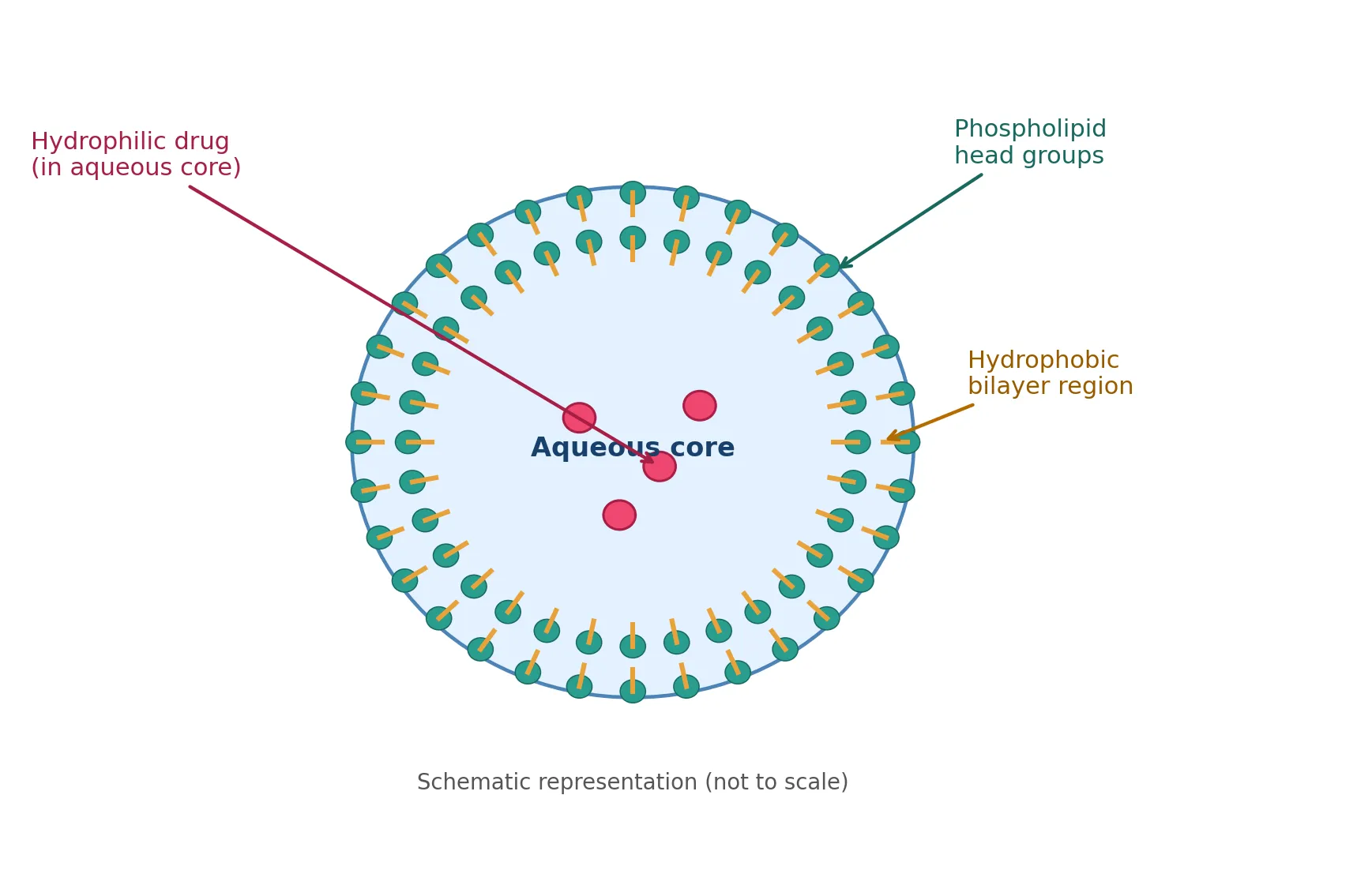
Figure 1: Schematic structure of a liposome, showing the phospholipid bilayer and the aqueous compartment. The diagram is for illustration only and is not drawn to scale.
3. Structure And Types Of Liposomes
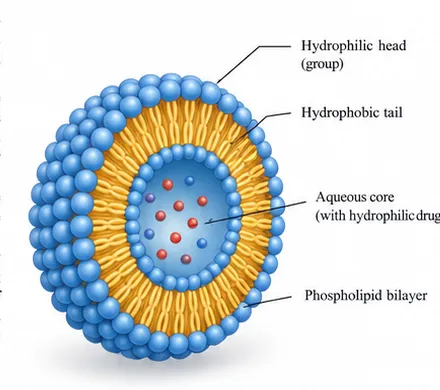
Figure. Realistic schematic of a liposome showing the phospholipid bilayer, hydrophilic heads, hydrophobic tails and aqueous core.
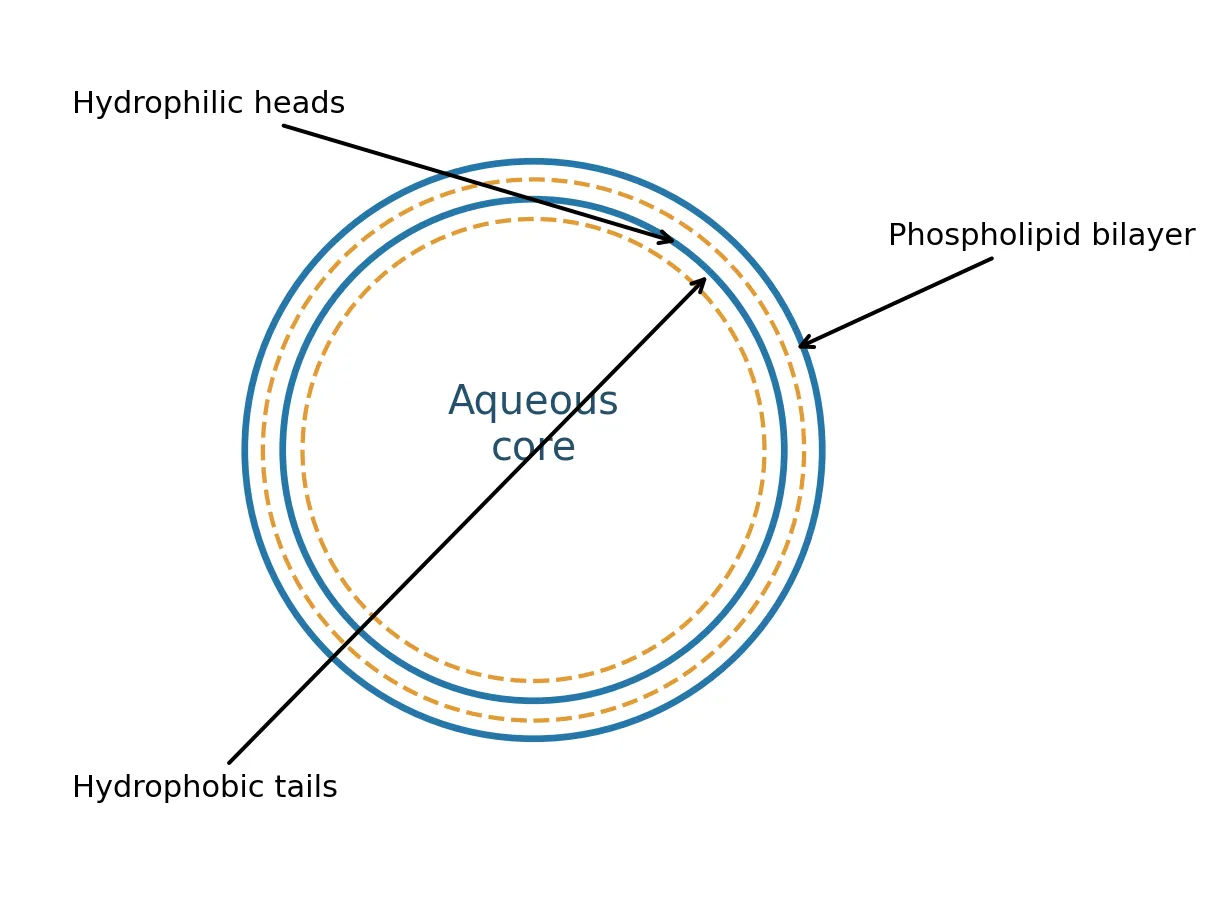
Liposomes is a spherical vesicle that forms when phospholipids arrange into one or more bilayers in water .The polar head groups face the water, both outside and inside the aqueous compartment while the hydrophobic tails tuck together inside the membrane. This arrangement lets hydrophilic drugs be trapped inside the compartment and many lipophilic drugs settle into the bilayer [5,6].
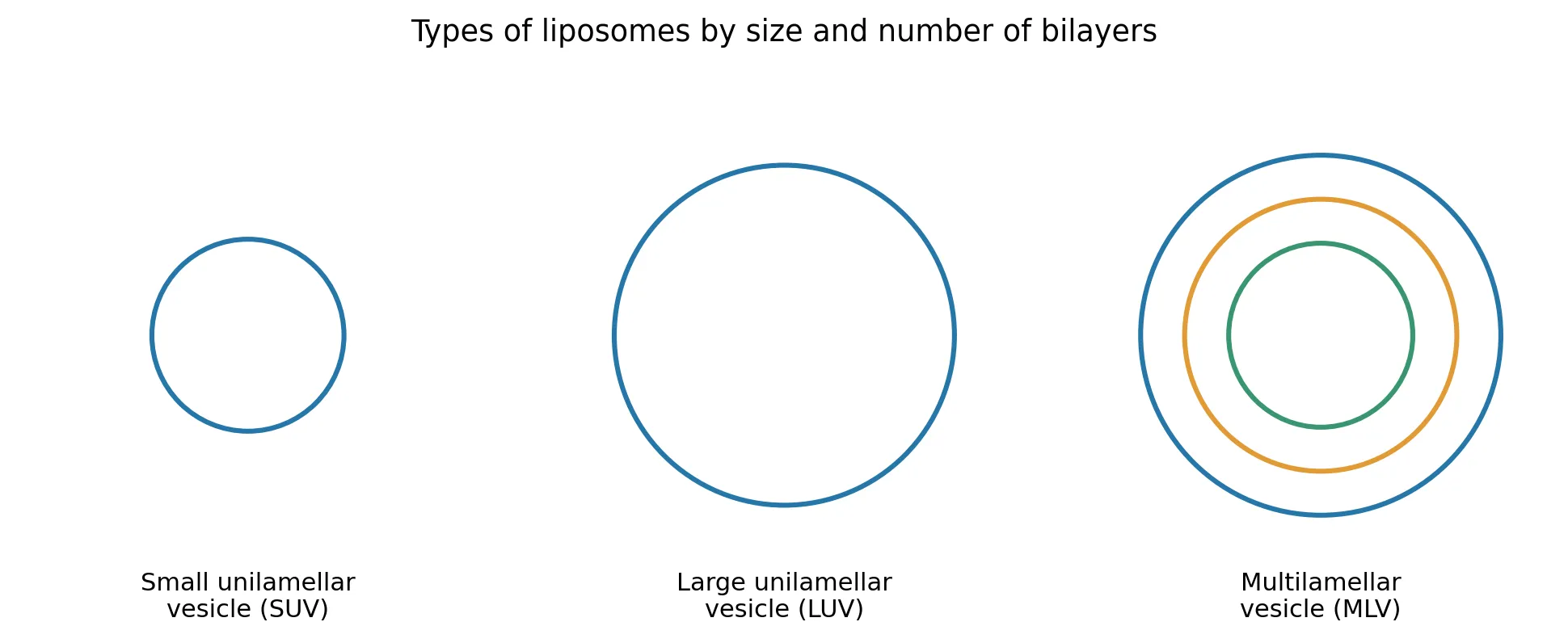
Liposomes can be sorted by how bilayers they have and by their size. Small unilamellar vesicles have a bilayer and a fairly small diameter. Large unilamellar vesicles also have one bilayer. Enclose a larger aqueous volume. Multilamellar vesicles contain concentric bilayers. The actual size ranges differ depending on the preparation method and, on how the termsre used. Formulations may also be described as PEGylated/stealth, ligand-modified, cationic or stimulus-responsive depending on their composition and surface design.
4. Formulation and Preparation Methods
I notice that the way we make liposomes changes a lot of things. It changes liposome size it changes the number of bilayers it changes how much drug is inside it changes how much drug leaks out and it changes how reproducible each batch is. We usually make liposomes by thin-film hydration. Then shrink them by injecting ethanol by evaporating a reverse phase by removing detergent or by mixing in microfluidic channels. After that we can squeeze liposome vesicles through a filter hit them with sound waves clean them up filter them with a sterile filter if we can and finally freeze-dry them with the right protective agents [5,6].
When we develop a formulation we look at properties. We look at how the sizes of liposomesre distributed how uniform they are, how much charge the liposome surface has what shape the liposome is, how much drug the liposome holds, how well the drug stays inside the liposome how the drug leaves in a lab test how much leftover solvent there is, whether the sample is sterile how much endotoxin the liposome contains and how the product holds up over time. All of these properties are linked. Changing one can change another. For instance if we add lipid we might be able to load more drug into the liposome but it can cost more or change the release pattern of the drug. If we coat the liposome it may stay in the body longer. It may also change how cells pick up the liposome.
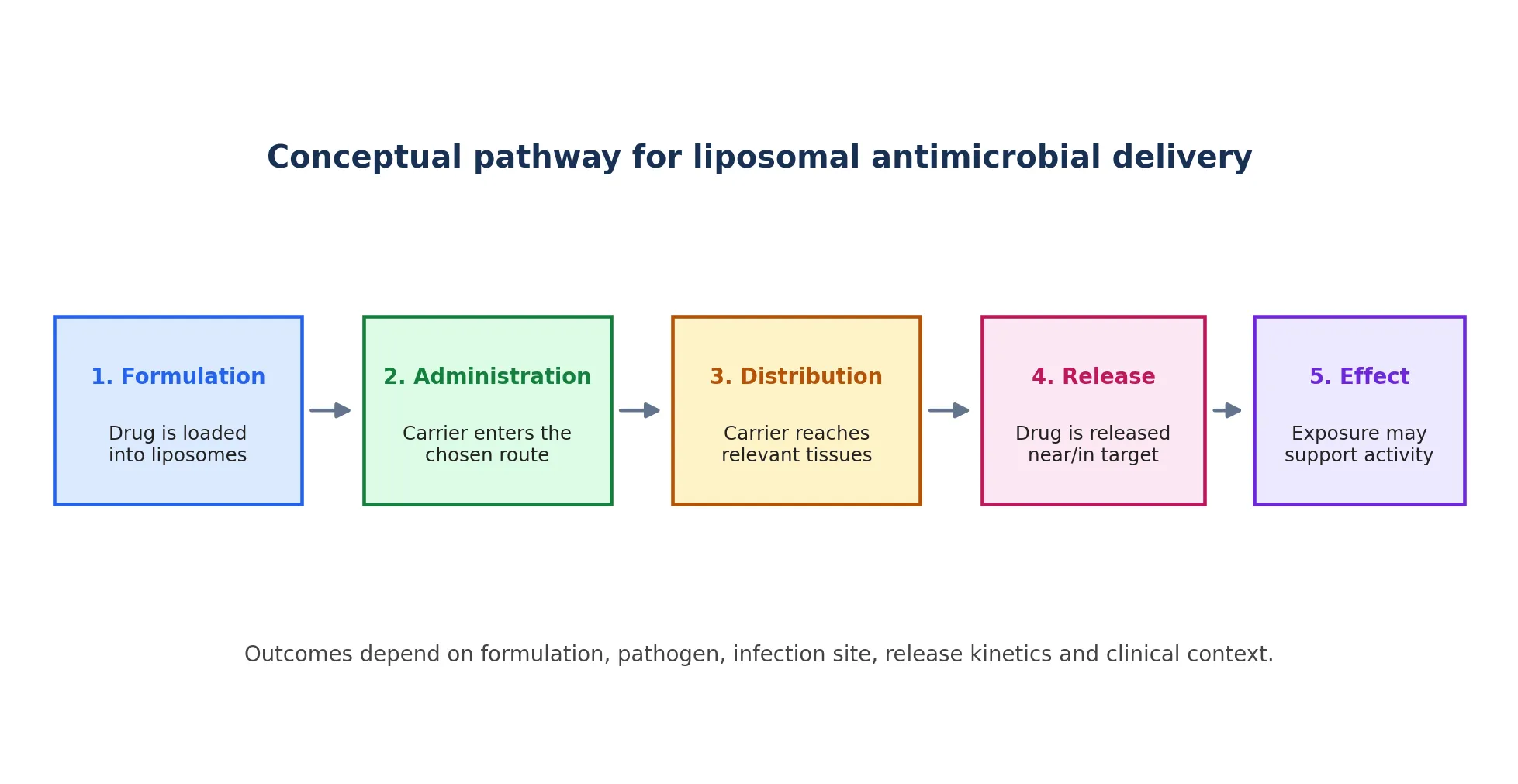
Figure 2: Conceptual stages of liposomal antimicrobial delivery. The pathway is a schematic; real clinical performance depends on the formulation and the infection.
5.5How liposomes may improve antimicrobial delivery
5.1 Protection and controlled release
I have seen how encapsulation can protect a drug from conditions. Encapsulation can keep a drug away from enzymes that break it down or from conditions. The lipid bilayer can act as a reservoir controlling how fast the drug becomes available. Whether this really improves efficacy depends on how stable the carrier's on whether the drug is released at a useful rate near the site of infection [1,2].
5.2 Altered distribution and tissue exposure
I wonder how the size of a liposome influences its journey through the body. The size, composition and surface chemistry of a liposome shape how the liposome interacts with proteins, immune cells and tissues. Some formulations can raise drug levels in organs or infected compartments while others are quickly cleared by the mononuclear phagocyte system. Liposomes are not targeted by default. The distribution of the liposome has to be measured for each formulation and each route of administration.
5.3 Intracellular delivery
I know that some pathogens hide inside cells. Some pathogens survive inside host cells, where a free drug may not reach concentrations. Cells can take up liposomes through pathways so the liposome may improve delivery to these intracellular compartments. How much the liposome helps depends on the cell type the properties of the carrier how the liposome travels inside the cell and where the pathogen is located.
5.4 Biofilm-associated infection
I find biofilms to be a barrier. Biofilms are communities of microbes embedded in an extracellular matrix. Both the matrix and the altered physiology of the microbes living inside the matrix can make them less sensitive to antimicrobials. Liposomal carriers may bring the drug into local contact protect the drug or allow several agents to be delivered together. So getting through the full depth of a biofilm and releasing the drug effectively close, to the embedded microbes is still hard. Improvements seen in the laboratory do not by themselves prove benefit [3,4,7].
6. Applications across infectious diseases
6.1 Bacterial infections
Researchers have studied forms of aminoglycosides, macrolides, fluoroquinolones and other antibacterial agents. Encapsulation might change a drug’s pharmacokinetics reduce its exposure to -target tissues or improve its activity in certain experimental models. The results vary depending on the drug and the organism so a liposomal formulation should not be assumed to beat the drug in every infection [1,2,7,8].
6.2 Respiratory infections
Inhaled delivery is an area because an inhaled formulation can place the medicine close to where a respiratory infection occurs. Liposomal amikacin has been developed for inhalation in a clinical setting, which shows that liposomal delivery can make it all the way to a regulated product. Pulmonary formulations still require control of aerosol performance how well the lungs tolerate them, drug release and dose consistency.
6.3. Intracellular infections
Liposomal amphotericin B is a known example of a lipid-based formulation in antifungal therapy. Its clinical use shows that reformulating a drug can change how well it is tolerated and how it is distributed compared with formulations although it does not remove every risk. Liposomal approaches have also been looked into for infections caused by pathogens, including mycobacteria and parasites. The evidence and clinical status vary widely from one product and disease to another.
6.4 Antimicrobial resistance
Liposomes might help improve drug exposure protect antibiotics or make it easier for the drug to reach bacteria. They are not a solution for resistance. Mechanisms such as target modification, drug inactivation, efflux and altered permeability can still work against the drug. Formulation design should go together with susceptibility testing, proper antimicrobial stewardship and clinical evaluation than being seen as a replacement, for them [2,4].
7.Emerging Design Strategies
PEGylation can make some interactions with proteins in the blood less likely. Might make the substance stay in the blood longer even though it can also change how the substance gets into tissues and how the immune system sees the particles. Liposomes that have ligands attached are made to connect with receptors or parts of microbes but making this targeting work the same way every time and making it consistently during production is still a challenge. Liposomes that have a charge can stick well to the negative charge on the surfaces of microbes but the charge can also make them more harmful and cause them to stick where they are not needed. Carriers that respond to changes in their environment are made to let go of their contents when the pH, enzymes, temperature or other conditions change. These signals need to be clear and reliable to work properly in real infected tissue [3,4,9].
Another area that is interesting is combining ways to deliver things. A single liposome can hold two agents or it can have an antimicrobial along with a substance that is meant to break apart the biofilm. For this to be useful the combination has to be loaded and released in a way that works together has to be safe enough and needs to be better, than giving the parts on their own.
8. Advantages and limitations
| Potential advantages | Key limitations |
|---|---|
| Can carry both hydrophilic and lipophilic agents | Drug loading and leakage vary with the compound and method |
| May protect unstable drugs and adjust how they are released | Release can be too slow, too fast, or inconsistent |
| Can change distribution and local drug exposure | Targeting is not automatic, and off-target uptake can occur |
| May improve delivery to selected cells or biofilms | Deep biofilm penetration and clinical benefit are still uncertain |
| Composition can be tailored to different routes | Scale-up, sterilization, storage, and quality control are demanding |
| Some liposomal medicines are already in clinical use | Costs and regulatory requirements can be considerable |
9.Safety, quality, and regulatory considerations
Every liposomal product requires its assessment of toxicity, immune reactions, pharmacokinetics, biodistribution and drug release behavior. Potential problems for a product include complement activation, infusion reactions, lipid related effects, aggregation, oxidation or hydrolysis of the lipids and leakage during storage. A general liposome platform cannot be assumed to behave the way, with every drug. The critical quality attributes and stability indicating methods must be defined early. The manufacturing process must produce the intended vesicles and drug content consistently.
10. Future perspective
Future research needs to concentrate on manufacturing that can be repeated and can grow. Future research also requires predictive models of infected tissue and standard tests that connect formulation details to how the drug works. Future research studies should compare liposome preparations, with real-world standards of care. Should share data on how much drug is loaded, how it is released, its toxicity and how it moves in the body. Future research must also dig deeper into how biofilmsre penetrated how drugs travel inside cells and how they interact with the immune system. Well-designed clinical tests, not just particle size or laboratory activity will prove which strategies help patients.
11. Translational challenges and formulation optimisation
Every liposomal product needs to be checked for toxicity. It also needs to be checked for reactions. It also needs to be checked for how the body handles the drug. It also needs to be checked for where the drug goes in the body. It also needs to be checked for how the drug comes out of the product. Possible problems for a product include activation of the bodys complement system. Possible problems include reactions during infusion. Possible problems include effects from the lipids. Possible problems include the lipids sticking together. Possible problems include the lipids breaking down because of oxygen. Possible problems include the lipids breaking down because of water. Possible problems include the drug leaking out during storage. A general liposome platform cannot be expected to act the way, with every drug. The important quality features and methods that show stability must be decided early. The way the product is made must create the particles and the right amount of drug every time.
11.2 Particle attributes and biological identity
The size of the vesicle how much it varies how layers it has, the charge on its surface and how stiff the membrane is all affect how stable it is and how it behaves in the body. Smaller particles are not always better because what works depends on how the drug's given, the barriers in the body and where the drug needs to go. When liposomes meet the fluids in the body, proteins and other molecules attach to their surface. Create a layer that changes how the particles are seen how long they stay in the blood how cells take them in and how they are removed. Particle analysis should therefore be supported by testing in biological fluids not just measurements done in simple solutions.
11.3 Release kinetics and exposure at the infection site
Studies on how the drug's released should use conditions that match the way the drug is given and the environment where the infection is. The amount of drug that appears to be released can be affected by how it moves through the membrane how the lipids break down how soluble the drug is, whether there is enough space to hold the drug and how the released drug is separated from the one inside. One test in the lab cannot fully show what happens in the body. When possible data on release should be considered with information on how the drug moves in the body, where it goes how well it works against the germs. How well it is tolerated. The goal is not just to release but to have a pattern of exposure that keeps the drug active against the germ it is meant to fight.
11.4 Scale-up and quality-by-design considerations
aking more of the product can change how things mix, how heat and materials move, how solvents are removed and how much the size of the vesicles varies. A method that works in the lab might not produce the results in bigger amounts. Quality-by-design ideas help in this situation: thMey find the features of the material and the steps in the process and connect them to the important quality features like the size of the particles how much drug is there how much free drug is present whether it is sterile and how stable it is. Methods that are proven to work rules for what's acceptable and data, from batches that are typical all help make sure that the product is the same each time.
12. Evidence appraisal and study design
12.1 Interpreting preclinical findings
In-vitro studies are useful for screening formulation properties and antimicrobial activity, but their results can be shaped by assay design, inoculum, media composition, protein content, and the method used to count viable organisms. Biofilm models differ in age, architecture, extracellular matrix, and microbial makeup, so findings from one model may not carry over to chronic or polymicrobial infections. Animal studies add information on distribution,
efficacy, and safety, but species-specific physiology and infection models remain important limitations. Claims should always match the type and strength of the evidence behind them.
12.2 Comparator selection and meaningful endpoints
Studies should compare liposomal formulations with free-drug controls. If it makes sense they should also compare with the standard-of-care treatment. Doses and routes of administration must be clearly reported. This helps people understand what’s causing any differences they see. Good endpoints to measure include the amount of microbes left how quickly cultures turn negative survival rates in realistic models whether infections come back how much drug gets into tissues, side effects and patient-focused outcomes in clinical trials. Just reporting particle size or one small change in a lab test isn’t enough to say a treatment is better.
12.3 translation and antimicrobial stewardship
New delivery systems should help support smart use of antimicrobials not replace the need for responsible prescribing. Development programs must think about how likely pathogensre to respond to the drug, how much to give how resistance might come up how the new treatment interacts with standard care and whether it can be used regularly in real-world settings. Formulations that require preparation, inhalation devices or cold storage might not get used even if they work well in the lab. Sharing results openly using methods that others can repeat and making comparisons that matter in the clinic will show where liposomal delivery truly adds value.
13. Research priorities
Important goals include finding ways to predict how well drugs reach infected tissues. There should be agreed-upon methods for testing how well liposomes penetrate biofilms. Long-term stability data is. Manufacturing processes must be able to scale up without changing how the product performs. Surface-targeting strategies must prove they work in biological environments not just in simple lab conditions. Researchers should also study how acceptable the treatments are to patients whether they are cost-effective what supply-chain needs they have and how accessible they are in places where drug resistance's a big problem. Including these factors will help make advances in formulation science lead to real improvements in fighting infections.
CONCLUSION
Liposomes are a platform for delivering antimicrobial agents. Their lipid bilayers and water-filled centers can carry different types of drugs. Depending on how they're made liposomes can protect drugs change where they go in the body allow slow release and improve delivery in certain infection models. Some liposomal medicines are already in use showing the technology can work in patients. Newer ideas, like targeting biofilms or specific tissues are still being tested. Still there are hurdles: manufacturing is complicated stability is an issue costs are high performance varies in biological systems and there’s a need for stronger clinical proof. Liposomes should be seen as a specific tool in antimicrobial therapy. Not as a single answer, to the problem of antimicrobial resistance.
REFERENCES

Janhavi Ranpura, Liposomes: New Approaches for the Delivery of Antimicrobial Drugs, Int. J. of Pharm. Sci., 2026, Vol 4, Issue 11, 1985-1994. https://doi.org/10.5281/zenodo.24155932
 10.5281/zenodo.24155932