

We use cookies to ensure our website works properly and to personalise your experience. Cookies policy
Noble University, Junagadh, Gujarat, India.
The Present Study Focused On Developing And Optimizing Mucoadhesive Buccal Patches Of Gliclazide Using The Natural Polymer Grewia Gum To Enhance Bioavailability And Bypass First-Pass Metabolism. The Objectives Were To Formulate Patches With Varying Polymer Compositions, Evaluate Their Physicochemical And Mechanical Properties, And Assess In Vitro Drug Release, Swelling Behavior, And Ex Vivo Permeation. Grewia Gum Was Chosen Due To Its Natural Origin, Biocompatibility, And Excellent Swelling And Mucoadhesive Properties, Making It Ideal For Controlled Buccal Drug Delivery.Buccal Patches Were Prepared By The Solvent Casting Method Using Varying Ratios Of Grewia Gum Alone And Combined With Polymers Such As HPMC And Carbopol, Along With Suitable Plasticizers. Compatibility Studies Confirmed No Drug–Excipient Interactions. The Patches Were Evaluated For Thickness, Weight Variation, Folding Endurance, Surface Ph, Drug Content Uniformity, Tensile Strength, And Mucoadhesive Strength.Swelling Index And Ex Vivo Permeation Studies Assessed Hydration Behavior And Drug Diffusion Across Buccal Mucosa. The Optimized Batch Showed Ideal Physicochemical Properties, Satisfactory Mechanical Strength, And A Surface Ph Near Neutrality For Patient Acceptability. It Exhibited A Balanced Swelling Profile, Strong Mucoadhesion, And The Highest Drug Permeation Among Formulations.In Vitro Drug Release Demonstrated A Sustained Release Pattern Governed Predominantly By A Non-Fickian Diffusion Mechanism. Stability Studies Confirmed The Optimized Patch Remained Stable With No Significant Changes In Drug Content Or Release Profile.In Conclusion, Grewia Gum Significantly Enhanced The Performance Of Gliclazide Buccal Patches, Highlighting Its Potential As An Effective Natural Polymer For Controlled Drug Delivery. The Optimized Formulation Presents A Promising Alternative To Conventional Dosage Forms, Improving Therapeutic Efficacy And Patient Compliance In Diabetes Management
The Oral Route Is The Most Common Method For Drug Administration, Accounting For Nearly 60% Of Marketed Dosage Forms, Primarily Oral Solids. Despite Its Advantages, Challenges Such As Reduced Bioavailability, Slow Onset, And Swallowing Difficulties Have Increased The Use Of Parenteral And Liquid Formulations. Liquid Orals (E.G., Syrups, Suspensions) Help Some Patients But Often Have Dosing Inaccuracies, While Parenteral Routes Can Cause Pain.
Swallowing Difficulties Affect Specific Groups Like Children, Elderly, And Travelers Without Water Access, Causing Low Compliance. This Has Driven The Development Of Fast-Dissolving Dosage Forms, Which Rapidly Disintegrate In The Mouth Without Water, Offering A Convenient Alternative.
Many Orally Administered Drugs Undergo Significant First-Pass Metabolism, Reducing Bioavailability. These Limitations Have Spurred The Growth Of Fast Dissolving Drug Delivery Systems Since The Late 1970s As Substitutes For Conventional Tablets.
Mucosal Drug Delivery Through The Buccal Route Is Gaining Attention For Improving Safety And Therapeutic Effectiveness For Both Local And Systemic Conditions. Buccal Mucoadhesive Systems Use Water-Soluble Polymers With Mucoadhesive Properties To Adhere To Moist Tissues, Avoiding Drawbacks Of The Sublingual Route Such As Unpleasant Taste, Drug Dilution By Saliva, Odor, And Local Anesthetic Effects.
MATERIALS AND METHODS
2.1. Solvent Casting Method
2.1.1. Preparation Of Mucoadhesive Buccal Patches By Solvent Casting Method
Materials:
The Following Materials Collected For The Experimental Work Done.
Table 1: List Of Materials
|
SR.NO. |
DRUG/EXCIPIENTS |
GRADE |
|
1 |
Gliclazide |
AR |
|
2 |
HPMC |
AR |
|
3 |
Carbopol934p |
AR |
|
4 |
Na Alginate |
AR |
|
5 |
Polivinyl Alcohol |
AR |
|
6 |
Eudragitl-100 |
AR |
|
7 |
Tween 80 |
AR |
Table 2: Natural Polymer List
|
Sr No. |
POLYMER |
ISOLATEDFROM |
BOTANICALNAME |
FAMILY |
|
1 |
Grewia Gum |
Bark |
Grewia Mollis |
Malvaceae |
Table 3: Composition Of Mucoadhesive Buccal Patches Of Gliclazide
|
Formulation |
Gliclazide (Mg) |
Grewia Gum (Mg) |
HPMC K15M (Mg) |
Carbopol 934P (Mg) |
Eudragit RL-100 (Mg) |
Propylene Glycol (%) |
Distilled Water (Ml) |
|
F1 |
82.00 |
350 |
100 |
50 |
– |
10 |
40 |
|
F2 |
82.00 |
400 |
150 |
50 |
– |
10 |
40 |
|
F3 |
82.00 |
450 |
200 |
50 |
– |
10 |
40 |
|
F4 |
82.00 |
350 |
– |
50 |
100 |
10 |
40 |
|
F5 |
82.00 |
400 |
– |
50 |
150 |
10 |
40 |
|
F6 |
82.00 |
450 |
– |
50 |
200 |
10 |
40 |
|
F7 |
82.00 |
400 |
100 |
50 |
100 |
10 |
40 |
|
F8 |
82.00 |
400 |
150 |
50 |
50 |
10 |
40 |
|
F9 |
82.00 |
400 |
200 |
50 |
100 |
10 |
40 |
|
F10 |
82.00 |
400 |
200 |
50 |
50 |
10 |
40 |
RESULTS AND DISCUSSION:
Evaluation Of Physicochemical Properties Of Grewia Gum Powder:
The Extracted Grewia Gum Showed Suitable Organoleptic And Physicochemical Properties For Use In Gliclazide Buccal Patches. Organoleptically, The Gum Was A Light Brown, Fine, Free-Flowing Powder With No Characteristic Odor And A Bland, Mucilaginous Taste, Indicating Good Patient Acceptability For Buccal Use.
The Solubility Profile Demonstrated That Grewia Gum Is Insoluble In Organic Solvents Like Ethanol, Acetone, And Chloroform, But Forms A Viscous Colloidal Dispersion In Water And Hydrates Completely In Hot Water To Produce A Thick Mucilage, Confirming Its Hydrophilic Nature.
The Ph Of The Dispersion Ranged From 6.2 To 6.4, Near Neutral, Ensuring Compatibility With Buccal Mucosa And Reducing The Risk Of Irritation.
Table 4: Organoleptic Properties Of Isolated Grewia Gum Powder
|
Organoleptic Properties |
|
|
Color |
Light Brown Powder |
|
Odor |
Odorless |
|
Taste |
Bland, Mucilaginous |
|
Appearance |
Fine, Free-Flowing Powder |
|
Solubility Behavior |
|
|
Solubility In Water |
Forms Viscous Colloidal Dispersion |
|
Solubility In Hot Water |
Completely Hydrates Forming Thick Mucilage |
|
Solubility In Ethanol (95%) |
Insoluble |
|
Solubility In Acetone |
Insoluble |
|
Solubility In Chloroform |
Insoluble |
|
Ph (1% W/V Dispersion) |
6.2 |
From A Physicochemical Perspective, Grewia Gum Exhibited A Moderate Yield (14.5%) And Acceptable Moisture Content (7.8%), Indicating Good Stability. Its Swelling Index (285%) And Viscosity (410 Cps) Demonstrate Excellent Water Uptake And Gel-Forming Ability, Essential For Mucoadhesion And Controlled Drug Release In Buccal Patches. This Enables The Formation Of A Hydrated Three-Dimensional Network From Which The Drug Can Efficiently Diffuse.
The Gum’s Hygroscopic Nature—Its Ability To Absorb Moisture—Was Assessed, As Excessive Hygroscopicity Can Alter Dosage Form Properties. Flow Properties Were Evaluated By:
These Indicate Passable Flow Characteristics, Suitable For Uniform Casting Of Patches.
Additionally, The Ash Value (3.1%) Indicates Low Inorganic Impurities, While Loss On Drying (8.2%) Reflects Acceptable Residual Moisture.
Overall, These Properties Confirm Grewia Gum As A Promising Natural Polymer For Buccal Patch Formulation, Offering Desirable Swelling, Adhesion, And Film-Forming Characteristics.
Table 5 : Physicochemical Properties Of Isolated Grewia Gum Powder
|
Physicochemical Properties |
|
|
Yield (%) |
14.5% |
|
Moisture Content (%) |
7.8% |
|
Ash Value (%) |
3.1% |
|
Swelling Index (%) |
285% |
|
Viscosity (1% Solution, Cps) |
410 Cps |
|
Bulk Density (G/Ml) |
0.52 G/Ml |
|
Tapped Density (G/Ml) |
0.67 G/Ml |
|
Carr’s Index (%) |
22.4% |
|
Hausner Ratio |
1.29 |
|
Ph Of Mucilage |
6.4 |
|
Loss On Drying (%) |
8.2% |
CALIBRATION DATA :
The Calibration Graph Exhibited A Straight-Line Relationship With A Correlation Coefficient (R² ≈ 0.9998), Demonstrating Strong Linearity And Confirming The Method's Suitability For Quantitative Analysis Of Gliclazide In Formulation Studies. This Calibration Curve Can Reliably Determine Unknown Gliclazide Concentrations In Subsequent Analyses.
Table 6 : Calibration Data Of Gliclazide In Phosphate Buffer Ph 7.4
|
Conc (µg/Ml) |
Absorbance At 229 Nm (A) |
|
0 |
0 |
|
2.0 |
0.1023 |
|
4.0 |
0.2017 |
|
6.0 |
0.3105 |
|
8.0 |
0.4034 |
|
10.0 |
0.5039 |
|
12.0 |
0.6008 |
|
16.0 |
0.8013 |
Regression (Linear Fit Of Absorbance Vs Concentration):
Y = 0.05x + 0.0031
R² = 0.9998
Where Y = Absorbance, X = Concentration (µg/Ml)
Correlation Coefficient: R² = 0.9998
Standard Deviation Of Residuals (Sy/X): 0.0031
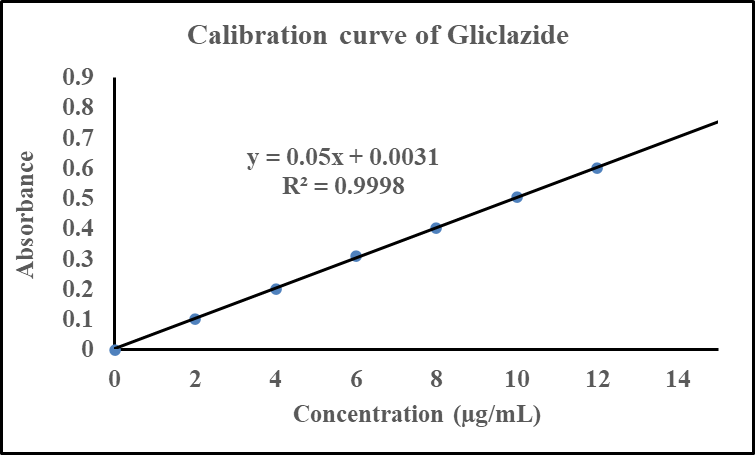
Figure 1: Calibration Curve Of Gliclazide In Buffer Ph 7.4
FT-IR Studies :-
The Spectral Data Showed That The Major Drug Peaks Appeared At Similar Values Across All Physical Mixtures Of The Drug And Polymers, With No Significant Changes In IR Peaks. This Indicates That The Drug Is Molecularly Dispersed Within The Polymers Or Drug-Loaded Formulations, Confirming The Absence Of Any Interactions Between The Drug And Polymers.
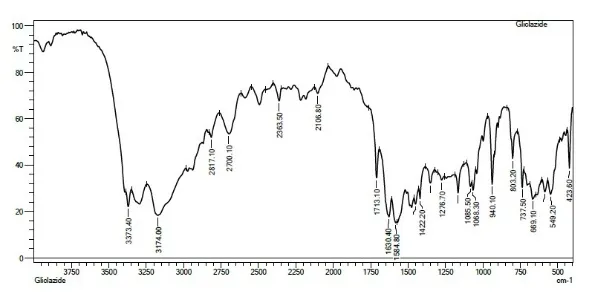
Figure 2: FTIR Graph For Gliclazide
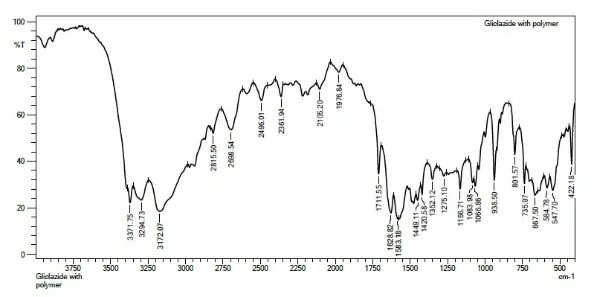
Figure 3: FTIR Graph For Gliclazide With Polymer Mixture
The FTIR Spectrum Of Pure Gliclazide Shows Characteristic Peaks Corresponding To Its Functional Groups. A Prominent Absorption Band Near 3300 Cm⁻¹ Is Attributed To N–H Stretching Of The Sulfonylurea Moiety. A Strong Peak Around 1700 Cm⁻¹ Indicates C=O Stretching Of The Amide Group. Peaks Between 1150–1350 Cm⁻¹ Correspond To S=O Stretching Vibrations Of The Sulfonyl Group. Additionally, Peaks Near 1600 Cm⁻¹ Arise From Aromatic C=C Stretching, Confirming The Drug’s Structural Integrity As Per Official Values.
PHYSICOCHEMICAL PARAMETERS OF DRUG :-
The Organoleptic Evaluation Of Gliclazide Revealed That It Is A White To Off-White, Fine Powder With A Bitter Taste And No Significant Odor, Which Is Typical Of Sulfonylurea Drugs.
Table 7: Organoleptic Properties Of Gliclazide
|
Parameter |
Observation |
|
Physical State |
Fine Powder |
|
Colour |
White To Off-White Fine Powder |
|
Odour |
Odourless To Slightly Characteristic |
|
Taste |
Slightly Bitter |
SOLUBILITY STUDY:
Gliclazide Is Practically Insoluble In Water But Exhibits Better Solubility In Organic Solvents Like Acetone And Chloroform, With Limited Solubility In Alcohol And Buffer Media. This Poor Aqueous Solubility Underscores The Need For Formulation Strategies Such As Buccal Patches Or Controlled-Release Systems To Improve Its Dissolution And Bioavailability.
Table 8: Solubility Gliclazide In Various Solvents
|
Solvent |
Solubility |
|
Water |
Practically Insoluble |
|
Methanol |
Slightly Soluble |
|
Ethanol (95%) |
Sparingly Soluble |
|
Acetone |
Freely Soluble |
|
Chloroform |
Soluble |
|
0.1 N Hcl |
Slightly Soluble |
|
Phosphate Buffer Ph 6.8 |
Slightly Soluble |
EVALUATION OF MUCOADHESIVE BUCCAL PATCHES OF GLICLAZIDE :-
Evaluating Buccal Patches Is Essential To Ensure Quality, Performance, And Patient Acceptability Of Gliclazide Formulations. The Assessment Focuses On Physicochemical, Mechanical, And Surface Properties That Affect Drug Release, Mucoadhesion, And Stability.
Key Evaluation Parameters Include:
Systematic Evaluation Of These Parameters Aids In Optimizing The Formulation, Ensuring Reproducibility, And Selecting The Best Buccal Patch For Effective Drug Delivery.
PHYSICAL APPEARANCE AND SURFACE TEXTURE OF PATCHES:
These Parameters Were Checked Simply With Visual Inspection Of Patches And By Feel Or Touch. The Observation Reveals That The Patches Are Having Smooth Surface And They Are Elegant In Appearance.
Table 9: Physical Evaluation Of Mucoadhesive Buccal Patches Of Gliclazide
|
Formulation |
Average Weight (Mg) |
Thickness (Mm) |
Folding Endurance |
Surface Ph |
|
F1 |
35.66±1.15 |
0.53±0.05 |
252.33±3.51 |
6.30±0.05 |
|
F2 |
36.66±0.57 |
0.55±0.05 |
260.00±1.00 |
6.13±0.05 |
|
F3 |
40.33±1.15 |
0.56±0.05 |
267.66±3.51 |
5.56±0.11 |
|
F4 |
26.00±1.73 |
0.51±0.01 |
224.33±2.08 |
6.26±0.05 |
|
F5 |
29.66±1.15 |
0.54±0.05 |
225.33±4.50 |
6.40±0.35 |
|
F6 |
32.33±1.15 |
0.53±0.05 |
245.66±2.08 |
5.71±0.37 |
|
F7 |
30.66±1.52 |
0.52±0.01 |
230.33±2.64 |
6.33±0.26 |
|
F8 |
32.26±1.52 |
0.53±0.05 |
246.00±1.95 |
5.62±0.15 |
|
F9 |
36.66±0.57 |
0.55±0.05 |
269.66±2.00 |
6.48±0.20 |
|
F10 |
36.26±1.52 |
0.55±0.05 |
266.00±1.95 |
5.76±0.20 |
EVALUATION OF BUCCAL PATCHES :-
CONCLUSIONS
The Study Aimed To Develop And Optimize Mucoadhesive Buccal Patches Of Gliclazide To Enhance Bioavailability And Bypass First-Pass Metabolism. Key Points Include:
The F8 Formulation Was Identified As The Optimized Batch, Showing:
The Drug Release Mechanism Was Predominantly Non-Fickian (Anomalous) Transport, Governed By Diffusion And Polymer Relaxation. Stability Results Confirmed Suitability For Long-Term Use.
Overall, The Study Demonstrated That Gliclazide Mucoadhesive Buccal Patches Can Improve Therapeutic Efficacy And Bioavailability, Offering A Promising Alternative To Conventional Oral Dosage Forms.
ACKNOWLEDGEMENTS
The Authors Are Grateful To The Management Of Noble Pharmacy College For Providing The Necessary Facilities And Support To Carry Out This Research Work. The Authors Would Like To Express Their Sincere Thanks To Dr. Sheetal Buddhadev Dr.Darshit Ram For Her Valuable Guidance, Encouragement, And Continuous Support Throughout The Research Work. The Authors Also Acknowledge All Teaching And Non-Teaching Staff For Their Cooperation And Assistance
REFERENCES

Dipak Parmar, Dr. Sheetal Buddhadev, Dr. Darshit Ram, Dr. Santosh Kirtane, Design And Optimization Of Gliclazide Fast Dissolving Tablets Employing Grewia Gum As A Novel Natural Superdisintegrant For Improved Antidiabetic Therapy, Int. J. of Pharm. Sci., 2026, Vol 4, Issue 6, 2742-2750, https://doi.org/10.5281/zenodo.20625004
 10.5281/zenodo.20625004