

We use cookies to ensure our website works properly and to personalise your experience. Cookies policy
Adhiparasakthi College of Pharmacy, The Tamil Nadu Dr. M. G. R. Medical University, Chennai 603319
Azithromycin is poorly water-soluble drug with a short half-life. Azithromycin loaded Nanosponges would be an alternative delivery system to a conventional oral formulation to improve its bioavailability. Azithromycin loaded nanosponges were prepared by emulsion solvent diffusion method by using Ethyl cellulose as a polymer, poly vinyl alcohol as a stabilizer and dichloromethane as a solvent. Two level factorial designs were used for the optimization of Azithromycin loaded Nanosponges. The prepared Nanosponges were evaluated for percentage yield, Entrapment Efficiency, Drug content, Particle size, In vitro drug release, Zeta potential. The spectrum FT-IR showed the stable character of Azithromycin in a mixture of polymers and revealed the absence of drug -polymer interactions. Scanning electron microscopic studies confirmed their porous structure of Nanosponges. The mean particle size and Z average of optimized formulation was found to be 183.5 nm. Poly diversity index and zeta potential of optimized formulation was found out to be 0.327 and -27.5 mV, indicating uniformity of particle size within formulation and the formulation is stable. The optimized Nanosponges were subjected to stability studies. The purpose of this research was to prepare Azithromycin loaded Nanosponges to improve the solubility, reduce dose dependent, side effects and improve the patient compliance.
Nano sponges are mesh – like minute structures that can be encapsulate a large variety of substances and medication molecules and offers a promising solution. They are like a 3D network having a backbone of long chain polyesters present in the solution along with crosslinkers that connect different parts of the polymer. These materials minimize drug carrier size, enhancing the solubility and bioavailability of hydrophobic medications ultimately improving their therapeutic effectiveness. The sponges are self-sterilizing as their pore size is about 0.25 µm, where bacteria cannot penetrate. Nano sponges can be delivered through the lungs and veins because of their microscopic size. Nanosponge can circulate into the whole body and release the drug at a specific site in a controlled manner. These microscopic particles are capable carrying both the lipophilic and hydrophilic substances and of improving solubility of drug molecules [57]. Pneumonia is an inflammatory condition of the lung primarily affecting the small air sacs known as alveoli. The severity of the condition is variable. pneumonia caused by infection like influenza and Hemophilus influenzae leading to patchy consolidations, mainly in the right upper lobe (arrow). Risk factors for pneumonia include cystic fibrosis, chronic obstructive pulmonary disease (COPD), sickle cell disease, asthma, a poor ability to cough (stroke), and immunodeficiency. Pneumonia can affect one or both lungs. Pneumonia in both lungs is called bilateral or double pneumonia. The inflammation causes the alveoli to fill with fluid and pus, which can be a mixture of immune cells, dead tissue, and infectious agents. This fluid buildup significantly reduces the surface area available for oxygen to pass from the air into the bloodstream and for carbon dioxide to be removed [29]. Azithromycin is a widely used antibiotic belonging to the macrolide class. It is effective against a broad range of bacterial infections, particularly those affecting the respiratory tract, skin, ears, and genitals. Azithromycin is an acid stable drug that can be orally administered structurally related to erythromycin, with a similar spectrum of antimicrobial activity. Azithromycin appears to be more active than erythromycin against many Gram-negative pathogens and other specific pathogens, including Haemophilus influenzae, Streptococcus pneumoniae, H. parainfluenza, Moraxella catarrhalis, Neisseria gonorrhoeae, Ureaplasma urealyticum and Borrelia burgdorferi [13]. Azithromycin binds to the 23S rRNA of the bacterial 50S ribosomal subunit. It stops bacterial protein synthesis by inhibiting the transpeptidation/translocation step of protein synthesis and by inhibiting the assembly of the 50S ribosomal subunit. This action in the control of various bacterial infections. The strong affinity of macrolides, including azithromycin, for bacterial ribosomes, and highlights its consistent with their broad?spectrum antibacterial activities due to its strong affinity for macrolides. Azithromycin is highly stable at a low pH, contributes to a longer serum half-life and increasing its concentrations in tissues [11].
MATERIALS AND METHODS
Azithromycin was gift sample from ATOZ Pharmaceuticals Private Limited, Chennai. Ethyl cellulose, Poly vinyl alcohol, Dichloromethane were purchased from Loba Chemie Private Limited, Mumbai.
METHODOLGY
DRUG-EXCIPIENT COMPATABILITY STUDY [34,19]
The drug and excipients selected for the formulation were evaluated for physical and chemical compatibility studies by using FT-IR.
SOLUBILTY STUDIES [19]
Solubility studies of Azithromycin were established by different solvent systems such as methanol and purified water as per the standard procedure.
DETERMINATION OF λ max
10 mg of Azithromycin was weighed and transferred to 100 ml of volumetric flask. The drug was dissolved and volume was made up to 100 ml using phosphate buffer pH 6.8 to obtain a stock solution of 1000 µg/ml (stock solution I). 1ml of this stock solution was again diluted with phosphate buffer pH6.8 up to 100 ml to obtain a solution of 100 µg/ml (Stock solution II). From stock solution-II, 1 ml was pipette out in 100 ml volumetric flask. The volume was made up to 100 ml using phosphate buffer pH 6.8 get a concentration of 10µg/ml. This solution was then scanned at 200-400 nm in UV-Visible spectrophotometer to attain the absorption maximum (λ max).
STANDARD CURVE FOR AZITHROMYCIN
Preparation of stock solution
500 mg of Azithromycin was weighed and transferred to 100 ml of volumetric flask. The drug was dissolved in 10 ml of methanol and volume was made up to 100ml using phosphate buffer pH 6.8 to obtain a stock solution of 1000 µg/ml (Stock solution I). 10 ml of this stock solution was again diluted with phosphate buffer pH 6.8 up to 100 ml to obtain a solution of 100µg/ml (Stock solution II). From stock solution II 5, 10, 15, 20, 25 ml were transferred to series of 100 ml volumetric flasks. The volume was made up with phosphate buffer pH 6.8. The absorbance of these solutions was measured at 250 nm against blank.
PREPARATION OF AZITHROMYCIN LOADED NANOSPONGES [23]
Azithromycin loaded Nanosponges were prepared by Emulsion solvent diffusion method. The polymer used in the formulation of Azithromycin loaded nanosponge is Ethyl cellulose.
External phase: Polyvinyl alcohol (0.4%-0.9%) in distilled water (50ml) was used as the aqueous phase.
Internal phase: Specified amount of drug and polymer was dissolved in an organic solvent dichloromethane(20ml) was used as dispersed phase (organic phase).
PREPARATION PROCESS: Aqueous phase consists of specified amount of poly vinyl alcohol dissolved in 50 ml distilled water. Disperse phase was added drop by drop into aqueous phase by stirring on a magnetic stirrer at (1000-2000) rpm for about 2 hours to remove the solvent dichloromethane from the mixture. The nanosponges formed were collected by filtration and dried in an oven at 40ºC for about 24 hours to remove the residual solvent dichloromethane.
FORMULATION OF AZITHROMYCIN LOADED NANOSPONGES BY USING FACTORIAL DESIGN [27].
A Factorial design was developed to statistically optimize the formulation factors and evaluate the main effects, interaction effects and linear effects on the independent factors. It was 3 factors, 2 levels factorial design was used to explore linear response surfaces with design expert software (version 13), and a matrix comprising 3 factors 2 levels and 8 runs is selected for optimization study. The experimental design is summarized in table 8.3.
Validation and data analysis
Statistical validation of the polynomial equation and ANOVA was calculated using Design Expert Software. The resultant experimental values of the responses were quantitatively compared with the predicted values to calculate the prediction error. Factorial Design was used for the optimization of Azithromycin loaded nanosponges formulation. The Ethyl cellulose, polyvinyl alcohol and Stirring speed were the three factors (independent variables) studied. The responses (dependent variables) studied were Percentage Entrapment efficiency and Percentage Drug release.
Summary of Experimental design
|
Independent Variable |
Units |
Level |
|
|
Low (-1) |
High (+1) |
||
|
X1 = Ethyl cellulose |
%w/v |
0.9 |
1.5 |
|
X2 = PVA |
%w/v |
0.6 |
0.9 |
|
X3 = stirring speed |
Rpm |
1000 |
2000 |
|
Dependent variable |
Units |
Constraints |
|
R1 = Entrapment Efficiency |
% |
Maximize |
|
R2 = Drug Release |
% |
Maximize |
PERCENTAGE YIELD [33,37]
The percentage yield (PY) can be determined by calculating initial weight of raw materials and final weight of nanosponges.
Percentage Yield= Practical weight of Nanosponge/ Theoretical mass*100
DETERMINATION OF DRUG ENTRAPMENT EFFICIENCY
For the determination of drug entrapment, the nanosponge dispersion with known amount of drug was centrifuged at 4000 rpm for 15 minutes. The supernatant solution was separated. 5ml of supernatant was distributed with 100 ml of phosphate buffer solution pH 6.8 and the absorbance was measured using UV-Visible spectrophotometer at 210 nm using of phosphate buffer solution pH 6.8 as blank. The amount of drug un entrapped was calculated. The percentage of entrapment efficiency was determined according to the following equation given below.
Entrapment Efficiency (%) = Total amount of drug – Amount of unbound drug/ Total amount of drug*100.
DRUG CONTENT DETERMINATION
Equivalent to 100 mg of the prepared formulation were weighed and dissolved in minimum quantity of ethanol and made up to 100 ml with phosphate buffer pH 6.8. The solution kept for 24 hours and filtered to separate fragments. Drug content was analyzed after suitable dilution by UV- Visible spectrophotometer at a wave length 210 nm against phosphate buffer pH 6.8 as blank. From the absorbance the drug content in the batches were calculated.
SOLUBILITY DETERMINATION OF OPTIMIZED AZITHROMYCIN NANOSPONGES
Solubility of the Azithromycin loaded Nanosponge formulation were tested in various medium (distilled water and phosphate buffer pH 6.8) by adding an excess amount of formulations. The mixtures were stirred in a mechanical shaker at speed 50 rpm for 24 hours at room temperature. Visual inspection was carefully made to ensure that there were excess Azithromycin solids in the mixture, indicating saturation had been reached. Then the mixtures were filtered using 0.45µm filter and filtrates were suitably diluted with same media. The absorbance of the solution was measured at 210 nm in UV-Visible spectrophotometer.
IN VITRO DRUG RELEASE STUDIES
The in vitro release of Azithromycin from Nanosponges was evaluated using USP Type-I (Basket) dissolution test apparatus. Azithromycin loaded Nanosponges were filled in capsule and placed in a dissolution jar containing 900ml of Phosphate buffer pH 6.8 as dissolution medium maintained at 37±0.50C and rotated at 50 rpm. 5ml of samples were withdrawn at predetermined intervals up to 8 hrs and replaced with equal amount phosphate buffer pH 6.8 for further dissolution testing. The absorbance was determined spectrophotometrically at 210nm.
MORPHOLOGY OF NANOSPONGE BY SCANNING ELECTRON MICROSCOPY
SEM analysis is significant for determination of surface characteristics and size of the particle. Scanning electron microscopy was operated at an acceleration voltage of 15kV. A concentrated aqueous suspension was spread in an equipment cell receiver and dried under vacuum. The sample was shadowed in a gold layer 20 mm thickened cathodic evaporator attached with a monitor which represents the images of the sample. The processed images were recorded and individual formulated Nanosponges particle diameter was measured to obtain average particle size.
PARTICLE SIZE AND POLYDISPERSITY INDEX
Particle size (z-average diameter) and polydispersity index (as a measure of particle size distribution) of Azithromycin loaded Nanosponge dispersion is performed by dynamic light scattering also known as photon correlation spectroscopy (PCS) using a Malvern Zetasizer 3000 nano S (Malvern Instruments, UK) at 25°C.
ZETA POTENTIAL
Zeta potential measurements were also made using an additional electrode in the same instrument. For zeta potential determination, 1ml of sample of Azithromycin suspension was filled in clear disposable zeta cell, without air bubble within the sample, the system was set at 25?C temperature, an electric field of about 15 V/cm and results was recorded. The more negative zeta potential, more stable the nanosponge preparation.
PREFORMULATION STUDY OF OPTIMIZED NANOSPONGES [19]
FLOW PROPERTY MEASUREMENTS
The flow properties of powders are critical for an efficient tableting and capsule filling operation. A good flow of the powder or granules is necessary to assure efficient mixing and acceptable weight uniformity for the compressed tablets and capsules. The flow property measurements include bulk density, tapped density, angle of repose, compressibility index and Hausner’s ratio. The flow properties of Nanosponges were determined.
RELEASE KINETICS OF THE OPTIMIZED FORMULATIONS [52]
To study the in vitro release kinetics of the optimized formulation, data obtained from dissolution study were plotted in various kinetics models.
Different kinetic models such as zero order (cumulative amount of drug released vs. time), first order (log cumulative percentage of drug remaining vs. time), Higuchi model (cumulative percentage of drug released vs. square root of time), Korsmeyer-Peppas model (Log Cumulative percent drug release versus log time) and Hixson Crowell model (cube root of log cumulative percentage of drug remaining vs. log time) were applied to interpret the drug release kinetics from the formulations. Based on the highest regression values for correlation coefficients for formulations, the best?fit model was decided
RESULTS AND DISCUSSION
FT- IR
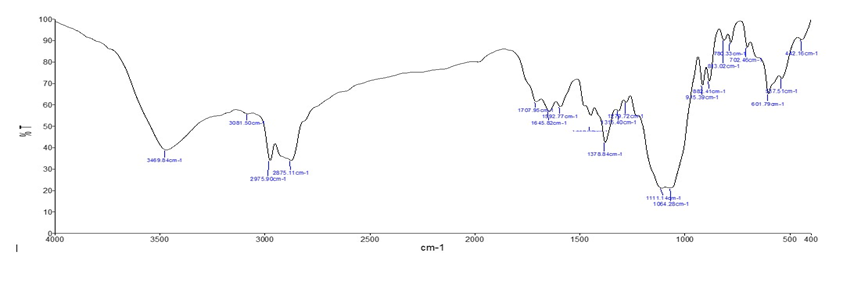
The peak observed in the FT-IR spectrum of Drug, Ethyl cellulose, polyvinyl alcohol showed no shift and no disappearance of the characteristic peaks of drug. This suggests that there is no interaction between the drug and the excipients.
DETERMINATION OF λ MAX FOR AZITHROMYCIN.
The maximum absorbance of the Azithromycin was studied. The maximum absorbance of the drug Azithromycin was found to be 210 nm. Hence the wavelength of 210 nm. was selected for analysis of drug in dissolution media.
STANDARD CALIBRATION CURVE OF AZITHROMYCIN IN 0.1N HCL AND PHOSPHATE BUFFER PH 6.8
The Ultraviolet Spectrophotometric method was used to analyze the calibration curve of Azithromycin. The absorbance of the drug in of concentration ranging from 5-25 µg/ml was measured at a wavelength of 210 nm against blank A calibration curve was plotted for Azithromycin in 0.1N HCl and pH 6.8 buffers in the range of 5-25 µg/mL (Beer’s Lambert’s range) at 210 nm respectively. A good linear relationship was observed between the concentration of Azithromycin and its absorbance in 0.1N HCl (r2=0.997) and pH 6.8 buffer (r2=0.999).
VARIABLES USED IN TWO LEVEL FACTORIAL DESIGN
A: Amount of ethyl cellulose (%w/v) 0.9-1.5, B: Amount of Polyvinyl alcohol (%w/v) 0.6-0.9, C: Stirring speed (Rpm) 1000-2000.
|
Variable |
Low |
High |
|
A: Amount of ethyl cellulose (%w/v) |
0.9 |
1.5 |
|
B: Amount of Polyvinyl alcohol (%w/v) |
0.6 |
0.9 |
|
C: Stirring speed (RPM) |
1000 |
2000 |
DETERMINATION OF ENTRAPMENT EFFICIENCY
The percentage Entrapment Efficiency was found to be in the range of 84.30 to 94.77. As a result of the performed statistical analysis on the data set, it was found that Ethyl cellulose (A) concentration has statistically significant effect and PVA (B) has mild effect on the entrapment process. The encapsulation efficiency could be enhanced by increasing the ethyl cellulose concentration and decreasing the PVA concentration as expected. This may be due to higher concentration of polymer provide more space and also reduces the escaping of drug into the external phase.
DERTERMINATION OF IN VITRO DRUG RELEASE
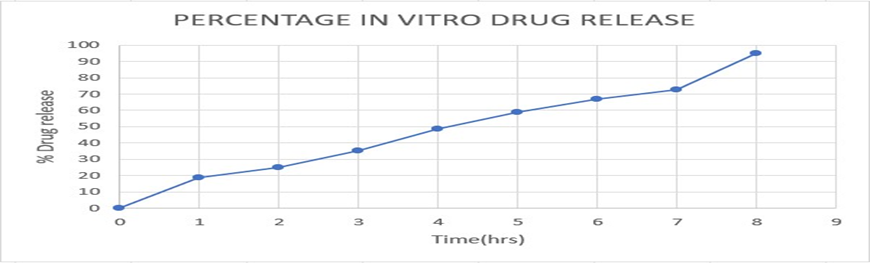
The cumulative percentage drug release for the prepared nanosponges was found to be in the range of 80.05 % - 95.10% for 8 hours. The drug release rate was related to the drug: polymer ratio. It was observed that the drug release rate decreased by the concentration of polymer. This may be due to the fact that the release of drug from the polymer matrix takes place after complete swelling of the polymer and the concentration of polymer in the formulation increases the time required to swell.
FORMULATION OF OPTIMIZED AZITHROMYCIN LOADED NANOSPONGES
The optimized Azithromycin loaded Nanosponges were prepared by Emulsion solvent diffusion method using the polymer of Ethyl cellulose (0.9g), Polyvinyl alcohol (0.9g), Dichloromethane(20ml) and stirring speed (2000Rpm).
FT-IR SPECTRUM OF OPTIMIZED FORMULATION:
From the FT-IR spectra, it is clearly evident that the optimized Nanosponge formulation showed the presence of characteristics bands of Azithromycin. This indicates the absence of chemical interaction between the Azithromycin and the excipients.
PERCENTAGE YIELD:
Azithromycin loaded nanosponge was prepared and their percentage yield was found to be 92.14%.
SOLUBILITY STUDIES:
The solubility study of optimized Azithromycin loaded Nanosponge in different dissolution medium is performed by saturation solubility method. The solubility of optimized Nanosponge formulation compared with pure drug and tabulated below.
|
Formulation code |
Solubility of Optimized Nanosponge |
|
|
Distilled water (mg/ml) |
Phosphate buffer Ph 6.8 (mg/ml) |
|
|
Pure Drug |
0.137 |
0.264 |
|
Optimized Nanosponge |
7.9833 |
13.2344 |
DETERMINATION OF DRUG CONTENT:
The UV-visible spectrophotometric method was used to determine the drug content of optimized nanosponge formulation. The drug content was found to be 94.6%.
DETERMINATION OF ENTRAPMENT EFFICIENCY:
The entrapment efficiency of the optimized formulation was determined and their entrapment efficiency of the formulations was observed to be 94.77 %.
IN VITRO DRUG RELEASE
In vitro release of optimized formulation showed a rapid initial burst, followed by a very slow drug release. An initial, fast release may be due to more amount of the drug was entrapped near the surface of the Nanosponge due to larger surface area, rather than inside the particles. The optimized formulation shows controlled release up to 8th hour.
SEM IMAGE OF OPTIMIZED FORMULATIONS AT 3.00 KX
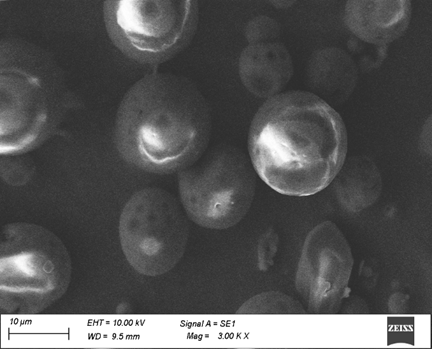
The shape and surface morphology of optimized formulations were observed in scanning electron microscope. It shows that the Nanosponges were spherical with numerous pores on their surface, uniform and spongy in nature. The pores are tunneled inwards which may be due to diffusion of solvent (dichloromethane) from the surface of the Nanosponges.
PARTICLE SIZE DISTRIBUTION
The particle size analysis of optimized Nanosponge formulation was measured. The mean particle size and Z average was found to be 183.5 nm. This is within nanometric range.
POLY DIVERSITY
Polydispersity of optimized Nanosponge formulation was found to be 0.328 indicating uniformity of particle size within formulation.
ZETA POTENTIAL
The zeta potential for the optimized Nanosponge formulation was found to be -25.2 mV which shows that the formulation is stable.
FLOW PROPERTIES
Flow properties are measured for the optimized Azithromycin loaded nanosponge.
The optimized formulation has good flow property compared with pure drug.
OPTIMIZED AZITHROMYCIN NSs FILLED IN THE CAPSULES
The optimized Nanosponges were filled into “1” size hard gelatin capsules without adding glidant or excipients because of good flow properties. The filled capsules contain 500 mg of Azithromycin.
Uniformity of weight 0.5806 ±0.001779 (Mean ±SD (n=20)
The Capsules comply with the official test for Uniformity of weight.
Disintegration test 8.30 mins. The Capsules comply with the official test for Disintegration test.
Drug Content Optimized formulation 94.6±0.267 Mean ±SD (n= 2)
The drug content was within the limits (not less than 90% and not more than 110%). It complies with the official standard.
Kinetic Models
|
Kinetic Models |
Coefficient of determination (R2) of optimized formulations |
|
First order |
0.985 |
|
Zero order |
0.967 |
|
Higuchi |
0.920 |
|
Korsmeyer- peppas kinetics |
0.969 |
|
Hixson Crowell |
0.885 |
STABILITY STUDIES OF OPTIMIZED FORMULATION
The optimized formulation was subjected to stability studies as per ICH guidelines. No significant changes in physical appearance, entrapment efficiency, drug content at storage conditions of room temperature, 40°C ± 2°C / 75 ± 5% RH & 4±20 C after the end of 0,15 days and 30 days were observed.
CONCLUSION
The purpose of this research was to prepare Azithromycin Nanosponges for controlled release of drug, to improve the solubility, reduce dose dependent side effects and improve the patient compliance.
ACKNOWLEDGEMENT
All the authors are thankful to Dr. E. Srilekha Senthilkumar, Correspondent, Adhiparasakthi College of Pharmacy, Melmaruvathur 603 319, Tamil Nadu, India for providing enormous research facilities.
REFERENCES

Snekha. A, A. Selvi, Design, Formulation and Evaluation of Azithromycin Loaded Nanosponges for the Treatment of Pneumonia, Int. J. of Pharm. Sci., 2026, Vol 4, Issue 1, 2724-2736. https://doi.org/10.5281/zenodo.18360763
 10.5281/zenodo.18360763