

We use cookies to ensure our website works properly and to personalise your experience. Cookies policy
JES SND institute of pharmacy Babhulgaon Yeola Nashik -423401.
Diabetic wounds are chronic wounds in which normal repair is disrupted by a complex microenvironment involving persistent inflammation, oxidative stress, impaired angiogenesis, abnormal extracellular-matrix Remodelling, infection risk and altered cellular responses. Conventional dressings mainly provide protection and fluid management and may not actively respond to changing wound conditions. Stimuli-responsive hydrogels have therefore emerged as an advanced wound-delivery platform because their swelling, permeability, degradation or mechanical Behaviour can change in response to wound-associated signals such as pH, glucose, reactive oxygen species or enzymes [1–4]. Curcumin, a natural bioactive compound obtained from Curcuma longa, has been widely investigated for wound healing because of its antioxidant, antiinflammatory, antimicrobial and potential pro-angiogenic properties. However, its poor water solubility, instability and limited bioavailability can restrict its therapeutic application, making suitable topical delivery systems important [5,6]. Experimental studies have reported that topical curcumin-based formulations can improve wound contraction, collagen deposition, reepithelialization and angiogenesis while reducing oxidative stress and inflammatory responses in diabetic wound models [6,7]. The present review proposes a sprayable pH-responsive in-situ gel as a local delivery platform. The formulation would be applied as a relatively low-viscosity liquid and then undergo a physicochemical change at the wound surface, increasing local viscosity and residence. This concept combines the potential wound-healing activity of curcumin with the formulation advantages of responsive hydrogels. Published studies on curcumin-loaded hydrogels and other responsive wound-delivery systems support the feasibility of using curcumin in advanced hydrogel platforms, although systems specifically designed as a pH-responsive sprayable in-situ gel require further formulation
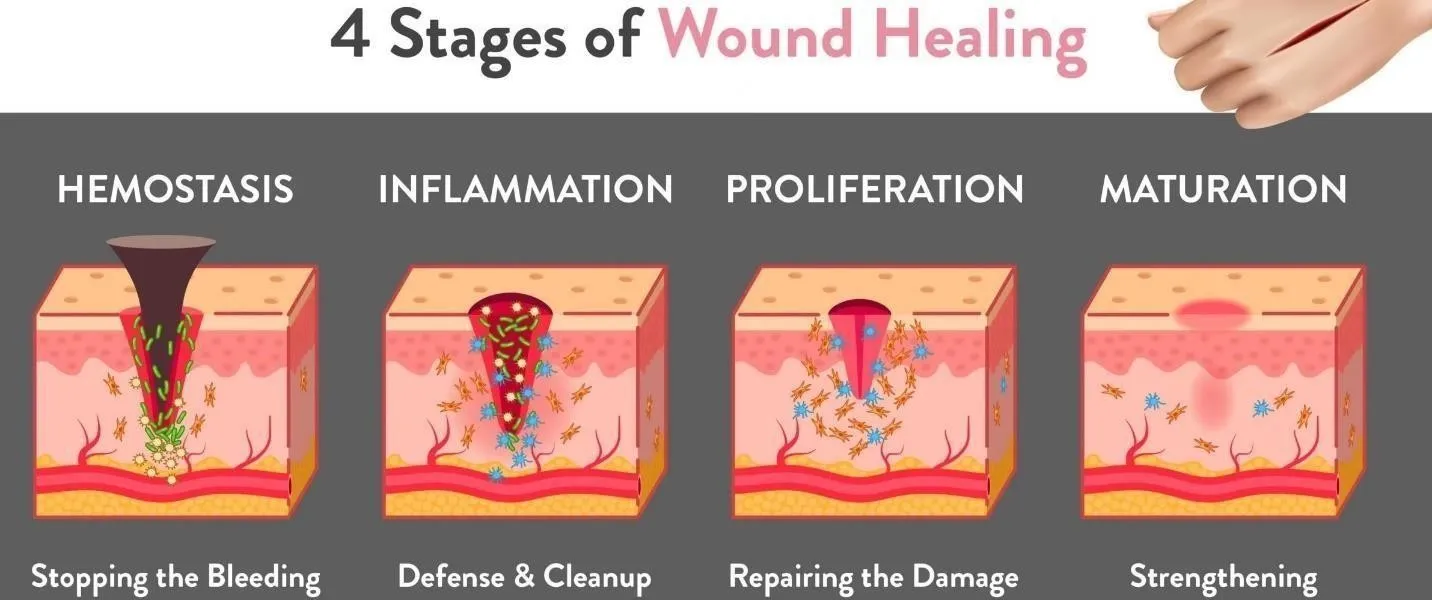
Wound healing is a complex and dynamic biological process, and several events, such as cellular, molecular and biochemical, are involved in restoring the damage tissue [8,9]diabetic wounds are a common and serious complication are a common and serious complication of diabetic mellitus and often take longer to heal high blood glucose levels can lead to prolonged inflammation increase oxidation stress, poor blood circulation, impaired formation of new blood vessels, and reduced tissue regeneration, normally[8,9] wound healing takes place through four closely connected stages haemostasis, inflammation, proliferation, and remodelling. [6,7]
Curcumin is a naturally occurring polyphenolic compound mainly obtained from curcuma mainly obtained from curcuma longa and gained considerable interest in wound healing research, it possesses antioxidant, anti microbial that may help reduce oxidative stress, regulate excessive inflammation, and support tissue [4,5] deferoxamine is an iron chelation agent that has been investigation for it potential role in improving diabetic wound healing treatment can enhance neovascularization and accelerate wound healing in diabetic models through HIF-1A-dependent mechanism [7], combing DFO with curcumin may provide complementary therapeutic effect by addressing impaired angiogenesis together with oxidative stress and inflammation.
4.Pathophysiology of wound healing
When the skin structural encounter physical disruption, it often result in fluid loss, injury and pain, wound are categorized as acute or chronic, depending on the healing timeline and process[12] in contract, chronic wounds, like diabetic ulcer, required more than 12 weeks to heal and progress at a healing process [12,13] this process consists of four distinct phases inflammation, proliferation, haemostasis, coagulation, and remodeling.
|
Stages |
Major events |
|
1.Haemostasis |
This is the first stage of wound healing, where a blood clot forms to stop bleeding and protect the injured area |
|
2.Inflammation |
Immune cells move to the wound site to control infection, remove damaged cells and clear debris. |
|
3.Proliferation |
New tissue begins to develop through fibroblast activity, extracellular-matrix formation, new blood-vessel growth (angiogenesis), and re-epithelialization of the wound surface.[1,2] |
|
4.Remodelling |
The newly formed tissue gradually becomes stronger as collagen is reorganized, matured and strengthened, helping restore the structure and function of the wound area.[1,2]
|
In diabetic wounds, the normal stages of healing may become delayed or disturbed, which can result in slow and incomplete wound repair. Therefore, an important challenge in wound formulation is to deliver the treatment directly to the wound while also maintaining a favourable environment for healing.[13]
A smart topical drug-delivery system may focus on several important factors involved in diabetic wound healing, such as oxidative stress, prolonged inflammation, microbial infection, poor angiogenesis and short drug residence time at the wound site.
5.curcumin in wound healing
Curcumin is the naturally occurring compound obtained mainly from curcuma [turmeric]. it has received considerable attention in wound healing research because of it antioxidant, anti inflammatory, antimicrobial, and tissue repair properties[11] during normal wound healing.
Curcumin has been particularly studies for treatment of diabetic wounds another important role of curcumin is its possible effect on tissue regeneration experimental studies have reported that curcumin can support fibroblast activity, collagen deposition, angiogenesis, wound contraction and important because fibroblasts and collagen are involved in the formation of new tissue, while angiogenesis help provide oxygen and nutrient to the developing tissue. Overall, the available experimental evidence suggest that curcumin has considerable potential as a wound healing agent, further well designed clinical studied are needed to confirm its effectiveness and to determine suitable formulation and doses for human wound treatment [11]
6.skin its role in wound healing
The skin is the largest organ of the human body and acts as a protective barrier against harmful substances, microorganisms, and physical damage. It helps prevent water loss, maintains body temperature, and allows us to feel sensations such as touch, heat, and pain. Skin also plays an important role in wound healing by repairing damaged tissues and restoring the body's natural protective barrier. However, in people with diabetes, wound healing is often delayed due to high blood glucose levels, poor blood circulation, increased oxidative stress, and prolonged inflammation. These factors can slow tissue repair and increase the risk of wound infection.
1.Epidermis: The outermost layer of the skin. It provides protection against microorganisms, harmful substances, and water loss. It mainly consists of keratinocytes.
2.Dermis: The middle layer, containing collagen, elastin, blood vessels, nerves, hair follicles, and glands. It provides strength and elasticity and supplies nutrients to the skin.
3.Hypodermis (subcutaneous layer): The deepest layer, mainly composed of fatty and connective tissues. It provides insulation, cushioning, and support to the skin.
7.Deferoxamine in diabetic wound healing
Deferoxamine is a nature substance obtained from alcohol fermentation of streptococcus spp. Deferoxamine is soluble in water and its aqueous solution is stable it has been reported that deferoxamine stimulate the secretion of vascular endothelial growth factor, stromal cell designed factor [SDF-1a] [SDF-1a] and the synthesis of nitric oxide.
DFO can bind to excessive irons in the inflammation site and act as an antioxidant to eliminate reaction oxygen species present at the chronic wound site recent studies have confirmed that deferoxamine and its slow release drug carries can accelerate vascular regeneration and wound healing.
8.Literature review
More recently, Chen et al. (2025) reviewed the use of curcumin-loaded hydrogels for skin wound healing. Their review suggested that these hydrogel systems can help keep the wound moist, provide a more sustained release of curcumin, reduce the risk of infection and support the natural process of tissue repair. The authors also discussed their possible application in diabetic wounds, indicating that curcumin-loaded hydrogels could be a promising approach for developing advanced topical wound-healing formulations.
A recent study by Prabhu, Ravikumar and Momin (2026) developed a thermoresponsive spraybased, no-contact delivery system containing curcumin and asiatic acid for burn and diabetic wound treatment. The formulation was designed to be easily sprayed onto the wound and then form a gel at the application site. The study reported improved wound closure, fibroblast migration and tissue regeneration in experimental models. These findings suggest that sprayable curcuminbased formulations may be a promising approach for improving local drug delivery and supporting wound healing
.
|
Study/Source |
System/Focus |
Main relevance to present topic |
|
Shah SA, Sohail M, Minhas Mu, et al, [2021] |
Curcumin-loaded hyaluronic acid–pullulan-based biomaterial for diabetic wound healing. The study focused on developing a curcumin- containing |
Provides evidence that curcumin can be incorporated into a polymeric biomaterial for diabetic wound healing. It supports the present concept of using a polymer-based |
|
|
biomaterial to improve wound repair in diabetic conditions. |
topical delivery system to improve curcumin retention and therapeutic action at the wound site. |
|
Chen et al., 2025. |
Curcumin-loaded hydrogels for skin wound healing. |
Supports the use of curcumin in polymer-based topical systems and provides a basis for developing an in-situ gelling spray for improved local delivery and wound healing. |
|
Prabhu D, Ravikumar P, Momin M. (2026) |
Sprayable thermoresponsive system for diabetic and burn wounds. |
Supports the use of a spraybased gel system for easy topical delivery and wound healing. |
|
Mohanty and Sahoo, 2017 |
Topical curcumin formulation for wound healing |
Support the use of curcumin in topical wound healing formulation |
|
Akbik et al,2014 |
Curcumin as a wound healing agent |
Antioxidant and anti inflammatory in curcumin |
9. pH-Respective drug delivery system pH-responsive polymers contain ionizable acidic or basic groups whose degree of ionization changes with the surrounding pH, causing swelling, collapse, dissolution, or gelation[13]Two broad classes are used. polycationic polymers and polyanionic polymers [for example chitosan]are protonated and gel forming or precipitating as pH approach and exceeds their pka.
Polyanionic polymers coiled at low pH and swollen or gelled when neutralized above about pH
5.5 to 6. For wound direct system for a wound direct system the triggers is difference between the formulation pH [near neutral to alkaline in chronic wounds], because curcumin is most stable in an acidic with wounds is logical match between drug stability and target side. [13,14]
For the present project, 'pH-responsive' refers to the proposed mechanism of formulation response. It should not be assumed that any generic gel will automatically respond appropriately to a diabetic wound. Polymer selection, concentration, ionisation behaviour, gelation kinetics and drug-polymer interactions must all be investigated.
10.In-situ gelling system
In situ gelling system is a liquid or semi liquid formulation that is easy to apply to the wound and changes into a gel after application this transformation occurs when the formulation cores into contact with specific condition at the wound site, such as changes in pH, temperature, ionic strength, or other biological stimuli [5,6], there system are particularly useful in wound care in situ spray system is applied directly to the wound as a liquid and forms a gel or protective film because the formulation can spread easily our wound and then form gel that remains at application site for a longer periods allowing pronged and controlled drug release. [6]
11.In-situ gelling spray for wound healing
An after application it can easily cover irregular wounds surfaces and reduce direct handing of the wound. [7]
The formed gel can remain at the wound site and help improve local drugs retention, it may also provide controlled or prolonged release of the incorporated drugs.[7]sprayable hydrogel systems have therefore gained interest as convenient wound dressing approaches however, their effectiveness depends on properties, such as sprayability and drug release behaviour.
A spray also imposes formulation limits. The pre-gel solution must be sufficiently fluid (generally low viscosity, of the order of tens to a few hundred mPa·s) to atomise into a uniform plume, yet it must gel quickly and strongly enough after landing to resist run-off. Spray characteristics such as spray pattern, plume angle, droplet distribution and delivered dose per actuation must therefore be optimised together with the gelation behaviour
12.formulation of components
Conducting preliminary trials, and evaluating its stability The final formulation should be selected
after confirming the compatibility of the ingredients,.
|
components |
Possible example |
Role in formulation |
|
1.Active drugs
|
curcumin |
Curcumin is the main therapeutic agent and is investigated for its antioxidant, antiinflammatory, and woundhealing properties |
|
2.pH responsive polymer |
Suitable ph sensitive polymer system |
Helps the formulation respond to the wound pH and promotes in-situ gel formation, which can improve drug retention and controlled release at the wound site. |
|
3.Hydrophilic vehicle |
Purified water |
Acts as the main vehicle and provides the continuous aqueous phase of the formulation. |
|
4.Solubilizer |
Suitable pharmaceutically acceptable excipient |
Helps improve the dispersion or solubility of curcumin, which has poor water solubility. |
|
5.Humectant |
Glycerol or propylene glycol |
Helps maintain moisture in the formulation and may improve its spreading and application over the wound surface. |
|
6.Preservative |
Suitable approved preservative |
Helps prevent microbial growth and maintain the quality of the formulation, particularly when a multidose aqueous spray is used. |
|
7.pH adjust |
Suitable acid, base, or buffer |
Used to adjust and maintain the formulation at the desired pH for appropriate gel formation and stability. |
|
8.Optical antioxidant |
Selected after compatibility studies |
May be incorporated when required to improve the chemical stability of the formulation, provided compatibility with the other ingredients is established. |
|
9.Spray container |
Compatible topical spray pack |
Allows convenient and reproducible application of the formulation directly onto the wound area. |
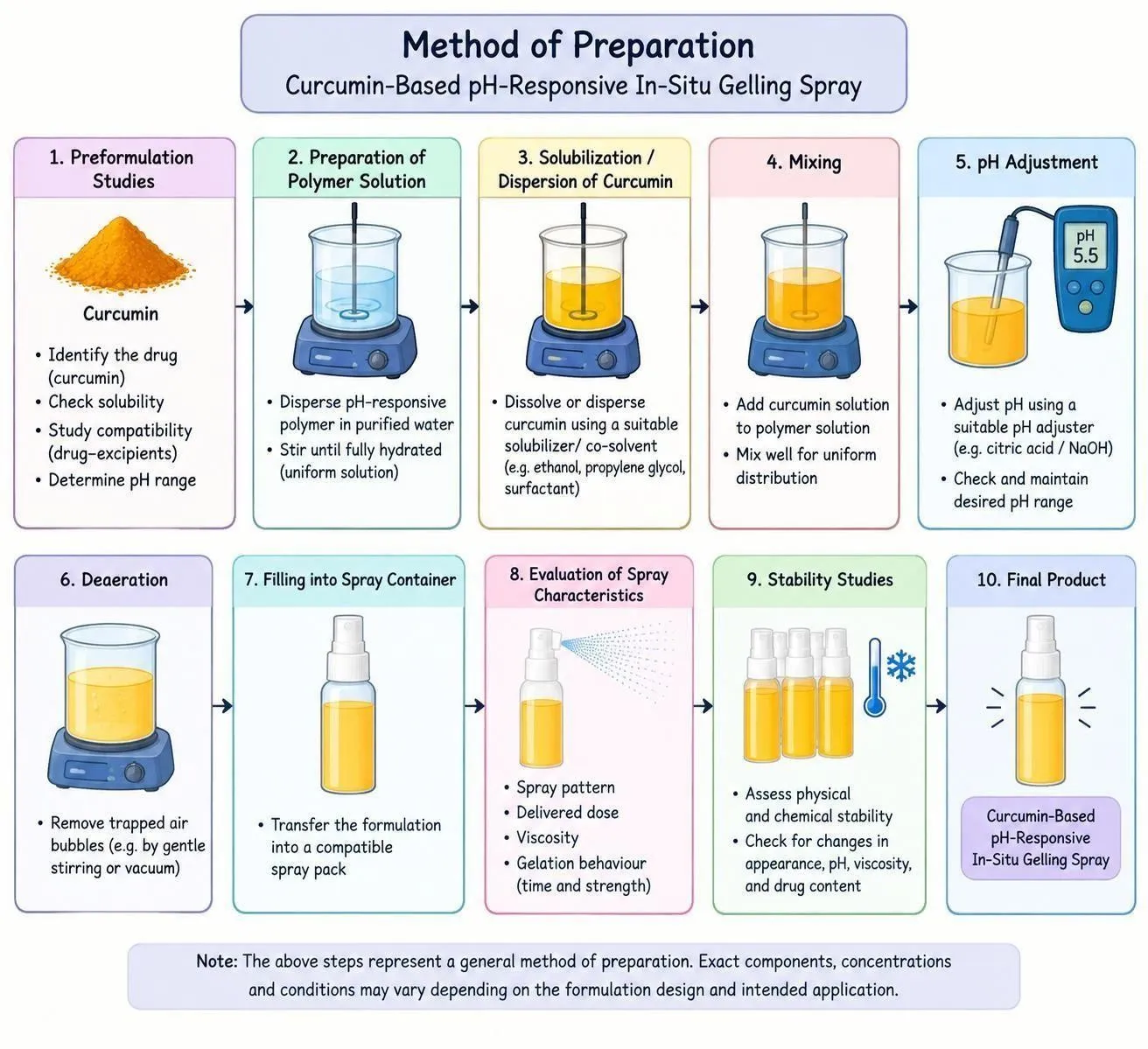
13.Methods of preparation
1.Preformulation; assess curcumin solubility, pH stability, polymer compatibility and possible drugs excipient interaction.
2.Polymer screening; prepare small baches using different suitable pH responsive polymer or polymer concentration and evaluate their gelation and spray properties
3.Hydration; allow the selected polymer to hydrate completely in purified water under controlled mixing condition to obtained a uniform polymeric solution.
4. Curcumin incorporation; prepare the curcumin phase using suitable pharmaceutical solubilizer, co solvent or dispersion technique.
5.pH adjustment; adjust the formulation pH to the derived range and record the final pH, viscosity, appearance, and gelation behaviour.
6.Deaeration; remove excessive entrapped air to improve filling and spray reproductability.
7.Filling; transfer the prepared curcumin formulation into suitable and compatible spray container filled with appropriate actuator
8.Performance screening; evaluate the formulation for important spray and gel properties such as spray pattern, delivered dose, viscosity, gelation time, and gel strength.
9.Stability screening; monitor appearance, pH, viscosity, drug content, spray performance.
14.Evaluation parameters
|
Parameter |
Purpose |
Typical observation/output |
|
Appearance |
Detect visible instability |
Colour, clarity/dispersion, sedimentation, phase separation |
|
Homogeneity
|
Check uniform distribution |
Absence of visible aggregates or nonuniform regions |
|
pH |
Confirm formulation condition |
Measured pH and change during storage |
|
Drug content |
Verify assay |
Percentage of labelled/target curcumin. |
|
content uniformity |
Check batch reproducibility |
Variation between samples / actuations |
|
Viscosity |
characteristics spray and gel behaviour |
Flow behaviour before and after trigger |
|
Gelation time |
Assess trigger response |
Time required to reach defined gel state |
|
Gel strength/retention |
Assess robustness after gelation |
Resistance to deformation / erosion under test conditions. |
|
Spray pattern |
Assess coverage |
Pattern shape, area and reproducibility |
|
Delivered dose |
Assess actuator performance |
Mass or drug amount delivered per actuation |
|
Spreadability/adhesion |
Assess contact |
Ability to cover and remain on a wound-relevant surface |
|
In vitro release |
Characteristics drug liberation |
Cumulative drug released versus time |
|
Ex vivo retention/permeation |
Study local deposition |
Drug retained in tissue versus permeated. |
|
Microbial quality |
Protect product quality |
Microbial enumeration / specified microbiological testing as applicable
|
15.Future scops
1. Optimizing the polymer concentration and pH response to achieve better gel formation and drug release.[3]
2.Improving the solubility and stability of curcumin by exploring suitable nano-carriers or solubilization techniques.
3.Combining curcumin with antimicrobial or antioxidant agents, after confirming their compatibility and safety.[5]
4. Investigate antibacterial, antioxidant, anti-inflammatory and pro-angiogenic endpoints where scientifically justify.
5. Evaluate safety, irritation, sensitisation and local tissue compatibility.
6. Develop a reproducible spray container and actuator with reliable delivered dose.
7. Conduct properly designed human studies before making clinical efficacy claims.
16.Limitations
1.Curcumin has low water solubility and limited stability, which can make its formulation and delivery challenging.
2.Wound pH can vary between patients and may also change during different stages of wound healing, which can affect the performance of a pH-responsive system.[5,6]
3.Achieving a balance between easy spraying and proper gel formation can be difficult, as a formulation with very high viscosity may not spray effectively.
4.In-vitro drug-release studies alone cannot confirm actual wound-healing effectiveness, so further animal and clinical studies are needed.[6]
5.Before such a formulation can be used in patients, it would require detailed evaluation of its safety, quality, stability, regulatory requirements, and clinical effectiveness.
CONCLUSION
Diabetic wounds are difficult to heal because they often have prolonged inflammation, high oxidative stress, poor blood vessel formation, and an increased risk of infection. These problems create an unhealthy wound environment and delay the normal healing process. Smart hydrogels and in-situ gelling systems are being explored as promising approaches because they can deliver drugs directly to the wound and may respond to changes in the wound environment.[3,8] Curcumin is considered a promising candidate for wound-care formulations because several studies and reviews have reported its antioxidant, anti-inflammatory, antimicrobial, and tissuehealing properties. However, its use in pharmaceutical formulations can be challenging due to its poor solubility in water and limited stability. Therefore, developing a suitable drug-delivery system is important to improve its stability and effectiveness at the wound site The proposed pHresponsive in-situ gelling spray is designed to be easily sprayed onto the wound and then form a thicker gel after coming in contact with the wound environment. This approach may help the formulation remain at the wound site for a longer period and provide better local drug delivery. The formulation can be evaluated for its physical appearance, pH, viscosity, sprayability, gelation behaviour, drug content, in-vitro drug release, and stability. However, the actual results should be reported only after conducting the laboratory experiments. Overall, this formulation concept appears suitable for a college-level formulation development project and could provide a useful foundation for further optimization and future research on diabetic wound healing.
REFERENCES

Sarthak Mahajan, Vinod Anuse, Manthan Wade, Sima Khemnar, Kalyani Deore, Anita Karnar, Development and Evaluation of a Curcumin-Loaded ph-Responsive In-Situ Gelling Spray for Enhanced Diabetic Wound Healing , Int. J. of Pharm. Sci., 2026, Vol 4, Issue 11, 2896-2904. https://doi.org/10.5281/zenodo.24332644
 10.5281/zenodo.24332644