

We use cookies to ensure our website works properly and to personalise your experience. Cookies policy
1Final Year Bachelor of Pharmacy Student, Dr. Babasaheb Ambedkar Technological University, Pune, Maharashtra, India-412216.
2Assistant Professor, Department of Pharmaceutical Chemistry, Delight College of Pharmacy, Koregaon Bhima, Pune, Maharashtra, India- 412216.
3Principal of Delight College of Pharmacy, Koregaon Bhima, Pune, Maharashtra, India, 412216.
Fast disintegrating tablets have attracted significant interest as a convenient alternative to conventional tablets because they break down quickly in the mouth and can be taken without water. This makes them especially beneficial for patients who have difficulty swallowing, including children, elderly individuals, and those with certain medical conditions. Cetirizine hydrochloride, a widely used second-generation antihistamine for allergic disorders, is a suitable drug candidate for formulation as a fast disintegrating tablet. This review discusses the development and evaluation of cetirizine hydrochloride fast disintegrating tablets based on published literature. It focuses on the selection of the drug and excipients, the type and concentration of super disintegrants used, formulation techniques, and the key factors that influence tablet performance. Attention is given to natural and synthetic super disintegrants, including plant-derived mucilages, which show promise as natural pharmaceutical excipients for achieving rapid tablet disintegration and drug release. Different formulation methods, especially direct compression, are reviewed along with the roles of diluents, binders, lubricants, glidants, sweeteners, and flavouring agents. Common evaluation tests such as weight variation, hardness, friability, wetting time, disintegration time, drug content, and in-vitro dissolution are also discussed. Previous studies suggest that careful selection and optimization of super disintegrants and other excipients are essential to produce tablets with adequate mechanical strength, rapid disintegration, and effective drug release. The review further highlights the potential of combining natural and synthetic super disintegrants for future development of cetirizine hydrochloride fast disintegrating
Fast disintegrating tablets (FDTs) are solid oral dosage forms designed to break down quickly in the mouth, usually without the need for water. They have become increasingly popular because they make taking medicines easier and more convenient, especially for patients who find it difficult to swallow conventional tablets. Once the tablet disintegrates rapidly, it exposes a larger surface area of the drug to body fluids, which can enhance drug dissolution and may help achieve a quicker onset of action.1,2
The performance of a fast-disintegrating tablet depends on several formulation factors, with the choice and amount of super disintegrant being especially important. Super disintegrants help the tablet break apart quickly after coming into contact with saliva. They work through mechanisms such as swelling, wicking, and capillary action, which allow water to enter the tablet and promote rapid disintegration. Both synthetic and natural super disintegrants have been explored for this purpose. Common synthetic options include crospovidone, croscarmellose sodium, and sodium starch glycolate. Natural materials, such as plant-derived gums and mucilages, are also receiving increasing attention because they are widely available and may offer useful pharmaceutical benefits. However, the amount of super disintegrant must be carefully optimized, as increasing its concentration does not always lead to a proportional decrease in disintegration time.2,3
Cetirizine hydrochloride is a widely used second-generation antihistamine for the treatment of allergic conditions. Developing it as a fast-disintegrating tablet can provide patients with a more convenient dosage form that breaks down quickly in the mouth while ensuring effective drug release. In one formulation study, cetirizine hydrochloride fast disintegrating tablets were prepared using the direct-compression method. Sodium starch glycolate was selected and optimized as the super disintegrant. The prepared tablets were then evaluated for important quality parameters, including hardness, friability, weight variation, wetting time, disintegration time, drug content, and in-vitro dissolution.5
Natural materials have also been investigated as super disintegrants in cetirizine hydrochloride tablet formulations. One study used Hibiscus rosa-sinensis mucilage along with croscarmellose sodium and showed that natural and synthetic disintegrants can be combined to achieve suitable tablet disintegration and drug-release properties.In another study, material derived from Ocimum canum seeds was evaluated as a tablet disintegrant. The extracted seed material showed good swelling properties, indicating its potential use as a natural pharmaceutical disintegrant in tablets prepared by direct compression.7
These findings support further research on plant-derived mucilages and their use in combination with well-established synthetic super disintegrants for developing fast disintegrating tablets. The formulation of cetirizine hydrochloride fast disintegrating tablets requires careful selection of the drug, excipients, type and concentration of super disintegrant, manufacturing method, and compression conditions. The prepared tablets must then be evaluated for their physical properties, disintegration behaviour, drug content, and dissolution profile to identify a formulation that performs satisfactorily. This review summarizes the formulation strategies, excipients, manufacturing methods, super disintegrants, and evaluation techniques reported for cetirizine hydrochloride fast disintegrating tablets. Special emphasis is placed on the role of natural and synthetic super disintegrants in achieving rapid tablet disintegration and effective drug release.
2. SUPERDISINTEGRANTS:
Super disintegrants are pharmaceutical excipients that help tablets break down quickly into smaller particles when they come into contact with water or saliva. They are especially important in fast disintegrating tablets, where rapid tablet breakup increases the surface area available for drug dissolution and can support faster drug release. Therefore, selecting the right super disintegrant and using it at an appropriate concentration are key steps in developing an effective fast disintegrating tablet formulation.1,7
Super disintegrants can generally be divided into two groups: synthetic and natural. Common synthetic super disintegrants include crospovidone, croscarmellose sodium, and sodium starch glycolate. These are widely used in pharmaceutical formulations because they act quickly and have well-established applications in tablet manufacturing. Natural super disintegrants include plant-derived gums, mucilages, and other materials rich in polysaccharides. They have gained increasing attention because they are readily available, biocompatible, and capable of absorbing water and swelling, which can help tablets disintegrate rapidly.3,4
The effectiveness of a super disintegrant mainly depends on its ability to absorb or interact with water and help the tablet break apart quickly. This rapid disintegration occurs through mechanisms such as swelling, wicking, and capillary action. These processes allow water to enter the tablet, causing it to break down into smaller particles and release the drug more efficiently.
2.1 SYNTHETIC SUPER DISINTEGRANTS.
Synthetic super disintegrants are commonly used in the formulation of fast and orally disintegrating tablets. Some of the most widely studied materials include crospovidone, croscarmellose sodium, and sodium starch glycolate. Crospovidone helps water enter the tablet quickly because of its porous structure and strong wicking action. In contrast, croscarmellose sodium and sodium starch glycolate mainly work by swelling when they come into contact with water. The choice of super disintegrant depends on several factors, including its concentration, compatibility with other excipients, and the desired disintegration behaviour of the final tablet formulation.3,8
2.2 NATURAL SUPER DISINTEGRANTS.
Natural super disintegrants are obtained from plant sources and include materials such as gums, mucilages, and other naturally occurring polysaccharides. Their ability to absorb water, swell, and help tablets break apart makes them promising alternatives to synthetic super disintegrants. They can also be used together with synthetic materials to improve tablet disintegration. Natural excipients have gained attention because they are generally easy to obtain and can provide useful functional properties in tablet formulations.3,4
Plant-derived mucilages are especially useful in the development of fast disintegrating tablets because they can absorb water and swell rapidly, helping the tablet break apart more quickly. For this reason, mucilages from several plant sources have been studied as natural tablet disintegrants. In particular, seed-derived material from Ocimum canum has been investigated for its potential pharmaceutical use as a tablet disintegrant. Its ability to swell in the presence of water suggests that it may be useful for promoting rapid tablet disintegration.7
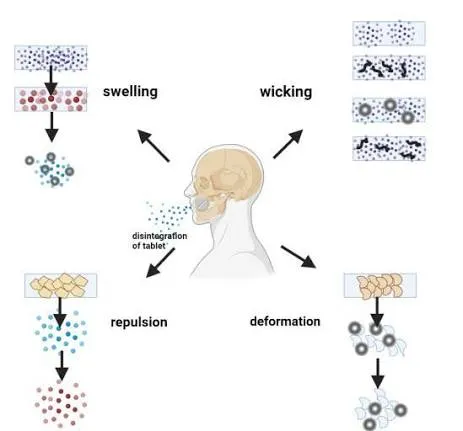
Figure 1: Natural Super Disintegrants 3
2.3 COMBINATION OF NATURAL AND SYNTHETIC SUPER DISINTEGRANTS.
The combination of natural and synthetic superdisintegrants is another approach in fast disintegrating tablet formulation. Such combinations may allow the formulation to take advantage of the rapid and established performance of synthetic materials while incorporating the functional properties of natural excipients. Studies involving Cetirizine hydrochloride have investigated combinations of natural mucilage with synthetic superdisintegrants, demonstrating the potential of this approach for obtaining desirable tablet disintegration and drug-release characteristics.6
For Cetirizine hydrochloride fast disintegrating tablets, the selection and optimization of superdisintegrants are therefore important formulation considerations. Crospovidone may be considered as a synthetic super disintegrant, while Ocimum Canum seed mucilage can be investigated as a natural material. Their individual and combined effects on disintegration time, wetting behavior, friability, drug content and dissolution can be evaluated during formulation development.
3. CETIRIZINE HYDROCHLORIDE:
Combining natural and synthetic super disintegrants is another useful approach in the formulation of fast disintegrating tablets. This strategy can combine the rapid and reliable action of synthetic super disintegrants with the beneficial functional properties of natural excipients. Studies on cetirizine hydrochloride fast disintegrating tablets have explored the use of natural mucilage together with synthetic super disintegrants. These studies suggest that such combinations can help achieve suitable tablet disintegration and desirable drug-release characteristics.9
Cetirizine hydrochloride is commonly available as a conventional oral tablet. However, swallowing standard tablets can be difficult for some patients, particularly children and older adults. Fast disintegrating tablets offer a more convenient alternative because they break down quickly in the mouth and usually do not require water for administration. This dosage form can make cetirizine easier and more acceptable to take, especially for pediatric and geriatric patients who may have difficulty swallowing conventional tablets.5
Several studies have examined the suitability of cetirizine hydrochloride for formulation as a fast disintegrating tablet. Sharma et al. prepared cetirizine hydrochloride fast disintegrating tablets by direct compression, using sodium starch glycolate as the super disintegrant. Different concentrations of sodium starch glycolate were tested to identify and optimize the most suitable formulation. The prepared tablets were evaluated using key quality-control tests, including weight variation, hardness, friability, wetting time, disintegration time, drug content, and in-vitro dissolution.5
Different super disintegrants and formulation approaches have also been studied for cetirizine hydrochloride fast disintegrating tablets. Patro and Sahu developed orally disintegrating tablets of cetirizine hydrochloride using a combination of the synthetic super disintegrant croscarmellose sodium and natural Hibiscus rosa-sinensis mucilage. They used a central composite design to examine how the two disintegrants affected disintegration time, friability, and drug release. The study showed that combining natural and synthetic disintegrants can be an effective approach for achieving desirable tablet properties.6
Taste is an important factor in orally disintegrating dosage forms because the drug comes into direct contact with the taste buds once the tablet breaks down in the mouth. For this reason, taste masking is especially important when developing orally disintegrating tablets of cetirizine hydrochloride. Studies have explored methods such as coating the drug and using different super disintegrants to maintain rapid tablet disintegration while improving the taste and overall palatability of the formulation.10
Based on the available studies, cetirizine hydrochloride appears to be a suitable drug candidate for the development of fast disintegrating tablets. The performance of these tablets can be affected by several factors, including the type and concentration of super disintegrant, the choice of diluents and binders, compression conditions, tablet porosity, and other formulation variables. Therefore, careful selection and optimization of all formulation components are essential to produce cetirizine hydrochloride fast disintegrating tablets with good mechanical strength, rapid disintegration, and an appropriate drug-release profile.1,2
3.1 CETIRIZINE HYDROCHLORIDE AND ITS FAST-DISINTIGERATING TABLET
FORMULATION.
Cetirizine hydrochloride is a second-generation antihistamine commonly used to treat allergic conditions such as allergic rhinitis and urticaria. However, conventional tablets can be difficult to swallow for some patients, especially children and older adults. Fast-dissolving tablets are designed to disintegrate quickly in the mouth, making the medicine easier and more convenient to take. Developing cetirizine hydrochloride fast-dissolving tablets requires the careful selection of suitable excipients, including super disintegrants, diluents, binders, sweeteners, and lubricants. Direct compression is a commonly studied manufacturing method because it is simple and involves fewer processing steps. Super disintegrants such as sodium starch glycolate, croscarmellose sodium, and crospovidone have been investigated to promote rapid tablet disintegration and improve drug release.5,6
Table 1: Common Excipients Used in Fast-Disintegration Tablets of Cetirizine Hydrochloride.5
| INGREDIENTS | FUNCTIONS |
|---|---|
| Cetirizine Hydrochloride | Active Pharmaceutical Ingredient (API) |
| Sodium Starch Glycolate (SSG) | Super Disintegrant that promotes tablet breakup through swelling. |
| Croscarmellose sodium (CCS) | Super Disintegrant that facilitates rapid disintegration |
| Mannitol | Diluents that improve Mouth feel |
| Micro crystalline Cellulose (MCC) | Supports powder compaction and may assist disintegration |
| Sodium Saccharin or aspartame | Sweetening Agent |
| Flavoring Agent | Improves Palatability |
| Sodium Stearyl Fumarate | Lubricant |
4. EXCIPIENTS USED IN FAST DISINTEGRATING TABLETS:
Excipients play a key role in the formulation of fast disintegrating tablets because they affect important properties such as tablet strength, porosity, wetting, disintegration, and drug release. Selecting the right
excipients is essential to ensure that the tablets are strong enough to withstand handling while still breaking down quickly in the mouth. The choice of excipients should also be based on their compatibility with the drug and with other ingredients in the formulation.1,11
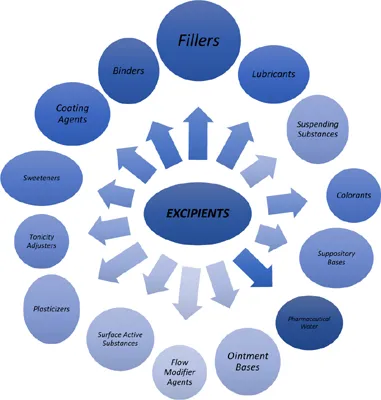
Figure 2: Overview of Excipients 17
4.1 DILUENTS.
Diluents are added to tablet formulations to provide the necessary bulk and to improve powder handling and compression during manufacturing. Mannitol is commonly used in orally disintegrating and fast disintegrating tablets because it has good compressibility, dissolves easily in water, and gives a pleasant cooling mouthfeel.
Because mannitol is water-soluble, it can also support the rapid dissolution of the tablet after administration.5,11
Microcrystalline cellulose (MCC) is another widely used excipient in tablet formulations. It improves the compactibility of powders and helps provide sufficient mechanical strength in tablets prepared by direct compression. Its porous structure and ability to draw in water through wicking can also support faster tablet disintegration.5,11
4.2 BINDERS.
Binders are added to tablet formulations to help powder particles stick together and to give the compressed tablet enough mechanical strength. Polyvinylpyrrolidone K30 (PVP K30) is a commonly used pharmaceutical binder for this purpose. However, its concentration should be carefully controlled. Too much binder can make the tablet excessively hard, which may slow down its disintegration.5
4.3 SUPER DISINTEGRANTS.
Super disintegrants are among the most important excipients used in fast disintegrating tablet formulations. They help the tablet break apart quickly after it comes into contact with saliva or water. Crospovidone is a synthetic super disintegrant that promotes rapid water penetration through its porous structure and strong wicking ability. Natural materials, such as plant-derived mucilages, can also be explored as disintegrating agents because they absorb water and swell, helping the tablet disintegrate more rapidly.3,8
In developing cetirizine hydrochloride fast disintegrating tablets, both natural and synthetic super disintegrants can be considered. Seed-derived material from Ocimum canum has been investigated for its potential use as a natural tablet disintegrant because of its swelling properties. Crospovidone, on the other hand, is a well-established synthetic super disintegrant that promotes rapid tablet breakup. Using these materials individually or in combination may help achieve faster tablet disintegration and suitable drug-release characteristics.7,8
4.4 SWEETENERS AND FLAVORING AGENTS.
Sweeteners and flavouring agents are often added to fast disintegrating tablets to improve their taste and overall acceptability. This is especially important because the tablet breaks down in the mouth, allowing the drug to come into direct contact with the taste buds. Sodium saccharin may be used as a sweetening agent, while suitable flavouring agents can help improve the mouthfeel and make the dosage form more pleasant for patients to take.10
4.5 LUBRICANTS AND GLIDANTS.
Lubricants are added to tablet formulations to reduce friction between the powder blend and the punch and die surfaces during compression and tablet ejection. Magnesium stearate is one of the most commonly used tablet lubricants. Talc may also be included to improve powder flow and reduce friction during manufacturing. However, hydrophobic excipients should be used in carefully controlled amounts. Excessive quantities can reduce tablet wetting and slow down water penetration, which may delay tablet disintegration.3,11
4.6 IMPORTANCE OF EXCIPIENT SELECTION.
The performance of a fastdisintegrating tablet depends on how well the drug and excipients work together. Diluents affect tablet bulk and mouthfeel, binders provide mechanical strength, super disintegrants help the tablet break apart quickly, and lubricants and glidants support smooth manufacturing. Sweeteners and flavouring agents improve the taste and overall acceptability of the tablet. Therefore, careful selection and optimization of excipients are essential to achieve the right balance between tablet strength, rapid disintegration, palatability, and effective drug release.3,11
5. FORMULATION APPROACHES FOR FAST DISINTEGRATING TABLETS:
The method used to prepare fast disintegrating tablets has a major effect on their properties, including mechanical strength, porosity, disintegration time, and drug release. The manufacturing process should produce tablets that are strong enough to withstand handling, yet able to break down quickly when they come into contact with saliva or water. The most suitable manufacturing technique depends on the properties of the drug and the excipients included in the formulation.11,12
5.1 DIRECT COMPRESSION.
Direct compression is one of the most commonly used methods for preparing fast disintegrating tablets because it is simple and involves relatively few processing steps. In this method, the drug and selected excipients are blended thoroughly, and the resulting powder mixture is compressed directly into tablets. This approach is particularly suitable when the formulation ingredients have good flow properties and can be compressed easily.12
Direct compression has been successfully used to develop cetirizine hydrochloride fast disintegrating tablets. In one study, Sharma et al. prepared these tablets by direct compression using sodium starch glycolate as the super disintegrant. Different concentrations of sodium starch glycolate were tested, and the binder system was then optimized to obtain the most suitable formulation. The powder blend was passed through sieve No. 60 before being compressed into tablets using an 8 mm punch. The prepared tablets were evaluated for their physical properties, disintegration behaviour, and dissolution characteristics.5
Another study by Patro and Sahu developed cetirizine hydrochloride orally disintegrating tablets using the direct-compression method. The researchers examined the combined effect of synthetic croscarmellose sodium and natural Hibiscus rosa-sinensis mucilage as disintegrants. A central composite design was used to evaluate how different concentrations of these disintegrants influenced disintegration time, friability, and drug release. The findings showed that direct compression, when combined with an experimental design approach, can be useful for optimizing cetirizine hydrochloride orally disintegrating tablet formulations.6
5.2 OPTIMIZATION OF FORMULATION VARIABLES.
Optimizing formulation variables is an important step in developing fast disintegrating tablets. The type and concentration of super disintegrant can greatly affect how quickly a tablet breaks down. In the cetirizine hydrochloride study by Sharma et al., sodium starch glycolate was evaluated at concentrations ranging from 1% to 10% w/w. Based on the results, an appropriate concentration was selected for further formulation development.5
Binder concentration is another important formulation factor because too much binder can make tablets excessively hard and slow down their disintegration. For this reason, Sharma et al. studied different concentrations of PVP K30 and microcrystalline cellulose (MCC) together with the optimized level of sodium starch glycolate.5 Experimental design methods can be used to understand how formulation variables work together and influence tablet performance. Patro and Sahu used a central composite design to study different concentrations of croscarmellose sodium and Hibiscus rosa-sinensis mucilage. They evaluated how these ingredients affected key tablet properties, including disintegration time, friability, and drug release.6
5.3 COMPRESSION CONDITIONS.
Compression conditions can strongly affect the mechanical strength and disintegration behaviour of fast disintegrating tablets. Excessive compression can produce tablets that are too hard and less porous, making it more difficult for water to enter the tablet and initiate disintegration. Therefore, compression conditions should be carefully optimized to maintain a balance between adequate tablet strength and rapid disintegration.13
In the reported cetirizine hydrochloride direct-compression study, the powder blend was blended, sieved, and then compressed into tablets using an 8 mm punch.⁵ This highlights the importance of selecting suitable compression conditions when developing a new formulation, especially when natural and synthetic super disintegrants are used together.
5.4 SELECTION OF SUITABLE FORMULATION APPROACH.
The choice of formulation method should take into account the flow properties, compressibility, and compatibility of both the drug and the excipients. Direct compression is particularly suitable for fast disintegrating tablets because it is simple, requires fewer processing steps, and allows super disintegrants to be added directly to the powder blend. Published studies on cetirizine hydrochloride show that direct compression can be successfully used with synthetic super disintegrants alone or in combination with natural disintegrants.5,6
For further development of cetirizine hydrochloride fast disintegrating tablets, direct compression may be a suitable method for studying the individual and combined effects of crospovidone and Ocimum canum seed mucilage on tablet performance. However, the suitability of this combination should be confirmed through experimental preparation and evaluation of the formulated tablets.
6. MANUFACTURING TECHNIQUES:
Several manufacturing methods are available for preparing fast disintegrating tablets. The most suitable method depends on the properties of the drug and excipients, the desired disintegration time, manufacturing requirements, and the intended performance of the final dosage form. Common approaches include direct compression, wet granulation, dry granulation, sublimation, and other specialized techniques.1,12
6.1 DIRECT COMPRESSION.
Direct compression involves blending the drug with suitable excipients and then compressing the powder mixture directly into tablets. It is a simple and cost-effective method because it requires fewer processing steps and does not use a granulating liquid. This method is especially suitable when the ingredients in the formulation have good flow properties and can be compressed easily.12
Direct compression is particularly relevant for developing cetirizine hydrochloride fast disintegrating tablets because published studies have successfully used this method with both synthetic and natural disintegrants.5,6
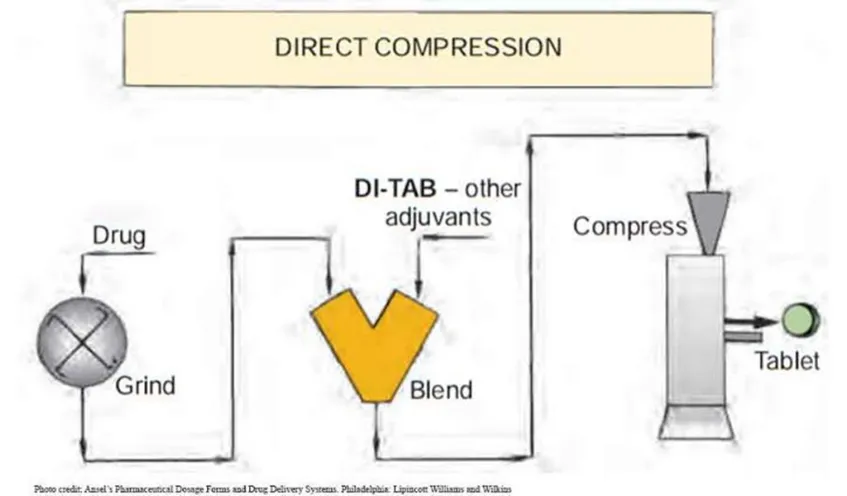
Figure 3: Direct Compression Method
6.2 WET GRANULATION.
Wet granulation is a tablet-manufacturing method in which a suitable granulating liquid is added to a powder mixture to form granules. The wet mass is then dried, sized, and compressed into tablets. This method can improve the flow and compressibility of powders. However, because it involves additional processing steps, it may be less suitable when a simple direct-compression method can be used effectively.12
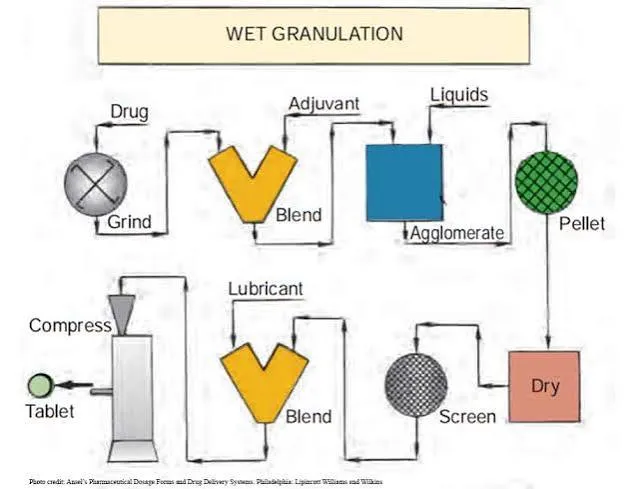
Figure 4: Wet Granulation Method
6.3 DRY GRANULATION.
Dry granulation is a method in which powder particles are compacted into granules without using a granulating liquid. It can be useful when the drug or excipients are sensitive to the moisture or heat involved in wet granulation. However, its suitability for a specific fast disintegrating tablet formulation depends on the properties of the granules produced and how they affect the tablet’s ability to disintegrate quickly.12
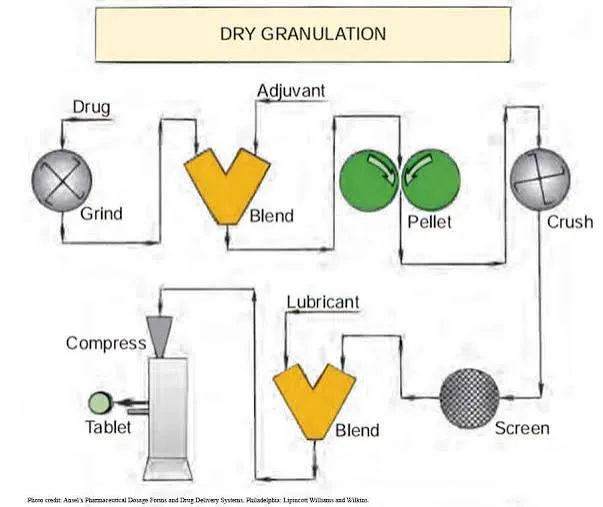
Figure 5: DRY Granulation Method
6.4 SPECIALIZED TECHNIQUES.
Specialized methods such as sublimation, spray drying, freeze drying, and other porous-tablet technologies have also been explored to improve the disintegration of orally disintegrating tablets. These techniques can produce tablets with greater porosity, allowing saliva or water to enter the tablet more quickly and promote rapid disintegration. However, compared with conventional direct compression, these methods may require specialized equipment and more controlled processing conditions.12
6.5 SELECTION OF MANUFACTURING TECHNIQUE.
The choice of manufacturing method should be based on the physicochemical properties of the drug, the characteristics of the excipients, and the desired performance of the final tablet. For cetirizine hydrochloride fast disintegrating tablets, published studies have shown that direct compression is a practical and suitable approach. Therefore, direct compression may be considered for further studies examining the combined effect of crospovidone and Ocimum canum seed mucilage. However, the suitability of this method should be confirmed by evaluating tablet quality, disintegration behaviour, and drug-release characteristics.
7. EVALUATION PARAMETERS OF FAST DISINTEGRATING TABLETS:
Evaluating fast disintegrating tablets is essential to assess their physical quality, mechanical strength, disintegration behaviour, and drug-release performance. An effective formulation should have acceptable tablet properties while still wetting and disintegrating rapidly. Common evaluation parameters include appearance, weight variation, thickness, hardness, friability, wetting time, disintegration time, drug content, and in-vitro dissolution.1,15
7.1 GENERAL APPEARANCE.
The prepared tablets are visually examined for their overall appearance, including their shape, colour, surface texture, and any visible defects such as cracks, chipping, or capping. A uniform appearance provides an initial indication that the tablets have been prepared consistently and are of acceptable quality.1
7.2 WEIGHT VARIATION.
Weight variation is measured to check whether the tablets have a uniform weight. Individual tablets are weighed and compared with the average tablet weight. Good weight uniformity indicates that the powder blend was mixed properly and filled consistently into the tablet die during compression.1
7.3 THICKNESS.
Tablet thickness is measured using an appropriate instrument, such as a vernier caliper or thickness gauge. Maintaining uniform thickness is important for consistent tablet dimensions and may also indicate whether compression was uniform during manufacturing.1
7.4 HARDNESS.
Hardness measures a tablet’s ability to resist breaking during handling, packaging, and transportation. Tablets should be strong enough to remain intact during these stages while still being able to disintegrate quickly after administration. If a tablet is too hard, water may enter it more slowly, which can increase its disintegration time.1
7.5 FRIABILITY.
Friability measures the tendency of tablets to lose small particles from their surface during handling. It is usually determined using a friability apparatus. A well-formulated fast disintegrating tablet should be resistant to abrasion and remain intact during handling while still disintegrating rapidly when administered.1
7.6 WETTING TIME.
Wetting time is an important parameter for fast disintegrating tablets because rapid wetting allows liquid to enter the tablet matrix more easily. A shorter wetting time usually indicates that the tablet interacts quickly with the surrounding liquid, which can support faster disintegration.1,14
7.7 DISINTEGRATION TIME.
Disintegration time is one of the most important quality parameters for fast disintegrating tablets. It refers to the time required for a tablet to break down into smaller particles under specified test conditions.
Several factors can affect disintegration behaviour, including the type and concentration of super disintegrant, tablet porosity, compression force, and the properties of other excipients used in the formulation.1,14
7.8 DRUG CONTENT.
Drug content, or content uniformity, is measured to confirm that each tablet contains the intended amount of the active pharmaceutical ingredient. For this test, a known quantity of powdered tablets is treated with a suitable solvent to extract the drug, which is then measured using an appropriate analytical method. Uniform drug content is essential to ensure that every tablet delivers a consistent dose.1
7.9 IN-VITRO DISSOLUTION.
In-vitro dissolution testing is used to measure how cetirizine hydrochloride is released from the tablet into a dissolution medium under specified conditions. These studies provide information about both the rate and extent of drug release. Dissolution testing is especially useful for comparing different tablet formulations and evaluating the effect of various super disintegrant concentrations on drug release.1
7.10 STABILITY STUDIES.
Stability studies are carried out to determine whether a formulation maintains acceptable physical and chemical properties during storage. At predetermined intervals and under specified storage conditions, tablets may be evaluated for parameters such as appearance, hardness, friability, disintegration time, and drug content.1,15
7.11 OVERALL IMPORTANCE OF EVALUATION.
No single test can fully determine the quality of a fast-disintegrating tablet. A suitable formulation should maintain the right balance between adequate mechanical strength, low friability, rapid wetting, short disintegration time, uniform drug content, and satisfactory drug release. Therefore, evaluating several parameters together is necessary to identify a formulation with reliable overall performance.1
Table 2: Evaluation Parameter. 1,19,20
| EVALUATION PARAMETER | PURPOSE |
|---|---|
| Angle of Repose | Used to determine the flow properties of the powder blend before compression |
| Bulk Density | Determines the mass of powder per unit bulk volume and helps assess powder packaging properties |
| Tapped Density | Determines powder density after tapping and is used to assess packaging and compressibility characteristics |
| Carr’s compressibility Index | Calculated from bulk and tapped densities to estimate powder compressibility and flow behavior. |
| Hausner Ratio | Calculated as the ratio of tapped density to bulk density and used to assess powder flow properties. |
| Weight Variation | Determines consistency in tablet weight by weighing individual tablets and comparing them with the average weight |
| Hardness/ Crushing strength | Measures the mechanical strength of tablets and their ability to withstand handling and transportation |
| Friability | Determines the tendency of tablets to lose mass due to abrasion or mechanical stress during handling |
| Thickness and Diameter | Measures tablet dimensions to assess physical uniformity between tablets |
| Disintegration Time | Measures the time required for a tablet to break down into smaller particles under specified test conditions. This is a key parameter for fast disintegrating tablets |
| Wetting Time | Measures the time required for liquid to penetrate and wet the tablet. Shorter wetting time may indicate faster disintegration |
| Water Absorption ratio | Estimates the amount of water absorbed by the tablet and helps assess its ability to take up liquid |
| Drug content | Determines whether the tablets contain the intended amount of Cetirizine Hydrochloride and whether drug content is consistent |
| Stability Studies | Assess changes in appearance, drug content, disintegration, dissolution and other quality attributes during storage |
CONCLUSION:
Fast-disintegrating tablets (FDTs) of cetirizine hydrochloride offer a convenient oral dosage form that may improve ease of administration and patient compliance. They disintegrate rapidly in the mouth in the presence of saliva, making them a potential alternative for patients who have difficulty swallowing conventional tablets, particularly children and older adults.
Successful development of cetirizine hydrochloride FDTs depends on the appropriate selection and optimization of excipients, particularly superdisintegrants, binders, and diluents. Superdisintegrants such as sodium starch glycolate can promote rapid tablet disintegration. Direct compression may be suitable when the drug and excipients possess appropriate flow and compression properties.
Evaluation of the prepared tablets is essential to confirm their quality and performance. Important tests include weight variation, hardness, friability, wetting time, disintegration time, and drug-content uniformity. In-vitro dissolution studies help assess the drug-release characteristics of the formulation, while drug–excipient compatibility and stability studies provide additional information about formulation suitability and product stability. Together, these tests help identify an optimized formulation with satisfactory physical properties and rapid disintegration.
In the study conducted by Sharma et al. (2014).5 cetirizine hydrochloride FDTs were successfully prepared using direct compression. The researchers optimized the concentration of sodium starch glycolate and evaluated different binders to obtain suitable tablet characteristics. Their findings showed that careful selection of excipients can produce tablets with rapid disintegration while maintaining an appropriate balance between disintegration time and mechanical strength. This approach may improve the convenience and acceptability of cetirizine administration.
Overall, cetirizine hydrochloride FDTs offer a useful approach for developing a convenient and patient-friendly dosage form. However, the final formulation should be selected only after proper experimental evaluation of disintegration, dissolution, drug content, compatibility, and stability. Although rapid disintegration can improve administration and drug release, it does not by itself prove a faster clinical onset or improved bioavailability. Further optimization and stability studies may help develop a robust formulation suitable for future pharmaceutical use.5,16
9. FUTURE PERSPECTIVES:
Future research on cetirizine hydrochloride fast disintegrating tablets may focus on optimizing natural and synthetic superdisintegrants to achieve rapid tablet disintegration without affecting tablet strength or drug-release properties.1,6,8 Plant-derived materials, such as Ocimum canum seed mucilage, may be further explored for their potential use as pharmaceutical excipients and for their compatibility with established synthetic superdisintegrants.⁷
Careful optimization of excipient concentration, compression conditions, and other formulation variables may help identify a suitable tablet formulation. Future studies could also include comparative formulation evaluation, in-vitro dissolution testing, and stability studies to assess the performance and storage characteristics of the developed tablets.1,15
10. IMPROVEMENT IN TASTE MASKING AND PATIENT ACCEPTABILITY:
Taste is an important factor in the development of fast disintegrating tablets because the formulation remains in the mouth briefly before it is swallowed. An unpleasant taste can reduce patient acceptance, especially among children.
Future research may focus on effective taste-masking methods, such as suitable sweeteners, flavouring agents, polymer coatings, and drug–resin complexes where appropriate. These methods should reduce the unpleasant taste without delaying tablet disintegration or affecting drug release.
For cetirizine hydrochloride formulations, different sweeteners and flavours can be evaluated along with suitable taste-masking technologies. Patient acceptability and mouthfeel should also be considered during formulation development. However, all taste-masking agents should be selected based on their compatibility, safety, and experimental evaluation.1,19
11. ENHANCEMENT OF DRUG DISSOLUTION AND BIOAVAILABILITY:
Although fast disintegrating tablets break down quickly in the mouth, rapid disintegration does not always mean that the drug will dissolve faster or show improved bioavailability. Drug dissolution and absorption also depend on the physicochemical properties of the active ingredient and the overall characteristics of the formulation.
Future research should therefore examine the relationship between disintegration time, in-vitro dissolution, and drug absorption. Where needed, suitable formulation strategies may be explored to improve drug dissolution without affecting the physical quality of the tablet.
For cetirizine hydrochloride, comparative dissolution studies can be carried out using different formulations and appropriate dissolution conditions. However, pharmacokinetic or bioavailability studies would be needed before concluding that an optimized formulation provides greater systemic drug exposure or a faster therapeutic effect.1,19
12. DEVELOPMENT OF ADVANCED MANUFACTURING TECHNOLOGIES:
Future advances in orally disintegrating tablet development may involve improvements in direct compression, freeze-drying, sublimation, and other manufacturing technologies. Each method has its own advantages and limitations related to production cost, processing time, equipment needs, tablet strength, and disintegration performance.
Direct compression is often attractive because it is relatively simple and requires fewer processing steps. However, factors such as powder flow, compressibility, segregation, and content uniformity must be carefully controlled. Other techniques may be considered when they offer specific advantages for a particular formulation.
Emerging technologies, including three-dimensional (3D) printing, may also create opportunities to produce tablets with customized shapes, internal structures, and drug-release characteristics. However, applying these technologies to cetirizine hydrochloride would require further studies on dose accuracy, manufacturing reproducibility, product quality, stability, and production cost.1,19
13. IMPROVEMENT IN STABILITY AND PACKAGING:
Fast disintegrating tablets can be sensitive to moisture and other environmental conditions, depending on their composition and method of manufacture. Moisture uptake during storage may affect tablet hardness, friability, disintegration time, and overall physical integrity.
Future studies should assess how temperature, relative humidity, light exposure, and storage duration affect the quality of cetirizine hydrochloride fast disintegrating tablets. Stability testing should monitor changes in appearance, drug content, degradation products, disintegration time, dissolution, and other relevant quality parameters.
Suitable packaging, such as moisture-protective blister packs or other protective systems, may help preserve tablet quality during storage. The final packaging choice should be based on the formulation’s stability profile and applicable regulatory requirements.20
14. CONFLICT OF INTEREST:
The authors declare no conflict of interest.
15. ACKNOWLEDGMENT:
The authors sincerely thank Ms. Prajkta A. Kate for her valuable guidance, constructive suggestions, and careful review of the manuscript. Her feedback and corrections helped improve the quality of this review article.
REFERENCES


Khan Saadullah Noorullah, Kate Prajkta S., Navale Sampat D., Formulation Development and Evaluation of Fast Disintegrating Tablets of Cetirizine Hydrochloride, Int. J. of Pharm. Sci., 2026, Vol 4, Issue 11, 2916-2930. https://doi.org/10.5281/zenodo.24332979
 10.5281/zenodo.24332979