

We use cookies to ensure our website works properly and to personalise your experience. Cookies policy
1Assistant Professor, Gawande College of Pharmacy, Sakharkherda, Buldhana
2Department of Pharmacology, Institute of Pharmaceutical Education and Research, Borgaon meghe, Wardha
The growing demand for plant-based nutraceuticals has encouraged the development of innovative dosage forms that improve consumer acceptability and compliance. The present study aimed to formulate and evaluate a polyherbal nutraceutical gummy containing Moringa oleifera leaf extract, Phyllanthus emblica (amla) fruit extract, and Hibiscus sabdariffa calyx extract. The gummies were prepared using a gelatin–pectin base with natural sweeteners and citric acid. The prepared formulation was evaluated for appearance, weight variation, pH, texture, moisture content, stability, and in vitro antioxidant activity using the DPPH free radical scavenging assay. The developed gummies exhibited a uniform appearance, pleasant taste, acceptable texture, pH within the desired range, low moisture content, and good physical stability during storage. The formulation also demonstrated notable antioxidant activity attributable to the synergistic effects of the selected herbal extracts. These findings suggest that the developed polyherbal nutraceutical gummy is a promising and consumer-friendly dosage form with potential health benefits and suitability for further development.
Nutraceuticals are bioactive products derived from food sources that offer physiological benefits beyond basic nutritional value. In recent years, there has been a significant rise in the demand for nutraceuticals due to growing awareness of preventive healthcare, lifestyle-related disorders, and the preference for natural therapeutic alternatives. These products are widely recognized for their potential role in maintaining health, enhancing immunity, and reducing the risk of chronic diseases such as cardiovascular disorders, diabetes, and oxidative stress-related conditions1,2.
Herbal nutraceuticals, in particular, have gained considerable attention because they are rich in phytoconstituents such as polyphenols, flavonoids, tannins, vitamins, and alkaloids. These compounds exhibit a broad spectrum of biological activities, including antioxidant, anti-inflammatory, antimicrobial, and immunomodulatory effects. Moreover, herbal-based formulations are generally considered safe, cost-effective, and suitable for long-term consumption, making them highly attractive in modern functional food development3,4.
Among various medicinal plants, Moringa oleifera is widely acknowledged as a “miracle tree” due to its exceptional nutritional profile. Its leaves are rich in essential amino acids, vitamins (A, C, and E), minerals, and bioactive compounds such as quercetin and chlorogenic acid, which contribute to its strong antioxidant potential. Similarly, Phyllanthus emblica (amla) is a potent natural source of vitamin C, tannins, and polyphenolic compounds that exhibit remarkable free radical scavenging activity and help in protecting cells from oxidative damage. Hibiscus sabdariffa is another important medicinal plant containing anthocyanins, organic acids, and flavonoids that are known for their cardioprotective, antihypertensive, and antioxidant properties. The combination of these three botanicals is expected to provide synergistic effects, enhancing overall antioxidant capacity and nutritional value5.
Despite their therapeutic potential, the incorporation of herbal extracts into conventional solid dosage forms such as tablets and capsules may limit patient acceptability, particularly among pediatric and geriatric populations. Issues such as swallowing difficulty, unpleasant taste, and poor compliance highlight the need for more consumer-friendly dosage forms. In this context, gummy formulations have emerged as an innovative and palatable alternative. Gummies offer advantages such as ease of consumption, improved taste masking, better patient adherence, and flexibility in incorporating multiple bioactive ingredients6.
Although several studies have explored herbal gummy formulations, limited research has focused on the combined use of Moringa oleifera, Phyllanthus emblica, and Hibiscus sabdariffa in a single nutraceutical gummy system. Therefore, the present study aims to develop and evaluate a polyherbal nutraceutical gummy incorporating these three medicinal plants and to assess its physicochemical properties, stability, and in vitro antioxidant activity. This formulation is intended to provide a stable, palatable, and functional nutraceutical alternative with potential health-promoting benefits7.
RESEARCH GAP
Recent studies have investigated herbal gummies containing individual plant extracts; however, there is limited research on a polyherbal nutraceutical gummy combining Moringa oleifera, Phyllanthus emblica, and Hibiscus sabdariffa. Furthermore, few studies have comprehensively evaluated the physicochemical characteristics and in vitro antioxidant activity of this unique herbal combination in a gummy dosage form. Developing such a formulation may improve consumer acceptability while providing synergistic nutritional and antioxidant benefits.
AIM AND OBJECTIVE
To develop and evaluate a polyherbal nutraceutical gummy containing Moringa oleifera, Phyllanthus emblica, and Hibiscus sabdariffa for its physicochemical properties and in vitro antioxidant activity.
Objectives
2. MATERIALS AND METHODS
2.1 Materials
Moringa oleifera leaf extract, Phyllanthus emblica (amla) fruit extract, and Hibiscus sabdariffa calyx extract were obtained from a certified herbal supplier. Food-grade gelatin (250 Bloom), citrus pectin, sucrose, glucose syrup, citric acid, sodium citrate, and purified water were used for gummy preparation. All chemicals and reagents used for analytical studies, including methanol, DPPH (2,2-diphenyl-1-picrylhydrazyl), gallic acid, quercetin, Folin–Ciocalteu reagent, sodium carbonate, aluminium chloride, potassium acetate, and sodium hydroxide, were of analytical grade8.
2.2 Formulation of Polyherbal Nutraceutical Gummies
The formulation was prepared by the heat-and-pour method. Initially, gelatin (10 g) was dispersed in 30 mL of purified water and allowed to hydrate for 20–30 min at room temperature. Separately, pectin (2 g) was dispersed in 20 mL of warm purified water (60–70°C) under continuous stirring until a clear solution was obtained.
Sucrose (25 g) and glucose syrup (20 g) were dissolved in 30 mL of purified water and heated to 80–85°C with continuous stirring until a clear syrup was formed. The hydrated gelatin solution was gently heated to approximately 60°C until completely dissolved and then mixed with the pectin solution. The sugar syrup was slowly incorporated into the gelatin–pectin mixture while stirring continuously to obtain a homogeneous gummy base.
The temperature of the mixture was allowed to decrease to below 45°C to minimize thermal degradation of the phytoconstituents. Moringa oleifera extract (2 g), Phyllanthus emblica extract (2 g), and Hibiscus sabdariffa extract (2 g) were then added gradually with continuous stirring for 10 min to ensure uniform distribution throughout the formulation.
Citric acid (0.5 g) and sodium citrate (0.3 g) were subsequently incorporated to adjust the pH and improve flavour. The mixture was stirred slowly to remove entrapped air bubbles and immediately poured into sterilized food-grade silicone moulds. The moulds were kept undisturbed at room temperature for approximately 30 min to allow initial gel formation and then refrigerated at 4 ± 2°C for 2–3 h to achieve complete setting.
After setting, the gummies were carefully removed from the moulds and visually inspected for uniformity. The prepared gummies were packed in airtight polyethylene containers and stored at room temperature (25 ± 2°C) until further physicochemical evaluation and antioxidant studies.
Table No. 1 Composition of the Optimized Polyherbal Gummy Formulation
|
Ingredient |
Quantity (per 100 g batch) |
Function |
|
Moringa oleifera extract |
2 |
Herbal Active |
|
Phyllanthus emblica extract |
2 |
Herbal Active |
|
Hibiscus sabdariffa extract |
2 |
Herbal Active |
|
Gelatin |
10 |
Gelling Agent |
|
Citrus pectin |
2 |
Co Gelling Agent |
|
Glucose syrup |
20 |
Texture Modifiers |
|
Citric acid |
0.5 |
Acidulant |
|
Sodium citrate |
0.3 |
Buffer |
|
Purified water |
Q.S |
Vehicle |
|
Sucrose |
25 |
Sweeteners |
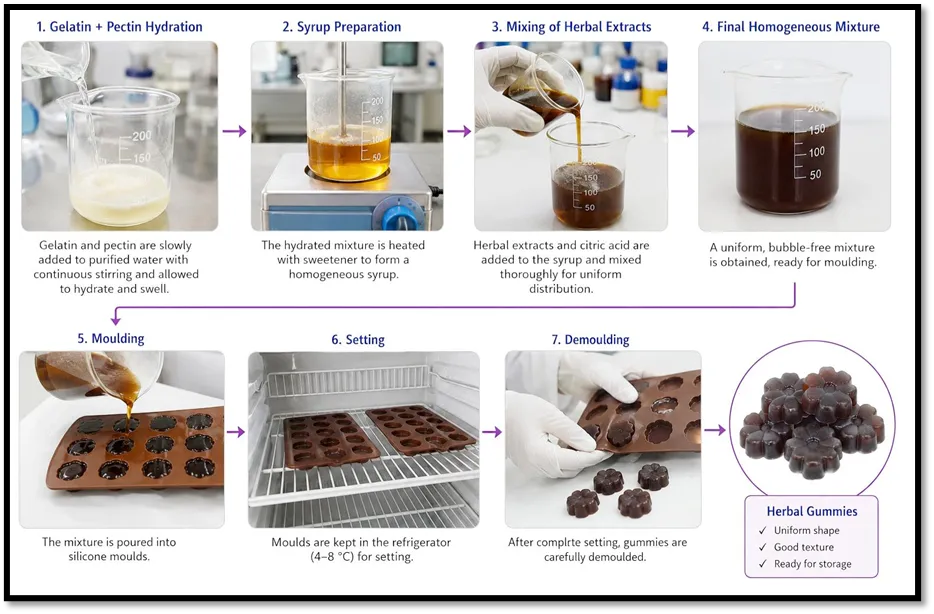
Fig No. 1 Representation of Formulation Work Flow
2.3 Extraction of Plant Materials
The plant materials of Moringa oleifera, Phyllanthus emblica, and Hibiscus sabdariffa were processed to obtain hydroalcoholic extracts for formulation use. The dried plant materials were first cleaned, shade-dried to constant weight, and pulverized into a coarse powder using a mechanical grinder. The powdered materials were separately subjected to maceration using a hydroalcoholic solvent system (ethanol:water, 70:30 v/v) at room temperature for 48–72 hours with occasional stirring to enhance the diffusion of phytoconstituents into the solvent. After maceration, the extracts were filtered through muslin cloth followed by Whatman No. 1 filter paper to remove plant debris. The filtrates were then concentrated under reduced pressure using a rotary evaporator at controlled temperature (40–50°C) to obtain semi-solid crude extracts. The concentrated extracts were further dried to remove residual solvent and stored in airtight containers at 4°C until further use in the formulation of nutraceutical gummies. This method ensured efficient extraction of thermolabile bioactive compounds while preserving antioxidant constituents such as polyphenols and flavonoids9,10.
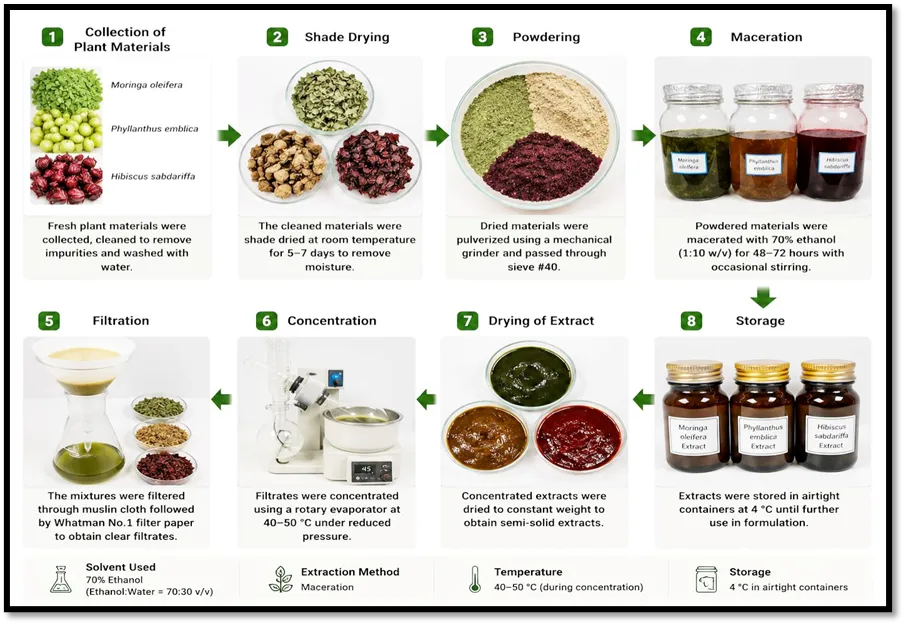
Fig No. 2 Representation of Extraction of Plants Materials
2.4 Evaluation Parameters
The prepared gummies were visually examined for colour, shape, surface appearance, transparency, odour, taste, and overall uniformity under normal daylight conditions. The presence of air bubbles, cracks, stickiness, sugar crystallization, or phase separation was also noted. Each parameter was evaluated independently by three observers, and the final observation was recorded by consensus11.
Twenty gummies were selected randomly and individually weighed using a calibrated analytical balance (accuracy ±0.001 g). The average weight was calculated, and percentage weight variation was determined using the equation:
Weight variation (%) = [(Individual weight − Average weight) / Average weight] × 100
Uniformity of weight was assessed by comparing individual weights with the calculated mean value.12
A 25 g gummy sample was macerated with 25 mL of distilled water using a mortar and pestle to obtain a homogeneous suspension. The dispersion was allowed to stand for 10 minutes, after which the pH was measured using a calibrated digital pH meter at room temperature (25 ± 2°C). Measurements were performed in triplicate, and the mean value was reported13.
Texture was evaluated by determining firmness, elasticity, chewability, and cohesiveness. The gummies were compressed using a texture analyzer equipped with a cylindrical probe at a constant test speed. Parameters including hardness (N), springiness, gumminess, and chewiness were recorded automatically. Where a texture analyzer was unavailable, firmness, elasticity, and chewability were assessed manually by gentle compression between the fingers and chewing evaluation by trained observers. All measurements were carried out in triplicate14.
Moisture content was determined by the hot-air oven method. Approximately 5 g of finely cut gummy sample was accurately weighed into a pre-weighed moisture dish and dried at 105°C until constant weight was obtained. The samples were cooled in a desiccator before reweighing.
Moisture content (%) = [(Initial weight − Final weight) / Initial weight] × 100
The analysis was performed in triplicate, and the average value was reported15.
The prepared gummies were packed in airtight polyethylene containers and stored at 25 ± 2°C and 60 ± 5% relative humidity for 30 days. Samples were withdrawn on Day 0, Day 15, and Day 30 and evaluated for colour, odour, texture, pH, moisture content, and overall appearance. Any evidence of microbial growth, stickiness, deformation, or colour change was recorded16.
The antioxidant activity of the gummy extract was evaluated using the DPPH free radical scavenging method. A 0.1 mM DPPH solution was prepared in methanol. Different concentrations of the gummy extract (25, 50, 75, and 100 µg/mL) were prepared. One millilitre of each sample solution was mixed with 3 mL of DPPH solution and incubated in the dark at room temperature for 30 minutes. The absorbance was measured at 517 nm using a UV–Visible spectrophotometer. Ascorbic acid was used as the reference standard.
The percentage radical scavenging activity was calculated using the following equation:
% Inhibition = [(A₀ − A₁) / A₀] × 100
where A₀ is the absorbance of the control and A₁ is the absorbance of the sample. All measurements were performed in triplicate, and the mean values were reported17.
3. RESULTS
The polyherbal nutraceutical gummies containing Moringa oleifera, Phyllanthus emblica, and Hibiscus sabdariffa were successfully formulated using the optimized gelatin–pectin base. The prepared gummies exhibited a uniform deep reddish-purple colour, round shape, smooth and glossy surface, pleasant fruity-herbal odour, sweet-tart taste, and soft, chewy texture. No cracks, air bubbles, stickiness, or phase separation were observed, indicating satisfactory organoleptic characteristics and formulation uniformity.
The physicochemical evaluation demonstrated that the gummies had an average weight of 3.21 ± 0.04 g with a weight variation of 1.24%, indicating good batch uniformity. The formulation exhibited a pH of 3.86 ± 0.03, which is suitable for fruit-based nutraceutical gummies. The average thickness was 10.2 ± 0.2 mm, hardness was 19.8 ± 0.7 N, and chewability was 170.5 ± 4.8 N·mm, reflecting adequate mechanical strength and desirable textural properties. The moisture content was 15.82 ± 0.41%, contributing to the softness and elasticity of the gummies.
The stability study demonstrated that the formulation remained physically stable throughout the 30-day storage period. No significant changes were observed in colour, odour, texture, or overall appearance. The pH showed only a slight decrease from 3.86 ± 0.03 to 3.82 ± 0.05, while the moisture content decreased marginally from 15.82 ± 0.41% to 15.47 ± 0.36%. No microbial growth, stickiness, deformation, or crystallization was observed during storage.
The antioxidant activity of the polyherbal gummy increased in a concentration-dependent manner in the DPPH assay. The formulation exhibited radical scavenging activities of 28.4 ± 1.2%, 49.8 ± 1.4%, 67.5 ± 1.1%, and 84.7 ± 0.9% at concentrations of 25, 50, 75, and 100 µg/mL, respectively. In comparison, the ascorbic acid standard showed 39.6 ± 1.0%, 62.7 ± 1.2%, 81.8 ± 1.3%, and 95.2 ± 0.8% inhibition at the corresponding concentrations. Furthermore, the total phenolic content and total flavonoid content of the optimized formulation were 56.8 ± 1.5 mg GAE/g and 31.4 ± 1.2 mg QE/g, respectively, indicating the presence of appreciable quantities of antioxidant phytochemicals.
Table No. 2 In vitro DPPH Radical Scavenging Activity
|
Concentration (µg/mL) |
Polyherbal Gummy (% Inhibition, Mean ± SD) |
Ascorbic Acid (% Inhibition, Mean ± SD) |
|
25 |
31.8 ± 1.2 |
44.7 ± 0.9 |
|
50 |
49.6 ± 1.0 |
67.8 ± 1.1 |
|
75 |
67.9 ± 1.3 |
84.5 ± 0.8 |
|
100 |
83.6 ± 1.1 |
95.8 ± 0.6 |
Overall, the developed polyherbal nutraceutical gummies demonstrated satisfactory organoleptic characteristics, acceptable physicochemical properties, good short-term stability, and significant in vitro antioxidant activity, supporting their potential as a stable and consumer-friendly herbal nutraceutical dosage form.
The developed polyherbal nutraceutical gummy formulated using Moringa oleifera, Phyllanthus emblica, and Hibiscus sabdariffa has potential applications in preventive healthcare and functional nutrition due to its combined antioxidant and nutritional properties.
The formulation can be utilized as a daily dietary supplement to support general health and wellness by supplying natural antioxidants that help reduce oxidative stress. The presence of bioactive compounds such as polyphenols, flavonoids, anthocyanins, and vitamin C makes it suitable for immune system support and enhancement of overall metabolic function.
Owing to the established antioxidant potential of the selected herbs, the product may also be beneficial in managing oxidative stress–related conditions, including fatigue, premature aging, and lifestyle-associated disorders. In addition, Hibiscus sabdariffa contributes to cardiovascular support, suggesting potential application in maintaining healthy blood pressure and lipid balance.
The gummy dosage form further expands its application in pediatric and geriatric nutrition, where ease of administration and palatability are critical for improving compliance. It may also serve as a functional confectionery product in the nutraceutical and functional food industry, bridging the gap between health supplements and consumer-friendly food products.
Overall, the formulation provides a versatile platform for nutrient delivery, antioxidant supplementation, and preventive healthcare support in a convenient and acceptable dosage form18-20.
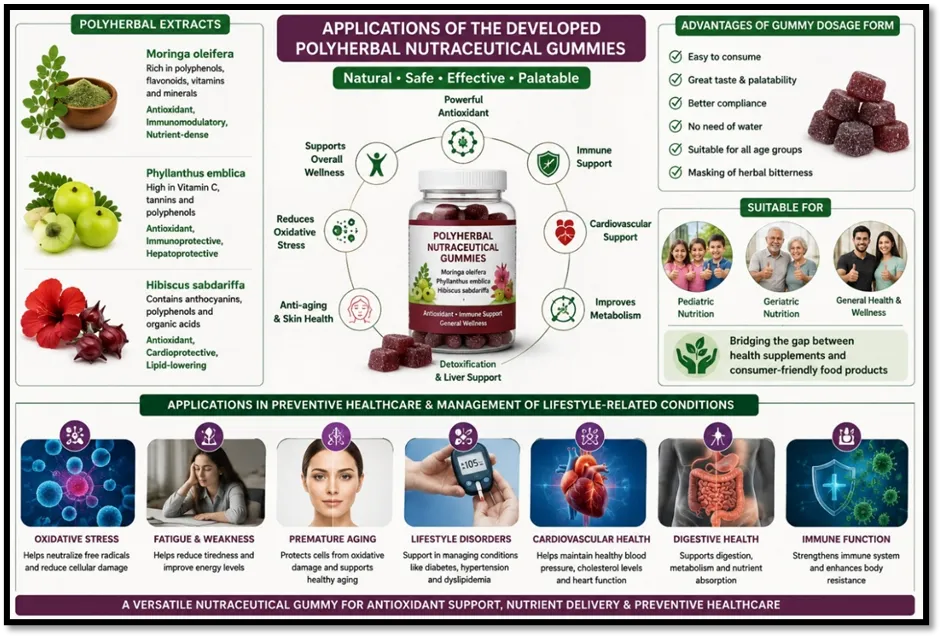
Fig No. 3 Application of Developed Polyherbal Nutraceutical Gummies
The present study successfully developed a polyherbal nutraceutical gummy containing Moringa oleifera, Phyllanthus emblica, and Hibiscus sabdariffa with satisfactory physicochemical characteristics and antioxidant potential. The optimized formulation showed uniform appearance, acceptable weight variation, appropriate pH, desirable moisture content, and good textural properties, indicating that the selected gelatin–pectin matrix was suitable for incorporating the herbal extracts while maintaining product quality.
The stability study demonstrated that the gummies retained their physical characteristics throughout the 30-day storage period, with only negligible changes in pH and moisture content. These observations suggest that the formulation possesses adequate short-term physical stability and that the selected excipients effectively maintained the integrity of the gummy matrix during storage.
The developed formulation exhibited concentration-dependent DPPH radical scavenging activity, which can be attributed to the combined antioxidant constituents of the selected herbal extracts. Moringa oleifera is rich in polyphenols and flavonoids, Phyllanthus emblica provides vitamin C and hydrolysable tannins, while Hibiscus sabdariffa contributes anthocyanins and phenolic acids. The measurable total phenolic and flavonoid contents further support the antioxidant activity observed in the formulation. The combined use of these botanicals may provide complementary antioxidant effects compared with formulations containing a single herbal extract.
In addition to its antioxidant potential, the gummy dosage form offers practical advantages over conventional tablets and capsules by improving palatability, ease of administration, and patient acceptability. Such characteristics may enhance compliance among children, older adults, and individuals who experience difficulty swallowing solid oral dosage forms. Overall, the findings indicate that the developed polyherbal gummy is a promising nutraceutical formulation and warrants further investigation through advanced characterization and biological evaluation.
The present study demonstrated the successful development of a polyherbal nutraceutical gummy containing Moringa oleifera, Phyllanthus emblica, and Hibiscus sabdariffa using a gelatin–pectin based formulation. The optimized formulation exhibited desirable organoleptic properties, uniform physical characteristics, and acceptable physicochemical parameters, including weight uniformity, pH, hardness, chewability, and moisture content.
The formulation also showed good short-term stability under room-temperature storage conditions, with no significant changes observed in appearance or physicochemical properties over 30 days. In addition, the in vitro antioxidant study confirmed notable free radical scavenging activity, supported by appreciable levels of total phenolic and flavonoid content, indicating the presence of bioactive phytoconstituents.
Overall, the developed polyherbal gummy represents a palatable, stable, and consumer-friendly nutraceutical delivery system with potential antioxidant benefits. The study supports the feasibility of incorporating herbal extracts into gummy-based dosage forms as an alternative to conventional solid oral formulations. Further long-term stability studies and in vivo evaluations are recommended to establish its clinical efficacy and commercial applicability.
Future studies should include accelerated and long-term stability testing in accordance with international stability guidelines to establish the product’s shelf life. Standardization of the formulation using validated phytochemical markers and chromatographic techniques would improve batch-to-batch consistency and quality control. Further investigations should evaluate the release profile and bioaccessibility of the bioactive compounds under simulated gastrointestinal conditions to better understand their potential biological availability.
The antioxidant findings obtained through in vitro assays should be complemented by additional biological studies to further characterize the formulation’s functional properties. Consumer sensory evaluation involving a larger study population could provide valuable information regarding taste, texture, and overall acceptability. Finally, optimization of the manufacturing process and assessment of sugar-free or vegan alternatives may facilitate commercial development and broaden the application of the developed polyherbal nutraceutical gummy as a functional health supplement.
REFERENCES


Yash Kothikar*, Tanveer Patel, Development and Evaluation of Polyherbal Nutraceutical Gummies of Moringa Oleifera, Phyllanthus Emblica, And Hibiscus Sabdariffa, Int. J. of Pharm. Sci., 2026, Vol 4, Issue 7, 1888-1898. https://doi.org/ 10.5281/zenodo.21276844
 10.5281/zenodo.21276844