

We use cookies to ensure our website works properly and to personalise your experience. Cookies policy
Kalyani Charitable Trust’s R.G Sapkal College of Pharmacy, Sapkal Knowledge Hub, Kalyani Hills, Anjaneri, Trimbakeshwar Rd, Nashik, 422213, Maharashtra, India
Amlodipine besylate (AB), a third-generation dihydropyridine calcium-channel blocker, remains one of the most widely prescribed antihypertensive and anti-anginal agents worldwide 1,2. Reliable, sensitive and environmentally responsible analytical methods are essential for its routine quality control in bulk drug substance and finished tablet dosage forms. Conventional reversed-phase high-performance liquid chromatography (RP-HPLC) assays for amlodipine typically rely on large volumes of acetonitrile or methanol and are optimized empirically, one factor at a time, which offers limited assurance of robustness across the normal range of operating conditions. This review synthesizes the literature on Analytical Quality by Design (AQbD) and Green Analytical Chemistry (GAC) as applied to amlodipine assay development, and proposes an integrated framework for developing, optimizing and validating an eco-friendly RP-HPLC method for amlodipine in bulk and tablet form. The framework combines definition of an Analytical Target Profile (ATP), risk-based identification of critical method parameters using Ishikawa/failure-mode-and-effect analysis, Design-of-Experiments-based optimization (e.g., Box–Behnken or central composite design), replacement of acetonitrile with a greener solvent system (e.g., ethanol or reduced-solvent isocratic elution), validation according to ICH Q2(R2)/Q14 8,9, and greenness scoring using the Green Analytical Procedure Index (GAPI) and Analytical GREEnness (AGREE) metrics 15,16. Representative published AQbD-based amlodipine methods report retention times under 6 minutes, correlation coefficients ?0.999, accuracy of 98–102% and RSD values below 2% [[11–14]], illustrating the attainability of the proposed approach. A green, QbD-optimized RP-HPLC method built on this framework is expected to combine regulatory-grade robustness with reduced solvent toxicity, lower operating cost, and a favourable environmental footprint, making it suitable for routine pharmacopeial-style quality control of amlodipine bulk drug and tablets.
1.1 Amlodipine besylate: pharmacological profile
Amlodipine is an orally active, long-acting dihydropyridine calcium-channel blocker that inhibits the trans-membrane influx of calcium ions into vascular and, to a lesser extent, cardiac smooth muscle by binding at both dihydropyridine and non-dihydropyridine sites on L-type calcium channels 3,4. Its slow rate of association/dissociation with the receptor produces a gradual onset and a long duration of antihypertensive action, permitting once-daily dosing with an elimination half-life of approximately 30–50 hours 3. Amlodipine is marketed as the besylate salt, first approved by the US FDA in 1987, and is indicated as first-line therapy for hypertension and for chronic stable or vasospastic angina, either alone or combined with other antihypertensive classes such as angiotensin receptor blockers and thiazide diuretics 1,3,4.
1.2 Physicochemical properties relevant to method development
Amlodipine besylate is a white to off-white crystalline powder with a molecular weight of approximately 567.1 g/mol; it is only slightly soluble in water and sparingly soluble in ethanol 4. The free base has a pKa of approximately 8.6, meaning the molecule exists predominantly in its ionized form across the physiological and typical chromatographic pH range 4; this has direct consequences for peak shape and retention behaviour in RP-HPLC and often necessitates buffered, acidic mobile phases or the addition of ion-pairing/silanol-blocking agents such as triethylamine to minimise peak tailing on unencapped C18 stationary phases 14. The molecule possesses a single chiral centre and is marketed as a racemate, with UV absorbance maxima commonly exploited for detection in the 230–240 nm region 1,11,14. These properties collectively define the “design space” that an AQbD program must explore pH, buffer type/strength, organic-modifier identity and percentage, column chemistry, and temperature.
1.3 Need for a validated, quality-control-grade analytical method
Because amlodipine is formulated alone and in numerous fixed-dose combinations (with valsartan, olmesartan, hydrochlorothiazide, atorvastatin, telmisartan, lisinopril, and others), pharmacopeial and in-house quality-control laboratories require a assay that is simple, selective, sufficiently sensitive, and robust enough to tolerate the normal day-to-day variability of a QC laboratory [[12–14]]. A method that has been “validated” in the traditional sense shown to meet ICH Q2 acceptance criteria at one set of conditions does not guarantee that it will continue to perform acceptably when reagents, columns, or instruments are changed within normal operating tolerances. This gap is the central motivation for adopting a QbD approach to method development 6,7.
1.4 Rationale for an Analytical Quality by Design (AQbD) approach
Analytical Quality by Design extends the QbD philosophy first articulated for pharmaceutical manufacturing (ICH Q8–Q11) to analytical procedures. Rather than optimizing a method empirically and validating it at a single, fixed set of conditions, AQbD defines an Analytical Target Profile, identifies Critical Analytical Attributes (CAAs) and Critical Method Parameters (CMPs) through structured risk assessment, and uses Design of Experiments to map how CMPs influence CAAs across a multidimensional “design space” or Method Operable Design Region (MODR) 6,7,10. Operating within this region provides prospective assurance of robustness and supports more flexible, science- and risk-based post-approval change management, an approach now formally endorsed by ICH Q14 (Analytical Procedure Development) alongside the revised ICH Q2(R2) validation guideline, both adopted in November 2023 8,9.
1.5 Rationale for green analytical chemistry in HPLC method development
Conventional RP-HPLC assays for amlodipine and related dihydropyridines commonly rely on acetonitrile–buffer or acetonitrile–methanol–buffer mobile phases 11,14,17. Acetonitrile is classified as an ICH Class 2 solvent whose use should be limited because of its toxicity, and both acetonitrile and methanol carry occupational-exposure and environmental-disposal burdens when consumed in the volumes typical of routine QC testing 11,17. Green Analytical Chemistry (GAC) seeks to reduce these burdens through solvent substitution (e.g., ethanol, isopropanol, or aqueous-rich mobile phases), reduced flow rates and run times, and miniaturization without compromising method performance 17. Quantitative greenness-assessment tools such as the Green Analytical Procedure Index (GAPI) and the Analytical GREEnness (AGREE) metric now allow this environmental performance to be reported alongside conventional validation data, giving reviewers and readers an objective basis for comparison 15,16.
1.6 Objective and scope of this review
This review (i) summarises previously reported analytical approaches for amlodipine, with emphasis on RP-HPLC and QbD-based methods; (ii) describes, step by step, an AQbD workflow suited to amlodipine assay development; (iii) outlines the principles and tools of green analytical chemistry relevant to mobile-phase and method design; and (iv) proposes a structured protocol including materials, chromatographic conditions, validation plan per ICH Q2(R2), and application to bulk drug and marketed tablets that can be executed and reported as an eco-friendly, QbD-optimized RP-HPLC method for amlodipine. The intention is to provide both a critical literature synthesis and a ready-to-execute experimental template for laboratories undertaking this work.
2. LITERATURE REVIEW:
2.1 Reported analytical methods for amlodipine estimation
A wide range of analytical techniques has been reported for amlodipine, reflecting both its clinical importance and its frequent presence in fixed-dose combination products. UV-spectrophotometric and HPTLC methods offer simplicity and low cost for single-component assay, while LC–MS/MS methods are used for bioanalytical and trace-level applications. RP-HPLC remains the workhorse technique for pharmacopeial and in-house quality control because of its selectivity, precision, and compatibility with UV detection at the drug's absorbance maximum. Early RP-HPLC assays, such as that of Zarghi et al., used acetonitrile–phosphate buffer mobile phases with UV detection near 239 nm for bioanalytical quantification of amlodipine in plasma 19, while Dinda et al. reported a conventional RP-HPLC assay for amlodipine besylate in bulk and pharmaceutical formulations without any AQbD or green-chemistry element 18. These early methods established the feasibility of RP-HPLC for amlodipine but were optimized empirically and validated only at the conditions used for development, without systematic exploration of robustness.
2.2 Reported RP-HPLC and UPLC methods: mobile phase, column and validation status
Several more recent reports incorporate elements of QbD, DoE, or green chemistry. Ibrahim et al. developed and validated an eco-friendly, stability-indicating UPLC method for amlodipine besylate using a 3² full-factorial design to optimize methanol percentage and column temperature against retention time, peak area and resolution as critical quality attributes; the optimized method (60% methanol, 25 °C) eluted amlodipine at 5.37 ± 0.21 min with r² = 0.994, and its greenness was quantified using the HPLC-Environmental Assessment Tool (HPLC-EAT), giving a low score of 2.91 on a 1–10 scale 11. Alshora et al. reported a UPLC method for the simultaneous quantification of hydrochlorothiazide, amlodipine besylate and valsartan in a marketed fixed-dose combination tablet 12. Babar, Padwal and Bachute applied a Box–Behnken design within an AQbD framework to optimize a phosphate-buffer/methanol mobile phase (25:75 v/v, pH 6.5, 1 mL/min) for the simultaneous RP-HPLC estimation of amlodipine besylate and lisinopril dihydrate, achieving baseline resolution (retention times 2.332 and 3.584 min), linearity from 10–50 μg/mL (r² = 0.999), accuracy of 99.75–100.04%, and intra-/inter-day precision below 2% RSD 13. Most recently, Horyn et al. used a QbD approach to develop and validate a single RP-HPLC method for the simultaneous determination of five dihydropyridine calcium-channel blockers amlodipine, nifedipine, lercanidipine, nimodipine and nitrendipine on a Luna C8 column with an acetonitrile–methanol–0.7% triethylamine mobile phase at pH 3.06, achieving linearity with r² ≥ 0.9989 across all five analytes 14.
2.3 Reported QbD-based method developments for amlodipine and structurally related drugs
Beyond the amlodipine-specific literature, the broader analytical QbD literature provides methodological precedent. Karmarkar et al. described one of the earlier structured applications of QbD to a stability-indicating HPLC method for a drug and its impurities, formally linking risk assessment, DoE-based optimization and a defined design space to method robustness 6. Thakor and Amrutkar reviewed the implementation of QbD principles specifically in chromatographic method development, describing the sequential use of ATP definition, CAA/CMP identification via fishbone or Ishikawa analysis, and DoE-based design-space mapping 7. Kamal et al. demonstrated the integration of QbD with green-chemistry optimization in a single HPLC workflow for the simultaneous determination of fluorescein and benoxinate, illustrating that robustness (via QbD) and environmental performance (via GAC) can be pursued concurrently rather than as competing objectives 10.
2.4 Reported green analytical methods relevant to amlodipine
Green analytical chemistry approaches for RP-HPLC have increasingly focused on solvent substitution. Yabré et al. comprehensively reviewed strategies for greening RP-HPLC methods for pharmaceutical analysis, concluding that replacement of acetonitrile and methanol with ethanol is currently the most practical and widely applicable greening strategy, since ethanol is comparatively inexpensive, less toxic, and compatible with classical RP-HPLC method-development workflows, while totally aqueous mobile phases, micellar liquid chromatography and ionic-liquid-modified eluents represent complementary but less broadly adopted alternatives 17. Within the amlodipine literature specifically, the HPLC-EAT-scored UPLC method of Ibrahim et al. is, to date, one of the few reports that both quantifies and reports the greenness of an amlodipine RP/UPLC assay using a formal metric rather than qualitative claims 11.
2.5 Research gap
Taken together, the literature shows: (i) multiple validated RP-HPLC/UPLC methods for amlodipine alone or in combination, but relatively few that apply a full AQbD workflow (ATP → risk assessment → DoE → design space) specifically to single-component amlodipine assay in bulk drug and tablets; (ii) even fewer methods that simultaneously report a quantitative greenness score (GAPI/AGREE/HPLC-EAT) alongside conventional ICH-style validation data; and (iii) limited use of the newest ICH Q14/Q2(R2) framework (finalized November 2023), which several amlodipine-specific papers pre-date [[8,9,11–14]]. This review addresses that gap by proposing an integrated AQbD + GAC protocol, referenced against current ICH guidance, specifically for amlodipine in bulk and tablet dosage form.
3. ANALYTICAL QUALITY BY DESIGN (AQBD) METHODOLOGY:
3.1 Concept and principles
AQbD is a systematic, science- and risk-based approach to analytical method development in which method performance is engineered in from the outset rather than tested for after the fact [[6–9]]. The workflow proceeds from a predefined analytical goal (the ATP), through identification of the attributes and parameters that most influence that goal, to experimentation that maps their relationship, and finally to a defined operating region within which the method is guaranteed by design to perform acceptably. Figure 2 summarises this workflow as applied to an amlodipine RP-HPLC assay.
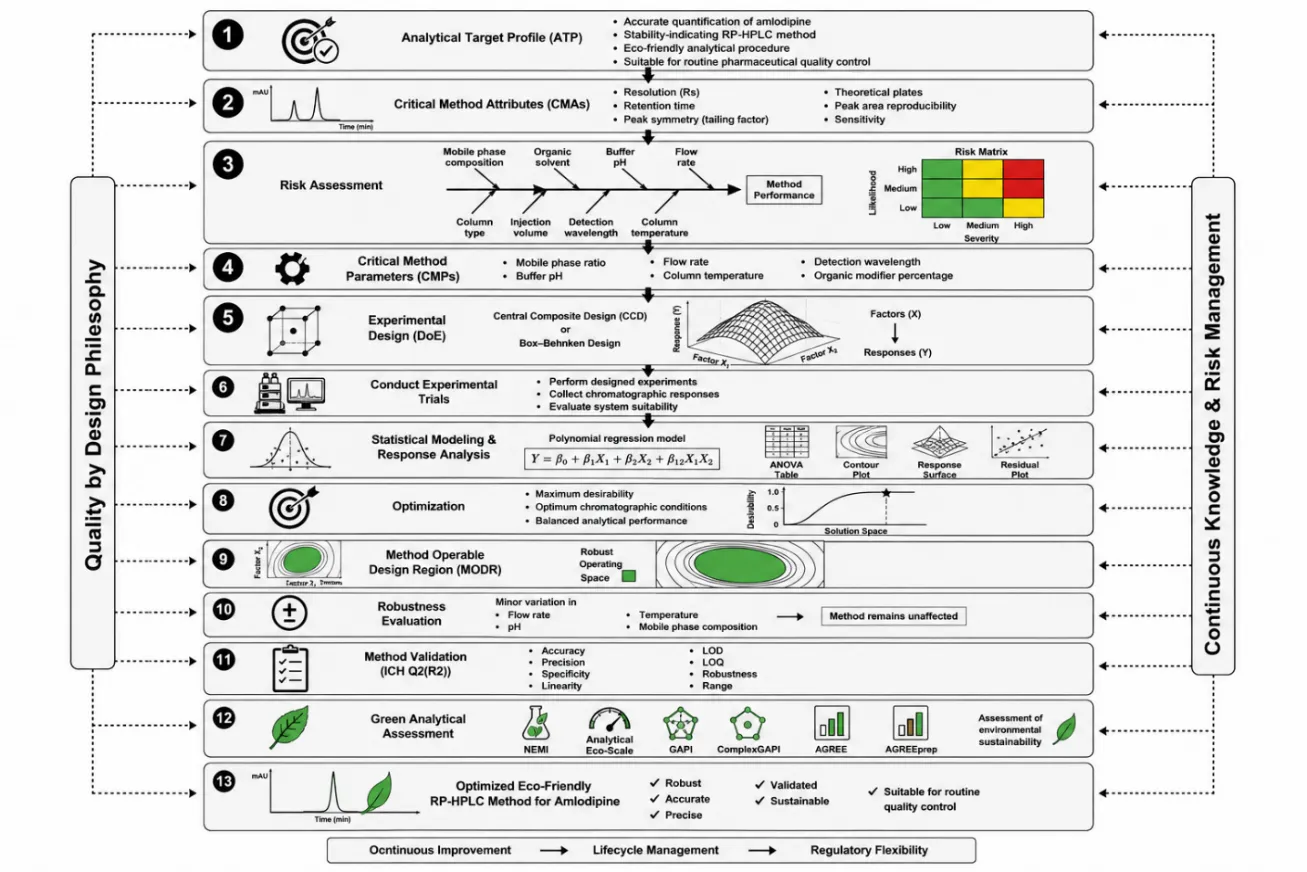
Figure 2. Schematic Analytical Quality by Design (AQbD) workflow proposed for development of the eco-friendly amlodipine RP-HPLC method, adapted from the general AQbD sequence described by Thakor and Amrutkar 7 and Karmarkar et al. 6, and aligned with ICH Q14 8.
3.2 Analytical Target Profile (ATP)
The ATP is a prospective statement of the performance the finished method must deliver, independent of the specific technique chosen. For the present application, a representative ATP would specify: quantitative determination of amlodipine besylate in bulk drug substance and tablet dosage form, over a concentration range covering 50–150% of the label claim, with accuracy of 98–102% recovery, precision (RSD) ≤ 2%, specificity in the presence of excipients and (where a stability-indicating claim is required) degradation products, and a total analysis time and solvent consumption consistent with green-chemistry objectives.
3.3 Identification of Critical Analytical Attributes (CAAs)
From the ATP, measurable CAAs are derived: retention time of amlodipine, peak area/height (linked to sensitivity), resolution from the nearest interfering peak (excipient, degradant, or system peak), theoretical plate count, tailing factor, and total run time. These correspond closely to the CAAs used in the published amlodipine QbD literature retention time, peak area and resolution were the explicit responses optimized by both Ibrahim et al. 11 and Babar et al. 13.
3.4 Risk assessment: identifying Critical Method Parameters (CMPs)
A structured risk-assessment tool typically an Ishikawa (fishbone) diagram supplemented by failure-mode-and-effects analysis (FMEA) is used to systematically enumerate factors that could influence the CAAs and to rank them by severity, occurrence and detectability 6,7. Figure 3 presents a representative Ishikawa diagram for an amlodipine RP-HPLC assay, organized around mobile-phase composition, column, instrument and sample/method categories. Mobile-phase pH, organic-modifier percentage (and identity conventional acetonitrile/methanol versus a greener alternative such as ethanol), buffer strength, flow rate and column temperature are typically identified as high-risk CMPs for a basic, ionizable dihydropyridine such as amlodipine, consistent with the parameters actually varied in the published DoE studies 11,13,14.
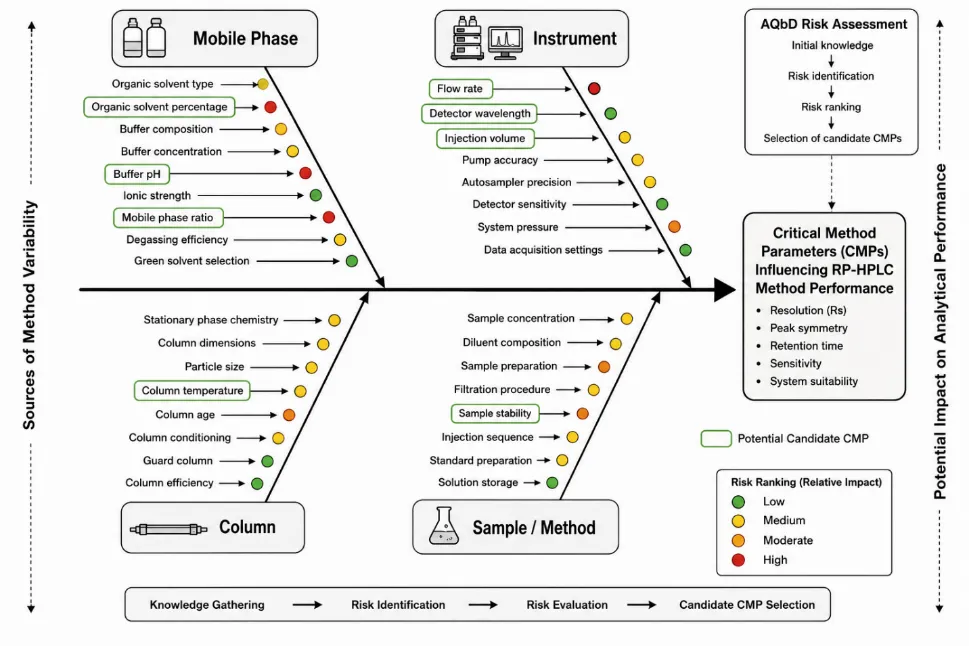
Figure 3. Ishikawa (fishbone) risk-assessment diagram identifying candidate critical method parameters (CMPs) for the amlodipine RP-HPLC assay, grouped by mobile phase, column, instrument, and sample/method categories.
3.5 Design of Experiments (DoE): screening and optimization
Following risk ranking, a screening design (e.g., a fractional factorial or Plackett–Burman design) can be used to confirm which CMPs have a statistically significant effect on the CAAs, after which a response-surface optimization design most commonly a Box–Behnken design (BBD) or central composite design (CCD) is used to model the relationship quantitatively and locate the optimum. Published amlodipine work has used a 3² full-factorial design (two factors, three levels) 11 and a Box–Behnken design (three factors) 13; the dihydropyridine multi-analyte method of Horyn et al. likewise used a formal QbD/DoE optimization to resolve five structurally related calcium-channel blockers on a single run 14. Figure 4 illustrates, schematically, the type of design matrix and quadratic response surface generated at this stage; the exact coefficients must be derived from the investigator's own experimental runs and must not be taken from this illustrative figure.
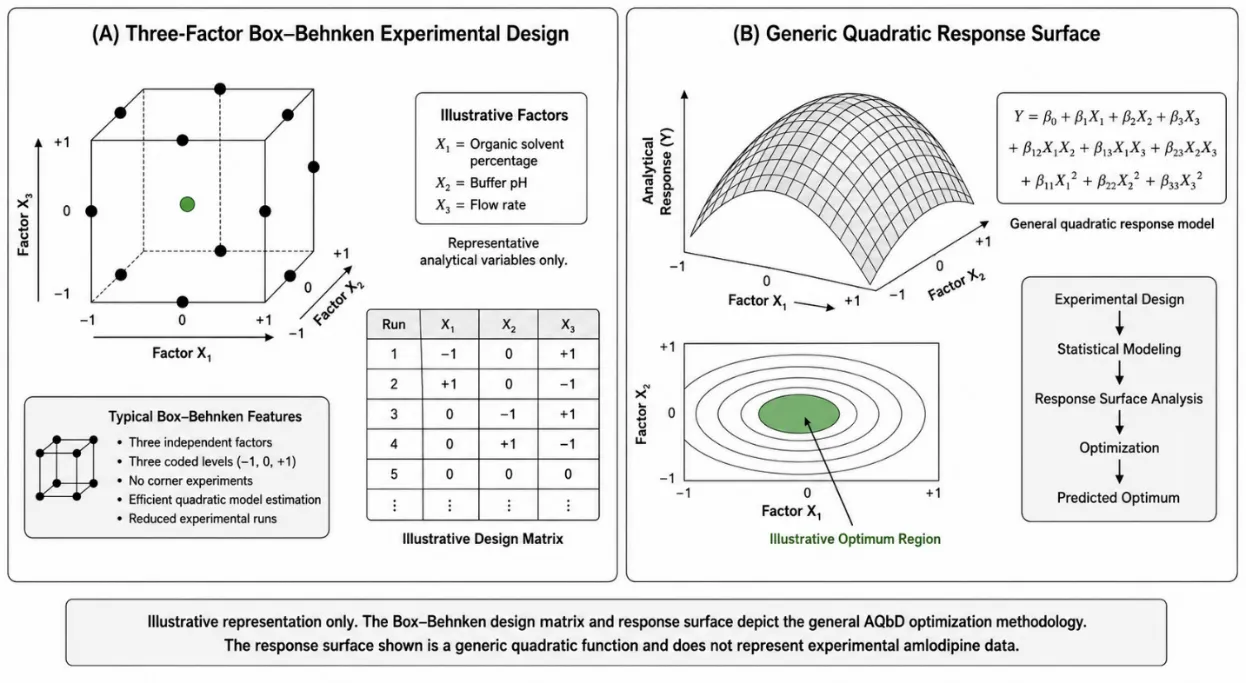
Figure 4. Schematic illustration of (A) a three-factor Box–Behnken design matrix and (B) the general quadratic response-surface form fitted during optimization. This figure is illustrative of the design methodology only; the surface shown is a generic quadratic function and does not represent experimental amlodipine data.
3.6 Design space and Method Operable Design Region (MODR)
Once the fitted response-surface models are validated (e.g., by ANOVA lack-of-fit testing and adequate R²/adjusted-R² values), the design space or MODR is defined as the multidimensional combination of CMP settings within which all CAAs simultaneously meet their acceptance criteria with an acceptable probability. Operating anywhere within this region, rather than at a single fixed point, is the core deliverable of AQbD and the basis for the flexible change-management provisions described in ICH Q14 8.
3.7 Control strategy
A control strategy translates the design space into practical laboratory controls system suitability criteria, permitted ranges for CMPs (e.g., ± 2% organic modifier, ± 0.2 pH units, ± 1 °C column temperature), and a plan for continued verification of method performance over its lifecycle, closing the loop shown in Figure 2 7,8.
4. GREEN ANALYTICAL CHEMISTRY (GAC) CONSIDERATIONS:
4.1 Principles of Green Analytical Chemistry
GAC principles call for minimizing or eliminating hazardous reagents, reducing solvent and energy consumption, minimizing waste generation, and protecting analyst and environmental safety, without sacrificing analytical performance 17. In RP-HPLC, the dominant environmental burden arises from the mobile-phase organic modifier (typically acetonitrile or methanol) and from total solvent consumption, which is a function of flow rate and run time 17.
4.2 Selection of eco-friendly mobile-phase components for amlodipine
For an ionizable, moderately lipophilic dihydropyridine such as amlodipine, ethanol is the most promising green substitute for acetonitrile or methanol: it is classified as a safer (ICH Class 3) solvent, is comparatively inexpensive, and despite its higher viscosity, which may require modest flow-rate or temperature adjustment has been shown across multiple pharmaceutical RP-HPLC applications to give chromatographic performance comparable to acetonitrile or methanol 17. Reduced flow rate, shortened run time, and use of a sub-2 μm or core–shell column to enable UPLC-scale solvent savings (as used by Ibrahim et al. for amlodipine, with a flow rate of only 0.05 mL/min 11) are complementary green strategies that can be layered onto solvent substitution within the same AQbD design space.
4.3 Greenness assessment tools
Several complementary metrics are available to quantify and report the greenness of the final method. The Green Analytical Procedure Index (GAPI), introduced by Płotka-Wasylka, evaluates the entire analytical procedure from sample collection through to final determination using a five-pentagram, colour-coded pictogram (green/yellow/red for low/medium/high environmental impact) that gives both an at-a-glance visual summary and detailed process-level information 15. The Analytical GREEnness (AGREE) metric, developed by Peña-Pereira, Wojnowski and Tobiszewski, scores a method against the twelve principles of green analytical chemistry on a 0–1 scale for each principle and aggregates them into a single overall score, displayed as an intuitive clock-face diagram 16. The HPLC-Environmental Assessment Tool (HPLC-EAT), applied by Ibrahim et al. to their amlodipine UPLC method, instead sums per-solvent safety, health and environmental sub-scores weighted by the mass of solvent consumed, giving a single numerical index on a 1–10 scale 11. Figure 5 provides reporting templates for the GAPI pictogram and AGREE clock diagram; the colour fields and numerical score shown are placeholders and must be populated from the specific mobile phase, sample-preparation steps, and instrument parameters of the finally optimized method.
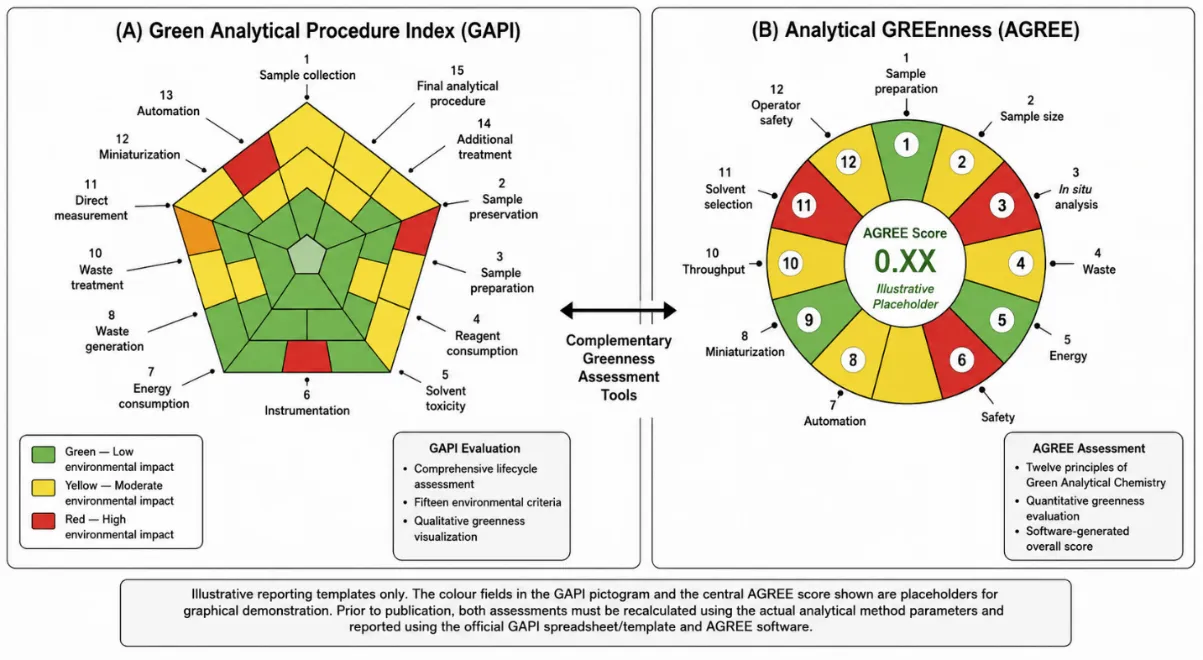
Figure 5. Greenness-assessment reporting templates: (A) Green Analytical Procedure Index (GAPI) pictogram 15 and (B) Analytical GREEnness (AGREE) clock diagram 16. Colour fields and the central score are illustrative placeholders only; they must be recalculated from the actual method parameters and reported with the corresponding scoring software/spreadsheet before publication.
4.4 Comparison with conventional reported methods
Conventional amlodipine RP-HPLC assays using acetonitrile-rich mobile phases at 1–1.5 mL/min for 8–15 minutes per injection 18,19 consume substantially more hazardous solvent per sample than either the ethanol-substituted or reduced-flow UPLC-scale approaches described above. A structured greenness comparison table (conventional vs. proposed eco-friendly QbD method), populated with GAPI/AGREE scores calculated for both the literature method chosen as a benchmark and the newly developed method, is recommended as a standard results element (see Section 9.3).
5. METHOD VALIDATION (PER ICH Q2(R2)/Q2(R1)):
Method validation should be conducted according to the current ICH guideline on Validation of Analytical Procedures. The revised ICH Q2(R2), adopted alongside the new ICH Q14 (Analytical Procedure Development) by the ICH Assembly in November 2023, extends the earlier Q2(R1) framework and should be cited and followed in any new submission 8,9. The validation parameters below follow this framework; acceptance criteria shown are representative of pharmacopeial norms and the ranges reported in the amlodipine QbD literature 11,13,14 and must be finalized against the laboratory's own validation protocol.
5.1 System suitability testing
System suitability should be assessed before each validation and routine run using replicate injections (typically n = 5–6) of a system-suitability standard, with acceptance criteria commonly set at RSD of peak area/retention time ≤ 2%, tailing factor 0.8–1.2 (as reported for amlodipine 11), theoretical plates > 2000, and resolution (where a second peak is present) > 2.0.
5.2 Specificity/selectivity
Specificity is demonstrated by showing that the amlodipine peak is resolved from tablet-excipient peaks, from the mobile-phase/solvent front, and where a stability-indicating claim is sought from degradation products generated under forced-degradation stress (Section 6.9). Peak-purity assessment using PDA detection is recommended.
5.3 Linearity and range
Linearity should be established using at least five to six concentration levels spanning the ATP-defined assay range, each injected in triplicate, with peak area (or height) plotted against concentration. A correlation coefficient (r or r²) ≥ 0.999 (or ≥ 0.998, depending on the validation protocol) is the typical acceptance criterion; published amlodipine methods have reported r² values of 0.994–0.9989 11,13,14.
5.4 Accuracy (recovery studies)
Accuracy should be assessed by the standard-addition/recovery method at a minimum of three concentration levels (e.g., 50%, 100% and 150% of the nominal assay concentration), each in triplicate, against a placebo or blank tablet matrix. A mean percentage recovery within 98–102% is the typical acceptance criterion, consistent with the 99.75–100.04% recovery reported for a related amlodipine AQbD method 13.
5.5 Precision (repeatability and intermediate precision)
Repeatability (intra-day precision) should be assessed by replicate analysis (n ≥ 6) of a homogeneous sample at 100% of the test concentration on the same day; intermediate precision should be assessed on different days and/or by different analysts and/or instruments. An RSD ≤ 2% is the typical acceptance criterion for both.
5.6 Limit of Detection (LOD) and Limit of Quantification (LOQ)
LOD and LOQ may be determined from the standard deviation of the response and the slope of the calibration curve (LOD = 3.3σ/S; LOQ = 10σ/S) or experimentally via signal-to-noise ratios of approximately 3:1 and 10:1, respectively 11. These values should be reported and compared against pharmacopeial requirements where available.
5.7 Robustness
Robustness is assessed by making small, deliberate variations to CMPs identified as significant in the risk assessment (Section 3.4) for example, ± 0.1–0.2 mL/min flow rate, ± 2–5% organic-modifier percentage, ± 2 nm detection wavelength, and ± 2–5 °C column temperature and confirming that system-suitability and assay results remain within acceptance criteria throughout, as illustrated for a comparable amlodipine assay by Ibrahim et al. 11. Because these variations are drawn directly from the AQbD design space (Section 3.6), robustness testing in a QbD-developed method serves primarily to confirm, rather than newly establish, method reliability.
5.8 Solution stability
Stability of standard and sample solutions under normal laboratory storage conditions (e.g., room temperature and/or refrigerated) should be verified over a defined period (e.g., 24–48 hours), with assay results remaining within ± 2% of the initial (freshly prepared) value.
5.9 Forced degradation / stability-indicating assessment
Where a stability-indicating claim is required, amlodipine should be subjected to forced degradation under acid hydrolysis, base hydrolysis, oxidative stress (e.g., hydrogen peroxide), and thermal stress, following general forced-degradation principles 20. Published data indicate amlodipine is markedly more susceptible to oxidative and alkaline degradation than to thermal stress, although the relative extent varies between studies 11; the developed method should demonstrate adequate resolution between the intact drug peak and all degradation-product peaks formed under these conditions.
6. APPLICATION OF THE DEVELOPED METHOD:
6.1 Assay of amlodipine in bulk drug
The validated method should be applied to assay the amlodipine besylate bulk drug substance against the working reference standard, with the percentage assay (on an as-is or dried basis, as appropriate) reported together with its RSD across replicate determinations.
6.2 Assay of amlodipine in marketed tablet formulations
The method should be applied to one or more marketed amlodipine tablet products (label claim, e.g., 5 mg or 10 mg), with content uniformity assessed according to a recognised compendial approach (e.g., the acceptance-value calculation used in USP <905>) and, where relevant, in-vitro dissolution testing performed and quantified using the validated method, following the general application pattern reported for amlodipine tablet products 11,12.
6.3 Statistical evaluation of results
Assay results should be summarised as mean ± standard deviation (or RSD%) across replicates, with appropriate statistical comparison (e.g., Student's t-test) against label claim or a reference/comparator method where applicable.
CONCLUSION
The literature reviewed here demonstrates that amlodipine besylate can be reliably quantified by RP-HPLC, and that recent reports increasingly incorporate either AQbD 6,7,11,13,14 or green-chemistry principles [[11,15–17]], but rarely both within a single, ICH Q14/Q2(R2)-aligned workflow. This review has proposed an integrated protocol spanning ATP definition, risk-based CMP identification, DoE-based optimization, green mobile-phase selection, formal validation, and quantitative greenness scoring for the development of an eco-friendly, QbD-based RP-HPLC method for amlodipine in bulk drug and tablet dosage form. When executed with the analyst's own experimental data populating Sections 8 and the corresponding tables/figures, such a method is expected to combine regulatory-grade robustness and sensitivity with a demonstrably reduced environmental footprint, making it well suited to routine quality-control use and to publication in an analytical-chemistry or pharmaceutical-sciences journal.
FUTURE SCOPE
Future work building on this framework could extend the AQbD/green-chemistry protocol to amlodipine's numerous fixed-dose combination products (e.g., with valsartan, olmesartan, telmisartan, hydrochlorothiazide, atorvastatin or lisinopril) [[12–14]]; incorporate the multivariate/spectroscopic validation elements newly addressed in ICH Q2(R2) 9; explore further green mobile-phase alternatives (e.g., propylene carbonate, Cyrene, or fully aqueous systems) beyond ethanol 17; and pursue formal stability studies and regulatory (pharmacopeial or ANDA/dossier) submission of the validated method.
REFERENCES

Nikita Rathod, S A Jadhav, Development and Validation of an Eco-Friendly, Quality-by-Design (QbD)-Based RP-HPLC Method for the Estimation of Amlodipine in Bulk Drug and Tablet Dosage Form: A Review, Int. J. of Pharm. Sci., 2026, Vol 4, Issue 8, 46-58, https://doi.org/10.5281/zenodo.21735842
 10.5281/zenodo.21735842