

We use cookies to ensure our website works properly and to personalise your experience. Cookies policy
1Department of Pharmaceutical Chemistry, School of Pharmaceutical sciences, RIMT University, Mandi Gobindgarh, Pin-147301
2School of Pharmacy, Desh Bhagat University, Mandi Gobindgarh, Pin-147301
3Sikkim College of Pharmacy, Sikkim Skill University, Sikkim, Pin-737132
4Department of Pharmacology, School of Pharmacy, Desh Bhagat University, Mandi Gobindgarh, Pin-147301
5School of Pharmacy, Desh Bhagat University, Mandi Gobindgarh, Pin-147301
6Department of Pharmaceutical Chemistry, School of Pharmacy, RIMT University, Mandi Gobindgarh, Pin-147301.
The development of second-generation antihistamines represents a significant milestone in allergy management, driven by a continuous effort to optimize efficacy while minimizing sedating side effects. Central to this evolution is cetirizine, which was traditionally administered as a 50:50 racemic mixture. While the therapeutic success of the racemate is driven by the (R)-enantiomer (levocetirizine), its mirror image, (S)-cetirizine—commonly known as dextrocetirizine—has historically been dismissed as an inactive "passenger" molecule. This comprehensive review deconstructs the structural biochemistry, stereoselective disposition, and overlooked environmental impact of dextrocetirizine.Applying the Cahn-Ingold-Prelog (CIP) priority rules confirms that the (S)-configuration of dextrocetirizine imposes a spatial obstruction that limits its binding affinity at the human H?-receptor, rendering it 30-fold less potent than levocetirizine. However, despite its clinical inactivity, dextrocetirizine exhibits distinct pharmacokinetic behavior, characterized by a lower plasma protein binding profile, a broader volume of distribution, and accelerated renal tubular clearance. Furthermore, because it bypasses major human metabolism and resists traditional activated sludge wastewater treatment, multi-ton quantities of dextrocetirizine are continuously discharged into aquatic ecosystems.Alarmingly, recent data reveals that riverbed biofilms and microbial communities can induce biotic chiral inversion, transforming this "harmless" passenger molecule back into biologically active levocetirizine. This creates a continuous, unrecognized threat to non-target aquatic wildlife. This review highlights the need to shift from treating dextrocetirizine as a neglected entity to implementing rigorous enantiomeric environmental monitoring and transitioning fully to pure asymmetric synthesis.
1.1. The Paradigm of Chirality in Modern Pharmacology
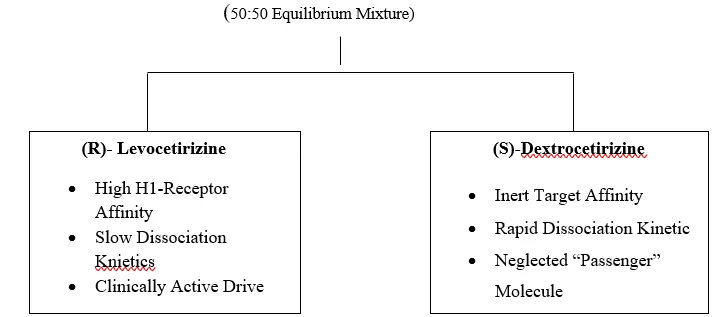
In the contemporary landscape of rational drug discovery, macromolecular biochemistry, and regulatory therapeutics, the concept of molecular chirality has fundamentally transitioned from a theoretical stereochemical nuance to a core operational mandate. Historically, the pharmaceutical landscape was populated by racemic formulations—50:50 equilibrium mixtures of non-superimposable mirror-image enantiomers—which were synthesized, packaged, and administered under the structural assumption that the inactive isomer was merely a benign, pharmacologically silent passenger. This industrial and clinical complacency was severely challenged during the late 20th century by profound insights into stereospecific biology.
Because human biological structures, including transmembrane receptors, enzymatic active sites, and transport proteins, are themselves constructed from homochiral building blocks (L-amino acids and D-sugars), they present highly asymmetric spatial topologies to circulating xenobiotics. Consequently, the two enantiomers of a chiral drug frequently exhibit completely divergent pharmacodynamic, pharmacokinetic, and toxicological pathways. One enantiomer, designated as the eutomer, typically carries the desired therapeutic profile due to complementary spatial docking, while its mirror image, the distomer, may be therapeutically inert, act as a metabolic burden, or induce completely independent, off-target toxicities.
RACEMIC XENOBIOTIC
This realization prompted global regulatory bodies, such as the United States Food and Drug Administration (FDA) and the European Medicines Agency (EMA), to issue strict guidelines in the early 1990s discouraging the development of new racemic chemical entities unless scientifically justified. This shift in regulatory policy catalyzed a massive industrial movement known as the "chiral switch". This strategy involves the isolation, systematic re-evaluation, and commercial re-patenting of established racemic blockbuster drugs as single-enantiomer formulations.
The clinical rationale behind a chiral switch centers on reducing total active dosage mass, improving the overall therapeutic index, streamlining systemic metabolic clearance, and minimizing patient-to-patient pharmacokinetic variability. Concurrently, from a corporate perspective, the chiral switch has served as a highly strategic lifecycle management tool, allowing pharmaceutical manufacturers to navigate patent expirations and mitigate generic competition by shifting the clinical standard of care toward a newly patented, enantiopure monograph.
1.2. Cetirizine and the Clinical Shift to Levocetirizine
A quintessential, highly successful case study of this chiral evolution is the second-generation H₁-antihistamine cetirizine. Originally derived as a primary carboxylic acid metabolite of the first-generation piperazine sedative hydroxyzine, racemic cetirizine was approved and commercialized globally under famous trade names including Zyrtec and Reactine. For nearly two decades, racemic cetirizine dominated the over-the-counter market for the symptomatic relief of seasonal allergic rhinitis, perennial allergic conjunctivitis, and chronic idiopathic urticaria. Its design marked a massive breakthrough over first-generation agents because its highly hydrophilic zwitterionic structure restricted its passage across the endothelial membranes of the blood-brain barrier, resulting in a drastically reduced incidence of central nervous system sedation.
RACEMIC CETIRIZINE
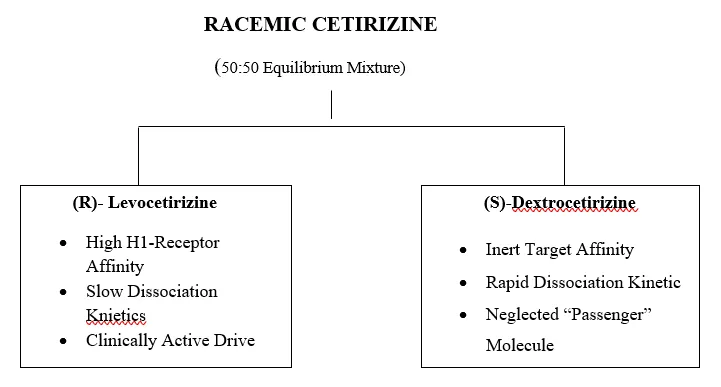
Despite its undisputed clinical success, the therapeutic efficacy of racemic cetirizine was a split reality. Extensive in vitro radioligand binding displacement assays, human skin wheal-and-flare models, and molecular docking studies eventually revealed that the drug’s antihistaminic value was driven almost exclusively by its (R)-enantiomer, genericized as levocetirizine. Levocetirizine features an exceptionally high affinity for the human histamine H₁-receptor, forming tight salt bridges and hydrophobic interactions that anchor it firmly within the receptor's active site.
This tight binding results in an unusually slow receptor dissociation rate, giving levocetirizine a prolonged duration of action and a highly predictable clinical profile. Recognizing these advantages, the manufacturer executed a commercial chiral switch, introducing pure levocetirizine to the global market. This allowed clinicians to achieve the exact same therapeutic outcome while cutting the total structural chemical dose administered to patients in half (from a 10 mg racemic tablet to a 5 mg levocetirizine tablet).
1.3. Introducing Dextrocetirizine: The Overlooked Mirror Image
As the medical community and global regulatory bodies fully embraced pure levocetirizine, its optical mirror image, (S)-cetirizine—commonly known as dextrocetirizine—was quickly pushed into scientific obscurity. Structurally, dextrocetirizine shares the exact same molecular formula, atomic connectivity, and chemical bond lengths as its active sibling, differing only in the spatial orientation of its substituents around its single asymmetric carbon center. However, this subtle change in stereochemical configuration has profound biological implications. [1]
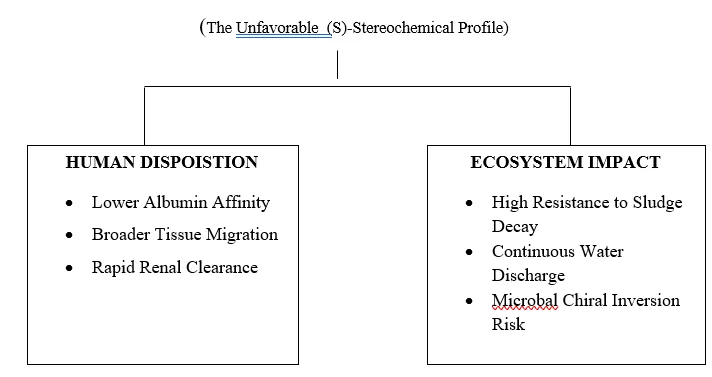
Pharmacodynamic screening confirmed that the (S)-conformation forces its aromatic chlorophenyl and phenyl rings into an unfavorable spatial profile that cannot effectively align with the H₁-receptor pocket. This spatial mismatch compromises its binding capabilities, rendering it roughly 30-fold less potent than levocetirizine and unable to generate any meaningful anti-allergic response.
DEXTROCETIRIZINE
Because dextrocetirizine lacked measurable H₁-receptor activity, early clinical documentation dismissed it as simple chemical dead-weight. This omission was historically justified by its clean off-target safety profile. Extensive toxicology testing demonstrated that dextrocetirizine did not bind to muscarinic acetylcholine, alpha-adrenergic, or serotonergic pathways, nor did it block human ether-à-go-go-related gene (hERG) potassium channels, avoiding the severe cardiotoxicity risks that forced earlier antihistamines off the market.
Because it was non-toxic and therapeutically silent, it was deemed safe to co-administer alongside levocetirizine in multi-ton quantities worldwide under the guise of an inactive "passenger" molecule. As the market shifted toward pure levocetirizine to optimize dosing, academic curiosity regarding dextrocetirizine ceased, effectively cementing its reputation as a neglected, irrelevant distomer.
1.4. Shifting the Narrative: Why the Distomer Demands Attention
As clinical focus shifted almost entirely toward pure levocetirizine, dextrocetirizine was cast into scientific obscurity. However, dismissing (S)-cetirizine as mere biological dead-weight ignores its critical role in stereoselective pharmacokinetics [1] and environmental toxicology. Within the human body, dextrocetirizine does not mirror the pharmacokinetics of its active sibling; it displays distinct, highly stereoselective profiles regarding human serum albumin protein binding, systemic volume of distribution, and renal organic anion transporter dynamics, which culminate in a significantly accelerated clearance rate.
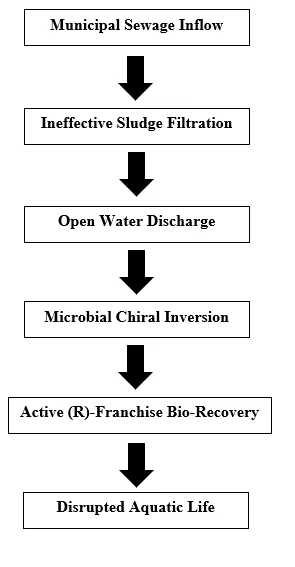
More alarmingly, because it bypasses primary hepatic metabolism, massive quantities of this un-retained, chemically stable zwitterion are excreted intact by the human population directly into domestic sewage infrastructures. Traditional municipal wastewater treatment plants, relying on standard activated sludge processes, possess virtually zero capacity to degrade or filter out the recalcitrant piperazinyl core of cetirizine molecules. As a direct result, dextrocetirizine is continually discharged into aquatic systems at microgram-per-liter scales, transforming an overlooked pharmaceutical passenger into a ubiquitous environmental pollutant.
The most profound danger surrounding environmental dextrocetirizine introduces an entirely new dimension of ecological risk: biotic chiral inversion. While the human body is unable to convert the inert (S)-enantiomer into the active form, the microbial ecology of natural riverbed biofilms, sediment pseudomonads, and sewage microflora contains specialized stereospecific epimerase and isomerase enzymes. These environmental microorganisms can utilize dextrocetirizine as a metabolic substrate, systematically inverting its stereochemical structure back into the highly potent, biologically active (R)-levocetirizine.
This microbially driven back-conversion creates a hidden, self-sustaining reservoir of active antihistamine pollution in natural waters. This bioavailable toxin continually binds to the peripheral H₁-receptors of non-target aquatic organisms, fundamentally disrupting the swimming behaviors, immune functions, and ecological balances of fish and macroinvertebrate populations. This review shifts the scientific spotlight onto dextrocetirizine, demonstrating why this neglected enantiomer demands independent scientific evaluation.
THE ENVIRONMENTAL DANGER LOOP
2. Molecular Architecture and Stereochemistry
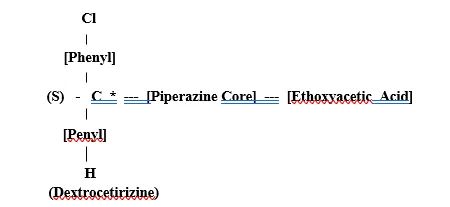
2.1. The Chiral Center and the Diarylmethyl Core.
The architectural asymmetry of cetirizine resides strictly at its \(C1\)-diphenylmethyl chiral core. This stereocenter consists of a central \(sp^{3}\)-hybridized carbon atom that anchors the highly bulky (2-chloro-phenyl)-phenylmethyl aromatic moiety to the nucleophilic aliphatic piperazinyl ring structure. The four distinct substituents generating this optical asymmetry are:
The high molecular weight and steric density of the three surrounding rings establish a rigid asymmetric node. This forces the remaining functional chains to protrude into opposing geometric faces of the molecule, setting the stage for strict stereospecific interactions.
2.2. Spatial Orientation and Cahn-Ingold-Prelog (CIP) Priority Assignment
Following standard Cahn-Ingold-Prelog (CIP) priority rules, priority is assigned based on atomic numbers directly bonded to the chiral carbon, cascading outward to secondary atoms when ties occur:
\(\text{Priority\ Hierarchy:\ }-\text{Piperazine}>-\text{Chlorophenyl}>-\text{Phenyl}>-\text{Hydrogen}\
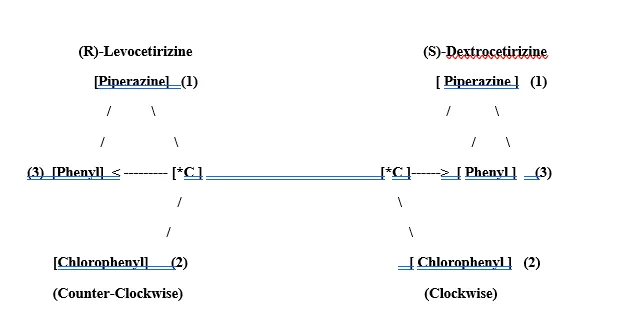
When orienting the molecule with the lowest priority atom (hydrogen) pointing directly away from the observer, tracing a path from Priority 1 to Priority 2 to Priority 3 creates a counter-clockwise vector for levocetirizine, defining its status as the \((R)\)-enantiomer. Conversely, tracing this path for dextrocetirizine establishes a clockwise vector, anchoring its structural spatial orientation as the \((S)\)-enantiomer.
This structural deviation dictates how each molecule interacts with three-dimensional biological landscapes. While the \((R)\)-enantiomer presents a conformation that effortlessly slides into target binding configurations, the \((S)\)-conformation of dextrocetirizine forces the aromatic rings into an unfavorable spatial profile, preventing critical alignment with key receptor targets.
2.3. Racemic Synthesis Pathways vs. Preparative Chiral Resolution
During traditional, non-stereospecific classic synthesis routes—such as the nucleophilic alkylation of 1-[(4-chlorophenyl)phenylmethyl]piperazine with 2-(2-chloroethoxy)acetic acid—the absence of asymmetric catalysts leads to equal, unhindered attacks from both spatial faces of the intermediate planar carbocation. This results in an exact 50:50 racemic mixture.
To isolate pure dextrocetirizine for independent analysis, specialized preparative separation techniques are required:
Unlike some volatile chiral pharmaceuticals, dextrocetirizine exhibits a high degree of configurational stability in standard aqueous solutions. It does not undergo spontaneous, non-enzymatic racemization at physiological pH, meaning its unique structural characteristics remain completely intact from initial administration through systemic elimination.
3. Pharmacodynamics (Why It Is Neglected)
3.1. Receptor Affinity and Dissociation Kinetics
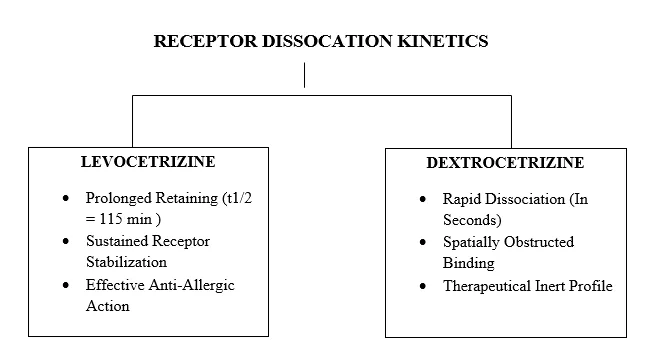
Dextrocetirizine is fundamentally neglected in clinical medicine due to a massive stereoselectivity binding affinity ratio at the human histamine H₁-receptor. In vitro radioligand displacement binding assays demonstrate that levocetirizine binds to the receptor with an incredibly tight dissociation constant (\(K_d \approx 3.2 \text{ nM}\)), whereas dextrocetirizine displays significantly weaker binding profiles (\(K_d \approx 100 \text{ nM}\)).
Stereosectivity Ratio:Kd (Dextrocetirizine)Kd(Levocetirizine)≈30-fold difference

This dramatic 30-fold difference in affinity is completely driven by their receptor dissociation kinetics. Levocetirizine forms highly stable salt bridges and hydrophobic pockets inside the active site of the receptor, resulting in an exceptionally prolonged dissociation half-life (\(t_{1/2} \approx 115 \text{ minutes}\)). Dextrocetirizine's (S)-conformation spatially obstructs these specific electrostatic interactions, preventing critical salt-bridge formation. Consequently, it dissociates rapidly from the H₁-receptor within seconds, making it clinically inert and incapable of sustaining the inverse agonist activity required to stabilize allergic reactions.
3.2. Evaluation of Off-Target Interactions
While inert at the primary H₁-site, dextrocetirizine's spatial geometry changes its affinity across alternative biological signaling pathways. Understanding these off-target profiles explains why it has historically been categorized as a non-toxic passenger:
This toxicological inertness explains why the ingestion of historic racemic cetirizine did not present heightened toxicological or cardiotoxic hazards compared to pure levocetirizine; the passenger enantiomer is simply an inactive, non-toxic metabolic burden inside the human body.
4. Stereoselective Pharmacokinetics & Disposition
4.1. Absorption and Transport Dynamics
The systemic movement of dextrocetirizine reveals distinct, highly stereoselective handling by mucosal and cellular transport proteins:
4.2. Metabolism & Clearance
Unlike many lipophilic drugs, cetirizine does not rely extensively on hepatic oxidation paths; less than 14% of the systemic load undergoes hepatic transformation via cytochrome P450 (CYP3A4). The metabolic pathway primarily involves a highly stereospecific oxidative O-dealkylation.
|
Pharmacokinetic Parameter |
Levocetirizine (R) |
Dextrocetirizine (S) |
|
Plasma Protein Binding (Albumin) |
Higher (≈ 96%) |
Lower (≈ 88%) |
|
Volume of Distribution (\(V_{d}\)) |
Narrow (≈ 0.4 L/kg) |
Broad (≈ 0.6 L/kg) |
|
Renal Clearance Rate (\(CL_{r}\)) |
Slowe(Active Reabsorption) |
Faster (Active Tubular Secretion) |
|
Elimination Half-life (\(t_{1/2}\)) |
Long (≈ 8--9 hours) |
Short (≈ 5--6 hours) |
Dextrocetirizine exhibits a lower affinity for human serum albumin, leaving a significantly higher fraction of unbound, free drug in systemic circulation. This high free-fraction causes a broader volume of distribution as the drug migrates easily out of plasma and into peripheral tissues. This lack of protein binding also accelerates its elimination; unbound dextrocetirizine is filtered rapidly by the glomerulus and undergoes active renal tubular secretion, resulting in a clearance rate that is faster than levocetirizine.
5. Environmental and Ecotoxicological Impact
5.1. The Sewage Problem and Wastewater Treatment Inefficacy
Because over-the-counter racemic cetirizine remains highly accessible and cost-effective globally, millions of kilograms of the 50:50 mixture are consumed annually. Due to its pharmacokinetic properties, up to 70% of the ingested dextrocetirizine is excreted completely unchanged through human urine and feces directly into domestic sewage networks.
Recent ecotoxicological monitoring shows that conventional activated sludge (CAS) systems in municipal Wastewater Treatment Plants (WWTPs) are completely ineffective at removing cetirizine molecules. The compound's structural zwitterionic stability resists bacterial degradation within active sludge aeration tanks. Consequently, influent and effluent concentrations remain essentially equal—frequently discharging into freshwater rivers and marine basins at sustained levels ranging between 1.0 to 8.0 μg/L, heavily exceeding predicted no-effect concentrations (PNEC ≈ 0.52 μg/L).
5.2. Chiral Inversion in Nature and Bio-Recovery Risks
The most critical, overlooked hazard regarding environmental dextrocetirizine is the phenomenon of environmental biotic chiral inversion. While the (S)-enantiomer is stable inside the human body and does not cross-convert to the active (R)-form, the open environment introduces a completely different metabolic landscape.

Riverbed biofilms, sediment-dwelling pseudomonads, and specialized wastewater microflora possess unique stereospecific epimerase and isomerase enzymes. These environmental microorganisms can utilize the carbon backbone of dextrocetirizine, temporarily processing it through an achiral planar enol or imine intermediate, which is then non-selectively re-hydrogenated. This microbial pathway systematically inverts a large percentage of the "inert, harmless" (S)-dextrocetirizine back into the highly potent, biologically active (R)-levocetirizine.
This hidden environmental transformation effectively creates a continuous, baseline reservoir of active antihistamine pollution in aquatic habitats. This bioavailable levocetirizine continually binds to peripheral H₁ systems in non-target aquatic organisms like teleost fish and Daphnia magna, altering their swimming behavior, immune responses, and feeding patterns, and turning an ignored passenger drug into a major ecotoxicological concern.
6. DISCUSSION AND FUTURE PERSPECTIVES
The comprehensive structural, pharmacokinetic, and environmental profiling of cetirizine highlights that dextrocetirizine is far more than a simple "inactive passenger." Instead, it serves as a critical case study in the broader field of chiral pharmacology and sustainable green chemistry. For decades, the co-administration of dextrocetirizine alongside levocetirizine in racemic formulations was clinically justified because the (S)-enantiomer lacked severe, off-target toxophores like hERG potassium channel binding or muscarinic receptor cross-reactivity. However, looking at this molecule through a modern multi-disciplinary lens reveals significant hidden burdens. It imposes an unnecessary metabolic load on human elimination pathways, complicates industrial scale-up, and presents unique, post-consumption environmental hazards.
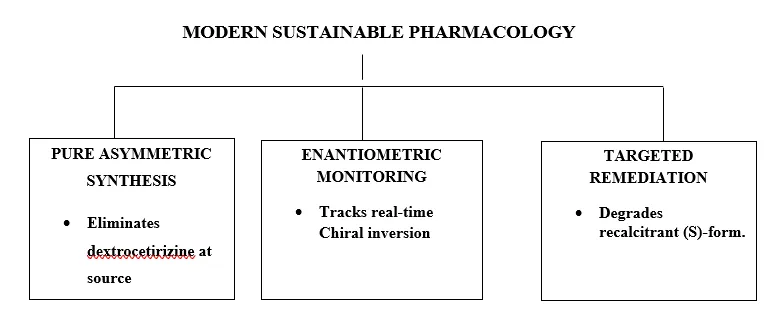
The future of managing dextrocetirizine rests on three distinct pillars:
Ultimately, dextrocetirizine serves as a powerful reminder that "therapeutically inert" does not mean "ecologically benign." Transitioning from a state of neglect to one of active structural remediation will be critical as pharmacology moves toward a more sustainable, green future. [1]
CONCLUSION
In conclusion, labeling dextrocetirizine simply as the "neglected, inactive enantiomer" of cetirizine is an oversimplification that ignores its complex pharmacological and environmental realities. Although structural biochemistry and receptor kinetics confirm that its (S)-conformation cannot maintain the key electrostatic bonds needed for effective H₁-receptor stabilization, its journey through human and environmental systems is highly dynamic. Dextrocetirizine’s unique pharmacokinetic profile—driven by lower protein affinity and rapid active renal clearance—demonstrates that the human body handles it as a distinct chemical entity rather than a passive bystander.
The true challenge of dextrocetirizine lies beyond the human body. Its stability in municipal wastewater, coupled with the ability of environmental microbes to invert it back into the active (R)-enantiomer, presents a unique ecotoxicological threat to aquatic habitats.
Moving forward, the pharmaceutical industry and environmental regulators must treat dextrocetirizine with the independent scientific scrutiny it requires. Eradicating its global footprint demands a multi-pronged approach: fully phasing out legacy racemic formulations in favor of green asymmetric synthesis, deploying advanced oxidation technologies in wastewater plants, and mandating chiral-specific environmental monitoring. Embracing these steps will ensure that the future of allergy management aligns with the principles of sustainable, eco-friendly pharmacology.
REFERENCES


Prince Bhalla, Harmanjot Singh, Jahangir Ahmad Ganie, Inderjeet Singh, Hmeeda Bano, Achal Kumar, Dextrocetirizine: The Neglected Enantiomer of Cetirizine - A Comprehensive Review on Its Pharmacological and Environmental Profile, Int. J. of Pharm. Sci., 2026, Vol 4, Issue 9, 1817-1829, https://doi.org/Prince Bhalla, Harmanjot Singh, Jahangir Ahmad Ganie, Inderjeet Singh, Hmeeda Bano, Achal Kumar, Dextrocetirizine: The Neglected Enantiomer of Cetirizine - A Comprehensive Review on Its Pharmacological and Environmental Profile, Int. J. of Pharm. Sci., 2026, Vol 4, Issue 9, 1817-1829, https://doi.org/10.5281/zenodo.22767646
 10.5281/zenodo.22767646