

We use cookies to ensure our website works properly and to personalise your experience. Cookies policy
Department of Pharmacy Practice, JKKN College of Pharmacy, Kumarapalayam, Namakkal District, Tamil Nadu, India.
Dextromethorphan (DXM) is a widely available antitussive drug that acts on NMDA receptors, sigma-1 receptors, and monoamine transporters, giving it both antidepressant potential and a capacity to produce serious neuropsychiatric toxicity. CYP2D6 pharmacogenomic variability is a key determinant of individual risk, but this variability is not uniform across the populations grouped together as “Asian”: East and Southeast Asian populations carry the reduced-function CYP2D610 allele at high frequency, while South Asian populations show a different, less-studied allelic profile. This narrative review, guided by the SANRA framework, examines DXM’s pharmacology, therapeutic evidence, psychosis risk, misuse epidemiology, and pharmacogenomic determinants, focusing on how CYP2D6 allele distribution differs between South and East Asian populations. Dextromethorphan-bupropion (Auvelity) produces rapid antidepressant benefit in major depressive disorder, and DXM-quinidine (Nuedexta) helps dementia-associated agitation and pseudobulbar affect; both pair DXM with a CYP2D6 inhibitor to sustain its plasma concentration. Supratherapeutic misuse produces dissociation and schizophrenia-like psychosis via NMDA and sigma-1 mechanisms. CYP2D610 reaches 40 to 60 percent frequency across East and Southeast Asia, but South Indian data put it closer to 10 to 20 percent, with alleles such as 2, 4, 5, and 41 contributing more to the region’s metabolizer profile, so guidance built from East Asian cohorts does not automatically transfer to South Asia. “Asian populations” is therefore not one pharmacogenomic category for CYP2D6, and prescribing, misuse surveillance, and regulatory policy need region-specific data rather than figures borrowed wholesale from East Asia, a point made more urgent by India’s recent move to end over-the-counter cough syrup sale
Dextromethorphan (DXM) has been sold as a cough suppressant without a prescription for over six decades. This changed when researchers began to notice that the way it works in the brain closely resembles mechanisms being studied for rapid antidepressant effects. DXM blocks NMDA glutamate receptors, activates sigma-1 receptors, and inhibits the reuptake of serotonin and norepinephrine.1,2 Each of these properties has a role in mood regulation, and each can also produce neuropsychiatric effects when DXM is taken above the therapeutic range.
Two regulatory approvals confirmed DXM’s move into mainstream psychiatry. In 2022, the FDA approved dextromethorphan-bupropion (Auvelity) for major depressive disorder, based on phase 2 and phase 3 randomised controlled evidence.3,4,5 A separate combination with quinidine (Nuedexta) had already been approved for pseudobulbar affect and was subsequently studied in Alzheimer-related agitation.6,7 Both combinations, despite treating different conditions, rest on the same pharmacokinetic trick: bupropion and quinidine are each potent CYP2D6 inhibitors, added deliberately to slow DXM’s metabolism and keep its plasma concentration in a useful range. That detail turns out to matter a great deal once CYP2D6 activity itself starts varying by population, a point this review returns to directly. At the same time, emergency physicians have continued to encounter young people presenting with florid psychosis after intentional high-dose misuse of DXM-containing cough preparations.8,9
Several existing reviews already cover pieces of this picture well. Silva and Dinis-Oliveira mapped DXM’s pharmacokinetics and pharmacodynamics in detail.10 Spangler and colleagues catalogued patterns of misuse and the regulatory response to them.2 Akbar and colleagues systematically reviewed the antidepressant trial evidence for DXM-bupropion.11 What none of these examine together is the fact that DXM’s therapeutic window, its toxicity risk, and its misuse potential all pass through the same enzyme, CYP2D6, and that this enzyme’s activity is distributed very differently across the populations that pharmacogenomic commentary tends to lump together as “Asian.” CYP2D610, the reduced-function allele most often cited in this context, reaches frequencies of 40 to 60 percent across East and Southeast Asia.12,13 Data from South Indian cohorts put the same allele closer to 10 to 20 percent, with a different combination of alleles, including 2, 4, 5, and *41, doing more of the work in shaping the region’s metabolizer profile.14,15 A clinician in Chennai or Pondicherry reading pharmacogenomic guidance built from Han Chinese or Japanese cohort data is, in effect, applying evidence from a different population. This review brings the mechanistic, therapeutic, toxicological, and pharmacogenomic literature on DXM together with that distinction as its organizing thread, with particular attention to South Asian and specifically Indian clinical practice, where the pharmacogenomic evidence base is thinnest and where over-the-counter access to cough preparations has just changed in ways that make this question more urgent rather than less.
Methods
A structured literature search was conducted in PubMed, Scopus, and Embase for articles published between January 2000 and November 2025. The search strategy combined the following keywords and MeSH terms using Boolean operators: dextromethorphan, NMDA receptor, sigma-1 receptor, psychosis, substance misuse, CYP2D6, pharmacogenomics, treatment-resistant depression, and ketamine. Human studies and review articles published in English that reported pharmacological, clinical, toxicological, neuropsychiatric, or pharmacokinetic outcomes related to dextromethorphan were considered eligible. After removal of duplicates, 94 records were screened by title and abstract. After duplicate records were removed, 73 studies underwent title and abstract screening. Of these, 31 records were excluded because they were not relevant to the four predefined themes, were published in languages other than English, were case reports lacking mechanistic or pharmacokinetic data, or were conference abstracts without accessible full texts. A total of 42 publications met the eligibility criteria and were included in the thematic synthesis. Methodological rigor and reporting quality were guided by the SANRA framework for narrative reviews.
Mechanistic Pharmacology
NMDA Receptor Antagonism
DXM and its active metabolite, dextrorphan (DXO), bind within the N-methyl-D-aspartate (NMDA) receptor channel, producing a use-dependent blockade. NMDA receptors regulate synaptic plasticity, excitatory neurotransmission, and long-term potentiation. Reduced NMDA receptor function has been implicated in schizophrenia, and antagonists such as phencyclidine and ketamine are known to induce psychosis-like symptoms in healthy individuals.16,17,18 At therapeutic doses, NMDA antagonism produces mild dissociative and psychotomimetic effects similar to those observed with other NMDA antagonists.3,16 The rapid antidepressant effects of ketamine, mediated through glutamatergic modulation, provided the rationale for evaluating DXM as a potential antidepressant.19,20 The comparative pharmacology of DXM and DXO is summarized in Table 1.
Table 1. Comparative pharmacological profiles of dextromethorphan (DXM) and its active metabolite dextrorphan (DXO)
|
Property |
DXM (Parent Compound) |
DXO (Active Metabolite) |
|
NMDA antagonism |
Moderate |
Potent; primary dissociative mediator |
|
Sigma-1 receptor agonism |
Strong |
Weak |
|
SERT/NET inhibition |
Present |
Minimal |
|
Dissociation risk |
Lower at therapeutic doses |
Higher; increases with dose |
|
CYP2D6 role |
Substrate; O-demethylated to DXO |
Primary metabolic product |
DXM, dextromethorphan; DXO, dextrorphan; NMDA, N-methyl-D-aspartate; SERT, serotonin transporter; NET, norepinephrine transporter.
Sigma-1 Receptor Agonism
The sigma-1 receptor sits at the endoplasmic reticulum and mitochondria-associated membrane and has broad downstream effects on calcium signalling, neurotrophic factor expression, and synaptic plasticity.21,22 DXM is a potent sigma-1 agonist, which clearly differentiates it from ketamine, whose sigma-1 activity is minimal. At therapeutic concentrations, sigma-1 agonism appears to enhance brain-derived neurotrophic factor (BDNF) signalling and protect neurons from excitotoxic damage. At very high doses, overstimulation of sigma-1 receptors disrupts intracellular calcium handling and contributes to the psychotic syndrome seen in heavy misuse.22
Monoamine Transporter Inhibition
DXM inhibits both the serotonin transporter (SERT) and the norepinephrine transporter (NET) with moderate potency, adding a serotonergic and noradrenergic dimension to its pharmacological profile.10 This mechanism increases the risk of serotonin toxicity when DXM is co-administered with selective serotonin reuptake inhibitors (SSRIs), serotonin-norepinephrine reuptake inhibitors (SNRIs), or monoamine oxidase inhibitors (MAOIs). A 2024 case report described serotonin syndrome in a patient on fluoxetine after starting Auvelity.23 In the Auvelity formulation, bupropion contributes additional dopamine transporter (DAT) and NET inhibition and, through CYP2D6 inhibition, extends DXM’s half-life to allow twice-daily oral dosing.3,4 There are three main mechanisms through which dextromethorphan produces both its treatment benefits and its neuropsychiatric toxicity risks: NMDA receptor antagonism, sigma-1 receptor agonism, and monoamine transporter blockade, shown together in Figure 1.
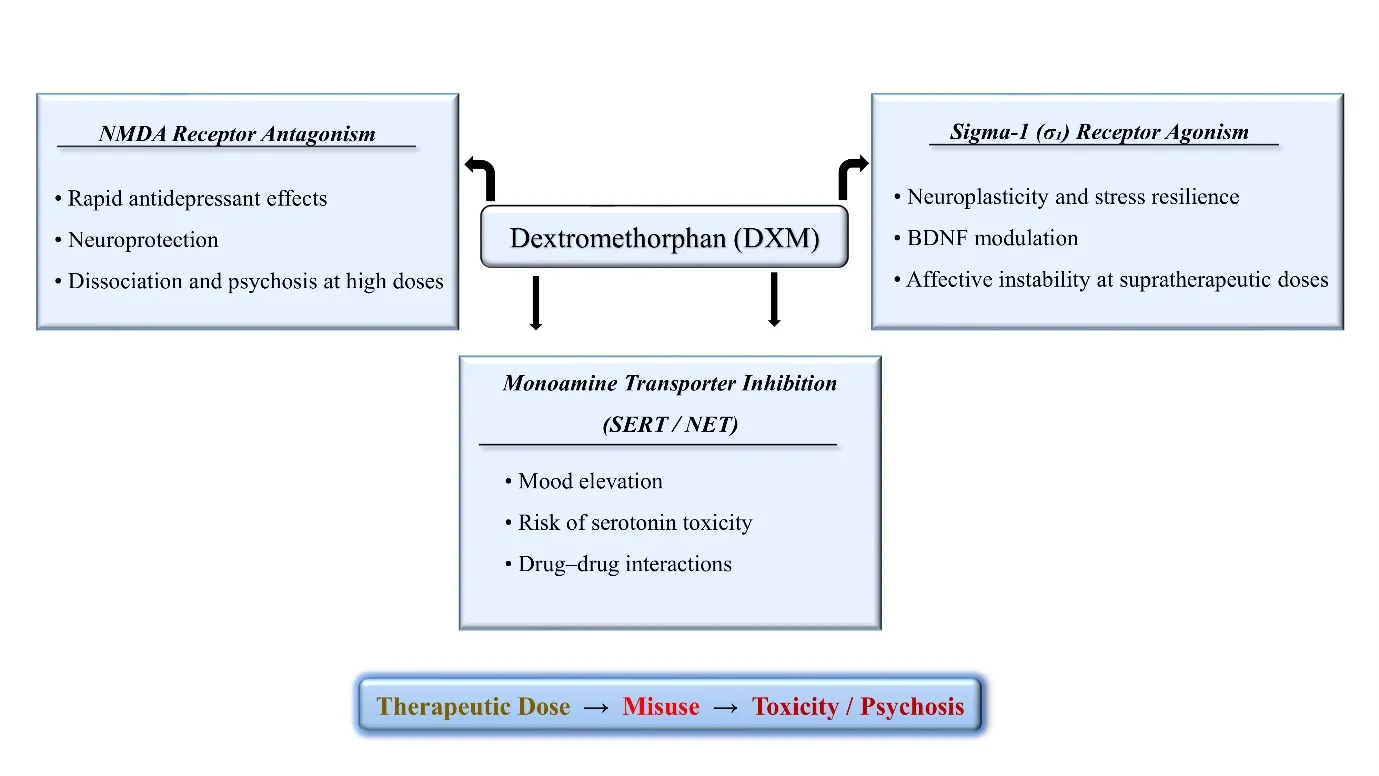
Figure 1. Receptor mechanisms of dextromethorphan (DXM). DXM acts simultaneously on three receptor systems: NMDA receptor antagonism, sigma-1 receptor agonism, and monoamine transporter inhibition via SERT and NET.
Pharmacokinetics and CYP2D6: Two Different Asian Pharmacogenomic Pictures
Cytochrome P450 2D6 (CYP2D6) activity is the principal pharmacokinetic determinant of DXM exposure. This highly polymorphic enzyme catalyses the O-demethylation of DXM to dextrorphan (DXO). Based on CYP2D6 activity, individuals are categorized as poor (PM), intermediate (IM), extensive (EM), or ultrarapid (UM) metabolizers, and this categorization produces substantial variation in DXM-to-DXO plasma concentration ratios.10 Poor metabolizers accumulate higher concentrations of the parent compound, increasing exposure to sigma-1-mediated and serotonergic effects, while ultrarapid metabolizers generate higher DXO levels, enhancing NMDA receptor antagonism and dissociative risk.10,24 Genotype does not always predict metabolic phenotype consistently, particularly in some populations, which supports phenotypic assessment where it is clinically feasible.24
This is where “Asian populations” stops being a useful single category. CYP2D6 allele frequencies vary considerably by ethnicity, and the reduced-function CYP2D610 allele, the variant most often invoked when discussing Asian pharmacogenomics, is not distributed evenly across the continent. A systematic review of East and Southeast Asian populations found CYP2D610 frequencies of roughly 40 to 60 percent across most countries studied, making intermediate metabolizer status close to the population norm in China, Japan, Korea, and much of Southeast Asia.13 Vietnamese cohorts specifically have reported CYP2D610 frequencies near 44 percent, a figure often cited on its own as representative of “Asian” populations generally.25 It is not representative of South Asia. Studies of South Indian populations, largely from Tamil Nadu, report CYP2D610 frequencies closer to 10 to 20 percent, well below the East and Southeast Asian range, with alleles such as 2, 4, 5, and 41 making a proportionally larger contribution to the region’s overall metabolizer distribution.14,15 A recent multi-ethnic Asian cohort study that genotyped Chinese, Malay, and Indian participants side by side confirmed this directly: the Chinese and Malay groups were dominated by CYP2D610-related haplotypes, while the Indian participants showed a distinctly different pattern built around 2, 41, 5, and *4, and even the ultrarapid metabolizer frequency differed by ancestry within the same study, higher in the Chinese participants than in the Indian ones.15 Table 2 summarizes these differences.
Table 2. CYP2D6*10 frequency and dominant reduced-function alleles across selected Asian populations
|
Population |
Approximate CYP2D6*10 frequency |
Other clinically relevant alleles |
Dominant metabolizer consequence |
|
East Asian (Chinese, Japanese, Korean) |
40-60% |
36, 5 |
Intermediate metabolizer status close to population norm |
|
Southeast Asian (Vietnamese, Malay) |
Roughly 40-50% |
36, 41 |
Intermediate metabolizer status common |
|
South Indian (Tamil Nadu cohorts) |
Roughly 10-20% |
2, 4, 5, 41 |
More heterogeneous; extensive metabolizer more common than in East Asia, but a distinct reduced-function profile still present |
Figures are approximate and drawn from the cohort studies cited in the text; allele frequency studies in South Asia remain far fewer in number than those from East Asia, which is itself part of the evidence gap this review is pointing to.
The clinical consequence is straightforward to state and easy to get wrong in practice. A prescriber who reads that “CYP2D610 is common in Asian populations” and applies East Asian dosing caution to an Indian patient is applying the right instinct to the wrong number. The Indian population is not simply a lower-frequency version of the East Asian 10 pattern; it has its own allele mix, and the practical implication, that a meaningful minority of Indian patients will still have reduced or variable CYP2D6 function, just for different genetic reasons, gets lost if the two populations are treated as interchangeable. A meta-analysis pooling European and East Asian depression cohorts confirmed that CYP2D6 metabolic phenotype frequencies differ by ancestry group in ways that affect antidepressant response, which supports the same point from the treatment-outcome side rather than the allele-frequency side.26 For clinicians in South Asia prescribing DXM-based treatments, awareness of the locally relevant allele profile, rather than a borrowed East Asian one, is not an academic nicety but a practical safety question, summarized alongside the metabolic pathway itself in Figure 2.
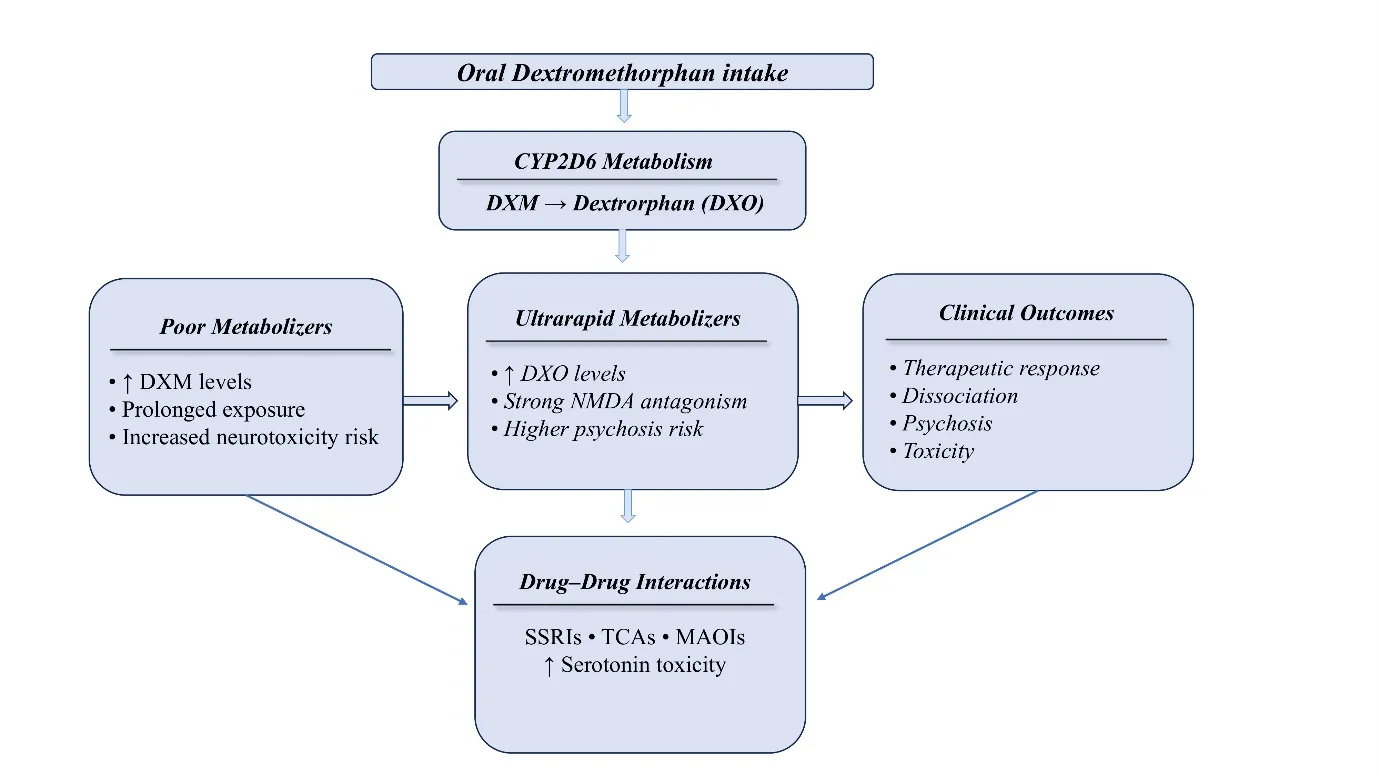
Figure 2. CYP2D6-mediated metabolism of dextromethorphan and its clinical consequences.
Following oral intake, DXM undergoes O-demethylation to DXO via CYP2D6. Poor metabolizers accumulate DXM, with elevated sigma-1 receptor and serotonergic exposure and greater neurotoxicity risk. Ultrarapid metabolizers generate higher DXO concentrations, intensifying NMDA receptor antagonism and dissociative and psychosis risk. Which allele combinations produce these phenotypes, and how common each combination is, differs between East Asian and South Asian populations as detailed in Table 2.
This also reframes what the Auvelity and Nuedexta formulations are doing pharmacologically. Both bupropion and quinidine are added specifically to inhibit CYP2D6 and prolong DXM exposure, which is a deliberate way of pushing a patient’s phenotype toward poor metabolizer behaviour regardless of their starting genotype. In a population where a substantial fraction of patients already carry reduced-function alleles for independent genetic reasons, as is true of South India even though the specific allele involved differs from East Asia, that pharmacological push starts from a different baseline than it does in a population with mostly normal-function CYP2D6. This is a testable pharmacokinetic question, not a settled one, and it is currently unanswered for Indian patients because the pivotal Auvelity and Nuedexta trials were conducted in predominantly Western cohorts.
Clinical Applications
The Unmet Need in Depression
Depression remains poorly controlled in a large proportion of patients. Approximately 60 to 65 percent of patients fail to remit on a first-line antidepressant, and remission rates fall further with each subsequent treatment attempt.19 This persistent unmet need has driven interest in mechanistically distinct approaches, particularly after ketamine showed that glutamatergic modulation could produce rapid antidepressant effects in otherwise refractory patients.19,20,27 DXM-based treatments have been introduced as oral alternatives in this setting, with complementary receptor activity.
Phase 2 and Phase 3 Randomised Evidence
A phase 2 trial by Tabuteau and colleagues compared dextromethorphan-bupropion with bupropion alone in 80 patients with major depressive disorder. The DXM combination produced a significantly greater reduction in MADRS scores across weeks 1 to 6 (least-squares mean difference -4.9 points; p less than 0.001), with remission at week 6 achieved by 46.5 percent of the DXM group versus 16.2 percent on bupropion alone.5
The subsequent phase 3 GEMINI trial (n=327) demonstrated significantly greater MADRS reduction with DXM-bupropion versus placebo at week 6 (least-squares mean difference -3.87 points; p=0.002), with separation from placebo apparent within the first week.4 A systematic review by Akbar and colleagues synthesised data from five trials and found that efficacy could be maintained for up to 12 months, with a mean MADRS reduction of 23 points from baseline.11 Across the pivotal trials, the most commonly reported adverse events were dizziness, nausea, and somnolence, generally mild to moderate and rarely leading to discontinuation, though systematic long-term tolerability data beyond 12 months remain limited.
These findings are encouraging, but several limitations deserve consideration. Both pivotal trials were sponsored by Axsome Therapeutics and ran for only six weeks. No direct head-to-head comparisons with ketamine or esketamine have been published. The systematic review incorporated only five trials, four of which were industry-sponsored.11 Independent replication in real-world populations is needed, and this need is sharper in Asian cohorts than the existing literature acknowledges, because the pharmacokinetic consequence of bupropion’s CYP2D6 inhibition will play out differently depending on which reduced-function alleles a given population actually carries, not simply whether it is broadly labelled “Asian”.25,26
Agitation in Dementia and Pseudobulbar Affect
Tampi and colleagues reviewed evidence for DXM combined with quinidine in Alzheimer-related agitation and found significant reductions in NPI-AA scores with an acceptable tolerability profile.6 Pioro’s review documented consistent efficacy for pseudobulbar affect, supporting regulatory approval of Nuedexta.7 Wang and colleagues demonstrated clinically meaningful depressive symptom reduction with adjunctive DXM-quinidine in treatment-resistant depression.28 As discussed in the Pharmacokinetics and CYP2D6 section, quinidine’s role here is mechanistically identical to bupropion’s role in Auvelity: it is a potent CYP2D6 inhibitor added to keep DXM concentrations high enough to be clinically useful. Older patients being considered for Nuedexta, a population in which polypharmacy and age-related changes in drug clearance are already common, deserve the same CYP2D6-aware caution as younger patients on Auvelity, and this has received little specific attention in the dementia-agitation literature to date. Key trial evidence is summarised in Table 3.
Table 3. Key clinical studies of DXM-based therapies in neuropsychiatric conditions
|
Study |
Regimen |
Design |
Population |
Key Outcome |
|
Tabuteau et al. 2022 |
DXM/bupropion vs bupropion |
Phase 2 RCT |
MDD |
MADRS LS mean difference -4.9 (p<0.001); remission 46.5% vs 16.2% |
|
Iosifescu et al. (GEMINI) 2022 |
DXM/bupropion vs placebo |
Phase 3 RCT |
MDD |
MADRS LS mean difference -3.87 (p=0.002); onset within 1 week |
|
Akbar et al. 2023 |
DXM/bupropion (5 trials pooled) |
Systematic review |
MDD |
12-month efficacy maintained; mean MADRS reduction 23 points |
|
Wang et al. 2023 |
DXM/quinidine adjunct |
Open-label |
TRD |
Meaningful reduction in depressive symptoms |
|
Tampi et al. 2020 |
DXM/quinidine (Nuedexta) |
RCT |
Alzheimer’s agitation |
Significant NPI-AA reduction; tolerable safety profile |
|
Pioro 2014 |
DXM/quinidine (Nuedexta) |
Review/RCT |
Pseudobulbar affect |
CNS-LS improvement; regulatory approval confirmed |
MDD, major depressive disorder; TRD, treatment-resistant depression; RCT, randomized controlled trial; MADRS, Montgomery-Asberg Depression Rating Scale; NPI-AA, Neuropsychiatric Inventory Agitation/Aggression subscale; CNS-LS, Center for Neurologic Study Lability Scale; LS, least-squares.
DXM and Psychosis
Acute Presentation
Large doses of DXM produce a clinical syndrome marked by visual and auditory hallucinations, paranoid ideation, agitation, and disorganised behaviour.9,29 The shared NMDA receptor antagonism with phencyclidine (PCP) accounts for the close clinical resemblance between DXM-induced psychosis and PCP intoxication, both of which can present indistinguishably from acute schizophrenia without a careful history.8,30 Case reports document severe outcomes including self-harm, homicidal ideation, convulsions, and haemodynamic collapse.29,31 Concurrent use of multiple NMDA antagonists can produce particularly severe and treatment-refractory psychotic presentations.32
Differential Diagnosis
Accurate diagnosis requires differentiating DXM-induced psychosis from several other conditions. Substance-induced psychotic disorder is suggested by a clear temporal association with drug ingestion and resolution after clearance. Primary schizophrenia, by contrast, typically lacks such a temporal relationship and persists beyond the period of intoxication. PCP intoxication presents a similar clinical picture but more commonly features prominent nystagmus and marked analgesia. Delirium is marked by a fluctuating level of consciousness and significant attentional impairment. Serotonin syndrome should be considered where there is clonus, hyperthermia, or recent serotonergic co-exposure.9,33 Urine toxicology screening and a thorough medication history are essential in diagnostically uncertain cases.
Chronic Misuse and Persistent Symptoms
Repeated high-dose DXM use produces a syndrome that persists beyond acute intoxication. Paranoia, perceptual disturbance, cognitive slowing, and mood instability may continue for weeks to months after use.9,34 CYP2D6 genotype shapes individual risk here as well: ultrarapid metabolizers generating high DXO concentrations face greater NMDA-mediated neurotoxicity, while poor metabolizers accumulating DXM are more exposed to sigma-1 and serotonergic toxicity.10 Given the allele differences described in the Pharmacokinetics and CYP2D6 section, the practical mix of which risk, NMDA-driven or serotonergic, predominates in a given community of misusers is likely to differ between East Asian and South Asian settings, though this has not been studied directly in either region.
Management
No specific antidote for DXM toxicity exists, and management is primarily supportive. Benzodiazepines are recommended for agitation, and atypical antipsychotics such as risperidone, olanzapine, and quetiapine may be considered when persistent psychotic symptoms require pharmacological treatment.33 Haloperidol should be used cautiously and generally avoided if serotonin toxicity is suspected. Naloxone has been reported to partially reverse toxicity through opioid receptor antagonism.35 Most patients recover with appropriate inpatient care, though individuals with chronic heavy use may need ongoing psychiatric follow-up.9,34
Misuse and Public Health
Epidemiology and Dose-Dependent Effects
DXM misuse is concentrated among adolescents and young adults, driven by over-the-counter availability, low cost, and the mistaken belief that medicines are inherently safer than illicit substances.8,34 Surveillance data collected through the US National Poison Data System between 2000 and 2010 found that DXM abuse cases rose steadily through 2006 before plateauing at roughly 15 to 18 cases per million population, with the highest rates concentrated in 15 to 19 year olds.36 That plateau is now itself more than a decade old. Comprehensive, published national-level surveillance of DXM misuse trends after roughly 2015 is sparse in the literature we could locate, in the United States and even more so in South and East Asia, which is a gap worth stating plainly rather than papering over with an older figure. Misuse has been documented outside the United States as well, including in India, Japan, and China, and Sweden reclassified DXM as prescription-only as early as 1986 after two adolescent deaths, an early precedent for the kind of restriction several other jurisdictions are only now considering.37 Users describe the effects of recreational DXM use in terms of four escalating plateaus of progressive NMDA receptor blockade, summarised in Table 4.9,38,39,40
Table 4. Recreational DXM dosing plateaus and associated neuropsychiatric effects
|
Plateau |
Approximate Dose (mg) |
Clinical Features |
NMDA Antagonism |
|
First |
100-200 |
Mild stimulation, euphoria, restlessness |
Minimal |
|
Second |
200-400 |
Hallucinations, perceptual distortion, impaired coordination |
Moderate |
|
Third |
400-600 |
Dissociation, psychosis-like state, loss of motor control |
Marked |
|
Fourth |
Above 600 |
Complete dissociation, sedation, catatonia, respiratory depression |
Severe |
Dose ranges are approximate and vary between individuals depending on CYP2D6 phenotype, body weight, and concurrent substance use.
Regulatory Responses
Several US states have restricted DXM sales to minors, and the FDA has issued advisory communications on the risk of paediatric misuse.2,39 These measures may have had some deterrent effect, though surveillance data likely underestimate true prevalence, since many episodes of recreational use never reach clinical services. Schifano and colleagues have argued that misuse of over-the-counter medications is an underrecognised part of the global substance use disorder burden and have called for more systematic pharmacovigilance capture.39
The regulatory picture in India has just shifted in a way directly relevant to this review. Following a string of child deaths linked to contaminated cough syrups, India’s Drugs Consultative Committee approved the removal of cough syrups from the exemption list under Schedule K of the Drugs Rules, and as of late 2025 cough syrups, including DXM-containing formulations, can no longer be sold without a doctor’s prescription anywhere in the country.41 The immediate trigger was solvent contamination rather than DXM misuse specifically, but the practical effect is that India has moved, in one step, from an OTC model closer to the historical US position toward something closer to Sweden’s 1986 prescription-only approach. Whether this incidentally reduces DXM misuse in India, and whether it creates new access problems for legitimate antitussive and, eventually, antidepressant use, is an open and immediately answerable research question that a pharmacovigilance-minded clinician in India is well placed to study now rather than after the fact.
Discussion
DXM Within the Evolving Treatment Landscape for Depression
The approval of Auvelity in 2022 introduced a mechanistically distinct option into a treatment landscape long dominated by monoaminergic agents. The treatment paradigm for treatment-resistant depression (TRD) now includes atypical antipsychotic augmentation, esketamine, dextromethorphan-bupropion, and several agents in late-stage development.27,42 Among these, dextromethorphan-bupropion is the only orally administered, home-based therapy associated with a rapid onset of antidepressant effect in clinical trials. Whether this confers superior real-world effectiveness compared with esketamine or other TRD-directed interventions remains uncertain, since prospective head-to-head studies have not been conducted.11,27
DXM Versus Ketamine and Esketamine: A Comparison
Table 5 summarizes the key differences between DXM-bupropion, intravenous ketamine, and intranasal esketamine, with an added column addressing what changes, if anything, for patients in South Asian settings. Shared NMDA antagonism conceals substantial practical differences. Ketamine and esketamine require supervised in-clinic administration, which limits misuse potential but also restricts access.42 DXM-bupropion achieves comparable glutamatergic modulation orally at home and adds sigma-1 agonism and monoaminergic effects that ketamine’s profile lacks.21,4 Whether these additional mechanisms confer meaningful clinical advantages requires head-to-head trials that have not yet been conducted.
From a public health standpoint, DXM’s over-the-counter availability, now changing in India but still the norm in much of the world, creates a population-level misuse risk that neither ketamine nor esketamine shares. This gap between therapeutic convenience and accessible misuse risk is an argument for closer regulatory attention to non-prescription DXM formulations generally, and for region-specific pharmacogenomic data before DXM-based antidepressants are prescribed widely outside the populations in which they were tested.39
Table 5. Comparative clinical profile of DXM-bupropion, ketamine (IV), and esketamine (intranasal) in depression treatment
|
Feature |
DXM/Bupropion (Auvelity) |
Ketamine (IV) |
Esketamine (IN) |
South Asian consideration |
|
Route |
Oral, home use |
IV infusion, clinic |
Intranasal, clinic |
Oral route lowers the barrier to use in settings with limited infusion clinic capacity |
|
NMDA antagonism |
Moderate (via DXO) |
Potent |
Potent |
DXO generation depends on CYP2D6 genotype, which differs from East Asian patterns as shown in Table 2 |
|
Sigma-1 agonism |
Yes (DXM) |
No |
No |
Sigma-1 mediated accumulation risk applies specifically to reduced-function CYP2D6 carriers |
|
Monoamine reuptake inhibition |
SERT/NET + DAT/NET (bupropion) |
Minimal |
Minimal |
Bupropion’s own CYP2D6 inhibition compounds any pre-existing reduced-function genotype |
|
Supervised administration |
No |
Yes (2 hrs post-infusion) |
Yes (REMS program) |
Home dosing removes a natural safety check that clinic-based options retain |
|
Misuse liability |
High (OTC availability) |
Low (controlled setting) |
Low (REMS program) |
OTC status has just changed in India; effect on misuse rates is untested |
|
FDA approval in depression |
MDD (2022) |
Off-label / anaesthesia |
TRD (2019) |
Trials conducted in predominantly Western cohorts; South Asian pharmacokinetic data absent |
|
Long-term data |
12-month open-label extension |
Limited |
Up to 1 year (SUSTAIN-2) |
No published long-term South Asian cohort data |
OTC, over-the-counter; REMS, Risk Evaluation and Mitigation Strategy; TRD, treatment-resistant depression; MDD, major depressive disorder; IV, intravenous; IN, intranasal.
Research Priorities
The evidence base for DXM in neuropsychiatry is growing but remains incomplete in several specific ways. Management of DXM-induced psychosis has no randomized controlled trial evidence behind it and rests entirely on case-based evidence and indirect inference.39 Longitudinal data on whether chronic misuse causes lasting structural brain changes, or an elevated risk of primary psychotic disorder, are absent.9 The contribution of neuroinflammatory mechanisms to DXM’s neuropsychiatric effects remains proposed but unstudied in human cohorts.20 Beyond these, and specific to the argument of this review, two evidence gaps stand out as the most clinically pressing: pharmacokinetic studies of Auvelity and Nuedexta dosing in South Indian and broader South Asian CYP2D6 genotype groups, since none of the pivotal trials enrolled these populations, and head-to-head trials comparing DXM-bupropion with esketamine in treatment-resistant depression. A prospective pharmacovigilance study of DXM-related presentations in India following the 2025 prescription-only change would also be a natural and currently uncontested contribution.
Limitations
This review has several limitations worth stating plainly. First, as a narrative rather than a systematic review, the literature synthesis is open to selection bias. We followed the SANRA framework and applied predefined inclusion criteria, but we cannot rule out that relevant studies were missed. Second, the clinical evidence base for DXM-bupropion rests mainly on industry-sponsored trials of short duration, and the systematic review supporting 12-month efficacy included only five studies.11 Third, all pivotal trials were conducted in predominantly Western, non-Asian populations. Given that CYP2D6*10 prevalence, and indeed the entire allele profile, differs substantially between East Asian and South Asian ancestry groups, as detailed in the Pharmacokinetics and CYP2D6 section, safety and efficacy data from these trials cannot be assumed to translate to either population, and current guidance that treats “Asian” as one category compounds rather than resolves this problem.14,15 Fourth, published data on DXM misuse epidemiology in Asia generally, and in India specifically, remain limited, which restricts how strong a claim we can make about the regional public health burden, though the 2025 regulatory change in India creates a natural opportunity to close this gap prospectively. Fifth, management recommendations for DXM-induced psychosis rest entirely on observational data and expert opinion. These limitations point to where prospective research is most urgently needed, and several of them are addressable with data that is, in principle, collectable in India today.
CONCLUSION
Dextromethorphan (DXM) has evolved from a traditional antitussive agent into a neuropsychiatric therapeutic, supported by phase 2 and phase 3 randomized controlled trials of fixed-dose combinations in major depressive disorder, treatment-resistant depression, dementia-related agitation, and pseudobulbar affect. The same receptor mechanisms that produce these therapeutic effects also account for the psychotomimetic and dissociative toxicity seen with supratherapeutic exposure, and both the Auvelity and Nuedexta formulations work by deliberately inhibiting the same enzyme, CYP2D6, that governs this balance. That enzyme’s activity is not distributed evenly across the populations commonly grouped together as Asian: East and Southeast Asian cohorts carry the reduced-function CYP2D610 allele at high frequency, while South Indian data point to a lower 10 frequency and a different mix of contributing alleles. Prescribing guidance, misuse surveillance, and regulatory policy that treat these as interchangeable risk substantially misjudging individual patients on either side of that divide, as this review has argued throughout. This is a live, practical question in India specifically, where over-the-counter access to DXM-containing cough preparations has just narrowed sharply and where the pharmacokinetic data needed to prescribe DXM-based antidepressants with real confidence has not yet been collected. Closing that gap, rather than continuing to borrow East Asian pharmacogenomic figures for a South Asian population, is the most concrete next step this review can point to.
Declarations
Funding: The authors received no specific funding for this work.
Conflicts of interest: The authors declare that they have no conflicts of interest.
Ethical approval: Not applicable. This narrative review did not involve human participants or patient data.
AI disclosure: An artificial intelligence-based language tool was used to assist with language editing of selected sections. The authors reviewed and approved all revisions and accept full responsibility for the final content.
Author contributions:
Sasidharan S: Conceptualization, literature search, and manuscript drafting.
Vishagar S: Literature search and manuscript review.
Revanth R: Critical revision of the manuscript and guarantor of the work.
REFERENCES



Sasidharan S, Vishagar S, Revanth R, Dextromethorphan in Neuropsychiatry: Therapeutic Promise, Psychotic Risk, and CYP2D6-Guided Prescribing in South and East Asian Populations, Int. J. of Pharm. Sci., 2026, Vol 4, Issue 7, 4900-4914, https://doi.org/10.5281/zenodo.21563033
 10.5281/zenodo.21563033