

We use cookies to ensure our website works properly and to personalise your experience. Cookies policy
1,2,3,4 Student of Ashokrao Mane Institute of Pharmaceutical Sciences and Research, Save. Shahuwadi, Kolhapur.
5,6 Student of Vasantidevi Patil Institute of Pharmacy, Kodoli, Panhala, Kolhapur.
Artificial intelligence is transforming the pharmacy sector by utilizing advanced technology to identify risks, inform treatment decisions, and enhance operational efficiency. Recent research indicates that it assists pharmacists in monitoring prescriptions and expediting routine tasks while making informed decisions in clinics and community pharmacies. Evidence suggests that AI-driven systems, such as predictive tools and adaptive software, can optimize medication use, minimize errors, and improve the overall quality of care. Additionally, it accelerates processes: improving inventory management, decreasing dispensing errors, and facilitating interactions with patients through intelligent applications. Furthermore, retrieving drug information, recommending personalized treatments, or managing complex medication regimens has become integrated into everyday workflows. A significant impact is observed in the monitoring of medications post-use. In this domain, intelligent algorithms aid in the rapid identification of side effects and the detection of warning signs while continuously monitoring ongoing situations. This ensures that issues are recognized promptly. Broader studies indicate that machines assist in consistently managing records, adhering to regulatory requirements smoothly, and enhancing medication safety through tools that provide continuous oversight. Community pharmacies gain when digital solutions minimize prescription errors, verify proper medication adherence, and enhance the reliability of care. Ultimately, AI-powered tools can identify potentially harmful drug combinations while also optimizing dosages, resulting in improved patient outcomes. However, despite these technological advancements providing tangible benefits for pharmacies, challenges such as cumbersome implementations, unreliable data, inconsistent learning experiences, and technical issues still persist
Artificial intelligence is rapidly transforming the operations of pharmacies. Specialists note that it assists staff in making informed medical decisions, managing daily activities, and reducing risks in hospitals and community clinics. With an increasing volume of health data, intelligent systems quickly identify trends, help prevent errors, streamline processes, and enhance patient safety. Research indicates that these technologies now play a role in guiding medication orders, recommending therapies, automating prescription filling, and improving the quality of care, thereby changing the daily responsibilities of pharmacists.
The demand for faster, safer, and more efficient medication management has resulted in heightened use of AI. Research demonstrates that these systems can select appropriate medications, adjust dosages, anticipate supply needs, and provide guidance to patients, leading to enhanced care standards. In monitoring drug side effects, AI is vital, detecting issues more rapidly and offering clearer understanding of treatment effects outside of clinical settings. Autonomous alerts, software that interprets notes, and intelligent predictors all contribute to shorter response times in identifying risks, thereby enhancing prescription safety.
AI is also streamlining routine tasks in local pharmacies, such as monitoring patient adherence to medications and optimizing service delivery. In clinical settings, intelligent tools analyze prescriptions, identify harmful drug interactions, refine treatment strategies, and support decisions that improve health outcomes. Despite these advantages, challenges arise, including inconsistent data, difficulties in integrating with legacy systems, the need for staff to acquire new skills, and concerns regarding data privacy and equity. Overall, AI is revolutionizing pharmacy operations, resulting in more precise dosing, reduced daily disorder, fewer mistakes, and increased trust in the quality of medical care that individuals receive.
Methodology:
This review was conducted in a storytelling format to explore the ways AI is currently influencing the pharmacy profession. It aimed to address important areas such as patient care, everyday operations, community pharmacies, and drug safety, as highlighted by recent significant studies. Rather than focusing on quantitative analysis, it aimed to explore interpretations, which is more suitable given the novelty of the technology and the diversity of research methodologies.
The review utilized a selection of 20 peer-reviewed scientific articles published between 2023 and 2025. It combined various types of research, including narrative summaries, structured reviews, broad topic overviews, concrete case studies, and focused examinations of medication management, safety concerns, and decision-support tools for healthcare providers. This diversity of sources, drawn from multiple countries and healthcare environments, ensured that the findings were not biased by any singular system or geographical region.
Although the review included only 20 carefully selected papers, collectively they highlight the most critical aspects of AI in pharmacy research. These sources provide in-depth insights into decision-support tools for healthcare providers, intelligent algorithms, robotic dispensing systems, streamlined local clinic procedures, and monitoring of medication side effects. Additionally, there was a particular focus on advancements in safety protocols, detection of adverse drug reactions, and AI-influenced risk assessment methodologies. Some studies highlighted technological improvements in community pharmacies, methods for tracking patient adherence to medication regimens, and enhancements to behind-the-scenes operations.
The selection of articles and studies for this review was guided by several criteria: Papers published from 2023 to 2025 to reflect the latest developments.
Research examining the role of AI in pharmacies, illustrating its advantages and disadvantages in hospital settings, daily operations, or community pharmacies.
Studies investigating AI-driven drug safety mechanisms, intelligent algorithms, early identification of side effects, and tracking of adverse reactions.
Research focusing on improving the efficiency of community pharmacies, enhancing check-up procedures, and placing a greater emphasis on patient care through advanced technological tools.
Papers that have undergone peer review and are published in recognized international journals.
To maintain relevance and focus, the following types of research were excluded:
Publications that do not pertain to pharmacy operations or solely discuss the technological aspects of AI. While some may address algorithms, they lack a concrete application in medication management. Research related to biotechnology, robotics not directly connected to pharmaceuticals, or the use of artificial intelligence outside of drug management contexts.
Articles not included in the pre-determined list of twenty sources.
Grey literature, such as outdated reports or trial notes, informal conference presentations, editorial pieces in journals, or unpublished drafts.
A systematic and thorough approach was employed to review all 20 studies. Key aspects examined included objectives, methodologies, main findings, recurring themes, and highlighted outcomes. The analysis concentrated on common trends—such as AI-supported medication reviews, improved dosing accuracy, reduced prescription errors, optimized workflows, and enhanced clinical decision-making. Additionally, frequent references to AI utilization in drug safety emerged, encompassing the identification of side effects, risk prediction, detection of subtle signals, and monitoring systems—integrated comprehensively. The findings illustrated advancements in community pharmacies, tools designed to improve patient adherence to medications, and enhancements in daily operational efficiency, derived from reports concentrated on service delivery and care support activities.
A thematic synthesis approach was employed to merge the results from each selected study. The gathered information was organized into broad categories, such as clinical pharmacy applications, improved medication management, enhanced workflow, advancement in local pharmacies, better drug safety monitoring, and challenges in implementation.
Insights into clinical and operational aspects were primarily derived from research on AI-assisted decision-making, task optimization, and improvements in treatment quality.
Pharmacovigilance themes emerged from the analysis of machine learning models, as well as studies on natural language processing tools, signal detection, and the monitoring of adverse drug reactions.
Ideas related to community pharmacy arose from research on AI tools used for dispensing medications, advising patients, predicting inventory requirements, and monitoring patient adherence to medication regimens.
The combination of various types of research aided in understanding the overall impact of AI on pharmacy practices—however, only 20 specific studies were reviewed, so no external findings were included. Each conclusion directly relates to the studies selected, maintaining a focused yet clear perspective.
Summary of Artificial Intelligence in Pharmacy Practices
Artificial intelligence (AI) is revolutionizing pharmacy practice by enabling pharmacists to deliver care that is safer, faster, and more personalized. AI technologies—such as machine learning (ML), deep learning (DL), and natural language processing (NLP)—are increasingly being utilized in operational, research, and patient-centered areas of pharmacy. The main aspects of AI integration into pharmacy practice are summarized in the following points:
Table: AI Technology used in Pharmacy Practice
|
Sr. |
AI Technology |
Application Area |
Function |
|
1. |
Machine learning |
Pharmacovigilance |
Pattern recognition, ADR prediction |
|
2. |
Deep learning |
Drug Discovery |
Molecule design, Target Prediction |
|
3. |
NLP |
Clinical decision support |
Extracting clinical meaning from text |
|
4. |
Robotics |
Dispensing |
Automated feeling and verification |
|
5. |
Predictive analytics |
Inventory management |
Forecast drug demand |
AI supports pharmacists in making well-informed clinical decisions by providing timely alerts regarding drug-drug interactions, contraindications, and dosing errors. Predictive algorithms can identify patients at risk for adverse drug events (ADEs) and recommend individualized therapeutic interventions, enhancing medication safety and improving outcomes.
AI boosts medication therapy management by automating the review of prescriptions and monitoring adherence. By utilizing NLP and predictive analytics, pharmacists can pinpoint errors, redundancies, or omitted information in prescriptions, while AI-driven adherence systems track patient compliance and provide timely feedback.
AI enhances pharmacovigilance by analyzing data from electronic health records, spontaneous reporting systems, and social media to more effectively identify adverse drug reactions (ADRs) compared to traditional methods. Automated signal detection and data mining increase the speed and accuracy of post-marketing surveillance, thereby enhancing patient safety.
AI accelerates the drug development process by predicting interactions, refining lead compounds, and simulating pharmacokinetic and pharmacodynamic properties. Machine learning methods facilitate the screening of large chemical databases, thereby reducing preclinical timeframes and costs, while AI-enhanced formulation techniques improve product stability and treatment efficacy.
Solutions improve pharmacy workflows by automating processes such as medication dispensing, stock management, and demand forecasting. Automated systems decrease medication distribution errors, and predictive data analysis optimizes inventory levels, reducing waste and allowing pharmacists to focus more on patient care.
AI aids in treatment customization by integrating patient-specific data, including vital signs, laboratory results, and lifestyle information. Innovative mobile applications and technology, along with chatbot-driven platforms, enhance patient engagement, education, and adherence tracking, ultimately leading to better health outcomes.
AI boosts operational efficiency in both hospital and community pharmacies by automating routine tasks, streamlining workflows, and facilitating quality assurance processes. Predictive analytics and process monitoring help minimize errors, ensure adherence to regulatory requirements, and enhance overall pharmacy performance.
Application of Artificial Intelligence in Pharmacy Practice
The integration of artificial intelligence (AI) into various aspects of pharmacy practice is reshaping research, clinical care, operational processes, and patient-centered services. The following subpoints outline the recognized applications as found in the literature reviewed:
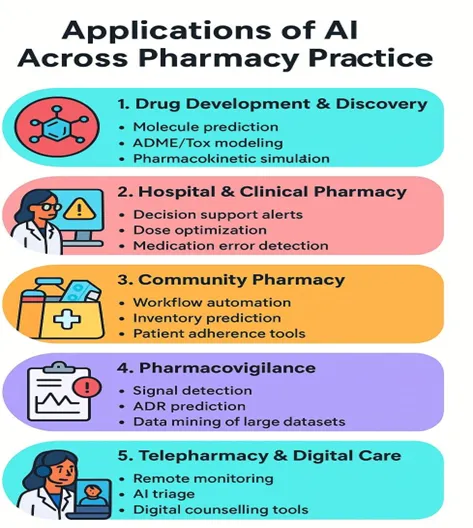
Fig: Application of AI across Pharmacy practice
AI-powered Clinical Decision Support Systems (CDSS) assist pharmacists in recognizing drug-drug interactions, dosing mistakes, and contraindications, thereby improving medication safety. Machine learning algorithms help forecast therapeutic outcomes and potential side effects, enabling personalized treatment strategies and promoting safer prescribing practices.
AI technologies enhance medication review procedures by evaluating prescriptions and patient data to identify errors, duplications, and non-adherence. Predictive analytics track adherence behaviors and provide alerts or interventions to improve treatment results, especially in the management of chronic diseases.
Artificial intelligence enhances pharmacovigilance by analyzing various data sources, including health records, spontaneous reporting systems, and social media, to effectively identify adverse drug reactions (ADRs). Natural Language Processing (NLP) improves the understanding of this information, while automated signal detection systems speed up the recognition of safety concerns that assist in regulatory decision-making.
AI streamlines the process of drug discovery by predicting interactions, identifying lead compounds, and optimizing pharmacodynamic properties. By integrating virtual screening with machine learning methods, it decreases the reliance on laboratory tests, thereby reducing costs and project timelines. Additionally, AI contributes to formulation development by predicting stability, adjusting ingredient ratios, and designing advanced delivery mechanisms.
AI technologies boost efficiency in both community and hospital pharmacies by utilizing automated dispensing systems, effective inventory management, and demand-driven stock control. Robotics and inventory management solutions minimize errors, prevent stock shortages, and enhance procurement processes, allowing pharmacists to concentrate more on patient care.
AI enhances patient care by consolidating medical histories, vital signs, and lifestyle information to inform treatment choices. Digital instruments, such as AI-driven applications, wearable devices, and chatbots improve education, patient engagement, and adherence, especially in managing chronic conditions and telehealth services.
AI strengthens operational efficiency and quality assurance by overseeing pharmacy workflows, forecasting demand, and pinpointing potential bottlenecks. Predictive analytics optimize resource distribution, reduce waste, and ensure adherence to regulations, thus contributing to cost-effective and high-quality pharmacy services.
Benefits of Artificial Intelligence in Pharmacy Practice
Artificial intelligence (AI) offers significant advantages in pharmacy practice by improving clinical accuracy, enhancing operational productivity, facilitating patient management, and advancing research outcomes. Based on the literature reviewed, the benefits of AI can be summarized in the following points:
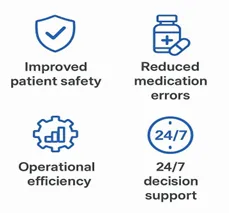
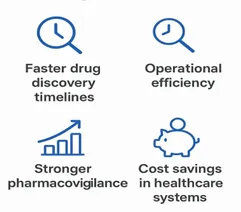
Fig: Benefits of AI in Pharmacy Practice
AI technologies assist pharmacists in making well-informed decisions by providing timely notifications regarding drug–drug interactions, contraindications, and dosage errors. Predictive algorithms can assess patient risk, paving the way for personalized treatment strategies and reducing the likelihood of adverse medication events. These tools enhance pharmacists’ ability to deliver effective care.
AI contributes to medication safety through automated prescription reviews, error detection, and pharmacovigilance systems. Natural Language Processing (NLP) methods analyze unstructured data from health records and spontaneous reporting systems to quickly identify early adverse drug reactions (ADRs), thereby improving the speed and accuracy of post-marketing surveillance. This approach decreases the risk of medication errors and increases patient safety.
AI significantly reduces the time and costs associated with drug development by anticipating interactions, refining lead compounds, and modeling pharmacokinetic and pharmacodynamic properties. Machine learning algorithms enable efficient virtual screening, facilitating the rapid discovery of potential therapeutic agents. Furthermore, AI supports formulation design by forecasting stability and advancing drug delivery methods, ultimately enhancing product quality.
Artificial intelligence improves pharmacy operations by automating tasks such as dispensing, inventory management, and demand forecasting. Robotic technology reduces errors, prevents stock shortages, and enhances resource allocation, allowing pharmacists to focus more on clinical and patient-centered responsibilities. Predictive analytics also contributes to minimizing waste and enhancing the cost-effectiveness of pharmacy services.
AI enables customized healthcare by integrating patient information, including vital signs, lab results, and lifestyle factors to inform treatment decisions. Tools like AI-powered applications, wearable devices, and chatbots enhance medication adherence, patient education, and engagement in managing chronic conditions as well as remote monitoring. This ultimately improves patient outcomes and satisfaction.
AI improves post-marketing drug safety monitoring by detecting adverse drug reactions (ADRs) more swiftly and accurately than traditional methods. Automated data extraction from platforms such as social media and clinical records ensures timely recognition of safety signals. This supports regulatory measures and reduces risks to public health.
Challenges, Limitations, and Ethical Considerations of AI in Pharmacy Practice
Despite the benefits AI brings to pharmacy, its implementation is accompanied by several challenges, limitations, and ethical dilemmas. The following subpoints summarize these issues based on the reviewed literature:
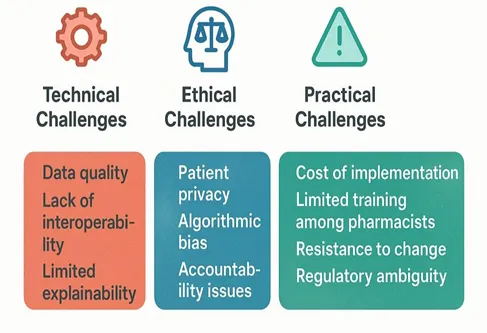
Fig: challenges and ethical issues in AI adoption
AI systems rely on high-quality data sets to make accurate predictions and recommendations. Data that is incomplete, inconsistent, or biased can compromise the effectiveness of algorithms, leading to errors in decision-making. Many AI models are trained using specific datasets, limiting their applicability to diverse patient populations.
Many AI systems, particularly deep learning models, function as "black boxes" with decision-making processes that are hard to understand. Pharmacists and clinicians may struggle to interpret or validate AI-generated recommendations, which can undermine trust in these tools and hinder their acceptance in clinical environments.
The adoption of AI requires digital infrastructure, significant computing power, and seamless integration with existing electronic health records (EHRs) and pharmacy systems. The lack of such infrastructure and the costly nature of AI technologies present significant barriers to widespread adoption.
A considerable number of pharmacists lack training in AI, data analytics, and digital health technologies. Insufficient understanding of AI tools may reduce their effectiveness, impede their implementation, and create reliance on external technical support. Ongoing professional development is vital to build competencies in evaluating and using AI effectively.
The use of AI raises ethical issues related to patient privacy, data security, and informed consent. Extensive datasets often contain sensitive medical information that must be protected from unauthorized access, breaches, or misuse. Adhering to standards is essential for the ethical use of AI.
AI models can mirror biases present in their training data, potentially leading to flawed treatment recommendations or inaccurate risk evaluations for marginalized groups. Addressing bias is crucial to ensure equitable healthcare delivery and prevent health disparities.
The absence of regulations and legal frameworks surrounding the use of AI in pharmacy complicates the assignment of accountability for errors arising from AI recommendations. Determining liability—whether it falls on pharmacists, software developers, or healthcare organizations—remains ambiguous, posing challenges in clinical contexts.
Excessive dependence on AI may impair pharmacists’ critical thinking and decision-making abilities. While AI supports the decision-making process, human oversight remains essential to ensure patient-centered care and to catch errors that automated systems might overlook.
Summary
While AI brings significant advantages to pharmacy practice, issues regarding data integrity, transparency, infrastructure capabilities, workforce preparedness, ethical concerns, algorithmic biases, legal ambiguities, and dependence need to be addressed. To achieve ethical, safe, and fair incorporation of AI, comprehensive planning, stringent regulations, training, and continuous pharmacist supervision are essential.
Role of Pharmacists in the AI Era
As the integration of AI into pharmacy operations increases, pharmacists' roles are evolving from traditional dispensing to encompass the management, verification, and ethical oversight of AI systems. Research highlights important responsibilities for pharmacists in this AI-focused context:
Pharmacists are responsible for assessing AI-generated insights to ensure their clinical relevance and patient safety. Although AI can predict drug interactions and recommend dosages, pharmacists must consider individual patient characteristics, such as comorbidities, allergies, and lab results, to evaluate the appropriateness of these recommendations. This oversight minimizes errors and keeps patient needs at the forefront of decision-making.
AI technologies facilitate the detection of prescription errors; however, pharmacists remain responsible for monitoring AI performance and addressing any inaccuracies or false alerts. By combining their expertise with AI-generated data, pharmacists can enhance medication safety and reduce the risk of adverse drug events.
Pharmacists collaborate with AI in post-marketing surveillance, validating initial safety alerts, and analyzing complex data from electronic health records and reporting systems. They ensure that AI-based pharmacovigilance tools produce valuable outcomes while adhering to regulatory requirements.
Pharmacists contribute to AI-supported drug discovery by refining datasets to verify model accuracy and providing insights on research trajectories. Their expertise in pharmacology ensures that AI-generated predictions regarding drug efficacy, toxicity, and formulation are scientifically valid and clinically relevant.
Pharmacists assist in the adoption of AI-driven Clinical Decision Support Systems (CDSS) within pharmacy operations by educating staff, providing feedback, and ensuring effective implementation. Their involvement improves the usability of the systems, promotes adherence to guidelines, and encourages collaboration among healthcare professionals.
Pharmacists uphold ethical AI practices by maintaining patient confidentiality, safeguarding data, and complying with regulations. They identify algorithmic biases, ensure equitable implementation across diverse populations, and advocate for responsible AI utilization.
Pharmacists play a vital role in advancing digital literacy and AI competencies within healthcare teams. They help design educational programs, conduct training sessions, and support colleagues and students in the proficient application of AI technologies, thereby cultivating a workforce ready for AI-enhanced pharmacy practice.
Pharmacists serve as a link between AI systems and patients, clarifying AI-generated recommendations, assisting with adherence, and ensuring transparency in treatment decisions. Their engagement boosts trust and fosters cooperative decision-making in AI-driven healthcare.
Summary
In the era of AI, pharmacists are not just passive technology users, but proactive leaders who validate AI outputs, ensure medication safety, supervise pharmacovigilance, guide research efforts, implement clinical decision support, uphold ethical practices, educate their peers, and engage with patients. Their knowledge guarantees that AI complements rather than supplants human judgment, fostering a safe, efficient, and patient-focused pharmacy practice.
Future Outlook
Artificial intelligence is infiltrating pharmacies at an accelerated pace - quicker than anticipated - and it’s transforming not just the dispensing of prescriptions. Imagine innovative tools supporting doctors during consultations, reviewing extensive records, managing chaos at administrative desks, or redefining conversations between pharmacists and patients. What’s worth your attention? Exactly this list.
Envision this - genetics interwoven with daily habits, physical indicators, and real-time health notifications. Computers analyze these factors to tailor treatments specifically for you. Instead of making random choices, doctors receive insightful recommendations indicating the most suitable options. Consequently, outcomes improve while adverse effects diminish. It’s as if your medication truly understands your needs now.
AI is becoming increasingly proficient at identifying issues related to medications. By examining medical histories, social media, or global warnings - potentially through a combination of these - it quickly detects warning signals. With advanced analytical techniques and pattern recognition, adverse reactions can be identified sooner. This allows teams to intervene promptly, while regulators can take swift action when risks arise.
The landscape of drug discovery has changed dramatically. With the aid of AI, researchers can forecast drug behavior, refine initial prototypes, or conduct intricate simulations swiftly. When combined with automated laboratories and intelligent chemistry tools, it enhances efficiency, reduces costs, minimizes errors, and lessens the workload.
Fewer errors and better inventory management ensure that pharmacy operations run more seamlessly. Relying less on human oversight for restocking or estimations, intelligent systems constantly monitor supplies, keeping shelves stocked when prescription demands surge. Moreover, employees can dedicate more time to direct interactions with customers.
As the use of AI becomes more prevalent in pharmacies, regulations must keep pace. Strong ethical standards are essential - alongside effective oversight. Safeguarding personal information, rectifying biased results, and establishing clear accountability are all crucial for achieving safe and equitable outcomes with AI.
Today’s pharmacy professionals are moving beyond traditional practices. They need to become adept at data management, collaborating with AI systems, and navigating digital platforms. Training programs are no longer solely focused on medications - some may encompass teaching the flow of prescription testing or operating intelligent software, enabling skilled individuals to transition into influential roles where technology meets patient care.
Patients on medication might find it easier to adhere to their treatment, as innovative devices and applications monitor their conditions from a distance. When healthcare providers receive updates on patients' progress, they can intervene promptly if any issues arise. Rather than relying on assumptions, clinicians can follow data-driven recommendations - although in-person conversations still play a vital role.
CONCLUSION
The field of pharmacy is being revolutionized by artificial intelligence, which provides resources that help enhance treatment decisions while prioritizing patient safety. In addition to speeding up processes, these innovations streamline routine tasks and promote new approaches to drug discovery. Research shows that AI applications—including forecasting tools, voice recognition technology, automated medication dispensers, and adverse effect monitors—allow pharmacists to focus more on patient care rather than administrative duties. This transition leads to a significant reduction in prescription errors, simplifies the tracking of medication effects, and allows for quicker identification of adverse reactions, resulting in safer and more precise care.
AI is having a major influence on the pharmacy sector by equipping pharmacists with tools like smart alerts, improved dosing recommendations, and various enhancements that boost treatment efficacy. At the same time, it is utilized in initiatives to ensure drug safety—enabling quicker detection of effects and real-time analysis of vast amounts of patient data, thereby contributing to medication safety after approval. When it comes to drug development, AI accelerates the process by identifying promising candidates early, optimizing molecular structures, and refining medication formulations—all resulting in reduced trial costs and faster breakthroughs.
Despite the genuine benefits AI brings, experts emphasize the need to address ongoing issues, such as unreliable data quality and ambiguous algorithms—along with concerns about privacy, inadequate systems, untrained staff, and potential biases in models. To ensure fairness and safety, robust guidelines must support decision-making, safeguard patient information from misuse while implementing AI in pharmacies. Oversight mechanisms should be established to ensure accountability in operations.
As technology progresses, pharmacists will play a crucial role in ensuring that AI is applied responsibly—merging safety with practical benefits. They are becoming the interpreters of data generated by machines, guardians of information, leaders in monitoring medication risks, participants in drug development, and advisors in navigating technology-driven healthcare—all essential positions that are transforming pharmacy practice today. As AI continues to evolve, the role of pharmacists will only increase in importance—not merely verifying the efficacy of advanced algorithms, but ensuring that decisions remain equitable, grounded, and centered on human judgment instead of allowing technologies to dominate decision-making.
In summary, artificial intelligence has the potential to significantly alter pharmacy operations—enhancing safety, speed, and potentially accuracy. As technology advances, supported by sound regulations and genuine input from pharmacists, it could entirely transform drug care; steering medicine toward personalized treatments and informed decisions, fueled by data and tools we are only beginning to harness.
REFERENCES






Avinash Shinde, Snehal Patil, Saloni Dalavi, Vaishnavi Naiknaware, Reva Patwardhan, Chinmay Tarkar, Effect Of Artificial Intelligence On The Pharmacy Practice, Int. J. of Pharm. Sci., 2026, Vol 4, Issue 8, 2227-2239, https://doi.org/10.5281/zenodo.21917702
 10.5281/zenodo.21917702