

We use cookies to ensure our website works properly and to personalise your experience. Cookies policy
Pres’s College Of Pharmacy For Women Chincholi , Nashik , Maharashtra India 422102
Emulgel is a sophisticated topical drug delivery technology that combines the advantages of emulsions and gels to improve the administration of both hydrophilic and hydrophobic medicines. Conventional gels have good patient acceptance but are unsuitable for poorly water-soluble medicines, whereas emulgels address this issue by integrating an emulsion within a gel foundation. These formulations enable enhanced medication penetration via the skin, improved stability, regulated drug release, better spreadability, non-greasy texture, simplicity of application, and increased patient compliance. Emulgels also skip first-pass metabolism and decrease gastrointestinal side effects associated with oral medication administration. The formulation typically includes of an aqueous phase, oil phase, emulsifiers, gelling agents, preservatives, and permeation enhancers, each contributing to product stability and therapeutic performance. Depending on droplet size, emulgels are divided into macroemulgel, microemulgel, and nanoemulgel. Their quality is tested using factors such as pH, viscosity, extrudability, drug release, skin irritation, swelling index, rheological behavior, stability, and release kinetics. Overall, emulgels constitute a viable, patient-friendly, and efficacious platform for topical and transdermal drug delivery with enormous pharmaceutical potential
The application of a medication-containing formulation to the skin in order to directly treat a cutaneous condition is known as topical drug delivery. When other drug delivery methods (such as oral, sublingual, rectal, and parental) are ineffective or when a local skin illness, such as a fungal infection, occurs, the topical drug delivery system is typically employed.[1] One appealing option for both local and systemic treatment is topical medication administration. The direct accessibility of the skin as a target organ for diagnostic and treatment is a distinctive feature of dermatological pharmacology.[2] Bypassing first pass metabolism is the topical delivery system's primary benefit. Another benefit of the topical drug delivery method is that it avoids the dangers and hassles of intravenous therapy as well as the many circumstances of absorption, such as pH fluctuations, the presence of enzymes, and gastric emptying time.[3] The formulations come in a variety of forms, including liquid, semisolid, and solid. Drugs are applied topically to have systemic effects or to act at the application site. If a medicine is in solution, has a favorable lipid/water partition coefficient, and is non-electrolyte, its absorption thru the skin is improved [.4] The human skin is a specially designed organ that allows living on land by controlling the body's loss of heat and moisture while keeping harmful substances and microbes out. It is also the largest organ in the human body, with an average area of 1.7 m2 and contributing around 10% of an average person's body mass. Human skin is a highly effective self-repairing barrier that keeps the insides in and the outs out, even tho such a vast and widely accessible organ seems to offer excellent and many sites to administer therapeutic substances for both local and systemic activities.[5] The most widely used dermatological products are semisolid preparations, however they come in a variety of formulations and consistencies, from liquid to powder. Transparent gels are now widely used in both pharmacological and cosmetic preparations within the main category of semisolid preparations. Large volumes of aqueous or hydroalcoholic liquid are trapped in a network of colloidal solid particles to generate gels, a relatively novel class of dosage form that can include inorganic materials like aluminum salts or organic polymers of synthetic or natural origin. Compared to the ointment or cream basis, they feature a higher aqueous component that allows for increased drug solubility and easier drug migration thru a vehicle that is virtually a liquid. In terms of patient acceptability and ease of use, these are better.[2] Nevertheless, the administration of hydrophobic medications is severely limited by these beneficial gels. Emulgel is therefore created and utilized to make up for this deficiency so that even a hydrophobic medicinal moiety can benefit from the special qualities of gels. In actuality, a conventional emulsion becomes an emulgel when a gelling agent is present in the water phase.[4] They are a blend of gel and emulsion, as their name implies. Different medications are delivered to the skin using both water-in-oil and oil-in-water emulsions. Additionally, they are highly capable of penetrating the skin. Thixotropic, greaseless, readily spreadable, easily removable, emollient, non-staining, water-soluble, longer shelf life, bio-friendly, clear, and esthetically pleasant are just a few of the benefits of using Emulgel for dermatological purposes.[3]
The intact stratum corneum, sweat ducts, or sebaceous follicles are the three main ways that molecules can enter the skin. Over 99% of the skin's surface is available for percutaneous medication absorption on the stratum corneum. The rate-limiting stage for percutaneous absorption is passing thru this outermost layer. The creation of a concentration gradient, which serves as the catalyst for drug movement across the skin, drug release from the vehicle (partition coefficient), and drug diffusion across the skin's layers (diffusion coefficient) are the main processes in percutaneous absorption.[4]
FACTORs AFFECTING TOPICAL ABSORPTION OF DRUG [6- 7.]
Physiological Factors
1. Skin thickness.
2. The amount of fat.
3. Hair follicle density.
4. Sweat gland density.
5. Ph of the skin.
6. Blood flow.
7. Skin hydration.
8. Skin inflammation
Physiochemical Factors
1. The partition coefficient.
2. Molecular weight (less than 400 dalton)
3. Ionization degree (only unionized medicines are well absorbed).
4. The impact of cars
Factors to be Considered When choosing a Topical Preparation [8-9]
ADVANTAGE OF EMULGEL [10,11]
1) Hydrophobic drug incorporation;
2) Better loading capacity;
3) Better stability;
4) No intensive sonication;
5) Controlled release;
6)Avoiding first pass metabolism;
7) Avoiding gastrointestinal incompatibility;
8) More site-specific selectivity;
9) Improving patient compliance and suitability for self-medication;
10) Using medication with a short biological half-life and a narrow therapeutic window;
11) Easily stopping medication when necessary.
DISADVANTAGES OF EMULGEL [10,11]
1) Large-particle medications are difficult for the skin to absorb.
2) Some drugs have poor skin penetration.
3) Allergic response or skin irritation due to contact dermatitis.
4) Bubble creation during emulgel formation.
EMULGEL:[12-13]
Focusing on emulgel is both fascinating and challenging because it is a relatively young field in topical medicine delivery with few commercialized solutions to date. Before applying either gel or emulsion for topical drug delivery, it's critical to comprehend their advantages. Emulsions are controlled release systems consisting of two immiscible phases, one of which is dispersed into the other. Transparent, biocompatible, thixotropic, spreadable, readily removable, emollient, and non-staining are all characteristics of Emulgel. They are also esthetically pleasing and greaseless. Additional benefits include their great cutaneous penetration and long shelf life. Emulgel works as a dual control release system because it possesses the characteristics of both a gel and an emulsion. Emulgel is one kind of biphasic semisolid formulation. Applications for regulated delivery are being used with them these days. Emulgel can distribute hydrophilic and lipophilic drug moieties since it has both aqueous and nonaqueous phases. Because it is not greasy like other topical formulations like ointments, creams, etc., which are thick and require a lot of rubbing, it is applied to the skin appropriately. The efficacy of topical medication administration is well known. Emulgel can deliver lipophilic or hydrophilic medications since it contains both aqueous and non-aqueous phases.
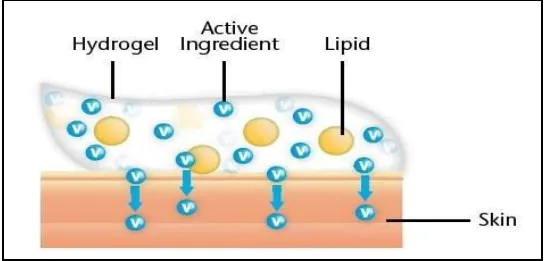
Figure 1: Structure of Emulgel[14]
TYPES OF EMULGEL :
A.Macroemulsion Gel –
emulgel with emulsion droplets bigger than 400 nm. Under a microscope, the individual droplets are easily visible even tho they are physically unnoticeable. Surface-active materials are thermodynamically unstable even tho they can help stabilize macroemulsions.[15] Depending on the emulsification method and kind of emulsifier, the macro emulsion can be either O/W or W/O.[16]
B.Microemulsion Gel –
Microemulsions exhibit both thermodynamic stability and optical transparency. This microemulsion has a diameter of 20 to 200 nm and is made up of monodispersed spherical droplets.[16] It is made up of certain amounts of water, oil, co-surfactant, and surfactant. Microemulsions can have a broad interfacial region, extremely low interfacial tension, and the ability to dissolve both aqueous and oil-soluble compounds. The components of the microemulsion may promote a greater rate of medication penetration by lowering the stratum corneum's diffusion barrier [15]. Furthermore, by blocking medication absorption in the bloodstream, microemulsion-based gel promotes drug accumulation in the skin for efficient action [13].
C.Nanoemulsion Gel –
When gel and nanoemulsion are combined, the result is called nanoemulgel. Oil and water dispersions are stabilized by an interfacial coating of surfactant and cosurfactant molecules with a droplet size of less than 100 nm, resulting in transparent and translucent nanoemulsions that retain thermodynamic stability.The word "nanoemulgel" refers to the combination of gel and emulsion. Several medications have higher transdermal penetration when compared to more traditional forms like emulsions and gels. The nanoemulsion shows enhanced transdermal and dermal transport capability both in vitro and in vivo [15].
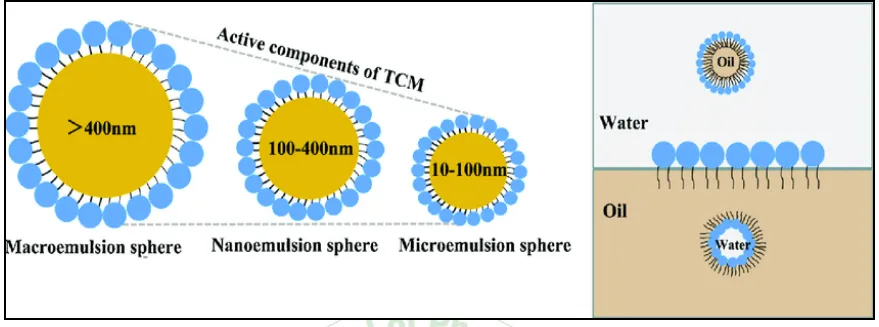
Figure-2: Types of Emulgels [17]
IMPORTANT CONSTITUENTS OF EMULGEL PREPARATION :
This creates the emulsion's aqueous phase. Alcohol and water are often used agents.[18]
For externally applied emulsions, mineral oils, either alone or combined with soft or hard paraffins, are widely used both as the vehicle for the drug and for their occlusive and sensory characteristics. Widely used oils in oral preparations are nonbiodegradable mineral and castor oils that provide a local laxative effect, and fish liver oils or various fixed oils ofvegetable origin (e.g., arachis, cottonseed, and maize oils) as nutritional supplements.[19-20]
Emulsifying agents are used both to promote emulsification at the time of manufacture and to control stability during a shelf life that can vary from days for extemporaneously prepared emulsions to months or years for commercial preparations.eg Polyethylene glycol 40 [21] stearate, Sorbitan monooleate[22] Span 80), Polyoxyethylene sorbitan monooleate (Tween 80) [23,] Stearic acid [24,] Sodium stearate[.25]
Deze middelen worden ingezet om de consistency van elke dosering te verhogen, en ze kunnen ook worden ingezet als thickening agent.[26-27]
Deze stoffen splitsen zich in en beïnvloeden de huidcomponenten om een tijdelijk en herhaaldelijk stijging van de permeability van de huid te veroorzaken.[28]
Several excipients are used in emulgels to help with formulation and enhance their qualities. The main excipients in emulgel consist of:
Emulsifiers: [29,30,31]
Help emulsify the phases of water and immiscible oil; examples include sorbitan esters, glyceryl esters, cetostearyl alcohol, and other common emulsifiers; the HLB value determines the O/W or W/O emulsion that an emulsifier will create; emulsification during manufacturing and emulsion stability beyond the product's shelf life depend on the presence of emulsifying agents; selecting the appropriate emulsifying agent and concentration requires experience and trial and error. Tween 20 was used in the aqueous phase of Emulgel.
Vehicle:[13]
Uses: Apply the drug to the intended site. Keep the targeted tissue at a therapeutic concentration long enough to produce a pharmacological effect. To make it easier for the drug to reach the place of action, release it.
a) Water-based material that forms the aqueous phase of the emulsion.
b) Common agents are used, such water and alcohol.
c) Lipids: These substances come from the oil phase. For externally applied emulsions, mineral oils are frequently utilized either alone or in conjunction with soft or hard paraffins.
Properties of Vehicle-
• Evenly and effectively apply the drug to the skin.
• To allow for unrestricted movement to the site of action, release the drug.
• Deliver the drug to the designated spot.
• Keep the prescribed dosage at a therapeutic level.
• Barrier: In general, the stratum corneum allows very little topical treatment to pass through. • Both the active agent and the vehicle's characteristics affect the rate and degree of absorption.
Thickeners:[31]
Viscosity and a gel-like consistency are necessary for emulgels. Carbomer, hydroxypropyl cellulose, and xanthan gum are common thickeners. The type and concentration of thickener used determines whether a fluid, soft solid, or hard solid emulgel is created.
Emulsifiers:[29,30]
Choosing the appropriate emulsifying agents depends not only on their ability to emulsify but also on how they will be used and, in the end, how dangerous they are. Each surfactant is given an HLB value that represents the proportions of the molecule's hydrophilic and lipophilic constituents. High numbers indicate a surfactant primarily exhibiting hydrophilic or polar properties, whilst low values indicate lipophilic or non-polar properties. Emulsifying chemicals are necessary for both actual emulsification during manufacturing and emulsion stability throughout the product's shelf life. Emulsifying chemicals are necessary for both actual emulsification during manufacturing and emulsion stability throughout the product's shelf life.Choosing the appropriate emulsifying agents depends not only on their ability to emulsify but also on how they will be used and, in the end, how dangerous they are. Each surfactant is given an HLB value that represents the proportions of the molecule's hydrophilic and lipophilic constituents. High numbers indicate a surfactant primarily exhibiting hydrophilic or polar properties, whilst low values indicate lipophilic or non-polar properties. Emulsifying chemicals are necessary for both actual emulsification during manufacturing and emulsion stability throughout the product's shelf life.
Gelling agents: [32]
These substances can be employed as thickening agents or to improve the consistency of any dosage form.
Preservatives: [13]
used to protect the emulgel from microorganisms. For instance, methyl and propyl parabens.
Permeation Enhancers: [30,33],
These chemicals cause a transient, reversible increase in skin permeability by interacting and partitioning into the skin's constituent parts. In order to increase drug absorption, drug delivery vehicles often include penetration-enhancing chemicals that temporarily disrupt the skin barrier, fluidize the lipid channels between coenocytes, alter how the drug is partitioned into skin structures, or improve skin delivery in other ways. For example, 8% clove oil and 5% menthol.
Properties of penetration enhancers:
• They should be devoid of poisons, allergies, and irritants. In a perfect world, their activity and duration would be predictable, repeatable, and they would respond swiftly.
• They shouldn't have any pharmacological effects on the body or bind to receptor locations.
• The penetration enhancers should work in a unidirectional manner, allowing therapeutic materials to enter the body while preventing endogenous material from extruding.
• The penetration enhancers should be compatible with both drugs and excipients so they can be incorporated into different topical formulations.
• They should also be visually appealing and have a good "feel" to their skin.
Aqueous Material:[30]
This creates the emulsion's aqueous phase. Water, alcohol, and other substances are frequently utilized.
Oils: [34]
These agents are present in the oily phase of the emulsion. Because of their occlusive and sensory qualities, mineral oils are frequently used as the drug's vehicle either by themselves or in conjunction with soft or hard paraffin for topically administered emulsions. Because they have a local laxative effect, fish liver oils and nonbiodegradable mineral oils are frequently used in oral preparations.
ESSENTIAL CONSTITUENTS OF EMULGEL PREPARATION [35]
This creates the emulsion's aqueous phase. Typical agents are alcohols and water.
These substances create the emulsion's oily phase. Mineral oils are widely utilized as the drug's transport and for their occlusive and sensory properties in topically administered emulsions, either by themselves or in combination with soft or hard paraffins. Nonbiodegradable mineral and castor oils, which have a local laxative effect, fish liver oils, and several fixed vegetable oils (such as arachis, cottonseed, and maize oils) are frequently employed as nutritional supplements in oral preparations.
Emulsifying agents, such as polyethylene glycol stearate, sorbitan mono-oleate (Span 80), polyoxyethylene sorbitan mono-oleate (Tween 80), stearic acid, and sodium stearate, are used to control stability over a shelf life that can range from days for spontaneously prepared emulsions to months or years for commercial preparations.
These substances can be employed as thickening agents or to improve the consistency of any dosage form.
These substances cause a transient and reversible increase in skin permeability by partitioning into and interacting with skin constituents.
Method to Enhance Drug Penetration and Absorption
1. Chemical improvement
2. Improvement of the body
3. Improvement of biochemistry
4. Enhancement of supersaturation
METHOD OF PREPARATION [35]
Step 1: O/W or W/O emulsion formulation
Step 2: Gel base formulation
Step 3: Stirring continuously while incorporating the emulsion into the gel foundation
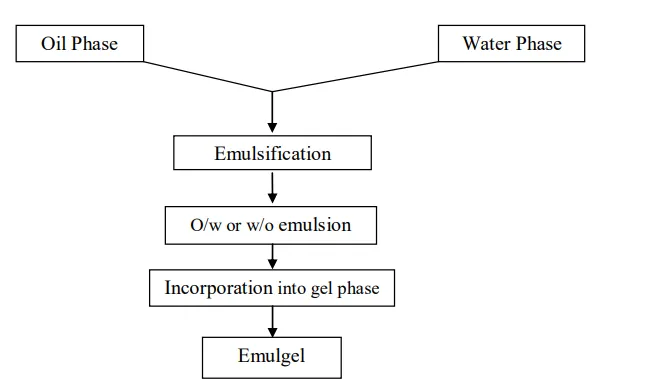
Figure 3: Emulgel Preparation Process
EVALUAIONPARAMETERS:
Physical examination:[36,38]
Visual inspection is used to assess the emulgel's pH, homogeneity, color, consistency, and appearance. A pH meter uses a 1% water solution of the emulgel to determine the pH value.
Determination of pH:[38,39]
A pH meter is used to determine the emulgel's pH. The skin responds favorably to a topical product. It is easier to make sure a product is suitable for the skin when you know its pH.
Determination of viscosity:[40,41]
A appropriate viscometer is used to measure the emulgel's viscosity. By varying the shear rate and storage temperature, we may investigate the effects of temperature and pressure on viscosity. This aids in our comprehension of how the product performs when applied with varying degrees of force and how its consistency varies while stored at various temperatures.
Extrudability:[42,43]
Determining the power needed to extrude the gel from a tube is one way to assess extrudability, a crucial characteristic of topical gel compositions.A gel formulation's extrudability is evaluated by applying light finger pressure to the tube and calculating the percentage of gel that is extruded. The protocol can be used to assess the gel compositions' extrudability. Carbopol and HPMC gels were shown to have better extrudability than sodium CMC gel.
Film Weight:[44]
A properly calibrated one-gram sample of the gel is put into a petri dish to calculate the film weight. After that, the sample is allowed to fully dry. A high-precision electronic balance is used to precisely weigh the final film after it has dried.
Rheological Studies:[45,46]
A Brookfield viscometer with a spindle 07 is used to precisely test the viscosity of the produced batches. The formulation being evaluated is carefully transferred into a beaker and let to settle for half an hour at the specified assay temperature before measurement. To ensure ideal measuring circumstances, the spindle is then lowered perpendicularly into the emulgel's center.
In vitro Drug Release Study:[47,48]
Using inert membranes that function as simplified human skin models, the Franz Diffusion Cell is used to examine and contrast the in vitro release properties of different formulations. These membranes are appropriate for this use because they have a porous substructure made of a hydrophobic matrix. The data produced offers important insights into the relative permeabilities of various formulations, even though these membranes' permeability to medications is greater than that of human skin. Synthetic membrane pieces are carefully mounted in a Franz-type diffusion cell after being submerged in a 0.2 M potassium dihydrogen phosphate buffer for a full day.Make sure there are no air bubbles and that the membrane is firmly in place.Apply 200 mg of the sample to the donor side of the diffusion cell, making that the membrane is completely covered. Put the entire assembly in a water bath that is kept at 32°C. To maintain consistent conditions throughout the experiment, make sure the assembly is vigorously agitated.Carefully take 2 mL samples from the receiver chamber at prearranged intervals. To preserve the integrity of the experiment, swap out each sample for an equivalent volume of new buffer.To ascertain the amount of drug release at a particular wavelength, perform spectrophotometric analysis on all samples that were obtained.
Skin irritation Test:[49,38]
The skin irritation test, often known as the patch test, is a crucial assessment method used to determine whether an emulgel has the potential to produce cutaneous responses or skin irritation.In order to prepare laboratory animals—usually rats, mice, or rabbits—for the test, a particular section of their skin is shaved. After applying the emulgel product to the exposed skin area, any negative skin changes are closely monitored and documented.If, after a set amount of time, the treated skin region shows evidence of irritation, such as redness, inflammation, or other negative reactions, the product is deemed to have a high potential for producing skin irritation.
Ex-vivo Drug Release Study:[50,51,52]
Take a skin sample from a male Wistar rat and cut it gently so that the dorsal side is facing up.Secure the skin slice securely by clamping it to one end of the modified diffusion cell's hollow glass tube.Make sure the membrane is completely covered by applying an even layer of Emulgel.Make a phosphate buffer with a pH of 5.5 to use as the medication release study's dissolving medium.Bring the donor and receptor compartments together to assemble the diffusion cell. Before starting the medication release research, let the system settle.
Swelling index:[53]
Make sure to evenly distribute 1 gram of the emulgel on a piece of aluminum foil that is porous.The emulgel sample should be kept in a 50 ml beaker with 10 ml of 0.1 N sodium hydroxide (NaOH) solution. The emulgel sample should be carefully taken out of the beaker at different intervals and left in a dry area for a brief amount of time.Weigh the swelled emulgel sample (wt) and note the result. Use the following formula to determine the swelling index:
Swelling Index (SW%) = [(wt - wo) / wo] x 100
Where
Wo= is the initial weight of the emulgel at zero time
(SW) % = Percent Swelling Index, and
Wt =is the weight of the swelled emulgel after time t.
Kinetics Modeling: [54]
Data from ex-vivo permeation experiments are fitted into a number of mathematical models to assess the drug release kinetics, including:
1. The zero-order model
2. Model of the first order
3. Higuchi model
The goodness of fit for each model is evaluated based on the coefficient of determination (R2). The optimum model for explaining the drug release kinetics is the one with the highest R2 value, which is closest to 1.
Stability study:[55]
Make sure the tubes are securely sealed before adding the emulgel mixture to 5g aluminum collapsible tubes.
Storage Conditions
Put the filled tubes in stability chambers that are kept in the following circumstances:
1. Conditions under refrigeration: 5°C
2. The ambient temperature is 25°C and the relative humidity (RH) is 60%.
3. High temperatures: 30°C and 65% relative humidity
Duration of Study
Store the emulgel samples at the specified conditions for a period of one month
CONCLUSION
Emulgel is a revolutionary topical drug delivery technology that improves the penetration and stability of both hydrophilic and hydrophobic medicines by combining the advantages of gels and emulsions. Because it is non-greasy and simple to use, it provides regulated drug release and increased patient compliance. Its therapeutic potential has been further enhanced by developments in nanoemulgel technology and formulation techniques. Emulgel is a flexible carrier with significant future advancements anticipated in topical formulations, despite certain drawbacks such possible skin irritation and permeability problems.
REFERENCES
Drug development and industrial pharmacy. 2005 Jan 1;31(4-5):405-16.
Drug development and industrial pharmacy. 2005 Jan 1;31(4-5):405-16.


Namrata Godhari, Rahul Khaire, Kiran Rayte , Vaishnavi Devhad, Sharvari Mhaske, Emulgel-Based Delivery Systems, Int. J. of Pharm. Sci., 2026, Vol 4, Issue 9, 3498-3510, https://doi.org/10.5281/zenodo.23010591
 10.5281/zenodo.23010591