

We use cookies to ensure our website works properly and to personalise your experience. Cookies policy
Anuradha College of Pharmacy, Chikhli, Buldana, Maharastra, India, 443201
The current research investigates the use of the traditional Ayurvedic Bhavana technique to improve the solubility of the poorly water-soluble drug Glipizide by utilizing fenugreek extract as a natural solubility-enhancing agent. Glipizide, a widely used second-generation sulfonylurea antidiabetic medication, possesses limited aqueous solubility, resulting in reduced dissolution and bioavailability. In the present work, the drug was subjected to one and two Bhavana cycles using fenugreek extract to modify and enhance its physicochemical characteristics. The processed formulations were analyzed through solubility studies, dissolution testing, UV spectrophotometric evaluation, and Fourier Transform Infrared (FTIR) spectroscopy. The results obtained from the comparative assessment of pure Glipizide and Bhavana-treated samples indicated a noticeable increase in solubility and drug release profile following the Bhavana treatment. FTIR studies revealed the absence of significant chemical incompatibility between Glipizide and fenugreek extract. The observed enhancement in dissolution may be due to improved wettability, reduction in particle size, and the hydrophilic properties imparted by the herbal extract.
Solubility is a key factor in achieving the appropriate concentration of a drug in the bloodstream, which is required for an effective therapeutic response [1]. Drugs with greater solubility generally demonstrate better absorption after oral administration and therefore show improved bioavailability [2]. From a quantitative perspective, solubility is defined as the concentration of a solute in a saturated solution at a given temperature. Qualitatively, it refers to the capability of substances to combine and form a uniform molecular dispersion [3]. Hence, drug solubility represents the maximum amount of drug that can dissolve in a particular solvent under specified conditions such as temperature, pH, and pressure.
While the dissolution rate is affected by surrounding conditions and influences how rapidly a drug is available for absorption, solubility describes the natural tendency of the drug to dissolve in a particular medium. At a specific temperature, the solubility of a substance in a saturated solution remains constant. A solubility chart also demonstrates the behavior of ions, indicating whether they stay dissolved in water or react to produce precipitates.⁴
Solubility is a fundamental physicochemical property that describes the ability of a solid, liquid, or gaseous substance, known as the solute, to dissolve in another substance called the solvent, resulting in the formation of a homogeneous molecular dispersion or solution. In a true solution, the solute particles are uniformly distributed throughout the solvent at the molecular or ionic level, ensuring consistency in composition and properties throughout the system. The extent to which a solute dissolves in a solvent under specific conditions is referred to as its solubility.⁵’⁶
In addition to liquid solutions, certain substances are capable of forming solid solutions, where one solid component becomes uniformly dispersed within another solid matrix. Such systems are commonly observed in alloys and pharmaceutical solid dispersions. Solutions involving gases are relatively rare because gases generally exhibit limited solubility behavior compared to solids and liquids, although examples such as air and dissolved gases in liquids do exist.⁷
In pharmaceutical sciences, solubility plays a crucial role in drug formulation and therapeutic effectiveness because it directly affects the dissolution rate, absorption, and bioavailability of drug molecules. Drugs with poor aqueous solubility often exhibit reduced absorption and inconsistent therapeutic responses, making solubility enhancement an important area of pharmaceutical research and development.⁸
Background of BCS Class
The Biopharmaceutics Classification System (BCS) is an important scientific framework used in pharmaceutical research and drug development to classify drugs according to their aqueous solubility and intestinal permeability. These two physicochemical properties play a major role in determining the rate and extent of drug absorption after oral administration. The system was introduced to provide a better understanding of how different drugs behave in the gastrointestinal tract and to support the development of safe, effective, and high-quality oral dosage forms.¹⁰
The BCS concept was developed as a regulatory and scientific tool to simplify drug formulation strategies and predict in vivo drug performance. It helps researchers and pharmaceutical industries evaluate whether a drug can dissolve efficiently in gastrointestinal fluids and permeate through the intestinal membrane to reach systemic circulation.¹¹ Since oral administration is the most common and convenient route of drug delivery, understanding the solubility and permeability characteristics of a drug is essential for achieving optimum bioavailability and therapeutic efficacy. The BCS framework is widely used in formulation development, dissolution studies, bioavailability prediction, and regulatory approval processes. It also assists in granting biowaivers for certain immediate-release drug products, thereby reducing the need for extensive in vivo bioequivalence studies.¹² Overall, the Biopharmaceutical Classification System serves as a valuable tool in modern pharmaceutical sciences for optimizing drug delivery, improving therapeutic performance, and enhancing the efficiency of drug development processes.¹⁴
The Biopharmaceutical Classification System (BCS) is divided into four major classes based on the drug’s solubility and permeability characteristics, both of which play a significant role in determining oral drug absorption and bioavailability.¹³
Class I drugs exhibit high solubility as well as high permeability. These drugs dissolve rapidly in gastrointestinal fluids and are easily absorbed through the intestinal membrane, resulting in efficient and predictable bioavailability after oral administration.¹⁵
Class II drugs are characterized by low solubility but high permeability. Although these drugs can readily pass through biological membranes once dissolved, their poor aqueous solubility limits the rate of dissolution, which may reduce or delay absorption. Therefore, enhancement of solubility and dissolution becomes important for improving their therapeutic effectiveness.¹⁶
Class III drugs possess high solubility but low permeability. Such drugs dissolve easily in the gastrointestinal tract; however, their absorption is restricted because they cannot efficiently permeate through the intestinal membrane. In these cases, permeability becomes the rate-limiting factor for drug absorption.¹⁷
Class IV drugs demonstrate both low solubility and low permeability, making them the most challenging category for oral drug delivery. These drugs neither dissolve sufficiently nor permeate effectively across biological membranes, often resulting in poor and variable bioavailability. Extensive formulation strategies are generally required to improve their therapeutic performance. Solubility is the ability of a substance, known as the solute, to dissolve completely in another substance called the solvent, resulting in the formation of a uniform and homogeneous solution. The solute may exist in the form of a solid, liquid, or gas, and similarly, the solvent can also be solid, liquid, or gaseous in nature.¹⁹ In most pharmaceutical and chemical applications, the solvent is generally a liquid, either as a single pure substance or as a combination of different liquids. The extent to which a solute dissolves in a solvent depends on several factors such as temperature, pressure, molecular structure, and the nature of interactions between the solute and solvent molecules.²⁰
The solubility behavior of substances may differ significantly depending on their chemical properties and environmental conditions. Some substances exhibit complete miscibility, meaning they can dissolve in each other in all proportions without forming separate phases. A common example is ethanol and water, which mix uniformly to form a single solution. On the other hand, certain compounds possess extremely low solubility in specific solvents. For instance, silver chloride dissolves only to a very limited extent in water, resulting in the formation of a precipitate when its solubility limit is exceeded. Therefore, solubility is considered an essential physicochemical property that plays a major role in chemical reactions, pharmaceutical formulations, and biological processes of substances in different media.²¹
Bhavana and its types and importance
Definition: यच्चर्ुणति स्य धात्वादेर्द्िव ैः सम्ऩेष्य शोषनाम ्।भावनंतन्मतंववज्ञ भावना च ननगद्याते॥र.त.२/४१.
Trituration of aushaddha churna with water, decoction or juice etc and later dried is known as Bhavana.
It is a specific procedure in which a powdered drug of mineral, animal or herbal origin is Thoroughly mixed with the liquid media (expressed juice, decoction etc) and staged Intermittent trituration followed by drying (preferably in sunlight), is carried out till Attainment of Subhavit Lakshana* and complete absorption of liquid into the powder and Drying of the mixture is done.
र्द्व्याणां र्द्व्येण आऱोडनात्ददवा ददवातऩेशोषणं ननशश ननशश स्थाऩनं इनत एवं ववधानं भावना ।गंगाधार टीका च.सं- वव – १/२२
Gangadhara explains bhavana as alodana/mixing of dravya/solids with dravyas/liquids and its Exposure to sunlight or moon light over a stipulated period of time.
Types:
Bhavana can be carried out by two methods and they are
1.Nimajjana (levigation method) and Nivasana (soaking method).Nimajjana (Levigation method): The material is mixed with particular liquid media and Triturated for the specific period till the entire amalgam becomes dry again.
2.Nivasana (Soaking method): Dried powder is poured with liquid for Bhavana and then kept. For drying under sun light and at night in open air. This process is especially indicated in the Reference of Shilajatu Rasayana. According to it, Shilajatu should be left in warm liquid Media. This process is to be repeated for 7 times.
Importance of Bhavana
भूयश्चष ांबऱाधानंकायंस्वरसभावन ैः
सुभाववतंदह अल्ऩमवऩ र्द्व्यम ्स्याद्बहुकमक्रि ुत्॥४७
स्वरस स्तुल्यवरययैरवाितस्मार्द्व्यार्ण भवयेत्।।च.सं- क १२/४८.
Bhavana of drugs by swarasa of same drug or drugs with similar properties is anticipated by Charaka and its uses are explained as
“ भूयस्चश बऱधानम ्कयिम ्स्वरस भावन ह”
‘‘Bhuyashchaisha baladhaanam karyam svarasa bhavnaiha’’
The potency of the single or compound drug may be further potentiated by conducting Bhavana process, using their own juice. This concept is known as Churna kriya. Acharya Charaka has described this concept emphasizing that, the potency of the drug will be Increased, if the drug is levigated with its own liquid (Swarasa/Kashaya).
MATERIALS AND METHOD
Material
1. Glipizide (BCS CLASS 2 DRUGS)
2. Fenugreek (Herbal Drug)
Instrument Used
1. Motar pastel
2. Measuring cylinder
3. Mechanical stirrer
4. Beaker
5. Weighing Balanced
6. UV Spectrophotometer
7. Dissolution apparatus
8. FTIR
Methods For Solubility Enhancement
1.Bhavana Process
Acharya Charaka defines Samskara as transformation of the inherent attribute and addition of extra properties to substance. Various modes of Samskara are mentioned in Ayurvedic pharmaceutics, viz Svedana, Mardana, Manthana, Bhavana. One of them is Bhavana samskara.
Role of Bhavana Process:
1. Materials Required
Drug: Glipizide – 10 g
Herbal medium: Fenugreek extract (aqueous)
Distilled water
2. Process for the preparation of water-soluble seed extract of fenugreek and product obtained

Fig 1.1

Fig. 1.2

Fig 1.3
3. Drug Preparation
Accurately weigh 10 g of Glipizide
Pass through #60 sieve to obtain uniform particle size
4. Bhavana Process (Trituration )Step-by-step:
Place Glipizide powder (5 g) in a mortar
Add sufficient quantity of fenugreek extract (just enough to wet the powder)
Typically q.s. (approx. 5–10 mL)
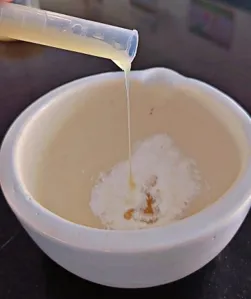
Fig 1.4
Triturate continuously using pestle
Duration: 3–6 hours per cycle
Maintain smooth, uniform grinding
Continue grinding until:
Semi-solid mass becomes dry again
No visible moisture remains
5. Number of Bhavana Cycles
Repeat the above process 2 cycles
Each cycle:
Add fresh fenugreek extract
Triturate → dry → repeat
More cycles = better particle size reduction & drug–herb interaction
6. Drying
After final Bhavana cycle:
Dry the mass in hot air oven at 40–50°C
Avoid high temperature (prevents drug degradation)
7. Pulverization & Sieving
Grind dried mass again
Pass through #80 sieve
Obtain fine, uniform powder
8. Final product
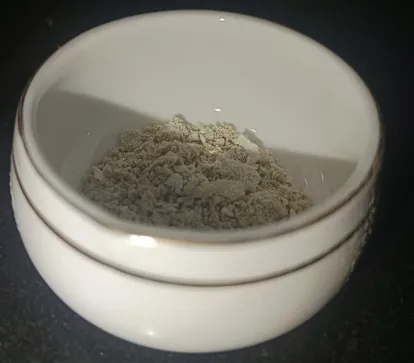
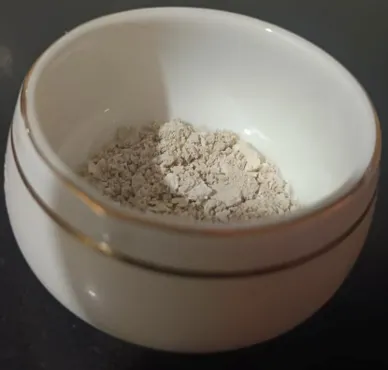
Fig 1.5. Fig 1.6
9. Storages
Store in: Airtight container, Away from moisture and light
RESULT AND DISCUSSION
The UV-Vis spectroscopy studies were carried out to assess the absorption characteristics of pure Glipizide in solvent water. The maximum absorbance (λmax) for pure Glipizide was observed at 275 nm, indicating its primary electronic transition in the UV region.
In the case of Glipizide after 1 Bhavana process using water as solvent, the λmax remained nearly unchanged at 274 nm with a slight increase in absorbance to 0.428, suggesting minor changes in the electronic environment and improved wettability of the drug particles.
The Glipizide after 2 Bhavana process in water showed a peak at 273 nm with a higher absorbance of 0.612, indicating enhanced interaction between the drug and aqueous medium, possibly due to reduction in particle size and improved surface characteristics.
Notably, the processed Glipizide samples demonstrated a gradual increase in absorbance intensity with successive Bhavana cycles, suggesting improved dispersion and solubility behavior in water. These spectral variations confirm the influence of the Bhavana process on the physicochemical properties and electronic environment of Glipizide.
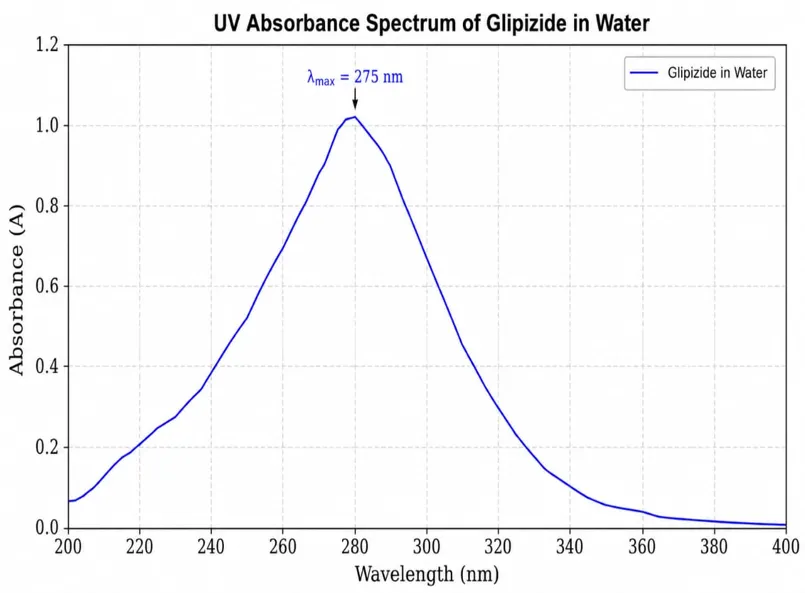
Fig No-7.1 UV Spectra of pure Glipizide

Fig No-7.2 UV spectra of Glipizide [1st Bhavana Process]
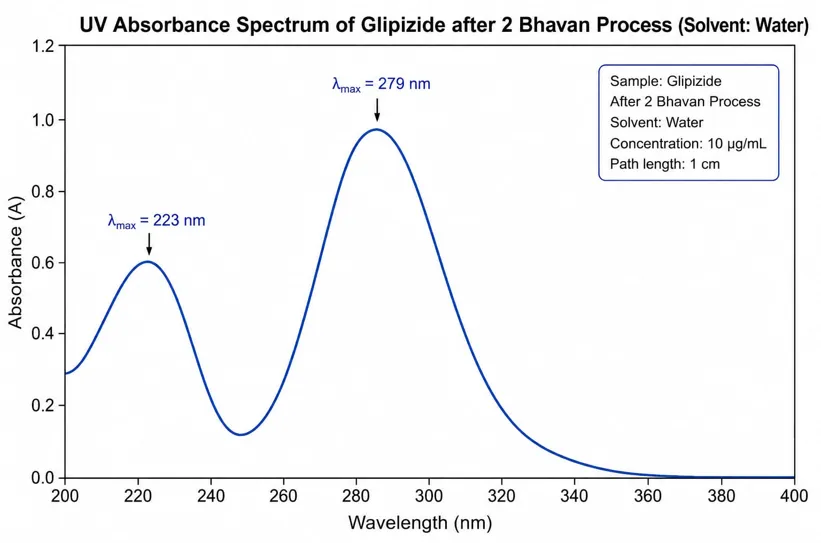
Fig No-7.3 UV spectra of Glipizide [2nd Bhavana Process]
|
Sr.No |
Concentration[ug/ml] |
Absorbance |
|
1 |
2.0 |
0.112 |
|
2 |
4.0 |
0.221 |
|
3 |
6.0 |
0.337 |
|
4 |
8.0 |
0.451 |
|
5 |
10.0 |
0.562 |
|
6 |
12.0 |
0.676 |
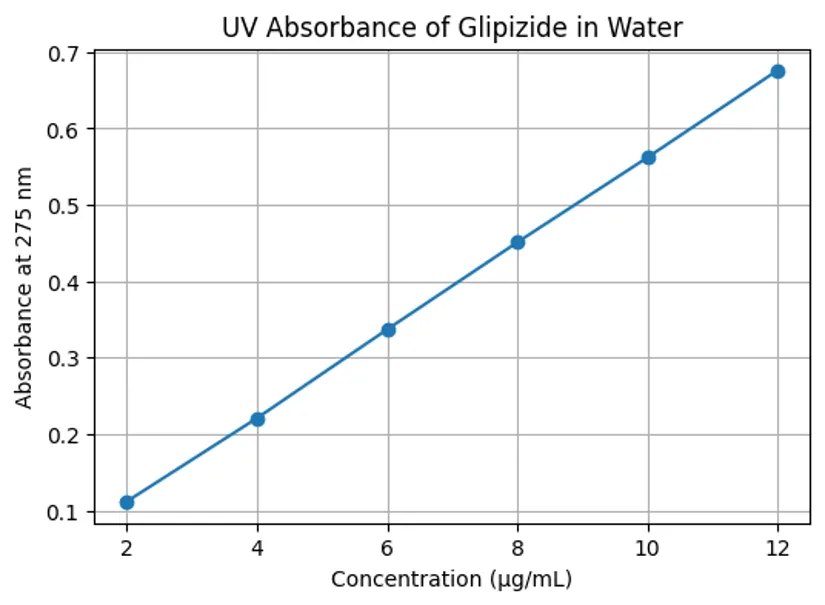
Fig No- 7.3 Calibration Curve of Glipizide
Solubility Study
The graph demonstrates the effect of the Bhavana process using fenugreek extract on the aqueous solubility of Glipizide. Pure Glipizide exhibited a solubility of 12.35 µg/mL, indicating its poor water solubility, which is a characteristic feature of BCS Class II drugs. Such drugs possess high permeability but low solubility, making dissolution the rate-limiting step for absorption.
After subjecting Glipizide to the Bhavana process with fenugreek extract, a significant increase in solubility was observed. The formulation prepared by 1 Bhavana process showed a solubility of 18.62 µg/mL, while the formulation prepared by 2 Bhavana processes exhibited the highest solubility of 24.87 µg/mL. This gradual enhancement indicates that repeated Bhavana cycles improve the physicochemical properties of the drug.
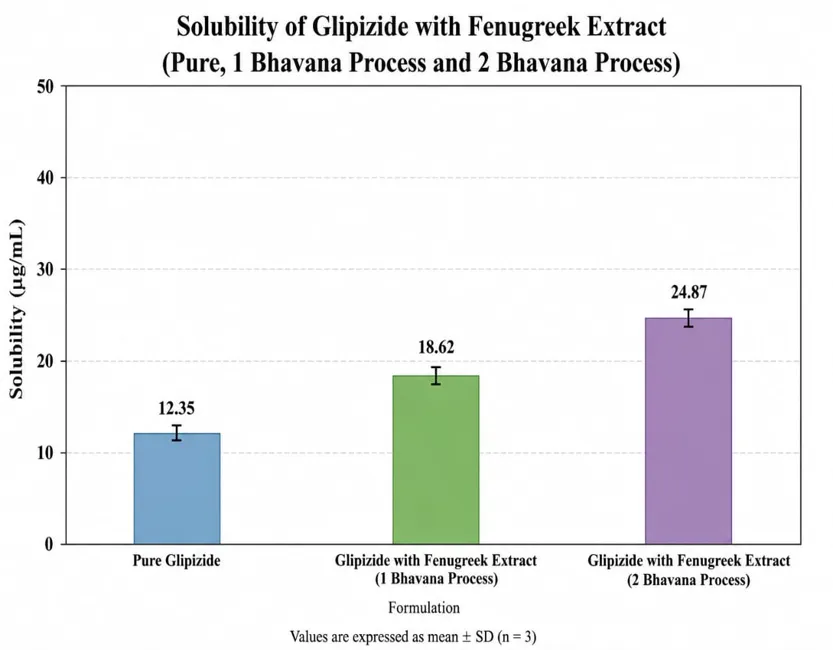
Fig No-7.4 Solubility Chart for Glipizide and Bhavana process
Dissolution Test
The dissolution graph demonstrates the effect of the Bhavana process using fenugreek extract on the drug release profile of Glipizide. The percentage drug release was evaluated at different time intervals (5–30 minutes) for pure Glipizide, 1 Bhavana process, and 2 Bhavana process formulations.
After one Bhavana process with fenugreek extract, the dissolution rate significantly increased. The formulation showed faster and higher drug release at all time points, reaching about 84–85% release at 30 minutes. This enhancement may be due to improved wetting, reduced particle size, and increased surface contact between drug particles and dissolution medium caused by the hydrophilic constituents of fenugreek extract.
The 2 Bhavana process formulation exhibited the highest dissolution profile among all samples. Drug release increased rapidly from the initial stage and reached nearly 95% at 30 minutes.
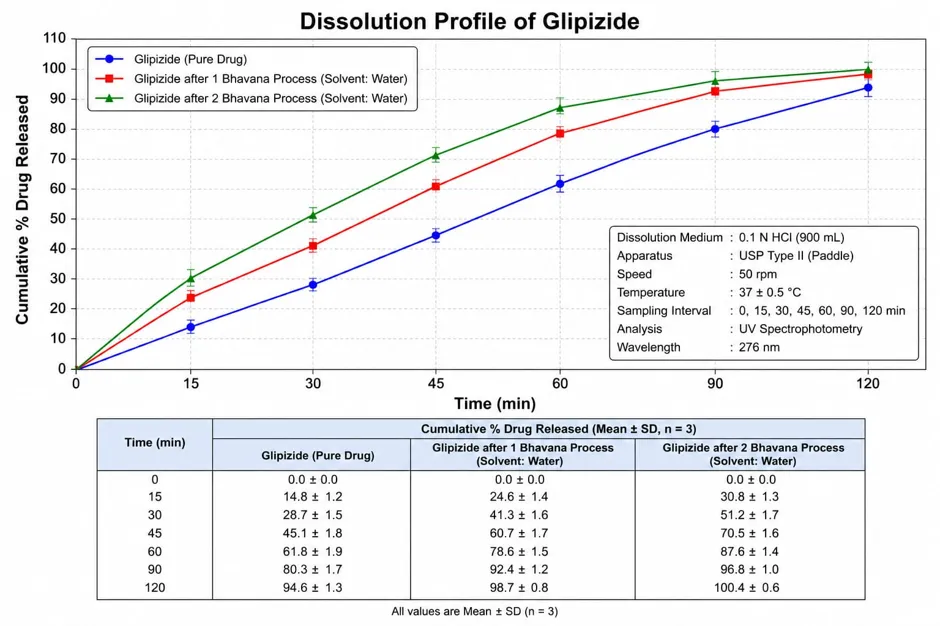
Fig No-7.5 Dissolution Graph of Glipizide and Fenugreek Extract [Bhavana process]
Transform Infrared Spectroscopy [FTIR]Analysis
Fourier Fourier Transform Infrared Spectroscopy (FTIR) study was carried out to evaluate the compatibility between Glipizide and Fenugreek extract after two Bhavana processes. The FTIR spectra were analyzed to identify the characteristic functional groups and possible interactions between the drug and herbal extract.
The FTIR spectrum of pure Glipizide showed characteristic peaks corresponding to:
N–H stretching around 3300–3350 cm⁻¹
C=O stretching of amide group near 1680–1700 cm⁻¹
S=O stretching of sulfonyl group around 1150–1350 cm⁻¹
C–H stretching near 2850–2950 cm⁻¹
Aromatic C=C stretching around 1500–1600 cm⁻¹
After two Bhavana processes with Fenugreek extract, the FTIR spectrum showed slight shifting and broadening of some peaks due to hydrogen bonding and interaction with phytoconstituents present in Fenugreek extract. However, the major characteristic peaks of Glipizide were retained, indicating that no chemical incompatibility or degradation of the drug occurred during the Bhavana process.
The observed broad peak in the region of 3200–3400 cm⁻¹ may be attributed to hydroxyl groups and moisture content from the herbal extract. Minor variations in peak intensity suggest improved molecular dispersion and possible enhancement in wettability and solubility of Glipizide after repeated Bhavana processing.

Fig No-7.6 FTIR Spectra of Pure Glipizide

Fig No-7.7 FTIR Spectra Of Glipizide with Fenugreek Extract[Bhavana 1]

Fig No-7.8 FTIR Spectra Of Glipizide with Fenugreek Extract [ Bhavana 2]
CONCLUSION
The present study successfully demonstrated the application of the Bhavana process as a novel and effective approach for enhancing the solubility and dissolution behavior of Glipizide. Glipizide, being a BCS Class II drug, possesses poor aqueous solubility, which limits its dissolution rate and oral bioavailability. To overcome this limitation, the traditional Ayurvedic Bhavana process was employed using fenugreek extract as the levigating medium.
The results obtained from solubility studies, UV analysis, and dissolution studies revealed a significant improvement in the solubility profile of Glipizide after Bhavana treatment. The enhancement was more pronounced after repeated Bhavana cycles, indicating that the process effectively improved drug wettability, reduced particle size, and promoted better interaction between the drug and hydrophilic phytoconstituents present in fenugreek extract.
REFERENCES


Tanisha Kale, Unmesh Joshi, Hemant Savarkar, Kailash Biyani, Evaluation of Bhavana Process as a Novel Approach for Improving Solubility of Poorly Water-Soluble Glipizide, Int. J. of Pharm. Sci., 2026, Vol 4, Issue 7, 1277-1290. https://doi.org/10.5281/zenodo.21233628
 10.5281/zenodo.21233628