

We use cookies to ensure our website works properly and to personalise your experience. Cookies policy
1,2,3,5th Pharm.D Student,Ezhuthachan college of pharmaceutical Science,Marayamuttom.
5Associate professor,Department of pharmacy practice, ,Ezhuthachan college of pharmaceutical science,Marayamuttom,Neyyatinkara,Thiruvanthapuram.
6Assistant professor,Department of pharmacy practice,Ezhuthachan college of pharmaceutical science,Marayamuttom,Neyyatinkara,Thiruvanthapuram.
7HOD/Principal,Department of pharmacy practice, Ezhuthachan college of pharmaceutical sciences, Marayamuttom,Neyyatinkara,Thiruvanthapuram.
Chronic Obstructive Pulmonary Disease or COPD is a lung problem that gets worse over time. It makes it hard to breathe. People with COPD have a lot of symptoms. To figure out how bad the symptoms are doctors need to assess them. This is important for deciding what treatment to use and, for checking if the treatment is working. There are two tools that doctors use to evaluate how bad the symptoms are. One is called the COPD Assessment Test or CAT. The other is called the Modified Medical Research Council or mMRC dyspnea scale. This review looks at what we know about how well these two tools work. The CAT looks at lots of aspects of COPD while the mMRC mainly looks at how hard it is for people to breathe. When we compare the two tools we can see that they are somewhat related. They are not exactly the same. The CAT and the mMRC do not always pick up on the things like how well someone responds to treatment or how their disease is progressing. Using both the CAT and the mMRC might be an idea because it could help doctors get a better understanding of what is going on with their patients. This could lead to treatment plans that are tailored to each individual person with COPD.
Chronic Obstructive Pulmonary Disease or COPD is a health problem around the world. It causes a lot of sickness and death(1,2).
COPD is marked by long-term airway inflammation, airflow blockage and ongoing respiratory symptoms. These symptoms include feeling short of breath coughing and producing sputum(3,5).
In the past doctors mainly used measurements, like FEV1 to evaluate COPD severity. However studies have shown that lung function alone does not fully capture the severity of symptoms patients experience(6,8).
Patients with FEV1 values can have very different levels of breathlessness, physical activity limitation and quality-of-life impairment(9,10). To improve this doctors now use symptom-based assessment tools. The COPD Assessment Test or CAT and the Modified Medical Research Council or mMRC dyspnea scale are widely recommended. They help evaluate symptom burden and guide treatment strategies.
Symptom Burden in COPD
Symptom burden in COPD refers to the impact of respiratory and systemic symptoms on patients. These symptoms include feeling short of breath, fatigue, coughing, sputum production, chest tightness and sleep disturbance(10,16).
A higher symptom burden in COPD has been linked to a risk of exacerbations, hospitalizations, reduced exercise tolerance and poorer quality of life(25,28). Therefore reliable symptom assessment tools are crucial, for monitoring COPD
symptoms.COPD Assessment Test (CAT)
The COPD Assessment Test is a test with eight questions that looks at how COPD affects a patients daily life(16). Each question gets a score from 0 to 5. The total score can be anywhere from 0 to 40.
If the score is high it means the patient is having a lot of symptoms and their health is not good.
Validation and Reliability
The CAT test was. It seems to be a good test. It was consistent and reliable when it was first tested(1,17). The CAT scores also match up with tests that measure how well someone can breathe and their quality of life like the St George’s Respiratory Questionnaire(26).
Responsiveness to Clinical Changes
Some studies have shown that when patients get certain treatments like medicine to help them breathe or therapy to help them get stronger their CAT scores go down. This is a thing. If the score goes down by two points that is considered a big improvement. The COPD Assessment Test scores do change when patients get treatments, like bronchodilator therapy, pulmonary rehabilitation and smoking cessation(11,34). The COPD Assessment Test is a way to measure how well these treatments are working for patients with COPD(12).
Clinical Significance
Higher CAT scores are linked to flare-ups and hospital visits(21,28). This is why CAT is seen as a tool to track how a disease is progressing and if treatments are working.
Modified Medical Research Council (mMRC) Dyspnea Scale
The mMRC dyspnea scale is a way to rate breathlessness based on how much it limits daily activities(8). The scale goes from 0 to 4 with numbers meaning more severe breathlessness.
Clinical Relevance
Higher mMRC grades mean patients with COPD have ability to exercise feel worse overall and have a higher risk of death. This is shown in studies(8,9).
The good things, about mMRC are that it is easy quick to use and patients and doctors can understand it easily.
However mMRC has some limitations. It only looks at breathlessness. Does not consider other symptoms of COPD like tiredness or feeling like the chest is tight(8,19).
Comparison Between CAT and mMRC
Studies have found that the CAT scores and the mMRC scores are somewhat related.. The CAT and the mMRC scores do not always say the same thing about how bad the symptoms are.
The CAT and the mMRC scores can be different, for some patients. For example some patients may have a mMRC score, which means they have mild symptoms but they may have a high CAT score, which means they have a lot of symptoms.
The CAT looks at different things but the mMRC only looks at how hard it is for patients to breathe when they are doing everyday things. The CAT and the mMRC are two tools that measure different things(38,4 0).
Multidimensional Assessment of Dyspnoea in COPD
Dyspnoea is an important clinical feature of chronic obstructive pulmonary disease, but its effect on patients varies according to individual functional capacity, disease severity and everyday activities. Some patients experience breathlessness mainly during strenuous exercise, whereas others may have difficulty with routine tasks such as walking, dressing or performing household activities. Therefore, assessing dyspnoea requires attention not only to its presence but also to the degree to which it interferes with normal functioning. The mMRC scale provides a structured method of grading activity-related breathlessness, making it useful for clinical assessment. However, a single dyspnoea grade may not fully describe the range of respiratory symptoms experienced by an individual patient. [40,42–44]
Importance of Patient-Reported Symptom Assessment
Clinical assessment of COPD commonly involves physiological measurements, clinical history and the evaluation of symptoms reported by the patient. Although spirometry is important for identifying airflow obstruction and assessing lung function, the degree of airflow limitation does not necessarily represent the complete burden of symptoms or functional impairment. Patient-reported outcome measures can provide additional information about how COPD affects daily activities and perceived health status. CAT and mMRC contribute to this assessment from different perspectives: CAT addresses a broader range of disease-related effects, while mMRC focuses on the functional consequences of breathlessness. Using these measures appropriately may help clinicians develop a more comprehensive understanding of an individual’s clinical condition. [40,41,44,45]
Comparison of CAT and mMRC Scales
| FEATURE | CAT Score | mMRC Scale |
|---|---|---|
| Type of assessment | Multidimensional | Dyspnea focused |
| Score range | 0-40 | 0-4 |
| Number of question | 8 | 1 |
| Measures | Symptoms+ quality of life | Breathlessness |
| Sensitivity to change | High | Moderate |
| Clinical use | Monitoring overall disease impact | Functional dyspnea grading |
Tab 1 Compares the CAT score and mMRC scale used in COPD assessment. The CAT score evaluates overall symptoms and quality of life using 8 questions with a score range of 0-40, while the mMRC scale mainly measure breathlessness using a single question with a score range of 0-4. The CAT score provides a more comprehensive assessment, where as the mMRC scale is simpler and focuses only on dyspnea severity.
Differences in the Domains Measured by CAT and mMRC
CAT and mMRC should not be regarded as identical instruments because they measure different aspects of COPD. The mMRC scale grades breathlessness-related activity limitation, whereas CAT assesses several dimensions of respiratory symptoms and their effects on health status. Consequently, a patient may report substantial overall disease impact despite having a relatively low mMRC grade. Conversely, marked breathlessness during ordinary activity may be evident on the mMRC scale even when the overall CAT score does not reflect the same degree of symptom burden. Published comparative evidence indicates that the classification of patients can vary according to the instrument selected. These differences are clinically relevant when interpreting assessment results and planning follow-up. [40,42–44]
Interpretation of Changes in Symptom Scores
The interpretation of symptom scores requires consideration of both the numerical result and the clinical circumstances in which it was obtained. A change in CAT score may reflect a change in several dimensions of health status, while a change in mMRC grade indicates a shift in the patient’s reported level of breathlessness-related activity limitation. These outcomes are related but are not interchangeable. Research evaluating CAT during COPD exacerbations and pulmonary rehabilitation has demonstrated that the instrument can detect changes in health status over time. Nevertheless, the magnitude of change and its clinical importance should be interpreted using appropriate evidence rather than assuming that every numerical difference represents a meaningful improvement or deterioration. [11,12,16,17]
1.5 Relationship Between Symptom Burden and Clinical Outcomes
Symptom burden is relevant to COPD management because it contributes to the patient’s functional experience of the disease and may influence clinical decisions. Breathlessness, reduced exercise tolerance and persistent respiratory symptoms can affect independence and participation in everyday activities. In addition, symptom assessment can complement information about exacerbations, lung function and previous healthcare utilisation. However, symptom scores should not be used in isolation to predict an individual’s prognosis or determine treatment. Their findings need to be considered alongside clinical examination, exacerbation history, comorbidities and other relevant patient characteristics. [40,44,45]
Changes in Symptom Burden Over Time
Symptom change monitoring plays an important role in assessing the efficacy of treatment.
The available research proves significant improvements in CAT scores following pharmacological treatment and respiratory rehabilitation (17,11). Changes in mMRC score were noted but less reliable as compared to CAT (16,32).
An increase in the values of both scores during the period of exacerbation and improvement once it is over were shown in several studies (8,10).
Implications of Current Research Findings
CAT and mMRC could be used together in COPD severity assessment and treatment decision-making (8,10). They also serve as recommendation tools in international guidelines for managing patients with COPD (2,49).
Problems with Existing Data on the Subject
Even though CAT and mMRC are recognized instruments, there are some drawbacks to their use:
• Different cultural and linguistic background may influence results;
• There is information about variations in symptom classification threshold levels;
• Long-term data comparison lacks .
Symptom Assessment During Pharmacological Treatment
Clinical trials of inhaled therapies in COPD evaluate outcomes such as exacerbations, lung function, health status and other indicators of treatment effectiveness. These outcomes provide different types of information about the benefits and limitations of treatment. Improvement in lung function, for example, does not automatically establish that every symptom or activity limitation has improved to the same extent. Therefore, symptom assessment can provide a complementary perspective when interpreting treatment outcomes. Where the original trial reports CAT, mMRC or another validated patient-reported measure, those results may help clarify the effect of treatment on perceived health status or breathlessness. Studies reporting only lung function, exacerbations or survival should not be interpreted as direct evidence of changes in CAT or mMRC. [46–50]
Implications for Routine COPD Management
The choice of symptom assessment instrument should be guided by the clinical question being addressed. When the principal objective is to grade activity-related breathlessness, mMRC provides a concise and practical assessment. When a broader evaluation of COPD-related health impact is required, CAT offers information across multiple symptom and health-status domains. These instruments can therefore be viewed as complementary rather than competing measures. Their appropriate use may support communication between patients and healthcare professionals, help document symptom changes during follow-up and contribute to a broader assessment of treatment response. Neither questionnaire replaces clinical evaluation or objective lung-function testing. [40,44,45]
DISCUSSION
The COPD assessment method has evolved from being based exclusively on spirometry to taking a more holistic look at symptom evaluation due to the complexity of COPD burden. In this review, key studies will be reviewed in order to critically evaluate the utility of COPD Assessment Test (CAT) and Modified Medical Research Council (mMRC) dyspnea scale in capturing changes in symptom burden over time.
In the study by Jones et al. (1), the creation and validation of CAT was conducted in a way that made it an effective tool for evaluating the overall health status of patients with COPD. Unlike physiological measures, such as FEV₁, which are indicative of lung dysfunction, CAT evaluates the health burden related to daily life experience, including fatigue, poor sleep and inability to conduct everyday activities (18,2). It appears that CAT has introduced a paradigm change in the assessment method moving away from the disease to a patient-centered measure.
The study by Nishimura et al. (7) shows that dyspnea itself has high predictive value in terms of mortality even exceeding the predictive ability of airway limitation. This adds weight to the practical significance of mMRC scale despite its simple nature as an assessment tool. At the same time, it should be pointed out that the measure is limited to its one-dimensional character failing to capture other symptoms (9,7).
It was obvious from the heterogeneity in the symptomatology observed in the COPDGene trial done by Han et al. (6) among the patients having similar grades of spirometry that only a single measure is not sufficient to determine COPD status, and therefore, multidimensional measures are necessary.
The high responsiveness to clinical variations shown by Miravitlles et al. (31) in CAT measures in exacerbations shows how well it can be used for monitoring the condition of patients. The CAT measures increase during exacerbations and decrease after recovery, and although the changes in mMRC also occur, its sensitivity compared to that of CAT is much lower (19,16).
| STUDY | STUDY TYPE | POPULATION | KEY FINDING | CLINICAL IMPLICATION |
|---|---|---|---|---|
| Jones et al. | validation study | COPD patients | Developed and Validated CAT as a reliable multidimensional tool | Established CAT for routine symptom assessment |
| Nishimura et al. | Cohort study | COPD patients | Dyspnea is a strong predictor of mortality | mMRC useful for prognosis |
| Han et al. | Observationa (COPD gene) | Large COPD cohort | Symptom burden varies despite similar FEV1 | Need for multidimensional tools like CAT |
| Miravitlles et al. | Clinical study | COPD patients | CAT sensitive to exacerbations and recovery | Useful for monitoring disease progression |
| Kon et al. | Clinical analysis | COPD patients | CAT change≥2 points is clinically significant | Helps assess treatment response |
| Kim et al. | Comparative study | COPD patients | CAT and mMRC show moderate correlation but differ in classification | Combined use recommended |
Table 2 summarizes the major studies evaluating the clinical utility of CAT and mMRC scores in COPD assessment. The findings highlight the complementary strengths of both tools across different clinical contexts.
Changes in CAT and mMRC scores over time
Figure 1 demonstrates the progression of CAT scores and mMRC scores in COPD patients. CAT and mMRC scores are both declining over time from baseline until after treatment, implying a positive change in symptoms following treatment and pulmonary rehabilitation (11,17).
CAT scoring demonstrates a larger decline than the mMRC score; hence, it is believed to be more sensitive in measuring improvements (11,12). This is because CAT assesses various factors related to COPD, including coughing, fatigue, insomnia, and physical activity (1,10). On the other hand, mMRC score only considers the severity of breathlessness (8,9).
Moreover, CAT score demonstrates improvement on a broader aspect of COPD symptoms, whereas mMRC score demonstrates a gradual improvement in breathlessness severity (19,30). As such, the simultaneous use of CAT and mMRC offers a comprehensive analysis of COPD symptoms.
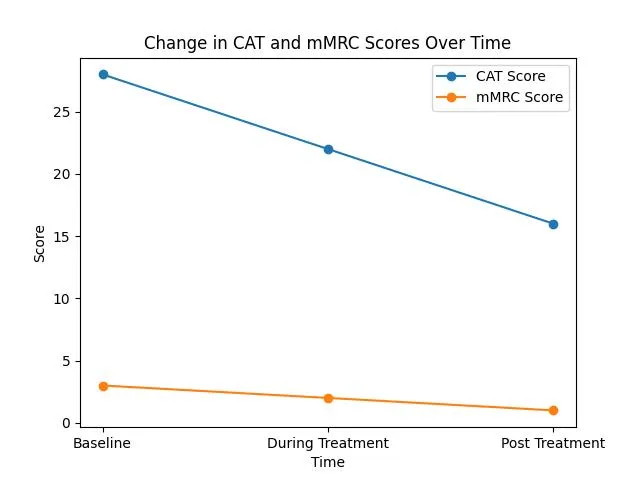
Figure 1, CAT scores show a more pronounced decline over time compared to mMRC scores, indicating greater sensitivity in detecting clinical improvement, while mMRC reflects gradual changes in dyspnea severit.
CONCLUSION
Comprehensive and patient-oriented approach is required for appropriate diagnosis and treatment of COPD. This literature analysis shows that both the CAT and the mMRC dyspnea scale are useful tools for symptom burden assessment, each possessing certain benefits for clinical practice.
Firstly, the COPD Assessment Test helps to achieve a holistic estimate of COPD symptoms. The scale allows one to consider not only physical but also psychological and functional consequences of this respiratory disorder. In addition, the test exhibits higher sensitivity compared to other assessment tools when used for evaluation of changes.
Secondly, even simple mMRC can be a reliable predictor of mortality associated with COPD due to its attention to dyspnea-related functional limitations. Moreover, the research proves that the use of only one scale leads to an underestimated picture of disease burden. Thus, the combination of both scales can significantly increase accuracy of patient classification and monitoring.
Future development of methods aimed at assessment of the disease should pay attention to using digital healthcare devices and solutions for real-time monitoring.
REFERENCES


Krishna B., Jerin. M., Krishna Sooraj, Lubanathul Mubeena, Sam Jeeva Kumar, Dr. Chintha Chandran, Dr. Shaiju S. Dharan, Evaluation of Changes in Symptom Burden Using CAT and mMRC Scores in Patients with Chronic Obstructive Pulmonary Disease, Int. J. of Pharm. Sci., 2026, Vol 4, Issue 10, 4458-4467. https://doi.org/10.5281/zenodo.23727149
 10.5281/zenodo.23727149
Severity: 8192
Message: substr(): Passing null to parameter #1 ($string) of type string is deprecated
Filename: frontend/article.php
Line Number: 890