

We use cookies to ensure our website works properly and to personalise your experience. Cookies policy
Faculty of Pharmacy, Marwadi University, Rajkot-Morbi Highway, Rajkot 360003, Gujarat, India.
Emesis is a debilitating condition causing significant psychological and physiological distress. Ginger (Zingiber officinale) bioactive constituents, particularly gingerols and shogaols, offer a well-documented herbal antiemetic alternative to conventional drugs. Medicated Chewing Gummies (MCG) represent a patient-friendly dosage form; however, the inherent pungency of ginger limits its acceptability. This study aimed to formulate, develop, and evaluate ginger rhizome extract MCG with favorable taste, texture, and physicochemical properties for the management of nausea and vomiting. A gelatin-based gum was prepared by dissolving gelatin (6.66 g) in warm distilled water, incorporating 1 g ginger extract powder, and combining with a simple syrup containing sodium saccharin, propylene glycol, peppermint oil, citric acid, and varying concentrations of glycerin (0–3 ml) across five formulations (A1–A5). Evaluation parameters included a linearity test (UV-spectrophotometry at 282 nm), pH measurement, organoleptic assessment, and weight uniformity. The gingerol linearity test demonstrated a direct relationship between concentration and absorbance (R² = 0.9894). All formulations exhibited slightly acidic pH (4.23–4.62), consistent with product stability requirements. Organoleptic evaluation showed acceptable color, mint scent, sweet-minty taste, and satisfactory texture across all batches, with glycerin concentration influencing color intensity and elasticity. Weight uniformity percentage standard deviation ranged from 0.704% to 1.177%, within pharmacopoeial acceptance criteria. Formula A3 (2 ml glycerin) demonstrated the most optimal physicochemical and organoleptic profile. These findings support the feasibility of ginger MCG as a stable, acceptable antiemetic delivery system for further development and scale-up.
Emesis disease is a chronic condition characterized by recurrent episodes of extreme nausea and vomiting that, if untreated, can lead to dehydration, electrolyte imbalances, and malnutrition [1]. Nausea and vomiting are recognized as defensive mechanisms triggered by emetic stimuli acting on the central and peripheral nervous systems, with the vomiting center in the medulla oblongata playing a central coordinating role [2, 3].
Current pharmacological management relies on antiemetics such as 5-HT3 receptor antagonists (ondansetron, granisetron), dopamine receptor antagonists (metoclopramide, prochlorperazine), antihistamines (promethazine, cyclizine), and neurokinin inhibitors (aprepitant) [4]. While effective, these agents carry significant adverse effect profiles and are not universally accessible in resource-limited settings. Herbal alternatives, particularly ginger (Zingiber officinale), have demonstrated clinically relevant antiemetic activity through 5-HT3 receptor inhibition and modulation of gastrointestinal motility [5, 6].
Ginger's principal bioactive constituents; 6-gingerol and 6-shogaol, exert gastroprotective and antiemetic effects while exhibiting favorable pharmacokinetic profiles following oral administration [7, 8]. Their lipophilic nature supports mucosal absorption, and their low molecular weights (294.38 and 276.37 g/mol, respectively) facilitate buccal uptake [9].
Medicated Chewing Gummies (MCG) have emerged as an innovative oral drug delivery platform combining palatability, rapid buccal absorption, and avoidance of first-pass hepatic metabolism [10, 11]. By releasing the active pharmaceutical ingredient (API) progressively through chewing, MCG offers advantages over conventional tablets and capsules, particularly for pediatric, geriatric, and motion-sickness-prone populations [12]. However, formulating ginger-based MCG presents challenges related to taste masking of its characteristic pungency and optimization of textural properties [13].
This study therefore aimed to formulate and develop ginger rhizome extract MCG with optimized taste and texture, evaluate physicochemical parameters across five formulations with varying glycerin concentrations, and identify the optimal formula for potential commercial scale-up.
MATERIALS AND METHODS
Materials
Ginger rhizome extract (5% gingerols; HealthyHey Nutrition, BRM Herbals, Mumbai, India), gelatin crystals, sodium saccharin, sucrose, propylene glycol, peppermint oil, citric acid, and glycerin were procured. All other reagents were of analytical grade, sourced from the Faculty of Pharmacy, Marwadi University, Rajkot, Gujarat, India.
Preparation of Simple Syrup
A simple syrup was prepared by the hot method: sucrose crystals were dissolved in an equal volume of distilled water (w/v ratio 1:1) with heating and stirring until a homogeneous syrup was obtained.
Preparation of Gelatin-Ginger Base (Solution 1)
Gelatin crystals (6.66 g) were dissolved in 15 ml of warm distilled water with continuous stirring until a viscous gel was formed. Ginger rhizome extract powder (1 g) was incorporated into the gel and mixed to homogeneity.
Preparation of Excipient Solution (Solution 2)
Propylene glycol (1 ml), peppermint oil (0.4 ml), and glycerin (0, 1, 2, or 3 ml per formulation) were added to 10 ml of simple syrup. Sodium saccharin (3.4 g) and citric acid (0.5 g) were dissolved in this mixture with gentle heating.
Formulation Composition
Five formulations (A1–A5) were prepared as shown in Table 1, differing in glycerin concentration. Formulation A5 omitted propylene glycol as an additional variable.
Table 1: Formulation composition of ginger medicated chewing gummies
|
Sr. |
Ingredient (Function) |
A1 |
A2 |
A3 |
A4 |
A5 |
|
1 |
Ginger extract (Antiemetic) |
1g |
1g |
1g |
1g |
1g |
|
2 |
Gelatin (Gum base) |
6.66g |
6.66g |
6.66g |
6.66g |
6.66g |
|
3 |
Sodium saccharin (Sweetener) |
3.4g |
3.4g |
3.4g |
3.4g |
3.4g |
|
4 |
Simple syrup (Sweetener/Coating) |
10ml |
10ml |
10ml |
10ml |
10ml |
|
5 |
Propylene glycol (Binder) |
1ml |
1ml |
1ml |
1ml |
0 |
|
6 |
Peppermint oil (Flavoring) |
0.4ml |
0.4ml |
0.4ml |
0.4ml |
0.4ml |
|
7 |
Citric acid (Preservative) |
0.5g |
0.5g |
0.5g |
0.5g |
0.5g |
|
8 |
Glycerin (Plasticizer) |
0 |
1ml |
2ml |
3ml |
0 |
Preparation Procedure
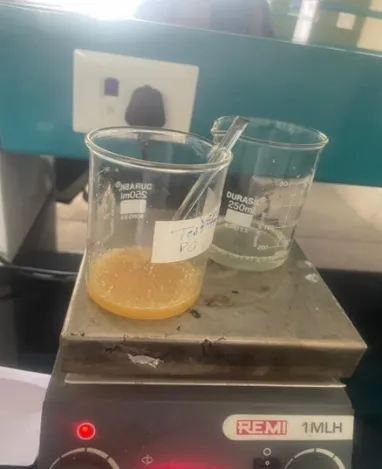
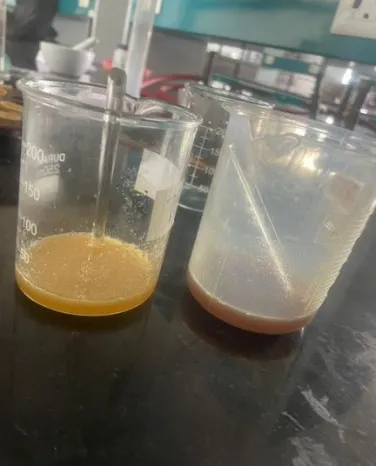
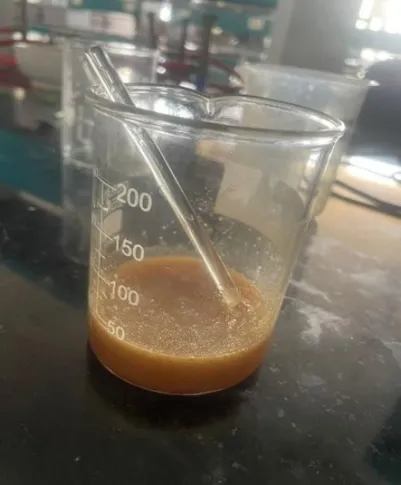
Solution 2 was heated to 90 °C with continuous stirring, then combined with Solution 1 and mixed until homogeneous. The combined mixture was allowed to stand for 10 minutes before pouring into silicon molds. Molds were refrigerated at 4 °C for 24 hours. Five gummies were obtained per batch. The preparation steps are illustrated in Fig. 1.

(C) (D)
Fig. 1: Steps in the preparation of ginger medicated chewing gummies. (A) Prepared solutions 1 and 2 on heat; (B) Heated solutions; (C) Mixed homogeneous solution; (D) Poured into silicon molds.
Evaluation Parameters
Linearity Test
A standard stock solution was prepared by dissolving 100 mg of ginger rhizome extract in 100 ml of distilled water. Five working solutions (200–1000 µg/ml) were prepared by serial dilution. Absorbance was measured using a UV-visible spectrophotometer (Shimadzu Double Beam 1900; Fig. 2) at 282 nm. A calibration curve was plotted to assess the linear relationship between gingerol concentration and absorbance.
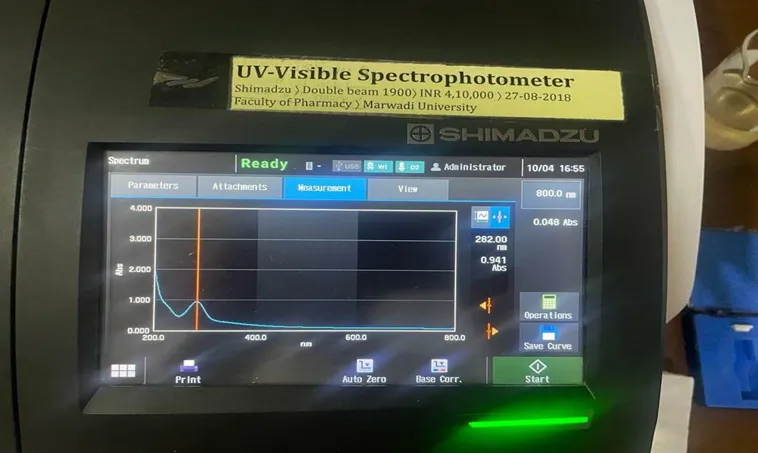
Fig. 2: UV-Visible spectrophotometer (Shimadzu Double Beam 1900) used for the linearity test.
pH Determination
The pH of each formulation was measured by immersing a calibrated pH meter probe directly into a melted gummy sample from each batch. A slightly acidic pH range was considered optimal for product durability [14].
Organoleptic Evaluation
Ten student volunteers (second-year Bachelor of Pharmacy students, Marwadi University) evaluated the formulations for color, scent, shape, taste, and texture under blinded conditions.
Weight Uniformity
Twenty gummy samples were randomly selected per formulation and individually weighed. Mean weight, standard deviation (SD), and percentage SD were calculated. Compliance was assessed against the criterion that no more than two of twenty samples deviate by more than 5% from the mean weight [15].
RESULTS AND DISCUSSION
Linearity Test
The UV-spectrophotometric analysis at 282 nm yielded a linear calibration curve (R² = 0.9894; Table 2; Fig. 3), confirming a direct relationship between gingerol concentration and absorbance over the range 200–1000 µg/ml. The regression equation y = 0.0008x + 0.1215 supports accurate quantitative assessment of gingerol content in the gummy matrix, consistent with published spectrophotometric methods for ginger standardization [8].
Table 2: Absorbance results of gingerol concentrations in water at 282 nm
|
Sr. |
Vol. stock (ml) |
Vol. diluent (ml) |
Conc. (µg/ml) |
Absorbance |
|
1 |
2 |
8 |
200 |
0.260 |
|
2 |
4 |
6 |
400 |
0.480 |
|
3 |
6 |
4 |
600 |
0.657 |
|
4 |
8 |
2 |
800 |
0.815 |
|
5 |
10 |
0 |
1000 |
0.941 |
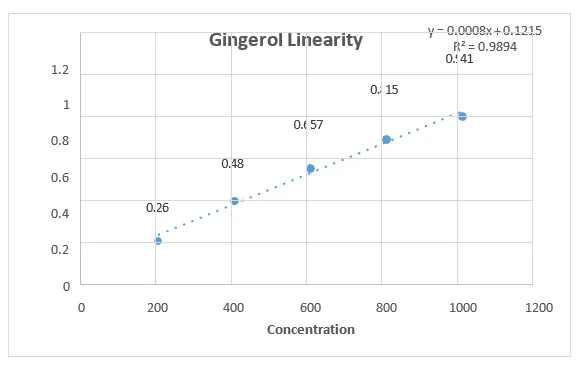
Fig. 3: Linearity response graph of gingerol (R² = 0.9894; y = 0.0008x + 0.1215)
pH Determination
All five formulations exhibited slightly acidic pH values ranging from 4.23 to 4.62 (Table 3; Fig. 4). This pH profile is favorable for product stability, as it limits the thermally and pH-sensitive dehydration of gingerols to shogaols [9]. Minor inter-formulation variation may reflect the differing glycerin and propylene glycol content, which can modestly influence the buffering capacity of the syrup base.
Table 3: pH results of ginger medicated chewing gummy formulations
|
Formulation |
pH |
|
A1 |
4.47 |
|
A2 |
4.62 |
|
A3 |
4.26 |
|
A4 |
4.35 |
|
A5 |
4.23 |
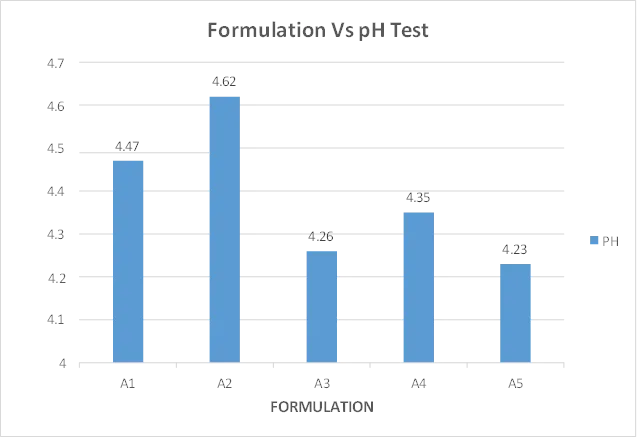
Fig. 4: A graph of Formulation vs pH for all five ginger medicated chewing gummy formulations.
Organoleptic Evaluation
Organoleptic results are presented in Table 4. All formulations showed consistent mint scent and sweet-minty taste, confirming effective masking of ginger's characteristic pungency. Color varied from pale yellow (A1, A2) to yellowish-brown (A3), brown (A4), and bright yellow (A5), correlating with increasing glycerin concentration; higher glycerin progressively reduced color brightness, likely through interaction with Maillard reaction products during heating. Texture improved meaningfully with glycerin content: A3 and A4 demonstrated superior elasticity and moisture retention, reflecting glycerin's established role as a humectant plasticizer [10]. Formulation A3 (2 ml glycerin) achieved the best balance of color, texture, and sensory acceptability (Fig. 5).
Table 4: Organoleptic test results of ginger medicated chewing gummy formulations
|
Parameter |
A1 |
A2 |
A3 |
A4 |
A5 |
|
Colour |
Pale yellow |
Pale yellow |
Yellowish-brown |
Brown |
Bright yellow |
|
Scent |
Mint |
Mint |
Mint |
Mint |
Mint |
|
Shape |
Square |
Round |
Round |
Round |
Square |
|
Taste |
Sweet minty |
Sweet minty |
Sweet minty |
Sweet minty |
Sweet minty |
|
Texture |
Soft, slightly elastic, chewy |
Soft, slightly elastic, chewy |
Soft, elastic, chewy |
Soft, elastic, chewy |
Soft, slightly elastic, chewy |
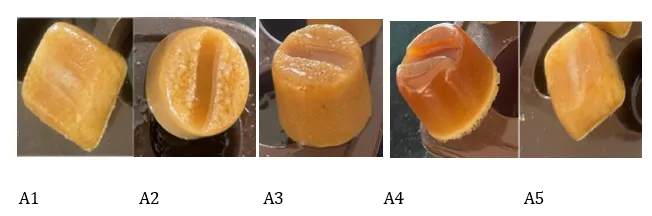
Fig. 5: Organoleptic appearance of formulations A1–A5 showing variation in colour and texture.
Weight Uniformity
Weight uniformity results are presented in Table 5. Mean weights ranged from 9.867 g to 10.116 g, and percentage SDs from 0.704% to 1.177%, all well within the pharmacopoeial acceptance criterion of ≤5% deviation [15]. This confirms consistent filling and mold reproducibility across all batches. Minor inter-formulation weight differences are attributable to the varying glycerin volume contributing to the overall gummy mass.
Table 5: Weight uniformity test results of ginger medicated chewing gummy formulations
|
Formulation |
Mean Weight (g) |
SD |
% SD |
|
A1 |
9.867 |
0.113 |
1.140 |
|
A2 |
9.953 |
0.095 |
0.953 |
|
A3 |
10.072 |
0.105 |
1.046 |
|
A4 |
10.116 |
0.119 |
1.177 |
|
A5 |
9.879 |
0.070 |
0.704 |
CONCLUSION
This study successfully formulated and evaluated five ginger rhizome extract medicated chewing gummy formulations (A1–A5) using a gelatin-based matrix. All formulations demonstrated consistent weight uniformity within pharmacopoeial limits, slightly acidic pH optimally suited for product stability, and desirable organoleptic attributes with effective pungency masking. UV-spectrophotometric linearity analysis confirmed proportional gingerol content across gummy mass, supporting dosing reliability. Glycerin concentration was identified as the critical formulation variable, influencing color, elasticity, and moisture retention. Formula A3 (2 ml glycerin) exhibited the most balanced physicochemical and sensory profile and is recommended for further optimization, in vitro drug release characterization, and stability studies toward commercialization as a patient-acceptable herbal antiemetic.
ACKNOWLEDGEMENT
The authors express sincere gratitude to Mr. Harshil Majethiya (Supervisor) and Dr. Lalji Baldaniya (Principal), Faculty of Pharmacy, Marwadi University, for their guidance, support, and provision of laboratory facilities throughout this research project.
CONFLICT OF INTEREST
The authors declare no conflict of interest.
AUTHORS' CONTRIBUTIONS
All four authors contributed equally to the conceptualization, experimental work, data collection, analysis, and manuscript preparation. Aaron Mwesigwa served as the corresponding author and coordinated submission.
REFERENCES




Aaron Mwesigwa, Wilson Mwakimi, Ritah Marias Natasha, Harshil Majethiya, Formulation And Development Of Medicated Chewing Gummies For Anti-Emetics Using Ginger Rhizome Extract, Int. J. of Pharm. Sci., 2026, Vol 4, Issue 6, 5950-5958, https://doi.org/10.5281/zenodo.20813142
 10.5281/zenodo.20813142