

We use cookies to ensure our website works properly and to personalise your experience. Cookies policy
Oyster Institute of Pharmacy, chatrapati sambhajinagar, Maharashtra, India
Acne vulgaris is one of the most common skin disorders affecting adolescents and young adults. The increasing demand for herbal cosmetics has encouraged the development of natural skincare products that are safe, effective, and economical. The present study aimed to formulate and evaluate a polyherbal anti-acne face pack using natural ingredients such as Multani Mitti, turmeric, sandalwood, aloe vera, rose water, betel leaf, almond oil, manjlodhra. and Lodhra. These ingredients possess antibacterial, anti-inflammatory and antioxidant, moisturizing, and skin rejuvenating properties that help manage acne and improve skin health.The formulation was prepared by mixing the powdered herbal ingredients in suitable proportions and evaluated for various physicochemical parameters including colour, odour, texture, pH, spreadability, washability, irritancy, and stability. The prepared formulation exhibited satisfactory physicochemical characteristics, good spreadability, easy washability, and no signs of skin irritation.The results suggest that the developed polyherbal anti-acne face pack can be used as a safe, economical, and effective herbal cosmetic preparation for acne management and maintenance of healthy skin.
The skin is the largest organ of the human It serves as a protective barrier against environmental pollutants, microorganisms, ultraviolet radiation, and physical injuries. Various skin disorders such as acne, pimples, blackheads, pigmentation, and excessive oil secretion adversely affect the physical and psychological well-being of individuals.Acne vulgaris is a chronic inflammatory disorder of the pilosebaceous unit characterized by comedones, papules, pustules, nodules, and cysts. The major factors responsible for acne development include increased sebum production, follicular hyperkeratinization, microbial colonization, and inflammation.
Herbal cosmetics have gained significant popularity due to their safety, efficacy, affordability, and minimal side effects. Medicinal plants contain bioactive compounds such as flavonoids, alkaloids, tannins, phenolics, glycosides, and antioxidants that provide therapeutic benefits to the skin.
The present study focuses on the formulation and evaluation of a polyherbal anti-acne face pack. One face pack was prepared using selected medicinal herbs possessing antimicrobial, anti-inflammatory, antioxidant, and skin-rejuvenating properties.
NEED FOR THE STUDY
Modern lifestyles, environmental pollution, hormonal imbalance, stress, and unhealthy dietary habits have increased the prevalence of acne and other skin disorders. Most commercially available anti-acne products contain synthetic chemicals that may cause adverse effects such as dryness, irritation, redness, and allergic reactions.
The growing demand forr herbal cosmetic products necessitates the development of safe, effective, economical, and environmentally friendly formulations.
MATERIALS USED
|
Sr. No |
Ingredient |
Scientific Name |
Function |
|
1 |
Multani Mitti |
Fuller's Earth |
Oil absorber, cleanser |
|
2 |
Turmeric |
Curcuma longa |
Antibacterial |
|
3 |
Sandalwood |
Santalum album |
Cooling agent |
|
4 |
Aloe Vera |
Aloe barbadensis |
Moisturizer |
|
5 |
Rose Water |
Rosa damascena |
Skin toner |
|
6 |
Betel Leaf |
Piper betle |
Antimicrobial |
|
7 |
Almond Oil |
Prunus dulcis |
Skin nourisher |
|
8 |
Manjistha |
Rubia cordifolia |
Skin purifier |
|
9 |
Lodhra |
Symplocos racemosa |
Astringent |
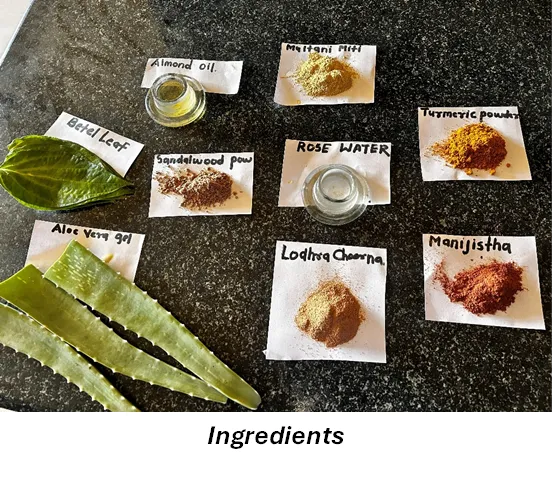
FORMULATION TABLE
|
Ingredient |
Quantity (g) |
|
Multani Mitti |
50 |
|
Turmeric Powder |
10 |
|
Sandalwood Powder |
20 |
|
Manjistha Powder |
15 |
|
Lodhra Powder |
15 |
|
Betel Leaf Powder |
10 |
|
Aloe Vera Powder |
20 |
|
Almond Oil |
5 |
|
Rose Water |
q.s. |
METHOD OF PREPARATION
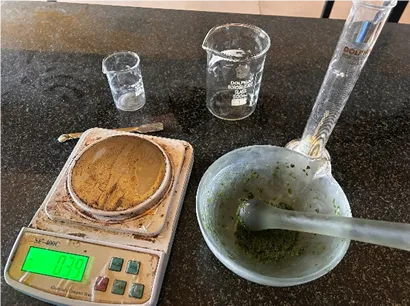
Instruments
FLOWCHART OF PREPARATION
Collection of Raw Materials
↓
Cleaning and Drying
↓
Pulverization
↓
Sieving
↓
Accurate Weighing
↓
Mixing of Ingredients
↓
Addition of Almond Oil
↓
Packaging
↓
Evaluation
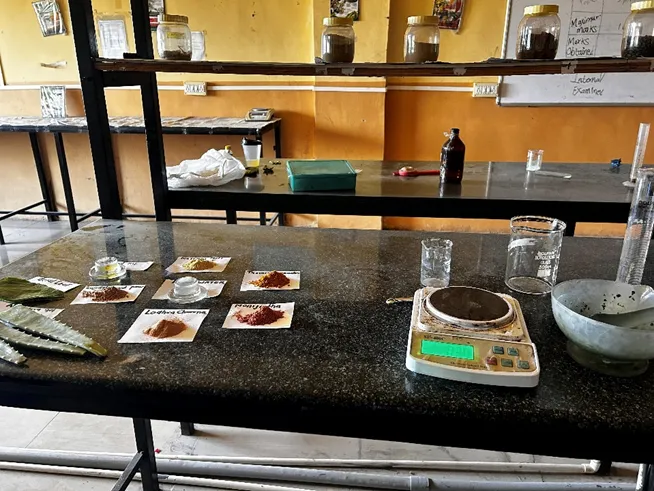
Procedure
EVALUATION PARAMETERS
The pH was determined using a digital pH meter.
Spreadability was evaluated using the glass slide method.
Ease of removal using water was observed.
Observed for redness, itching, and swelling.
Stored for 30 days and monitored periodically.
RESULTS
|
Parameter |
Observation |
|
Colour |
Light Brown |
|
Odour |
Characteristic Herbal |
|
Appearance |
Smooth Powder |
|
Texture |
Fine |
|
pH |
6.4 ± 0.2 |
|
Spreadability |
Good |
|
Washability |
Excellent |
|
Irritancy |
Nil |
|
Stability |
Stable |
RESULT AND DISCUSSION
The formulated polyherbal anti-acne face pack exhibited satisfactory physicochemical properties. The pH of the formulation was found to be 6.4 ± 0.2, which is compatible with normal skin pH anIt minimizes the risk of irritation. The formulation showed good spreadability and washability, facilitating convenient application and removal.
The absence of skin irritation indicates the safety of the herbal ingredients used. Multani Mitti effectively absorbed excess oil and impurities, while turmeric and betel leaf contributed antibacterial activity. Sandalwood and aloe vera provide soothing and anti-inflammatory effects. Manjistha and Lodhra improved complexion and reduced pigmentation. Almond oil maintained skin hydration and softness.
CONCLUSION
The present study successfully formulated and evaFoFFormulated a polyherbal anti-acne face pack using natural medicinal ingredients. The formulation demonstrated acceptable physicochemical properties, good spreadability, excellent washability, and no signs of skin irritation. The herbal ingredients collectively provided antibacterial, anti-inflammatory, antioxidant, moisturizing, and skin-rejuvenating effects.
The developed formulation can be considered a safe, economical, and effective herbal cosmetic preparation for acne management and maintenance of healthy skin.
REFERENCES




Vijay Gadiwan, Sunil Raut, Om Ghuge, Shubham Shirsat, Ekta Waghmare, Formulation And Evaluation of a Polyherbal Anti-Acne Face Pack, Int. J. of Pharm. Sci., 2026, Vol 4, Issue 6, 5353-5357, https://doi.org/10.5281/zenodo.20773013
 10.5281/zenodo.20773013