

We use cookies to ensure our website works properly and to personalise your experience. Cookies policy
Rungta Institute of Pharmaceutical Sciences, Bhilai.
An ulcer may result from excessive HCl production from the parietal cell due to hyperactivity of the H+/K+-ATPase enzyme, which damages the mucosal cell and causes bleeding.[1] The purpose of this study was to assess the preventable effects of a combination of omeprazole, zingiber, and aloe vera. Herbal ingredients have long been utilized as phytogenic agents to prevent and treat peptic ulcers.[2] Among herbal medications, alve vera and zingiber officinale have been widely utilized and their clinical effects have been recorded. This kind of combination medication lessens the negative effects of PPIs (Omeprazole).[1,2]When the H+/K+-ATPase enzyme is hyperactive, the parietal cell produces too much HCl, which destroys the mucosal cell and causes bleeding. This can lead to an ulcer.[4] This study aimed to evaluate the avoidable effects of a combination of aloe vera, zingiber, and omeprazole.[6] Peptic ulcers have long been prevented and treated with the use of herbal compounds as phytogenic agents. Herbal medicines such as alve vera and zingiber officinale have been used extensively and their therapeutic effects documented; this type of combination medication reduces the adverse effects of PPIs (omeprazole).[7] Ethnomedical methods also employ a variety of plant ulcers. This article looks at medicinal plants that have phytochemicals with gastroprotective and antiulcer qualities.[9]
The word "ulcer" first emerged in the Old French word ulcere, which is derived from the Latin word ulcus, which meaning "ulcer," before 1200 CE. The word also originated in French and crossed the English Channel.[11] The word "ulcer" means "painful area, Ulceration occurs when either increased aggressiveness or decreased mucosal resistance break the natural balance. Numerous factors are associated with the pathophysiology of stomach ulcers. The ideal objectives of treatment for peptic ulcer disease are pain reduction, ulcer healing, and ulcer recurrence prevention.[12, 13]
2 Peptic Ulcer
A hole in the stomach, duodenum, or esophagus's lining is known as a peptic ulcer. Gastric ulcers, duodenal ulcers, and esophageal ulcers are the terms used to describe peptic ulcers of the stomach, duodenum, and esophagus, respectively. The stomach's parietal cells secrete acidic digesting fluids that corrode the lining of these organs, causing an ulcer.
3 Types
3.1 Gastric peptic ulcer –
A gastric ulcer is a rupture in the mucosa of the stomach lining that penetrates the muscularis mucosa and is larger than 5 mm in diameter. The gastric mucosa may alter as a result of modifications to the stomach's defense mechanisms, which may eventually cause erosion and ulceration.[19]
3.2 Duodenal peptic ulcer
Duodenal ulcers occur when the mucosa of the duodenum is damaged. Peptic ulcer disease, which encompasses these ulcers, affects the stomach and the first portion of the duodenum. This exercise reviews the evaluation and treatment of duodenal ulcers and explains the role of the interprofessional team in improving patient care.[20]
4. cause
There are major cause of peptic ulcer –
4.1 H pyloric bacteria
H. pylori is now believed to be the cause of the majority of ulcers (Cover & Blaser, 1992). The H. pylori bacteria found in the stomach can damage the tissue of the stomach and duodenum, causing inflammation and ulcers, when paired with the creation of acid. The mucous membranes of the digestive tract are home to a bacterium known as Helicobacter pylori. Ninety-five percent of duodenal ulcers and seventy percent of stomach ulcers have been linked to H. pylori.[22]
4.2 Nonsteroidal anti-inflammatory drug (NSAIDs)
Aspirin, other NSAIDs, and corticosteroids are among the many drugs that might irritate the stomach lining and cause ulcers. Most people who take corticosteroids and NSAIDs do not suffer peptic ulcers.25. For people who are at a high risk of developing peptic ulcers, some doctors recommend coxibs (COX-2 inhibitors), which are less likely to irritate the stomach, instead of an older class of NSAIDs.[25]
Table 4.1 Peptic ulcer risk by specific NSAIDs
|
Lowest Risk |
Midium Risk |
Highest Risk |
|
Nabumetone (Relafen) Etodolac (Lodine) Salsalate Sulindac (Clinoril)
|
Aspirin. Even low-dose aspirin (81 mg) used to protect the heart may pose some risk (although lower than standard doses). Ibuprofen (Motrin, Advil, Nuprin, Rufen) Naproxen (Aleve, Naprosyn, Naprelan, Anaprox) Diclofenac (Voltaren) Tolmetin (Tolectin) |
Flurbiprofen (Ansaid) Piroxicam (Feldene) Fenoprofen Indomethacin (Indocin) Meclofenamate (Meclomen) Ketoprofen (Action, Orudis KT)
|
4.3 Other factor
may also make a person more susceptible to ulcers, for instance. Smokers have a higher risk of both developing an ulcer and dying from an ulcer's complications.[27]
Gastric mucus, the stomach's surface cells, bicarbonate ions (which neutralize acid), and compounds known as prostaglandins protect the stomach from ulcers. In addition, ischemia, decreased mucosal blood flow, acid, free radicals, prostaglandin, hyperglycemia, angiotensin II, nicotine, thyrotropin-releasing hormone (TRH), and bile salts can all lead to stress ulcers. [28]In addition to these, there are a few other factors, such as:
• Smoking: Research has shown that smoking cigarettes increases the risk of ulcers. Furthermore, smoking prevents pre-existing ulcers from healing and encourages ulcer recurrence.[28]
• Caffeine: Caffeine-containing foods and beverages might increase the stomach's production of acid. This may exacerbate an ulcer that already exists, but caffeine alone is not responsible for the production of stomach acid.[28]
• Stress: People who experience emotional stress often report that their pre-existing ulcers pain worse, even though it is no longer thought that emotional stress causes ulcers. Physical stress, however, is different. It might increase the risk of ulcers, especially in the stomach. Physical factors that might cause ulcers include people with injuries such as serious burns and those having major surgery.[28]As shown below, ulcerogens have mostly targeted acid secretion and disruption of mucosal defense (Figure 1.4 & 1.5). Understanding the physiological control in stomach cells becomes evident prior to comprehending their targeted involvement during ulcerogenesis. Since H+, K+-ATPase, and mucosal defense have been essential for,regulating.[28]
5. Diagnosis of Ulcer
A physical examination and many diagnoses can be used to make a diagnosis.[30]Physical examination: The most common finding in patients with duodenal or stomach ulcers is epigastric pain. Finding signs of ulcer complications requires a physical examination. Orthostasis and tachycardia point to dehydration brought on either vomiting or active gastrointestinal blood loss. A perforation is suggested by an extremely sensitive, board-like abdomen.[29]
The most precise and targeted technique for evaluating the upper gastrointestinal system is endoscopy (Figure 1.10). In addition to providing direct view of the mucosa, endoscopy enables tissue collection and photographic documentation of a mucosal abnormality.[29]rule out cancer or H. pylori. Endoscopic examination is particularly useful for assessing uncommon radiographic anomalies, identifying lesions too small to be noticed by radiographic examination, or confirming whether an ulcer is the origin of blood loss.[29] The diagnostic procedure for H. pylori includes a urease test in the biopsy samples, which has a sensitivity and specificity of >90 to 95%. In an attempt to diagnose H. pylori without the need for endoscopy, a number of noninvasive methods have been developed.[29]
6. Effects of different PPIs on the parietal cell
The first PPI to be used in therapeutic settings was omeprazole, a derivative of benzimidazole. Later benzimidazole PPIs included lansoprazole, pantoprazole, and rabeprazole. Each of these compounds consists of a pyridine and a benzimidazole moiety, two heterocyclic components joined by a methyl sulfinyl,group.[1]
Omeprazole transforms into a sulfenamide analogue when acid is present, and this analogue inhibits the ATPase irreversibly by creating a covalent disulfide link with an essential sulfhydryl group in the active site. The enantiomerically pure S-isomer, esomeprazole, is marketed commercially as Nexium.[1]
Mode Of Action

7. Plant Profile
Family name: Liliaceae
Common name: Aloe vera
Origin: It is perennial plant native to mediterranean and
african countries. it is cultivated in cyprus, india, malta
and sicily
Parts used: Leaf
Active constituent: Saponin, barbaloin, isobarbaloin
Traditional uses: Its gel is used in preparation of
beverages, lotions and cosmetics such as shampoos, razors,
moisturizers, soaps, sunscreens and makeup
Roles in human body: Detoxification, laxative, wound
healing, skin burns care, antiulcer, cytoprotective, anti-
fungal, hepatoprotective, immunostimulator, mucus
secreting and anti-diabetic.[30]
Common name: Ginger
Family name: Zingiberaceae (Ginger family)
Parts used: Rhizome
Active constituents: Gingerols (especially 6-gingerol), Shogaols, Zingerone
Traditional use: Relief of nausea and vomiting (motion sickness, pregnancy-related nausea),Treatment of colds and cough, Digestive aid (indigestion, bloating, flatulence), Anti-inflammatory remedy for joint pain.
Roles in the human body: Stimulates digestive enzymes and improves gut motility,
Acts as an anti-inflammatory by inhibiting prostaglandins and leukotrienes, Antioxidant activity (reduces oxidative stress).[30]
8. MATERIALS AND METHODS
FORMULATION DEVELOPMENT OF OMEPRAZOLE SODDELAYED RELEASE TABLETS
Formula for preparation of Omeprazole Sodium core tablets
|
S.NO |
Ingredient (mg) |
Formulation code
|
||||
|
F1 |
F2 |
F3 |
F4 |
F5 |
||
|
1 |
Omeprazole |
20 |
20 |
20 |
20 |
20 |
|
2 |
Mannitol |
96.5 |
76.5 |
78.5 |
60.5 |
43.5 |
|
3 |
Heavy magnesium oxide |
10 |
30 |
30 |
50 |
50 |
|
4 |
Hydroxy propyl cellulose |
5 |
5 |
3 |
1 |
1 |
|
5 |
L-HPC-LH-21 |
15 |
15 |
15 |
15 |
30 |
|
6 |
Crospovidone |
q.s |
q.s |
q.s |
q.s |
q.s |
|
7 |
Isopropyl alcohol |
q.s |
q.s |
q.s |
q.s |
q.s |
|
8 |
Aloe vera |
q.s |
q.s |
q.s |
q.s |
q.q |
|
9 |
Zingiber officinale |
q.s |
q.s |
q.s |
q.s |
q.s |
9. PREPARATION OF TABLETS
Step 1: Weighing & Sifting
Step 2: Dry Mixing
Step 3: Preparation of Binder Solution
Step 4: Wet Granulation
Step 5: Granule Formation
Step 6: Drying
Step 7: Sizing
Step 8: Lubrication (Optional if needed)
tep 9: Compression
10. EVALUATION STUDIES OF OMEPRAZOLE DELAYED RELEASE TABLETS
a)Dissolution
the drug is released over time in different pH environments (simulating stomach → intestine).
TABLE NO-10.1
|
EVALUATION PARAMETER |
FORMULATION (min.) |
||||
|
F1 |
F2 |
F3 |
F4 |
F5 |
|
|
DISSOLUTION TEST |
62 |
54 |
52 |
48 |
65 |
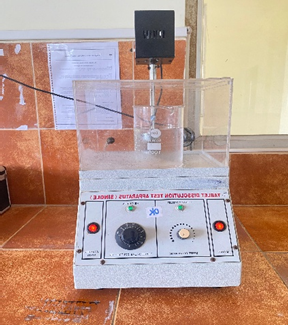
Fig No.- 10.1
b) Hardness:
To endure the mechanical shocks of handling during production, packaging, and transportation, tablets need to have a specific level of strength, or hardness and resistance to friability. The force needed to break a tablet during a diametric compression test is known as tablet hardness. A hardness tester was used to measure hardness.
TABLE NO.5.2
|
EVALUTION PARAMETRE |
FORFULATION |
||||
|
F1 |
F2 |
F3 |
F4 |
F5 |
|
|
HARDNESS TEST |
6 |
4.50 |
3.50 |
5 |
4 |
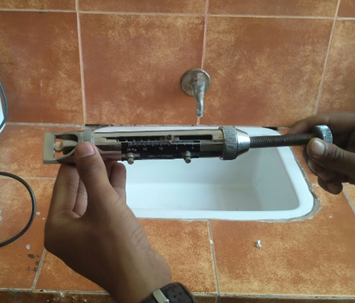
Fig No.- 10.2
c) Weight variation test:
In order to guarantee that a tablet has the right amount of medication, the weight of the tablet was regularly measured. Tablets are made to include a specified amount of medication in a specific amount of tablet formula.
Twenty pills were chosen at random, their individual weights were recorded, and the average weight of the tablets was calculated. The average weight was not exceeded by more than two of the individual weights.
(Weight of tablet (mg) - Average weight of tablet (mg))
Percentage deviation =---------------------------------------------------------×100
TABLE NO.-10.3
|
EVALUTION PARAMETER |
FORMULATION (mg) |
||||
|
F1 |
F2 |
F3 |
F4 |
F4 |
|
|
Weight Variation |
0.52 |
0.30 |
0.41 |
0.49 |
0.53 |
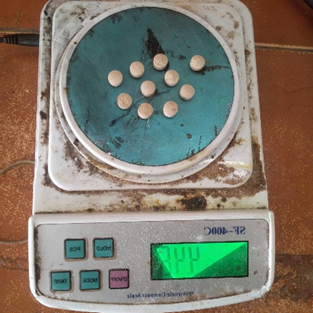
Fig No.-10.3
d) Friability:
The weight loss of the tablet in the container as a result of the small particles being removed from its surface is known as friability. Roche Friabilator was used to assess the tablet's friability. The percentage (%) was used to express it. Twenty pills were put into the friabilator after being first weighed. For four minutes, the Friabilator was run at 25 rpm. The final weight of the tablets was measured once more. The following formula was then used to determine the percentage of friability.
Friability = Initial wt – Final wt / Initial
wt X 100 Limit: Friability should be less than 1%.
TABLE NO.-10.4
|
EVALUATION TEST |
FORMU;ATION |
||||
|
F1 |
F2 |
F3 |
F4 |
F5 |
|
|
FRIABILITY TEST |
2% |
0.47% |
0.34% |
0.60% |
0.20% |
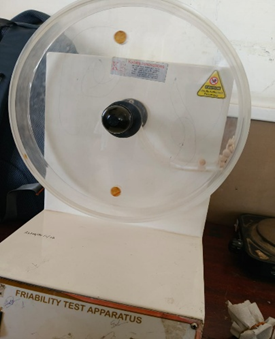
Fig No.-10.4
e) Disintegration time:
Using a disintegration test instrument, the tablet's disintegration time was monitored.
TABLE NO.-10.5
|
EVALUATION TEST |
FORMULATION TEST |
||||
|
F1 |
F2 |
F3 |
F4 |
F5 |
|
|
DISINTEGRATION TEST |
9 |
17 |
11 |
14 |
15 |
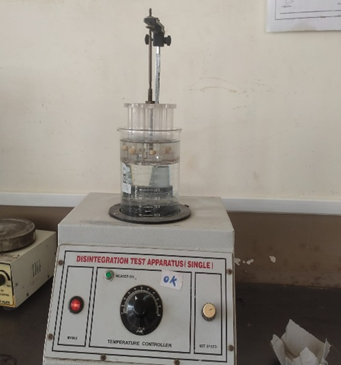
Fig NO. 10.5
CONCLUSION
Omeprazole delayed-release tablets are successfully formulated utilizing the wet granulation method, which guarantees the stability of the acid-labile medication and enables targeted drug release in the digestive region through enteric coating. Good flow characteristics, compressibility, and efficient tablet core disintegration are all facilitated by the use of appropriate excipients like mannitol, hydroxypropyl cellulose, L-HPC, and crospovidone.
Additional therapeutic benefits, such as gastroprotective, anti-inflammatory, and antioxidant properties, can be obtained by using herbal agents such as Aloe barbadensis Miller and Zingiber officinale. These herbal remedies could improve the formulation's overall safety profile and lessen stomach discomfort.All things considered, combining pharmaceutical formulation with herbal supplementation is a potential way to enhance omeprazole therapy's effectiveness, stability, and patient compliance. To verify the improved safety and therapeutic efficacy of this combination system, more research is advised, including in-vitro and in-vivo assessments.
RESULT
The formulated Omeprazole delayed-release tablets prepared by the wet granulation method showed satisfactory physicochemical properties.
|
Sr. No. |
Parameter |
Method/Instrument |
Acceptance Criteria |
|
1 |
Appearance |
Visual inspection |
Uniform color, no cracks/defects |
|
2 |
Size & Shape |
Visual / Vernier caliper |
Consistent and uniform |
|
3 |
Thickness |
Vernier caliper / Screw gauge |
±5% variation allowed |
|
4 |
Diameter |
Vernier caliper |
Uniform for all tablets |
|
5 |
Weight Variation |
Digital balance (20 tablets) |
Within pharmacopeial limits (±5–10%) |
|
6 |
Hardness |
Monsanto/Pfizer tester |
4–8 kg/cm² (typical) |
|
7 |
Friability |
Roche friabilator |
≤ 1% weight loss |
REFERENCES
Effect of Piper longum linn, Zingiber officianails linn and Ferula species on gastric ulceration and secretion in rats. J. of Exp. Biol., 38 (10): 994-99
Effect of Piper longum linn, Zingiber officianails linn and Ferula species on gastric ulceration and secretion in rats. J. of Exp. Biol., 38 (10): 994-99

Dharmesh Koushal, Sushmita Pradhan, Vimla, Shweta Ram, Suchita Wamankar Dr. Gyanesh Sahu, Dr. Chanchal Deep Kaur, Formulation and Evaluation of Herbal-Integrated Omeprazole Delayed Release Tablets for Enhanced Gastroprotective Safety, Int. J. of Pharm. Sci., 2026, Vol 4, Issue 4, 2219-2229, https://doi.org/10.5281/zenodo.19588685
 10.5281/zenodo.19588685