

We use cookies to ensure our website works properly and to personalise your experience. Cookies policy
Smt. Tarawati Institute of Bio-Medical & Allied Sciences, Roorkee, Uttarakhand.
Introduction : Oro dispersible tablets are the tablets that dissolves very fast as compared with normal tablets just because of use of super disintegrates in the tablets.Objective : This study’s primary goal was to prepare and evaluate Amlodipine Oro dispersible tablet using a natural super disintegrants. Identification study of Mango peel pectin & dehydrated Banana powder, Extraction of Pectin form Mango. Identification test for Drug (Amlodipine), Tablet Formulation, Disintegration time evaluation , Evaluation of Physicochemical Properties, Assessment of Drug Release.Method : By using Direct Compression method After being tested for a number of precompression parameters, including Hausner’s ratio, bulk density, tapped density, compressibility index, and angle of repose, the blend of all formulations was determined to be satisfactory. Several characteristics, including weight variation, thickness, hardness, friability, wetting time, water absorption ratio, disintegration time, content uniformity, and in vitro drug release, were assessed for the tablets.Result: In the study 4 formulation of the API named as F1, F2, F3 & F4 were formulated using different super disintegration agents. Dried banana powder 3% in F1, 6% in F2, Mango peel pectin 3% in F3 & chai seed 6% in F4. In the study, F2 showed 99.50 % drug release at 30 min among F1(98.68 %), F3 (97.35 %) & F4 (96.67 %).The results showed that the tablet's hardness ranged from2.9 to 3.4 kg/cm2Conclusion: The study was aimed to formulate Oro dispersible tablet – Amlodipine using Natural polymers like dried banana powder or Mango peel pectin in order to increase the medication release of the API
Oro dispersible tablet
ODT tablets dissolves and split very fast in our mouth in a very less time and it does not need any liquid for consumption. The Oro dispersible tablets spilts. very fast into the saliva of our mouth and gives the pharmacological action of the API. In comparison with normal tablets, oral dispersible Tablet have good compliance with patients, improved drug plasma concentration
Oral administration is preferred over alternative methods due to its ease of dosage form administration, lack of pain during administration, and zero patient noncompliance. The most used dose form is tablets and capsules. However, the difficulty of swallowing tablets is one of their main drawbacks. The formulation department has created a fast-dissolving technique to get around this kind of swallowing obstacle. Compared to consumed tablets, they have advantages. It is particularly difficult for elderly individuals and little toddlers to swallow the tablet. FDT is formulated using a variety of techniques, including lyophilization, blow drying, molding, sublimation, and direct compression.[1,2]
Advantage of ODT
Can be given to patients who could not swallow like old age, victims of shock.
Easy to consume for small children, patients of mental disorder.
Can be easily used by person who used to travel a lot and does not have any water to take the medicine.
Easy for administering dose & precisely dosing with respect to liquid dosage form.
Fast absorption rate & quick onset of action.
Shocking while administration of dosage form can be bypassed.
Disadvantage of ODT
Needs to handle carefully because of poor strength.
Improper formulation leads to undesirable taste.
Needs dry place because of water absorption nature.
Cannot be given to patients who have dryness in their mouth.
Needs different type of packaging material for the stability of the product.
Contraindicated for person having anti-cholinergic drugs.
Oro dispersible tablet for high blood pressure
Hypertension: Consequent increase the systolic and diastolic blood pressure also called hypertension. Blood pressure increase during heart beat also called increase systolic and blood pressure increase during heart rest between the heart rest called increase distollic blood pressure.
ODT in hypertension
Hypertension, commonly referred to as elevated blood pressure, is a long-term condition. Our blood puts a lot of pressure on our arterial walls when we have hypertension. This can cause artery damage over time, raising the prevalence of heart disease, other heart-related conditions, and other conditions linked to hypertension. In many European countries as well as the United States of America, pediatric hypertension is thought to be the primary cause of death and morbidity. Due to lifestyle changes in children and adolescents, the incidence and prevalence of pediatric hypertension have grown. There are various types of medications used to treat high blood pressure. Beta blockers, Ca++ channel blockers, angiotensin converting enzyme inhibitors, and ARB blockers are the most commonly utilized. These medications lower blood pressure by causing blood vessels to relax.
Oro dispersible (ODTs) have gained popularity as high blood pressure medication in recent years. ODT must split into smaller particles in a very less span of time without requiring any fluid during dosage intake. As a result, they are a practical and simple solution for people who have trouble swallowing medications.
Superdisintegrants
Superdisintegrants have more capacity of disintegration thus, they are known to be unique polymers. Superdisintegrants is a type of ingredients, which is employed for the manufacturing of tablet so that it will not break up in the humid environment. Disintegrant is a mixture of compound that use for the breaking
Natural super disintegration: There are now a large number of naturally occurring pharmaceutical excipients on the market, and many researchers have investigated probable of compounds employed as disaggregation. naturally occurring disintegration agents are favored in the preparation of the formulation because to their abundance, relative affordability, softness, and lack of toxicity. Some pharmaceutical substance occur in the natural sources such as chia seed mucilage, dehydrated banana powder, gum have found extensive application in the administration of the drug because of his ease of use.
disintegrant of drug particles into small fragments that soluble very fast. Small fragment will soluble quickly presence of fast dissolving agents such as dehydrated banana powder. Many steps taken to produce prepare the mouth dissolving tablet in order to minimize the challenges related to patients adherence. Fast disintegrates use in both capsule and tablet for rapid disintegration time.
Synthetic superdisintegrants Synthetic Superdisintegrants use Preparation of FDT for the improve of disintegration rate of formulation. Synthetic fast disintegration agent are used in formulation for improve the bioavailability of the tablet. like Croscarmellose, Sodium Starch Glycolate etc.
Amlodipine besylate
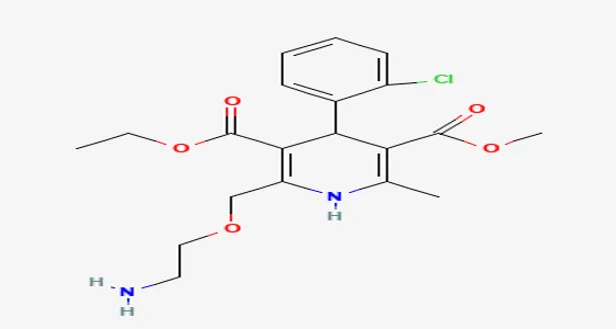
Figure: 1 Amlodipine besylate
Amlodipine is a calcium channel blocker that blocks calcium channels in the heart and blood vessels. By relaxing the blood arteries, reducing blood pressure, and boosting the heart's blood and oxygen flow, this decreases the strain on the heart. The longest half-life is that of amlodipine, which lasts between thirty and fifty hours. This extended half-life is beneficial because it permits a once-daily dosing. Currently sold under the brand name Amlodipine Besylate, amlodipine was initially approved by the FDA in 1987. Amlodipine, a calcium antagonist dihydropyridine, prevents calcium ions from entering cardiac and vascular smooth muscle. Amlodipine is used to treat hypertension in both young and older people. When an instant release formulation is taken orally, its therapeutic effects become apparent after 6 to 8 hours. Amlodipine stops smooth muscle from absorbing calcium ions by attaching to the L-shaped calcium binding site. Dihydropyridine has a stronger effect on blood vessels than heart muscle and lowers blood pressure. Non-dihydropyridines have a stronger effect on heart muscle than blood arteries, and they can be used to treat hypertension. Amlodipine is used to treat hypertension both on its own and in conjunction with other medications like hydrochlorothiazide.
MATERIAL AND METHOD
Amlodipine Besylate is given as gift sample by Merril Pharma From Raipur (Roorkee)Natural Superdisintegrants by Local market, Talc and magnesium stearate were Merril Pharma From Raipur (Roorkee)
Extraction
Prepare unripe banana power
Banana is the same as a plantain (family: Musaceae). It has retinol, or vitamin A. Additionally, it has pyridoxal, or vitamin B6, which is recommended to lessen stress. Rich in potassium and carbohydrates, it contributes to increased brain activity. Cut 6 fresh, unripe bananas into tiny pieces after carefully peeling them. These parts were sun-dried for a whole day. The dry particles were then appropriately ground into a powder. Making banana powder is an environmentally beneficial procedure.
Table 1 Evaluation test of banana powder
|
S.No |
Properties Evaluated |
Observations |
|
1. |
Taste |
Typical Flavour |
|
2. |
Color |
Off White |
|
3. |
Appearance |
Off White |
|
4. |
Odour |
Sweet |
|
5. |
pH (5% solution) |
4.8 |
|
6. |
Carbohydrate Test |
+ve |
|
7. |
Tannins Test |
+ve |
|
8. |
Alkaloid Test |
+ve |
|
9. |
Glycosides Test |
+ve |
|
10. |
Protein Test |
+ve |
Isolation of mango pectin 10 g of mango peel powder (MPP) were taken in a two 250 mL conical flask and added 150 mL buffer solutions of pH 1, 2 and 3 which was prepared before by adding different concentration (16 g/100 mL, 12 g/100 mL and 6 g/100 mL) of citric acid and (0.13 g/100 mL) trisodium citrate in water. the mixture was heated and stirred at three different temperature 70 °C, 80 °C and 90 °C and three different hours 3, 4 and 5. The hot acid extract was filtered with cotton. Ethanol (96%) was added to the filtrate in a 2:1 ratio and stored in a refrigerator at 4 °C around 18 h in order to fully precipitation That portions may be the polysaccharides containing pectin. Afterward, the gelatinous precipitate was removed by normal filtration and washed three times with 96% ethanol. The ethanol was recovered by distillation and further used in pectin's extraction process. The wet pectin was dried at 55 °C in a vacuum oven around 24 hr.
Table 2 Evaluation parameter of mango pectin
|
S.No |
Properties Evaluated |
Observations |
|
1. |
Taste |
tasteless |
|
2. |
Color |
brownish to yellowish |
|
3. |
Appearance |
Flaky |
|
4. |
Odour |
odorless to slightly fruity/citrusy |
|
5. |
Solubility |
high solubility in warm or hot wate |
|
6. |
pH (5% solution) |
4.3 |
|
7. |
Carbohydrate Test |
-ve |
|
8. |
Tannins Test |
+ve |
|
9. |
Alkaloid Test |
+ve |
|
10. |
Glycosides Test |
+ve |
|
11. |
Protein Test |
-ve |
Table 2: Composition of Experimental Batches of Tablets
|
Ingredients |
F1 |
F2 |
F3 |
F4 |
|
Amlodipine |
10 |
10 |
10 |
10 |
|
Banana Power |
3 |
6 |
- |
- |
|
Mango pectin |
- |
- |
3 |
6 |
|
Mannitol |
41 |
41 |
41 |
41 |
|
Microcrystalline cellulose |
90 |
87 |
90 |
87 |
|
Aspartame |
3 |
3 |
3 |
3 |
|
Magnesium stearate |
2 |
2 |
2 |
2 |
|
Talc |
1 |
1 |
1 |
1 |
|
Total |
150 |
150 |
150 |
150 |
Precompression study
Determination of melting point determining the melting point The medication Amlodipine is to be placed into a fused capillary tube with one end and placed within a digital melting point instrument. The melting point of a medicine is the temperature at which it begins to melt.[11]
Determination of λ max of Amlodipine Using a UV-visible spectrometer (UV-2450, Shimadzu), the UV spectra of Amlodipine was produced. The medication was introduced to a 100 ml volumetric flask with an accurate weight of 10 mg. Using 100 μg/ml of water, the volume was increased to 100 ml. This was a stock solution that was applied. This solution (100 μg/ml) was used to generate appropriate working solutions at various concentrations (10, 20, 30, 40, and 50 μg/ml). After scanning the resulting solution from 400 to 200 nm, the maximum wavelength in each of the solvents was determined by recording the spectra. A spectrophotometer was used to measure each standard solution's absorbance. [12,13]
Bulk density powder's bulk density varies with powder consolidation and is influenced by particle packing. The bulk powder was poured into a graduated cylinder using a large funnel, and the weight and volume were measured to determine the apparent bulk density. The formula for calculating bulk density is as follows:.[14]
Bulk Density = weight of powder
Bulk Volume
Angle of repose (θ) The maximum angle that can exist between a powder pile's surface and a horizontal plane is known as the angle of repose. By measuring the angle of repose, one can determine the frictional force in loose powder or grains[14]
θ = tan-1 h/r
Hausner’s ratio One measure of powder flow easiness that is not direct is Hausner's ratio Here's the formula that calculates it: [15,16]
H = Tapped density
Bulk density
Compressibility Index (Carr’s Index) Carr's devised a second indirect technique for determining powder flow from bulk densities. Powder arch or bridge strength and stability can be directly determined by calculating the % compressibility of the powder. Equation following is used to compute it.[17,18]
Compressibility Index = 100 × (Tapped Density – Bulk Density)
Tapped density
POST COMPRESSION STUDIES
Weight variation test: Twenty tablets of the formulation type were weighed individually using an electronic scale, the average weight was determined, and the weights of each tablet were compared to the average to find weight differences. [19,20]
%𝐰𝐞𝐢𝐠𝐡𝐭 𝐯𝐚𝐫𝐢𝐚𝐭𝐢𝐨𝐧 = I𝐧𝐝𝐢𝐯𝐢𝐝𝐮𝐚𝐥 𝐰𝐞𝐢𝐠𝐡𝐭 − 𝐚𝐯𝐞𝐫𝐚𝐠𝐞 𝐰𝐞𝐢𝐠𝐡𝐭
𝐢𝐧𝐝𝐢𝐯𝐢𝐝𝐮𝐚𝐥 𝐰𝐞𝐢𝐠𝐡𝐭 × 𝟏𝟎0
Thickness and diameter Physical dimensions are the regulated parameter used in formulation preparation. In the marketplace and for regularity of tablet formulations, thickness and diameter are important factors. measurements were verified in millimeters using a "Digital vernier caliper." The thickness of the tablets was measured using a Vernier calipers.
Hardness Before being utilized, a tablet's hardness dictates how resilient it is to shipping, handling, storage, and transit conditions. Six tablets per formulation were tested for hardness using the Monsanto hardness tester. The tablet was held along its oblong axis between the tester's two jaws. Right now, the reading should be 0 kg/cm2.[24,25]
Friability Friability is a measure of tablet strength. The following procedure was used to assess friability using a Roche Friabilator: In this test, tablets are subjected to the combined effects of impact abrasion by being dropped from a distance of six inches with each rotation of a plastic container rotating at a speed of 25 rpm. [26,27]
%𝑭𝑹𝑰𝑨𝑩𝑰𝑳𝑰𝑻𝒀 = 𝑰𝑵𝑰𝑻𝑰𝑨𝑳 𝑾𝑬𝑰𝑮𝑯𝑻−𝑭𝑰𝑵𝑨𝑳 𝑾𝑬𝑰𝑮𝑯𝑻 x100
𝑰𝑵𝑰𝑻𝑨𝑰𝑳 𝑾𝑬𝑰𝑮𝑯𝑻
Disintegration test A USP disintegration device utilizing phosphate buffer at pH 6.8 was used to measure time it took for mouth-dispersing pills to dissolve. medium had a capacity of 900 milliliters and a temperature of 37 °C±2 °C. amount of time (measured in seconds) required for tablet to completely dissolve and leave no discernible mass on the mesh was recorded. [28,29]
In vitro dissolution test The USP type II (paddle) instrument was used to study how the medication was released from the tablet. In method, 900 milliliters of pH 6.8 phosphate buffer served as dissolve media, and the paddle was rotated at steady 500 revolutions per minute. medium's temperature was kept at 37°C±0.5 °C.
RESULT AND DISCUSSION
Melting point : Finding the melting point The drug Amlodipine will be put into a one-end fused capillary tube and kept in a digital melting point device. The melting point of drug is 146±1
Calibration Curve of AM In 6.8 pH Phosphate Buffer Solution at 236 Λ max Method is The standard plot of Amlodipine in Solution of 6.8 pH Phosphate Buffer, as explained in section 6.1.2, shows that the Amlodipine standard curve complied with Beer's law. The R2 value and linearity between 1-10 µg/ml were determined to be at nm 0.9987, 239 nm 0.9981, and 236 nm 0.9986.
Table: 3 calibration curve data of Amlodipine
|
Conc. Of Drug in Phosphate Buffer Sulotion (µg/ml) |
λmax 237 |
|
3 |
0.095±0.038 |
|
6 |
0.195±0.076 |
|
9 |
0.335±0.044 |
|
12 |
0.488±0.009 |
|
15 |
0.616±0.019 |
|
18 |
0.751±0.0068 |
|
21 |
0.877±0.025 |
Figure:3 calibration cure of Amlodipine
Table: 4 Precompression parameters for Oro dispersible tablets of F1 to F4 Formulation code
|
Formulation |
Angle of repose (g/ml) |
Bulk density |
Tapped density (g/ml) |
Compressibility index (%) |
Hausner’s ratio |
|
F1 |
27.81±0.018 |
0.366±0.0046 |
0.420±0.0059 |
15.14±2.24 |
1.069 |
|
F2 |
28.42±0.027 |
0.362±0.0036 |
0.412±0.0062 |
12.16±1.63 |
1.142 |
|
F3 |
27.12±0.029 |
0.321±0.0076 |
0.398±0.0054 |
16.26±2.46 |
1.202 |
|
F4 |
29.46±0.023 |
0.376±0.0052 |
0.408±0.0068 |
14.14±3.28 |
1.129 |
Table:5 Precompression parameters for Oro dispersible tablets of F1 to F4 Formulation code
|
Formulation code |
Thickness (mm) (mean±SD) |
Hardness at* Kg/cm2 +-S-D |
Friability Percentage |
Time in secs +-S.D |
(F1) Wt. mgs |
|
F1 |
2.22±0.008 |
3.42±0.026 |
0.71±0.02% |
35±1.66 |
149±0.14 |
|
F2 |
2.28±0.006 |
3.12±0.124 |
0.52±0.05% |
25±1.32 |
146±0.12 |
|
F3 |
2.26±0.034 |
3.28±0.046 |
0.68±0.06% |
48±1.6 |
152±0.18 |
|
F4 |
2.24±0.015 |
2.96±0.045 |
0.46±0.05% |
28±1.24 |
148±0.16 |
Table:6 Drug releasing of Diltiazem
|
Time |
%Drug Release (F1) |
%Drug Release (F2) |
%Drug Release (F3) |
%Drug Release (F4) |
|
0 |
0 |
0 |
0 |
0 |
|
5 |
75.18 |
76.64 |
71.58 |
66.19 |
|
10 |
80.45 |
81.89 |
80.53 |
73.64 |
|
15 |
93.10 |
94.25 |
81.23 |
87.48 |
|
20 |
94.34 |
95.20 |
82.96 |
91.96 |
|
25 |
98.15 |
98.68 |
88.78 |
94.54 |
|
30 |
98.68 |
99.50 |
97.35 |
96.67 |
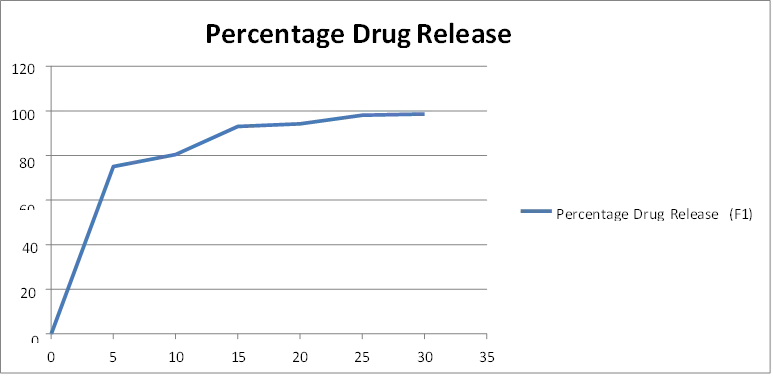
Figure:4 Drug releasing of Diltiazem
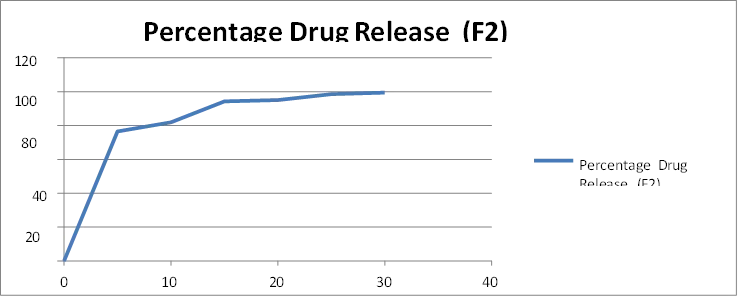
Figure:5 Drug releasing of Diltiazem
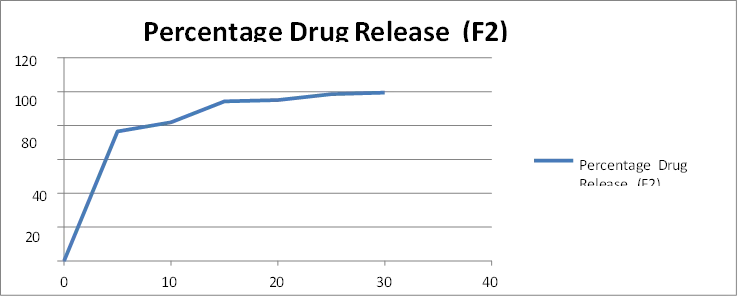
Figure:6 Drug releasing of Diltiazem
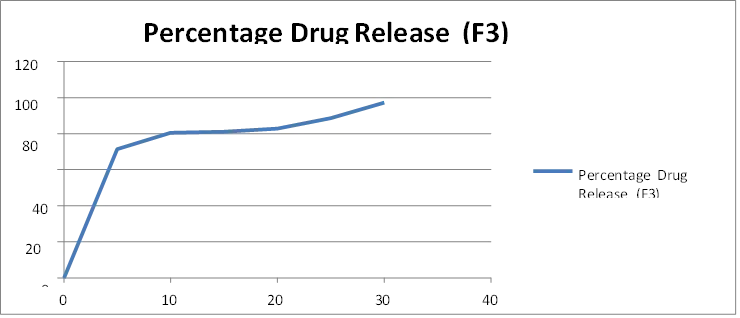
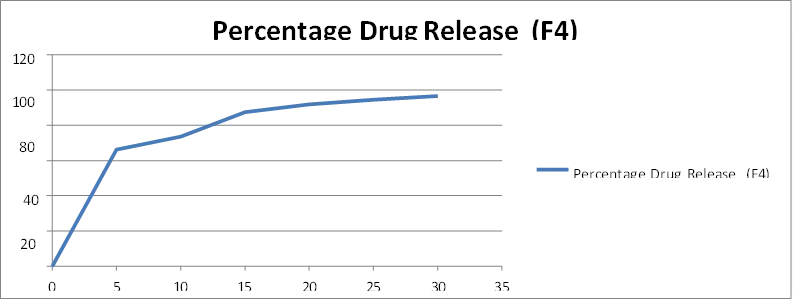
Figure:7 Drug releasing of Diltiazem
CONCLUSION
In the study 4 formulation of the API named as F1, F2, F3 & F4 were formulated using different super disintegration agents. Dried banana powder 3% in F1, 6% in F2, chai seed 3% in F3 & chai seed 6% in F4. In the study, F2 showed 99.50 % drug release at 30 min among F1(98.68 %), F3 (97.35 %) & F4 (96.67 %).The results showed that the tablet's hardness ranged from 2.9 to 3.4 kg/cm2. The tablet formulated have potential for increase the patient complaints and to be used in medical conditions. Yet for the studies need to be done for the optimal study of the disintegration agent in terms of its concentration and stability. The super disintegrates agents used in the study showed in the improvement of the drug release of the API mod peen resulting and significant and potential increase in therapeutic outcomes.
REFERENCES


Ashu Saini, mohd Kashif, Deepak Saini, Chitra Gupta, Formulation And Evaluation of Oro-Dispersible Tablet of Amlodipine by Using Natural Polymers, Int. J. of Pharm. Sci., 2026, Vol 4, Issue 9, 2893-2903, https://doi.org/10.5281/zenodo.22915320
 10.5281/zenodo.22915320