

We use cookies to ensure our website works properly and to personalise your experience. Cookies policy
Faculty of Pharmacy, Oriental University Indore (M.P.), India.
Migraine is a common and debilitating neurological disorder characterised by recurrent episodes of moderate to severe headache accompanied by nausea, vomiting, photophobia, and phonophobia. Although dihydroergotamine mesylate (DHE) is an effective antimigraine agent, its conventional dosage forms are associated with limitations such as poor oral bioavailability, extensive first-pass metabolism, variable nasal absorption, and rapid mucociliary clearance. The present study aimed to formulate and evaluate a thermo-sensitive in-situ nasal gel of DHE for rapid and sustained intranasal drug delivery. The formulation was prepared using the cold method with Poloxamer 407 as the primary thermosensitive polymer, Poloxamer 188 to optimize gelation temperature, and chitosan as a mucoadhesive and permeation-enhancing polymer. Preformulation studies, including solubility, melting point, partition coefficient, FTIR, and DSC analyses, confirmed the suitability and compatibility of the drug with the selected excipients. Three formulations (F1, F2, and F3) were prepared and evaluated for physicochemical properties, pH, viscosity, gelation temperature, gelation time, gel strength, drug content, mucoadhesive strength, spreadability, in-vitro drug release, ex-vivo nasal permeation, and stability. Among the formulations, F3 demonstrated optimum performance with a gelation temperature of 32.8°C, drug content of 99.1%, excellent mucoadhesive strength, sustained drug release of 93.8% over the study period, and ex-vivo permeation of 91.5%. Stability studies conducted for three months showed no significant changes in appearance, pH, drug content, viscosity, or gelation temperature. The findings indicate that the optimized thermo-sensitive in-situ nasal gel offers prolonged nasal residence time, enhanced drug permeation, sustained release, and improved bioavailability, making it a promising alternative for effective and patient-friendly management of acute migraine
Headaches occurring frequently, with a moderate to strong intensity and with pulsating nature are typical symptoms of a migraine. Migraine has photophobia, phonophobia, nausea, and vomiting. It is estimated that migraines affect about 15% of the world’s population, which makes migraine one of the leading causes of disabilities among young individuals. Migraine has serious implications on healthcare expenditures, work performance, and quality of life.
Migraines may occur with an aura or without it; however, regardless of the presence of the aura, migraines can persist for four to seventy-two hours. Due to hormones, females are twice as likely to experience migraines in comparison with males. According to recent research, migraine is a complex neurovascular disease.(Frimpong-Manson et al., 2024)
1.2 Pathophysiology of Migraine
All of these events, including trigeminovascular activation, spreading depression of cortex, neurogenic inflammation, and secretion of vasoactive neuropeptides such as calcitonin gene related peptide (CGRP), constitute the pathophysiology of migraines. Activation of trigeminal sensory nerves leads to dilation of blood vessels of the brain and pain sensation transmitted to the central nervous system.
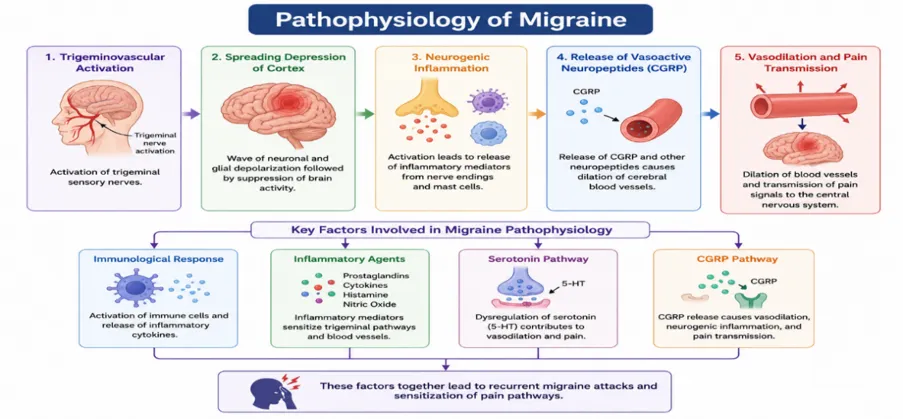
Figure: 1. Pathophysiology of Migraine
Immunological response, inflammatory agents, serotonin pathway, and CGRP pathway have recently emerged as important factors involved in the pathophysiology of migraines. They cause recurrent episodes of migraine attacks and sensitization of pain pathway.(Ha & Chu, 2024)
1.3 Chemical Structure
Dihydroergotamine is a hydrogenated ergot alkaloid obtained from ergotamine. The hydrogenation process reduces its vasoconstrictive effects while maintaining its antimigraine activity. The molecule contains an ergoline ring system responsible for its pharmacological action.
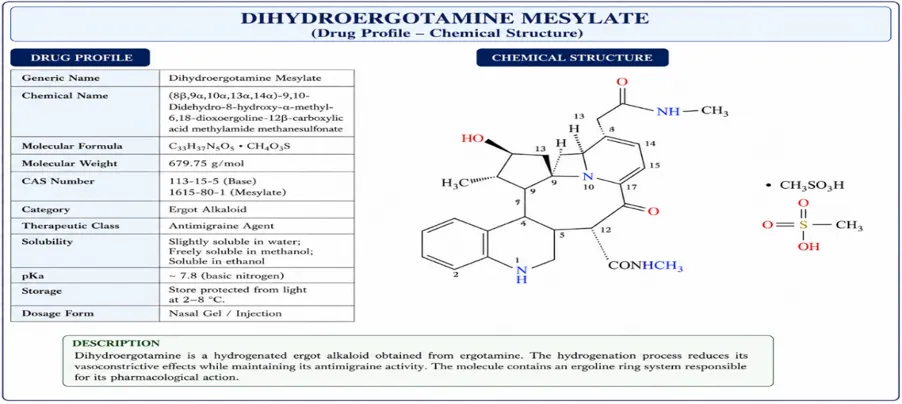
Figure No: 2. Chemical Structure
1.4 Current Treatment Approaches for Migraine
Acute care
NSAIDs, non-steroidal anti-inflammatory drugs (NSAIDs)
These drugs are often employed for the management of patients with mild to moderate attacks of migraines. NSAIDs reduce the production of prostaglandins through blocking the actions of COX enzymes, and prostaglandins are known to stimulate headaches and cause inflammation. Common NSAIDs include aspirin, ibuprofen, naproxen sodium, and diclofenac. NSAIDs help in alleviating pain during the early phase of a migraine attack.
Triptans
Triptans have the ability to activate selective serotonin (5-HT1B/1D) receptors and block pain receptors. Triptans reduce the dilation of cerebral blood vessels while preventing the release of neuropeptides such as CGRP. Examples of common triptans include sumatriptan, rizatriptan, zolmitriptan, and eletriptan.
DHE or Di-Hydro-Ergotamine
DHE or di-hydro-ergotamine is used in the treatment of acute migraines and migraines of prolonged duration known as status migrainosus. It is an ergot alkaloid and a semi-synthetic drug. DHE inhibits neuroinflammation and constricts cranial vessels using the mechanism of serotonin, adrenergic, and dopamine receptors. DHE is available in injectables and nasal sprays and has a reduced rate of recurrence compared to triptans.
Gepants
The gepants are one of the newer classes of drugs used for treating migraines. They work as antagonists to the CGRP receptors. The use of gepants in individuals with cardiac risks is preferred since unlike triptans, they do not cause any vasoconstriction. Examples include Zavegepant, rimegepant, and ubrogepant.
Antiemetics
Vomiting and nausea are frequent signs of migraine attacks. Adjunctive therapy frequently includes antiemetic drugs such metoclopramide, domperidone, chlorpromazine, and prochlorperazine. These treatments alleviate nausea and vomiting symptoms, improve stomach emptying, and increase oral medication absorption.
Preventive Treatment
When there is an issue of severe impairment or frequent episodes of migraine, prevention becomes necessary. The goal would be to lower the frequency, severity, and need for use of any acute medication.
Beta-Blockers
Among the commonly prescribed medicines used in preventing migraines, the beta blockers are a prominent one. This is because they help normalize the tone of the blood vessels, as well as decrease neural excitation. Some effective beta-blockers that can prevent migraine include timolol, atenolol, metoprolol, and propranolol. These are very effective for patients suffering from anxiety disorders or hypertension.
Anti-depressants
Some anti-depressants have been observed to help prevent migraine among people having anxiety disorders or depressions. Commonly used tricyclic anti-depressants include nortriptyline and amitriptyline.
Anti-Epileptic Drugs
Anti-epileptic drugs are helpful in preventing migraines because of their ability to stabilize neural membranes and reduce cortical hyper-excitability. Some examples of anti-epileptic drugs that are commonly used are topiramate, valproate, and gabapentin. Based on clinical studies, topiramate is among the best preventive treatments for migraines.
Monoclonal CGRP Antibodies
Monoclonal CGRP antibodies are a new approach to the prevention of migraines. Their efficacy results from their targeted interference with the action of calcitonin gene-related peptide or its receptor which plays an important role in the pathogenesis of migraines. Thereare several monoclonal CGRP antibodies such as erenumab, fremanezumab, galcanezumab, and eptinezumab.(Burch, 2024),
1. Dihydroergotamine as an Antimigraine Drug
A widely employed semisynthetic ergot alkaloid that is useful for the acute treatment of migraine attacks is dihydroergotamine (DHE). The drug works agonistically on dopaminergic, adrenergic, and serotonin (5-HT1B/1D) receptors to elicit its medicinal effects. DHE decreases neurogenic inflammation and leads to cranial vasoconstriction.
DHE has been found to exert a relatively prolonged duration of action, with a reduced frequency of recurrence as compared to triptans. The effectiveness and safety of DHE nasal sprays in the treatment of acute migraines have been confirmed by recent studies. (Tepper et al., 2024)
2. Nasal Drug Delivery System
One method of achieving systemic delivery without invasion is the use of nasal delivery. The large amount of surface area, extensive vascularization, and high permeability in the nasal cavity make rapid absorption into the bloodstream possible.
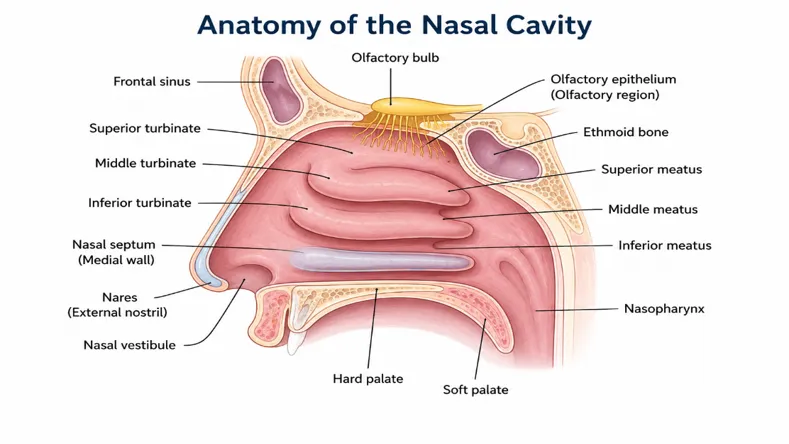
Figure: 2. Anatomy of the Nasal Cavity
The nasal method offers faster onset since first-pass effect through the liver and digestive system can be avoided, making it more beneficial to treat neurological diseases, such as migraines.
Advantages of Intranasal Drug Delivery
3. In-Situ Gel Drug Delivery Systems
In-situ gels are the polymer formulations that experience transformation from sol to gel form on exposure to physiological conditions such as temperature, pH, or ionic strength. They transform into gels following their administration in liquid form.
The use of in-situ gels in nasal drug delivery enhances their effectiveness due to increased retention and decreased clearance rate.
4. Thermo-Sensitive Polymers
Temperature changes lead to the phase transition of thermosensitive polymers. Two types of thermoreversible polymers that are mostly used in nasal formulations include Poloxamer 407 and Poloxamer 188.
These polymers remain in a fluid state at room temperature but become gelled at nasal cavity temperature of 32°C to 34°C. This property makes them highly suitable for nasal in-situ gels.
Advantages of Thermo-Sensitive In-Situ Nasal Gels
Possibility for targeted delivery to the brain
In view of these advantages, thermo-sensitive gels in nasal application appear to be promising vehicles for antimigraines.
Rationale For Present Work
Even though DHE is effective against migraine, conventional forms have some limitations, such as mucociliary transport, short period of stay in the nose, and inconsistent drug absorption. These problems can be overcome by designing an in-situ nasal gel which is fast to act and better absorbed.(Dafer et al., 2024)
2. MATERIALS AND METHODS
Materials
Dihydroergotamine Mesylate was selected as the active pharmaceutical ingredient. Poloxamer 407 was used as the primary thermosensitive polymer, while Poloxamer 188 was incorporated to optimize the gelation temperature. Chitosan was used as a mucoadhesive and permeation-enhancing polymer. Benzalkonium chloride served as a preservative, acetic acid was used for dissolving chitosan and pH adjustment, and purified water was used as the vehicle.
Formulation Composition
Three formulations (F1–F3) of 10 mL were prepared with varying concentrations of Poloxamer 407, Poloxamer 188, and chitosan. Dihydroergotamine Mesylate (10 mg) and benzalkonium chloride (2 mg) were kept constant in all formulations.
Table 1: Formulation Composition of Dihydroergotamine Mesylate Thermo-Sensitive In-Situ Nasal Gel (10 mL)
|
Ingredients |
F1 |
F2 |
F3 |
|
Dihydroergotamine Mesylate |
10 mg |
10 mg |
10 mg |
|
Poloxamer 407 |
1.8 g (18%) |
2.1 g (21%) |
2.4 g (24%) |
|
Poloxamer 188 |
0.8 g (8%) |
0.6 g (6%) |
0.4 g (4%) |
|
Chitosan |
50 mg (0.5%) |
100 mg (1.0%) |
150 mg (1.5%) |
|
Benzalkonium Chloride |
2 mg |
2 mg |
2 mg |
|
Acetic Acid |
q.s. |
q.s. |
q.s. |
|
Purified Water |
Up to 10 mL |
Up to 10 mL |
Up to 10 mL |
Method of Preparation
The thermo-sensitive in-situ nasal gel was prepared by the cold method. Accurately weighed Poloxamer 407 and Poloxamer 188 were slowly dispersed in chilled purified water at approximately 4°C with continuous magnetic stirring. The polymeric solution was refrigerated overnight to ensure complete hydration and formation of a clear solution.
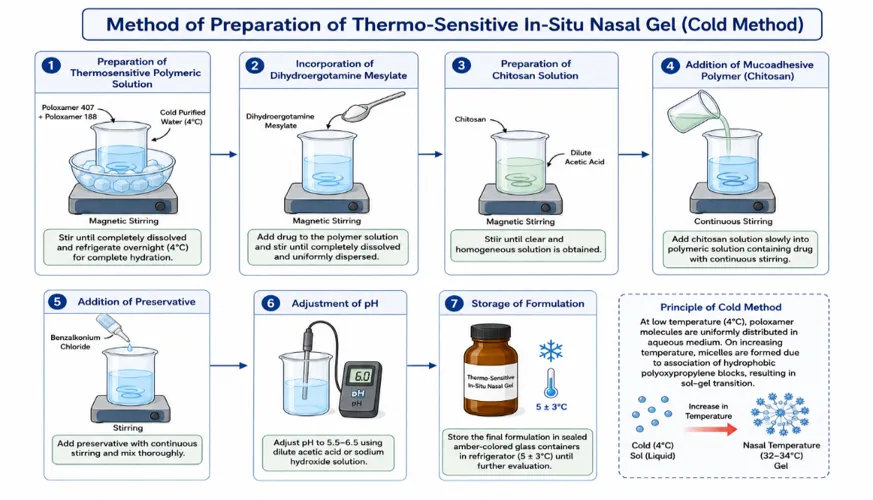
Figure No: 3. Methods of Preparation
Dihydroergotamine Mesylate was accurately weighed and incorporated into the chilled polymeric solution with continuous stirring until uniformly dissolved. Separately, the required quantity of chitosan was dissolved in dilute acetic acid to obtain a homogeneous solution. The chitosan solution was slowly added to the drug-polymer solution with continuous stirring.
Benzalkonium chloride was then added as a preservative and mixed uniformly. The pH was adjusted to approximately 5.5–6.5 using diluted acetic acid or sodium hydroxide. The final volume was adjusted to 10 mL with purified water. The prepared formulations were filled into sealed amber-colored containers and stored at 5 ± 3°C until further evaluation.
Principle of Cold Method
Solubility of poloxamers is dependent on temperature. At lower temperatures (4°C), poloxamer molecules are uniformly distributed in aqueous medium and produce a clear liquid solution. At increasing temperature, poloxamer molecules become associated due to increased interaction among hydrophobic polyoxypropylene blocks, which leads to formation of micelles. Cold process ensures complete hydration of polymer molecules and prevents premature gelling.
Step 1: Preparation of Thermosensitive Polymeric Solution
Cold filtered water held at a temperature of 4°C was slowly incorporated with accurately measured quantities of Poloxamer 407 and Poloxamer 188.
In order to avoid formation of aggregates and ensure complete disintegration, gradual addition of the polymers while simultaneously stirring them magnetically continued until they dissolved completely.
Following this, the solution containing the polymers was allowed to stay in the refrigerator overnight at 4°C in order to ensure full hydration of the solution.
Purpose
Step 2: Incorporation of Dihydroergotamine Mesylate
Dihydroergotamine Mesylate was precisely weighed and incorporated into the cooled polymer solution in a predetermined quantity.
The mixture was continuously stirred until the drug was fully dissolved and well dispersed.
Purpose
Step 3: Preparation of Chitosan Solution
The amount of chitosan required was then dissolved in a solution of acetic acid to form chitosan solution separately.
Agitation was done until a clear and consistent chitosan solution was obtained.
Purpose
Step 4: Addition of Mucoadhesive Polymer
The polymeric solution containing DHE was gradually mixed with the prepared chitosan solution while being continuously stirred.
The process of mixing was carried out until a consistent formulation was achieved.
Purpose
Step 5: Addition of Preservative
After precisely weighing benzalkonium chloride, it was added to the mixture while being constantly stirred.
To guarantee that the preservative was distributed evenly, the recipe was completely blended.
Purpose
Step 6: Adjustment of pH
A digital pH meter was used to determine the formulation's pH.
A solution of sodium hydroxide or diluted acetic acid was used to bring the pH down to about 5.5–6.5.
Purpose
Step 7: Storage of Formulation
After the finished mixture was put into sealed amber-colored glass containers, it was kept in a refrigerator at 5 ± 3°C until further testing.
Purpose
Evaluation Parameters
The prepared formulations were evaluated for appearance, pH, viscosity, gelation temperature, gelation time, gel strength, drug content, mucoadhesive strength, spreadability, in-vitro drug release, ex-vivo nasal permeation, and stability.
RESULTS
The preformulation, formulation evaluation, in vitro drug release, ex vivo permeation, and stability investigations of the created thermosensitive in-situ nasal gel of Dihydroergotamine Mesylate are presented in this chapter. In order to comprehend how formulation variables, specifically the concentrations of Poloxamer 407, Poloxamer 188, and chitosan, affected the nasal gel system's performance, the results were thoroughly examined. The most appropriate formulation was chosen based on overall performance after the results were compared with published literature.
I. In-Vitro Drug Release:
1. In-Vitro Drug Release Results
Table 2: Percentage Cumulative Drug Release
|
Time (h) |
F1 (%) |
F2 (%) |
F3 (%) |
|
1 |
18.5 ± 0.8 |
15.2 ± 0.7 |
12.4 ± 0.6 |
|
2 |
35.6 ± 1.2 |
29.8 ± 1.1 |
24.5 ± 0.9 |
|
3 |
58.4 ± 1.5 |
51.2 ± 1.4 |
46.8 ± 1.2 |
|
4 |
70.2 ± 1.4 |
74.5 ± 1.3 |
81.4 ± 1.5 |
|
5 |
79.5 ± 1.2 |
87.6 ± 1.1 |
93.8 ± 1.0 |
II. Ex-Vivo Permeation Release:
1. Ex-Vivo Permeation Results
Table 3: Ex-Vivo Permeation Parameters
|
Parameter |
F1 |
F2 |
F3 |
|
Drug Permeation (%) |
73.4 ± 1.5 |
84.8 ± 1.3 |
91.5 ± 1.2 |
|
Flux (µg/cm²/hr) |
72.5 ± 2.4 |
84.7 ± 2.2 |
96.8 ± 2.1 |
|
Permeability Coefficient (cm/hr ×10⁻³) |
0.071 |
0.084 |
0.096 |
III. Selection of Optimized Formulation:
Table 4: Evaluation Parameters
|
Evaluation Parameter |
F1 |
F2 |
F3 |
|
pH |
Acceptable |
Acceptable |
Excellent |
|
Drug Content |
Good |
Very Good |
Excellent |
|
Gelation Temperature |
Higher |
Suitable |
Optimum |
|
Viscosity |
Low |
Moderate |
High |
|
Mucoadhesion |
Moderate |
Good |
Excellent |
|
Drug Release |
Fast |
Controlled |
Sustained |
|
Permeation |
Good |
Very Good |
Excellent |
|
Stability |
Good |
Very Good |
Excellent |
|
Overall Rank |
III |
II |
I |
DISCUSSION
Effect of Polymer Concentration on Gelation:
Increasing Poloxamer 407 concentration decreased the gelation temperature due to enhanced micelle formation. This allowed the formulation to rapidly form a gel at nasal physiological temperature.
Effect on Viscosity and Drug Release:
Higher polymer concentration increased viscosity and formed a denser gel network, resulting in slower and prolonged drug release. Lower polymer concentration produced lower viscosity and faster drug release.
Comparison with Literature:
The findings were consistent with reported studies showing that higher Poloxamer 407 concentration improves gelation, viscosity, mucoadhesion, and sustained drug release. Chitosan also enhanced nasal permeation.
Selection of Optimized Formulation:
F3 was selected as the optimized formulation due to its suitable gelation temperature, high viscosity, strong mucoadhesion, improved permeability, prolonged drug release, and good stability. Overall, F3 showed good potential for effective intranasal delivery of Dihydroergotamine Mesylate.
CONCLUSION
All experimental observations and analytical data were methodically collated and put through the proper statistical analysis following the successful completion of formulation development, assessment, optimization, and stability studies. In order to evaluate the impact of formulation variables like Poloxamer 407, Poloxamer 188, and chitosan on the physicochemical properties, gelation behavior, mucoadhesive qualities, drug release profile, and permeation performance of the thermosensitive in-situ nasal gel, the obtained results were carefully interpreted.
Numerous factors, such as pH, viscosity, gelation temperature, gel strength, drug content, mucoadhesive strength, in-vitro drug release, ex-vivo penetration, and stability, were assessed for the generated formulations. The optimized formulation outperformed the other created formulations in terms of suitable gelation at nasal physiological temperature, sufficient viscosity, superior mucoadhesive qualities, high drug content, prolonged drug release, improved nasal penetration, and acceptable stability during storage. These results validated the designed thermosensitive nasal gel system's appropriateness for efficient intranasal administration of Dihydroergotamine Mesylate.
To confirm the formulation approach and determine the importance of the current study, the experimental results were further compared with previously published literature. The efficiency of Poloxamer-Chitosan-based formulations for enhancing nasal residence time and drug absorption was supported by the observed results, which were found to be compatible with published studies on thermosensitive and mucoadhesive nasal drug delivery systems.
The created thermo-sensitive in-situ nasal gel has considerable potential as an alternate delivery strategy for Dihydroergotamine Mesylate in the treatment of migraine, according to the overall findings. Rapid start of action, avoidance of hepatic first-pass metabolism, extended nasal cavity residence duration, increased bioavailability, better patient compliance, and long-lasting therapeutic effect are only a few benefits of the formulation. Ultimately, all of the study results were arranged and methodically recorded in a dissertation. The Introduction, Review of Literature, Aim and Objectives, Plan of Work, Drug Profile, Materials and Methods, Experimental Work, Evaluation Parameters, Results and Discussion, Conclusion, and References were the different chapters that made up the dissertation. The results were supported by relevant tables, figures, graphs, release profiles, FTIR spectra, DSC thermograms, penetration tests, and statistical analyses. The finished dissertation offers a thorough scientific account of the research and makes a significant contribution to the fields of migraine treatment and nasal medication delivery.
6. EXPECTED OUTCOMES
A stable thermo-sensitive in-situ nasal gel should:
Table 5: Sample Stability Study Observation Table
|
Parameter |
Initial |
1 Month |
2 Months |
3 Months |
|
Appearance |
Clear |
Clear |
Clear |
Clear |
|
pH |
5.8 ± 0.1 |
5.8 ± 0.1 |
5.7 ± 0.1 |
5.7 ± 0.1 |
|
Drug Content (%) |
99.2 ± 0.5 |
98.9 ± 0.4 |
98.5 ± 0.6 |
98.1 ± 0.5 |
|
Gelation Temperature (°C) |
33.2 ± 0.3 |
33.3 ± 0.2 |
33.4 ± 0.2 |
33.5 ± 0.3 |
|
Viscosity (cP) |
3450 ± 45 |
3438 ± 40 |
3425 ± 38 |
3412 ± 42 |
Statistical Analysis
All experiments were performed in triplicate (n = 3).
Results were expressed as:
Mean ± Standard Deviation (SD)
Statistical analysis was performed using:
A p-value less than 0.05 was considered statistically significant.
ACKNOWLEDGEMENT
The authors are thankful to the Department of Pharmaceutics Sciences for providing laboratory facilities and technical support for conducting this study.
REFERENCES


Nisha Parsodkar, Dr. Ramakant Sharma, Dr. Sudha Vengurlekar, Formulation Development and Evaluation of Thermo-Sensitive In-Situ Nasal Gel for Rapid Delivery of Antimigraine Drug Dihydroergotamine, Int. J. of Pharm. Sci., 2026, Vol 4, Issue 8, 4590-4602, https://doi.org/10.5281/zenodo.22129560
 10.5281/zenodo.22129560