

We use cookies to ensure our website works properly and to personalise your experience. Cookies policy
Department of Pharmaceutics, Centre for Pharmaceutical sciences, University college of engineering, science and technology JNTUH, Kukatpally, Hyderabad, 500085.
Miconazole is a broad-spectrum imidazole antifungal agent extensively used for the treatment of superficial fungal infections such as candidiasis, dermatophytosis, and tinea infections. However, its poor aqueous solubility, high lipophilicity, limited skin permeation, and inadequate retention at the site of action reduce the therapeutic effectiveness of conventional topical formulations. The present study aimed to develop, optimize, and characterize a miconazole-loaded nanoemulgel for enhanced topical delivery. Nanoemulsion systems were prepared using suitable oil, surfactant, and co-surfactant selected through solubility screening and pseudo-ternary phase diagram studies. The optimized nanoemulsion was incorporated into a Carbopol gel base to improve viscosity, spreadability, and residence time on the skin. A Quality by Design (QbD) approach using Box–Behnken Design was employed to optimize the formulation variables. The optimized nanoemulgel contained 0.10 g Carbopol, 1.00 mL propylene glycol, and 0.04 mL triethanolamine. It exhibited desirable physicochemical characteristics including pH 6.04 ± 0.03, viscosity 34,780 ± 210 cP, spreadability 6.79 ± 0.08 g·cm/sec, extrudability 96.1 ± 0.7%, and drug content 98.52 ± 0.45%. The formulation showed sustained in vitro drug release of 92.10 ± 0.90% over 24 h. The study concluded that miconazole nanoemulgel is a promising topical drug delivery system with improved physicochemical properties and potential therapeutic superiority over conventional formulations.
Fungal infections are among the most common dermatological disorders affecting millions of people worldwide. Superficial fungal infections caused by dermatophytes, yeasts, and molds commonly affect skin, nails, scalp, and mucosal tissues. These infections are more prevalent in humid climates, tropical regions, diabetic patients, and immunocompromised individuals1-4.
Miconazole is a widely used imidazole antifungal drug effective against Candida albicans, Trichophyton, Microsporum, and Epidermophyton species. It acts by inhibiting ergosterol synthesis, thereby disrupting fungal cell membrane integrity. Despite its broad-spectrum activity, miconazole suffers from poor aqueous solubility and high lipophilicity, resulting in low drug release and poor penetration from conventional creams and ointments.
Nanoemulsion-based systems have gained significant attention for improving the delivery of poorly soluble drugs. Nanoemulsions possess droplet sizes in the range of 20–200 nm, providing increased surface area, improved solubilization, and enhanced skin permeation. However, their low viscosity limits topical residence time. Incorporation of nanoemulsion into a gel matrix forms a nanoemulgel, combining the penetration-enhancing advantages of nanoemulsions with the rheological benefits of gels6-8.
Therefore, the present study was undertaken to formulate, optimize, and characterize a miconazole-loaded nanoemulgel for enhanced topical antifungal therapy.
2. Materials
Miconazole, Peceol, Captex 200, Captex 300, Capmul GMO, Maisine CC, Labrasol, Tween 80, Tween 20, Kolliphor RH 40, Transcutol HP, PEG 400, Propylene glycol, Ethanol, Carbopol 934, Carbopol 940, Carbopol 980, Triethanolamine, Methanol.
3. Methodology
3.1 Preformulation Studies
Preformulation studies were carried out to understand the physicochemical characteristics of miconazole and to ensure its suitability for development into a nanoemulgel dosage form. Initially, the absorption maximum (λmax) of miconazole was determined using UV–Visible spectrophotometry. Accurately weighed miconazole was dissolved in a small quantity of methanol due to its poor aqueous solubility and further diluted with phosphate buffer pH 7.4 to obtain suitable concentrations. The prepared solution was scanned over the wavelength range of 200–400 nm against blank buffer, and the wavelength showing maximum absorbance was selected for further analytical estimations9-14.
A calibration curve of miconazole was constructed in phosphate buffer pH 7.4 by preparing a series of standard solutions within the concentration range of 2–10 µg/mL. The absorbance of each solution was measured at the determined λmax using quartz cuvettes of 1 cm path length. A graph of concentration versus absorbance was plotted, and the regression equation along with correlation coefficient was calculated. This standard curve was used for estimation of drug content and in vitro release samples.
Drug–excipient compatibility studies were performed using Fourier Transform Infrared (FTIR) spectroscopy. Pure miconazole and physical mixtures of miconazole with selected oils, surfactants, co-surfactants, and gelling agents were analyzed over the spectral range of 4000–400 cm⁻¹. Characteristic peaks corresponding to functional groups of miconazole were compared before and after mixing with excipients. The absence of significant peak shifts, disappearance, or formation of new peaks indicated compatibility between drug and excipients.
Solubility studies were carried out to identify suitable formulation components capable of dissolving maximum amount of miconazole. Excess quantity of drug was added separately to various oils such as Peceol, Captex, and Maisine, surfactants such as Labrasol and Tween 80, and co-surfactants such as Transcutol HP and PEG 400. The mixtures were vortexed and shaken for 48 h at room temperature, followed by centrifugation. The supernatant was filtered, suitably diluted, and analyzed spectrophotometrically. Components showing highest solubility were selected for formulation development115-17.
Melting point determination was carried out using capillary method to assess purity and crystalline nature of the drug. Finely powdered miconazole was filled into a capillary tube and placed in the melting point apparatus. The temperature at which the drug melted completely was recorded and compared with reported values.
3.2 Preparation of Nanoemulsion
Pseudo-ternary phase diagrams were constructed by aqueous titration method to identify the nanoemulsion region and optimize the ratios of oil, surfactant, and co-surfactant. Based on solubility studies, Peceol was selected as oil phase, Labrasol as surfactant, and Transcutol HP as co-surfactant. Surfactant and co-surfactant were mixed in different weight ratios (Smix) such as 1:1, 2:1, and 3:1. Each Smix ratio was blended with oil in varying proportions from 1:9 to 9:1. Distilled water was added dropwise under gentle stirring, and the mixtures were visually observed for clarity, transparency, and phase separation. Clear and isotropic systems were considered as nanoemulsion region and plotted on phase diagrams.
For preparation of drug-loaded nanoemulsion, accurately weighed miconazole was dissolved in the selected oil phase containing Peceol. The required quantity of Labrasol and Transcutol HP was then added to form a uniform isotropic oily mixture. Distilled water was added gradually under continuous magnetic stirring to obtain a coarse emulsion. This system was subjected to high-speed homogenization at 10,000–15,000 rpm for 10–15 min to reduce droplet size, followed by bath sonication for 5–10 min to obtain a clear or slightly bluish nanoemulsion. The prepared nanoemulsion was stored for 24 h and examined for stability, transparency, and phase separation19-21.
3.3 Evaluation of Nanoemulsion
The prepared nanoemulsion formulations were evaluated for droplet size, polydispersity index (PDI), zeta potential, drug content, pH, and viscosity. Droplet size and PDI were determined using Dynamic Light Scattering (DLS) after suitable dilution with distilled water. Smaller droplet size and lower PDI values indicate uniform and stable nanoemulsion systems.
Zeta potential was measured using a zeta potential analyzer to determine surface charge and predict physical stability of droplets. Higher absolute zeta potential values suggest better repulsion between droplets and lower tendency for aggregation.
Drug content was estimated by taking an accurately measured quantity of nanoemulsion, disrupting the droplets using methanol, followed by dilution and UV spectrophotometric analysis at λmax. This ensured uniform distribution of drug within the formulation.
The pH of nanoemulsion was measured using a calibrated digital pH meter to ensure suitability for skin application. Viscosity was measured using Brookfield viscometer at controlled temperature and spindle speed to understand flow characteristics and suitability for incorporation into gel base22-23.
3.4 Preparation of Nanoemulgel
The optimized nanoemulsion was converted into nanoemulgel by incorporating it into a hydrated Carbopol gel base. Required quantity of Carbopol was slowly sprinkled into purified water with continuous stirring to prevent lump formation and allowed to hydrate for several hours until complete swelling occurred. Propylene glycol was then added as humectant and co-solvent with continuous mixing.
The optimized nanoemulsion was gradually incorporated into the hydrated gel base with slow stirring to ensure uniform distribution. Triethanolamine was then added dropwise to neutralize Carbopol dispersion and adjust the pH to skin-compatible range. Neutralization caused thickening and formation of smooth gel consistency. The final nanoemulgel was packed in suitable containers and stored for further evaluation9-14.
3.5 Optimization by Quality by Design (QbD)
A systematic Quality by Design (QbD) approach was adopted for optimization of nanoemulgel formulation. Quality Target Product Profile (QTPP) was defined to achieve a stable, elegant, non-irritant, and effective topical gel with acceptable viscosity, spreadability, drug content, and release characteristics. Critical Quality Attributes (CQAs) such as pH, viscosity, spreadability, extrudability, drug content, and percentage drug release were identified.
Box–Behnken Design (BBD) with three independent variables at three levels was employed for optimization. The selected formulation factors were X1 = Carbopol concentration, X2 = Propylene glycol concentration, and X3 = Triethanolamine concentration. A total of 17 experimental runs were generated including center points. Responses measured for each run included pH, viscosity, spreadability, extrudability, drug content, and cumulative percentage drug release. Statistical analysis, regression modeling, contour plots, and response surface methodology were used to determine the effect of variables and to obtain optimized formulation with highest desirability19-21.
3.6 In Vitro Drug Release Study
In vitro drug release study of optimized nanoemulgel was carried out using Franz diffusion cell apparatus. A dialysis membrane previously soaked in receptor medium was mounted between donor and receptor compartments. The receptor compartment was filled with phosphate buffer pH 7.4 and maintained at 37 ± 0.5°C with continuous magnetic stirring to simulate physiological conditions.
An accurately weighed quantity of nanoemulgel was placed in the donor compartment over the membrane surface. At predetermined time intervals, aliquots of receptor medium were withdrawn and replaced with equal volume of fresh buffer to maintain sink conditions. The withdrawn samples were filtered, suitably diluted, and analyzed spectrophotometrically at λmax. Cumulative percentage drug release was calculated and plotted against time to study release behavior. Release kinetics were further analyzed using zero-order, first-order, Higuchi, and Korsmeyer–Peppas models9-12.
Top of Form
Bottom of Form
4. RESULTS AND DISCUSSION
4.1 Preformulation Studies
The preformulation studies were carried out to establish the identity, purity, compatibility, and analytical profile of miconazole prior to formulation development. The UV spectrophotometric scanning of miconazole in phosphate buffer pH 7.4 exhibited a distinct absorption maximum at 222.4 nm, which was selected for further quantitative estimations. The calibration curve prepared in the concentration range of 2–10 µg/mL showed good linearity with a high correlation coefficient, confirming the suitability and accuracy of the analytical method for drug estimation during formulation studies.
FTIR spectroscopy of pure miconazole displayed characteristic peaks corresponding to imidazole ring stretching, aromatic C–H stretching, C=N stretching, and chlorinated aromatic groups. The spectra of physical mixtures containing miconazole with selected excipients such as Peceol, Labrasol, Transcutol HP, and Carbopol did not show significant shifting, disappearance, or emergence of additional peaks. This confirmed the absence of chemical interaction between drug and excipients, indicating compatibility and stability of the selected formulation components.
The melting point of miconazole was found within the reported range of 178–184°C, confirming the crystalline nature and purity of the drug sample. Solubility studies revealed that miconazole exhibited maximum solubility in Peceol among the tested oils, while Labrasol showed superior solubilization among surfactants and Transcutol HP among co-surfactants. These findings justified the selection of these components for nanoemulsion preparation.
4.2 Selection and Optimization of Nanoemulsion
Pseudo-ternary phase diagrams were constructed using different Smix ratios to identify the nanoemulsion region. Among the tested surfactant/co-surfactant ratios, the combination producing the largest transparent and stable nanoemulsion region was selected for further optimization. The transparent region indicated efficient reduction of interfacial tension and spontaneous formation of fine droplets. The presence of a broad nanoemulsion region also suggested formulation robustness and flexibility in selecting oil-water ratios.
Drug-loaded nanoemulsions were prepared by homogenization followed by sonication. Visual inspection showed clear to slightly bluish dispersions without phase separation, indicating successful formation of nanosized emulsions. Homogenization reduced coarse droplet size, while sonication further decreased droplets into nanometric range and improved uniformity. The bluish appearance observed in optimized batches was attributed to Tyndall scattering, which is characteristic of nanoemulsion systems.
4.3 Evaluation of Nanoemulsion
The optimized nanoemulsion exhibited nanoscale droplet size with narrow size distribution, confirming efficient emulsification. Small droplet size is advantageous because it provides larger surface area for drug release and intimate contact with the skin surface, thereby improving topical permeation. The polydispersity index was found to be low, indicating uniform droplet population and monodispersity of the system. Lower PDI values are desirable as they reflect formulation homogeneity and improved storage stability.
Zeta potential analysis revealed adequate surface charge on the droplets, which helped maintain electrostatic repulsion between particles and minimized aggregation. This suggests good physical stability of the prepared nanoemulsion during storage. Drug content was found close to theoretical value, confirming efficient incorporation of miconazole into the internal oil phase and negligible drug loss during preparation.
Table-1: Evaluation of Drug-Loaded Nanoemulsions of Miconazole
|
Batch Code |
Smix Ratio |
Droplet Size (nm) |
PDI (Mean ± SD) |
Zeta Potential (mV) (Mean ± SD) |
Drug Content (%) (Mean ± SD) |
Viscosity (cP) (Mean ± SD) |
pH (Mean ± SD) |
|
NE4-1 |
4:1 |
78.4 |
0.18 |
−24.6 |
99.2 ± 1.1 |
78 ± 4 |
5.82 ± 0.06 |
|
NE4-2 |
4:1 |
92.6 |
0.21 |
−22.1 |
98.6 ± 1.3 |
74 ± 3 |
5.79 ± 0.07 |
|
NE4-3 |
4:1 |
118.3 |
0.27 |
−19.4 |
97.4 ± 1.5 |
70 ± 3 |
5.75 ± 0.06 |
|
NE3-1 |
3:1 |
104.7 |
0.24 |
−21.0 |
98.0 ± 1.4 |
72 ± 3 |
5.78 ± 0.05 |
|
NE3-2 |
3:1 |
129.8 |
0.31 |
−18.6 |
96.8 ± 1.6 |
68 ± 3 |
5.74 ± 0.06 |
The pH of the nanoemulsion remained within acceptable dermatological limits, indicating suitability for skin application. Viscosity of the nanoemulsion was comparatively low, which is a characteristic feature of liquid nanoemulsions. Although low viscosity promotes easy spreading, it may reduce residence time on the skin, which justified its conversion into nanoemulgel form.
4.4 Optimization of Nanoemulgel by QbD Approach
A Quality by Design approach was employed to systematically optimize the gel phase of the formulation. Carbopol concentration (X1), propylene glycol concentration (X2), and triethanolamine concentration (X3) were selected as critical formulation variables. These variables were studied using Box–Behnken Design to evaluate their influence on viscosity, spreadability, extrudability, pH, drug content, and drug release.
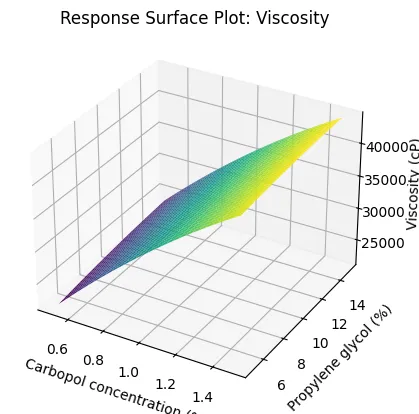
Fig- 1: Effect on viscosity
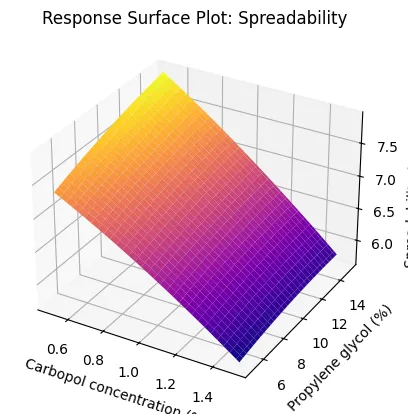
Fig- 2 :Effect on spreadability
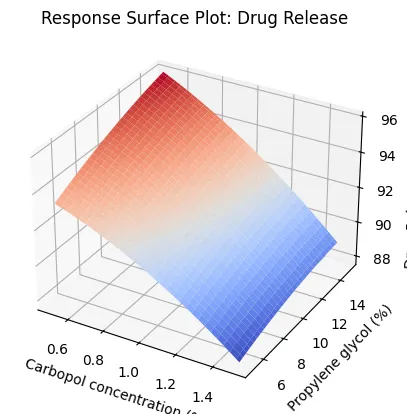
Fig-3 :Effect on drug release
Response surface analysis demonstrated that increasing Carbopol concentration significantly increased viscosity due to formation of a stronger polymeric network. However, excessive polymer concentration reduced spreadability and drug release by creating a dense gel matrix. Propylene glycol improved spreadability and drug diffusion due to its humectant and co-solvent properties. Triethanolamine played a critical role in neutralizing Carbopol and developing gel structure; its optimum concentration was necessary to obtain desired pH and viscosity.
Based on desirability function, the optimized nanoemulgel formulation contained 0.10 g Carbopol, 1.00 mL propylene glycol, and 0.04 mL triethanolamine. This composition provided balanced rheological properties, acceptable pH, excellent drug content, and sustained drug release profile.
4.5 Physicochemical Evaluation of Optimized Nanoemulgel
The optimized nanoemulgel was smooth, homogeneous, glossy in appearance, and free from grittiness or phase separation. Such characteristics indicate uniform incorporation of nanoemulsion within the gel matrix and good product elegance. The pH of the optimized formulation was found to be 6.04 ± 0.03, which is close to normal skin pH and therefore suitable for topical use without causing irritation.
The viscosity was recorded as 34,780 ± 210 cP, demonstrating sufficient consistency to remain localized at the site of application. Higher viscosity enhances retention time and minimizes runoff, especially when applied to curved or moist skin surfaces. Spreadability was found to be 6.79 ± 0.08 g·cm/sec, indicating easy application and uniform distribution over the affected area. Good spreadability is essential for patient compliance and effective dosing.
Extrudability was found to be 96.1 ± 0.7%, confirming that the formulation could be easily removed from collapsible tubes with minimum effort. Drug content was 98.52 ± 0.45%, indicating uniform drug distribution and reproducibility of the manufacturing process. These results collectively confirmed that the developed nanoemulgel possessed desirable pharmaceutical attributes for topical administration.
4.6 In Vitro Drug Release Study
The in vitro release study of the optimized nanoemulgel was carried out using Franz diffusion cell apparatus with dialysis membrane and phosphate buffer pH 7.4 as receptor medium. The formulation exhibited cumulative drug release of 92.10 ± 0.90% over 24 h, indicating prolonged and controlled release behavior. Initial release was moderate due to surface-associated drug, followed by sustained diffusion from the nanoemulsion droplets entrapped within the gel network.
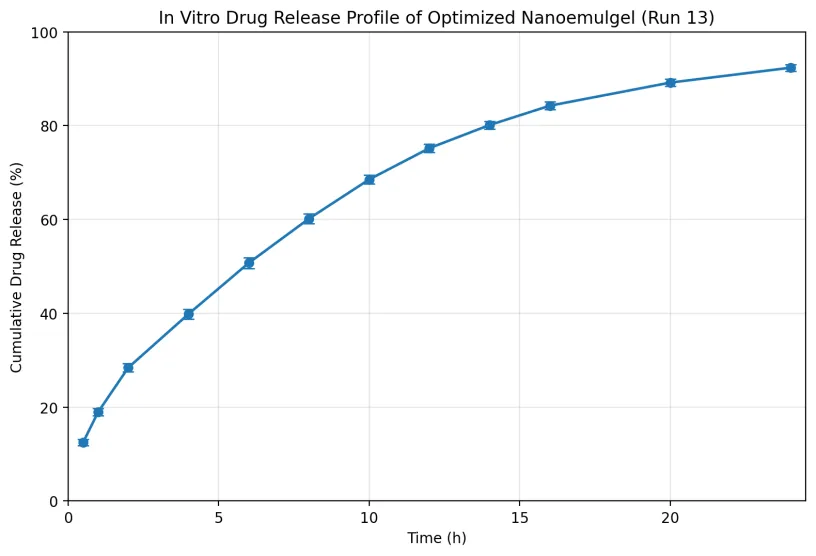
Fig-4: Invitro drug release profile of Optimized Nanoemulgel (Run 13)
Table-2: Drug release kinetics for optimized nanoemulgel (Run 13)
|
Kinetic model |
Equation used |
Regression value |
|
Zero-order |
Q vs t |
R² = 0.8987 |
|
First-order |
log (100 − Q) vs t |
R² = 0.9983 |
|
Higuchi model |
Q vs √t |
R² = 0.9846 |
|
Korsmeyer–Peppas model* |
log (Mt/M∞) vs log t |
R² = 0.9986 |
|
Hixson–Crowell |
cube root of drug remaining vs t |
R² = 0.9818 |
|
Weibull model |
ln[-ln(1−m)] vs ln t |
R² = 0.9913 |
*Korsmeyer–Peppas is usually applied to the initial ~60% drug release region.
The sustained release profile can be attributed to dual control mechanisms: first, miconazole had to partition from the internal oil droplets into the aqueous phase, and second, the released drug had to diffuse through the Carbopol gel matrix. This two-step release mechanism effectively prolonged drug availability at the application site and may reduce dosing frequency.
The superior performance of the developed formulation can be explained by the synergistic combination of nanoemulsion and gel technologies. Nano-sized droplets increased solubilization of poorly water-soluble miconazole and improved contact with the skin surface. Labrasol and Transcutol HP not only stabilized the nanoemulsion but also acted as permeation enhancers by modifying the lipid arrangement of the stratum corneum.
The Carbopol gel base provided structural integrity, increased viscosity, prolonged retention time, and sustained drug release. Compared with conventional creams and ointments, the nanoemulgel offered better spreadability, controlled release, non-greasy feel, enhanced patient convenience, and potential improvement in antifungal efficacy. Therefore, the developed miconazole-loaded nanoemulgel represents a promising advanced topical drug delivery system for effective management of superficial fungal infections.
窗体顶端
CONCLUSION
The present investigation successfully developed and optimized a miconazole-loaded nanoemulgel for topical antifungal delivery. The formulation demonstrated suitable physicochemical properties, sustained drug release, good spreadability, high drug content, and skin-compatible pH. The synergistic combination of nanoemulsion and gel technology significantly enhanced the formulation performance. Thus, miconazole nanoemulgel may serve as an effective alternative to conventional antifungal creams for superficial fungal infections.
REFERENCES



Enugala Akshitha, Dr. K. Anie Vijetha, Dr. M. Sunitha Reddy, Formulation Development, Optimization and Physicochemical Characterization of Miconazole-Loaded Nanoemulgel, Int. J. of Pharm. Sci., 2026, Vol 4, Issue 9, 3487-3497, https://doi.org/10.5281/zenodo.23010146
 10.5281/zenodo.23010146