

We use cookies to ensure our website works properly and to personalise your experience. Cookies policy
Department of Zoology, Government of Maharashtra, Ismail Yusuf College of Arts, Science and Commerce, Jogeshwari (E), Mumbai-60..
The study aimed to formulate a herbal cream from Tagetes erecta extract. All the ingredients used were extracted naturally, which are beneficial for our skin and also do not possess any adverse effects. These ingredients are rich in antioxidant properties, which help to protect the skin from free radical damage, which leads to premature ageing (fine lines & wrinkles). It also possesses anti-inflammatory, antiseptic, soothing, and healing. The herbal cream was prepared by the trituration method and further assessed for various parameters such as physical properties, determination of pH, viscosity, greasiness, stability test, etc. This formulation did not display any phase separation, and it was easily washable with tap water. The no-staining test for the cream obtained positive results, and it had uniform consistency. The result of the physical test suggests that the product can be further tested for human application. GoldenShield will provide softness, deep hydration, and natural radiance to skin. GoldenShield is enriched with powerful herbal actives that enhance skin tone, support collagen repair, and protect against daily environmental stressors.
Marigold, scientifically known as Tagetes erecta, is a widely used medicinal plant valued for its rich antioxidant and anti-inflammatory properties. The presence of bioactive compounds such as flavonoids, carotenoids, and essential oils makes marigold highly beneficial for skin health and protection.
Marigold extract plays a significant role in skincare formulations due to its ability to neutralize free radicals and reduce oxidative stress on the skin. It helps in soothing irritation, promoting wound healing, and improving overall skin texture. Its natural antiseptic and anti-inflammatory properties make it effective in treating acne, redness, and minor skin infections.
Incorporating marigold into antioxidant creams enhances skin hydration, supports repair of damaged skin, and protects against environmental stressors such as pollution and UV exposure. Being a natural ingredient, it is considered safe, gentle, and suitable for regular use, making it an ideal component in herbal cosmetic formulations.
In recent years, consumers have increasingly preferred herbal and natural skincare products due to concerns about synthetic chemicals causing irritation, allergies, or long-term skin damage. Plant-based ingredients are perceived as safer, eco-friendly, and beneficial due to their antioxidant, anti-inflammatory, and skin-soothing properties. Natural components such as Hibiscus rosa-sinensis, aloe vera, shea butter, Sandal wood, Carrot Oil and jojoba oil offer moisturizing and protective benefits, making them suitable for herbal cosmetic formulations.
Pharmacologically, the BPF also has anti-inflammatory, antioxidant, and antidiabetic activities. Flavonoids are found in almost all parts of the BPF including fruit, roots, leaves and outer bark of the stem. Antioxidants are substances that in low concentrations can neutralize free radicals by donating electrons so that free radicals become stable. Free radicals in high concentration in the absence of an effective antioxidant mechanism can cause extensive damage to cell structures. (Kusuma, N. R., Sulistyani, N., & Sugihartini, N. (2024)
MATERIAL AND METHOD
The Herbal herbal cream plant material used for the preparation of face cream is obtained from the college campus, Aloe Vera was collected from college medicinal garden and essential oil is also purchased from the local super market. All the other chemicals are available in the College laboratory.
Preparation of Tagetes erecta Extract:
Fresh Tagetes erecta flowers are washed to remove impurities and dried under shade at room temperature until moisture is completely removed, flower material with distilled water or ethanol in a ratio of approximately 1:10 (plant material : solvent). Filter the extract using filter paper or muslin cloth to remove plant residues. (Burange, P S. Nalawade, P. P., et al. (2025),Store the extract. The prepared extract is incorporated into the aqueous phase of the cream formulation during the preparation.
Formulation of Herbal Antioxidant Cream
The cream is prepared using four phases: oil phase, aqueous phase, active herbal phase, and cool-down phase.
|
Sr. No |
Ingredients |
Uses |
|
Oil Phase |
||
|
|
Emulsifying Wax |
Acts as an emulsifier to combine oil and water phases |
|
|
Shea Butter |
Provides deep moisturization and improves skin softness |
|
|
Jojoba Oil |
Helps in skin hydration and maintains oil balance |
|
|
Carrot Oil |
Rich in antioxidants and improves skin tone |
|
|
Vitamin E Oil |
Acts as an antioxidant and protects skin from damage |
|
Aqueous Phase |
||
|
|
Distilled Water |
Base of the formulation |
|
|
Glycerine |
Humectant that retains moisture in the skin |
|
|
Niacinamide |
Improves skin texture and reduces pigmentation |
|
Active Herbal Phase |
||
|
|
Aloe Vera |
Soothes and hydrates the skin |
|
|
Tagetes erecta |
Provides anti-inflammatory and antioxidant benefits |
|
|
Green Tea Extract |
Rich in polyphenols, protects against oxidative stress |
|
|
Hibiscus Flower Extract |
Promotes skin elasticity and anti-aging effects |
|
|
Turmeric Powder |
Acts as an antibacterial and brightening agent |
|
Cool Down Phase |
||
|
|
Phenoxyethanol |
Preservative to prevent microbial growth |
|
|
Sandalwood Fragrance |
Provides pleasant aroma |
Preparation of Herbal Face herbal creams:
Step 1: Preparation of Oil Phase (Phase A)
All lipophilic components, including Emulsifying Wax (5.0%), Shea Butter (3.0%), Cetearyl Alcohol (2.0%), Jojoba Oil (2.0%), and Carrot Oil (2.0%), were accurately weighed and transferred into a clean 250 mL borosilicate beaker. The mixture was heated on a thermostatically controlled water bath to 75°C. Heating was continued until all waxes and butters were completely melted and a clear, homogenous oily liquid was obtained. Turmeric(0.2%) is extracted in oil phase because in oil phase turmeric is not leave any stain. Vitamin E (0.5%) was added to this phase just before emulsification to prevent prolonged heat exposure.
Step 2: Preparation of Aqueous Phase (Phase B)
In a separate beaker, Distilled Water (61.5%) , Glycerin (5.0%), Marigold Extract (3.0%),Aloevera Gel (10.0%), , Hibiscus flower Extract (3.0%), and Green Tea Extract (3.0%)were mixed and heated to the same temperature of 75°C. Maintaining an identical temperature between both phases is critical to prevent the premature crystallization of waxes during the mixing process.
Step 3: Emulsification (Formation of the Base)
The heated Aqueous Phase (Phase B) was added slowly, in a continuous stream, to the Oil Phase (Phase A) while maintaining constant high-speed stirring (approx. 1200–1500 rpm) using a mechanical stirrer or a glass rod. The high-shear mixing facilitates the reduction of oil globule size, leading to the formation of a stable Oil-in-Water (O/W) emulsion. Stirring was continued as the mixture gradually cooled.
Step 4: Integration of Herbal Actives (Phase C)
Once the emulsion temperature dropped to 45°C – 50°C (the “warm” stage), the bioactive herbal components – Aloe Vera Gel (10.0%), Marigold Extract (3.0%), Green Tea Extract (3.0%), and Hibiscus Extract (3.0%) – were introduced. Turmeric Powder (0.2%) was pre-dispersed in a small amount of glycerin to avoid clumping and then incorporated into the bulk. This temperature-sensitive addition ensures that the phytochemical constituents (flavonoids, polyphenols) do not undergo thermal degradation.
Step 5: Cool-Down and Preservation (Phase D)
As the lotion reached the cool-down stage (below 40°C), the preservative Phenoxyethanol (0.8%) and Fragrance (0.5%) were added. Stirring was maintained at a lower speed until the formulation reached room temperature, resulting in a smooth, uniform, and aesthetically pleasing poly-herbal moisturizing lotion
RESULT AND DISCUSSION
The formulated herbal cream was evaluated for colour, odour, and consistency. The colour was assessed visually and found to be pale orange, characteristic of marigold extract. The odour of the cream was pleasant due to the addition of sandalwood fragrance. The physical state of the formulation was examined visually and observed to be semisolid in nature, suitable for topical application. Consistency was evaluated by manual application on the skin, and the formulation exhibited a smooth, non-greasy, and easily spreadable texture, indicating good emulsification and stability.
|
Sr. No. |
Characteristics |
Formulation |
|
|
Colour |
Orange |
|
|
Odour |
Pleasant |
|
|
State |
Semisolid |
|
|
Consistency |
Smooth |
The pH of the Orange Marigold flower cream was determined using a calibrated digital pH meter. For analysis, 1 mL of the sample was diluted with 9 mL of distilled water to obtain a uniform dispersion. The pH electrode was then immersed in the prepared sample, and the pH value was recorded after the reading stabilized, (Nuraini, A., & Naila, F. (2025).
The measurement was carried out in triplicate to ensure accuracy and reproducibility, and the mean pH value was calculated. The average pH of the formulation was found to be 5.3, which falls within the acceptable range for topical skin applications, indicating its suitability for use on the skin.
The prepared Cream was transferred in a suitable wide mouth container. Set aside for storage the oil phase and aqueous phase separation were visualizing after 24h.
|
Sr. no |
Formulation |
Phase Separation |
|
01. |
Cream |
No Phase separation |
Formulation was applied on the skin and then ease extends of washing with water was checked.
|
Sr. no |
Formulation |
Washability |
|
01. |
Cream |
Easily washable |
Emolliency, slipperiness, and the amount of residue left after applying a fixed quantity of cream were evaluated, and the formulation was found to leave the skin feeling smooth and hydrated.
|
Sr. no |
Formulation |
After feel |
|
01. |
Cream |
Good |
Herbal Cream formulation was evaluated for the non-irritancy test. Preparation shown no redness, inflammation and irritancy. Observation of the state was done for 24 h.
|
Sr. no |
Formulation |
Result |
|
01. |
Cream |
Non-irritancy |
Approximately 1 mL of the formulated cream was taken in a test tube and diluted with 5 mL of distilled water to obtain a uniform solution. Subsequently, 2–3 drops of dilute sodium hydroxide (NaOH) solution were added slowly using a dropper, and the mixture was gently stirred with a glass rod, (Thuy, N. M., et al..(2021). The solution retained its characteristic colour, indicating the presence of anthocyanins derived from flower extract in the formulation.
The presence of flavonoids was assessed using the alkaline reagent test. The extract was treated with a few drops of sodium hydroxide solution, resulting in the formation of an intense yellow coloration. Upon the subsequent addition of dilute acid, the yellow colour disappeared, confirming the presence of flavonoids in the formulation.
Phenolic compounds were detected using the ferric chloride test. The extract was treated with 3–4 drops of ferric chloride solution. The appearance of a cream’s solution indicated the presence of phenolic compounds.
The Salkowski test was carried out to determine the presence of terpenoids in the herbal formulation. Approximately 2 mL of the extract was mixed with chloroform, followed by the careful addition of concentrated sulfuric acid along the wall of the test tube to form a distinct lower layer. The development of a reddish-brown ring at the junction of the two layers indicated the presence of terpenoid compounds.
d) Detection of Saponins (Foam Test):
Saponins were evaluated using the foam test. Approximately 0.5 g of the extract was shaken vigorously with 2 mL of distilled water. The formation of persistent foam lasting for about 10 minutes confirmed the presence of saponins.
The results of the phytochemical screening revealed that flavonoids, phenols, and saponins were present in the Formulation of Herbal Antioxidant Cream, indicating its rich phytochemical composition.
|
Sr. no |
Test |
Result |
|
|
Flavonoids |
Present |
|
|
Phenols |
Present |
|
|
Saponins |
Present |
|
|
Terpenoids |
Present |
CONCLUSION
The findings of the present study demonstrate that GoldenShield, a polyherbal skin cream formulated with Tagetes erecta, Aloe vera, Hibiscus rosa-sinensis, Camellia sinensis, Curcuma longa, and Santalum album oil, possesses desirable qualities for topical skincare applications. Phytochemical investigations confirmed the presence of important secondary metabolites, including flavonoids, phenolic compounds, saponins, terpenoids, and santalol, which are associated with antioxidant, anti-inflammatory, antimicrobial, and skin-conditioning activities. The combination of these herbal ingredients provides a natural approach to skin nourishment, protection, and regeneration.
The formulated cream exhibited satisfactory physicochemical properties, including uniform consistency, appropriate pH, good spreadability, ease of washability, and physical stability throughout the evaluation period. These characteristics indicate that the formulation is suitable for topical use and has the potential to serve as an effective herbal cosmetic. Although the preliminary results are encouraging, further studies involving long-term stability, microbiological quality assessment, dermatological safety, and clinical evaluation are necessary to validate its therapeutic performance and support its future development as a commercially viable natural skincare product.
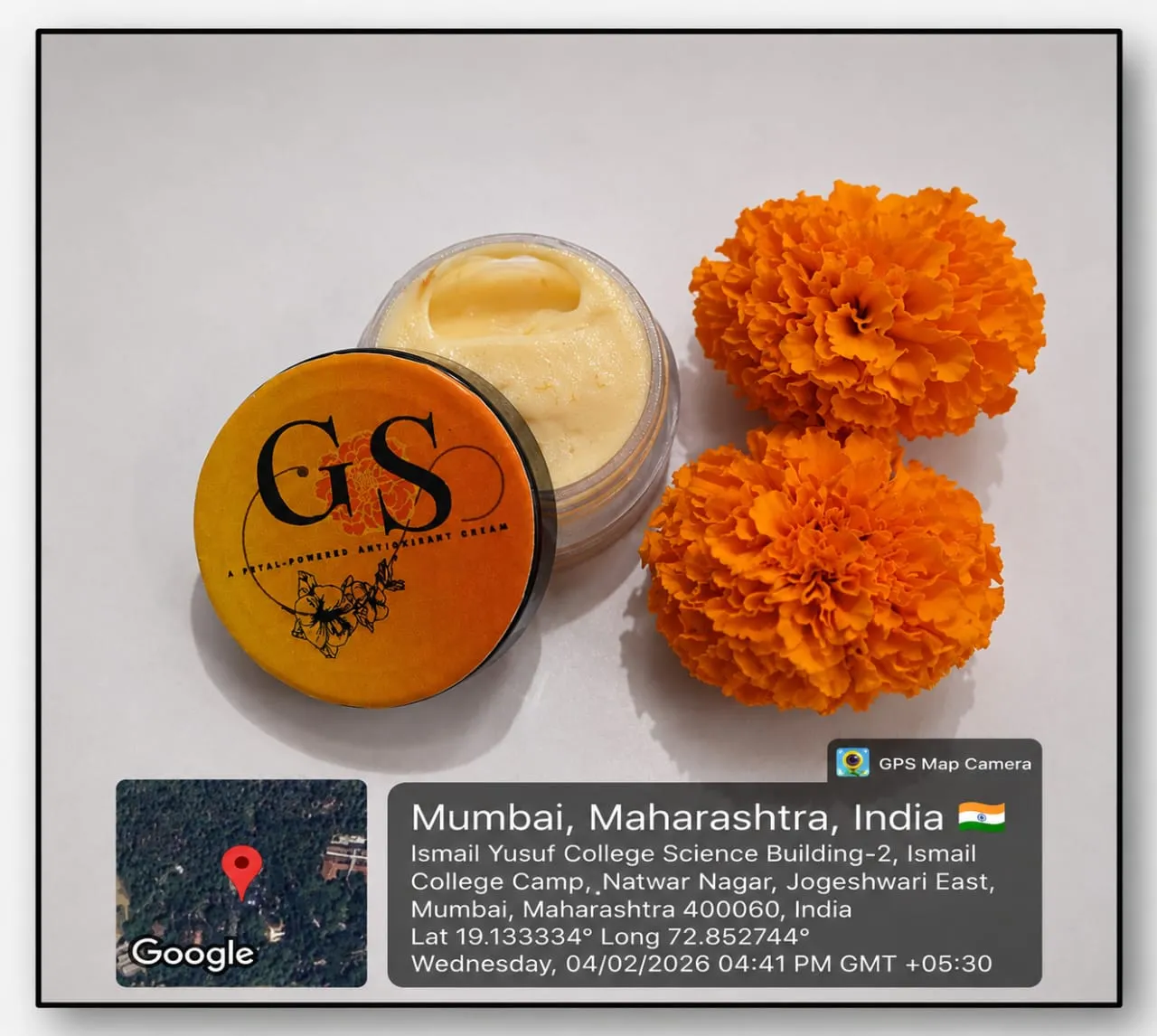
GoldenShield: A Petal-Powered Antioxidant Cream
ACKNOWLEDGEMENT
I would like to express my sincere gratitude to the Principal of the Ismail Yusuf College, Dr. Swati Wavhal, for providing the opportunity to undertake the present research work and for her encouragement and institutional support.
I am deeply thankful to the Head of the Department of Zoology, Dr. G. T. Kedar, for granting permission to carry out the laboratory experiments and for providing the necessary facilities required for this study. I also extend my sincere thanks to Dr. Ulka P. Aade for her valuable assistance in arranging the required chemicals and laboratory materials essential for the successful completion of the experimental work.
I would like to acknowledge with great appreciation the guidance, continuous support, and encouragement provided by my research guides, Ms. Akisha Sayed and Ms. Priyanka Jha, whose valuable suggestions, supervision, and moral support were instrumental throughout the research work and preparation of this manuscript.
I also express my sincere thanks to the laboratory assistants of the Department of Zoology for their cooperation and technical assistance during the experimental procedures. Finally, I am grateful to all those who contributed directly or indirectly to the successful completion of this research work.
REFERENCES


Dr. Ulka Aade, Ghanshyam Kedar, Akisha Irfan Sayed, Priyanka Jha, Sandhya Jaiswal, Nashra Bano, GoldenShield: A Petal-Powered Antioxidant Cream, Int. J. of Pharm. Sci., 2026, Vol 4, Issue 7, 5108-5114, https://doi.org/10.5281/zenodo.21622851
 10.5281/zenodo.21622851