

We use cookies to ensure our website works properly and to personalise your experience. Cookies policy
Lee pharma Limited, Visakhapatnam 531001, Andhra Pradesh, India.
The industrial-scale handling of azide compounds presents severe process safety challenges due to the rapid generation of highly volatile, toxic, and potentially explosive hydrazoic acid HN3 Gas. This paper establishes a rigorous chemical engineering framework for the design and sizing of an emergency relief venting system during a batch reactor emission event involving triethylammonium chloride and sodium azide. Stoichiometric mass balance evaluation identifies sodium azide as the strictly limiting reactant, limiting the maximum theoretical yield of volatile HN3 to 1.107 kmol (47.62 kg). showing that a critical density drops to 1.42 Kg/m3 at elevated temperatures dictates the maximum volumetric displacement. By constraining the maximum allowable relief velocity to 15 m/s to limit backpressure, fluid-dynamic sizing formulations were utilized to determine the minimum cross-sectional area. The engineering analysis demonstrates that a 4-inch nominal diameter vent line is required to safely discharge the peak volumetric flow without risking vessel over pressurization. This study provides a scalable, standardized baseline for loss prevention and safety relief design in hazardous azide-based batch manufacturing operations.
BACKGROUND
In modern organic synthesis and pharmaceutical manufacturing, azide-mediated reactions serve as a critical synthetic pathway for the production of primary amines, heterocycles, and energetic compounds. A common industrial route involves the nucleophilic substitution or proton-transfer reaction between triethylammonium chloride (C2H5)3NH+ Cl- and sodium azide NaN3. While synthetic utility remains high, the unintended or deliberate acidification of azide salts inherently hazards the generation of hydrazoic acid HN3 also known as hydrogen azide. Under ambient or elevated processing temperatures, HN3 vaporises readily due to its low boiling point of 37°C evolving from the liquid phase as a highly volatile gas.
1.2 Problem Statement
The generation of gas-phase HN3 introduces profound operational risks to chemical manufacturing facilities. Characterised by extreme acute toxicity (with an OSHA permissible exposure limit of 0.1 ppm), escaping vapours present severe occupational health hazards to plant personnel. Furthermore, gaseous HN3 is thermodynamically unstable and prone to violent, autoxidative exothermic decomposition or detonation when exposed to mechanical shock, elevated temperatures, or concentrated vapor phases. In a sealed or poorly vented batch reactor system, a runaway gas evolution event can cause rapid, uncontrolled vessel over pressurization. Such pressure accumulations threaten structural catastrophic failure, resulting in Loss of Primary Containment (LOPC), toxic clouds, or secondary industrial explosions. To mitigate these hazards, process engineers must install robust emergency relief systems (ERS) or process vent lines capable of handling worst-case volumetric vapor loads. However, sizing calculations must be precisely tailored; undersized venting lines induce excessive backpressure and vessel rupture, while oversized systems cause unnecessary capital expenditure and complicate downstream gas abatement systems
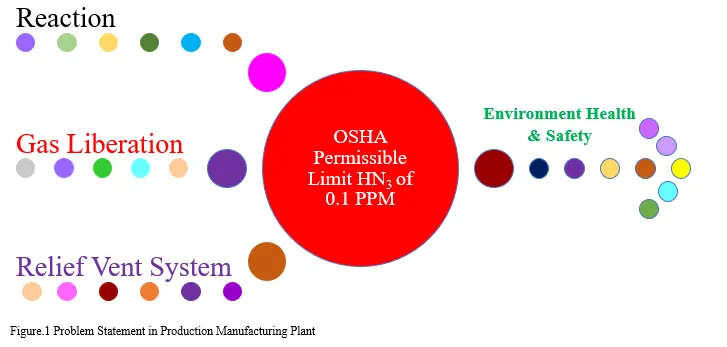
Figure 1: Problem Statement in Production Manufacturing Plant
1.3 Objective of our work
This study presents a standardized, quantitative framework to accurately evaluate, size, and validate process vent geometries during a critical gas evolution event. Using empirical process metrics from a defined batch operation, the specific technical objectives are to Identify the precise mass and molar limitations of the multi-component reaction mixture to avoid over-conservative calculations. Model the fluid density changes of volatile HN3 across an operational thermal spectrum 55°C to 95°C.Derive the minimum cross-sectional vent area and nominal pipe diameter required to maintain peak relief velocities below standard backpressure thresholds 15 m/s By resolving the core stoichiometry and physical transport parameters, this paper provides a clear roadmap for engineers seeking to comply with industrial safety standards, such as API RP 520 and DIERS methodologies, for hazardous volatile acids.
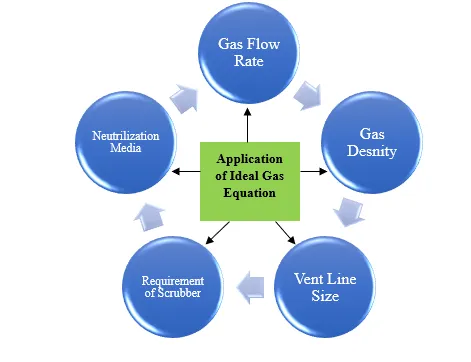
Figure 2: Objective of Our Work from Application of Ideal Gas Equation
1.4 Importance of Ideal Gas Law in Industrial gas Evolution Estimation
The Ideal Gas Law is a fundamental relationship in chemical engineering used to estimate the pressure, volume, temperature, and molar quantity of gases under specified operating conditions. It is expressed as (PV=n×R×T), where (P) represents absolute pressure, (V) is gas volume, (n) is the number of moles, (R) is the universal gas constant, and (T) is absolute temperature. This equation provides a practical mathematical framework for evaluating gas generation and predicting changes in gas volume and density during industrial chemical processes. In pharmaceutical and chemical manufacturing, gas evolution may occur as a result of chemical reactions, thermal decomposition, or changes in phase equilibrium. Estimating the quantity and physical properties of the generated gas is important for material-balance calculations, process monitoring, equipment design, and preliminary hazard assessment. By combining the Ideal Gas Law with stoichiometric calculations, engineers can estimate the theoretical gas inventory and evaluate how variations in temperature and pressure influence gas density and volumetric expansion. In the present study, the Ideal Gas Law is considered as a preliminary engineering tool for evaluating the temperature-dependent density of hydrazoic acid (HN₃) vapor under specified conditions. The estimated gas properties provide a basis for understanding the relationship between theoretical gas generation and volumetric flow. Such information can support the initial evaluation of gas-handling requirements in industrial batch operations. However, the Ideal Gas Law describes the thermodynamic relationship of a gas and does not independently predict reaction kinetics, the instantaneous rate of gas generation, or the pressure developed during an emergency event. Its application to hazardous reactive systems must therefore be complemented by appropriate thermodynamic data, reaction-rate information, and a comprehensive process-safety assessment. Accordingly, the present work uses the Ideal Gas Law as a preliminary calculation method rather than as a standalone method for validating emergency relief-system design.
2. Chemical Kinetics and Mass Balance
2.1 Reaction Stoichiometry
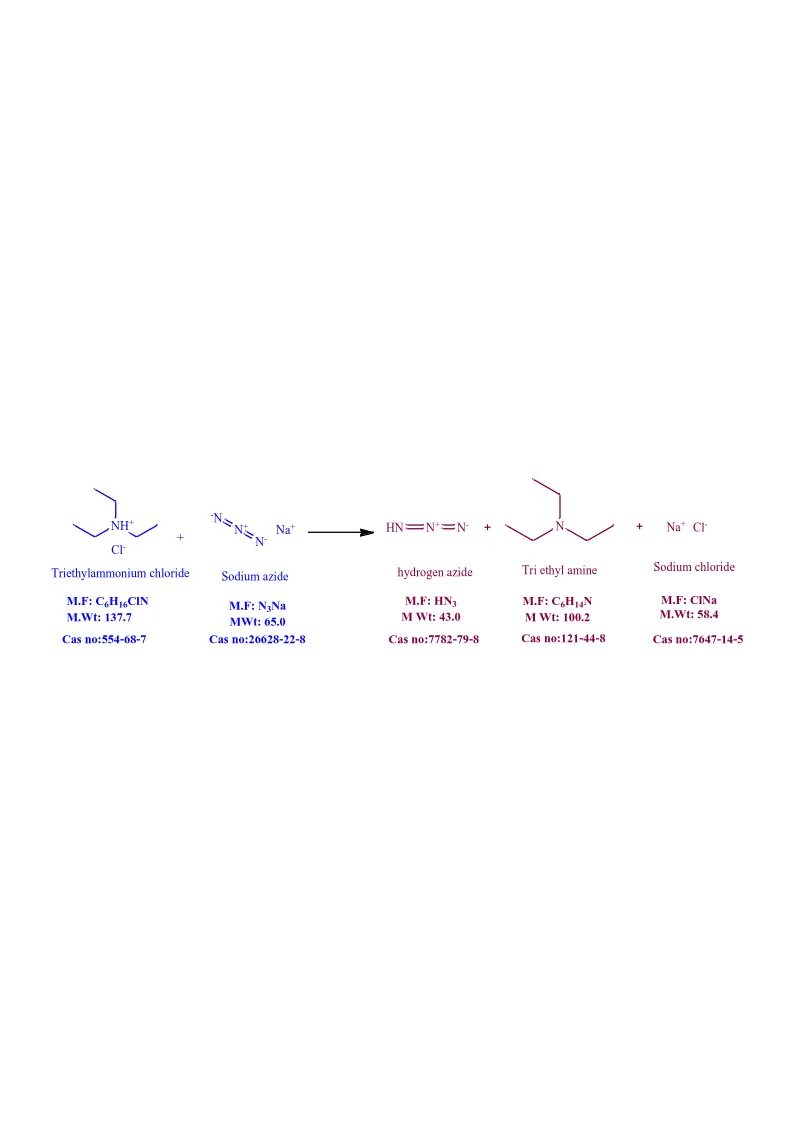
(C2H5)3NH+Cl- (aq) + NaN3-(aq) HN3(g) + (C2H5)3N+ + Nacl
Thermodynamic properties are Considered as a Safety Module. Before an explosion we Must Take a Safety precautionary Action. The Major Issue in This Tetrazole Formation is Liberation of Hydrazoic Acid (HN3) Gas with highly Volatile and ready to Vaporizes into Colourless Gases [6].
Molecular weight=43.03g/mol
Boiling Point: 37°C
Melting point: -80°C
Density: 1.09 g/cm3 at 25°C
Standard Enthalpy of Formation (Δ f H): +294 kj/mol
This highly positive heat of formation indicates that the molecule is thermodynamically unstable
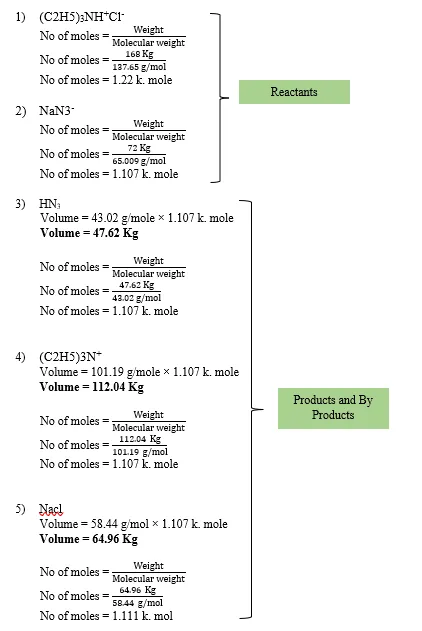
2.2 Material Balance
METHODOLOGY
3.1 Gas Flow Rate
To size the relief system effectively, the mass flow rate (W) of the escaping gas must be determined. This represents the source term for the safety relief system. In industrial batch operations where, transient kinetic data is unavailable, process engineers apply a conservative, steady-state peak release assumption over the observed reaction window. The total mass of liberated hydrazoic acid HN3 gas is evaluated over a worst-case generation timeframe (t) of 5 minutes (300 seconds).
Mass Release Rate (W) = (47.62 Kg)/(5 min)
Mass Release Rate (W) = 9.52 kg/min
Mass Release Rate (W) = 0.1586 kg/sec
3.2 Gas Density by using Ideal gas Equation
To transition the mass flow kinetics into a structural volumetric release matrix, the physical state and density (∫) of the evolved hydrazoic acid HN3 vapor must be quantified. Because process conditions operate near standard atmospheric pressures, intermolecular attractions are negligible, allowing the vapor behaviour to be accurately characterized using the Ideal Gas Equation of State
Gas Density at 95°C:
PV = n × R × T
P = m/V× RT/M
∫ = (P×M)/(R ×T)
∫ = (101,325 ×43.02)/(8314 ×(273+95°c) K)
∫ = 1.42 kg/m3
Gas Density at 55°C:
PV = n × R × T
P = m/V× RT/M
∫ = (P×M)/(R ×T)
∫ = (101,325 ×43.02)/(8314 ×(273+55°c) K)
∫ = 1.59 kg/m3
Gas Density at 45°C:
PV = n × R × T
P = m/V× RT/M
∫ = (P×M)/(R ×T)
∫ = (101,325 ×43.02)/(8314 ×(273+45°c) K)
∫ = 1.64 kg/m3
Gas Density at 35°C:
PV = n × R × T
P = m/V× RT/M
∫ = (P×M)/(R ×T)
∫ = (101,325 ×43.02)/(8314 ×(273+35°c) K)
∫ = 1.70 kg/m3
[Figure - see the formatted PDF]
3.3 Vent Size Calculation
To translate these volumetric profiles into a physical pipe diameter, the fluid velocity must be structurally constrained. In accordance with industrial gas venting guidelines (such as API RP 521), the maximum linear relief velocity (V) is limited to 15 m/s to prevent acoustic choking, excessive piping friction, and dangerous backpressure accumulation inside the reactor vessel.
Volumetric Flow Rate (Q) = W/∫
Volumetric Flow Rate (Q) = 0.1116 m3/sec
Calculate Minimum Vent Area
Area (A) = Q/V
Area (A) = 0.00744 m2
Calculate Diameter of Vent Line
Area (A) = π/4 D2
D = √(4 ×Area /π)
D = 0.09735 m × 1000
D = 97.35 mm / 25.4
D = 3.83”
Vent size = approximately 4” is Required this evolution of HN3 Gas.
3.4 Requirement of Scrubber
Flowrate Estimation is m=0.1586 Kg/sec and gas Density is Calculated by using Ideal Gas equation is ρ=1.42 Kg/m3
Calculation: Q=m˙/ ρ
Q = 0.1586 Kg/sec / 1.42 Kg/m3
Q = 0.1116 m3/sec
Then Convert into Kg/sec:
Q = 0.1116 Kg/Sec × 3600
Q = 397 m3/Hour
Then Convert into CFM:
CFM= 397 m3/Hour × 0.588
CFM = 233.43
Then finally we Have requirement of 233 CFM of Scrubber
3.5 NaOH Requirement:
HN3 + NaOH NaN3 + H2O
Moles of HN3:
n = 47000 g/43.03 g/mol
n = 1092.26 mol
NaOH Required = 1092.26 mol × 40 g/mol
NaOH Required =43680 g.
Convert in Kg’s is 43.68 Kg’s
Here I Take 25% if Excess Quantity
Required Quantity= 43.68 kg × 1.25
Required Quantity NaOH= 54.6 Kg’s
3.6 Estimation of Lye Solution Volume in Scrubber:
Generally, in Industrial Cases we prepare 10% of NaOH Solution.
Required Quantity of NaOH= 54.6 Kg’s
Solution Required = 54.6 /0.10
Solution Required = 546 kg’s
Since the Density = 1.11 kg/L
Solution Volume (V) = 546 kg/1.11 kg/L
Solution Volume (V) = 491.85 L
Here Recommendation is
500 L of 10 wt.% NaOH solution
3.7 Temperature Contribution Towards Raise in Pressure
P V = n × R × T = P1/T1=P2/T2
P2 = P1 × T2/T1
Initial Absolute Pressure (P1) = 101.325 kPa
Initial Temperature T1 = 55°C = 55+273.15 K = 328 K
Final Temperature T2 = 95°C + 273.15 K = 368.15 K
P2 = (101.325 kPa × (368.15 / 328.15))
P2 = 113.67 kPa
Then Finding the Pressure raise
Δ P = 113.67 kPa - 101.325 kPa
Δ P = 12.35 kPa
Convert kPa into Kg/cm2
1 Kg/cm2 = 98.0665 kPa
Pressure = 12.35/98.066 = 0.126 Kg/cm2 from 55°C to 95°C
| Final Temperature | Final Absolute Pressure | Pressure Increase |
|---|---|---|
| 65°C | 104.41 kPa | 3.08 kPa |
| 75°C | 107.49 kPa | 6.16 kPa |
| 85°C | 110.58 kPa | 9.25 kPa |
| 95°C | 113.67 kPa | 12.35 kPa |
RESULTS AND DISCUSSION
4.1 Stichometry analysis and Theoretical gas Generation
The stoichiometric analysis was performed to estimate the theoretical quantity of hydrazoic acid (HN₃) that could be generated from the reaction mixture containing triethylammonium chloride and sodium azide. Based on the quantities reported in the material balance, triethylammonium chloride was present at approximately 1.22 kmol, whereas sodium azide was present at approximately 1.107 kmol. Assuming a 1:1 molar reaction stoichiometry, sodium azide was identified as the limiting reactant. The theoretical maximum quantity of HN₃ corresponding to complete conversion of 1.107 kmol of sodium azide is approximately 1.107 kmol. Using a molar mass of 43.03 kg/kmol, the corresponding theoretical mass is approximately 47.62 kg. This value represents the maximum stoichiometric inventory under the assumed reaction pathway and complete conversion conditions. It does not establish the actual quantity released to the gas phase, which depends on reaction kinetics, phase equilibrium, and operating conditions. The material balance therefore provides a preliminary estimate of the potential HN₃ inventory. The assumptions concerning reaction completion, competing reactions, and the chemical form of the products should be verified experimentally or through validated process data before the theoretical quantity is used in a safety assessment.
| Reactants | Products | |||||
|---|---|---|---|---|---|---|
| Parameter | (C2H5)3NH+Cl- | NaN3 | HN3 | (C2H5)3N | Nacl | |
| Weight | 168 Kg | 72 Kg | 47.62 Kg | 112.04 Kg | 64.28 Kg | |
| Molecular Weight | 137.65 g/mol | 65.009 g/mol | 43.02 g/mole | 101.19 g/mole | 58.44 g/mole | |
| No. of Moles | 1.22 k. mole | 1.107 k. mole | 1.10 k. mole | 1.10 k. mole | 1.10 k. mole | |
| Volume | - | - | 1.10 k/mole × 43.02 g/mole | 1.10 k.mole × 101.19 g/mole | 1.10 k. mole × 58.44 g/mole | |
4.2 Temperature Dependence of Gas Density
The ideal gas equation of state was used to examine the relationship between temperature and the density of HN₃ vapor. The gas density was calculated using the following expression
∫ = (P×M)/(R ×T)
where is ∫ gas density, (P) is absolute pressure, (M) is molar mass, (R) is the universal gas constant, and (T) is absolute temperature. At constant pressure, the ideal gas equation predicts an inverse relationship between gas density and absolute temperature. Consequently, increasing the temperature decreases the density of a fixed quantity of gas and increases its specific volume. This relationship is important when evaluating gas-phase inventories and understanding the volumetric consequences of vapor generation. The density values reported in the initial calculations are approximately 1.70 kg/m³ at 35°C, 1.64 kg/m³ at 45°C, 1.59 kg/m³ at 55°C, and 1.42 kg/m³ at 95°C. These values show the expected qualitative trend of decreasing density with increasing temperature. However, the numerical values require verification against a consistent absolute-pressure assumption. At a fixed pressure of 1 atm, using a molar mass of 43.03 g/mol, the ideal-gas densities are approximately 1.67 kg/m³ at 35°C, 1.62 kg/m³ at 45°C, 1.56 kg/m³ at 55°C, and 1.38 kg/m³ at 95°C. These calculations demonstrate the importance of specifying temperature and pressure when estimating gas density. The ideal gas model provides a useful first approximation, but it does not account for chemical decomposition, non-ideal behaviours, condensation, or the effects of a reactive gas mixture. Its applicability must therefore be assessed against the actual process conditions.
4.3 Estimation of Gas release Rate
The theoretical HN₃ mass was considered over an assumed release interval of five minutes (300 seconds). Based on a theoretical mass of 47.62 kg Substitution of the stated values gives an average mass release rate of approximately 0.1587 kg/s, equivalent to 9.52 kg/min. This result represents an assumed average rate rather than a measured or validated peak generation rate. In batch chemical operations, gas generation may be transient and strongly dependent on reaction kinetics, heat transfer, mixing, pressure, and the chemical environment. The actual instantaneous release rate may therefore differ substantially from the average value. For this reason, the five-minute interval should be identified as a modelling assumption rather than an established reaction characteristic. A defensible emergency-relief assessment requires a justified worst-case source term based on credible process scenarios and suitable experimental or validated kinetic data.
REFERENCES



Srikanth Reddy Jonnala, Ranjith Kumar Patnala, Ravindra Chitturi, Srinivas Satti, Jagadeeshwarao Bora, Naidu Dwarapureddi, Mahesh Bevera, Ideal Gas Law Based Assessment of Gas Generation and Pressure Raise in Industrial Scale, Int. J. of Pharm. Sci., 2026, Vol 4, Issue 11, 2931-2938. https://doi.org/10.5281/zenodo.24333219
 10.5281/zenodo.24333219