
View Article

Abstract

How an orally dosed small-molecule drug is absorbed depends heavily on its chemical makeup and the body's digestive environment. A key challenge is the difference between fed and fasted states: eating alters gut transit times and complicates oral absorption estimates, making food-effect studies necessary across every Biopharmaceutics Classification System (BCS) category. Food intake sets off major gastrointestinal changes—shifting stomach and bowel pH, slowing gastric emptying, boosting bile release, and increasing blood flow to the liver and gut.Although these physiological shifts directly dictate how well a drug dissolves and enters circulation, dietary influences are still routinely overlooked and under-researched. Physiologically based pharmacokinetic (PBPK) simulations bridge this gap by modeling drug disposition under fed and fasted conditions alongside intrinsic properties like permeability and solubility.This paper surveys existing literature on PBPK models built to capture food effects, weighing their core capabilities, current flaws, and areas for refinement. Today's models struggle most with anticipating reduced absorption (negative food effects) and mapping outcomes in children. Improving these computational tools will yield a clearer mechanistic understanding of feeding-related drug variations and significantly improve oral formulation development.

Keywords

Diet-drug interactions, physiologically based pharmacokinetic (PBPK) simulation, gastrointestinal drug uptake, computational pharmacokinetic modeling

Introduction

× Popup Image

Oral delivery remains the preferred method of drug administration owing to its affordability, convenience, and superior patient adherence. However, predicting in vivo oral pharmacokinetics continues to be challenging due to substantial variability both within and between individuals, which directly influences drug bioavailability and clinical outcomes. While baseline oral absorption is initially determined by intrinsic physicochemical properties—principally solubility and intestinal permeability—it is also heavily modulated by dynamic gastrointestinal physiology, such as pH fluctuations, gastrointestinal motility, mesenteric blood flow, and bile secretion.

Because normal gastrointestinal homeostasis directly governs absorption, dietary intake represents a major source of pharmacokinetic variability. Standard meal patterns can dictate both the timing and scheduling of oral dosing. Under regulatory standards established by the FDA, the fasted state requires an overnight fast of at least 10 hours with no food consumed for 4 hours post-dose. Conversely, the fed state follows the same overnight fast but requires a meal within 30 minutes prior to administration, followed by a 4-hour post-dose fasting window. Concurrent food intake can significantly shift drug exposure: elevated absorption may improve efficacy but elevates the risk of concentration-dependent toxicity, whereas impaired absorption lowers systemic bioavailability and risks therapeutic failure. While ideal drug candidates would display meal-independent absorption to simplify regimens, many require strict adherence to fed- or fasted-state administration.

To evaluate these interactions, preclinical and clinical pharmacokinetic trials assess whether meal-associated effects are clinically significant. Historically, poor pharmacokinetic characterization has caused high attrition rates in drug pipelines, resulting in substantial financial losses. Early translational approaches relied heavily on allometric scaling to bridge preclinical in vitro and in vivo findings to first-in-human trials; however, allometry fails to account for critical interspecies variations in drug transporters and metabolic enzyme kinetics. Consequently, pharmacokinetic assessment has transitioned from empirical, non-compartmental analyses toward mechanistic physiologically-based pharmacokinetic (PBPK) modeling. PBPK platforms now play an integral role across the drug development continuum—from early candidate selection through Phase III trials—to robustly evaluate efficacy and clinical safety.

Physiologically based pharmacokinetic (PBPK) frameworks replicate biological systems through linked anatomical compartments representing specific organs and tissues integrated via blood flow. These mathematical platforms mechanistically model the full ADME continuum (absorption, distribution, metabolism, and excretion). Available commercial software ranges from ready-to-use, standardized templates to customizable architectures; effectively evaluating their a priori projections requires evaluating each platform's built-in mathematical assumptions.

Model execution relies on drug-specific physicochemical and biochemical inputs, including molecular weight, lipophilicity (\log P), acid-base dissociation (\mathrm {p}K_\mathrm {a}), particle size, aqueous solubility, and intrinsic metabolic clearance. Sourced from in vitro screens, preclinical assays, or empirical literature, these parameters allow researchers to simulate diverse clinical contexts, produce plasma concentration–time curves, and derive key pharmacokinetic parameters like absorption kinetics and total elimination. Consequently, these simulations inform formulation optimization for pharmaceutical scientists and direct dosing strategies throughout Phase I–III trials. Beyond standard kinetics, PBPK platforms are widely utilized to anticipate liabilities such as food effects and drug–drug interactions (DDIs). With regulatory bodies increasingly accepting PBPK data for clinical filings, assessing the scope, utility, and limitations of existing models has become essential across pharmaceutical science and regulatory domains. This review examines the physiological mechanisms underlying food effects and evaluates the performance of PBPK modeling in predicting meal-induced changes in human oral drug bioavailability.
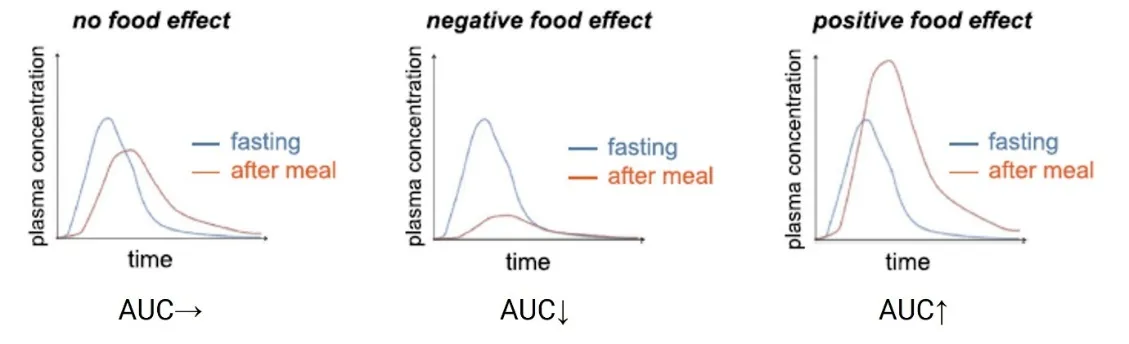
figure

Systemic exposure following oral dosing is compared across prandial states.

Impacts of Food Consumption on Physiological Processes and Oral Drug Absorption :

Fasted gastric physiology is defined by high acidity (pH 1.0–3.0) and low fluid volume (~250 mL). Ingestion transforms food into chyme, accompanied by a transient, meal-dependent buffering effect that shifts average baseline pH from 1.88 to 4.98 for up to 4.5 hours. Concurrently, intra-gastric volumes expand beyond 500 mL, displaying hydrodynamics governed by caloric density and lipid fraction.

These environmental shifts dictate the ionization state, solubility limits, and dissolution behavior of ionizable pharmaceuticals. Proximal gastric receptive relaxation accommodates the meal, whereas coordinated antral shearing emulsifies larger particulates. This activity replaces fasted Migrating Motor Complex (MMC) housekeeping waves with continuous postprandial motility, extending gastric emptying times and metering chyme delivery into the duodenum.

Within the small intestine, luminal pH remains buffered between 6.0 and 8.0, with fluid volume rising from 200 mL up to 1000 mL. This luminal environment depends on synchronized gastric emptying, bicarbonate-rich pancreatic secretions, and biliary flow.
figure

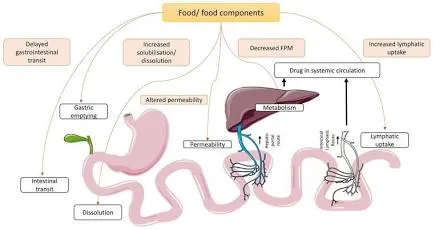
Gallbladder discharge raises luminal bile salt concentrations from resting levels (2–5 mM) to postprandial ranges (10–20 mM). When mixed with dietary lipids and lipolytic products (2-monoglycerides, free fatty acids), these surfactants assemble into mixed micelles and colloidal vesicles. This supramolecular restructuring elevates the luminal solubility and dissolution rate of poorly soluble, lipophilic drugs (BCS Classes II and IV), driving a classic positive food effect.

Mechanistic pathways governing food effects on oral drug absorption and bioavailability.

Concurrent physiological alterations further modulate oral pharmacokinetics:

  • Viscous Resistance and Diffusional Retardation: The pseudoplastic consistency of chyme raises hydrodynamic resistance compared to fasted luminal water. Per the Stokes–Einstein equation (D∝1/η), increased viscosity lowers drug diffusion coefficients and attenuates convective mixing, limiting transport across the unstirred mucosal water layer.
  • Splanchnic Perfusion and Reduced First-Pass Clearance: Splanchnic and portal blood flow increases by 30% to 100% postprandially. For highly cleared substrates, accelerated hepatic blood flow can saturate local metabolizing enzymes, lowering presystemic extraction and increasing systemic exposure (AUC).
  • Transporter and Enterocytic Enzyme Interference: Nutrients and lipid breakdown products can competitively inhibit or suppress enterocyte efflux pumps (P-gp/ABCB1, BCRP/ABCG2) and cytochrome P450 3A4, improving mucosal permeability and increasing the absorbed fraction (Fa).

Biopharmaceutics Classification System (BCS) and Regulatory Frameworks for Food-Effect Assessments :

The Biopharmaceutics Classification System (BCS) organizes pharmaceutical active ingredients based on thermodynamic aqueous solubility and trans-epithelial permeability. Within drug development, this paradigm informs how prandial physiological changes—such as delayed gastric transit, elevated bile secretion, and viscosity shifts—alter systemic drug availability, defining regulatory criteria for in vivo studies or biowaivers.

BCS-Dependent Absorption Profiles in the Fed State

  • Class I Agents (High Solubility, High Permeability): Total drug exposure remains unaffected by food intake. Slowed gastric evacuation routinely defers the time to reach peak concentration (Tmax), but because dissolution and membrane transport occur readily, overall absorption (AUC) matches fasted levels. Regulatory frameworks allow in vitro dissolution performance to substitute for in vivo fed BE evaluations in immediate-release formulations.
  • Class II Agents (Low Solubility, High Permeability): Luminal dissolution represents the primary absorption bottleneck. Dietary lipids evoke gallbladder emptying, producing high concentrations of bile salts and phospholipids that assemble into mixed micelles. This colloidal solubilization elevates apparent solubility, driving marked increases in bioavailable exposure (AUC and Cmax). Clinical fed studies remain mandatory.
  • Class III Agents (High Solubility, Low Permeability): Mucosal permeability limits systemic uptake. Prandial fluids demonstrate higher viscosity, expanding the unstirred mucosal water layer and impeding solute diffusion. Furthermore, digested nutrients compete for apical active transporters, frequently attenuating oral bioavailability. Regulatory biowaivers demand exceptionally rapid dissolution along with qualitative and quantitative excipient equivalence.
  • Class IV Agents (Low Solubility, Low Permeability): Characterized by dual permeability and dissolution barriers. Meals induce contradictory outcomes: while biliary secretion promotes solubility, mucosal transport remains restricted and susceptible to active efflux or localized metabolism, producing erratic bioavailability profiles. Comprehensive in vivo clinical assessment is strictly enforced.

Regulatory Guidelines for Clinical Food-Effect Assessments

To assess the maximal physiological impact of food on drug disposition, regulatory protocols (US FDA, EMA, ICH M9) establish explicit trial parameters:

  • Meal Specifications: Studies employ a standardized high-fat, high-calorie meal (800–1000 kcal, with ~50% caloric contribution from lipid sources) administered over 30 minutes.
  • Dosing Schedules: Formulations are ingested alongside 240 mL of water either following an overnight fast of at least 10 hours or exactly 30 minutes after the commencement of the test meal.
  • Equivalence Benchmarks: Complete absence of a food effect requires the 90% confidence intervals of the fed-to-fasted geometric mean ratios for AUC and Cmax to lie strictly within 80.00%–125.00%.

Predictive Methodologies for Food–Drug Interactions :

Anticipating postprandial alterations in oral drug bioavailability has shifted from empirical preclinical animal screening toward mechanistic in vitro, in silico, and translational modeling platforms. Early identification of food-dependent pharmacokinetic deviations—whether manifested as accelerated absorption, reduced systemic exposure, or formulation vulnerability—mitigates clinical development risks, directs formulation engineering (e.g., lipid-based nanocarriers, amorphous dispersions), and reinforces regulatory submissions across global agencies.

In Vitro Biorelevant Dissolution and Phase-Transition Assays

Standard compendial dissolution media fail to simulate the colloidal architecture, hydrodynamic stresses, and amphiphilic diversity of postprandial gastrointestinal fluids. To overcome these limitations, physiologically tailored biorelevant media are routinely implemented:

• Biorelevant Intestinal Media (FaSSIF vs. FeSSIF):

  • Fasted State Simulated Intestinal Fluid (FaSSIF-V2): Reflects interdigestive conditions (pH 6.5, osmolality ~180 mOsm/kg, 3 mM sodium taurocholate, 0.75 mM lecithin).
  • Fed State Simulated Intestinal Fluid (FeSSIF-V2): Models the prandial lumen (pH 5.8, higher buffer capacity, osmolality ~390 mOsm/kg, 10 mM sodium taurocholate, 2.0–3.0 mM lecithin). The expanded surfactant pool mirrors the micellar reservoir that solubilizes poorly water-soluble lipophilic entities (BCS Class II/IV).
  • Dynamic Transfer and Precipitation Systems: For weakly basic molecules, dissolution in acidic gastric fluid is followed by transfer into neutral or weakly acidic intestinal buffers, often inducing supersaturation and subsequent nucleation. Transfer models monitor these kinetics, providing quantitative estimates of precipitation rates and supersaturation half-lives.
  • In Vitro Dynamic Lipolysis: For lipid-based delivery vehicles (SEDDS/SMEDDS) and lipophilic active pharmaceutical ingredients (APIs), pH-stat lipolysis models digest matrices via porcine pancreatin and bile salts to evaluate drug distribution among the undigested oil core, mixed micellar phase, and precipitated pellet.

In Silico Physiologically Based Pharmacokinetic (PBPK) Modeling

Mechanistic absorption software platforms (e.g., GastroPlus [ACAT model], Simcyp [ADAM model]) merge compound-specific physicochemical attributes with parameterized gastrointestinal physiology:

  • Physiological Frameworks: Algorithms account for dynamic gastric emptying kinetics (Weibull or zero-order functions), segmented intestinal pH transitions, bile secretion curves, and mesenteric blood flow alterations.
  • Integrated Dissolution and Permeation Dynamics: Models link modified Noyes–Whitney dissolution kinetics with passive and carrier-mediated transport equations, factoring in micellar partitioning coefficients (Kmic:aq), the unstirred mucosal boundary layer, and transporter saturation.
  • Regulatory utility: Regulatory agencies (FDA, EMA) increasingly accept verified PBPK models to establish safe-space dissolution specifications, optimize clinical trial dosing regimens, and justify biowaivers for minor post-approval chemistry, manufacturing, and control (CMC) modifications.

Preclinical Animal Models and Interspecies Discordance

While animal studies provide whole-organism physiological validation, anatomical and biochemical disparities restrict direct quantitative human extrapolation:

  • Canine Models: Frequently selected for their physical gastrointestinal capacity to swallow clinical solid dosage forms. However, elevated resting gastric pH, distinct tauro-conjugated bile acid profiles, and vigorous intestinal motility patterns often overpredict human positive food effects.
  • Rodent Models: Practical for early lead screening and transporter kinetics, but rapid intestinal transit, continuous feeding behavior, and the absence of a gallbladder in rats compromise translational fidelity.
  • Porcine Models: Swine and mini-pigs remain the gold standard for oral drug delivery translation owing to striking similarities to humans in gastric volume, transit mechanics, and pancreatico-biliary secretions.

REFERENCES

  1. Amidon GL, Lennernäs H, Shah VP, Crison JR. A theoretical basis for a biopharmaceutic drug classification: the correlation of in vitro drug product dissolution and in vivo bioavailability. Pharm Res. 1995;12 (3):413-420.
  2. Charman WN, Porter CJ, Mithani S, Dressman JB. Physiochemical and physiological mechanisms for the effects of food on drug absorption: the role of lipids and bile salts. J Pharm Sci. 1997;86 (3):269-282.
  3. Dressman JB, Amidon GL, Reppas C, Shah VP. Dissolution testing as a prognostic tool for oral drug absorption: immediate release dosage forms. Pharm Res. 1998;15 (1):11-22.
  4. Fleisher D, Li C, Zhou Y, Pao LH, Hornbuckle A. Drug, meal and formulation interactions influencing drug absorption after oral administration. Clin Pharmacokinet. 1999;36 (3):233-264.
  5. Welling PG. Effects of food on drug absorption. Annu Rev Nutr. 1996;16 (1):383-415.
  6. Koziolek M, Alcaro S, Augustijns P, et al. The mechanisms of pharmacokinetic food-drug interactions—A perspective from the UNGAP COST Action. Eur J Pharm Sci. 2019;134:31-59.
  7. Jantratid E, Janssen N, Reppas C, Dressman JB. Dissolution media simulating conditions in the proximal human gastrointestinal tract: progress and issues. Pharm Res. 2008;25 (7):1663-1676.
  8. Vertzoni M, Dressman J, Butler J, et al. Simulation of fasting gastric conditions and its impact on the in vitro dissolution of lipophilic compounds. Eur J Pharm Biopharm. 2005;60 (3):413-417.
  9. Koziolek M, Grimm M, Becker D, et al. Investigation of uncomplicated stomach emptying, intestinal transit, and intra-luminal pH profile in healthy humans using SmartPill technology. Eur J Pharm Biopharm. 2015;94:456-463.
  10. Mudie DM, Murray K, Hoad CL, et al. Quantifying the impact of water intake on intra-gastric dilution, volume, and stomach emptying in healthy human volunteers. Mol Pharm. 2014;11 (9):3039-3047.
  11. Porter CJ, Trevaskis NL, Charman WN. Lipids and lipid-based formulations: optimizing the oral delivery of lipophilic drugs. Nat Rev Drug Discov. 2007;6 (3):231-248.
  12. Kostewicz ES, Wunderlich M, Brauns U, Becker R, Bock T, Dressman JB. Predicting the precipitation of poorly soluble weak bases upon entry in the small intestine. J Pharm Pharmacol. 2004;56 (1):43-51.
  13. Williams HD, Sassene P, Kleberg K, et al. Toward the establishment of standardized in vitro tests for lipid-based formulations, Part 1: method development and testing of a self-emulsifying drug delivery system (SEDDS). AAPS J. 2012;14 (2):202-212.
  14. Dahan A, Miller JM, Amidon GL. Prediction of solubility and permeability class membership: provisional BCS classification of the leading oral drugs on the US market. Mol Pharm. 2009;6 (5):1562-1569.
  15. Wu CY, Benet LZ. Predicting drug disposition via application of the Biopharmaceutics Drug Disposition Classification System (BDDCS). Pharm Res. 2005;22 (1):11-23.
  16. Jones HM, Chen Y, Gibson C, et al. Physiologically based pharmacokinetic modeling in drug discovery and development: a pharmaceutical industry perspective. Clin Pharmacol Ther. 2015;97 (3):247-262.
  17. Darwich AS, Neuhoff S, Jamei M, Rostami-Hodjegan A. Interplay of metabolism and transport in the gut: computer models of intestinal drug absorption and metabolism. Curr Drug Metab. 2010;11 (9):716-729.
  18. Ibekwe VC, Fadda HM, McConnell EL, Khela MK, Evans DF, Basit AW. Interplay between intestinal pH, transit time and feed status on the in vivo performance of delayed-release formulations. Aliment Pharmacol Ther. 2008;28 (8):1011-1016.
  19. U.S. Food and Drug Administration (FDA). Assessing the Effects of Food on Drugs in INDs and NDAs - Clinical Pharmacology Considerations. Guidance for Industry. Silver Spring, MD: CDER; 2022.
  20. International Council for Harmonisation (ICH). ICH Harmonised Guideline: Biopharmaceutics Classification System-Based Biowaivers (M9). Geneva, Switzerland: ICH; 2019.

Reference

  1. Amidon GL, Lennernäs H, Shah VP, Crison JR. A theoretical basis for a biopharmaceutic drug classification: the correlation of in vitro drug product dissolution and in vivo bioavailability. Pharm Res. 1995;12 (3):413-420.
  2. Charman WN, Porter CJ, Mithani S, Dressman JB. Physiochemical and physiological mechanisms for the effects of food on drug absorption: the role of lipids and bile salts. J Pharm Sci. 1997;86 (3):269-282.
  3. Dressman JB, Amidon GL, Reppas C, Shah VP. Dissolution testing as a prognostic tool for oral drug absorption: immediate release dosage forms. Pharm Res. 1998;15 (1):11-22.
  4. Fleisher D, Li C, Zhou Y, Pao LH, Hornbuckle A. Drug, meal and formulation interactions influencing drug absorption after oral administration. Clin Pharmacokinet. 1999;36 (3):233-264.
  5. Welling PG. Effects of food on drug absorption. Annu Rev Nutr. 1996;16 (1):383-415.
  6. Koziolek M, Alcaro S, Augustijns P, et al. The mechanisms of pharmacokinetic food-drug interactions—A perspective from the UNGAP COST Action. Eur J Pharm Sci. 2019;134:31-59.
  7. Jantratid E, Janssen N, Reppas C, Dressman JB. Dissolution media simulating conditions in the proximal human gastrointestinal tract: progress and issues. Pharm Res. 2008;25 (7):1663-1676.
  8. Vertzoni M, Dressman J, Butler J, et al. Simulation of fasting gastric conditions and its impact on the in vitro dissolution of lipophilic compounds. Eur J Pharm Biopharm. 2005;60 (3):413-417.
  9. Koziolek M, Grimm M, Becker D, et al. Investigation of uncomplicated stomach emptying, intestinal transit, and intra-luminal pH profile in healthy humans using SmartPill technology. Eur J Pharm Biopharm. 2015;94:456-463.
  10. Mudie DM, Murray K, Hoad CL, et al. Quantifying the impact of water intake on intra-gastric dilution, volume, and stomach emptying in healthy human volunteers. Mol Pharm. 2014;11 (9):3039-3047.
  11. Porter CJ, Trevaskis NL, Charman WN. Lipids and lipid-based formulations: optimizing the oral delivery of lipophilic drugs. Nat Rev Drug Discov. 2007;6 (3):231-248.
  12. Kostewicz ES, Wunderlich M, Brauns U, Becker R, Bock T, Dressman JB. Predicting the precipitation of poorly soluble weak bases upon entry in the small intestine. J Pharm Pharmacol. 2004;56 (1):43-51.
  13. Williams HD, Sassene P, Kleberg K, et al. Toward the establishment of standardized in vitro tests for lipid-based formulations, Part 1: method development and testing of a self-emulsifying drug delivery system (SEDDS). AAPS J. 2012;14 (2):202-212.
  14. Dahan A, Miller JM, Amidon GL. Prediction of solubility and permeability class membership: provisional BCS classification of the leading oral drugs on the US market. Mol Pharm. 2009;6 (5):1562-1569.
  15. Wu CY, Benet LZ. Predicting drug disposition via application of the Biopharmaceutics Drug Disposition Classification System (BDDCS). Pharm Res. 2005;22 (1):11-23.
  16. Jones HM, Chen Y, Gibson C, et al. Physiologically based pharmacokinetic modeling in drug discovery and development: a pharmaceutical industry perspective. Clin Pharmacol Ther. 2015;97 (3):247-262.
  17. Darwich AS, Neuhoff S, Jamei M, Rostami-Hodjegan A. Interplay of metabolism and transport in the gut: computer models of intestinal drug absorption and metabolism. Curr Drug Metab. 2010;11 (9):716-729.
  18. Ibekwe VC, Fadda HM, McConnell EL, Khela MK, Evans DF, Basit AW. Interplay between intestinal pH, transit time and feed status on the in vivo performance of delayed-release formulations. Aliment Pharmacol Ther. 2008;28 (8):1011-1016.
  19. U.S. Food and Drug Administration (FDA). Assessing the Effects of Food on Drugs in INDs and NDAs - Clinical Pharmacology Considerations. Guidance for Industry. Silver Spring, MD: CDER; 2022.
  20. International Council for Harmonisation (ICH). ICH Harmonised Guideline: Biopharmaceutics Classification System-Based Biowaivers (M9). Geneva, Switzerland: ICH; 2019.

Photo
Satvik Kanade
Corresponding author

Doctor of pharmacy (Post Baccalaureate) SRM College of Pharmacy KTR, Chennai, Tamilnadu 603203.

Photo
Anantha Kumar
Co-author

Doctor of pharmacy (Post Baccalaureate) SRM College of Pharmacy KTR, Chennai, Tamilnadu 603203.

Photo
Athisivam P.
Co-author

Doctor of pharmacy (Post Baccalaureate) SRM College of Pharmacy KTR, Chennai, Tamilnadu 603203.

Photo
Dr. M. S. Umashankar
Co-author

Doctor of pharmacy (Post Baccalaureate) SRM College of Pharmacy KTR, Chennai, Tamilnadu 603203.

Satvik Kanade, Anantha Kumar, Athisivam P., Dr. M. S. Umashankar, Influence of Food Intake on Drug Absorption and Systemic Bioavailability, Int. J. of Pharm. Sci., 2026, Vol 4, Issue 10, 4331-4337. https://doi.org/10.5281/zenodo.23721728

More related articles
Medicinal Herbal Plants and Their Pharmacological ...
Miganka Karmakar, Sanchita poddar, Probal Dhara, Gargi Seth, Muns...
Exploring the Relationship Between Consciousness, ...
Prabhat Tiwari, Dr. Tarkeshwar Prashad Shukla, Pramod Mishra, Suj...
More related articles
Medicinal Herbal Plants and Their Pharmacological Activities: A Comprehensive Re...
Miganka Karmakar, Sanchita poddar, Probal Dhara, Gargi Seth, Munshi Azmat Hossain, Rudrajit Saha, Ni...
Exploring the Relationship Between Consciousness, the Human Body, and Biofabrica...
Prabhat Tiwari, Dr. Tarkeshwar Prashad Shukla, Pramod Mishra, Sujeet Pratap Singh...
