

We use cookies to ensure our website works properly and to personalise your experience. Cookies policy
Arunai College of Pharmacy, Tiruvannamalai-606 603, Tamil Nadu, India.
Clitoria ternatea is a medicinal plant well known for its rich phytochemical constituents and diverse pharmacological activites. The present study was undertaken to investigate the in vitro pancreatic lipase inhibitory activity of hydroalcoholic leaf extract of clitoria ternatea and to characterize its major functional groups using Fourier Transform Infrared (FTIR) spectroscopy. Fresh leaves were collected, shade dried, powdered, and extracted by maceration using 70% ethanol. The obtained extract was concentrated and subjected to preliminary phytochemical screening, which revealed the presence of important bioactive constituents such as alkaloids, flavonoides, phenolic compounds, tannins, saponins, and anthocynins. FTIR spectral analysis confirmed the presence of characteristic functional groups including hydroxyl, alkane, aromatic, and ether linkages, indicating the presence of polyphenols, flavonoides, glycosides, and other biologically active compounds. Based on these phytochemical and spectral findings, the extract is expected to exhibit significant inhibitory activity against pancreatic lipase enzyme, suggesting its potential role in reducing dietary fat absorption. Thus, clitoria ternatea may serve as a promising natural source for the development of plant-based anti-obesity agents through pancreatic lipase inhibition. Further enzymatic evaluation is recommended to validate its therapeutic efficacy.
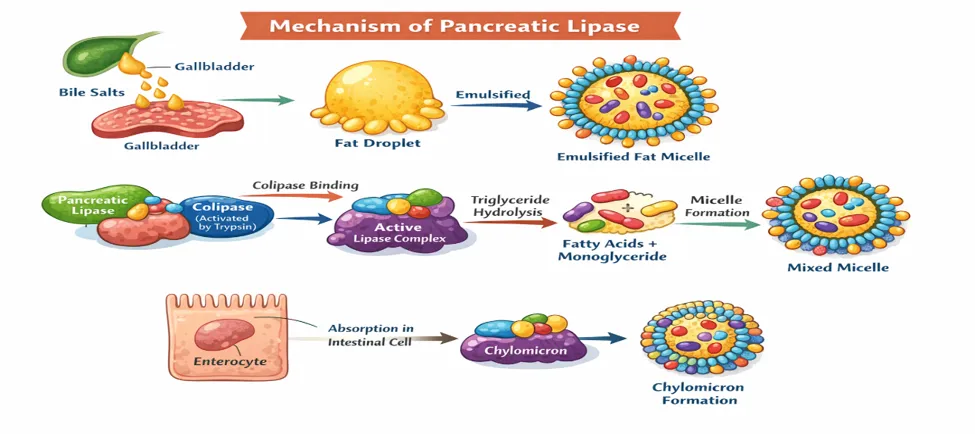
Lipases are enzymes responsible for breaking down triglycerides into free fatty acids and glycerol. Different types of lipases are found in various tissues such as the liver, adipose tissue, blood vessels, and pancreas. Among them, pancreatic lipase is the major digestive enzyme involved in fat digestion inside the small intestine. It hydrolyzes dietary fats into absorbable forms like monoglycerides and fatty acids. Bile salts help this process by emulsifying fats and increasing the surface area for enzyme action. Lipase activity depends on factors such as pH, temperature, substrate concentration, and inhibitors.
Pancreatic lipase plays an important physiological role in digestion and absorption of fats and fat-soluble vitamins. Increased lipase levels are usually associated with acute pancreatitis, gall bladder disease, pancreatic duct obstruction, kidney dysfunction, and certain medications. Decreased lipase activity occurs in conditions like chronic pancreatitis, cystic fibrosis, pancreatic insufficiency, severe malnutrition, and pancreatic surgery. These conditions impair fat digestion and lead to symptoms such as steatorrhea, bloating, abdominal pain, weight loss, and nutrient deficiencies.
The mechanism of pancreatic lipase action begins with emulsification of dietary fats by bile salts. Colipase stabilizes the lipase enzyme on the lipid surface, enabling triglyceride hydrolysis at specific positions. This reaction produces free fatty acids and monoglycerides, which form micelles with bile salts and are later absorbed in the intestine. The absorbed products are reassembled into triglycerides and transported through chylomicrons.
The introduction also discusses diagnostic methods used to evaluate pancreatic disorders. Blood lipase tests measure serum lipase levels using enzymatic methods. Amylase tests are supportive investigations for pancreatic diseases. Stool tests, particularly fecal elastase tests, help detect pancreatic insufficiency. Imaging techniques such as ultrasound, CT scan, MRI, and MRCP assist in identifying pancreatic inflammation, necrosis, duct obstruction, and other abnormalities associated with altered lipase levels. Celiac disease testing is also important because intestinal damage can indirectly reduce pancreatic enzyme secretion.
A major focus of the introduction is the therapeutic importance of pancreatic lipase inhibition. Inhibition of pancreatic lipase reduces the digestion and absorption of dietary fats, thereby decreasing caloric intake. This forms the basis for anti-obesity therapy. Drugs such as Orlistat act through this mechanism. Lipase inhibition is useful in managing obesity, overweight conditions, type-2 diabetes mellitus, dyslipidemia, metabolic syndrome, non-alcoholic fatty liver disease (NAFLD), and polycystic ovary syndrome (PCOD). Weight reduction achieved through lipase inhibition improves insulin sensitivity, lipid profiles, and overall metabolic health.
The project particularly focuses on Clitoria ternatea (Butterfly pea), a medicinal plant belonging to the family Fabaceae. The plant is rich in phytochemicals such as flavonoids, alkaloids, tannins, saponins, anthocyanins, and phenolic compounds. These bioactive constituents are known for several pharmacological activities including antioxidant, anti-inflammatory, antimicrobial, antidiabetic, hepatoprotective, Neuroprotective, and anti-lipase activities.
The introduction further highlights that natural products are gaining importance as safer alternatives to synthetic anti-obesity drugs because many synthetic drugs cause adverse effects. Previous studies reported that plant-derived polyphenols and flavonoids can inhibit pancreatic lipase activity effectively. Therefore, evaluating the lipase inhibitory activity of Clitoria ternatea extract may help identify potential natural anti-obesity agents.
The study also includes FT-IR spectroscopy for identifying functional groups present in the plant extract. FT-IR works by measuring the absorption of infrared radiation by molecular bonds. Each functional group produces characteristic peaks, helping identify the phytochemical constituents responsible for biological activity. Antimicrobial, Antidiabetic, hepatoprotective, neuroprotective, and anti lipase activities.
The introduction further highlights that natural products are gaining importance as safer alternatives to synthetic anti-obesity drugs because many synthetic drugs cause adverse effects. Previous studies reported that plant-derived polyphenols and flavonoids.
PLANT PROFILE:
CLITORIA TERNATEA
LATIN NAME: Clitoria ternatea Linn
FAMILY: Fabaceae, Leguminosae
COMMON NAMES: Butterfly pea, blue pea, Asian pigeon wings, Bunga telang
SYNONYMS: Butterfly pea, Aparjita
TAMIL NAME: Sangu pushpam ilai, Sangu poo ilai
PART USED: Leaves
DISCOVERED BY: Dr. Jakob Breyne
AUTHENTIFICATED BY: Dr. J. Suresh kumar
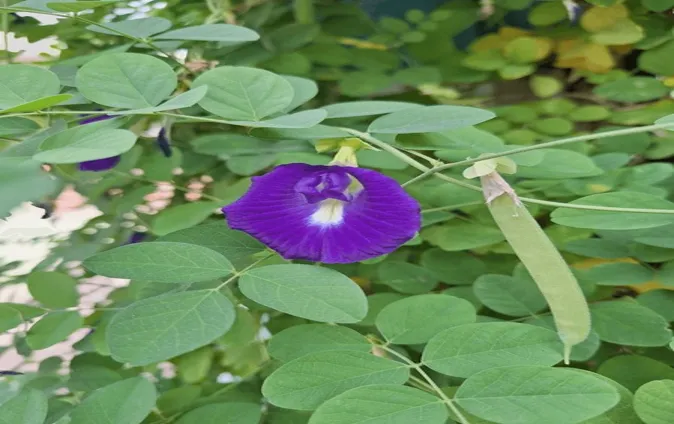
DISCRIPTION: The butterfly pea plant is perennial climbing herb belonging to the family Fabaceae. Its leaves are pinnately compound and arranged alternately on the stem. Each leaf typically consists of 5-7 leaves.
The leaflets are ovate to elliptic in shape, with a smooth (entire) margin and rounded (or) slightly pointed apex. They have soft, thin texture and are bright to deep green in color. The upper surface of the leaf is usually smooth, while the lower surface may be slight hairy.
The midrib is prominent, with lateral veins forming a reticulate venation pattern. Leaves are attached to the stem by a slender petiole, and small stipules are present at the base of the petiole.
Overall, the butterfly pea leaf is simple in appearance, delicate and lush green, supporting the plants climbing habit and contributing to its ornamental and medicinal value.
GEOGRAPHICAL SOURCE: Its native to tropical Asia, particularly in India. It is widely distributed throughout south and southeast Asia, including Sri Lanka, Thailand, Malaysia, Indonesia and the Philippines. Also found in subtropical regions of Africa, Australia, and the Americas.It is cultivated (or) grows naturally, it thrives well in warm climates, open grasslands, road sides, gardens and agricultural fields with well-drained soil.
MORPHOLOGICAL CHARACTERS
LEAFLET SHAPE: Ovate to elliptic
LEAFLET MARGIN: Entire (smooth)
LEAF SURFACE: Glabrous on upper surface, slightly pubescent on lower surface.
COLOUR: Bright to dark green
TEXTURE: Soft and thin
LEAF SIZE: length = 2-5cm ; width = 1.5-3cm
DISTRIBUTION: This plant is native to tropical equatorial Asia and tropical Africa, but in now naturalized and cultivated throughout most tropical and subtropical regions worldwide.
Through cultivation and escape from garden, butterfly pea is now widespread in humid and sub humid low lands of Asia, Northern and Eastern Australia, the pacific islands, the Caribbean, Central and South America, and the Southern United states (Florid Texas, Georgia, California).
It is commonly occurring along roadsides, river banks, pastures, distributed open woodlands and grasslands in these regions. The plant prefers tropical to subtropical climates with warm temperatures, growing from sea level up to roughly 600-650m altitude in many areas. It thrives in open, sunny to light shaded sites with moist, neutral to slightly acidic soils, often in grassland and distributed habitats.
Uses :
Phytoconstituents :
Vernacular names:
CHEMICAL TEST PROCEDURE:
|
Sr. No |
Chemical test name |
Observation |
Inference |
|
1. |
Wagnerʹs test |
+ |
Presence of alkaloids |
|
2. |
Dragendroff΄test |
+ |
Presence of alkaloids |
|
3. |
Ferric chloride test |
+ |
Presence of flavonoids |
|
4. |
Conc.H2SO4 test |
+ |
Presence of flavonoids |
|
5. |
Ferric chloride test |
+ |
Presence of phenolic compounds |
|
6. |
Iodine test |
+ |
Presence of phenolic compounds |
|
7. |
Bromine water test |
+ |
Presence of tanins |
|
8. |
Lead subacetate test |
+ |
Presence of tannins |
|
9. |
Foam test |
+ |
Presence of saponin |
|
10. |
HCL test |
+ |
Presence of anthocyanins |
FT-IR SPECTROSCOPY:
INTRODUCTION
FT-IR [Fourier transform infrared] spectroscopy is a vibrational spectroscopic technique that uses infrared radiation to vibrate molecular bonds within the sample and absorbs it. Functional group of the active components based on the peak value in the region of infrared radiation was detected and by the FTIR spectrum. It is very important technique that is widely used for the detection and analysis of inorganic materials. It has a wide range of applications, from chemical composition analysis, structure identification, and phase identification to surface analysis of inorganic materials.
PRINCIPLE
At the most basic level, FT-IR spectroscopy relies on the fact that different bonds in a molecule will vibrate at very specific frequencies when exposed to infrared (IR) light. Such vibrations are directly related to the molecular structure. A chemical bond can be viewed as spring linking the atoms in any molecule. The energy from the infrared light can be absorbed by a molecule, which makes these bonds vibrate in different modes. Such vibrations may be stretching (in which the separation between atoms changes), bending (where the angle between bonds changes), or more complicated movement of multiple atoms. These vibrations have their own frequencies, which will differ according to the masses of the atoms being vibrated, and howstrongly each atom is bonded to its nearby atoms. The higher the frequency of vibration, lighter the atoms and/or the stronger the bonds. Since different types of chemical bonds and functional groups within a molecule have unique vibrational frequencies, each molecule has a unique infrared pattern. This spectrum acts like a molecular fingerprint that can be utilized to identify and analyze the substance .
PREPARATION OF SAMPLE
Fresh leaves of Clitoria ternatea are collected and washed with water to remove dust particles, shade dried and ground into coarse particles. The powdered plant material is then extracted with 70% ethanol by maceration process. The extract were filtered using muslin cloth and concentrated.
FT-IR ANALYSIS
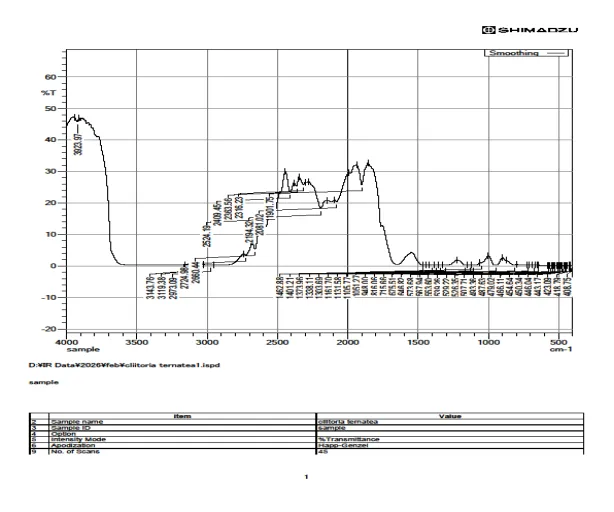
A small volume of the sample is placed between two infrared-transparent windows (KBr or CaF2), forming a transmission cell. The cell is positioned along the route of the infrared beam on a Schimadzu FT-IR Spectrometer IR affinity-1 series, between 400-4000 cm-1. Characteristic peaks and their functional groups were detected and IR chart was given below.
MATERIALS AND METHODS:
PROCESSING OF PLANT MATERIAL
Processing of Clitoria ternatea leaves involves a series of well-defined steps to ensure efficient extraction of phytoconstituents. Initially, fresh leaves or flowers are collected and carefully washed with clean water to remove dust, dirt, and other extraneous matter. The cleaned material is then shade-dried at room temperature to prevent degradation of heat-sensitive compounds and to maintain the stability of bioactive constituents such as polyphenols, flavonoids and anthocyanins. Proper drying is essential to reduce moisture content, inhibit microbial growth, and enhance the shelf life of the crude drug. After complete drying, the plant material is pulverized into a coarse powder using a mixer grinder, which increases the surface area for better solvent penetration during extraction. The powdered material is then stored in an airtight container, protected from light, moisture, and contamination until further processing.
MACERATION:
The term maceration denotes softening. The process of maceration extraction is a solid (plant material)-liquid (solvent) extraction process.
APPARATUS
PROCEDURE:
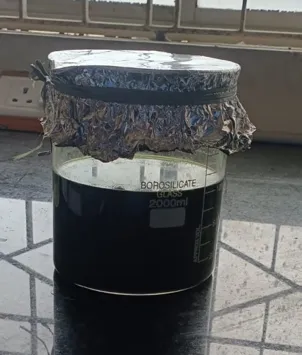
In this extraction process the dry or powdered plant material is placed in a beaker.
The solvent (menstrum) is poured on top until completely covered the drug material.
Keep for 24-72 hours at room temperature.
The content is stirred periodically and it should be shaken time to time to ensure complete extraction.
At the end of the extraction, filter the solution.
Evaporate the solvent to get extract.
ADVANTAGES:
The method is simple, only requiring a vessel with a lid.
There is no need for a skilled technician to perform the extraction.
The process is heat-free, thus conserving energy.
This method is suitable for less non-hard plant materials.
DISADVANTAGES:
Duration of this process is 2-7 days.
Consumption of large solvents compared to novel extraction methods.
Some solvents used are hazardous.
The process lacks selectivity.
Increased risk of microbial contamination, especially when water is used as the solvent.
Produces low extraction yield novel extraction methods.
MATERIALS:
Enzyme: pancreatic lipase
Substrate: PNPB
Chemicals: 90µl phosphate buffer, Dimethylformamide
Apparatus: Elisa microplate reader
Standard: orlistat
Chemicals: ethanal, 50mM Tris-Hcl, Dimethyl sulfoxide (DMSO), p-nitrophenyl Laurate(p-NPL)
Apparatus: FLUOstar OPTIMA micro reader
Substrate: 4-MU oleate
Chemical: buffer
Apparatus: fluorescence multi-detection reader
Substrate: olive oil (natural substrate)
Chemical: 200mM Tris-Hcl, 95% ethanol, 0.9% thymolphthalein indicator, 50mMSodium hydroxide
METHODS
Para nitrophenyl butyrate (PNPB)
Microplate Assay Method:
Pancreatic lipase inhibition was measured using the p-nitrophenyl butyrate (p-NPB) assay. In this method, 80 µL of the sample solution was mixed with 20 µL of pancreatic lipase and 90 µL of phosphate buffer, then incubated at 37°C for about 30–40 minutes. After incubation, 10 µL of p-NPB substrate was added in dimethyl formamide to start the reaction, followed by further incubation at 37°C for 30 minutes. The formation of p-nitro phenol was measured at 405 nm using a microplate reader. A blank (enzyme + substrate without sample) was used as control, and a orlistat standard inhibitor.
The percentage inhibition of lipase activity was calculated using the formula:
Percentage of inhibition = (blank – Test / blank) x 100
Where Test is the absorbance of the sample and Blank is the absorbance of the control.
Spectrophotometric Method:
Pancreatic lipase inhibitory activity was determined by mixing the plant extract with pancreatic lipase enzyme in Tris-HCl buffer (pH 8.5). The mixture was incubated at 37°C for a few minutes, then p-nitrophenyl laurate (p-NPL) substrate was added to start the reaction. After incubation at 37°C, the release of p-nitrophenol was measured at 410 nm using a FLUOstar. A control without extract (enzyme only) was used for comparison. The decrease in absorbance indicates lipase inhibition.
% of enzyme inhibition = [E – T/E] x100
Where E = absorbance of control (enzyme without extract) and T = absorbance with sample.
Fluorimetry Assay Method:
Pancreatic lipase inhibitory activity was measured using 4-MU oleate as a substrate. The reaction mixture containing substrate, buffer, and sample extract was prepared, then pancreatic lipase enzyme was added. The mixture was incubated at 37°C for about 10 minutes. During this time, the enzyme released 4-methylumbelliferone (4-MU), which was measured using a fluorescence reader at excitation 320 nm and emission 450 nm. A control without sample was used for comparison, and a decrease in fluorescence indicated inhibition of lipase activity.
Titrimetric method:
Pancreatic lipase solution was prepared by dissolving the enzyme (2 mg/ml) in 200 mM Tris-HCl buffer (pH 7.7). The reaction mixture was prepared by adding 2.5 ml of autoclaved distilled water, 1 ml of Tris-HCl buffer, 3 ml of olive oil (natural substrate), and 0.5 ml of pancreatic lipase enzyme solution. The mixture was mixed thoroughly to form an emulsion and incubated at 37°C for 30 minutes in an orbital shaker to facilitate enzymatic hydrolysis.
After incubation, the reaction was terminated by adding 3 ml of 95% ethanol to stop enzyme activity. Then, four drops of 0.9% thymolphthalein indicator (prepared in 95% ethanol) were added. The liberated free fatty acids were titrated with 50 mM sodium hydroxide solution until the appearance of a stable light blue color, indicating the endpoint.
For inhibition studies, the test sample (inhibitor) was pre-incubated with the pancreatic lipase enzyme before adding the substrate, and the same procedure was followed. A control without inhibitor was also maintained.
RESULT:
1. Extraction Process
The extraction of the plant material was successfully carried out using a hydro-alcoholic solvent. The extract obtained was:
Color: Dark green
Consistency: Powder
2. IR Spectroscopy (FTIR Analysis)
The IR spectrum of the extract showed characteristic absorption peaks indicating the presence of different functional groups:
|
Peak (cm⁻¹) |
Functional Group |
Bond Type |
Possible Phytoconstituents |
|
~3143 cm⁻¹ |
O–H stretching |
Alcohol / Phenol |
Polyphenols, flavonoids |
|
~3119 cm⁻¹ |
O–H / N–H stretching |
Phenol / Amine |
Flavonoids, alkaloids |
|
~2973 cm⁻¹ |
C–H stretching |
Alkane |
Lipids, fatty acids |
|
~2724 cm⁻¹ |
C–H stretching |
Aldehyde |
Aldehydes (minor components) |
|
~2660 cm⁻¹ |
O–H stretching (broad) |
Carboxylic acid |
Organic acids |
|
~2524–2409 cm-1 |
O–H (strong, broad) |
Carboxylic acid |
Phenolic acids |
|
~2363 cm⁻¹ |
CO₂ absorption |
Atmospheric |
Not sample-specific |
|
~2316 cm⁻¹ |
CO₂ absorption |
Atmospheric |
Not sample-specific |
|
~2194 cm⁻¹ |
C≡N stretching |
Nitrile |
Possible alkaloids |
|
~2081 cm⁻¹ |
C≡C stretching |
Alkyne |
Minor phytochemicals |
|
~1901 cm-1 |
C=O overtone |
Aromatic |
Aromatic compounds |
|
~1462 cm⁻¹ |
C–H bending |
Alkane |
Lipids, terpenoids |
|
~1401 cm⁻¹ |
O–H bending |
Phenol |
Polyphenols |
|
~1373 cm⁻¹ |
C-H bending |
Methyl group |
Flavonoids |
|
~1338 cm⁻¹ |
C–N stretching |
Amine |
Alkaloids |
|
~1303 cm⁻¹ |
C–O stretching |
Alcohol |
Phenolics |
|
~1161 cm⁻¹ |
C–O stretching |
Ether |
Glycosides |
|
~1131 cm⁻¹ |
C–O stretching |
Alcohol |
Carbohydrates |
|
~1105 cm⁻¹ |
C–O–C stretching |
Ether linkage |
Glycosides |
|
~1051 cm⁻¹ |
C–O stretching |
Primary alcohol |
Sugars |
|
~948 cm⁻¹ |
=C–H bending |
Alkene |
Flavonoids |
|
~816 cm⁻¹ |
C–H bending |
Aromatic ring |
Phenolics |
|
~715-675 cm-1 |
C-Cl/ C-H bending |
Halides/ Aromatic |
Minor Constituents |
These peaks confirm the presence of compounds such as phenols, flavonoids, and other organic constituents.
DISCUSSION:
From the methods above mentioned in materials and methods, we planned to perform titrimetric assay using olive oil due to its ability to mimic physiological conditions by using a natural triglycerides substrate. The method provides a direct and reliable estimation of lipase activity through measuring the released fatty acids. Additionally, it is cost effective because it requires basic lab equipments and no need for expensive instruments.
CONCLUSION
The study successfully carried out extraction, phytochemical screening, and IR spectroscopy analysis of the selected plant material. The extraction process yielded a crude extract rich in bioactive compounds. Preliminary phytochemical analysis confirmed the presence of important secondary metabolites such as alkaloids, flavonoids, tannins, and glycosides.
The IR spectroscopy results further supported these findings by identifying characteristic functional groups like hydroxyl, carbonyl, and aromatic groups, which are commonly associated with biologically active compounds.
Overall, the presence of these phytochemicals and functional groups suggests that the extract has potential biochemical and enzymatic activity, supporting its suitability for further studies such as in vitro lipase enzyme activity.
REFERENCES


Dr. V. Suresh, Dr. S. K. Senthilkumar, R. Asharaf Ali, C. Asma, A. Aziza, P. Chandrika, E. Deivamani, Investigation of In Vitro Inhibitory Activity of Clitoria Ternatea (L.) Extract, Int. J. of Pharm. Sci., 2026, Vol 4, Issue 6, 3978-3988. https://doi.org/10.5281/zenodo.20722587
 10.5281/zenodo.20722587