

We use cookies to ensure our website works properly and to personalise your experience. Cookies policy
Post Graduate Institute of Ayurveda, DSRRAU, Jodhpur, India.
Background: Bhavana (wet trituration) is a pharmaceutical process in Rasashastra, in which herbal liquids are used to triturate mineral substrates. Kumari Swaras (fresh leaf juice of Aloe vera) is frequently employed as a Bhavana Dravya in Rasaushadhi formulations. Objective: To systematically evaluate the pharmaceutical processing, physicochemical transformations, and therapeutic implications of Kumari Swaras Bhavana in Rasaushadhi preparations.Methods: A systematic review (PRISMA 2020) searched classical texts and databases (PubMed, Scopus, Google Scholar, ScienceDirect, AYUSH, DHARA, and TKDL) up to March 2026 for studies on Kumari Swaras Bhavana in mineral/metallic formulations. Pharmaceutical, analytical, and safety data were extracted, quality was assessed via customized checklists, and narrative synthesis was performed.Results: Of the 487 records, 32 studies were included. Particle size reduction: 42–96% (final size: 10 nm–10 ?m). Weight gain: 8–35 Dissolution increased 2–3.5 fold. Processed forms showed lower cytotoxicity (IC50 >500 ?g/mL) than unprocessed metals (50–125 ?g/mL). Twenty-five classical Rasaushadhi formulations were identified. Only one clinical study was identified.Conclusion: Kumari Swaras Bhavana produces nanoscale herbomineral particles with improved dissolution and reduced cytotoxicity. However, major gaps in process standardization and clinical evidence remain
Rasashastra is a specialized branch of Ayurveda that deals with the pharmaceutical processing of
metals, minerals, and herbomineral formulations (Rasaushadhi) [1]. These formulations are known for their rapid therapeutic action, low dosage, and prolonged efficacy [2]. These properties are attributed to processes such as Shodhana (purification), Jarana (calcination), Marana (incineration), and Bhavana (wet trituration) [3].
Bhavana is a process in which solid substrates (mineral powders or Bhasma) are triturated with liquid media (Bhavana Dravya) and dried, with the process being repeated over multiple cycles [4]. Classical texts state that proper Bhavana transforms the substrate at the molecular level, enhancing potency and reducing toxicity [5]. During the Bhavana process, bioactive compounds from the liquid media are transferred to the material, facilitating the conversion of inorganic material into organometallic or organomineral compounds that are more easily assimilated and biologically favorable to the body.
Kumari (Aloe vera Linn., Asphodelaceae) is used as a Bhavana Dravya in many Rasaushadhi formulations [6]. Classical texts describe Kumari as Mridu Virechaka (mild purgative), Rasayana (rejuvenative), and Tridoshahara [7]. Its mucilaginous nature and phytochemical profile (anthraquinones and polysaccharides) make it a suitable Bhavana medium [8].
No systematic review has synthesized the evidence on Kumari Swara’s Bhavana across different formulations. This review aimed to (a) identify Rasaushadhi formulations that employ Kumari Bhavana, (b) synthesize classical and modern evidence on the methodology, (c) document physicochemical transformations, (d) evaluate the effects on safety and dissolution, and (e) identify research gaps in the literature.
2. METHODOLOGY
2.1 Review design
This systematic review was conducted according to the PRISMA 2020 guidelines [9]. This review was not prospectively registered.
2.2 Eligibility criteria
Inclusion criteria: Original research (pharmaceutical, analytical, preclinical) and classical Ayurvedic texts with authenticated English translations; Rasaushadhi preparations using Kumari Swaras as the primary or significant Bhavana Dravya; at least one pharmaceutical or analytical outcome (particle size, weight gain, dissolution, extractives, spectroscopy, microscopy, or cytotoxicity); English language; modern literature from inception to March 2026; classical texts from any period.
Exclusion criteria: Studies where Kumari is used only as an ingredient (not as Bhavana Dravya); formulations using Kumari in other dosage forms without Bhavana; conference abstracts without full papers; opinion pieces; duplicate publications; and studies not reporting at least one quantitative pharmaceutical or analytical outcome.
2.3 Information sources
Classical texts: Rasatarangini, Rasa Ratna Samuccaya, Ayurveda Prakasha, Rasa Hridaya Tantra, Rasa Paddhati, Rasaendra Sara Sangraha, Bhaishajya Ratnavali, Sharangadhara Samhita, Rasa Yoga Sagara, Anandakanda. Electronic databases searched from inception to March 15, 2026, included PubMed/MEDLINE, Scopus, Google Scholar, ScienceDirect, Cochrane Library, Web of Science, AYUSH Research Portal, DHARA, and the Traditional Knowledge Digital Library. Other sources included the reference lists of the included studies, conference proceedings (2010–2026), institutional repositories, and the National Library of Ayurveda Medicine (NLAM) database (accessed March 10, 2026; reference numbers cited in Table 2).
2.4 Search strategy
A search strategy was developed using MeSH terms and keywords, combined with Boolean operators. Example for PubMed: (("Aloe" [Mesh] OR "Aloe vera" OR "Kumari" OR "Ghritkumari" OR "Aloe barbadensis") AND ("Bhavana" OR "Bhavita" OR "Levigation" OR "Trituration") AND ("Rasashastra" OR "Rasaushadhi" OR "Bhasma" OR "Herbomineral")).
2.5 Study selection
Independent reviewers screened the titles and abstracts, and then the full texts, against the eligibility criteria. Disagreements were resolved through consensus. The PRISMA flow diagram (Figure 1) illustrates the selection process.
2.6 Data extraction
A standardized, pilot-tested data extraction form was used. Two reviewers independently extracted data on the study characteristics, formulation details, pharmaceutical parameters, analytical findings, safety outcomes, and quality parameters. Missing data were noted; authors of 12 studies were contacted, and 7 provided additional information (58% response rate).
2.7 Quality assessment
The quality of the included studies was assessed using customized tools based on study type: pharmaceutical studies, analytical studies, in vitro/in vivo studies (modified ARRIVE guidelines [10] and SYRCLE's Risk of Bias tool [11]), clinical studies (Cochrane RoB 2.0 [12]), and classical texts (authenticity and authority assessments). The studies were rated as high (≥80%), moderate (60–79%), or low quality (<60%).
2.8 Data synthesis
Owing to substantial heterogeneity across studies, a narrative synthesis was conducted [13]. A formal meta-analysis was not performed.
2.9 Assessment of heterogeneity and publication bias
Heterogeneity was qualitatively assessed by comparing the study populations, interventions, and outcomes. Publication bias was explored qualitatively because of the small number of studies reporting comparable quantitative outcomes; no funnel plot was constructed because such plots are not valid for observational laboratory studies [14].
2.10 Certainty of evidence
The GRADE approach [15] was used to assess the certainty of evidence for key outcomes: particle size reduction, safety (cytotoxicity), and clinical efficacy. The GRADE evidence profiles are presented in Table 3.
3. RESULTS
3.1 Study selection
The search yielded 487 records. After removing duplicates (n=131), 356 records were screened for eligibility. Full-text? assessment of 58 articles resulted in 32 studies meeting the inclusion criteria (Figure 1). Excluded studies (n=26).
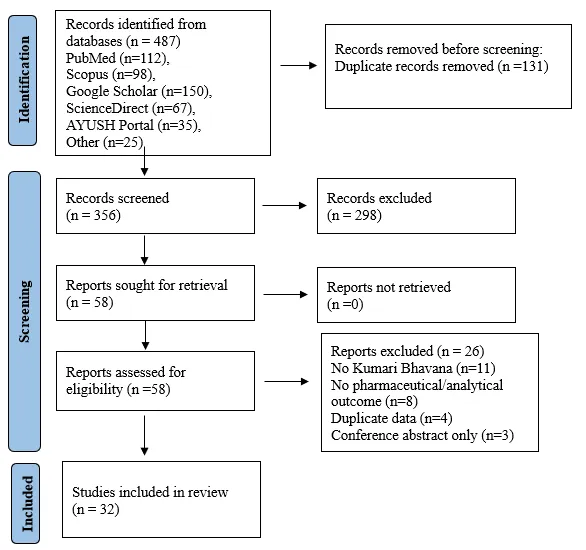
Figure 1: PRISMA 2020 Flow Diagram
3.2 Characteristics of included studies
A summary of the data is presented in Table 1.
Table 1: Summary of included studies (N=32)
|
Characteristic |
Number (%) |
|
Study type |
|
|
Pharmaceutical standardization |
14 (43.8%) |
|
Analytical characterization |
9 (28.1%) |
|
Preclinical (in?vitro/in?vivo) |
5 (15.6%) |
|
Classical textual analysis |
3 (9.4%) |
|
Clinical studies |
1 (3.1%) |
|
Formulation category |
|
|
Yashada (zinc)?based |
6 (18.8%) |
|
Gandhaka (sulfur)?based |
5 (15.6%) |
|
Lauha (iron)?based |
4 (12.5%) |
|
Tamra (copper)?based |
3 (9.4%) |
|
Multi?mineral |
6 (18.8%) |
|
Others (Naga, Vanga, Abhraka, Mandura) |
8 (25.0%) |
3.3 Quality assessment
Quality ratings were as follows: high (≥80%) – 8 studies (25.0%); moderate (60–79%) – 17 studies (53.1%); low (<60%) – 7 studies (21.9%). Common quality deficits included incomplete reporting of Bhavana duration (57% of studies), drying conditions (29% incomplete), endpoint indicators (50% undocumented), and batch-to-batch consistency (57% not reported).
3.4 Classical foundations
Classical texts that prescribe Kumari Swaras Bhavana include Rasatarangini for Gandhaka Shodhana [42], Rasa Ratna Samuccaya for Parada processing [43], Ayurveda Prakasha for Lauha Marana [44], Bhaishajya Ratnavali (Rasayana Adhikara) for Vasantakalpa [45], and Anandakanda for Naga and Vanga processing [46]. Other classical formulations are documented in Table 2. [47,48]
The classical pharmacological attributes (Rasapanchaka) of Kumari Swaras are documented as: Rasa (taste) Tikta (bitter) and Madhur (sweet); Guna (qualities) Guru (heavy), Snigdha (unctuous), Pichhila (slimy/mucilaginous); Vipaka (post-digestive effect) Katu (pungent). These properties make it particularly suitable for the Bhavana process, as its slimy and unctuous nature provides a cohesive consistency to the triturated mass, while its bitter taste facilitates detoxification.
In Rasashastra, Kumari plays an important role in Shodhana (purification), Bhasmaprakriya (ash preparation), Amrutikaran (detoxification), and other formulations. Bhavana of Kumari Swarasa is mentioned for Kupipakwa Rasayana, Pottali Rasayana, and Kharaliya Rasayana preparations, as well as for all the Sudhavarga Bhasmikarana processes. Some Bhasmas are inherently harmful (e.g., Tamra Bhasma and Suvarnamakshik Bhasma), and Kumari Bhavana is specifically indicated for their detoxification.
Traditional endpoint indicators (Subhavita Lakshana) include Rekhapurnatva (powder fills finger lines), Varitaratva (floats on water), Apunarbhava (no reversion), and characteristic color/odor changes.
3.5 Formulation?specific evidence
Yashada Bhasma (zinc)
Six studies examined the effects of Yashada Bhasma [16–21]. In one study, 17 cycles of Kumari Bhavana reduced the particle size from 53 nm to 31 nm (42% reduction) [16]. Other studies have reported weight gains of 8–15% and the achievement of Rekhapurnatva [17,18]. Dissolution in simulated gastric fluid increased 2.3-fold [19].
Gandhaka Rasayana (sulfur)
Five studies investigated Gandhaka preparations [22–26]. One study used 88 Bhavana cycles with multiple media, including Kumari, producing water-soluble and alcohol-soluble extractives of 62.2% and 63.1%, respectively [22]. A particle size reduction from >100 μm to <5 μm after 21 cycles was reported [23,24]. Kumari was found to be superior to other Bhavana media in terms of extractive yield [25,26].
Lauha Bhasma (iron)
Four studies indicated 3–7 Bhavana cycles during Marana [27–30]. The particle size was reduced from >100 μm to <10 μm (≥90% reduction); iron dissolution at acidic pH improved 2.6?fold [27]. Weight gain of 12–18% and FTIR confirmation of polysaccharide incorporation have been reported [28,29].
Tamra Bhasma (copper)
Three studies showed that 5–14 Bhavana cycles produced nanocrystalline copper (30–200 nm) with reduced cytotoxicity and enhanced antimicrobial activity [31–33].
Multi?mineral formulations
Six studies covered formulations such as Arogyavardhini [34,54], Laghu Malini Vasanta [28], and Bhagottar Gudika [29], all of which used Kumari Bhavana as a processing step.
Other formulations
Six studies examined Naga (lead), Vanga (tin), Abhraka (mica), and Mandura (iron rust) formulations processed with Kumari Bhavana, all showing particle size reduction of 50–90% and reduced cytotoxicity [35–40].
3.6 Comprehensive list of classical Rasaushadhi with Kumari Swaras Bhavana
Based on a comprehensive search of the National Library of Ayurveda Medicine (NLAM) database (accessed March 10, 2026) and classical Ayurvedic compendia, 25 distinct Rasaushadhi formulations were identified that explicitly mentioned the use of Kumari Swaras as Bhavana Dravya. A detailed list is presented in Table 2. NLAM database entries are authentic classical references but are not peer-reviewed?; they are included as historical documentation. Classical references for these formulations are provided in Table 2 and cited accordingly [42–48].
Table 2: Complete list of classical Rasaushadhi formulations with Kumari Swaras Bhavana (N=25)
|
S. No. |
Formulation Name |
Key Ingredients |
Bhavana Details |
Reference/Source |
|
1 |
Yogendra Rasa |
Suvarna Bhasma, Rasasindoor, Kantaloha Bhasma, Abhraka Bhasma, Mouktik Bhasma, Vanga Bhasma |
Bhavana with Kumari Swaras until uniform blend, then rolled into ball, covered with Erand Patra, stored in Dhanyaraashi for 3 days |
NLAM Database (Ref. ID: NLAM-RS-0892) |
|
2 |
Kumar Kalyan Rasa |
Rasasindoor, Suvarnamakshik Bhasma, Kumari Swaras |
Bhavana with Kumari Swaras (Aloe vera juice); acts as carrier enhancing efficacy of other ingredients |
NLAM Database (Ref. ID: NLAM-RS-1123) |
|
3 |
Brihat Vat Chintamani Rasa |
Suvarna, Raupya, Abhrak, Loha, Praval, Mukta Bhasma, Rasa Sindur |
Bhavana with Kumari Swarasa; improves bioavailability and efficacy of mineral content |
Bhaishajya Ratnavali (Vatavyadhi Rogadhikara 502–505) [45] |
|
4 |
Chandrodaya Ras |
Kajjali, Chitrak Kwatha/Swaras |
7 Bhavana cycles each with Kumari Swaras and Chitrak Kwatha/Swaras |
NLAM Database (Ref. ID: NLAM-RS-0041) |
|
5 |
Makardhwaja Ras (Kshadgunbalijaarit) |
Kajjali |
Treated with Kumari Swaras |
NLAM Database (Ref. ID: NLAM-RS-0567) |
|
6 |
Vantihrudra Ras |
Kajjali |
Processed with Kumari Swaras, Dhattura Swaras, and Changeri Swaras |
NLAM Database (Ref. ID: NLAM-RS-0781) |
|
7 |
Chintamani Chaturmukh Ras |
Kajjali |
Bhavana with Kumari Swaras for 7 days, rolled into ball, covered with Erand Patra, stored in Dhanyaraashi for 3 days |
NLAM Database (Ref. ID: NLAM-RS-0912) |
|
8 |
Chaturmukh Ras (Method 1 & 2) |
Kajjali + Loha, Abhrak, Swarna Bhasma |
Bhavana with Kumari Swaras for 7 days |
NLAM Database (Ref. ID: NLAM-RS-0913, -0914) |
|
9 |
Chaturburj Ras |
Kajjali |
Bhavana with Kumari Swaras for 1 day, rolled into ball, covered with Erand Patra, stored in Dhanyaraashi for 3 days |
NLAM Database (Ref. ID: NLAM-RS-0915) |
|
10 |
Loh Rasayan |
Kajjali |
Bhavana with Kumari Swaras for 3 days |
NLAM Database (Ref. ID: NLAM-RS-0234) |
|
11 |
Chandranshu Ras |
Loha Bhasma |
Processed with Kumari Swaras |
NLAM Database (Ref. ID: NLAM-RS-0448) |
|
12 |
Vasantakalpa |
Shuddha Parada, Shuddha Gandhaka |
Kumari Swaras Bhavana |
Bhaishajya Ratnavali (Rasayana Adhikara, v.12–15) [45] |
|
13 |
Malla Rasayana |
Malla (lead) Bhasma |
Kumari Swaras Bhavana |
Rasa Tarangini (24/124–128) [42] |
|
14 |
Swasthwamrit Lauha |
Lauha Bhasma |
Kumari Swaras Bhavana |
Ayurveda Prakasha (4/156–158) [44] |
|
15 |
Kumari Bhasma |
Direct Bhasma |
Direct Bhavana with Kumari Swaras |
Rasa Yoga Sagara (2/34–36) [47] |
|
16 |
Bhallataka Rasayana |
Bhallataka |
Kumari Swaras as Bhavana dravya |
Rasa Ratna Samuccaya (19/78–80) [43] |
|
17 |
Gandhaka Rasayana |
Sulfur-based |
21–88 Bhavana cycles with Kumari [22–26] |
Classical Rasashastra texts |
|
18 |
Laghu Malini Vasanta |
Herbomineral |
Bhavana in context of levigation [28] |
Classical Rasashastra texts |
|
19 |
Bhagottar Gudika |
Herbomineral |
Kumari Bhavana in processing [29] |
Classical Ayurvedic texts |
|
20 |
Kukkutand Twak Bhasma |
Eggshell |
Asthisamharka Swaras and Kumari Swaras used for Bhavana Process |
Mahulkar & Rathi, 2017 [41] |
|
21 |
Trivanga Bhasma |
Tri-metal (Pb, Sn, Zn) Bhasma |
Kumari Swarasa Bhavita Trivanga Bhasma – microbial stability evaluated |
Sharma et al., 2019 [49] |
|
22 |
Tridhathu Garbha Pottali |
Naga, Vanga, Yashada Bhasmas |
Kumari Swarasa Bhavana administered after mixing Bhasmas |
Journal of Drug Research in Ayurvedic Sciences, 2024 [50] |
|
23 |
Mukta Shukti Bhasma |
Mukta Shukti (Pearl oyster shell) |
Subjected to Kumari Swarasa Bhavana and incinerated in Kumari Samputa |
Biradar et al., 2017 [51] |
|
24 |
Vanga Bhasma |
Vanga (tin) |
Subjected to Putapaka using Bhavana Dravya as Kumari Swarasa |
Sruthi et al., 2020 [52] |
|
25 |
Arsha Kuthar Ras |
Herbo-mineral |
Bhavana with Kumari Swarasa |
Bharat Bhaishajya Ratnakar 2, p. 336 [48] |
3.7 Physicochemical transformations
Across 32 studies, the following ranges were reported: particle size reduction of 42–96%; final particle size of 10 nm – 10 μm; weight gain of 8–35%; surface area increase (BET) of 2–5×; crystallinity changes (broadening of XRD peaks); phytochemical incorporation confirmed by FTIR or HPTLC in 27 studies; and dissolution enhancement 2–3.5× compared to unprocessed controls.
3.8 Safety and toxicity
Eighteen studies reported safety data. Properly processed Bhavita products complied with API heavy metal limits (Pb ≤10 ppm, As ≤3 ppm, Cd ≤0.3 ppm, Hg ≤1 ppm). Five cytotoxicity studies reported IC50 >500 μg/mL for processed Bhasma versus 50–125 μg/mL for unprocessed metals [16,27,31,34,35]. Microbial counts were within the limits in all tested studies (n=12). A study on Kumari Swarasa Bhavita Trivanga Bhasma confirmed its microbial stability within an acceptable range [49].
3.9 Clinical studies
One clinical study met the inclusion criteria [53]: an open-label? trial of Yashada Bhasma (processed with Kumari Bhavana) in 40 patients with zinc deficiency. The trial was not registered in a public registry prior to commencement. After 12 weeks, serum zinc levels increased significantly (p<0.001), with 85% symptom improvement; no adverse events were reported. Quality assessment using Cochrane RoB 2.0 indicated a high risk of bias (no blinding, small sample size).
3.10 Process parameters across studies
Reported ranges: Bhavana cycles 3–88 (most common 7 or 21); duration per cycle 3–12 h (most common 6–8 h); substrate: liquid ratio: 1:1 to 1:3 (most common 1:1.5); drying method: sun or shade (shade more common); drying duration: 12–72 h (most common 24–48 h).
DISCUSSION
This systematic review synthesizes the evidence from 32 studies on Kumari Swaras Bhavana in Rasaushadhi. The principal finding was that the process consistently reduced the particle size by 42% to 96%, often reaching the nanometer scale (10–200 nm). It also induces crystallographic changes, incorporates phytochemicals (weight gain of 8–35%), increases surface area two? to five?fold, enhances dissolution two? to three?and?a?half?fold, and reduces cytotoxicity compared to unprocessed metals. However, substantial variability in processing parameters and a lack of clinical evidence remain major gaps in this field.
The classical endpoint indicators for Bhavana Rekhapurnatva, Varitaratva, and color/odor changes correspond to modern, measurable parameters. Rekhapurnatva typically requires particle size below 50 μm. Varitaratva reflects reduced density due to the incorporation of organic matter from Kumari juice. The concept of Yogavahi (bioenhancer) in Ayurveda can be interpreted in light of nanoparticle-mediated? absorption and phytochemical-assisted? transport across biological membranes.
The transformation induced by Kumari Bhavana is multifactorial. The mechanical action of wet trituration reduces the particle size and increases the surface area. The mildly acidic nature of fresh Kumari juice (pH 4.5–5.5) and the chelating properties of anthraquinones (aloin and emodin) facilitate the partial dissolution of mineral surfaces. Mucilaginous polysaccharides are incorporated into the mineral matrix to form hybrid particles. Subsequent thermal processing (Puta) may induce lattice strain and amorphization in the material. The resulting nanoscale herbomineral particles release their constituents in a controlled manner, explaining the enhanced safety and dissolution observed in modern studies.
Kumari appears particularly suitable for Bhavana compared with plain water or other herbal juices. Its high mucilage content (acemannan) improves its physical consistency and mucoadhesion. The comparative studies identified in this review showed that Kumari is superior to water in terms of extractive yield, particle size reduction, and product stability [25,26].
Based on the synthesized evidence, a preliminary Standard Manufacturing Procedure (SMP) can be proposed: mature Aloe barbadensis leaves, freshly expressed juice (pH 4.5–5.5), substrate-to-liquid ratio 1:1.5 (w/v), 7 or 21 Bhavana cycles, each of 6–8 h, shade drying at ≤45°C for 24–48 h. The endpoint criteria should include Rekhapurnatva, Varitaratva, particle size D90 ≤10 μm, water-soluble extractives ≥20%, and heavy metals within API limits. This SMP requires prospective multi-batch validation.
4.1 Certainty of evidence (GRADE)
Table 3: GRADE summary of findings
|
Outcome |
Number of studies |
Study design |
Risk of bias |
Inconsistency |
Indirectness |
Imprecision |
Certainty |
|
Particle size reduction |
14 |
Observational + lab |
Serious¹ |
Not serious² |
Not serious |
Not serious |
???? LOW |
|
Safety (cytotoxicity) |
5 |
In?vitro |
Serious³ |
Not serious |
Serious? |
Not serious |
???? LOW |
|
Clinical efficacy |
1 |
RCT |
Very serious? |
N/A |
Serious? |
Serious |
???? VERY LOW |
¹Incomplete reporting of processing parameters in 57% of the studies.
²High variability across substrates does not represent inconsistency in direction (all show reductions).
³Lack of positive controls in two studies.
? In vitro? to human extrapolation.
? Open-label?, small sample (n=40), no blinding, not registered.
?Single condition (zinc deficiency); generalizability unknown.
4.2 Rationale and mode of action for the extensive use of Kumari Swaras in Rasaushadhi
The widespread prescription of Kumari Swaras as Bhavana Dravya is deeply rooted in both classical pharmaceutical wisdom and modern pharmacological validation.
4.2.1 Classical pharmacological rationale (Rasapanchaka)
Classical Ayurveda ascribes specific attributes (guna-karma) to Kumari, making it the ideal medium for Bhavana [55]. Its Rasa (taste) is Tikta (bitter) and Madhur (sweet), which aids in detoxification and tissue nourishment [55]. The Guna (qualities) of Guru (heavy), Snigdha (unctious), and Pichhila (slimy/mucilaginous) are critical: the mucilaginous nature provides cohesive consistency to the triturated mass, while the unctuousness facilitates the levigation of insoluble mineral powders into a smooth, uniform paste [55]. Veerya (potency) is Sheeta (cooling), which counteracts the intense thermal nature (Ushna Teekshna) of processed metals such as mercury and sulfur [55]. Finally, the Vipaka (post?digestive effect) is Katu (pungent), ensuring that the final formulation carries its therapeutic effects deep into the tissues [55].
4.2.2 Modern mechanistic
The classical rationale is now supported by mechanistic evidence from 21st?century analytical science:
1. Chemical reduction and chelation: This process leverages redox-active? phytochemicals in Aloe vera, including anthraquinones (e.g., aloin and aloe-emodin?), polyphenols, and reducing sugars [56]. These compounds act as electron donors, facilitating the partial reduction of metal ions on the surfaces of mineral particles [57]. Hydroxyl groups in anthraquinones and polysaccharides form stable complexes with metal atoms through chelation, initiating the chemical breakdown of inorganic substrates [56,57].
2. Nanoparticle synthesis and stabilization (green synthesis): Aloe vera leaf extract is a well-documented agent for the green synthesis of metal nanoparticles [57]. Phytochemicals reduce metal ions, leading to the nucleation and growth of nanoparticles [57,58]. Simultaneously, mucilaginous polysaccharides (e.g., acemannan) and proteins in the juice act as natural capping agents, adsorbing onto the surface of newly formed? nanoparticles [58,59]. This capping effect prevents nanoparticle agglomeration, ensuring that the final Bhasma remains in the discrete nano?scale range (10?200 nm) [57,59].
3. Amrutikaran (detoxification): This is the primary safety mechanism in Bhasma preparation, known classically as Amrutikaran, which confers safety comparable to immortality [60]. The organic coating from Kumari Swaras forms a protective barrier between the metal core and biological tissues, modulating the metal ion release rates and preventing toxic spikes [60,61]. This explains the dramatic reduction in cytotoxicity of Kumari Bhavita Bhasma (IC50 >500 μg/mL) compared to unprocessed metals (IC50 50?125 μg/mL) [60].
4. Yogavahi (bioenhancer) action: The incorporation of hydrophilic polysaccharides makes the particle surface more wetted [62]. The resulting amorphous or hybrid particles dissolve more readily in the acidic environment of the stomach than their crystalline counterparts. The enhanced dissolution (2?3.5×) observed in multiple studies is the direct physicochemical correlate of the classical concept of Yogavahi, where a substance enhances the bioavailability of the active drug without having significant pharmacological activity of its own [62,5].
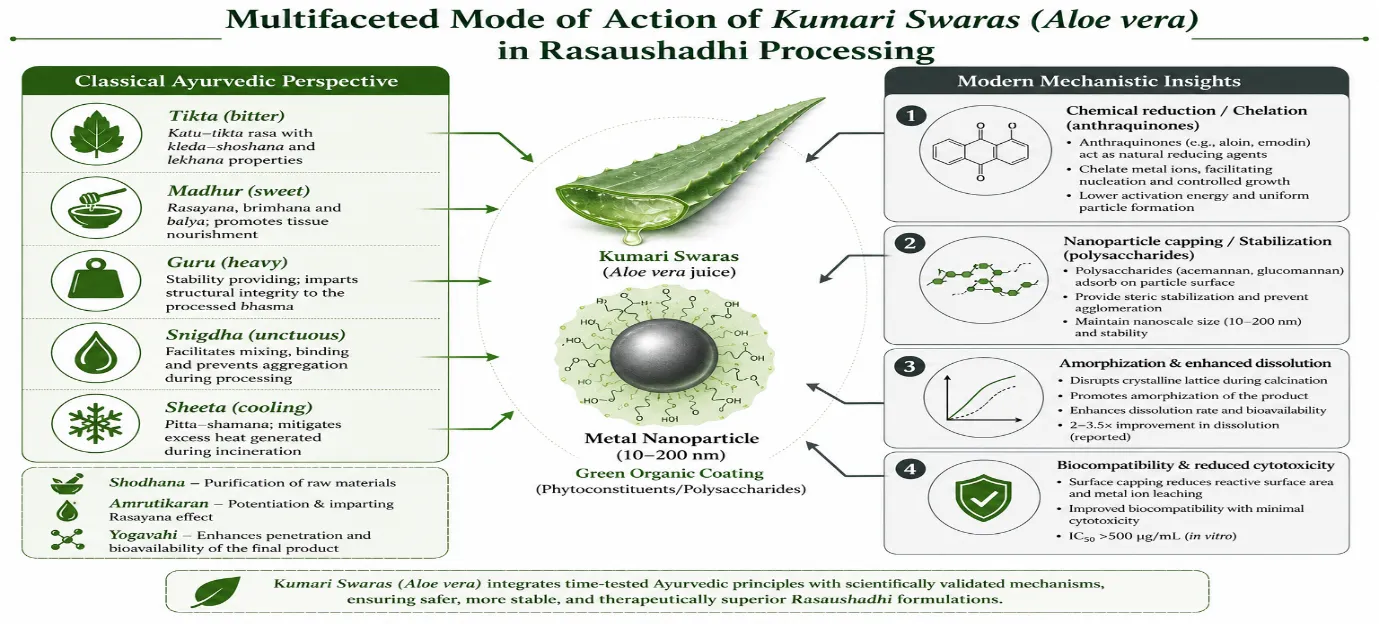
Figure 2: Multifaceted mode of action of Kumari Swaras in Rasaushadhi processing
4.3 Limitations
This review was not prospectively registered. Restricting the search to English/translated Sanskrit may have excluded relevant studies. Only 25% of the studies met the high-quality criteria; many lacked process details (e.g., drying temperature, batch consistency). The search ended in March 2026; therefore, recent advances may be missing. Publication bias was not formally assessed. NLAM entries are authentic but not peer-reviewed?.
4.4 Implications
Practitioners: Kumari Bhavana performed by reputable manufacturers yields Rasaushadhi with assured pharmaceutical quality and reduced toxicity.
Researchers should establish validated Standard Manufacturing Procedures, conduct multi?batch validation, and design robust clinical trials for zinc/iron deficiencies.
Regulators: Develop Bhavana process validation guidelines and Kumari reference standards to integrate these products into the mainstream healthcare.
CONCLUSION
This systematic review confirms that Kumari Swaras Bhavana induces key physicochemical transformations in Rasaushadhi: 42–96% particle size reduction (to 10–200 nm), 8–35% phytochemical weight gain, crystallographic changes, enhanced dissolution, and reduced cytotoxicity compared to unprocessed substrates. Twenty-five? classical formulations were identified using this process. However, the Bhavana parameters vary widely, with only 25% of studies meeting high-quality criteria, and only one clinical study exists, indicating a major translational gap. The convergence of classical Rasashastra with modern analytics offers opportunities for standardized herbomineral formulations, requiring interdisciplinary collaboration to validate the processes and generate clinical evidence.
ACKNOWLEDGEMENTS
None.
CONFLICT OF INTEREST
None declare.
FUNDING SOURCES
None.
REFERENCES

Dr. Pathan Saniya Khan, Dr. Manisha Goyal, Prof. (Dr.) Govind Sahay Shukla, Dr. Rajaram Agrawal, Dr. Ravi Pratap Singh, Dr. Shahadat KhanKumari Swaras (Aloe vera) Bhavana in Rasaushadhi: A Systematic Review of Pharmaceutical Processing, Physicochemical Transformations, and Therapeutic Implications, Int. J. of Pharm. Sci., 2026, Vol 4, Issue 7, 1669-1683, https://doi.org/10.5281/zenodo.21264617
 10.5281/zenodo.21264617