

We use cookies to ensure our website works properly and to personalise your experience. Cookies policy
YSPM’s Yashoda Technical Campus, Faculty of Pharmacy, Wadhe, Satara
Green chemistry involves developing sustainable chemical processes that generate minimal waste, energy savings, and toxic elements. For the current experiment, the synthesis of Phenytoin was done through microwave technology as opposed to traditional heating methods. The advantages of microwave irradiation include shortened reaction time, high yield, use of less solvent, and saving energy, thus qualifying as an efficient technique under green chemistry. In this study, benzil and urea were used as raw materials to prepare phenytoin under the assistance of an adequate catalyst via microwave irradiation. The obtained product was further purified and analyzed based on its melting point, solubility, and percent yield. The synthesized compound was further confirmed via UV spectrophotometric studies. The absorption measurement was done at a wavelength of 222 nm, yielding ? max that confirms the formation of phenytoin. As far as the synthetic process with microwave technology assistance is concerned, it was found that the process was rapid and quite efficient for producing phenytoin with reduced impact on the environment when compared with conventional processes. In this way, the research has highlighted the importance of green chemistry in pharmaceutical synthesis in particular.
Organic Synthesis Using Microwave Radiation (MAS) makes use of microwave radiation, usually at a frequency of 2.45 GHz, to heat the reaction mixture. Since its inception in synthetic laboratories in the late 1980s and early 1990s, MAS has become a routine practice for speeding up the reaction, improving selectivity, and performing solventless or solvent-minimized reactions in accordance with the concepts of green chemistry. Modern day specialized microwave reactors for chemistry allow precise power control, stirring, and pressure/temperature feedback.
2. Historical background :
The first systematic recording of microwave enhancement of organic reactions dates back to the late 1980s and early 1990s, while reviews highlighting its importance emerged during the early 2000s, propelling this method into the mainstream of synthetic chemistry. The next few decades saw advancements in technology design, enhanced interlocking mechanisms, and on-line monitoring capabilities which led to widespread use in both discovery and development applications.
3. Principles of Green Chemistry.
It is generally agreed that microwave-assisted organic synthesis (MAOS) is considered an important example of green chemistry since the process is in accordance with some of the 12 Principles of Green Chemistry as stated by Anastas and Warner. Energy conservation, shorter reaction times, solvent-free reactions, higher yields, and waste reduction are just some of the many benefits provided by the use of microwaves in organic synthesis
1. Waste Reduction: Microwave-assisted reactions typically take place at a faster rate with cleaner results than the conventional heating processes. With fast reactions and high selectivity, there is less production of byproducts that could lead to chemical waste. Many of the MAOS procedures do not require workup procedures or need minimal cleanup procedures, making waste reduction possible.
2. Atom Economy: Microwave heating makes cyclization, condensation, and multicomponent reaction more efficient. MAOS finds application mostly in MCRs (Ugi, Biginelli, Hantzsch) since these reactions are, by definition, atom economical, in which all reactants are incorporated into the final compound.
3. Less Production of Hazardous Chemicals: The use of microwave reactors enables reactions to take place:
a. Under more mild conditions.
b. In less hazardous solvents such as water, ethanol, polyethylene glycol (PEG), or glycerol.
c. Without any solvents at all.
4. Creating Safer Chemicals: Microwave techniques can enhance selectivity and minimize the production of harmful intermediates and by-products, thereby promoting cleaner methods for safer chemical synthesis.
5. Safer Solvents and Auxiliary MAOS fully conforms to this aspect because of the following reasons:
6. Energy Efficiency: The first sustainability benefit of MAOS is that it has the potential for dramatically reduced energy usage. Microwave heating is:
7. Renewable feedstocks the use of microwaves does not influence the source of feedstocks; however, the ability to use:
makes MAOS applicable to renewable reagent systems.
8. Reduce Derivatization: The microwave heating process reduces the need to use any protective groups or prolonged functionalization. The quick reactions and effective conversions reduce unnecessary derivatization according to this concept.
9. Catalysis
MAOS allows for:
10. Degradation Design: Using microwave technology to design materials and polymers whose degradation rate is improved. The ability to design clean products reduces the accumulation of persistent substances in the environment.
11. Real-time Analysis to Avoid Pollution: This means that it is necessary to have analytical methods developed to monitor and control the chemical reactions as they occur in real time. It helps to detect dangerous substances as they form before becoming pollutants. 1 Real-time monitoring of chemical reactions 2 Avoiding dangerous byproducts 3 Increases safety and quality of products 4 Reduces waste production
12. Inherently Safer Chemistry for Preventing Accidents: This approach is concerned with making use of safer chemicals and processes so that one can avoid dangers like explosions, fires, and toxic emissions.
Introduction of Experiment
The current experiment aims at investigating the microwave-assisted preparation of Phenytoin using the concept of green chemistry. Phenytoin is an important anticonvulsant drug that is widely used in the treatment of epilepsy among other conditions. The process of preparing phenytoin involves lengthy processes and uses considerable amounts of energy.
Microwave irradiation was used as an alternative heat source for the synthesis reaction in the present experiment. Microwave irradiation is known for uniform heat source, reduced reaction time, lower use of solvents, and higher yield production. It is considered to be a greener technique than traditional heating reactions.
The synthesis was done using benzil and urea as the starting compounds and a proper catalyst. The reaction took place quite fast due to microwave irradiation, yielding phenytoin. This was analyzed based on the melting point, percentage yield, and solubility of the compound. Further confirmation of the synthesis was obtained using a UV spectroscopy test with maximum wavelength at 222 nm.
This study illustrates the real-world use of green chemistry in the synthesis of pharmaceuticals and emphasizes the benefits of microwave-assisted methods in minimizing environmental effects while enhancing reaction efficiency.
Microwave technology is an example of modern heating technologies that are widely applied in chemical and pharmaceutical studies to quickly synthesize chemical compounds. Microwaves are types of electromagnetic waves whose frequencies range between 300 MHz and 300 GHz. During the process of synthesizing compounds using microwaves, the microwaves interact with the molecules of compounds and cause quick heating through processes such as ionic conduction and dipole rotation.
The microwave system refers to a modern approach to heat generation that is widely used within scientific investigation in the field of chemistry and pharmaceutics as a means for the fast creation of various compounds. Microwaves can be defined as electromagnetic waves whose frequency varies between 300 MHz and 300 GHz. During the process of microwave-assisted synthesis, microwaves interact with molecules by causing their rapid warming via dipole rotation or ionic conduction.
In the present study, the microwave technique was used in synthesizing Phenytoin. The two starting materials that were used were benzil and urea, and they were exposed to microwave irradiation for a relatively shorter time. The use of microwaves helped in speeding up the reaction and facilitated the production of phenytoin in less time than conventional methods.
In this experiment, the use of microwave technology provided several advantages, which included: Reaction time was reduced Lower energy usage Increased percentage yield Low solvent demand Environmentally friendly process Simple and rapid synthesis method.
After the synthesis process, the synthesized phenytoin was then analyzed through the determination of its melting point, percent yield, and UV spectrophotometry of the compound using wavelength of 222 nm. The successful synthesis served to prove the efficiency of microwave technology as an effective method in pharmaceutical chemistry.
Derivation and Methodology :
Phenytoin synthesis entails the interaction between benzil and urea in the presence of a base under microwave irradiation conditions. There is a cycle in this reaction, whereby a hydantoin ring is formed, which constitutes phenytoin.
Reaction :
Chemical Reaction :
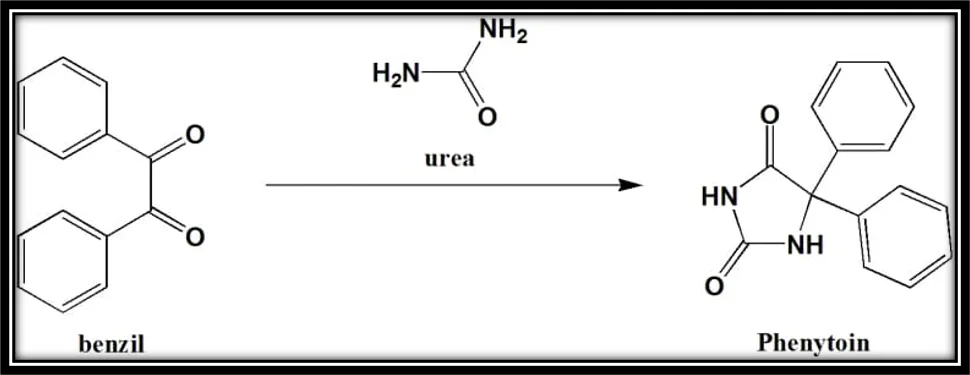
Procedure for Microwave Method Of Phenytoin:
Materials Requried :
Chemicals
Apparatus Required:
Experimental Procedure :
Calculations :
Molecular weight of Benzyl is 210.23gm/mol.
Molecular weight of urea is 60.06gm /mol.
Molecular weight of phenytoin is 252.26gm/mol.
Practical Yield : 2.3gm
Theoretical Yield : 252.26×2.10210.23

Theoretical Yield : 2.51gm.
Formula :
Percentage Yield : Practical yield / theoretical yield × 100
Percentage yield : 2.32.51

Percentage Yield : 91.63 % w/w
Result :
Phenytoin was successfully synthesized by microwave-assisted method & Percentage Yield is obtained 91.63 % w/w. This method was fast, economical, and environmentally friendly.
Identification Tests :
Phenytoin +Cobalt / pyridine : Purple colour.
C : Reaction with Acetone :
Phenytoin +Acetone : Clear Solution
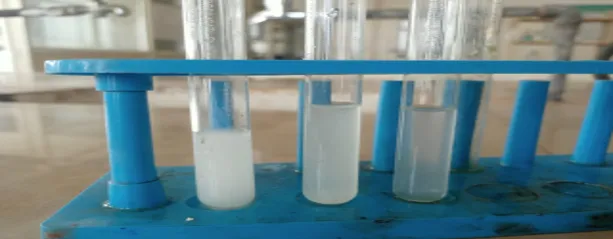
2..UV Spectroscopy :
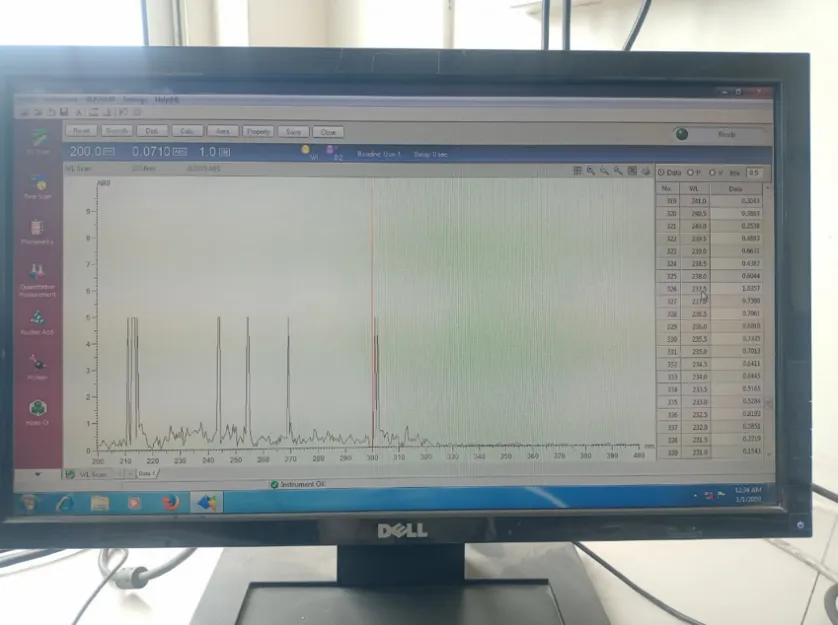
Materials Required :
Preparation of Standard Solution :
1. Accurately weigh about 10 mg of Phenytoin.
2.Dissolve it in a small quantity of ethanol.
3.Transfer into a 100 mL volumetric flask and make up the volume with solvent.
4.This gives a stock solution (100 µg/mL). Switch on the UV spectrophotometer .
5.Set wavelength range between 200–400 nm.
6.Fill quartz cuvette with blank (solvent) and calibrate.
7.Replace blank with sample solution.
8.Record the absorption spectrum.
9.Note the λmax (maximum absorbance.
Observation :
Phenytoin Shows λmax (maximum absorbance is 237.5nm
Result :
The observed λmax confirms the presence of Phenytoin.
Assay of Phenytoin :
Procedure :
Reading : 16ml.
Calculations:
Assay (%) : V×N ×Eq.wt ×100

W × 100
Standard Factor Often Used
1ml of 0.1 N NaoH ~ 0.02523 g of phenytoin .
Volume used : 16ml .
Sample Taken : 0.5g
Amount : 16 × 0.02523 = 0.40368 g
Assay = 0.403680.5

× 100 = 80.74%
Comparison :
|
Parameter |
Titration method |
UV Spectrophotometry |
|
Principle |
Neutralization |
Absorbance measurement |
|
Instrument |
Simple glassware |
UV spectrophotometry |
|
Accuracy |
Moderate |
High |
|
Sensitivity |
Less |
More |
|
Time |
More |
Less |
|
Cost |
Low |
High |
|
End Point |
Colour Change |
Digital Absorbance |
|
Use |
Routine Assay |
Precise Analysis |
RESULT
The characterization of synthetic phenytoin was done through UV spectroscopy and titration methods. The UV spectroscopy gave a characteristic absorption peak at 237.5 nm, giving more precise, sensitive, and fast results. On the other hand, the titration method was simple and affordable but less sensitive compared to the first one. These two methods confirmed the synthesis of phenytoin.
DISCUSSION
Phenytoin synthesis was performed through microwave-assisted synthesis method, which complies with the tenets of green chemistry. Microwave technology proved to be rapid, efficient, and eco-friendly when contrasted with conventional heating techniques. This method involves subjecting the reaction mixture to microwave energy, which uniformly heats the mixture and reduces the time of the reaction.
The synthesized product was obtained in the form of a white crystalline powder, and its yield was within acceptable limits. Its physical properties indicated that the synthesis of phenytoin had been accomplished successfully. Microwave-assisted synthesis called for lesser use of solvents and less consumption of energy resources, which made it fall in line with the principles of green chemistry. It took lesser time to complete the synthesis reaction using microwaves.The identification of synthesized phenytoin was confirmed by UV spectrophotometry. The compound showed characteristic absorption maximum at:
λmax : 237.5nm
The measured absorbance was sufficient to confirm both the presence and the purity of phenytoin. The method of UV spectrophotometry provided a precise and accurate way of analyzing the substance synthesized. Further methods of confirmation such as the measurement of the melting point were conducted.
The determination of phenytoin has been carried out by UV spectrophotometry as well as the titration technique. It has been observed that the UV spectrophotometric technique is more accurate, faster, and more sensitive than the titration technique. However, the latter is relatively simpler and economical, but less sensitive compared to the former technique.
To conclude, it is fair to say that microwave synthesis proved to be an efficient way of making phenytoin. It has a number of advantages, such as reduced duration of the reaction, increased productivity, reduced use of solvents, and environmental friendliness. Therefore, microwave synthesis can be considered a promising approach for creating pharmaceuticals.
CONCLUSION
Phenytoin Synthesis Under Microwave Assistance Could Be Carried Out Successfully Through Green Chemistry Technique. Microwave Irradiation technique appeared to be rapid, effective, and environmentally friendly as compared to conventional methods. The compound formed showed good results and possessed properties similar to normal phenytoin.
The identification tests, which encompassed UV spectrophotometry, melting point determination, and solubility assessments, validated the successful synthesis of phenytoin. The UV spectrophotometric evaluation revealed a distinctive absorbance at:
λmax : 237.5nm
which validated the purity and identity of the synthesized compound.
Results obtained through UV spectrophotometry and titration showed that the purity of the product was satisfactory. Comparing the two methods, UV spectrophotometry emerged as a more accurate, sensitive, and rapid method compared to titration. Results obtained through UV spectrophotometry and titration showed that the purity of the product was satisfactory. Comparing the two methods, UV spectrophotometry emerged as a more accurate, sensitive, and rapid method compared to titration.
In summary, the project illustrated that microwave-assisted synthesis is a straightforward, cost-effective, and eco-friendly method for producing phenytoin with high quality and yield.
REFERENCES


Pranav Gaikwad, Dr. Rasika Devale, Microwave Assisted Synthesis of Phenytoin, Int. J. of Pharm. Sci., 2026, Vol 4, Issue 6, 3953-3961. https://doi.org/10.5281/zenodo.20722336
 10.5281/zenodo.20722336