View Article

Abstract

Nanoemulsions (NEs) are advanced colloidal systems composed of oil, water, surfactants, and co-surfactants, with droplet sizes typically ranging from 20 to 200 nm. Their nanoscale dimensions confer unique properties such as high surface area, kinetic stability, and enhanced solubilization of poorly water-soluble drugs. These characteristics make NEs a promising platform in pharmaceutical development for improving bioavailability, targeted delivery, and therapeutic efficacy. This review explores the fundamentals of nanoemulsion systems, formulation strategies, methods of preparation, characterization techniques, stability considerations, and diverse pharmaceutical applications. Safety, regulatory considerations, and future perspectives including stimuli-responsive and personalized Nano emulsions are also discussed to provide a comprehensive understanding of this versatile drug delivery system

Keywords

Nano emulsion, drug delivery, bioavailability enhancement, formulation strategies, characterization, stability

Introduction

× Popup Image

Drug delivery systems have evolved significantly over the past few decades, aiming to overcome limitations associated with conventional dosage forms such as poor solubility, low bioavailability, and lack of site-specific targeting. Among the various colloidal carriers developed, nanoemulsions have emerged as a promising platform due to their unique physicochemical properties and versatile applications in pharmaceutical sciences. Nanoemulsions are kinetically stable, isotropic dispersions of oil and water stabilized by surfactants, with droplet sizes typically ranging between 20–200 nm. Their small droplet size confers advantages such as enhanced solubilization of hydrophobic drugs, improved absorption, controlled release, and protection of labile compounds from degradation. [1-2]

The formulation of nanoemulsions involves careful selection of oils, surfactants, and co-surfactants, along with optimization of preparation techniques such as high-pressure homogenization, ultrasonication, or spontaneous emulsification. Characterization of these systems is equally critical, encompassing parameters like droplet size distribution, zeta potential, viscosity, and stability, which directly influence their therapeutic performance. Furthermore, nanoemulsions offer flexibility in routes of administration including oral, parenteral, topical, and pulmonary making them suitable for a wide range of therapeutic agents.

Pharmaceutical applications of nanoemulsions span diverse areas, from enhancing the bioavailability of poorly water-soluble drugs to enabling targeted delivery in cancer therapy, vaccines, and central nervous system disorders. Their ability to cross biological barriers and provide sustained release profiles positions them as a cutting-edge technology in modern drug delivery research. Despite these advantages, challenges such as long-term stability, scale-up feasibility, and regulatory considerations remain areas of active investigation. [3-5]

This review aims to provide a comprehensive overview of formulation strategies, characterization techniques, and pharmaceutical applications of nanoemulsions, highlighting their potential as next-generation drug delivery systems while addressing current limitations and future perspectives.
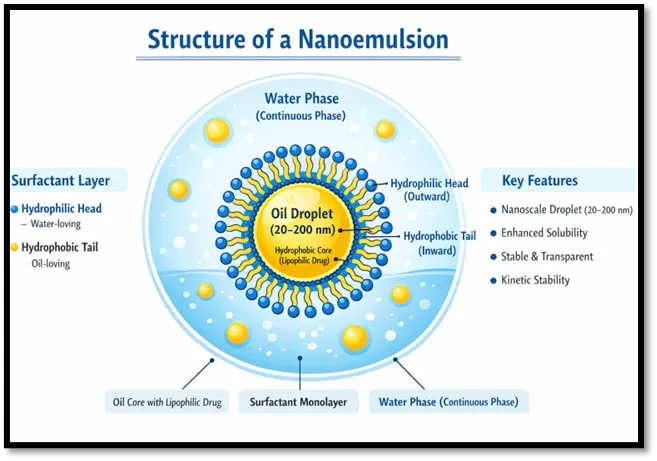


Fig No. 1: Graphical diagram of a nanoemulsion structure


  • Oil droplet (core with drug)
  • Surfactant monolayer
  • Hydrophilic heads (outward)
  • Hydrophobic tails (inward)
  • Continuous water phase

Key features (size, stability, solubility)

1. Introduction

The development of novel therapeutic agents often faces challenges such as poor aqueous solubility, low bioavailability, rapid metabolism, and inconsistent therapeutic responses. Traditional formulations like tablets, capsules, or conventional emulsions frequently fail to overcome these limitations. Nanotechnology-based drug delivery platforms, including liposomes, solid lipid nanoparticles, nanocrystals, and nanoemulsions, have emerged as viable solutions to these challenges. Among these, nanoemulsions have gained widespread interest due to their small droplet size, thermodynamic or kinetic stability, and versatility in administration routes. Nanoemulsions are isotropic, thermodynamically or kinetically stable dispersions of two immiscible liquids stabilized by surfactants and co-surfactants. Unlike conventional emulsions with droplet sizes in the micrometer range, nanoemulsions have droplet sizes in the nanometer range (20–200 nm), providing advantages such as improved solubility, enhanced absorption, and controlled drug release. [6-8]

1.1. Mechanistic Understanding of Drug Delivery

Nanoemulsions improve drug delivery through several interconnected biopharmaceutical mechanisms. Absorption enhancement is achieved by increasing the surface area of drug-loaded droplets, which accelerates the dissolution rate. Their interaction with intestinal membranes facilitates drug permeation, while promotion of lymphatic transport allows drugs to bypass hepatic first-pass metabolism, thereby improving systemic bioavailability. At the cellular level, nanoemulsions enhance cellular uptake via endocytosis pathways, including clathrin-mediated and caveolae-mediated mechanisms, and through direct fusion with biological membranes due to lipid compatibility. Furthermore, nanoemulsions enable controlled release of drugs through diffusion processes, droplet degradation, and modulation of the partition coefficient, ensuring sustained therapeutic action.

Nanoemulsions improve drug delivery via multiple biopharmaceutical mechanisms:

(A) Absorption Enhancement

  • Increased surface area enhanced dissolution rate
  • Interaction with intestinal membranes
  • Promotion of lymphatic transport, bypassing hepatic first-pass metabolism


(B) Cellular Uptake

  • Endocytosis pathways:

1) Clathrin-mediated

2) Caveolae-mediated

  • Fusion with biological membranes (lipid compatibility)

(C) Controlled Release

  • Diffusion
  • Droplet degradation
  • Partition coefficient

1.2. Extended Formulation Science

The formulation of nanoemulsions is governed by several critical formulation variables (CFVs), including the polarity of the oil phase, the hydrophilic-lipophilic balance (HLB) of the surfactant, the surfactant-to-co-surfactant ratio (Smix), and the phase volume ratio. These parameters collectively determine droplet size, stability, and drug-loading efficiency. A valuable tool in formulation optimization is the pseudo-ternary phase diagram, which graphically represents the proportions of oil, water, and surfactant/co-surfactant mixture. This diagram helps identify the nanoemulsion region, guiding researchers toward stable and effective formulations. Preparation methods are broadly classified into high-energy and low-energy techniques. High-energy methods, such as high-pressure homogenization and ultrasonication, overcome interfacial tension through mechanical force, generating intense shear that disrupts droplets into nanoscale dimensions. In contrast, low-energy methods rely on phase transition phenomena, where spontaneous curvature changes in the surfactant film drive nanoemulsion formation. A notable example is the phase inversion temperature (PIT) method, which exploits the temperature-dependent solubility of non-ionic surfactants to achieve spontaneous emulsification. [9-14]

Critical Formulation Variables (CFVs)

  • Oil phase polarity
  • Hydrophilic-lipophilic balance (HLB) of surfactant
  • Surfactant-to-co-surfactant ratio (Smix)
  • Phase volume ratio

Pseudo-Ternary Phase Diagram (Concept)

A triangular diagram representing:

  • Oil
  • Water
  • Surfactant/co-surfactant mixture
  • This diagram identifies the nanoemulsion region, crucial for formulation optimization.

Preparation Methods - Deeper Insight

  • High-Energy Methods (Mechanism)
  • Overcome interfacial tension using mechanical force
  • Generate intense shear droplet disruption

Low-Energy Methods (Mechanism)

  • Based on phase transition phenomena
  • Spontaneous curvature changes in surfactant film

Example:

PIT method exploits temperature-dependent solubility of nonionic surfactants.

1.3 Stability Science (Advanced)

Despite their advantages, nanoemulsions are prone to instability due to several physicochemical processes. Ostwald ripening occurs when smaller droplets dissolve and redeposit onto larger droplets, driven by solubility differences. Coalescence results from film rupture and droplet merging, while creaming or sedimentation arises from density differences between dispersed and continuous phases, as described by Stoke’s law. To mitigate these instability mechanisms, researchers employ strategies such as incorporating ripening inhibitors (e.g., long-chain triglycerides), optimizing surfactant concentration to strengthen interfacial films, and reducing the polydispersity index (PDI) to achieve uniform droplet size distribution. These approaches collectively enhance the long-term stability and therapeutic reliability of nanoemulsion-based drug delivery systems. [15-18]

Major Instability Mechanisms:

1. Ostwald Ripening

  • Driven by solubility differences
  • Smaller droplets dissolve larger droplets grow

2. Coalescence

Film rupture droplet merging

3. Creaming/Sedimentation

Governed by Stoke's law

Prevention Strategies:

  • Use of ripening inhibitors (e.g., long-chain triglycerides)
  • Optimizing surfactant concentration
  • Reducing polydispersity index (PDI) [19-23]

1.4 Characterization - Expanded Scientific Tools

Parameter

Advanced Technique

Significance

Droplet size

DLS, Cryo-TEM

Stability & absorption

Surface charge

Zeta potential

Electrostatic repulsion

Morphology

TEM/SEM

Structural confirmation

Thermal behavior

DSC

Phase transitions

Molecular interaction

FTIR

Drug-excipient compatibility

2. CLASSIFICATION OF EMULSIONS AND NANOEMULSIONS

2.1 Conventional Emulsions

Conventional emulsions are heterogeneous systems formed by dispersing one immiscible liquid into another, stabilized by surfactants. They are broadly classified into three types based on the nature of the dispersed and continuous phases:
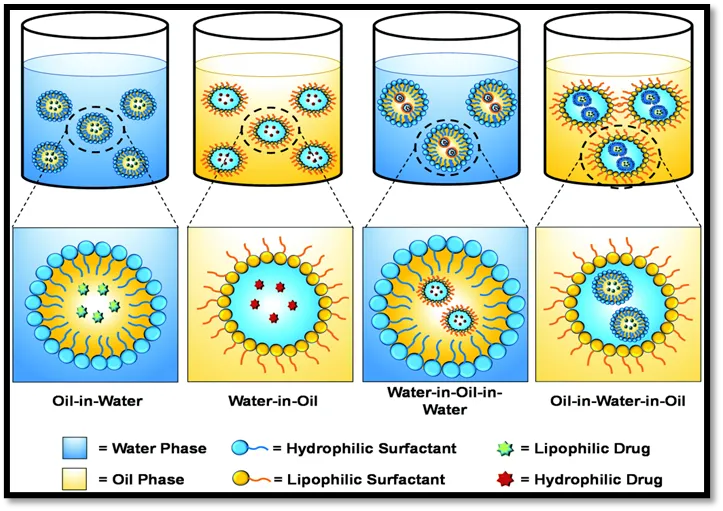
  • Oil-in-water (O/W): It consist of oil droplets dispersed in an aqueous phase and are widely employed in oral and topical drug delivery due to their ease of administration and patient acceptability.
  • Water-in-oil (W/O):  Water droplets dispersed in oil; used for sustained-release formulations.
  • Multiple emulsions (W/O/W or O/W/O): Complex systems with inner and outer dispersed phases; utilized for controlled or sequential drug release. [24,25]


Fig No. 2: Type of various conventional emulsions


2.2 Nanoemulsions

Nanoemulsions differ from conventional emulsions primarily in their droplet size, which typically falls within the nanometre range, imparting transparency or translucency and enhanced kinetic stability. Based on composition, they can be categorized into three types:
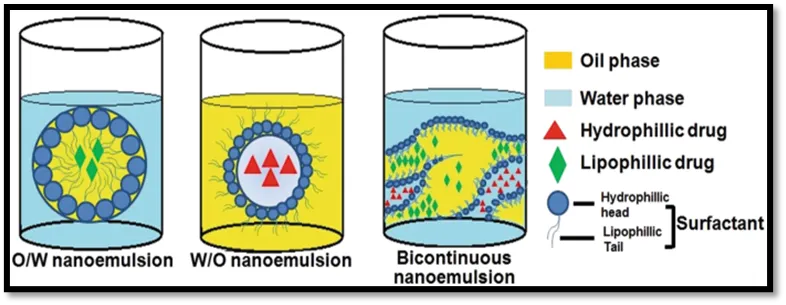


Fig No. 3: Type of various nanoemulsions


  • O/W nanoemulsions: Oil dispersed in water; widely used for hydrophobic drug delivery.
  • W/O nanoemulsions: Water dispersed in oil; suitable for sustained drug release.
  • Bi-continuous nanoemulsions: Interpenetrating networks of oil and water; useful for dual drug delivery. [26,27,28]

3. ADVANTAGES OF NANOEMULSIONS IN DRUG DELIVERY

Nanoemulsions possess several advantages that make them superior carriers for poorly soluble drugs:

  • Enhanced Solubility: Lipophilic drugs dissolve efficiently in the oil phase.
  • Improved Bioavailability: Small droplet size promotes rapid absorption and lymphatic transport.
  • Protection from Degradation: Drugs are shielded from enzymatic or chemical degradation.
  • Targeted Delivery: Functionalized surfactants can facilitate tissue-specific or intracellular targeting.
  • Dose Reduction: Higher bioavailability allows for lower doses, reducing side effects.
  • Versatile Administration Routes: Oral, topical, parenteral, ocular, and nasal delivery are all feasible.

These attributes enable nanoemulsions to address solubility, stability, and pharmacokinetic limitations of conventional dosage forms. [29,30,31]

4. FORMULATION COMPONENTS OF NANOEMULSIONS

The composition of nanoemulsions plays a critical role in determining their stability, drug-loading capacity, and release characteristics. Each component oils, surfactants, and co-surfactants must be carefully selected to achieve the desired physicochemical and biopharmaceutical properties.

4.1 Oils

Oils serve as the solubilizing medium for hydrophobic drugs and significantly influence the release profile and absorption characteristics of nanoemulsions. Medium-chain triglycerides (MCTs) are rapidly digested and absorbed, thereby enhancing drug bioavailability. In contrast, long-chain triglycerides (LCTs) provide sustained-release properties, making them suitable for prolonged therapeutic action. Oleic acid is often incorporated to improve permeability and solubilization, while isopropyl myristate is frequently used in topical formulations due to its skin penetration-enhancing properties. Long-chain triglycerides (LCTs): Provide sustained release properties.

  • Oleic acid: Enhances permeability and solubilization.
  • Isopropyl myristate: Often used in topical formulations.

4.2 Surfactants

Surfactants are essential for reducing interfacial tension and stabilizing nanoemulsions. Commonly used surfactants include polysorbates (Tween 20, Tween 80), which are non-ionic, biocompatible, and associated with low toxicity. Lecithin, a natural phospholipid, is widely employed as a stabilizer and is particularly suitable for parenteral delivery due to its biocompatibility. Cremophor EL is another effective solubilizer for hydrophobic drugs, though its use may be limited by hypersensitivity reactions in certain patients. Polysorbates (Tween 20, Tween 80): Nonionic, biocompatible surfactants with low toxicity.

  1. Lecithin: Natural phospholipid stabilizer, ideal for parenteral delivery.
  2. Cremophor EL: Solubilizes hydrophobic drugs but may cause hypersensitivity in some patients.


4.3 Co-surfactants

Co-surfactants complement surfactants by enhancing the flexibility of the interfacial film and improving overall stability. Common examples include ethanol, propylene glycol, and polyethylene glycol (PEG 400). The choice of co-surfactant depends on factors such as drug solubility, the intended route of administration, and regulatory acceptance. Together, surfactants and co-surfactants determine the robustness of the nanoemulsion system and its suitability for clinical applications. [32-36]

  • Propylene glycol
  • Polyethylene glycol (PEG 400)

5. METHODS OF PREPARATION OF NANOEMULSIONS

5.1 High-Energy Methods

High-energy methods rely on mechanical forces to reduce droplet size and generate stable nanoemulsions. High-pressure homogenization involves passing coarse emulsions through narrow gaps at extremely high pressures, resulting in nanoscale droplets with uniform distribution. Ultrasonication employs ultrasonic waves to induce cavitation, which disrupts larger droplets into smaller ones. Similarly, micro fluidization forces emulsions through microchannels at high pressure, producing highly uniform droplets with narrow size distribution. These techniques are advantageous because they are suitable for large-scale production, reproducible, and effective even for viscous systems. However, they require high energy input, involve expensive equipment, and may cause thermal degradation of heat-sensitive drugs.

Advantages: Suitable for large-scale production, reproducible, effective for viscous systems.

Disadvantages: High energy input, expensive equipment, potential thermal degradation.

5.2 Low-Energy Methods

Low-energy methods exploit spontaneous emulsification phenomena, relying on changes in interfacial tension or phase inversion to form nanoemulsions. The phase inversion temperature (PIT) method utilizes the temperature-dependent solubility of non-ionic surfactants, where heating and cooling cycles induce inversion of emulsions. The phase inversion composition (PIC) method, on the other hand, is based on gradual changes in phase composition, leading to spontaneous formation of nanoscale droplets. These approaches are gentle, cost-effective, and particularly suitable for heat-sensitive drugs. However, their applicability is limited to specific surfactant–oil–water systems, which restricts their universality in pharmaceutical formulations. [37-39]

Advantages: Gentle, cost-effective, suitable for heat-sensitive drugs.

Disadvantages: Limited to specific surfactant-oil-water systems.

STEPS FOR PREPARATION OF NANOEMULSIONS
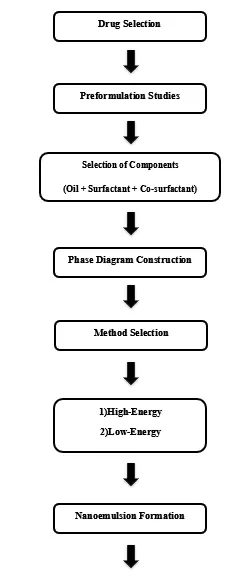


6. CHARACTERIZATION OF NANOEMULSIONS

Comprehensive characterization of nanoemulsions is essential to ensure their quality, reproducibility, and long-term stability, as these parameters directly influence therapeutic performance.

6.1 Droplet Size and Polydispersity Index (PDI)

Droplet size and distribution are typically measured using dynamic light scattering (DLS). A low polydispersity index (PDI), generally less than 0.3, indicates a uniform size distribution, which is critical for stability and predictable drug release.

6.2 Zeta Potential

Zeta potential reflects the surface charge of droplets and serves as an indicator of electrostatic stability. Values greater than ±30 mV suggest strong repulsive forces between droplets, thereby minimizing aggregation and coalescence.

6.3 Viscosity and Rheology

Viscosity and rheological behaviour are particularly important for topical, ocular, and parenteral formulations. These properties influence the ease of administration, spread ability, and drug release profile, making them key parameters in formulation optimization.

6.4 Drug Content and Entrapment Efficiency

Drug content and entrapment efficiency provide insights into the effectiveness of drug incorporation within the nanoemulsion system. High entrapment efficiency is desirable, as it ensures maximum therapeutic payload. These parameters are commonly determined using analytical techniques such as high-performance liquid chromatography (HPLC) or UV spectroscopy.

6.5 In vitro Drug Release Studies

In vitro drug release studies are conducted using dialysis or diffusion methods to simulate drug release kinetics. These studies provide predictive information about in vivo pharmacokinetics and help in correlating formulation properties with therapeutic outcomes. [40,41,42]

7. Stability of Nanoemulsions

Nanoemulsions are kinetically stable but may experience:

  • Ostwald ripening: Small droplets dissolve into larger droplets; mitigated with ripening inhibitors.
  • Coalescence: Droplets merge; reduced with appropriate surfactant selection.
  • Phase separation: Addressed by optimizing composition and storage conditions.
  • Stability Testing: Centrifugation, heating–cooling cycles, freeze–thaw studies, and long-term storage analyses. [43]

8. PHARMACEUTICAL APPLICATIONS OF NANOEMULSIONS

8.1 Oral Drug Delivery

Nanoemulsions have demonstrated significant potential in oral drug delivery by enhancing the solubility and gastrointestinal absorption of lipophilic drugs. Their nanoscale droplets increase the dissolution rate and facilitate lymphatic transport, thereby improving bioavailability. Notable examples include anticancer agents such as paclitaxel, antiretroviral drugs like efavirenz, and nutraceuticals including curcumin and omega-3 fatty acids, all of which benefit from improved pharmacokinetic profiles when formulated as nanoemulsions. [44,45]

Nanoemulsions enhance solubility and absorption of lipophilic drugs like:

  • Anticancer agents (paclitaxel)
  • Antiretrovirals (efavirenz)
  • Nutraceuticals (curcumin, omega-3 fatty acids)

8.2 Topical and Transdermal Delivery

In topical and transdermal applications, nanoemulsions enhance skin penetration through their small droplet size and surfactant-mediated permeation effects. This property makes them particularly useful for delivering anti-inflammatory and antifungal agents, as well as active ingredients in cosmetic formulations. Their ability to bypass the stratum corneum barrier provides improved therapeutic efficacy and patient compliance. Enhances skin penetration via nanodroplets and surfactant-mediated permeation; used for anti-inflammatory, antifungal, and cosmetic agents. [46]

8.3 Parenteral Delivery

Oil-in-water (O/W) nanoemulsions are widely employed in parenteral drug delivery due to their capacity for rapid systemic distribution, targeted delivery, and reduced toxicity. They serve as carriers for lipid-based intravenous drugs, offering enhanced stability and controlled release while minimizing adverse effects. O/W nanoemulsions enable rapid systemic delivery, targeted drug delivery, and reduced toxicity; used in formulations like lipid-based intravenous drugs. [47]

8.4 Ocular and Nasal Delivery

Nanoemulsions are also advantageous in ocular and nasal drug delivery systems, where they improve residence time, enhance permeation across corneal and nasal mucosa, and provide sustained release. These properties are particularly beneficial in the management of conditions such as glaucoma and nasal infections, where localized and prolonged drug action is desired. Nanoemulsions improve residence time, enhance permeation through corneal and nasal mucosa, and provide controlled release for conditions like glaucoma or nasal infections. [48-50]

9. Applications - Expanded Scope

Emerging fields of application include cancer nanomedicine, where nanoemulsions enable targeted chemotherapy with reduced systemic toxicity, and gene delivery systems, which exploit their ability to encapsulate and protect nucleic acids. Nanoemulsions are also being investigated as vaccine adjuvants, enhancing immune responses, and as carriers for brain-targeted therapies via the intranasal route. Clinically, these systems improve pharmacokinetics, optimize pharmacodynamics, and increase the therapeutic index of diverse drug classes. [49]

Emerging Fields:

  • Cancer nanomedicine (targeted chemotherapy)
  • Gene delivery systems
  • Vaccines (nanoemulsion adjuvants)
  • Brain targeting via intranasal route

Clinical Relevance:

Nanoemulsions enhance:

  • Pharmacokinetics (PK)
  • Pharmacodynamics (PD)
  • Therapeutic index

10. Critical Scientific Evaluation

Nanoemulsions offer several strengths, including high drug loading capacity, versatility across multiple administration routes, and enhanced bioavailability of poorly soluble drugs. However, limitations persist, such as the risk of surfactant-induced toxicity, their kinetic rather than thermodynamic stability, and challenges associated with large-scale manufacturing and reproducibility.

Strengths:

  • High drug loading
  • Versatile delivery routes
  • Enhanced bioavailability

Limitations:

  • Surfactant toxicity risk
  • Kinetic (not thermodynamic) stability
  • Scale-up challenges

11. Safety and Regulatory Considerations

Although nanoemulsions often employ excipients that are generally recognized as safe (GRAS), potential safety concerns remain. These include surfactant-related toxicity, irritation, sensitization, and risks associated with long-term systemic exposure. Regulatory authorities such as the FDA and EMA mandate comprehensive physicochemical characterization, toxicity and biocompatibility assessments, and stability testing under International Council for Harmonisation (ICH) guidelines before approval. These requirements ensure that nanoemulsion-based formulations meet rigorous standards for safety, efficacy, and quality. [51-60]

Despite using generally recognized as safe (GRAS) excipients, potential issues include:

  • Surfactant-induced toxicity
  • Irritation or sensitization
  • Long-term systemic exposure

Regulatory guidelines (FDA, EMA) require:

  • Comprehensive physicochemical characterization
  • Toxicity and biocompatibility studies
  • Stability testing under ICH conditions

FUTURE PERSPECTIVES

Emerging trends in nanoemulsion research are focused on advancing their therapeutic precision, safety, and adaptability. Targeted nanoemulsions are being developed through surface modification with ligands, enabling site-specific drug delivery and minimizing off-target effects. Another promising direction involves stimuli-responsive systems, which are engineered to respond to physiological triggers such as pH, temperature, or enzymatic activity, thereby allowing controlled and on-demand drug release. The use of biodegradable and natural nanoemulsions is also gaining attention, as these systems reduce toxicity risks and enhance biocompatibility, making them more suitable for long-term clinical use.

Integration of nanoemulsions with personalized medicine represents a transformative approach, where formulations can be tailored to individual patient pharmacokinetics and pharmacodynamics, ensuring optimized therapeutic outcomes. Furthermore, the adoption of quality-by-design (QbD) principles and the application of artificial intelligence-guided formulation strategies are expected to accelerate the translation of nanoemulsion technologies from laboratory research into clinical practice, improving reproducibility, scalability, and regulatory compliance.

CONCLUSION

Nanoemulsions represent a versatile and highly effective drug delivery system capable of addressing critical challenges related to solubility, stability, and bioavailability. Their unique physicochemical properties, ease of formulation, and adaptability across multiple administration routes including oral, topical, parenteral, ocular, and nasal position them as a cornerstone of modern pharmaceutics. Continued research into targeted, stimuli-responsive, and biodegradable nanoemulsions promises to expand their therapeutic potential, enhance patient safety, and strengthen their clinical relevance. With ongoing advancements in formulation science and regulatory frameworks, nanoemulsions are poised to play a pivotal role in the future of drug delivery and personalized medicine.

REFERENCES

  1. Mustafa MA, Rasheed N, Farooq H, Fazal M, Asif E, Shafiq H, Amin M, Jaan G, Nadeem A, Farooq T, Fatima N, Ahmad S, Iqbal MZ. Formulation techniques, characterization of nanoemulsion and their pharmaceutical applications: a comprehensive technical review. ‘J Pharm Res Int.’ 2024;36(2):12–27. ([IMSEAR Repository][1])
  2. Amin N, Das B. A review on formulation and characterization of nanoemulsion. ‘Int J Curr Pharm Res.’ 2019;11(4):xx–xx. ([Innovare Academics Journals][2])
  3. Changediya VV, Jani R, Kakde P. A review on nanoemulsions: a recent drug delivery tool. ‘J Drug Deliv Ther.’ 2019;9(5):185–191. ([JDDT][3])
  4. Shah P, Bhalodia D, Shelat P. Nanoemulsion: a pharmaceutical review. ‘Sys Rev Pharm.’ 2010;1(1):xx–xx. ([Systematic Reviews in Pharmacy][4])
  5. Verma NK, Singh AK, Yadav V, Mall PC, Jaiswal R. A review on nanoemulsion based drug delivery system. ‘Int J Pharm Pharm Sci.’ 2019;1(1):30–38. ([pharmacyjournal.org][5])
  6. Nan N, Ande SN, Chavhan SA, et al. A critical review on nanoemulsion: advantages, techniques and characterization. ‘World J Adv Res Rev.’ 2021;11(3):462–473. ([Wjarr][6])
  7. Mohd Fahim, Verma A, Faizan M. A review on nano emulsions in novel drug delivery systems (NDDS). ‘J Pharmacogn Phytochem.’ 2024;13(5):562–567. ([Phyto Journal][7])
  8. Najan AM, Sutar NG, Patil PP, Aher SJ, Patil KS, Dashpute AV, Mahajan KC. Nanoemulsion: formulation techniques, evaluation, characterization and application. ‘J Survey Fish Sci.’ 2025;9(1):1125. ([sifisheriessciences.com][8])
  9. Vigneshwaran LV, Dhamodaraprasad V, Pradheep C, Vasikaran M, Thulasiram S. Review article of nanoemulsion drug delivery system. ‘Int J Pharm Anal Res.’ 2025;14(3):738–745.
  10. Agnihotri N, Soni GC, Chanchal DK, Afrin, Tiwari S. A scientific review on nanoemulsion for targeting drug delivery system. ‘Int J Life Sci Rev.’ 2019;5(2):16–29. ([ijlsr.com][9])
  11. Gurpreet K, Singh SK. Review of nanoemulsion formulation and characterization techniques. ‘Indian J Pharm Sci.’ 2018;80(5):781–789. ([ijpsonline][10])
  12. Chavda VP, Shah D. A review on novel emulsification technique: a nanoemulsion. ‘Res Rev J Pharmacology Toxicol Stud.’ 2017;XX(X):xx–xx. ([RROIJ][11])
  13. Solans C, Izquierdo P, Nolla J, Azemar N, Garcia‑Celma MJ. Nano‑emulsions. ‘Curr Opin Colloid Interface Sci.’ 2005;10(3–4):102–110.
  14. Tadros T, Izquierdo P, Esquena J, Solans C. Formation and stability of nano‑emulsions. ‘Adv Colloid Interface Sci.’ 2004;108–109:303–318.
  15. Gupta A, Eral HB, Hatton TA, Doyle PS. Nanoemulsions: formation, properties and applications. ‘Soft Matter.’ 2016;12:2826–2841.
  16. McClements DJ. Nanoemulsions vs microemulsions: differences and similarities. ‘Soft Matter.’ 2012;8:1719–1729.
  17. Anton N, Benoit JP, Saulnier P. Design and production of nanoparticles from nano‑emulsion templates. ‘J Control Release.’ 2008;128:185–199.
  18. “Nano Emulsion Drug Delivery System: A Review.” ‘Curr Nanomed.’ 2023;13(1):2–16. doi:10.2174/2468187313666230213121011. ([ScienceDirect][12])
  19. “Nanoemulsions for topical delivery: formulation, applications and recent advances.” ‘Int J Pharm.’ 2025;xx(xx):xx–xx. ([PubMed][13])
  20. McClements DJ. Edible nanoemulsions: fabrication, properties, and functional performance. ‘Soft Matter.’ 2011;7(6):2297–2316.
  21. Kotta S, Khan AW, Pramod K, Ansari SH, Sharma RK, Ali J. Exploring oral nanoemulsions for bioavailability enhancement of poorly water‑soluble drugs. ‘Expert Opin Drug Deliv.’ 2012;9(6):585–598.
  22. Charles L, Attama AA. Current state of nanoemulsions in drug delivery. ‘J Biomater Nanobiotechnol.’ 2011;2:626–639.
  23. Heidi MM, Yun Seok R, Xiao W. Nanomedicine in pulmonary delivery. ‘Int J Nanomed.’ 2009;4:299–319.
  24. Singh BP, Kumar B, Jain SK, Shafaat K. Development and characterization of a nanoemulsion gel formulation for transdermal delivery of carvedilol. ‘Int J Drug Dev Res.’ 2012;4:151–161.
  25. Khan I, Saeed K, Khan I. Nanoparticles: properties, applications and toxicities. ‘Arab J Chem.’ 2019;12(7):908–931.
  26. Shakeel F, Baboota S, Ahuja A, Ali J, Shafiq S. Nanoemulsions as vehicles for transdermal delivery of aceclofenac. ‘AAPS PharmSciTech.’ 2007;8(4):E1–E10.
  27. Date AA, Nagarsenker MS. Design and evaluation of self‑nanoemulsifying drug delivery systems of celecoxib. ‘Int J Pharm.’ 2007;329(1‑2):166–175.
  28. Constantinides PP. Lipid microemulsions for improving drug dissolution and oral absorption: physical and biopharmaceutical aspects. ‘Pharm Res.’ 1995;12(11):1561–1572.
  29. Lawrence MJ, Rees GD. Microemulsion systems: structure, dynamics, and applications. ‘Adv Drug Deliv Rev.’ 2012;64(Suppl):S18–S38.
  30. Youssef MAA, El‑Hosary R. Nanoemulsions: formulation and applications in dermatology. ‘J Dermatol Sci.’ 2021;102(1):10–18.
  31. Shakeel F, Haq N, Alanazi FK, Alsarra IA. Nanoemulsions for pharmaceutical and cosmetic applications: a review. ‘Trop J Pharm Res.’ 2010;9(5):505–513.
  32. Pouton CW. Formulation of poorly water‑soluble drugs for oral administration: physicochemical and physiological issues and the lipid formulation classification system. ‘Eur J Pharm Sci.’ 2000;11(Suppl 2):S93–S98.
  33. Date AA, Nagarsenker MS. Lymphatic uptake of lipid nanoemulsions: implications for delivery of poorly water‑soluble drugs. ‘J Pharm Pharmacol.’ 2008;60(12):1631–1640.
  34. El‑Sayed MEH, Abdallah OY, Kang YS. Lipid‑based colloidal systems for drug delivery and targeting. ‘Curr Drug Deliv.’ 2007;4(4):297–306.
  35. Mansoor A, Sandhu P, Ali M, et al. Nanoemulsion based drug delivery systems: formulation characteristics and biomedical applications. ‘Int J Pharm Sci Rev Res.’ 2021;68(1):45–55.
  36. Tayyab S, Manzoor S, Ahsan MJ. Nanoemulsions: fabrication, characterization and applications. ‘Nano Biomed Eng.’ 2019;11(1):1–17.
  37. Marangoni G, Craig VSJ. Thermodynamics and structure of nanoemulsions. ‘J Colloid Interface Sci.’ 2019;541:1–15.
  38. Lawrence MJ. Surfactant systems: microemulsions and nanoemulsions. ‘Colloid Surf A Physicochem Eng Asp.’ 2017;532:17–30.
  39. Rao JR, McClements DJ. Impact of droplet size on nanoemulsion stability. ‘Food Hydrocoll.’ 2010;24(7):1630–1639.
  40. Wu W, Liu W, Wang Z. Nanoemulsions and their applications in food science. ‘Crit Rev Food Sci Nutr.’ 2015;55(9):1546–1563.
  41. Shakeel F. Nanoemulsion as vehicles for transdermal and dermal delivery: a review. ‘Dermatol Ther.’ 2012;25(5):404–413.
  42. Costa P, Sousa Lobo JM. Modeling and comparison of dissolution profiles. ‘Eur J Pharm Sci.’ 2001;13:123–133.
  43. Jaiswal M, Dudhe R, Sharma PK. Nano‑emulsion: an advanced mode of drug delivery system. ‘Biotech.’ 2015;5(2):123–127.
  44. Raza K, Kumar P, Singh B. Oral nanoemulsions for enhanced drug delivery: a review. ‘J Nanomed Nanotechnol.’ 2016;7:1000421.
  45. Shakeel F, Baboota S, Ahuja A. Nanoemulsions in targeted drug delivery: outlook and perspectives. ‘Drug Dev Ind Pharm.’ 2009;35(6):789–799.
  46. Mishra D, Pathak K. Fundamentals of nanoemulsions and their drug delivery applications. ‘Int J Pharm Investig.’ 2014;4(3):125–134.
  47. Hashem FM, El‑Naggar ME, El‑Hashash MW, El‑Gizawy KA. Nanoemulsion formulation for enhanced skin penetration: a review. ‘J Pharm Sci.’ 2022;111(4):1123–1135.
  48. Kaur IP, Garg A, Singla AK, Aggarwal D. Vesicular systems in ocular drug delivery: an overview. ‘Int J Pharm.’ 2004;269(1):1–14.
  49. Djekic L, Primorac M, Kalagasidis A. Nanoemulsions and their topical application in dermatological products. ‘Eur J Pharm Sci.’ 2020;148:105270.
  50. Sultana Y, Khan BH, Aqil M. Vesicular carriers for drug delivery: an overview. ‘J Drug Deliv Sci Technol.’ 2006;16(1):1–9.
  51. Naseem K, Shukla R. Nanoemulsion drug delivery system: formulation, characterization and applications. ‘Crit Rev Ther Drug Carrier Syst.’ 2018;35(1):1–43.
  52. Singh Y, Meher JG, Raval K, Khan FA, Chaurasia M, Jain NK. Nanoemulsion: concepts, development and pharmaceutical applications. ‘J Control Release.’ 2017;252:28–49.
  53. Solans C, Kunieda H. Nano‑emulsions. ‘Elsevier Colloid Sci.’ 2017;xx:1–45.
  54. Tadros T. Emulsion formation and stability. ‘Wiley‑VCH.’ 2013;xx:1–350.
  55. Hu M, McClements DJ. Nutraceutical delivery systems: nanoemulsions, biopolymer complexes and microgels. ‘Annu Rev Food Sci Technol.’ 2015;6:263–297.
  56. Alam MI, Venkatesh P, Khar RK. Nanoemulsion as carrier for cosmetic applications. ‘Int J Cosmet Sci.’ 2009;31(5):345–352.
  57. González‑Muñoz S, Martín‑González M, López‑Oliva E. Nanoemulsion use for large‑scale topical vaccine delivery. ‘Vaccine.’ 2023;41(7):1026–1034.
  58. Cipolla D, Loretz B, Bodmeier R. Nanoemulsion based carriers for enhanced hydration of skin. ‘Int J Pharm.’ 2011;403(1‑2):205–211.
  59. Qian C, McClements DJ. Formation of nanoemulsions stabilized by model food proteins using high‑pressure homogenization. ‘Food Hydrocoll.’ 2011;25(5):1006–1012.
  60. Jinturkar KA, Nende AP, Londhe VV. Nanoemulsion systems for enhanced drug solubilization and targeted delivery: a review. ‘J Pharm Sci.’ 2018;107(3):834–845.

Reference

  1. Mustafa MA, Rasheed N, Farooq H, Fazal M, Asif E, Shafiq H, Amin M, Jaan G, Nadeem A, Farooq T, Fatima N, Ahmad S, Iqbal MZ. Formulation techniques, characterization of nanoemulsion and their pharmaceutical applications: a comprehensive technical review. ‘J Pharm Res Int.’ 2024;36(2):12–27. ([IMSEAR Repository][1])
  2. Amin N, Das B. A review on formulation and characterization of nanoemulsion. ‘Int J Curr Pharm Res.’ 2019;11(4):xx–xx. ([Innovare Academics Journals][2])
  3. Changediya VV, Jani R, Kakde P. A review on nanoemulsions: a recent drug delivery tool. ‘J Drug Deliv Ther.’ 2019;9(5):185–191. ([JDDT][3])
  4. Shah P, Bhalodia D, Shelat P. Nanoemulsion: a pharmaceutical review. ‘Sys Rev Pharm.’ 2010;1(1):xx–xx. ([Systematic Reviews in Pharmacy][4])
  5. Verma NK, Singh AK, Yadav V, Mall PC, Jaiswal R. A review on nanoemulsion based drug delivery system. ‘Int J Pharm Pharm Sci.’ 2019;1(1):30–38. ([pharmacyjournal.org][5])
  6. Nan N, Ande SN, Chavhan SA, et al. A critical review on nanoemulsion: advantages, techniques and characterization. ‘World J Adv Res Rev.’ 2021;11(3):462–473. ([Wjarr][6])
  7. Mohd Fahim, Verma A, Faizan M. A review on nano emulsions in novel drug delivery systems (NDDS). ‘J Pharmacogn Phytochem.’ 2024;13(5):562–567. ([Phyto Journal][7])
  8. Najan AM, Sutar NG, Patil PP, Aher SJ, Patil KS, Dashpute AV, Mahajan KC. Nanoemulsion: formulation techniques, evaluation, characterization and application. ‘J Survey Fish Sci.’ 2025;9(1):1125. ([sifisheriessciences.com][8])
  9. Vigneshwaran LV, Dhamodaraprasad V, Pradheep C, Vasikaran M, Thulasiram S. Review article of nanoemulsion drug delivery system. ‘Int J Pharm Anal Res.’ 2025;14(3):738–745.
  10. Agnihotri N, Soni GC, Chanchal DK, Afrin, Tiwari S. A scientific review on nanoemulsion for targeting drug delivery system. ‘Int J Life Sci Rev.’ 2019;5(2):16–29. ([ijlsr.com][9])
  11. Gurpreet K, Singh SK. Review of nanoemulsion formulation and characterization techniques. ‘Indian J Pharm Sci.’ 2018;80(5):781–789. ([ijpsonline][10])
  12. Chavda VP, Shah D. A review on novel emulsification technique: a nanoemulsion. ‘Res Rev J Pharmacology Toxicol Stud.’ 2017;XX(X):xx–xx. ([RROIJ][11])
  13. Solans C, Izquierdo P, Nolla J, Azemar N, Garcia?Celma MJ. Nano?emulsions. ‘Curr Opin Colloid Interface Sci.’ 2005;10(3–4):102–110.
  14. Tadros T, Izquierdo P, Esquena J, Solans C. Formation and stability of nano?emulsions. ‘Adv Colloid Interface Sci.’ 2004;108–109:303–318.
  15. Gupta A, Eral HB, Hatton TA, Doyle PS. Nanoemulsions: formation, properties and applications. ‘Soft Matter.’ 2016;12:2826–2841.
  16. McClements DJ. Nanoemulsions vs microemulsions: differences and similarities. ‘Soft Matter.’ 2012;8:1719–1729.
  17. Anton N, Benoit JP, Saulnier P. Design and production of nanoparticles from nano?emulsion templates. ‘J Control Release.’ 2008;128:185–199.
  18. “Nano Emulsion Drug Delivery System: A Review.” ‘Curr Nanomed.’ 2023;13(1):2–16. doi:10.2174/2468187313666230213121011. ([ScienceDirect][12])
  19. “Nanoemulsions for topical delivery: formulation, applications and recent advances.” ‘Int J Pharm.’ 2025;xx(xx):xx–xx. ([PubMed][13])
  20. McClements DJ. Edible nanoemulsions: fabrication, properties, and functional performance. ‘Soft Matter.’ 2011;7(6):2297–2316.
  21. Kotta S, Khan AW, Pramod K, Ansari SH, Sharma RK, Ali J. Exploring oral nanoemulsions for bioavailability enhancement of poorly water?soluble drugs. ‘Expert Opin Drug Deliv.’ 2012;9(6):585–598.
  22. Charles L, Attama AA. Current state of nanoemulsions in drug delivery. ‘J Biomater Nanobiotechnol.’ 2011;2:626–639.
  23. Heidi MM, Yun Seok R, Xiao W. Nanomedicine in pulmonary delivery. ‘Int J Nanomed.’ 2009;4:299–319.
  24. Singh BP, Kumar B, Jain SK, Shafaat K. Development and characterization of a nanoemulsion gel formulation for transdermal delivery of carvedilol. ‘Int J Drug Dev Res.’ 2012;4:151–161.
  25. Khan I, Saeed K, Khan I. Nanoparticles: properties, applications and toxicities. ‘Arab J Chem.’ 2019;12(7):908–931.
  26. Shakeel F, Baboota S, Ahuja A, Ali J, Shafiq S. Nanoemulsions as vehicles for transdermal delivery of aceclofenac. ‘AAPS PharmSciTech.’ 2007;8(4):E1–E10.
  27. Date AA, Nagarsenker MS. Design and evaluation of self?nanoemulsifying drug delivery systems of celecoxib. ‘Int J Pharm.’ 2007;329(1?2):166–175.
  28. Constantinides PP. Lipid microemulsions for improving drug dissolution and oral absorption: physical and biopharmaceutical aspects. ‘Pharm Res.’ 1995;12(11):1561–1572.
  29. Lawrence MJ, Rees GD. Microemulsion systems: structure, dynamics, and applications. ‘Adv Drug Deliv Rev.’ 2012;64(Suppl):S18–S38.
  30. Youssef MAA, El?Hosary R. Nanoemulsions: formulation and applications in dermatology. ‘J Dermatol Sci.’ 2021;102(1):10–18.
  31. Shakeel F, Haq N, Alanazi FK, Alsarra IA. Nanoemulsions for pharmaceutical and cosmetic applications: a review. ‘Trop J Pharm Res.’ 2010;9(5):505–513.
  32. Pouton CW. Formulation of poorly water?soluble drugs for oral administration: physicochemical and physiological issues and the lipid formulation classification system. ‘Eur J Pharm Sci.’ 2000;11(Suppl 2):S93–S98.
  33. Date AA, Nagarsenker MS. Lymphatic uptake of lipid nanoemulsions: implications for delivery of poorly water?soluble drugs. ‘J Pharm Pharmacol.’ 2008;60(12):1631–1640.
  34. El?Sayed MEH, Abdallah OY, Kang YS. Lipid?based colloidal systems for drug delivery and targeting. ‘Curr Drug Deliv.’ 2007;4(4):297–306.
  35. Mansoor A, Sandhu P, Ali M, et al. Nanoemulsion based drug delivery systems: formulation characteristics and biomedical applications. ‘Int J Pharm Sci Rev Res.’ 2021;68(1):45–55.
  36. Tayyab S, Manzoor S, Ahsan MJ. Nanoemulsions: fabrication, characterization and applications. ‘Nano Biomed Eng.’ 2019;11(1):1–17.
  37. Marangoni G, Craig VSJ. Thermodynamics and structure of nanoemulsions. ‘J Colloid Interface Sci.’ 2019;541:1–15.
  38. Lawrence MJ. Surfactant systems: microemulsions and nanoemulsions. ‘Colloid Surf A Physicochem Eng Asp.’ 2017;532:17–30.
  39. Rao JR, McClements DJ. Impact of droplet size on nanoemulsion stability. ‘Food Hydrocoll.’ 2010;24(7):1630–1639.
  40. Wu W, Liu W, Wang Z. Nanoemulsions and their applications in food science. ‘Crit Rev Food Sci Nutr.’ 2015;55(9):1546–1563.
  41. Shakeel F. Nanoemulsion as vehicles for transdermal and dermal delivery: a review. ‘Dermatol Ther.’ 2012;25(5):404–413.
  42. Costa P, Sousa Lobo JM. Modeling and comparison of dissolution profiles. ‘Eur J Pharm Sci.’ 2001;13:123–133.
  43. Jaiswal M, Dudhe R, Sharma PK. Nano?emulsion: an advanced mode of drug delivery system. ‘Biotech.’ 2015;5(2):123–127.
  44. Raza K, Kumar P, Singh B. Oral nanoemulsions for enhanced drug delivery: a review. ‘J Nanomed Nanotechnol.’ 2016;7:1000421.
  45. Shakeel F, Baboota S, Ahuja A. Nanoemulsions in targeted drug delivery: outlook and perspectives. ‘Drug Dev Ind Pharm.’ 2009;35(6):789–799.
  46. Mishra D, Pathak K. Fundamentals of nanoemulsions and their drug delivery applications. ‘Int J Pharm Investig.’ 2014;4(3):125–134.
  47. Hashem FM, El?Naggar ME, El?Hashash MW, El?Gizawy KA. Nanoemulsion formulation for enhanced skin penetration: a review. ‘J Pharm Sci.’ 2022;111(4):1123–1135.
  48. Kaur IP, Garg A, Singla AK, Aggarwal D. Vesicular systems in ocular drug delivery: an overview. ‘Int J Pharm.’ 2004;269(1):1–14.
  49. Djekic L, Primorac M, Kalagasidis A. Nanoemulsions and their topical application in dermatological products. ‘Eur J Pharm Sci.’ 2020;148:105270.
  50. Sultana Y, Khan BH, Aqil M. Vesicular carriers for drug delivery: an overview. ‘J Drug Deliv Sci Technol.’ 2006;16(1):1–9.
  51. Naseem K, Shukla R. Nanoemulsion drug delivery system: formulation, characterization and applications. ‘Crit Rev Ther Drug Carrier Syst.’ 2018;35(1):1–43.
  52. Singh Y, Meher JG, Raval K, Khan FA, Chaurasia M, Jain NK. Nanoemulsion: concepts, development and pharmaceutical applications. ‘J Control Release.’ 2017;252:28–49.
  53. Solans C, Kunieda H. Nano?emulsions. ‘Elsevier Colloid Sci.’ 2017;xx:1–45.
  54. Tadros T. Emulsion formation and stability. ‘Wiley?VCH.’ 2013;xx:1–350.
  55. Hu M, McClements DJ. Nutraceutical delivery systems: nanoemulsions, biopolymer complexes and microgels. ‘Annu Rev Food Sci Technol.’ 2015;6:263–297.
  56. Alam MI, Venkatesh P, Khar RK. Nanoemulsion as carrier for cosmetic applications. ‘Int J Cosmet Sci.’ 2009;31(5):345–352.
  57. González?Muñoz S, Martín?González M, López?Oliva E. Nanoemulsion use for large?scale topical vaccine delivery. ‘Vaccine.’ 2023;41(7):1026–1034.
  58. Cipolla D, Loretz B, Bodmeier R. Nanoemulsion based carriers for enhanced hydration of skin. ‘Int J Pharm.’ 2011;403(1?2):205–211.
  59. Qian C, McClements DJ. Formation of nanoemulsions stabilized by model food proteins using high?pressure homogenization. ‘Food Hydrocoll.’ 2011;25(5):1006–1012.
  60. Jinturkar KA, Nende AP, Londhe VV. Nanoemulsion systems for enhanced drug solubilization and targeted delivery: a review. ‘J Pharm Sci.’ 2018;107(3):834–845.

Photo
Suchitra Thorat
Corresponding author

Department of Pharmaceutics, St. Wilfred's Institute of Pharmacy

Photo
Dr. Sanket Dharashivkar
Co-author

Department of Pharmaceutics, St. Wilfred's Institute of Pharmacy

Photo
Aakanksha Gaikwad
Co-author

Department of Pharmaceutics, St. Wilfred's Institute of Pharmacy

Photo
Rini Punathil
Co-author

Dept. of Pharmaceutics, Aldel College of Pharmacy and Research, Palghar

Suchitra Thorat, Dr. Sanket Dharashivkar, Aakanksha Gaikwad, Rini Punathil, Nanoemulsions As Drug Delivery Systems: Formulation Strategies, Characterization, And Pharmaceutical Applications, Int. J. of Pharm. Sci., 2026, Vol 4, Issue 6, 4986-4999, https://doi.org/10.5281/zenodo.20759336

More related articles
Formulation And Evaluation of Polyherbal Ayurvedic...
Phalke G.S, Kasbe R. P., Ingole R. D., Hardas K. A, Sakhare D.S, ...
Digital Transformation of Pharmaceutical Quality A...
Muskan Shaikh, O. G. Bhusnure, Prashant Chavan , Swapnil Kamble ,...
Marine-Derived Bioactive Compounds and Their Pharmaceutical Applications: A Revi...
Prajwal Tupe, Vilasini Pandav, Shruti Sonavane , Manav Watane...
Drug Repurposing: The Cost-Effective Approach to drug Development...
Sanika Nalande, Aarti More, Snehal Nage, Pranjali Narawade, Tanaya Markande, Sumeet Bhilwade...
Related Articles
Formulation And Evaluation of Herbal Dual Action Anti-Dandruff Shampoo...
Snehal Dhamodkar , Rohini Kale, Shivam Manjare , Swarup Aher, Vaishnav Mungelvar ...
Role of Quality Management System (QMS) for Effective Regulatory Compliance...
Mayuri Janakwade, Nikita Delmade, Rohit Muneshwar, Dr. Jadhav S. B., Dr. Vijay Navghare...
More related articles
Formulation And Evaluation of Polyherbal Ayurvedic Face Wash for the Management ...
Phalke G.S, Kasbe R. P., Ingole R. D., Hardas K. A, Sakhare D.S, Golait S.S...
Digital Transformation of Pharmaceutical Quality Assurance through Industry 4.0:...
Muskan Shaikh, O. G. Bhusnure, Prashant Chavan , Swapnil Kamble , Omkar Rankhamb ...
Formulation And Evaluation of Polyherbal Ayurvedic Face Wash for the Management ...
Phalke G.S, Kasbe R. P., Ingole R. D., Hardas K. A, Sakhare D.S, Golait S.S...
Digital Transformation of Pharmaceutical Quality Assurance through Industry 4.0:...
Muskan Shaikh, O. G. Bhusnure, Prashant Chavan , Swapnil Kamble , Omkar Rankhamb ...