

We use cookies to ensure our website works properly and to personalise your experience. Cookies policy
Department of Pharmaceutics, GES’s Sir Dr. M. S. Gosavi College of Pharmaceutical Education and Research, Nashik – 05.
Transdermal drug delivery systems (TDDS) offer a non-invasive and patient-friendly approach for delivering therapeutic agents while avoiding gastrointestinal degradation and first-pass metabolism. However, the limited permeability of the stratum corneum restricts the delivery of many drugs, particularly hydrophilic molecules, peptides, and biologics. This review discusses the evolution of conventional transdermal patches toward next-generation delivery platforms designed to overcome skin barriers and enhance therapeutic efficacy. Recent advances in microneedles, nanocarriers, physical permeation enhancement techniques, wearable devices, and smart transdermal systems are explored. Their mechanisms, advantages, limitations, and therapeutic applications are critically discussed. Emerging approaches involving stimuli-responsive systems, artificial intelligence, 3D printing, and personalized drug delivery are also highlighted. Furthermore, clinical translation, safety, manufacturing challenges, and future research opportunities are addressed, emphasizing the potential of next-generation TDDS to enable controlled, personalized, and non-invasive therapeutics.
The skin is the most effective place to administer medication because it is the most massive organ in the human body and the initial line of defence. However, the stratum corneum is a robust and durable barrier that stops the majority of drugs from passively diffusing into the skin. Although the stratum corneum's protective role preserves homeostasis and provides protection from dangerous substances, it also presents a significant obstacle to transdermal drug administration. [1]Depending on the medicine and formulation qualities, regular dosage over extended periods of time may be necessary for disease prevention and treatment [2] [3]. Enteral (oral tablets) and parenteral (intramuscular, subcutaneous, or intravenous injections) are currently the primary methods of medication administration [4] [5]. Oral dosing is the most popular method because it is easy to administer, patient-friendly, economical, and simple to manufacture on a large scale. However, most drugs' low bioavailability and first-pass metabolism require high or multiple daily oral doses to maintain systemic therapeutic levels [6] [7]. Because of the large pill load, this approach usually results in gastrointestinal (GI) after effect and poor adherence, which decreases the efficacy of treatment regimens [8] [9] [10]. Parenteral long-acting sustained drug delivery enhances PK and patient compliance while lowering the frequency of administration and GI adverse effects. [1][11]
However, parenteral dosage thru hypodermic needles is intrusive, uncomfortable, necessitates skilled medical staff or patient education (for self-injectable devices), and may lead to low patient compliance. [12] As a result, there is a lot of interest in creating long-acting delivery methods that are less invasive or non-invasive, increase drug bioavailability with few or no GI side effects, are reasonably priced, and improve treatment compliance.
Transdermal medication delivery systems (TDS) can provide a useful and effective means of continuous systemic as well as local drug delivery for a variety of purposes that cannot be satisfied by conventional oral or parenteral administration. The term "transdermal route of drug administration" describes how drug molecules penetrate the skin's layers, enter the circulation from the dermis, and then travel throughout the body.[13] One advantage of TDS is that it can administer medications continuously for a longer amount of time without the first-pass metabolism and GI adverse effects associated with oral dosage.[14] The fact that TDS is a nearly painless medication delivery method and that the formulations may be provided by health care professionals (HCPs) or even self-administered by end users with little training is perhaps its most significant benefit over injectables. Additionally, TDS encourages reducing variations in medication systemic exposure, which results in better therapy. Because of these characteristics, TDS is extremely useful for increasing drug adherence, particularly in low- and middle-income nations with inadequate resources for their healthcare systems. The market potential for TDS is significant and is anticipated to develop significantly in the upcoming years because to these benefits as well as the growing emphasis on patient convenience and compliance. With oral and injectable formulations, long-acting TDS may be able to address requirements not addressed by existing authorized treatments. This is particularly true for chronic conditions, which have become more common in recent decades and frequently need long-term adherence to regular prescription regimens. Wearable skin devices and other long-acting TDS provide intriguing methods for better managing these conditions with increased adherence and health outcomes. [15] Changes to a drug's physicochemical characteristics, the creation of new transdermal formulations, and physical enhancement technologies have all been investigated to increase the range of medications that can be applied transdermally and to get beyond the skin's diffusional barrier. [16]
Anatomy Of Skin
Structured into three primary layers: the epidermis (outer layer), the dermis (middle layer), and the subcutaneous hypodermis (inner layer) (Figure 1). The epidermis itself is separated into five distinct layers (stratum basale, stratum spinosum, stratum granulosum, stratum lucidum, and SC).[17] The topmost layer of the epidermis, the SC, is composed of 15–30 corneocyte layers that are 10–20 μm thick.[18] It renews approximately every four weeks. The SC, which is made up of ceramides, cholesterol, and free fatty acids, serves as the primary barrier to external agents, making transdermal medication penetration extremely difficult.[19] The primary component of the SC is keratin, which is produced by a process called cornification from dead keratinocyte cells. Only low-molecular-weight molecules (<500 Da) can successfully pass thru the SC, and high molecular-weight medications encounter major obstacles such membrane impermeability.[19] Nevertheless, compared to other membranes, the SC's permeability rates are about a thousand times lower. Only fingertips, palms, or soles contain the stratum lucidum, which is located beneath the SC. There are two to three rows of keratinocytes in this stratum.[20] The stratum granulosum, which is next to the strata lucidum, has granules containing keratohyalin and other proteins and has a stronger cellular membrane. The stratum spinosum, sometimes known as the "spiny layer," is composed of eight to ten layers of keratinocytes and lies beneath this layer. The stratum basale, which contains melanocytes that make melanin and Merkel cells that help with sensory perception, is where the epidermis ends.[21] The dermis, the intermediate layer of skin beneath the epidermis, contains blood arteries, sebaceous or sweat glands, lymphocytes, adipocytes, fibroblasts, or hair follicles, all of which aid in the absorption of medications. Lastly, the hypodermis, which is made up of fat and loose connective tissue, stores energy and acts as protection against temperature changes. Compared to oral administration, TDDs require smaller dosages.[19] They provide a comfortable delivery method and several advantages over traditional oral and injection approaches.[22] The benefits of this method include avoiding the first-pass reaction, enhancing bioavailability of drugs, increasing patient adherence, reducing the need for frequent dosing, allowing for prolonged and regulated drug administration, improving medication stability, and minimizing systemic adverse reactions, especially gastrointestinal discomfort.
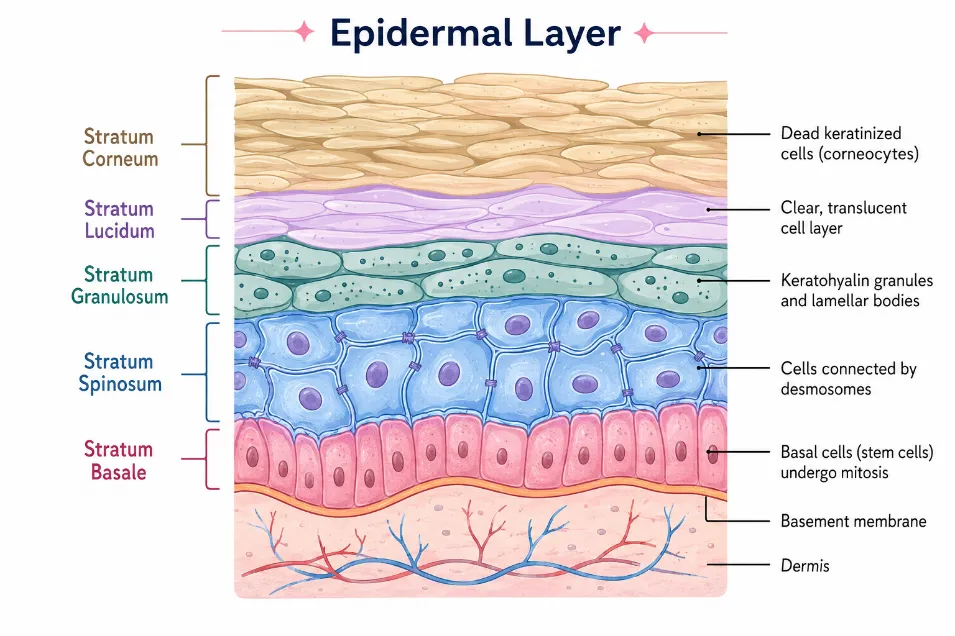
Fig 1: Anatomy of skin
Function of Barriers
The initial line of defence against outside intrusions is the skin's physical barrier. The microbiome affects this barrier, which is made up of several thin layers of keratinocytes in the epidermal layer and passes thru a strictly regulated epidermis to produce the stratum corneum.[23] Thru tight junctions and adherens crossings, epidermal keratinocytes retain close physical contact with one another, creating an almost impermeable barrier against harmful microbes.[24]Furthermore, during the wound healing process, tight junction proteins like the zona occludens can aid in keratinocyte proliferation and differentiation, rebuilding the barrier against microbes.[25]
The epidermis and microbiota secrete a variety of lipids and acids that arrange the skin's chemical barrier. While the microbial composition varies in sebaceous, moist, and dry parts of the skin, it is comparable in most other locations.[26] Both bacterium C. acnes or Corynebacterium, which are more prevalent in sebaceous areas, release lipases that break down triglycerides in sebum into free fatty acids.
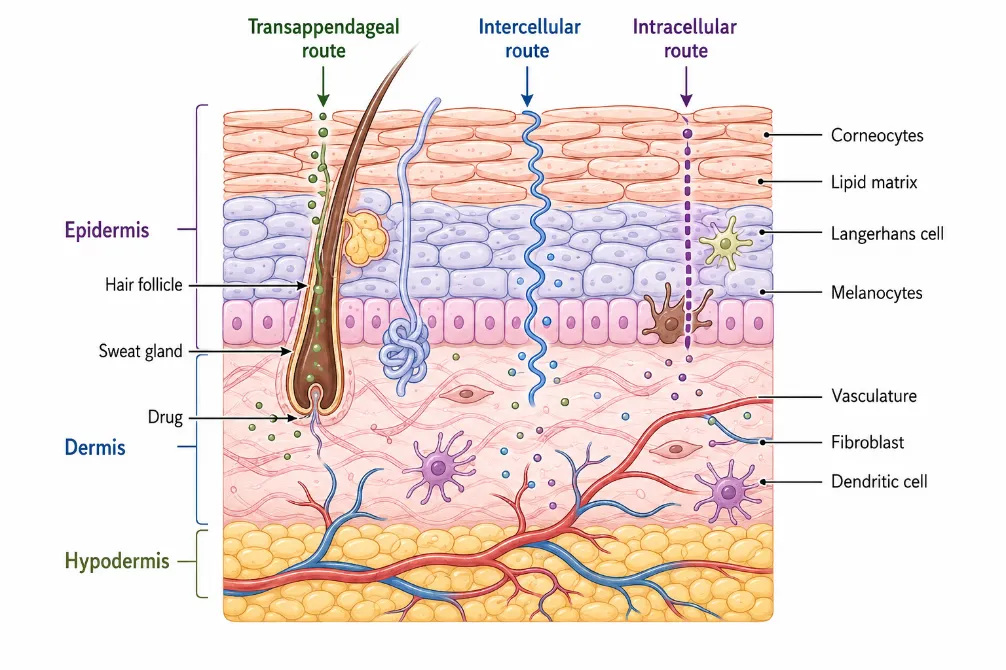
Fig 2: Permeation Process
Drug molecules can pass through the skin barrier and pass through the bloodstream through a variety of routes, including intracellular, intercellular, and transfollicular routes, as illustrated in Fig 2.[27] The intracellular route is an possible course of diffusion, but in the investigational study, diffusion's main course emerged thru the intercellular spaces owing to the presence of hydrating keratin, protein cellular envelope, covalently attached lipid monolayer, as well as free intercellular lipids. Most medications do not cross an SC thru this pathway because it has multiple partitioning-diffusion stages thru the hydrophilic domains; for instance, highly lipophilic drugs cannot penetrate the hydrophilic domains.[28] On the other hand, because of their likeliness, they will be able to navigate the lipophilic domains. Hydrophilic medications, on the other hand, have a higher chance of passing thru the SC due to flaws in the lipids around the corneocytes. The intercellular channel surrounds the corneocytes and continuously moves thru the lipid matrix thru the SC layer.[29] Between the first application and the establishment of a favourable steady state, the intercellular route does not alter the direction of penetration. As a result, it is thot to be the best route for tiny molecules. The rate of absorption and permeation process are unaffected by the time needed to reach a favourable steady state. As molecules moved along this path, they underwent successive dispersion and partitioning amid the rate of absorption and permeation process are unaffected by the time needed to reach a favourable steady state. Molecules were transferred thru this pathway by successive diffusion and partitioning between the polar head groups formed by the interstitial lipids and the length of the alkyl chains.[30] Since the sweat glands' and hair follicles' combined surface area is only about 0.1%, it is not thot to be a significant pathway for drug penetration. Moreover, the transfollicular route may contribute to the rapid drug diffusion in the early hours prior to reaching a steady-state concentration. However, for higher molecular weight medications, it might be necessary to transfer them via this route. Drug–vehicle interactions, vesicles and their analogs, horny layer modification, horny layer removal, and electrically-driven techniques are some of the methods that have been used up to this point to improve drug transport over the skin.[31] Techniques like drug and product selection, ion pairs, and eutectic mixtures are further categories for drug-vehicle interaction. Liposomes. ethosomes and niosomes, and transferosomes are subcategories of vesicles and their analogs. A variety of CPEs, such as water, ethanol, terpenes, azone, sulfur compounds, surfactants, phospholipids, and urea, are used to modify the horny layer. On the other side, microneedle procedures are used to remove the horny layer. Finally, conventional ultrasound, iontophoresis, electroporation, magnetophoresis, and photoelectric waves are examples of electrically driven methods.[32]
Factors Affecting Skin Permeation
One significant factor influencing skin penetration is molecular size. While larger molecules may lessen diffusion across the epidermal barrier, smaller molecules often pass thru the stratum corneum more easily. Therefore, molecular weight is frequently taken into account when determining whether a medication is appropriate for transdermal distribution. A drug's migration from the formulation into the stratum corneum is influenced by its lipophilicity and partitioning behaviour. Effective passive permeation typically requires an appropriate mix between hydrophilic and lipophilic characteristics.[33] Because many medications' unionized fraction has a higher affinity for the lipid-rich stratum corneum, the degree of ionization influences skin penetration. The amount of medicine present in a form that may penetrate the skin is thus influenced by the drug's pKa and the pH of the formulation.[34] Permeation can be influenced by thermodynamic activity and melting point. A medication may have a stronger driving force for skin penetration if it has favourable thermodynamic activity in the vehicle.[35]
The main obstacle to transdermal medication administration is the stratum corneum. How easily a substance can enter and pass thru the skin depends on its composition, thickness, and structure. Therefore, permeability may be affected by the anatomical place of application.[36] The stratum corneum's barrier qualities may be impacted by skin moisture. Increased hydration can change the barrier's structure and make several substances more permeable. By preventing water loss from the skin's surface, occlusive conditions can further improve hydration. The state of the skin is also crucial. The amount of medication that penetrates the skin may change as a result of changes brought on by inflammation, illness, or injury.[37]
Drug release, partitioning, and subsequent skin mobility are all influenced by the formulation vehicle. During use, the composition of topical semisolid products may alter, impacting characteristics including pharmacological activity, rheology, and the rate and degree of penetration.[38] Drug ionization can be altered by formulation pH, which in turn affects partitioning into the stratum corneum. Therefore, while creating a topical or transdermal formulation, the pH should be taken into account in addition to the drug's pKa.[39] By altering the barrier or promoting drug transport, penetration-enhancing techniques can boost medication delivery thru the skin. Chemical, physical, and hybrid methods to increase permeability have been used in recent transdermal delivery research.
By altering diffusion and the physical characteristics of the medication and skin barrier, temperature can have an impact on skin penetration. As a result, regulated temperature settings are frequently used for experimental permeation measurements.
Occlusion and humidity affect skin moisture, which can change permeability. Drug transport may be impacted by occlusive application, which decreases water loss and may improve stratum corneum hydration. Drug absorption may be impacted by exposure time and application circumstances. Research on topical formulations demonstrates that even brief exposure times can produce quantifiable drug absorption, and the characteristics of the formulation vehicle can influence the degree and mode of absorption.[40]
Transdermal drug delivery systems
The skin serves as the drug administration location for transdermal drug delivery systems. Through blood arteries in the skin, the delivered medication enters the systemic circulation and travels throughout the body.[41] Patients can benefit from transdermal drug delivery systems in a number of ways, including being less invasive (some techniques are completely non-invasive), avoiding first-pass metabolism, being simple to apply and administer, not requiring specialized staff, and possibly reducing the frequency of administration. Additionally, a variety of medicines, including both hydrophilic and hydrophobic molecules, have been delivered using this approach.[42] Pharmaceutical researchers are interested in creating and investigating transdermal drug delivery systems because of the advantages mentioned above, especially when it comes to altering or penetrating the stratum corneum to improve medication penetration via the skin.[43]
Drug Delivery Benefits:
• Steers clear of presystemic and hepatic metabolism (avoids first-pass impact).
• Makes the medication more bioavailable.
• Lessens the danger and trouble of intravenous (IV) delivery.
• Prevents medication concentration levels from fluctuating.
• It's simple to stop taking medications.
• Facilitates the delivery of drugs to a particular location.
• Lessens adverse effects related to the digestive system (GI).
• It has a comparatively wide range of applications when compared to the nasal or buccal cavities.
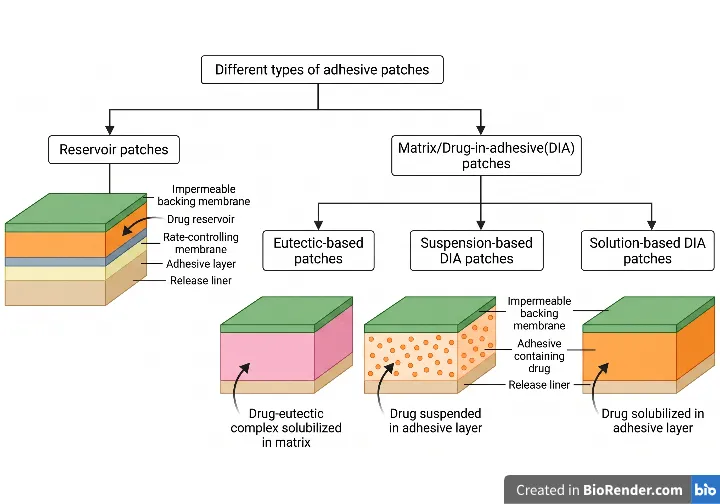
Fig 3: Types of adhesive patches
Enhancer of permeability
In order to increase the absorption of medicinal drugs through diffusion thru the skin's stratum corneum and epidermis, permeation enhancers are chemicals used. Other names for them include sorption enhancers and accelerants.[44] By lowering the stratum corneum's resistance to drug penetration via the diffusion mechanism, they are also able to improve drug transport across many layers of the skin. Ideal permeability enhancers should have the following qualities:[45]
Permeation enhancers' general mechanism
There are several ways in which the permeation enhancer’s function. Enhancers mainly boost performance in three ways, according to Barry's explanation of the lipid protein partitioning (LPP) theory.[46]
I. The stratum corneum's lipid structure is disrupted.
II. Cooperating with the keratin in the epidermis and
III. accelerating the skin partitioning of the medication.
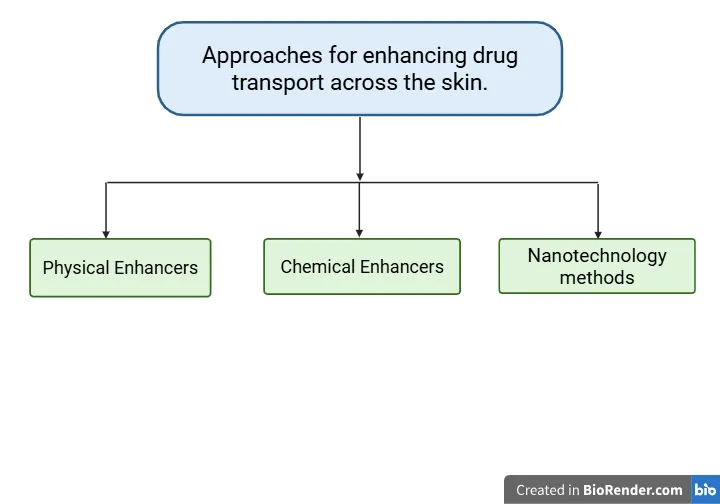
Fig. 4: Conventional Methods for Improving Skin Permeability
Physical Methods for Increasing Permeability
Techniques based on applying electric current or applying mechanical pressure to the skin are known as physical approaches for increasing permeability. These include: (1) iontophoresis; (2) sonophoresis; (3) microneedles; (4) elongated microparticles; (5) electroporation; and (6) needle-free jet injection.
Iontophoresis
Iontophoresis is an electrical current-based transdermal medication delivery technique. An electrode of the same charge is applied to the skin along with a charged molecule.[47] The medication is driven into the skin by direct current, where it is absorbed into the bloodstream and deeper tissues. Iontophoresis's capacity to precisely control the rate and amount of distribution is one of its main advantages.[48] By changing the current's length, strength, and profile, this enables dose modification. This control makes it possible to administer therapeutic dosages without the need for an infusion pump.[49] For therapeutic applications such as giving local anaesthesia prior to a venipuncture or dermatological procedure and managing acute postoperative pain in adult patients who need opioid analgesia using fentanyl for a brief period of time (less than 24 hours), iontophoresis is deemed medically necessary. The U.S.FDA has approved a few iontophoretic patch systems, such as IonsysTM for systemic fentanyl delivery and LidoSiteTM for quick local anaesthetic.[50] This technique works especially well with ionizable and hydrophilic compounds, such as proteins and peptides. Studies have demonstrated its potential for the non-invasive delivery of insulin, human-derived primary oocyte proliferation factor, and other NSAIDs and corticosteroids for musculoskeletal conditions.[51] Despite its benefits, iontophoresis is still being researched for usage in different medical conditions. Due to localized heating and pH shifts at the electrodes, there is a risk of burns, skin irritation, and burning.[52]
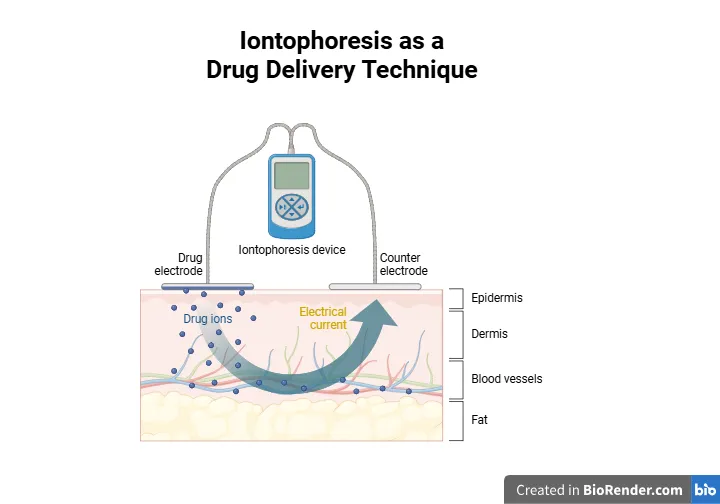
Fig 5: Process of Iontophoresis
Sonophoresis
Sonophoresis is a transdermal drug delivery method that increases solute penetration into and via the skin by using ultrasound. This technique uses a longitudinal sound wave with frequencies between 20 kHz and 16 MHz [53]
Cavitation, the creation, growth, contraction, and collapse of gaseous bubbles in a liquid medium—such as the coupling medium or the intercellular lipids in the skin—is the main mechanism behind sonophoresis.[54] The stratum corneum, the skin's outermost layer, may develop aqueous channels or microchannels as a result of this mechanical activity, increasing the skin's permeability. Cavitation is thot to be the main mechanism of action, even tho heat effects from ultrasonic energy absorption can also improve skin permeability.[55]
Sonophoresis is very useful for transdermal delivery of hydrophilic compounds and macromolecules, which is typically ineffective.[56] Research has shown that sonophoresis is effective in administering a variety of medicinal substances, such as big molecules like insulin and heparin, opioids like fentanyl, nonsteroidal anti-inflammatory medications (NSAIDs) like ketoprofen, and local anaesthetics like lidocaine.
Microneedles
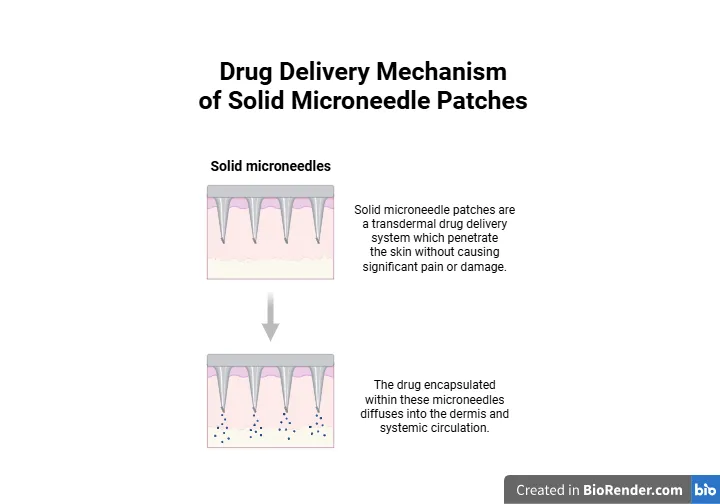
Microneedles are a minimally invasive transdermal medication delivery method that improves solute penetration into and thru the skin by using micrometer-scale needles.
The stratum corneum, the epidermis, and the skin's outermost layer are all painlessly penetrated by these microstructures, which avoid the dermis's pain-sensitive nerve endings. This procedure creates microchannels that significantly increase the skin's permeability capacity.[48]
The two main benefits of microneedles are their ability to be self-administered, which can greatly increase patient compliance, and their patient-friendly nature (less discomfort than traditional hypodermic injections).[57]
These patches have been particularly effective for the cutaneous distribution of a range of drugs, including large hydrophilic molecules, macromolecules, peptides, and proteins like insulin and vaccines.[58]
Microneedles have a lot of potential, but there are a number of restrictions and difficulties that prevent their widespread clinical use. These include worries regarding their mechanical durability and the elasticity of the skin, which may cause the needles to break or penetrate just partially. Skin inflammation, erythema, and edema are possible side effects of this medication.[59] These effects, however, are usually minor and transient. The necessity of aseptic manufacturing and the expense of fabrication continue to be significant economic factors.
The drug delivery system classifies microneedles as follows:
• Solid Microneedles: Using a "poke and patch" method, microneedles administer medications, including hypertension medications, into the dermis.
• Coating Microneedle: They use the "coat and poke" method.
• Hollow Microneedles: Similar to hypodermic needles, these microneedles administer drugs using pressure-driven liquid formulations.
• Dissolving Microneedle: These microneedles work using the "poke and flow" method and are made of biodegradable materials like sugars or polymers.
Electroporation
Short, high-voltage electrical pulses are used in electroporation, a revolutionary transdermal drug delivery method, to momentarily and noninvasively improve skin permeability, particularly the stratum corneum, the skin's outermost layer.[48] By creating reversible channels or transient pores within the SC's layer of lipids, this process significantly enhances the transdermal transfer of active medications. The main mechanism is that the stratum corneum's structure is disrupted by a high-voltage pulsed electric field. Electroporation depends on brief, high-voltage energy, in contrast to iontophoresis, which uses a continuous low-level current.[48]
Enhancing the transdermal distribution of a wide range of molecules, including as big hydrophilic medicines, macromolecules, peptides, proteins, and even genetic material like DNA, which are otherwise challenging to move across the skin, is a major benefit of electroporation. Transdermal penetration can be controlled by varying electroporation's efficiency through adjustments to parameters including pulse voltage, duration, stimulation quantity, and speed. According to studies, electroporation can produce pores that continue for at least two hours, with effects lasting more than twelve hours until the skin progressively regains its barrier qualities.[48]
Electroporation can be used to transport important big molecules like insulin and vaccinations, as well as opioids like fentanyl and local anaesthetics like lidocaine. It can be used in conjunction with other methods, including iontophoresis, to produce combinatorial increases in medication efficacy.[48]
Needle-Free Jet Injection
Instead of using traditional needles, needle-free jet injection uses a high-speed stream of liquid medication (60–140 m/s) to penetrate the epidermis and spread into subcutaneous tissue.[60] This technique produces a high-velocity jet from a nozzle, usually with an aperture diameter of 50 to 360 μm, using a power source, such as compressed gas or a spring. Rather of dispersing as a bolus, the fluid stream disperses in a roughly hemispherical pattern by taking the route of minimal resistance within the skin. Injection pressure, initial liquid velocity, nozzle diameter, distance from the skin, and the mechanical characteristics of the skin itself all affect the depth of penetration (intradermal, subcutaneous, or intramuscular) and delivery effectiveness.[48]
The needle-free aspect of jet injection, which results in less discomfort and harm than traditional syringes, and its potential for better penetration and absorption due to drug dispersion over a broader skin surface are two of its main advantages. Additionally, it can more accurately imitate endogenous insulin production and provide a quicker beginning of pharmacological action for some medications, including insulin, which lowers blood glucose levels within an hour.
Chemical Techniques for Increasing Permeability
The use of substances that promote skin permeability, referred to as penetrators, is a chemical approach of improving permeability. More than 600 chemical substances are currently categorized as chemical penetrators, according to the database released by Vasyuchenko et al. (2021).[48] Chemical structure can be used to categorize these substances: hydrocarbons, alcohols, acids, amines, amides, fatty acid esters, terpenes, essential oils, sulfoxides, and surfactants.
Water
Stratum corneum (SC) hydration is essential for improving skin content penetration, and water has long been recognized as a natural skin penetration enhancer.[61] Transdermal medication passing is generally increased when SC hydration is higher.[62]
Hydrocarbons
Alkanes, alkenes, squalane, squalene, and mineral oil are examples of hydrocarbons that can improve a drug's percutaneous penetration. The rupture of the lipid bilayer and the relaxation of the tight structure of SC are the causes of their mode of action. For example, shorter-chain alkanes were more successful in increasing coffee penetration, but alkanes with nine to ten carbon atoms had the greatest increase for medications like propranolol and diazepam.[48]
Alcohols
In transdermal preparations, alcohols are frequently utilized as transporters, solvents, or enhancers for drug penetration.[63] The primary mechanisms of action involve the extraction of lipids and proteins from the SC, which causes the SC to enlarge and increases the drug's solubility in the formulation or cutaneous dispersion. By disrupting SC lipid domains and increasing the local concentration of the active agent, ethanol is commonly used as a cosolvent to improve medication penetration thru SC. [48]
Fatty Acids
One of the most extensively studied skin penetration enhancers is long-chain fatty acids, particularly oleic acid. One of the main mechanisms in many chemical and nanotechnological enhancers is lipid disruption.[31] Because the SC is composed of corneocytes attached to a lipid matrix—often known as a "brick and mortar" paradigm—it provides a robust barrier to most drugs.[64]Fatty acids work by disrupting the SC's organized lipid domains, which increases drug penetration and makes it easier for lipophilic drug–fatty acid complexes to form.
Additionally, it has been shown that better drug penetration occurs when there is more space between the double bond and the carboxyl group.
Surfactants
Anionic, cationic, zwitterionic, and non-ionic surfactants are among the many types of surfactants that improve skin permeability. [48,65] Charge, lipid tail length, and hydrophilic-lipophilic balance are among of the variables that affect their action.[66] Surfactants can penetrate the SC, solubilize or disrupt intercellular lipids, bind to or denaturize skin proteins, or interact with corneocytes.[67]
Sulfoxides
Sulfoxides, particularly dimethyl sulfoxide (DMSO), are among the earliest and most well researched skin penetration enhancers.[63] Because DMSO interacts with hydrogen bonds rather than water, it functions as a potent aprotic solvent that enables quick action. Its binding with keratin, disrupting skin lipids, and altering the SC's aqueous milieu are all thot to contribute to its boosting effects. Additionally, DMSO produces water channels and removes lipids, increasing SC permeability.[68] However, extreme enhancement typically necessitates large concentrations, which can be dangerous and cause burning, tingling, erythema, blistering, peeling, urticaria, and protein denaturation.
Nanotechnology methods
Nano emulsion and Microemulsion
Oil-in-water, water-in-oil, or bicontinuous systems with nanoscale droplets stabilized by surfactants are referred to as nanoemulsions and microemulsions.[69] Similar to this, surfactant films stabilize microemulsions, which are oil-water systems. Natural or low-surfactant alternatives have gained attention due to skin irritation brought on by high surfactant levels (>20%) in microemulsions. For instance, an oil-in-water microemulsion with decreased surfactant and oleic acid successfully enhanced the transdermal administration of nifedipine. A surfactant-free microemulsion of n propanol and eucalyptus oil enhanced the solubility, stability, and transdermal penetration of all trans retinoic acid. It showed better absorption rates and was more soluble than water or other microemulsions.[48]
Ethosomes
Ethosomes are a specific type of transferosome that can be distinguished by their increased ethanol concentration.[70] Ethosomes showed better transdermal delivery than transferosomes, with sinapic acid penetration of 66.5 μg/cm² as opposed to.2 μg/cm² and 12.3 μg/cm² from transferosomal and plain hydrogels, respectively. This is due to the vesicle's flexibility and ethanol concentration, which enable deeper penetration of the stratum corneum.
Liposomes
Glycerophospholipids come in two varieties: natural and synthetic. Phosphatidic acid (PA), phosphatidylethanolamine (PEA), phosphatidylcholine (PC), phosphatidylglycerol (PG), phosphatidylinositol (PI), and phosphatidylserine (PS) are examples of naturally occurring glycerophospholipids.[71]Liposomes can be made by a variety of methods, including thin-film hydration, reverse-phase evaporation, solvent injection, detergent removal, dehydration–rehydration, pH jump, colloidal particle hydration, and freeze–thaw.[72] More sophisticated forms, like ligand-modified, stealth, and PEGylated liposomes, have been developed as a result of the short half-life, quick clearance, and plasma instability of conventional liposomes.[73]
Solid Lipid Nanoparticles (SLNs)
Solid lipid nanoparticles are aqueous colloidal carriers made of solid biodegradable lipids. They have attracted attention because they can boost solubility and oral bioavailability, unlike more conventional carriers such emulsions, liposomes, and polymeric particles.[74]A study compared and investigated the in-situ penetration of SLN loaded with nebivolol (NBV) and its commercial tablet formulation used to treat hypertension. The Single-Pass Intestinal Perfusion (SPIP) method was used for in-situ permeation investigations. PEG-modified SLN can be utilized to increase oral absorption of NBV, while SLNs by themselves can be employed as a permeability enhancer in oral drug administration.[75]
Application of AI in various stages of designing
1.1Formulation screening and formula optimisation
AI can save time and money in medication development by identifying compounds with the best physicochemical characteristics (such as lipophilicity and solubility) for transdermal delivery. By predicting the best drug and excipient formulation, machine learning (ML) algorithms improve drug penetration thru the skin [76]. Researchers may predict molecular interactions and properties using approaches like quantitative structure-activity relationships (QSAR) modelling and sophisticated deep learning techniques [77], which simplifies the process of finding appropriate candidates for TDDS. By predicting the ideal medication and excipient formulation, machine learning (ML) algorithms can improve drug penetration through skin.
1.2 Delivery system design and optimisation
By examining several factors like shape, adhesive qualities, and material composition, AI greatly improves the design and optimisation of transdermal patches [78]. Consistent delivery rates are ensured using AI-driven models that forecast how patch design elements will affect drug release profiles. To balance adhesion with drug diffusion, for example, machine learning algorithms can determine the best mix of matrix materials and sticky layers. AI also makes it possible to tailor patches to individual patient requirements, such as different skin types and drug absorption rates. Researchers can also forecast patch function under various physiological and environmental situations using sophisticated simulation approaches. Machine learning improves microneedle design by fine-tuning characteristics like length, tip sharpness, and material choice to optimise effectiveness while reducing discomfort. AI technologies evaluate how microneedles and skin interact to maximise drug diffusion and penetration depth without causing severe discomfort or harm. AI also makes it easier to create biodegradable microneedles, which guarantees secure and efficient medication delivery. Rapid microneedle array prototyping is made possible by simulation-based methods, which cut down on development time and resource use. Because of these developments, microneedles can be used for everything from hormone treatments to the delivery of vaccines [79,80,81,82].
1.3 Customised Healthcare
AI-enabled sensors built into smart patches can track the body's medication levels and dynamically modify administration. A significant advancement in TDDS is represented by smart patches with AI-enabled sensors [83]. In order to maintain therapeutic levels consistently, these systems dynamically monitor medication levels in real-time and modify delivery rates as necessary. This feedback system improves patient outcomes while reducing the possibility of overdosing or underdosing. By lowering complexity, the integration of these technologies improves patient adherence while simultaneously increasing therapeutic efficacy. AI systems customise medication dosages and delivery schedules by analysing patient data, such as skin type, age, and medical history. AI systems use patient-specific information, such as genetic profiles, medical histories, and skin features, to create customised medication schedules.
1.4 Stimuli responsive system
Drug interactions with the stratum corneum, epidermis, and dermis of the skin are replicated by AI-driven simulations. These models lessen reliance on conventional in vitro or in vivo research by offering comprehensive insights into the mechanisms of drug penetration. Differential equations, for example, are used in computational methods like compartmental and diffusion models to describe how medications pass across epidermal layers [84]. These simulations, which frequently replace or enhance "skin-on-a-chip" technologies, efficiently analyse the penetration of different drug types and their potential for transdermal delivery [85]. Predictive models driven by AI predict medication delivery results in a variety of scenarios, including different patient circumstances and drug compositions. Large datasets are used by these models to train machine learning algorithms that assess drug permeability, stability, and absorption
2. Hydrogel based transdermal system
Hydrogels are ideal for transdermal medication administration due to their exceptional properties. These qualities include soft consistency, high water content, biocompatibility, biodegradability, elasticity, non-allergenicity, and ease of application Hydrogels are used to improve medication transport over the skin by producing hydration effects [86]. As mentioned in the previous section, a drug-loading matrix is the fundamental part of the TDDS. Transdermal Drug Delivery Systems (TDDSs) commonly use hydrogels as matrices. The hydrogel showed good mechanical qualities, the ability to swell, biocompatibility, and skin non-toxicity [87]. Hydrogels are widely used in many different industries for transdermal medication administration. Systemic adverse effects, such as decreased bone marrow function, liver or renal failure, and neurological problems, are a danger associated with traditional cancer therapies, particularly chemotherapy. It has been demonstrated that hydrogel patches with microneedles are especially useful for delivering medication during cancer treatment [88]. patients with heart failure who have a lower ventricular ejection fraction may frequently have changes in pharmacokinetics (P.K.) and pharmacodynamics (P.D.), which can lead to poor drug absorption. Transdermal drug delivery appears to be a good substitute for traditional drug administration in certain situations. For example, people with cardiovascular problems may be prescribed propranolol, a nonselective beta-adrenergic blocker. The use of sildenafil citrate (S.C.) to treat pulmonary hypertension (P.H.) is another example of hydrogel-based transdermal medication delivery. P.H. is a cardiovascular illness that drastically lowers life expectancy, functional capacity, and quality of life [89]. The medication was administered transdermally using hydrogel-forming microneedles that pierced the stratum corneum Hydrogels are best suited for burn patients since they possess most of the ideal characteristics anticipated for wound healing. Healthcare professionals and biomaterial scientists acknowledge hydrogels as the preferred choice for wound dressing due to their numerous advantages. These include maintaining optimal moisture levels at the wound site, facilitating proper exchange of oxygen and moisture between the wound and its surroundings, biocompatibility, possessing a structure resembling tissue, ease of application owing to softness, elasticity, and flexibility, offering a cooling sensation for patient comfort, absorbing serous discharges from lesions, and minimizing interference with the wound healing process
Various hydrogels used in wound dressing and healing include composite formulations like gelatin-grafted dopamine/chitosan/carbon nanotubes, lignin–chitosan–PVA, and nano curcumin-loaded N, O-carboxymethyl chitosan/oxidized alginate hydrogel [90].
Therapeutic applications:
With an estimated 193 million new cases and 9.9 million deaths from cancer worldwide in 2020, the disease's incidence has been steadily rising. With 2.3 million new cases, breast cancer had the highest prevalence. This demonstrates the increasing impact of cancer on society and the necessity of continuous efforts to prevent, identify, and treat the disease. By administering novel treatments and boosting the effectiveness of chemotherapeutic medications, transdermal drug administration offers a promising strategy to improve cancer treatment. Biodegradable carriers have attracted attention when incorporated into a treated tumour because they can eliminate persistent cancer cells and prevent metastasis. Because biodegradable materials like BC have special qualities including high porosity, nontoxicity, and purity, they are frequently used in FDA-approved products [91]. To ensure regulated medication release, we can carefully build these materials utilizing customized encapsulation or cross-linking procedures, guaranteeing prolonged delivery while reducing potential side effects. Using biodegradable carriers can improve patient comfort and quality of life during cancer therapy by reducing the need for recurrent intrusive operations Biodegradable carriers can treat brain cancers by delivering chemotherapy medications straight to the tumour site [92]. The medications are released in a controlled manner as the carrier breaks down over time, guaranteeing a constant dosage to tumour cells while minimizing damage to the host [93]. By improving treatment efficacy and lowering the need for invasive procedures or repeat surgeries, this tailored drug delivery strategy improves patient convenience and the entire therapeutic experience. In summary, this approach reduces the possibility of problems from invasive treatments while providing a practical and comfortable treatment choice [94].
Elevated blood glucose levels (BGLs) are a hallmark of diabetes, a dangerous medical condition brought on by the body's inability to produce or absorb insulin. Insulin, which lowers blood sugar levels by reaching target cells, attaching to particular receptors, and taking part in metabolic processes, is produced and secreted by the pancreatic beta cells [95]. In order to maintain stable blood glucose levels, conventional diabetic treatments entail manually checking blood sugar levels with finger pricks and giving insulin or GLP-1 injections. However, traditional diabetic therapies, such manually checking blood sugar levels with finger pricks and giving insulin or GLP-1 injections, are frequently painful, inconvenient, and infection-prone. Furthermore, they are unable to consistently and efficiently monitor changes in blood glucose levels [96]. By continually monitoring and modifying insulin dosages in response to real-time glucose levels, closed-loop diabetes diagnostic devices are essential for preserving stable blood glucose levels The capacity of glucose-responsive microneedle patches to continually monitor blood glucose levels and provide the right amounts of insulin in real-time has attracted attention. These drug-compatible, painless technologies have great potential for clinical use [97]. Real-time diabetes monitoring and therapy are made possible by recent advancements in wearable diagnostic and therapeutic systems based on MN iontophoresis. These devices facilitate the penetration of drug macromolecules through the skin and enhance glucose signal monitoring [98]. The combination of iontophoresis and MN arrays improves the efficiency of insulin delivery and glucose extraction. This technology allows us to release medications under controlled settings by integrating an electrical system. The goal of this cutting-edge diabetes management approach is to increase the efficacy of glucose monitoring and therapy [99].
The use of TDDS can greatly improve the management of hypertension. By enabling a steady, extended release of antihypertensive drugs, these systems lessen the need for frequent dosing and increase patient compliance. Additionally, TDDS can lessen the gastrointestinal adverse effects that are frequently linked to oral drugs, improving tolerability and possibly improving patient outcomes [100]. Examining TDDS applications in the management of hypertension may yield insightful information for researchers and medical professionals, helping to improve treatment plans for people with high blood pressure. TDDS is a good choice for patients with hypertension because of its simplicity of use and fewer adverse effects. Reducing the frequency of doses while maintaining stable blood pressure control could significantly improve patients' quality of life [101]. Medical professionals may find new ways to create customized treatment programs that are suited to the unique needs of each patient as more study is done on the effectiveness of TDDS in controlling hypertension.
When taken orally, several drugs used to treat hypertension, such as calcium channel blockers and beta blockers, experience significant first-pass metabolism. By avoiding the hepatic first-pass impact, TDDS can improve medication bioavailability and efficacy at lower dosages, possibly reducing systemic adverse responses [102]. People with compromised hepatic function or gastrointestinal problems that impede drug absorption may benefit most from this strategy. TDDS provides a more straightforward and effective way to administer medication by avoiding first-pass metabolism, which eventually improves therapeutic results and patient adherence [103]. TDDS may revolutionize the treatment of hypertension as research and technology develop, offering a viable substitute for people who have struggled with traditional oral drugs. By lowering the frequency of doses and lowering the possibility of side effects, the use of TDDS may enhance patients' quality of life. Additionally, this novel approach to administration may improve long-term hypertension control and patient outcomes [104]. For example, a TDDS patch that delivers a regulated dose over a prolonged period of time may be helpful for a hypertensive patient who has trouble following daily drug schedules. Better blood pressure control and a lower chance of problems brought on by irregular medication adherence could result from this [105]. Additionally, the ease of use of a TDDS patch may improve patient adherence to their recommended regimen, leading to more reliable blood pressure control. In summary, this innovative delivery method has the potential to transform the treatment of hypertension and enhance patient outcomes [106].
Because hypertension frequently has no obvious symptoms, medication adherence may be less than ideal. For long-term treatment, TDDS offer a non-invasive option that may improve compliance, especially for those who have trouble following rigorous oral prescription schedules [107]. This strategy may be particularly helpful for older people or people with cognitive impairments who have trouble sticking to their daily drug schedule. TDDS patches have the potential to greatly increase patient adherence rates and improve health outcomes in the management of hypertension by simplifying the treatment procedure and lowering the daily medication load. Furthermore, by delivering the medication straight into the bloodstream and avoiding the digestive system, TDDS patches can lessen the possible negative effects of oral medications [108]. This technique improves overall therapy efficacy by enabling a more steady and regulated flow of medication. For instance, a patient with hypertension who struggles to take their medication regularly would benefit from a TDDS patch that only requires to be put once a week. In order to manage their illness, this streamlined routine can guaranty continuous drug delivery and enhance adherence [109] Additionally, by avoiding the digestive tract, TDDS patches can lessen gastrointestinal side effects that are frequently connected to oral drugs, making treatment more bearable and successful [110]. TDDS patches allow for the controlled release of medication into the bloodstream, which may result in more stable blood levels and better patient outcomes. For people with demanding lifestyles, this administration technique is a suitable alternative because it minimizes the need for regular dosage adjustments. Although the topic is certainly interesting and pertinent, in order to keep a focused and thorough scope, our current review concentrated exclusively on TDDS applications in oncology to address this crucial area of prospective TDDS deployment, we recognize the importance of TDDS in treating hypertension and plan to include a succinct summary of this application in the updated version.
FUTURE ASPECTS:
With the advancement of cutting-edge technology in recent years, the area of long-lasting TDS has continued to expand. Preclinical studies and some clinical trials have shown the viability and proof-of-concept of patches intended for prolonged drug release from several hours to days (adhesive and MNs patches) and months. Despite obstacles, the transdermal patch is a well-established and expanding DDS with over 10 long-acting versions available. Drug choices for consideration are limited by the physicochemical characteristics of medications needed for usage in adhesive patches. Loading capacity, production and scalability and regulatory requirements are further constraints and delivery, production and scalability, and legal requirements. It is difficult to design a reservoir- or matrix-type patch for prolonged medication administration because several factors may affect adhesive function. It can also be challenging to maintain appropriate adhesion on the skin when exposed to environmental factors like high temperatures and dampness. This makes the matrix and reservoir patches difficult for patients to apply since they must have the right amount of adhesiveness to avoid separating from the skin, which is especially difficult for once-weekly or biweekly systems.
Recent developments include eutectics and ion-pairs, which provide advantages including greater drug loading, increased permeability, and improved drug stability. However, more research is required to determine the efficacy and safety of such systems. Aside from that, MIP systems are still in their infancy but have great potential because of the significant advancements in material science methodologies. The main benefit of MIPs is their great stability, which makes them a good option for long-term drug administration.[111]
CONCLUSIONS
The pharmaceutical industry is still actively developing transdermal medication delivery technologies. These cutting-edge devices provide a different way to administer drugs that is difficult to accomplish using traditional methods. However, the drug's physicochemical characteristics, such as its molecular weight and lipophilicity, as well as the methods used to get past skin barriers, determine how well this strategy works. We looked at several ways to improve skin permeability in this review.
Iontophoresis, sonophoresis, and microneedles are examples of active physical techniques that show promise for improving transdermal medication penetration. Furthermore, the creation of vesicles and nanocarriers using passive techniques has demonstrated promise for enhancing medication delivery throughout the skin.
In the pharmaceutical sector, assessing transdermal drug delivery systems' efficacy is also essential. We looked at several analytical techniques for assessing drug penetration thru the skin, including in vitro, ex vivo, and in vivo evaluations. Combining these techniques is advised to guaranty a more thorough and precise assessment of transdermal medication delivery systems.
REFERENCES






Sanjana Choudhary, Ishwari Koparkar, Gargi Kulkarni, Krutika Birari, Vaishnavi Bhavsar, Nakshtra Khairnar, Next-Generation Transdermal Drug Delivery Systems: Advances in Skin Permeation and Non-Invasive Therapeutics, Int. J. of Pharm. Sci., 2026, Vol 4, Issue 8, 4527-4551, https://doi.org/10.5281/zenodo.22129230
 10.5281/zenodo.22129230