

We use cookies to ensure our website works properly and to personalise your experience. Cookies policy
Department of Pharmaceutics, Triveni Institute of Pharmacy, Kecheri, Thrissur, Kerala, India
Pharmaceutical gels are semisolid dosage forms widely used for topical and transdermal drug delivery because of their ease of application, non-greasy nature, and excellent patient acceptability. A gel consists of liquid phase immobilized within a three dimensional network formed by a suitable gelling agent, producing a stable, jelly-like system. Owing to their high water content, gels provide a cooling and soothing effect, promote uniform distribution, and enhance patient comfort. They are commonly used in the treatment of skin disorders, pain, inflammation, fungal infections, burns, and cosmetic applications.
Gels are semisolid system consisting of dispersion of small or large molecules in an aqueous liquid vehicle rendered jellylike by the addition of a gelling agent.1 The word “gel” is derived from “gelatin”, and both “gel” and “jelly” can we drawn back to the Latin gelu for “frost” and gel are, meaning “freeze” or “congeal”. This origin indicates the essential idea of a liquid setting to a solid-like material that does not flow, but is elastic and retain some liquid characteristics.
Gel are generally considered to be more rigid than jellies because gels contain more covalent cross links, a higher density of physical bonds, or simply less liquid. Some gel systems are as clear as water, and others are turbid because the ingredient may not be completely molecularly dispersed (soluble or insoluble), or they may form aggregates, which disperse light. The concentration of the gelling agents is mostly less than 10%, usually in 0.5% to 2.0% range, with some exceptions.2
ADVANTAGES3
DISADVANTAGES3
PROPERTIES OF GELS4
The water absorbing capacity of oleaginous and water-in-oil bases may be expressed in terms of the water number, defined in 1935 by Casparis and Meyeras the maximum quantity of water that is held (partly emulsified) by 100g of a base at 200c.
Gels exhibit different rheological properties. Do not flow at low shear stresses but undergo reversible deformation like elastic solids.
CLASSIFICATION OF GEL6
Monophasic gel consists of organic macromolecules distributed uniformly throughout a liquid in such a manner that no apparent boundaries exist between the dispersed macromolecules and the liquid.
E.g. organic gels consist of carbomer, tragacanth etc. as a gelling agent.
If the partition size of dispersed phase is relatively large and form the three-dimensional structure throughout gel, such a system consists of floccules of small particles rather than larger molecules and gel structure, in this, system is not always stable. They must be thixotropic-forming semisolid on standing and become liquid on agitation.
E.g. Aluminium hydroxide gel, bentonite magma
TYPES OF GELS
Hydrogels
A hydrogel is a network of polymer chains that are hydrophilic, infrequently found as a colloidal gel in which water is dispersion medium. They are highly absorbent natural or synthetic polymeric networks. They also have a degree of flexibility likely to the natural tissue, due to their significant water content.
Xerogels
It is solid formed from a gel by during with unrestricted shrinkage. It is frequently retains high porosity (15-50%) and huge surface area (150-900m2/g), along with very small pore size (1-10nm). When solvent removed under supercritical condition, the network doesn’t shrink and a highly porous, low-density material known as an aerogel is produced. Heat treatment of a xerogel at higher temperature produces viscous sintering and efficiently transforms the porous gel into a thick glass.
E.g. tragacanth ribbons, dry cellulose and polystyrene, gelatin sheets and acacia tears.
Organogels
An organogel is a non-crystalline, non-glassy thermoreversible solid material composed of a liquid organic phase trapped in a 3D cross-linked network. The liquid can be, E.g. vegetable oil, an organic solvent or mineral oil. The solubility and particle size of the structurant significant characteristics for the elastic properties and firmness of the organogel. Frequently, these systems are based on self-assembly of the structurant molecules.
MECHANISM OF ACTION7
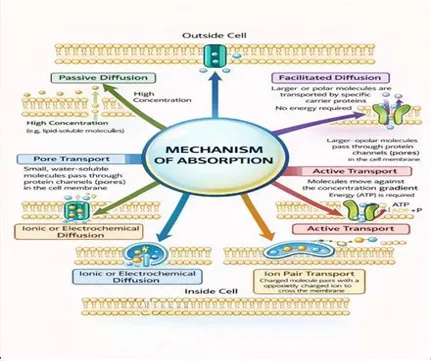
Drugs and other molecules are transported across the biological membranes through different mechanism known as transport mechanism or bio transportation. Transport mechanisms are categorized as
In this transport process, the drug molecules and other substances are transported into the cell via numerous small-sized proteins or ion channels located in the cell membrane. Since the transport of molecules is similar to that of filtration, the transport process is also known as filtration or convective transport or bulk flow.
It is the simplest and most common transport process also known as non-ionic diffusion. It is a process by which the drug molecule diffuses from an area of higher concentration to an area of lower concentration. The difference in concentration on either side of biological membranes termed as concentration or electrochemical gradient which act as a driving force for passive GI diffusion. The process does not require any energy or specific transport or carrier molecules.
Facilitated diffusion or facilitated transport involves the movement of large drug molecules across a selectively permeable membrane down the concentration gradient [downhill transport] by means of carriers without utilizing any energy. This process is much faster than simpler passive diffusion.
Characteristics
This transport process involves the movement of solute particles against concentration gradient using energy provided by ATP.
Characteristics
In this the ionized form of drug molecules that cannot pass through the lipoidal cell membrane form of reversible pair with the oppositively charged endogenous ions of the GIT. The so formed ion-pair is neutral and has high lipid solubility. Hence, it easily diffuses through the cell membrane and liberates the drug on the other side.E g; propranolol, quinine, sulphonic acid, tetracyclines etc.
Molecular forms of solutes are unaffected by the membrane charge and permeate faster than cationic forms. This, at the given pH, the rate of permeation maybe as follows;
Unionized molecule>anions>cations
Once inside the membrane, the cations are attached to negatively charged intracellular membrane, thus giving rise to an electrical gradient. If the same drug is moving from a higher to lower concentration i.e.; moving down the electrical gradient, the phenomenon known as electrochemical diffusion.
Endocytosis involves the engulfment of extracellular material by forming a vesicle. In this process, short stretch of the cell’s plasma membrane invaginates or folds inwards to form a vesicle engulfing some of the extracellular fluid containing the dissolved material. The vesicle then buds off forming a membrane bound vesicle called as endosome.
E.g. Barium sulphate
FACTORS EFFECTING SKIN PENETRATION8
Skin integrity refers to the overall condition, health, structure and wholeness of skin, acting the primary barrier against external contaminant, toxins and microbes. When skin integrity is high, the skin barrier is strong and drug penetration through the skin decrease. The skin integrity is low the barrier becomes weak and drug penetration increase.
Increased hydration enhance penetration by loosening the stratum corneum. Occlusive dressings or humid environments can increase hydration.
Elevated skin temperature can increase the rate of drug diffusion.
Traumatic or pathological injury refers to damage to the skin caused by wounds, burns, infections, or skin disease this conditions reduce the barrier function of the skin as a result skin become more permeable and drug can penetrate more easily through the skin.
Regional variation means that drug penetration differ in different parts of the body. Areas with thin skin, such as the face or scalp, show higher drug penetration. Areas with thicker skin, like the palms and soles, show lower drug penetration.
Cutaneous metabolism means the metabolic activity of enzymes present in the skin. These enzymes can break down or modify drugs before they reach systemic circulation. Therefore, skin metabolism can affect the amount of drug penetrates through the skin.
Surfactants (eg; sodium lauryl sulphate)
Solvents( e.g; ethanol, propylene glycol)
Fatty acid ( e.g; oleic acid)
FORMULATION10 VEHICLES
Normally purified water is used as a solvent. To enhance the solubility of the therapeutic agent in the dosage form and /or to improve drug permeation across the skin, co-solvents may be used, E.g., alcohol, glycerol, PG, PEG400, etc.
INCLUSION BUFFERS
Buffers may be involved in aqueous and hydro alcoholic-based gels to control the pH of the formulation. The solubility of buffer salts is reduced in hydro alcoholic-based vehicles.
E. g., phosphate, citrate, etc.
GELLING AGENTS
These are the substance which, when added to an aqueous mixture, increase its viscosity without substantially modifying its other properties, such as taste. They provide body, increase stability, and improve suspension of added ingredients. E.g., parabens, phenolics, etc.
PRESERVATIVES
Certain preservatives cooperate with the hydrophilic polymers used to prepare gels, thereby reducing the concentration of free (antimicrobially active) preservative in the preparation. Therefore, to compensate for this, the initial concentration of these preservatives should be improved.
E.g., parabens, phenolics etc.
ANTIOXIDANTS
It may be involved in the formulation to improve the chemical stability of therapeutic agents that are prone to oxidative degradation. Its choice is based on the nature of the vehicle used in the preparation of gel. Water-soluble antioxidants are generally used as the majority of gels are aqueous-based. E.g., Sodium metabisulphate, Sodium formaldehyde sulphoxylate, etc.
FLAVOURING AGENT
Flavours and sweetening agents are only incoperated in gels that are designed for administration into the oral cavity (E.g., for the treatment of infection, inflammation, ulceration, etc.)
SWEETNERS:
Sucrose, liquid glucose, glycerol, sorbitol, saccharin sodium, aspartame, etc.
FLAVOURS:
Butterscotch, apricot, peach, vanilla, wintergreen mint, cherry, mint, anise, citrus flavors, raspberry.
METHOD OF PREPARATION OF GELS11
Gels are prepared by mixing suitable thickening agent and aqueous vehicles. Drug is dispersed in aqueous vehicle and thickening agent is added by Triturated in a mortar. Triturated carried out until a homogenous preparation is formed.
FUSION METHOD
In this method various waxy material employed as gelling agent in nonpolar media. Drug was added when waxy materials melted by fusion, stirred slowly uniform gel formed
COLD METHOD
Water was cooled to 4-10 degree Celsius and placed in mixing container. Gelling agent was slowly added and agitating until solution is complete. Maintained temperature below 100 degree Celsius. Drug was added in solution form slowly with gentle mixing. Immediately transfer to container and allow to warm to room temperature where up on liquid become clear. \
DISPERSSION METHOD
Gelling agent was dispersed in water with stirring at 1200rpm for 30 minutes. Drug was dissolved in anon aqueous solvent with preservatives. This solution was added in above gel with continuous stirring.
EQUIPMENTS 12
JET FLOW AGITATOR
The get flow agitator use a high speed rotor and jet pipe in close proximity to the mixing vanes to disperse and circulate products within a vessel while avoiding inefficiency caused by back flow, air inclusions caused by a static whirlpool effect, and the need for flow break caused by continuously rotating mixture. The circulation mechanism also avoid the common issue of sediment formation when being used to produce emulsion. The unit can be used with open and pressurized vessel and mounting options exit to accommodate a wide variety of vessels and configuration. With this equipment, no seal material make contact with the product and food or pharmaceutical grade versions are readily available.
DUST FREE CONTINIOUS HOMOGENISING SYSTEM
The continuous process requires less floor space for storage and greatly reduces production times closed systems eliminate the creation of dust thereby enhancing safety and efficiency. The ingredients are continuously fed into the plant’s working chamber in the precisely controlled ratios required by the final product, where they are mixed and then dispersed. The units can handle mixtures of up to 80% solid content and viscosities of up to 50.000 mPas.
Since the only agitation of solid occur with in the machines working chamber after the liquid components have been introduced, no dust is generated.

SPEED LOW TUBE FILTER
Automated tube filling machines improve production efficiency by accurately filling, sealing and capping a range of tube-based packaging with minimal operator intervention. It features 10 workstations that can handle tube from 10 to 52mm diameter and can a accurately, dose from between 1.5 ml of 300ml of product at up to 70 tubes per minute.
TUBE UN LOADER AND SPEEDER
Automate tube unloading and feeding system that operate with high speed and accuracy are required to supply the tube fillers with a constant steam of empty tubes. The flexibility to handle all type of tube material and to quickly adjust to a variety of size and shape maximise efficiency and increase up time. The TZ Series can handle tube of diameter 12.7mm to 60mm, and input carton up to 650×600×265 mm. Simple to use humans/ machine interface makes product changeover simple. The operator only has to select the relevant program and new values are set automatically.

COMPACT MONO BLOCK FILLER
Mono block filling machine is an easy-to-use, multi-purpose machine designed for filling and capping of container with lid or pressure caps. Featuring a touch screen system, the machine easy to operate and allows simple readout and storage of all function information. For the sealing process, a choice of method is available including manual positioning of lids, or use of a fully automated cap supply system that uses pick and place. Final tightening can be by magnetic capping, servo capping, pressure capping or pilfer proof capping, to suit your requirements.
SINGLE HEADCAPPER
Single head capping machine offer maximum flexibility together with impressive performance for smaller scale production lines. These all stainless machine feature Siemens PLC and full touch screen control for accuracy and easy for use. The use of standardized components throughout from high- quality manufacturers increases longevity and reduces the down time for any maintenance. The gravity-fed cap sorter and magnetic torque head provide high level of reliability.

EVALUATION 10
MEASUREMENT OF pH
pH can be determined by using digital pH meter. E.g- 1g of gel mixed in 100ml distilled water and stored for 2 hours. Measurement of pH in triplicate and average value is calculated.
DRUG CONTENT
1g of gel dissolved with 100ml of appropriate solvent stock solution has been filled. The prepared aliquots of different concentration by using suitable dilution and absorbance are measured. Linear regression analysis of calibration curve is used o calculate he drug content.
VISCOSITY
Brookfield viscometer is used for its study rotate the gels at 0.3, 0.6 and 1.5 Rpm. Resultant dial reading are been noted at each speed. Viscosity was obtained by dial reading X factor set in the Brookfield viscometer catalogues the slides towards the path of certain lead is expressed or spreadability less time taken better spreadability. It can be designed with the formula
Spreadability [s] =M×L/T
Where,
M= weight tied to upper slide
L= length of glass slide
T= time taken to detached the slides.
EXTRUDABILITY
Before setting inside the container formulation are packed in the collapsible tubes. This is found out in terms of gm. Necessary to extrude a 0.5cm ribbon at gel in 10s.
SKIN IRRITATION STUDY
For this study, guinea pigs (400-500g both sex) were used. Which are kept on normal animal food and free contact to water. Hair was shaved from back 5ml of every sample was removed periodically at 1,2,3,4,5,6,7, and 8 hr and every sample is intergrated by equivalent size of new dissolution medium. Then drug content of sample analysed by using PH buffer guinea pigs and zone of 4cm noted as blank on each sides one side as test and other side as control. The gel applied twice a day for one wear and place was detected for any sensitive reaction.
IN-VITRO DIFFUSION STUDIES
It is done by using Franz diffusion cell, for learning dissolution discharge of gel done by a cellophane membrane. 0.5 of gel sample occupied in cellophane membrane. Diffusion studies done at 37±1ºC using pH buffer ( pH 7.4) 250ml as dissolution medium.
IN-VIVO STUDIES
It is done in 6 Wistar albino rats divided into 3 groups. Rubbing 100 mg of prepared gel carefully twice at 1 and 2h on each paw. Calculate the percentage of inhibition by using mercury plethysmometer.
STABILITY
It is done by freeze-thaw cycling. The product are kept under temperature of 4ºC for 1 month again 25ºC for 1 month and next 40ºC for 1 month, and syneresis have being detected. The gels are kept at room temperature and find the liquefied exudates separately.
SPREADABILITY
spreadability test is performed by placing the gel between two glass slides and applying a specific weight. Time taken for upper slide to move is measured to determine how easily the gel spread on the skin.
PACKAGING 13
SACKET PACKAGING FOR GELS
Sackets make for ideal gel product packaging as they contain liquid well and are extremely cheap to transport in comparison to other packaging types. Often holding one or two uses of the product, sackets are precisely filled with exact amount to ensure enough product is filled without creating excessive waste. Whether sackets are used for samples or travel sized product, or more, they are versatile and cost effective solution for gel packaging.
GELS PACKS PACKAGING
One of the most common gel products is gel packs which can be frozen or heated to provide an ice pack for shipping. The packaging for gel packs is flexible and can be frozen without a loss an integrity-usually plastic is used and not something that could absorb liquid and also freeze like paper. Although this plastic packaging type is not recyclable, it is the most effective at packaging these products.

BOTTLE PACKAGING
Especially in the beauty and cosmetic industry,bottles are used to store gels that are frequently used by consumers and contain many uses. For examples,shower gels are often contained within bottle packaging, with optional hooks for hanging and various pumps, lid sand caps to suit the application. Other uses of bottles for gel products include skincare and cosmetic makeup.
TUBE PACKAGING
For gel products used in small amounts frequently, tubes are a popular choice. High concentrate beauty gels, for example, suit tubes as consumers only require a small amount of product. The smaller opening and long-lasting durability of tubes, especially aluminium tubes, make them ideal for holding medium product amounts and dispensing a small, controlled amount.
STABILITY STUDIES 14
For all pharmaceutical dosage forms it is important to determine stability of dosage form. The stability study were carried out for the most satisfactory formulation as per the ICH guidelines to estimate the stability of the prepared drug dosage formulation. The formulation sealed in aluminium package and kept in humidity chamber maintained at 40±20c, 75±5%RH and at 30±20c, 65±5% for 3 months. At the end of studies invitro drug release were evaluated.
ACCELERATED STABILITY STUDY
the gel formulation is stored under high temperature and humidity conditions (40ºc±2ºc and 75±5%RH) foe 3months as per ICH guidelines, and samples are analysed at regular intervals to evaluate change in pH, spreadability and drug content to assess stability.
STABILITY AND SHELF LIFE STUDIES
The formulation is evaluated over time for physiochemical properties like pH, colour, opacity and rheology, along with microbiological analysis to detect contamination, helping to determine the products stability, safety and shelf life.
RHEOLOGICAL MEASUREMENTS
The gel samples were tested using a rheometer to study their flow properties. Tests were done three times for accuracy. Measurements checked how the gel behaves under small deformation and different temperatures (0-70ºc). most tests were carried out at 25ºc.
APPLICATION OF PHARMACEUTICAL GEL15
CONCLUSION
Gels are important semisolid pharmaceutical dosage form widely used for topical drug delivery due to their non-greasy nature, ease of application, and good patient compliance. They provide effective drug release and form a protective layer on the skin. The formulation of gels involves careful selection of gelling agents, additives, and preparation methods to achieve desired properties. Various factors such as skin condition, PH, drug concentration, and penetration enhancers influence drug absorption. Proper evaluation and stability studies are essential to ensure the quality, safety, and effectiveness of gel formulations.
REFERENCES


Raisey Jose, Soya Benny, Nishitha K M, Fathimathu Sana P, Fahana Shirin, Pharmaceutical Gel: An Overview, Int. J. of Pharm. Sci., 2026, Vol 4, Issue 7, 3571-3583. https://doi.org/10.5281/zenodo.21423490
 10.5281/zenodo.21423490