

We use cookies to ensure our website works properly and to personalise your experience. Cookies policy
1,4,5,6,7 3rd PG Scholar, Department of P.G Studies in Rasashastra and Bhaishajya Kalpana, Karnataka Ayurveda Medical College and Hospital, Mangalore
2Professor, Department of P.G Studies in Rasashastra and Bhaishajya Kalpana, Karnataka Ayurveda Medical College and Hospital, Mangalore.
3HOD and Professor, Department of P.G Studies in Rasashastra and Bhaishajya Kalpana, Karnataka Ayurveda Medical College and Hospital, Mangalore
Background: Sneha Kalpana is an Ayurvedic pharmaceutical preparation in which the therapeutic properties of medicinal drugs are incorporated into a lipid medium. Taila is employed in wound management owing to its protective and healing properties. Patoli Taila is a classical formulation indicated for Agnidagdha Vrana (burn wounds), for alleviating pain, burning sensation, discharge and blister formation. The present study was undertaken to evaluate the pharmaceutico-analytical properties and wound-healing activity of Patoli Taila with special reference to burn wounds. Materials and Methods: The study was conducted in three phases: pharmaceutical, analytical and experimental. Murchita Sarshapa Taila was prepared according to the guidelines described in Bhaishajya Ratnavali and used for the preparation of Patoli Taila as per Yogaratnakara. The prepared formulation was evaluated for organoleptic and physicochemical parameters, along with HPTLC analysis. Experimental evaluation was carried out using a burn wound model. Animals were divided into three groups: Control group receiving no treatment, Standard group treated with Silver Nitrate, and Trial group treated with Patoli Taila. Wound contraction and eschar fall duration were assessed and statistically analyzed. Results: Patoli Taila was successfully prepared, and the classical Sneha Siddhi Lakshanas were observed. The final formulation showed characteristic colour, odour and consistency suitable for application. Analytical evaluation indicated quality, stability and safety; the formulation was free from rancidity, while HPTLC demonstrated the presence of phytoconstituents. In the experimental study, Patoli Taila produced significant wound-healing activity, with faster wound contraction compared with the control group. Improved tensile strength and earlier eschar fall were also observed, indicating enhanced tissue repair and accelerated wound healing. Conclusion: Patoli Taila demonstrated satisfactory pharmaceutical and analytical characteristics and significant experimental burn wound-healing activity. The findings support its classical indication in the management of Agnidagdha Vrana and provide a basis for research on its wound-healing potential.
Dagdha Vrana (burn wound) is a challenging clinical condition characterized by tissue injury, pain, burning sensation, discharge and blister formation, with delayed healing potentially leading to Dushta Vrana that may arise either from intentional parasurgical interventions such as Agnikarma (therapeutic cauterization) or from accidental causes like fire, hot liquids or heated metals[1]. Vrana is referred to the condition wherein tissue undergoes destruction[2].Ayurveda describes various approaches for burn wound management, including the use of medicated oils for alleviating symptoms and promoting tissue repair.
Patoli Taila, a classical Ayurvedic formulation described in Yogaratnakara for Agnidagdha Vrana, is specifically indicated for managing Ruja (pain), Daha (burning sensation), Srava (discharge) and Visphotana (blister formation)[3]. Its traditional application in burn wounds and its proposed ability to promote faster healing make it a formulation of therapeutic interest. The lipid medium of Taila Kalpana facilitates local application and delivery of the medicinal properties of its constituent drugs to the wound site.
Despite its classical indication, systematic scientific evaluation of Patoli Taila remains limited. Hence, the present study was undertaken to evaluate Patoli Taila through pharmaceutical and analytical standardization and to assess its wound-healing efficacy in an experimental burn wound model, with particular emphasis on wound contraction and eschar fall.
Materials and Methods
The study comprised three components: pharmaceutical preparation, analytical evaluation and experimental assessment of the wound-healing activity of Patoli Taila.
1. Pharmaceutical Study
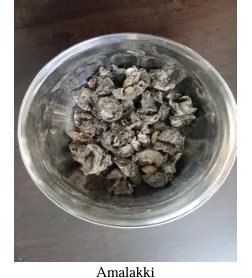
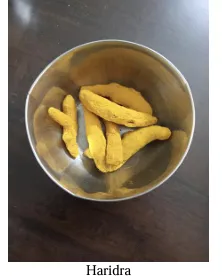
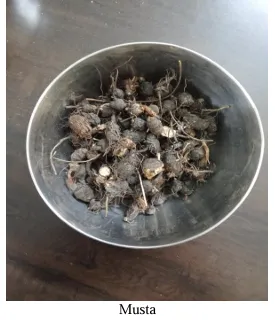
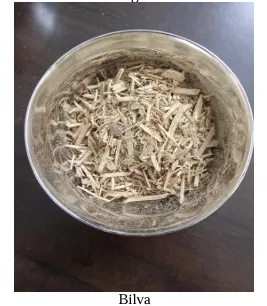
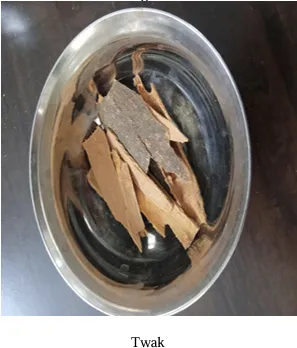
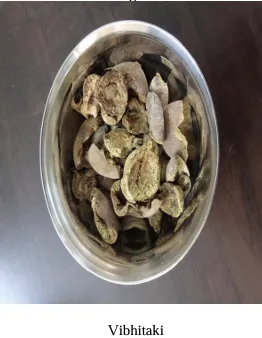
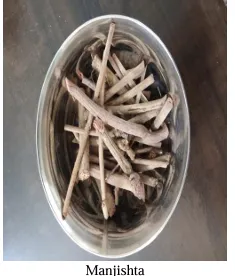
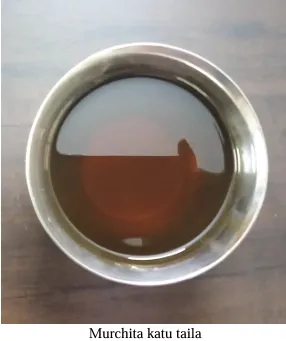
1.1 Murchana of Sarshapa Taila
Murchana of Sarshapa Taila was carried out as described in Bhaishajya Ratnavali[4].
Table 1. Ingredients used for Murchana of Sarshapa Taila
|
Sl. No. |
Ingredient |
Quantity |
|
1 |
Amalaki |
62.5 g |
|
2 |
Haridra |
62.5 g |
|
3 |
Musta |
62.5 g |
|
4 |
Bilva |
62.5 g |
|
5 |
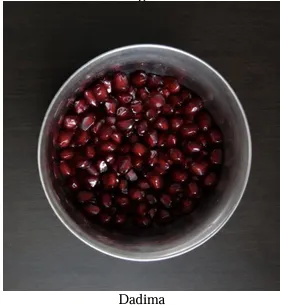
Dadima |
62.5 g |
|
6 |
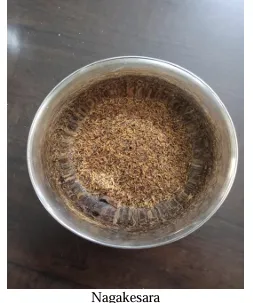
Nagakesara |
62.5 g |
|
7 |
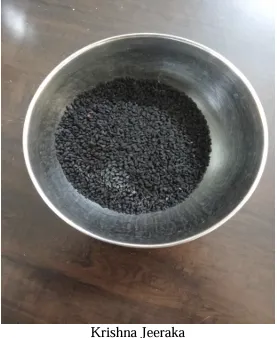
Krishna Jeeraka |
62.5 g |
|
8 |
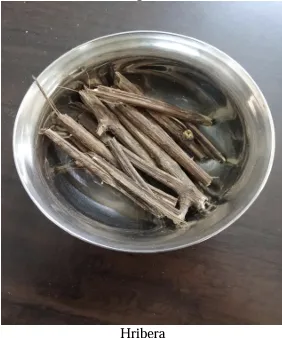
Hribera |
62.5 g |
|
9 |
Twak |
62.5 g |
|
10 |
Vibhitaki |
62.25 g |
|
11 |
Manjishta |
500 g |
|
12 |
Sarshapa/Katu Taila |
4 L |
|
13 |
Water |
16 L |
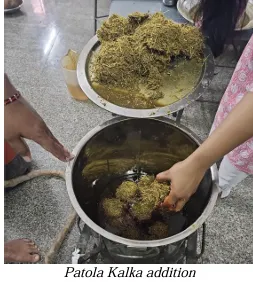
Sarshapa Taila was first heated gently to remove moisture and allowed to self-cool. The drugs listed in Table 1 were made into a Kalka with sufficient water and added to the oil. Four parts of water were added, and the mixture was heated over Mandagni with continuous stirring. Heating was continued until the moisture was removed and the Sneha Siddhi Lakshanas were attained. The Murchita Sarshapa Taila was then filtered through a clean cloth and stored. The initial quantity of oil was 4 L and the final yield was 2.9 L.
1.2 Preparation of Patoli Taila
Patoli Taila was prepared according to Yogaratnakara[3].Standard operating procedures were followed as mentioned in Sharangadhara Samhita[5].
Table 2. Ingredients used for preparation of Patoli Taila
|
Sl. No. |
Ingredient |
Quantity |
|
1 |
Murchita Sarshapa Taila |
2.9 L |
|
2 |
Patola Panchanga |
11.6 kg |
|
3 |
Water for Kwatha preparation |
46.4 L |
|
4 |
Patola Kalka |
725 g |
|
5 |
Patola Kwatha |
11.6 L |
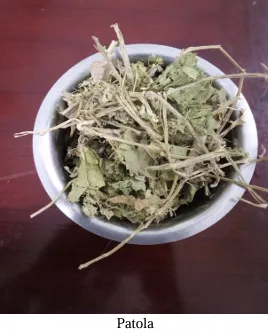
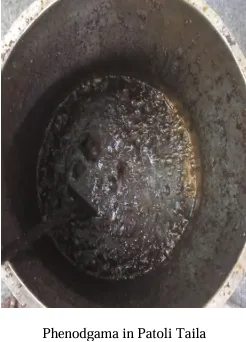
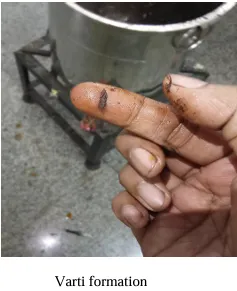
Table 2 shows the ingredient list of Patoli Taila, Patola Panchanga was boiled with 46.4 L of water over Mandagni and reduced to 11.6 L to obtain Patola Kwatha, which was subsequently filtered. Patola Kalka was prepared from 725 g of Patola Churna using sufficient Kwatha. Murchita Sarshapa Taila, Patola Kwatha and Patola Kalka were combined and subjected to Taila Paka over Mandagni with continuous stirring. Heating was continued until the aqueous portion evaporated and the Taila Paka Lakshanas were attained. The preparation was cooled to lukewarm temperature, filtered through a clean cloth and stored in a clean, dry container. The final yield was 2.1 L.
2. Analytical Evaluation
The prepared Patoli Taila was subjected to organoleptic and physicochemical evaluation for quality assessment and standardization. Organoleptic parameters included colour and odour. Physicochemical parameters evaluated were refractive index, specific gravity, viscosity, pH, acid value, saponification value, iodine value, peroxide value, unsaponifiable matter and loss on drying. The formulation was additionally assessed for rancidity and microbial load. HPTLC fingerprinting was performed using the chloroform-soluble fraction on precoated silica gel F254 plates, with Toluene:Ethyl acetate (9:1) as the mobile phase. The developed plates were visualized under UV at 254 and 366 nm and after derivatization with vanillin-sulphuric acid.
3. Experimental Study
The wound-healing activity of Patoli Taila was evaluated using the molten wax burn wound model in Wistar strain albino rats. Healthy rats of either sex weighing 150–300 g were selected and acclimatized for seven days under standard laboratory conditions, with balanced pellet diet and water ad libitum.
A total of 18 rats were divided into three groups of six animals each:
Table 3. Experimental grouping
|
Group |
No. of rats |
Treatment |
|
Control |
6 |
No topical treatment |
|
Standard |
6 |
Silver Nitrate |
|
Trial |
6 |
Patoli Taila |
3.1 Induction of Burn Wound
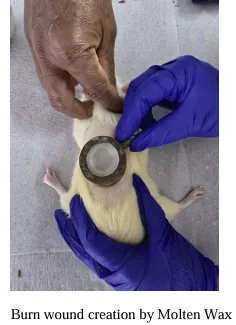
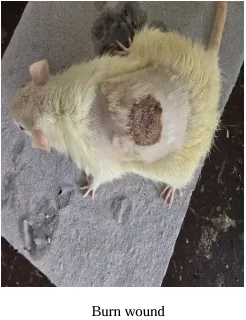
The dorsal hair of the animals was shaved after anaesthesia. A 2 × 2 cm metal cylinder was placed over the prepared dorsal area and filled with molten wax maintained at approximately 80°C. The wax was allowed to solidify, and after eight minutes the cylinder was gently removed, producing a well-demarcated burn wound.
3.2 Treatment
Topical treatment was initiated from the first day of wounding. Patoli Taila was externally applied to the Trial group and Silver Nitrate to the Standard group. The Control group received no topical treatment and was allowed to undergo natural healing.
3.3 Assessment of Wound Healing
Wound contraction: Wound margins were traced periodically on tracing paper and transferred to millimetre-scale graph paper. Percentage wound contraction was calculated using the formula:
Percentage wound contraction = [(Initial wound area − Specific day wound area) / Initial wound area] × 100
Observations were recorded on the 4th, 8th, 12th, 16th, 20th, 24th, 28th, 30th and 32nd post-wounding days.
Eschar fall: The period of epithelialization was assessed by recording the number of days required for the eschar to separate from the wound surface without leaving a raw wound. Animals were monitored daily until epithelialization was observed.
3.4 Statistical Analysis
The experimental data were statistically analyzed using ANOVA to assess differences among the study groups.
Results
Pharmaceutical Results
Murchana of Sarshapa Taila was successfully completed, with an initial quantity of 4 L yielding 2.9 L of Murchita Sarshapa Taila. Subsequently, Patoli Taila was prepared using 2.9 L of Murchita Sarshapa Taila, yielding 2.1 L of the final formulation.
Analytical Results
The prepared Patoli Taila exhibited a reddish-brown colour with the characteristic odour of its ingredients. Physicochemical evaluation is depicted in Table 4.
HPTLC fingerprinting of the chloroform fraction of Patoli Taila was carried out using Toluene:Ethyl acetate (9:1) as the solvent system. Distinct spots were observed under short UV, long UV and after derivatization, with Rf values ranging from 0.08 to 0.35, indicating the presence of multiple detectable constituents in the formulation.
Table 4.Physiochemical evaluation of Patoli Taila
|
Parameter |
Result |
|
Refractive index |
1.46956 |
|
Specific gravity |
0.8675 |
|
Viscosity |
57.42 |
|
pH |
6.0 |
|
Acid value |
5.47 |
|
Saponification value |
202.01 |
|
Iodine value |
15.99 |
|
Peroxide value |
0.57 |
|
Unsaponifiable matter (%) |
0.11 |
|
Rancidity |
Fat is not oxidised |
|
Moisture content |
0.0% |
|
Total solids |
0.0% |
|
Loss on drying |
0.0% |
Experimental Results
The wound-healing activity of Patoli Taila was assessed in a molten-wax burn wound model using three groups: Control, Standard and Trial. Wound contraction was evaluated at different intervals following induction of the burn wound.
The data related to effect of Patoli Taila on wound contraction on day 4,8,12,16,20,24,28&32 are shown in Table 5-12
On the 4th day, the mean percentage wound reduction was 17.74 ± 2.73 in the Patoli Taila group, compared with −7.77 ± 2.73 in the Standard group and −31.22 ± 7.18 in the Control group. The difference in the Trial group was statistically significant (p < 0.01).
On the 8th day, wound reduction increased to 39.20 ± 2.98% in the Patoli Taila group, compared with 18.06 ± 3.88% in the Standard group and −6.04 ± 7.41% in the Control group. The increase in wound contraction in both treated groups was statistically significant (p < 0.01).
By the 12th day, the Patoli Taila group showed 57.05 ± 1.97% wound reduction, compared with 46.26 ± 8.35% in the Standard group and 1.36 ± 6.40% in the Control group, with the difference in both treated groups being statistically significant (p < 0.01).
On the 16th day, wound reduction in the Patoli Taila group reached 90.25 ± 0.61%, compared with 55.12 ± 10.26% in the Standard group and 45.34 ± 13.82% in the Control group. The improvement in the Trial group was statistically significant (p < 0.05).
On the 20th day, the Patoli Taila group showed 93.24 ± 1.15% wound reduction, compared with 69.80 ± 8.99% in the Standard group and 47.76 ± 13.47% in the Control group. The improvement in the Trial group was statistically significant (p < 0.01).
On the 24th and 28th days, wound contraction continued to improve in all groups. The Patoli Taila group demonstrated 94.78 ± 1.00% reduction on day 24 and 98.28 ± 0.70% on day 28, compared with 79.31 ± 7.79% and 88.09 ± 5.99%, respectively, in the Standard group.
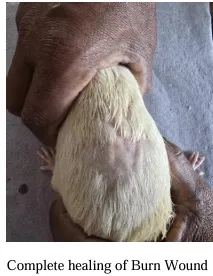
By the 32nd day, the Patoli Taila group achieved 99.19 ± 0.49% wound reduction, compared with 91.69 ± 5.74% in the Standard group and 83.76 ± 10.13% in the Control group.
Eschar Fall
The data related to effect of Patoli Taila on Eschar Fall are shown in Table 13
The mean duration for eschar fall was 14.67 ± 0.66 days in the Patoli Taila group, compared with 22.83 ± 3.71 days in the Standard group and 22.83 ± 3.11 days in the Control group. Patoli Taila demonstrated a 35.742% reduction in eschar-fall duration compared with the Control group; however, the observed difference was statistically non-significant.
Overall, Patoli Taila demonstrated progressive improvement in wound contraction throughout the observation period, with nearly complete wound closure by day 32. The formulation also showed a shorter mean duration of eschar fall compared with the Control and Standard groups.
Table 5 EFFECT ON WOUND CONTRACTION ON DAY 4
|
Group |
Percentage Reduction Day 4 |
Percentage Change |
|
No Drug |
-31.22±7.18 |
- |
|
Standard |
-7.77±2.73 |
75.08↓ |
|
Trial Drug |
17.74±2.73** |
156.82↓ |
Table 6 EFFECT ON WOUND CONTRACTION ON DAY 8
|
Group |
Percentage Reduction |
Percentage Change |
|
No Drug |
-6.04±7.41 |
- |
|
Standard |
18.06±3.88** |
407.84↓ |
|
Trial Drug |
39.20±2.98** |
748.79↓ |
Table 7 EFFECT ON WOUND CONTRACTION ON DAY 12
|
GROUP |
PERCENTAGE REDUCTION |
PERCENTAGE CHANGE |
|
NO DRUG |
1.36±6.40 |
- |
|
STANDARD |
46.26±8.35** |
3281.57↑ |
|
TRIAL DRUG |
57.05±1.97** |
4070.32↑ |
Table 8 EFFECT ON WOUND CONTRACTION ON DAY 16
|
Group |
Percentage Reduction |
Percentage Change |
|
No Drug |
45.34±13.82 |
- |
|
Standard |
55.12±10.26 |
21.57↑ |
|
Trial Drug |
90.25±0.61* |
99.05↑ |
Table 9 EFFECT ON WOUND CONTRACTION ON DAY 20
|
Group |
Percentage Reduction |
Percentage Change |
|
No Drug |
47.76±13.47 |
- |
|
Standard |
69.80±8.99 |
46.14↑ |
|
Trial Drug |
93.24±1.15** |
95.22↑ |
Table 10 EFFECT ON WOUND CONTRACTION ON DAY 24
|
Group |
Percentage Reduction |
Percentage Change |
|
No Drug |
72.02±10.11 |
- |
|
Standard |
79.31±7.79 |
10.12↑ |
|
Trial Drug |
94.78±1.00 |
31.60↑ |
Table 11 EFFECT ON WOUND CONTRACTION ON DAY 28
|
Group |
Percentage Reduction |
Percentage Change |
|
No Drug |
79.32±10.04
|
- |
|
Standard |
88.09±5.99 |
11.05↑ |
|
Trial Drug |
98.28±0.70 |
23.90↑ |
Table 12 EFFECT ON WOUND CONTRACTION ON DAY 32
|
Group |
Percentage Reduction |
Percentage Change |
|
No Drug |
83.76±10.13 |
- |
|
Standard |
91.69±5.74 |
9.46↑ |
|
Trial Drug |
99.19±0.49 |
18.42↑ |
Table 13 EFFECT ON ESCHAR FALL
|
Group |
Percentage Reduction |
Percentage Change |
|
No Drug |
22.83±3.11 |
- |
|
Standard |
22.83±3.71 |
0 |
|
Trial Drug |
14.67±0.66 |
↓35.742 |
Discussion
Patoli Taila was prepared according to the classical reference of Yogaratnakara using Murchita Sarshapa Taila as the base. The pharmaceutical process involved Murchana of Sarshapa Taila followed by Sneha Paka with Patola Kwatha and Kalka. The attainment of characteristic Sneha Siddhi Lakshanas indicated completion of the process. The final yield of Patoli Taila was 2.1 L from 2.9 L of Murchita Sarshapa Taila. The loss observed during preparation may be attributed to absorption of oil by the Kalka, retention during filtration and minor handling losses.
Analytical evaluation demonstrated satisfactory physicochemical characteristics of the prepared formulation. The pH of 6.0 was considered suitable for topical application, while the viscosity of 57.42 indicated adequate retention of the oil over the wound surface. The low acid value (5.47) and peroxide value (0.57), together with absence of rancidity, indicated minimal oxidative and hydrolytic deterioration. Moisture content and loss on drying were 0.0%, suggesting proper removal of aqueous content during Taila Paka.
HPTLC fingerprinting demonstrated multiple spots at different Rf values under short UV, long UV and after derivatization, indicating the presence of several detectable phytoconstituents in Patoli Taila. The chromatographic profile provides a useful fingerprint for quality control and future batch-to-batch standardization.
In the experimental burn wound model, Patoli Taila demonstrated progressive improvement in wound contraction throughout the observation period. Significant improvement was observed during the active healing phase, particularly on days 4, 8, 12, 16 and 20. Wound contraction in the Patoli Taila group increased from 17.74 ± 2.73% on day 4 to 93.24 ± 1.15% on day 20, compared with 69.80 ± 8.99% in the Standard group. By days 24, 28 and 32, the Patoli Taila group showed 94.78%, 98.28% and 99.19% wound contraction, respectively, indicating almost complete wound closure.
The enhanced wound contraction may be related to the combined properties of Patola and Sarshapa Taila. Patola is traditionally indicated for Agnidagdha Vrana and is described as useful in alleviating Daha, Srava and inflammatory changes, while Sarshapa Taila serves as the Sneha medium and facilitates local application and delivery of the formulation. These properties may collectively support the processes involved in wound contraction and tissue repair.
Patoli Taila also produced earlier eschar separation, with a mean eschar-fall duration of 14.67 ± 0.66 days, compared with 22.83 ± 3.11 days in the Control group and 22.83 ± 3.71 days in the Standard group. Although the difference was statistically non-significant, the shorter duration suggests a favourable trend towards earlier removal of necrotic tissue and progression of healing.
Overall, the pharmaceutical, analytical and experimental findings provide preliminary scientific support for the classical indication of Patoli Taila in Agnidagdha Vrana, particularly its potential to promote wound contraction and facilitate earlier eschar separation. Further studies with larger sample sizes and clinical evaluation are warranted to establish its therapeutic efficacy.
CONCLUSION
The present study was undertaken to evaluate Patoli Taila pharmaceutically, analytically and experimentally with special reference to burn wounds (Agnidagdha Vrana). The formulation was prepared according to the classical reference of Yogaratnakara, using Murchita Sarshapa Taila as the Sneha Dravya and Patola as the principal drug. The pharmaceutical preparation involved two major stages: Murchana of Sarshapa Taila followed by preparation of Patoli Taila through the Sneha Kalpana procedure. During the preparation, the classical Sneha Siddhi Lakshanas were observed, indicating proper completion of Taila Paka. The final preparation was obtained as a reddish-brown, characteristic-smelling medicated oil.
The Murchana procedure resulted in 2.9 L of Murchita Sarshapa Taila from an initial quantity of 4 L. Subsequently, 2.1 L of Patoli Taila was obtained from 2.9 L of Murchita Sarshapa Taila. The observed reduction in yield may be attributed to absorption of oil by the Kalka, retention during filtration and minor losses during processing. The successful completion of the pharmaceutical process demonstrates the feasibility of preparing Patoli Taila according to the classical method.
Analytical evaluation demonstrated satisfactory quality characteristics of the prepared formulation. The physicochemical parameters, including refractive index, specific gravity, viscosity, pH, acid value, saponification value, iodine value, peroxide value and unsaponifiable matter, provided a characteristic profile for Patoli Taila. The absence of rancidity indicated that the formulation did not show significant oxidative deterioration. Similarly, the absence of detectable moisture, loss on drying and microbial load indicated proper completion of the Sneha Paka and satisfactory hygienic quality of the preparation. These findings support the stability and quality of the prepared formulation.
HPTLC evaluation demonstrated multiple phytochemical bands at different Rf values under different visualization conditions. This indicates the presence of multiple detectable constituents incorporated into the oil medium during the Sneha Kalpana process. The HPTLC fingerprint provides a useful analytical profile for identification and quality control of Patoli Taila and may serve as a reference for future standardization and batch-to-batch comparison.
The experimental evaluation was conducted using a burn wound model to assess the wound-healing potential of Patoli Taila. The Trial group demonstrated a progressive increase in wound contraction throughout the observation period when compared with the untreated Control group. Statistically significant improvement was observed particularly on the 4th, 8th, 12th, 16th and 20th days, indicating a favourable effect of Patoli Taila during the active phases of wound healing. The magnitude of wound contraction continued to increase during the later observation period, with the Trial group achieving 99.19% wound contraction by the 32nd day, indicating nearly complete wound closure.
Patoli Taila also demonstrated a favourable effect on eschar fall. The Trial group showed earlier eschar separation compared with both the Control and Standard groups. Although the difference was statistically non-significant, the reduction in the duration of eschar fall indicates a positive trend towards earlier removal of necrotic tissue and progression towards wound healing.
The observed wound-healing activity may be understood in relation to the classical properties of the ingredients and the pharmaceutical process. Patola is traditionally indicated in Agnidagdha Vrana, while its properties are considered useful in addressing symptoms such as Daha, Srava and inflammatory changes associated with burn wounds. Sarshapa Taila provides the Sneha medium and facilitates topical application of the formulation. The Sneha Kalpana process allows incorporation of the constituents of Patola into the lipid medium, thereby producing a formulation suitable for external application.
Thus, the findings of the present study provide experimental support for the classical indication of Patoli Taila in Agnidagdha Vrana. The formulation demonstrated satisfactory pharmaceutical and analytical characteristics along with a favourable wound-healing response in the experimental burn wound model, particularly with respect to wound contraction and earlier eschar separation. However, the present findings are limited to experimental evaluation and should not be directly extrapolated to clinical efficacy in human burn wounds. Further investigations, including histopathological, molecular and clinical studies, are required to elucidate its mechanism of action and establish its clinical efficacy and safety.
|
|
|
|
|
|
|
|
|
|
|
|
|
|
|
|
|
|
|
|
|
|
|
|
|
REFERENCES







Dr. C . Shristy Shetty, Dr. Savitha KBhat , Dr. Rachana C., Dr. Chaithra P.B, Dr. Samarth Ballyaya, Dr. Apta, Dr . Shantala, Pharmaceutico-Analytical And Experimental Evaluation Of Patoli Taila With Special Reference To Burn Wounds, Int. J. of Pharm. Sci., 2026, Vol 4, Issue 9, 1076-1087. https://doi.org/ 10.5281/zenodo.22690425
 10.5281/zenodo.22690425