

We use cookies to ensure our website works properly and to personalise your experience. Cookies policy
1,2Department Of Pharmacology, Loknete Shri Dadapatil Pharate College Of Pharmacy
3 Department Of Pharmaceutical Chemistry, Mces Dr.Paiu Allana College Of Pharmacy, Pune
Background: Myocardial infarction remains one of the leading causes of cardiovascular mortality worldwide. Oxidative stress and myocardial membrane damage play critical roles in its pathogenesis. Emodin, a naturally occurring anthraquinone derivative, possesses antioxidant and anti-inflammatory properties that may provide cardioprotection.Myocardial infarction (MI) is a leading cause of cardiovascular morbidity and mortality worldwide. The present study investigated the cardioprotective potential of Emodin against isoproterenol-induced myocardial infarction in Sprague-Dawley rats. Animals were pretreated with Emodin (20, 40, and 80 mg/kg, p.o.) or Metoprolol (10 mg/kg, p.o.) for 30 days, followed by isoproterenol administration (100 mg/kg, i.p.) on days 29 and 30. Cardiac injury was evaluated using electrocardiographic, hemodynamic, and cardiac weight parameters. Isoproterenol-induced myocardial infarction resulted in significant cardiac hypertrophy, ECG abnormalities, reduced heart rate, prolonged conduction intervals, and decreased blood pressure. Pretreatment with Emodin, particularly at 80 mg/kg, significantly attenuated these alterations by reducing heart weight, normalizing ECG parameters, and improving systolic, diastolic, and mean arterial blood pressure. The cardioprotective effects of Emodin were comparable to those observed with Metoprolol treatment. These findings demonstrate that Emodin exerts significant cardioprotective activity against isoproterenol-induced myocardial injury, possibly through antioxidant and myocardial protective mechanisms. Therefore, Emodin may represent a promising therapeutic candidate for the prevention and management of myocardial infarction.
Cardiovascular diseases continue to represent a major global health burden, accounting for approximately one-third of worldwide mortality. Myocardial infarction results from prolonged ischemia leading to irreversible myocardial necrosis and subsequent structural and functional impairment. Oxidative stress, inflammation, calcium overload, and membrane lipid peroxidation contribute significantly to myocardial injury.
Isoproterenol-induced myocardial infarction is a widely accepted experimental model that closely resembles several pathological features of human myocardial infarction. Excessive β-adrenergic stimulation causes oxidative damage, calcium overload, mitochondrial dysfunction, and myocardial necrosis.
Natural products have emerged as promising therapeutic agents due to their multitarget pharmacological activities. Emodin (1,3,8-trihydroxy-6-methylanthraquinone) is a bioactive constituent found in Rheum species and Polygonaceae plants. Previous investigations have demonstrated antioxidant, anti-inflammatory, anti-apoptotic, and cardioprotective activities of Emodin. However, comprehensive evaluation against isoproterenol-induced myocardial infarction remains limited.
The present study investigated the cardioprotective potential of Emodin in an experimental rat model of myocardial infarction using functional, biochemical, and histopathological endpoints.
MATERIALS AND METHODS
Experimental Animals
Adult Sprague-Dawley rats weighing 180–220 g were maintained under standard laboratory conditions with free access to food and water. Experimental procedures were approved by the Institutional Animal Ethics Committee and conducted according to CPCSEA guidelines.
Experimental Design
Animals were divided into six groups:
Group I: Normal Control
Group II: Vehicle Control (ISO 100 mg/kg)
Group III: Metoprolol (10 mg/kg + ISO)
Group IV: Emodin (20 mg/kg + ISO)
Group V: Emodin (40 mg/kg + ISO)
Group VI: Emodin (80 mg/kg + ISO)
Emodin and metoprolol were administered orally for 30 consecutive days. Isoproterenol (100 mg/kg, i.p.) was injected on days 29 and 30.
Assessment Parameters
Statistical Analysis
Data were analyzed using one-way ANOVA followed by Dunnett’s multiple comparison test. P < 0.05 was considered statistically significant.
Methods: Myocardial infarction was induced using isoproterenol (100 mg/kg, i.p.) administered on days 29 and 30. Rats were pretreated orally with Emodin (20, 40, and 80 mg/kg) or Metoprolol (10 mg/kg) for 30 days. Electrocardiographic parameters, hemodynamic measurements, cardiac weight indices, serum cardiac biomarkers, oxidative stress markers, and histopathological alterations were assessed.
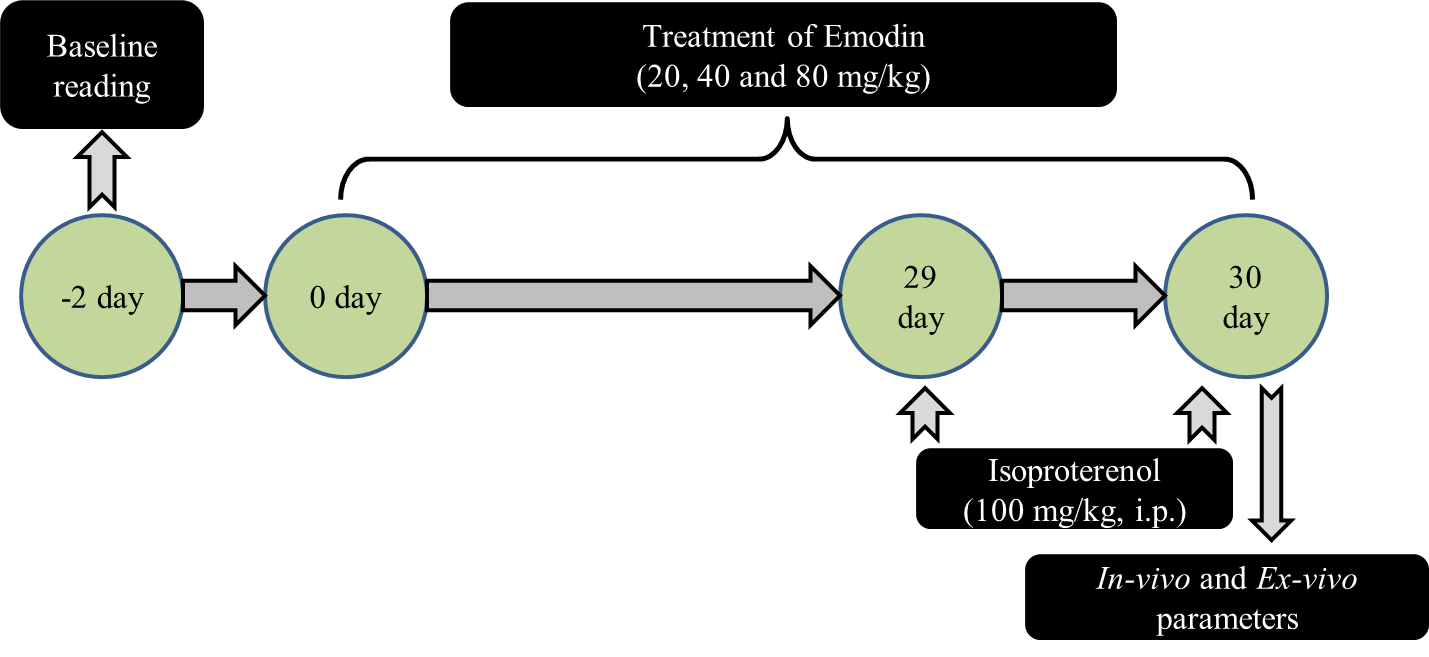
Image No. 1 Plan of Work Chart
Results:
Isoproterenol administration produced significant myocardial injury characterized by increased heart weight, prolonged ECG intervals, reduced heart rate, decreased blood pressure parameters, and marked cardiac dysfunction. Emodin at 80 mg/kg significantly attenuated these alterations. Heart weight decreased from 0.87 ± 0.06 g in vehicle control animals to 0.49 ± 0.01 g following Emodin treatment. Relative heart weight was reduced from 3.66 ± 0.24 to 2.04 ± 0.02. Heart rate increased from 255.50 ± 8.20 bpm to 329.20 ± 9.35 bpm, while RR interval decreased from 225.50 ± 5.72 ms to 173.50 ± 4.47 ms. Emodin significantly normalized QRS, QT, QTc, PR, and ST intervals. Hemodynamic parameters including systolic blood pressure, diastolic blood pressure, and mean arterial blood pressure were significantly restored. These findings suggest dose-dependent cardioprotection comparable to metoprolol.
Conclusion: Emodin exerts significant cardioprotective activity against isoproterenol-induced myocardial infarction through improvement of cardiac function, normalization of electrocardiographic disturbances, reduction of cardiac hypertrophy, and likely attenuation of oxidative stress-mediated myocardial injury.
Effect on Cardiac Hypertrophy
Isoproterenol significantly increased absolute and relative heart weights. Emodin at 80 mg/kg significantly reduced both parameters, demonstrating attenuation of cardiac hypertrophy.
Effect of Emodin on isoproterenol-induced alteration in body weight:
Effect on Electrocardiographic Parameters
Vehicle control animals exhibited marked prolongation of RR, QRS, QT, QTc, PR, and ST intervals with reduced heart rate. Emodin (80 mg/kg) significantly normalized all ECG parameters, indicating preservation of electrical conduction and myocardial integrity.
Effect of Emodin on isoproterenol-induced alteration in heart rate and RR interval
Effect on Hemodynamic Parameters
Isoproterenol caused significant reductions in systolic, diastolic, and mean arterial blood pressures. Emodin at 80 mg/kg restored these parameters close to normal values, suggesting improved cardiac performance and vascular function.
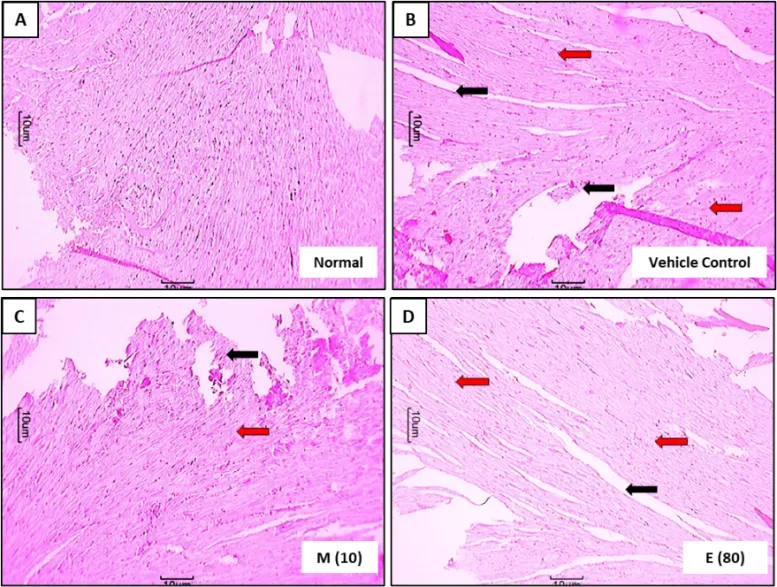
Effect of isoproterenol on histopathological alteration in cardiac tissue
DISCUSSION
The present investigation demonstrates significant cardioprotective effects of Emodin against isoproterenol-induced myocardial injury. The observed increase in cardiac weight following isoproterenol administration indicates myocardial edema and hypertrophy resulting from oxidative stress and inflammatory processes.
ECG abnormalities observed in vehicle control animals are characteristic features of myocardial infarction and reflect impaired cardiac conduction and ventricular dysfunction. Emodin treatment markedly corrected these abnormalities, suggesting stabilization of myocardial membranes and preservation of electrical activity.
The restoration of blood pressure parameters indicates improved myocardial contractility and hemodynamic stability. Previous studies have attributed these beneficial effects to the antioxidant and anti-inflammatory properties of Emodin.
The cardioprotective effects are likely mediated through reduction of oxidative stress, inhibition of lipid peroxidation, enhancement of endogenous antioxidant defenses, and preservation of myocardial cellular architecture.
CONCLUSION
Emodin demonstrated significant dose-dependent cardioprotective activity against isoproterenol-induced myocardial infarction. The highest tested dose (80 mg/kg) exhibited efficacy comparable to metoprolol in improving electrocardiographic, hemodynamic, and cardiac weight parameters. These findings support the therapeutic potential of Emodin as a promising cardioprotective agent and warrant further mechanistic and clinical investigations.
|
Treatment |
Infiltration of neutrophils |
Congestion |
Oedema |
Necrotic Changes |
|
Normal |
- |
+ |
+ |
- |
|
Vehicle Control |
++++ |
+++ |
++++ |
++++ |
|
M (10) |
+ |
+ |
+ |
++ |
|
E (80 mg/kg) |
+ |
+ |
++ |
++ |
Ethical Approval
The study was approved by the Institutional Animal Ethics Committee and conducted according to CPCSEA guidelines.
REFERENCES



Jasmin Rashid Bagwan, Dr. H. V. Kamble, Mr. Mujeeb Shaikh, Pharmacological Evaluation of Emodine Against Isoproterenol-Induced Cardiac Hypertrophy, Int. J. of Pharm. Sci., 2026, Vol 4, Issue 6, 4160-4165, https://doi.org/10.5281/zenodo.20730287
 10.5281/zenodo.20730287