

We use cookies to ensure our website works properly and to personalise your experience. Cookies policy
Upgraded Department of Rasashastra and Bhaishajya Kalpana, Government Ayurved College, Vadodara, Gujarat, India
Background: Sphatikamani is an important Uparatna described in classical Ayurvedic literature. A limited number of studies have been conducted on Uparatna, particularly Sphatikamani. Objective: The present study aimed to validate and standardize the pharmaceutical processes involved in the preparation of Sphatikamani Bhasma and Pishti. Materials and Methods: Sphatikamani Bhasma was prepared from Rock crystal and Rose quartz through Shodhana (purification) followed by Marana (incineration) in three batches each. Purification was performed by Svedana (boiling) for 6 hours using Gomutra, Nimbu Svarasa, Yavakshara and Svarjika Kshara. Incineration was carried out with Shuddha Gandhaka and Nimbu Svarasa through seven Gajaputa cycles. Sphatikamani Pishti was prepared from both varieties through seven Bhavana of 12 hours each with Gulab Arka. Results: SMPs were developed to formulate Sphatikamani Bhasma and Pishti. The average yield after purification was 98.09% for Rock crystal and 97.90% for Rose quartz. During incineration, the average peak temperature ranged from 864–891°C, with an average yield of 172 g for Rock crystal and 162.67 g for Rose quartz from an initial 150 g batch size. For Pishti, the average final yield was 164.67 g for Rock crystal and 163 g for Rose quartz from 150 g of purified material. Conclusion: Sphatikamani Bhasma and Pishti were successfully prepared from Rock crystal and Rose quartz using standardized procedures. Purification, levigation and incineration resulted in effective particle refinement and surface modification in Bhasma. Both Pishti varieties prepared with Gulab Arka showed comparable pharmaceutical outcomes.
In Rasashastra, Mani (Ratna and Uparatna) comprises precious and semi-precious gemstones with therapeutic and alchemical significance. Classical texts attribute Chakshushya and Sara properties to Ratna and Uparatna, along with the ability to alleviate Graha, Alakshmi, Visha, Kshina, Papa, and Santapa.[1] Sphatikamani, an important Uparatna, is generally correlated with quartz (SiO?) and is valued for its transparency, hardness, smooth texture, and cooling nature. Besides medicinal applications, traditionally rosaries made of Sphatikamani are used for Japa (chanting) and are believed to enhance concentration and the spiritual efficacy of the practice.[2]
Quartz occurs in several varieties, including Rock crystal, Rose quartz, Amethyst, and Citrine. The present study selected Rock crystal and Rose quartz. According to Rasashastra, gemstones undergo purification followed by incineration for Bhasma preparation, whereas Pishti is prepared through repeated levigation. Purification is considered the primary process for gemstones, while incineration may alter their inherent properties.[3] Thus, the distinct pharmaceutical processes may result in differences in the characteristics of the finished products.
Validation of both preparations enables comparison of the effects of different pharmaceutical processes on the same mineral substrate. The present study therefore aimed to validate and standardize the preparation of Sphatikamani Bhasma and Pishti based on process parameters, observations, duration, and yield.
MATERIALS AND METHODS
The study involved the procurement of raw materials followed by the preparation of Sphatikamani Bhasma (incinerated quartz) using two varieties. The complete pharmaceutical procedure, encompassing purification and incineration, was performed in three batches for each variety to ensure process validation and methodological consistency.
1. Procurement and authentication of the raw material
All the raw materials were procured and used for the incineration of Sphatikamani after proper identification and authentication. For that, Rock crystal and Rose quartz were procured from authentic gem traders from the market of Khambhat, Gujarat. Neel Gem’s Testing Laboratory [ISO (9001-2008) certified], Ahmedabad, Gujarat has identified and certified the sample as Rock crystal and Rose quartz. Fresh Yava Panchanga was procured from farmers in Dahod, Gujarat and subjected to pharmacognostical evaluation for its identification and authentication. Prepared Duralabha Ash was used for Svarjika Kshara. Cow’s urine was collected from a nearby cow shelter in Vadodara, Gujarat. Fresh lemon, fssai certified clarified butter and milk were procured from the local market of Vadodara. Gandhaka (Sulphur) was procured from the Government Ayurved Pharmacy, Vadodara, Gujarat.
2. Preparation of drug
To develop the SMPs, three batches each of Sphatikamani Bhasma [4] were prepared from Rock crystal (RCB) and Rose quartz (RQB) and three batches each of Sphatikamani Pishti [5] were prepared from Rock crystal (RCP) and Rose quartz (RQP) after subjecting them to the prescribed purification procedures. The entire pharmaceutical study was conducted in the Pharmaceutical Laboratory of the Upgraded Department of Rasashastra and Bhaishajya Kalpana, Government Ayurved College, Vadodara, Gujarat, under the following headings.
2.1. Preparation of Yavakshara and Svarjika Kshara
Yavakshara (alkali of Hordeum vulgare L.) and Svarjika Kshara (Alkali of Fagonia cretica L.) were prepared as per the reference of Rasatarangini. [6,7] Respective ash and water were taken in a ratio of 1:8 v/v. The ingredients were vigorously mixed and allowed to settle overnight. The supernatant Ksharajala was decanted using a rubber tube, filtered seven times through three-folded cotton cloth, and heated on a gas stove until complete evaporation. A total of three batches were prepared, each containing 500 ml (~ 406 g) of ash and 4 L of water for Yavakshara and 1 L (~ 693 g) of ash and 8 L of water for Svarjika Kshara. (Figure 1)
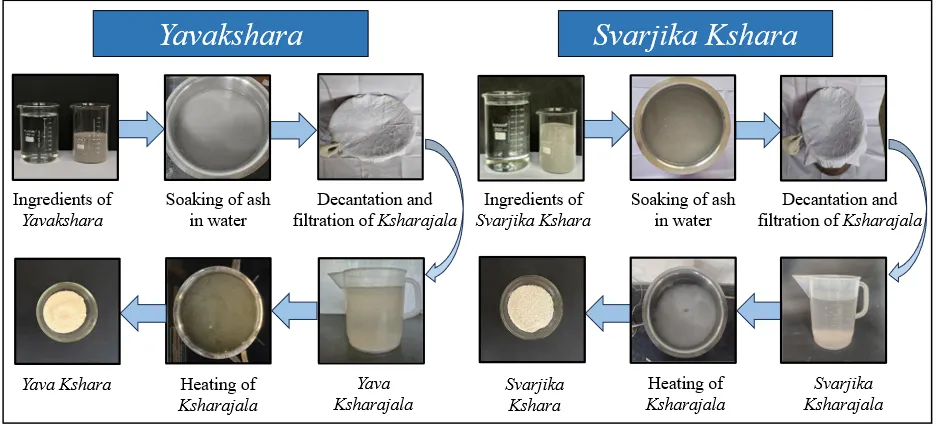
Figure 1. Preparation of Yavakshara and Svarjika Kshara
2.2. Preparation of Nimbu Svarasa
Nimbu Svarasa was prepared as per reference of Sharangdhara Samhita.[8] Fresh Citrus limon L. were cut and squeezed with a lemon squeezer, then the juice was collected and filtered. The final yield of the juice was 42%.
2.3. Sphatikamani Shodhana (RCS and RQS)
Purification of Sphatikamani was done on the principle of boiling using cow urine (1 part), Juice of Citrus limon L. (1/8th part), Alkali of Hordeum vulgare L. (1/40th part) and Alkali of Fagonia cretica L. (1/40th part) as liquid media.[9] 350 g of the material, which was bundled and suspended in a s.s. vessel containing a mixture of cow urine (1200 ml), Juice of Citrus limon L. (150 ml), Alkali of Hordeum vulgare L. and Alkali of Fagonia cretica L. (29 g) separately. The materials were boiled in prepared liquid media for 6 hours. After that, the material was washed with hot water and kept for drying. (Figure 2)
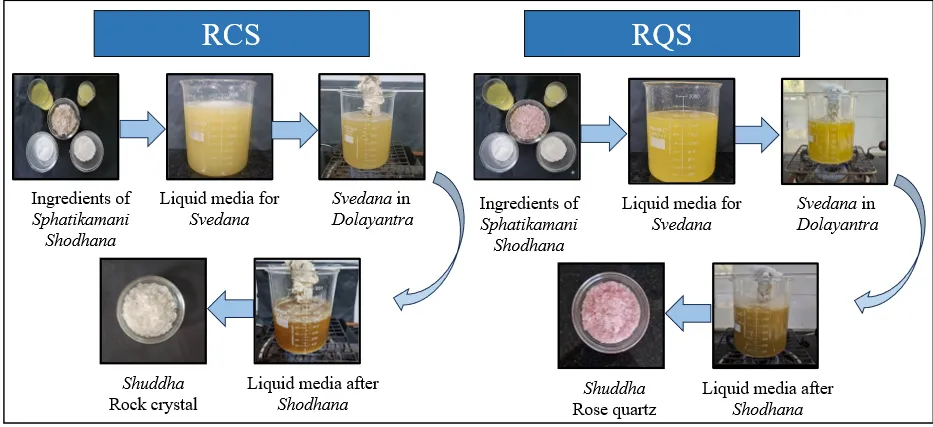
Figure 2. Preparation of Sphatikamani Shodhana
2.4. Gandhaka Shodhana
Purification of sulphur was performed in 10 batches as per Rasatarangini.[10] In each batch, 1 kg of powdered impure sulphur was melted over mild heat and filtered through a clarified butter smeared cotton cloth into milk. The solidified sulphur was collected, washed with hot water, powdered, and the process was repeated twice. The purified sulphur was finally dried and weighed. (Figure 3)
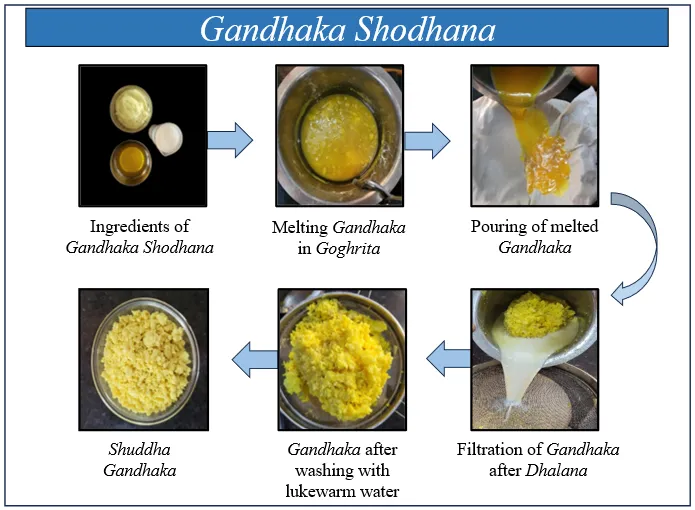
Figure 3. Preparation of Gandhaka Shodhana
2.5. Sphatikamani Marana (RCB and RQB)
Equal quantities (150 g each) of purified Sphatikamani and sulphur were levigated with juice of Citrus limon L. for 12 hours. The material was made into Chakrika (pellets) of 2 Tola (~24 g), dried, and Sharavasamputa was prepared using a clay-smeared cotton cloth and left to dry in the sunlight. After drying, the material was subjected to Gajaputa. After self-cooling, the material was collected, triturated, and subjected to subsequent Puta cycles with incorporation of purified sulphur after each Puta. After completion of the prescribed cycles, the obtained Bhasma was finely powdered, sieved, weighed, labelled, and stored in an airtight container for further analysis (Figures 4 and 5).
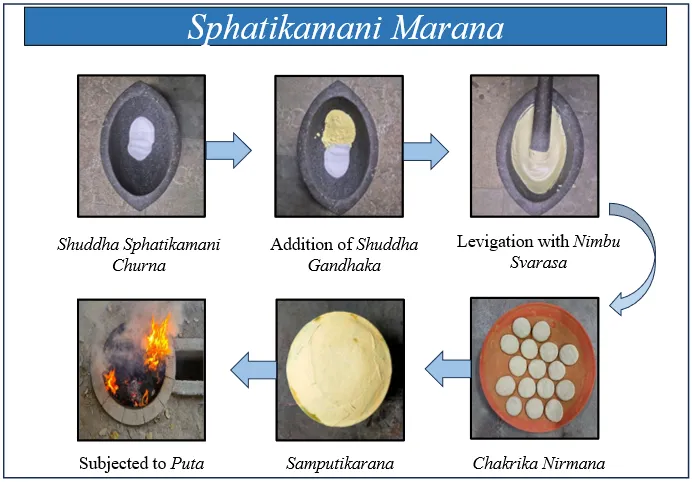
Figure 4. Preparation of Sphatikamani Marana
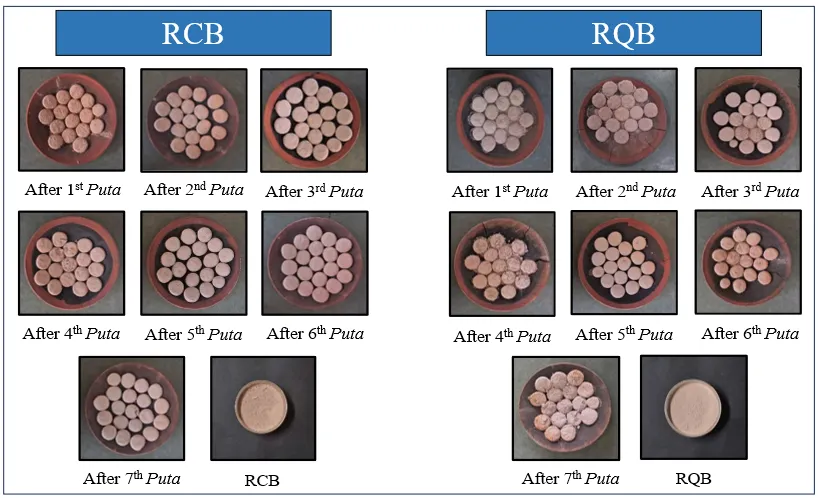
Figure 5. Preparation of Sphatikamani
Bhasma
2.6. Gulab Arka
A total of 300 g of Rosa Centifolia L. petals was soaked in 3750 ml of water (12.5 times its weight) and distilled. The temperature was maintained at 50°C throughout the distillation process. The collected distillate was stored in an airtight container for further use. (Figure 6)
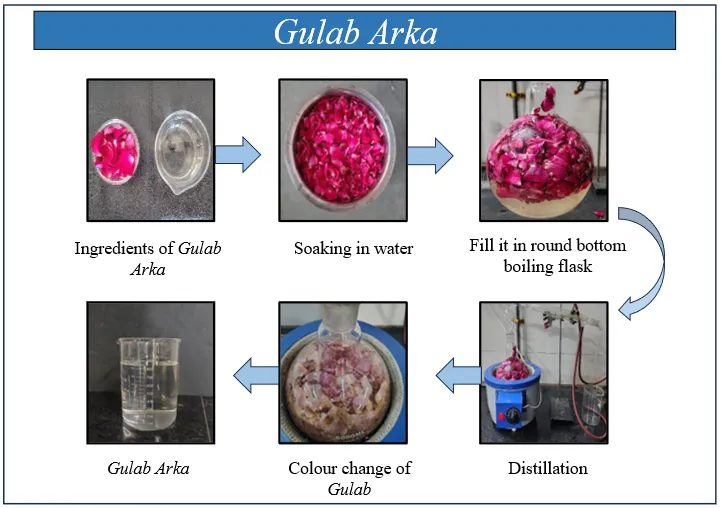
Figure 6. Preparation of Gulab Arka
2.7. Sphatikamani Pishti (RCP and RQP)
A total of 150 g of purified Sphatikamani powder was levigated with Rosa centifolia L. distillate as Bhavana Dravya for 12 hours per cycle, repeated for seven cycles. The resulting Sphatikamani Pishti was dried, weighed, labelled, and stored in an airtight container. (Figure 7)
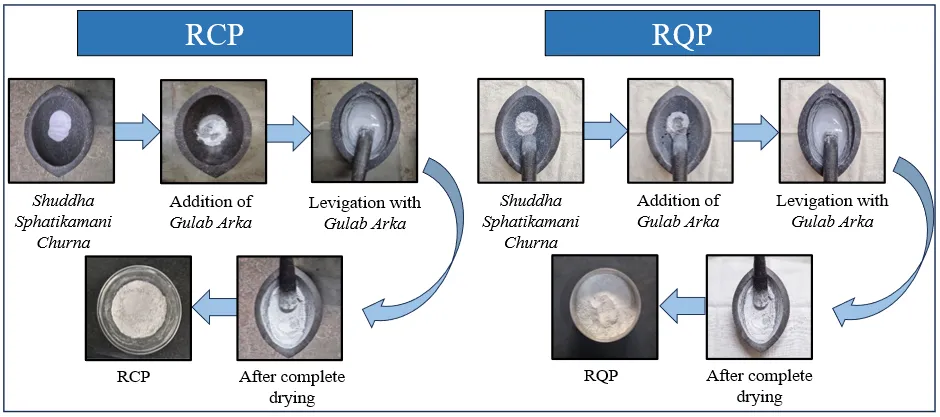
Figure 7. Preparation of Sphatikamani Pishti
RESULT AND DISCUSSION
Yavakshara, an ingredient of the Sphatikamani Shodhana medium, was prepared from 68 kg of fresh, mature Yava Panchanga (Hordeum vulgare L.). After 9 days of drying, 29 kg of dried material (42.65%) was obtained, yielding 2 kg of ash (6.9%). The average yield of Yavakshara was 14.53%. A review of research works of Sen DK et al. and Aggarwal P et al. revealed that the general yield percentage of Yavakshara ranges between 10% and 15%. [11,12]
Svarjika Kshara, another component of the Shodhana medium, was prepared using standardized Duralabha ash as per the departmental method. Three batches were prepared using the standardized volumetric ratio, yielding an average of 18.42%. Tarun et al. reported a 13.75% yield, and Janaki et al. reported a 18.46% yield of Svarjika Kshara.[13]
The Shodhana media were selected for their complementary acidic and alkaline actions. Gomutra, Yavakshara, and Svarjika Kshara provide alkalinity, whereas Nimbu Svarasa contributes citric acid. These media may promote mild surface etching and enhanced reactivity of quartz at defects and microfractures, facilitating removal of adhered impurities while preserving the Si–O–Si framework. [14,15] Thus, their combined action during Svedana facilitates effective surface cleansing with minimal alteration of the silica-rich mineral structure.
Effervescence occurred on heating, likely due to the acid–alkali interaction between Nimbu Svarasa and the alkaline media. The liquid gradually changed from yellow to dark brown with the characteristic odour of Gomutra. Following Shodhana, both varieties showed enhanced lustre with minimal weight loss, yielding 98.09% for Rock crystal and 97.90% for Rose quartz. The flame and liquid media temperatures were maintained at 330–350°C and 96–99°C, respectively.
10 main batches of Gandhaka Shodhana were conducted. The average yield was 98.17%. The minor weight variation was attributed to material adhering to the cloth and vessel surfaces and removal of physical impurities. For Sphatikamani Marana, 10 kg of sulphur was purified using 60 L of milk and 1000 g of clarified butter, yielding 10.19 kg of purified sulphur.
Sphatikamani possesses a Mohs hardness of 7 and considerable thermal stability; therefore, adequate heat is required for its Marana. The classical reference recommends Gajaputa for this process. Pilot batches were conducted to standardize the heating pattern and Bhavana requirements, including comparative processing of Rock crystal by Gajaputa and EMF, and Rose quartz by Gajaputa. The Gajaputa method RCB was light brown with a final yield of 172 g, while the EMF method RCB was reddish-brown and yielded 179 g. RQB obtained by Gajaputa was brownish-pink, yielded 170 g.
Three batches each of RCB and RQB were prepared with a uniform batch size of 150 g. The average juice of Citrus limon L. used for levigation was 1648.33 ml for RCB and 1656.67 ml for RQB, while 1050 g of purified sulphur was used for both varieties. After seven Puta, the average yield was 172 g for RCB and 162.67 g for RQB, with weight gain of 14.66% and 8.44%, respectively. The obtained Bhasma showed light pink colour in RCB and RQB. The average peak temperature during incineration ranged from 864 - 891°C, attained after approximately 2 hours 22 minutes. Variations in heat distribution within Sharavasamputa may influence surface properties, particle transformation, and colour intensity of Bhasma.
Comparative Average Temperature Profile of Sphatikamani Bhasma
The temperature profile during the Marana process of Sphatikamani was recorded at 15-minute intervals for 9 hours, and the comparative temperature variations are depicted in Graph 1 and Graph 2.
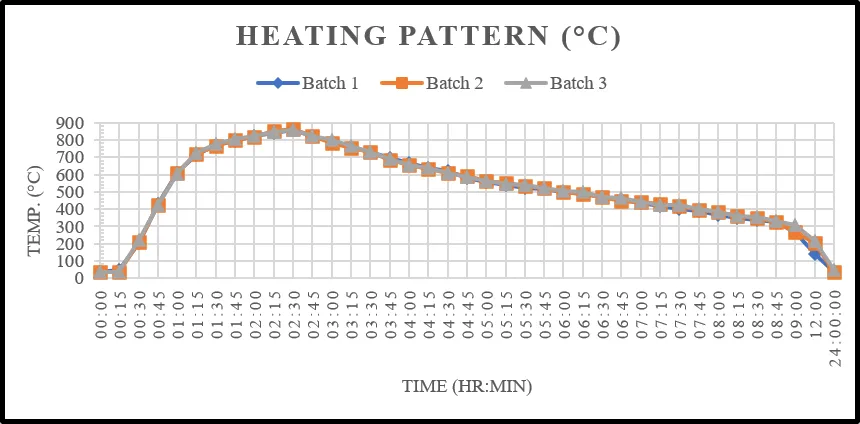
Graph No. 1: Average Temperature Pattern of Sphatikamani Bhasma (RCB)
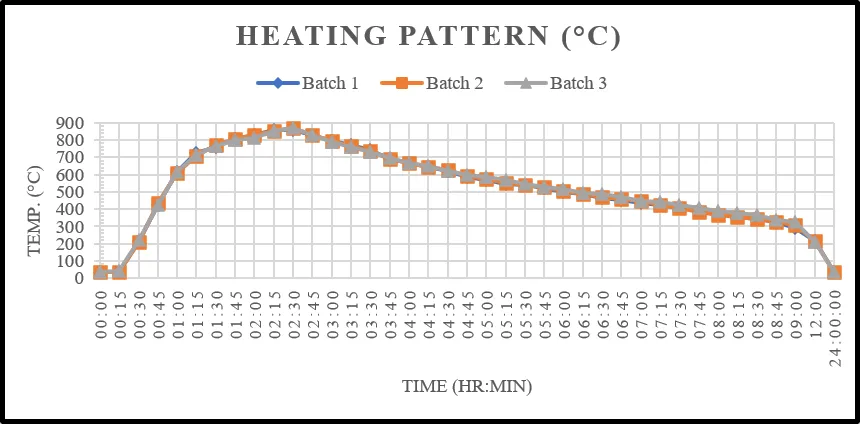
Graph No. 2: Average Temperature Pattern of Sphatikamani Bhasma (RQB)
Role of Bhavana and Maraka Dravya
Nimbu Svarasa acts as the Bhavana Dravya, providing moisture for uniform trituration of Sphatikamani with Shuddha Gandhaka. Its citric acid may enhance quartz surface reactivity and dissolution, facilitating particle refinement and homogeneous mixing.[15] Repeated levigation, heating, and self-cooling promote thermal stress, microcrack formation, and surface modification, resulting in progressive particle refinement. Thus, Nimbu Svarasa and Shuddha Gandhaka facilitate the pharmaceutical transformation of Sphatikamani into Bhasma primarily through surface and microstructural modifications without altering the SiO? composition.
Role of Gajaputa in Marana
The Gajaputa temperature profile showed gradual heating to a peak of 860–894°C, followed by slow cooling. Similar thermal behaviour has been reported by Ganesh Kumar et al. for the traditional Pudam process, where increased cow dung cake quantity resulted in higher peak temperature and longer heat retention, with slower heating facilitating greater heat penetration through the earthen enclosure.[16]
In the present study, the use of 36 kg cow dung cakes provided sustained heat for repeated Sphatikamani Marana. Gradual heating and slow cooling may facilitate controlled thermal processing while minimizing thermal stress. The earthen Sharava and sealing material provided insulation and limited heat dissipation, maintaining a controlled heating environment with negligible pressure development.
Role of Marana process in Sphatikamani Bhasma
Repeated Gajaputa subjected Sphatikamani to controlled calcination, promoting the removal of adsorbed moisture and organic residues along with structural rearrangement, surface modification, and changes in particle morphology without fusion.[17]
During Sphatikamani Marana, repeated Bhavana with Nimbu Svarasa followed by Gajaputa provided sequential wet-processing and thermal cycles. The organic constituents underwent gradual decomposition during heating, while repeated cycles promoted homogenization and microstructural modification of the mineral particles, influencing their crystallite organization, surface reactivity, and particle characteristics.
Gradual weight variation was observed across successive Puta cycles. Weight loss may be attributed to the removal of moisture, volatile constituents, and Gandhaka during repeated heating. The progressively lower weight loss in later cycles suggests reduced volatilization and gradual stabilization of the material during calcination.[18] Repeated Gajaputa cycles facilitated the pharmaceutical transformation of Sphatikamani into a finely processed Bhasma with improved pharmaceutical suitability.
Gulab Arka was used as the Bhavana Dravya for the levigation process in the preparation of Sphatikamani Pishti of both varieties. Gulab Arka was prepared according to the procedure described in the API. 3 main batches were prepared, with 300 g Gulab Pushpa and 3750 ml water. Gulab Arka was collected up to 50%, after which the heating process was discontinued due to the perception of a burnt odour during further distillation, yielding 1875 ml of Gulab Arka from each batch.
For the pilot batches, the total Gulab Arka used was 1060 ml for RCP and 1055 ml for RQP. The final yields were 164 g and 163 g, respectively. For the preparation of SMP, three batches each of RCP and RQP were prepared, with 150 g of purified Sphatikamani powder taken for each batch. As per pilot batch, the main batches of both varieties of Sphatikamani Pishti were prepared. The average quantity of Gulab Arka utilized for the preparation of RCP and RQP was 1055 ml and 1053.33 ml respectively. The average weight of the final Pishti product obtained was 164.67 g for RCP and 163 g for RQP, corresponding to a weight gain of 9.78% and 8.67%, respectively.
CONCLUSION
Sphatikamani Bhasma and Pishti were successfully prepared from both Rock crystal and Rose quartz using standardized manufacturing procedures. Purification resulted in improved lustre with minimal weight loss, while repeated levigation and incineration facilitated particle refinement and surface modification. The Gajaputa process provided gradual heating and slow cooling, supporting controlled thermal processing of Sphatikamani. Juice of Citrus limon L. and purified sulphur contributed to effective levigation and pharmaceutical transformation without altering the basic silica composition. Both varieties of Pishti were successfully prepared using Gulab Arka, with comparable pharmaceutical outcomes.
REFERENCES

Khushboo Parmar, Bharti Umretia, Process Validation of Bhasma and Pishti W.S.R. to Sphatikamani (quartz), Int. J. of Pharm. Sci., 2026, Vol 4, Issue 8, 5411-5420. https://doi.org/10.5281/zenodo.22221423
 10.5281/zenodo.22221423