

We use cookies to ensure our website works properly and to personalise your experience. Cookies policy
ASPM’s K. T. Patil College of Pharmacy, Dharashiv – 413501, Maharashtra, India.
Pharmacovigilance plays a key role in ensuring the safe and effective use of medicines by identifying and minimizing adverse drug reactions (ADRs). Traditionally, pharmacovigilance systems relied mainly on spontaneous reporting, which often resulted in underreporting and delayed detection of safety concerns.In recent years, pharmacovigilance has evolved with the integration of modern technologies and improved monitoring approaches. This review summarizes recent developments in pharmacovigilance reported between 2019 and 2025. Key areas include the application of artificial intelligence for early signal detection, the use of real-world data to understand drug safety in routine clinical settings, and digital platforms that facilitate efficient reporting. Increased patient involvement and global harmonization efforts have further strengthened pharmacovigilance systems.Despite these advancements, challenges such as data privacy concerns, variability in reporting practices, and limitations in infrastructure remain. Overall, pharmacovigilance is gradually shifting toward a more proactive, data-driven, and patient-centered approach to drug safety monitoring.
Pharmacovigilance refers to the science and activities related to the detection, assessment, understanding, and prevention of adverse effects associated with medicinal products (1,2). With the increasing use of pharmaceuticals worldwide, monitoring drug safety has become a major public health priority.
Earlier pharmacovigilance systems were largely based on spontaneous reporting, which had several limitations including underreporting, incomplete data, and delays in identifying risks (3,4,23). As a result, certain adverse effects were recognized only after extensive clinical use.
Over time, the field has moved toward more proactive and systematic approaches. Advances in data science, availability of large healthcare datasets, and improvements in regulatory frameworks have significantly contributed to this transition. Modern pharmacovigilance now focuses on early signal detection, continuous monitoring, and prevention of drug-related problems.
This review aims to provide an overview of recent advancements in pharmacovigilance and their role in improving drug safety monitoring systems.
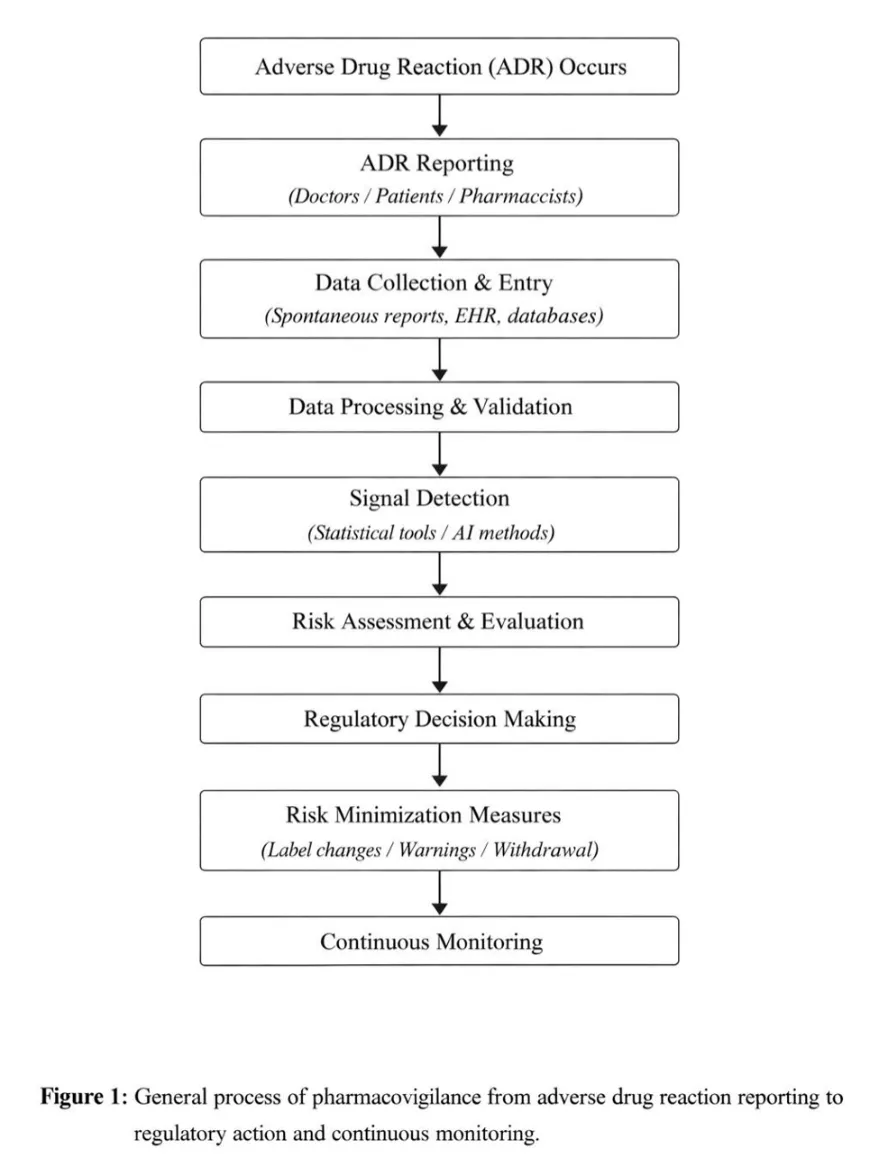
The overall workflow of pharmacovigilance, from adverse drug reaction reporting to regulatory action, is illustrated in Figure 1.
Figure 1: General process of pharmacovigilance from adverse drug reaction reporting to regulatory action and continuous monitoring.
2. RECENT ADVANCEMENTS IN PHARMACOVIGILANCE
2.1 Artificial Intelligence
Artificial intelligence (AI) has become an important tool in pharmacovigilance by enabling the analysis of large datasets and facilitating early detection of safety signals (6,7). Machine learning techniques can identify patterns in adverse drug reaction data and support predictive modeling.
Recent evidence from a systematic review has highlighted the growing role of AI in improving data analysis and signal detection in pharmacovigilance, although challenges related to data quality and regulatory acceptance remain (41).
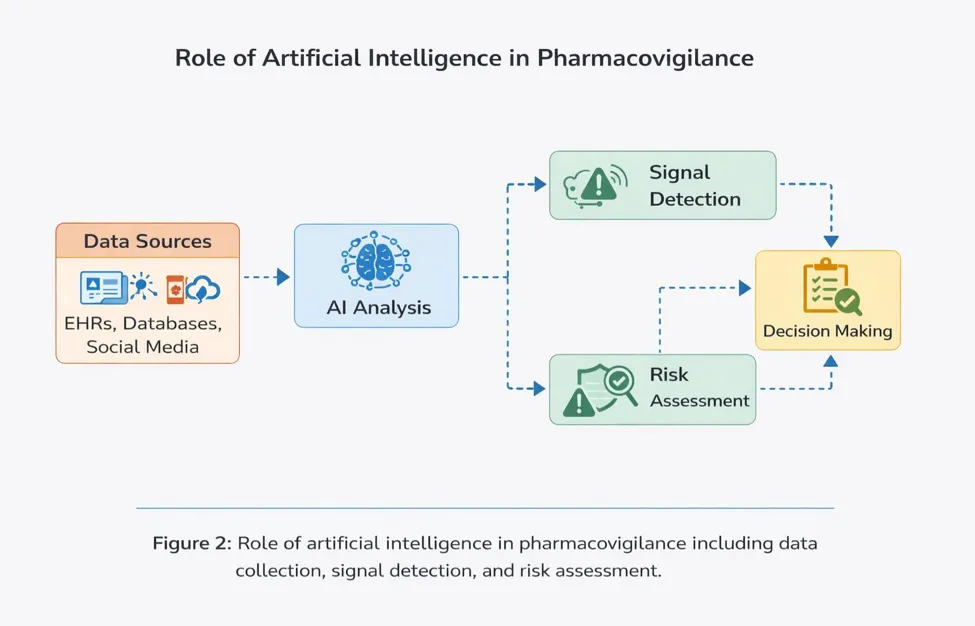
Figure 2: Role of artificial intelligence in pharmacovigilance from data collection and processing to signal detection, risk assessment, and decision making.
2.2 Automation
Automation has improved efficiency in pharmacovigilance activities such as case processing and report generation (8). It reduces manual workload and enhances consistency, although implementation may require adequate infrastructure and technical expertise.
2.3 Real-World Data
Real-world data obtained from electronic health records and clinical databases provides insights into drug safety under routine clinical conditions (10). It helps identify long-term and rare adverse effects that may not be observed during clinical trials.
2.4 Digital Pharmacovigilance
Digital tools, including mobile applications and online reporting systems, have improved the reporting and monitoring of adverse drug reactions (12,13). These platforms support faster communication and real-time data collection, although ensuring data accuracy remains essential.
2.5 Patient Participation
Increased involvement of patients in reporting adverse drug reactions has contributed valuable real-world insights into pharmacovigilance systems (14). However, variability in report quality can sometimes be a limitation.
2.6 Global Harmonization
Efforts toward global harmonization aim to standardize pharmacovigilance practices across different regions, improving consistency and data sharing (15).
2.7 Blockchain Technology
Blockchain technology offers a secure and transparent approach for storing pharmacovigilance data, ensuring data integrity and reducing the risk of unauthorized access (16).
2.8 Advanced Data Tools
Advanced computational tools assist in data analysis, literature review, and signal detection, improving overall efficiency in pharmacovigilance research (19).
2.9 Orphan Drug Monitoring
Pharmacovigilance plays a crucial role in monitoring orphan drugs, which often have limited safety data prior to approval (20).
2.10 Outsourcing
Outsourcing pharmacovigilance activities allows pharmaceutical companies to manage workload effectively and access specialized expertise (9), although it may raise concerns regarding data confidentiality.
TABLE 1: Key Advancements in Pharmacovigilance
|
Advancement |
Application |
Advantage |
Limitation |
|
Artificial Intelligence |
Signal detection |
Early identification |
Data dependency |
|
Automation |
Case processing |
Reduces workload |
Cost |
|
Real-World Data |
Clinical data |
Real-life insights |
Variability |
|
Digital PV |
Reporting |
Faster communication |
Accuracy issues |
|
Blockchain |
Data storage |
Security |
Limited adoption |
DISCUSSION
Recent developments in pharmacovigilance have significantly improved the ability to detect and manage drug safety issues. Compared to traditional approaches, modern systems are more data-driven and focus on early identification of potential risks.
Artificial intelligence has shown strong potential in enhancing signal detection and data analysis. A recent systematic review has further emphasized its importance in predictive modeling and large-scale data processing, although challenges related to data quality and regulatory frameworks still need to be addressed (41).
The use of real-world data has improved understanding of drug safety in everyday clinical practice. Digital reporting tools have made it easier for both healthcare professionals and patients to report adverse events, contributing to more efficient data collection.
At the same time, more active involvement of patients, along with efforts to standardize practices at a global level, has helped make pharmacovigilance systems more transparent and consistent.
Despite these advancements, challenges such as data privacy concerns, underreporting, and limitations in infrastructure continue to affect pharmacovigilance systems. Addressing these issues will be important for further strengthening drug safety monitoring.
TABLE 2: Challenges in Pharmacovigilance
|
Challenge |
Impact |
Solution |
|
Data privacy |
Limits data sharing |
Strong regulations |
|
Underreporting |
Delayed detection |
Awareness programs |
|
Implementation issues |
Technology barriers |
Infrastructure improvement |
CONCLUSION
Pharmacovigilance has evolved considerably with the integration of modern technologies and improved monitoring systems. These advancements have enhanced the efficiency and reliability of drug safety evaluation. Continued progress, along with better awareness and global collaboration, will further strengthen pharmacovigilance systems and improve patient safety.
REFERENCES



Shifa Salim Sayyad, Rafiya Ishtiyakhussaini Sayyed, Dr. Aamer Quazi, Recent Advances in Pharmacovigilance: A Comprehensive Review, Int. J. of Pharm. Sci., 2026, Vol 4, Issue 9, 2912-2917, https://doi.org/10.5281/zenodo.22915684
 10.5281/zenodo.22915684