

We use cookies to ensure our website works properly and to personalise your experience. Cookies policy
1Dept. of pharmaceutical quality assurance, vidya niketan institute of pharmacy & research center, bota, 422602,
2Dept. of pharmaceutical chemistry, vidya nikehetan institute of pharmacy & research center, bota, 422602
3 Dept. of pharmaceutical quality assurance,vidya niketan institute of pharmacy & research center, bota, 422602, 4Department of pharmaceutical quality assurance, vidya niketan institute of pharmacy & research center, bota, 422602
Quality by Design (QbD) represents a contemporary approach to ensuring the quality of pharmaceuticals. This paper explores the principles of Pharmaceutical Quality by Design and its application in maintaining pharmaceutical quality. It outlines the key components of QbD, identifies process parameters and quality attributes for each unit operation, and discusses the benefits, opportunities, and steps involved in implementing QbD in pharmaceutical products. The primary goal of pharmaceutical development is to create a quality product and manufacturing process that consistently delivers the desired performance. Quality should be integrated into products through design rather than tested in afterward. This includes defining the Quality Target Product Profile (QTPP), identifying Critical Quality Attributes (CQA), and understanding the impact of Critical Material Attributes (CMA) and Critical Process Parameters (CPP) on CQAs. The paper also contrasts traditional end-product testing with the QbD approach. The foundation of QbD is rooted in ICH Guidelines, specifically Q8 for pharmaceutical development, Q9 for quality risk management, and Q10 for pharmaceutical quality systems. Additionally, it discusses the application of QbD in the development and manufacturing of pharmaceuticals. [1]
The objective of pharmaceutical development is to design a quality product and its manufacturing process to reliably deliver the intended performance. Insights gained from development studies and manufacturing experiences provide the scientific basis for establishing design space, specifications, and manufacturing controls. It is crucial to understand that quality cannot merely be tested into products; it must be built in from the outset. Changes in formulation and manufacturing processes during development and lifecycle management should be viewed as opportunities to enhance knowledge and refine the design space. Similarly, insights from unexpected experimental results can be valuable. The design space proposed by the applicant is subject to regulatory assessment and approval, and any movement outside this space is considered a change, typically requiring a regulatory post-approval change process. [3]
Definition of Quality by Design (QbD) :
According to the ICH Q8 (R1) guideline, QbD is a systematic approach to development that starts with predefined objectives and emphasizes understanding product and process dynamics, alongside process control, grounded in sound science and quality risk management. The FDA's Process Analytical Technology (PAT) guidelines define QbD as a system for designing, analyzing, and controlling manufacturing through timely measurements of critical quality and performance attributes of materials and processes that impact product safety and quality. [4]
History of QbD :
The concept of QbD was pioneered by quality expert Joseph M. Juran. In 1986, W. Edwards Deming elaborated on the idea of quality by design, using disease as an analogy. In 2002, the FDA launched an initiative titled "cGMP for the 21st Century: A Risk-Based Approach," aimed at modernizing pharmaceutical quality regulation and establishing a framework focused on QbD, risk management, and quality systems. QbD necessitates an understanding of how product and process variables affect quality. This new approach was further solidified by the publication of two key ICH guidelines: Q8 on pharmaceutical development and Q9 on quality risk management. [5]
Advantages of QbD :
The advantages of QbD include:
Fundamental Aspects of QbD :
QbD requires comprehensive knowledge of how formulation development and processes influence product quality. It involves understanding sources of variability and their effects on the final product, allowing for better control of these variables. When QbD principles are effectively implemented, the need for extensive final product testing can be minimized or even eliminated. [6]
Objectives of Qbd :
The primary objective of QbD is to achieve high-quality products. Additional objectives include: [7]
Foundation of Qbd :
The foundation of QbD is built on ICH guidelines Q8 for pharmaceutical development, Q9 for quality risk management, and Q10 for quality systems. [9]
Design Principles :
Definition [ICH Q8(R1)] :
QbD is defined as a systematic approach to development that begins with predefined objectives and emphasizes understanding product and process dynamics, alongside process control, based on sound science and quality risk management. [12]
Benefits of Quality by Design (QbD)
1. Business Advantages :
2. Scientific Benefits :
Opportunities with QbD :
Steps Involved in QbD Product Development :
1. Development of New Molecular Entities :
2. Manufacturing:
3. Control Strategy :
Seven Steps for Implementing a QbD Startup Plan :
Fig 1 : Steps Invloved In Qbd
Understanding QbD in Pharmaceuticals :
Despite a strong focus on quality, the pharmaceutical industry has lagged behind other sectors in manufacturing efficiency and productivity. Current challenges include: [14]
High costs of revalidation.
Offline analysis for in-process needs.
Reliance on product specifications for control.
Unpredictable scale-up challenges.
Difficulty in understanding failures.
A systematic approach to development is essential, starting with predefined objectives and emphasizing a thorough understanding of products and processes. [15]
Quality Target Product Profile (QTPP) :
The QTPP summarizes the drug development program, focusing on safety and efficacy. Key components include: [16]
The QTPP naturally extends to product quality, outlining the essential characteristics that ensure the drug product consistently delivers the promised therapeutic benefits. [17]
Critical Quality Attributes (CQAs) :
Identifying critical quality attributes is vital for defining purity, potency, and bioavailability. Key points include: [18]
Establishing a link between critical process parameters (CPPs) and CQAs.
Recognizing manufacturability as a critical attribute for business success.
Understanding that the level of criticality may vary between active pharmaceutical ingredient (API) manufacturing and drug product manufacturing. [19]
Target Product Quality Profile (TPQP) :
The TPQP serves as a strategic foundation for drug development, emphasizing "planning with the end in mind." Its applications include: [20]
Drug Substance and Excipient Properties :
Thorough characterization of the drug substance is essential for achieving the specified product quality. [21]
Formulation Design and Development : Developing sensitive in vitro dissolution methods is crucial, as not all prototypes can be tested in humans. [22]
Manufacturing Process Design and Development : Process design must align with formulation design, documenting all factors necessary for commercial manufacturing. [23]
Successful Adoption of QbD :
Regulatory flexibility for QbD submissions.
Acceptance of a common dossier by regulatory agencies worldwide.
Ability to implement post-approval changes within a predefined design space with regulatory leniency. [24]
Legal protections for intellectual property.
Consistent Quality Assurance :
The design space concept ensures that critical process parameters are identified and consistently controlled, leading to products that consistently meet desired quality standards. [25]
Continuous Improvement through Quality by Design (QbD) :
Key Elements for Continuous Improvement :
ICH Q8, Q9, Q10 Guidelines: The Foundation of QbD
The ICH guidelines—Q8 for Pharmaceutical Development, Q9 for Quality Risk Management, and Q10 for Quality Systems—serve as the cornerstone for implementing QbD principles in the pharmaceutical industry. [27]
Alignment of QbD with ICH Guidelines :
Development and Utilization of Design Space :
Role of Process Analytical Technology (PAT) :
PAT is crucial in QbD, facilitating:
Applications of QbD in Pharmaceutical Development :
QbD represents a systematic approach to pharmaceutical development and manufacturing, contrasting with traditional methods. [36]
QbD in CMC Review Offices :
Case Studies Demonstrating Successful QbD Implementation :
1. Case Study 1: Tablet Formulation Optimization :
Objective: Enhance quality and consistency of tablet formulations.
QbD Approach: Identified critical quality attributes (CQAs) and utilized design of experiments (DOE) to establish a robust design space. [39]
Outcome: Achieved a more consistent formulation with real-time monitoring, leading to improved product quality and regulatory compliance. [40]
2. Case Study 2: Biopharmaceutical Process Optimization :
Objective: Optimize monoclonal antibody production.
QbD Approach: Identified critical process parameters (CPPs) and conducted risk assessments to manage potential deviations. [41]
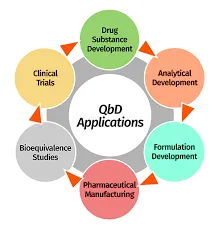
Fig 2 : QBD Applications
Benefits of Implementing QbD for the FDA :
Benefits to Industry :
Regulatory Landscape and QbD Expectations :
The regulatory environment has evolved to prioritize product quality, safety, and efficacy, with QbD becoming a key approach to meet these expectations. [47]
Integration of QbD Concepts in Regulatory Submissions :
Continuous Improvement through Quality by Design (QbD) :
Key Components for Continuous Improvement :
ICH Q8, Q9, Q10 Guidelines: The Foundation of QbD :
The ICH guidelines—Q8 for Pharmaceutical Development, Q9 for Quality Risk Management, and Q10 for Quality Systems—form the essential framework for implementing QbD principles in the pharmaceutical industry. [50]
Alignment of QbD with ICH Guidelines :
Development and Utilization of Design Space :
Applications of QbD in Pharmaceutical Development :
QbD represents a systematic approach to pharmaceutical development and manufacturing, contrasting with traditional methods. [50]
QbD in CMC Review Offices :
Case Studies Demonstrating Successful QbD Implementation :
1. Case Study 1: Tablet Formulation Optimization
Benefits of Implementing QbD for the FDA :
Regulatory Landscape and QbD Expectations :
The regulatory environment has evolved to prioritize product quality, safety, and efficacy, with QbD becoming a key approach to meet these expectations. [50]
Integration of QbD Concepts in Regulatory Submissions :
CONCLUSION:
The goal of a well-characterized method development effort is to create a reliable method that consistently produces data meeting predefined criteria within defined boundaries. QbD can be applied to the development and evaluation of analytical methods, studying all potential factors (inputs) and critical analytical responses (outputs) to determine their relationships. This approach parallels the process development outlined in ICH Q8 and Q9.A corporate knowledge repository is essential throughout this process to capture critical information, enabling continuous improvement and change control of methods over their lifecycle. Each method change should undergo a risk assessment to ensure performance criteria are still met, facilitating method improvements and transitions between different techniques. [50]
REFERENCES

O.S. Satpute*, M. S. Kirve, K. K. Shinde, Y. B. Tambade , Review on Quality by Design (Qbd) In Pharmaceutical Development, Int. J. of Pharm. Sci., 2026, Vol 4, Issue 6, 4725-4735. https://doi.org/10.5281/zenodo.20751710
 10.5281/zenodo.20751710